5 Apr 2021 | Non categorizzato
To love Jesus in his abandonment on the cross means to love him in the pains and sacrifices that being attentive to our neighbor entails. This is a true way to perfection in Christian life as Chiara Lubich communicates to us through her experience. […] To encourage us on the way of our collective sanctification […] I think you would like to get to know a very recent spiritual experience of mine. A small one but one which seems to me to be valid. As perhaps you know, I am dedicating some days during the month […] to considering in depth a cardinal point of our spirituality […] Jesus forsaken, the key to unity. This theme has touched me so deeply, it seemed to me to be so interesting and attractive that I felt compelled to live it straightaway in the present moment. Almost forgetting the commitment to the tension towards holiness as such, I started loving Jesus forsaken, embracing him under his various aspects. However, exactly in those days during morning meditation, what St. John of the Cross called the twelve stars of perfection, came to my attention again. Love of God, love of neighbour, chastity, poverty, obedience, peace, silence, humility, mortification, penitence, choir and prayer. I knew them well; in fact, by meditating on them, I had learnt them by heart. However, in these days, I was not thinking about them at all, taken up as I was by loving only Jesus Forsaken, because I was so touched by this theme. And then the surprise, the joyous surprise like a luminous rediscovery. Re-reading these twelve stars during meditation, I realized that in loving Jesus forsaken, I had made these twelve stars shine a bit more in my soul. I had loved God a little more because I had loved out of love for Jesus forsaken, who is God. I had loved my neighbour more, because out of love for Jesus forsaken I had made the effort to make myself one with everyone. I had improved the third star – chastity- because love for Jesus Forsaken leads us to mortify ourselves. In the same way poverty, because for Him I had made the effort to extinguish every attachment. And obedience – the fifth star – because for Him I had made the effort to silence myself in order to listen better to “that voice”. Then living Jesus forsaken in sufferings I was able to keep peace better, another star. Loving Jesus forsaken, again I was able to observe silence better, in the sense that I mortified better useless words. Humility, I think, profited with the death of myself, which love for Jesus forsaken provokes. And in the same way mortification and penitence – other stars. I took better care of the choir, which for us means prayer together of all our focolare. And so personal prayer was truly fuller. Everything better! Everything better, solely though love for Jesus Forsaken. I knew that Jesus Forsaken was, as we say, a monument of holiness but I had not yet experienced with such evidence and such breadth how living Him truly means tending fruitfully towards holiness. […] I can wish you nothing better than to have this same experience. Try it! Love Jesus forsaken in sufferings, in renunciations, in dying to ourselves so as to make ourselves one with every neighbour. […] May Jesus forsaken become everything for us, and our collective sanctification will be assured.
Chiara Lubich
(from a telephonic conference call, Rocca di Papa, 16 June 1982)
1 Apr 2021 | Non categorizzato
In spite of the continuing coronavirus emergency, Easter is still a time to pass from death to life and darkness to light through love for our neighbour. The strength that comes from solidarity and universal fraternity help us to keep alive hope for a united world. Easter greetings from Focolare President, Margaret Karram, and many others all over the world. Watch the video with subtitles in English, Spanish, French, Italian and Portuguese. https://youtu.be/2BVukpY5b5s
29 Mar 2021 | Non categorizzato
Dearest all, Easter will soon be here. It’s the greatest feast of the year and with it comes Holy Week, which abounds in the most precious mysteries of Jesus’ life. We are reminded of these especially on Holy Thursday, Good Friday, Holy Saturday and on Easter Sunday, the day of the Resurrection. For us, too, they represent central aspects of our spirituality. … So what can we live as Holy Week draws near, and during these blessed days? I think the best way to live all of them is to live Easter, to let the Risen Lord live in us. For the Risen Lord to shine out in us, we must love Jesus Forsaken and always be – as we say – “beyond his wound”, where charity reigns. Charity, then, urges us to be the new commandment in action; charity urges us to approach the Eucharist; charity leads us to live in unity with God and with our brothers and sisters. It is through charity that each of us can, in a certain way, be another Mary. … By doing so, all of us together will truly be that Easter People which some people have said they recognize in our Movement.
Chiara Lubich
https://vimeo.com/529414892 Link up, Sierre, March 24, 1994
24 Mar 2021 | Non categorizzato
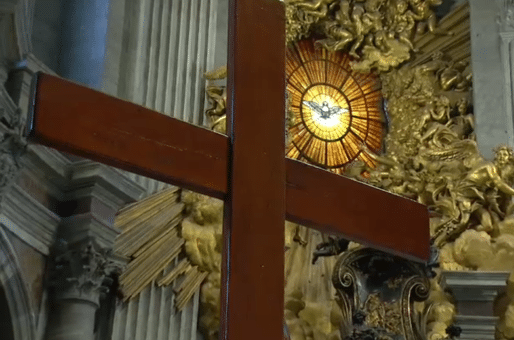
This is the journey towards the next World Youth Day in 2023. The story of a young woman from the Focolare who is collaborating in planning the event. The next World Youth Day will take place in Lisbon, the capital of Portugal, in 2023 with the theme “Mary got up and went in haste” (Lk 1:39). The pandemic leaves open questions regarding the event, but the preparatory work has been underway for some time. Mariana Vaz Pato, a young woman from the Focolare Movement, is part of the local team working to organise the event.
the WYD cross
23 Mar 2021 | Non categorizzato
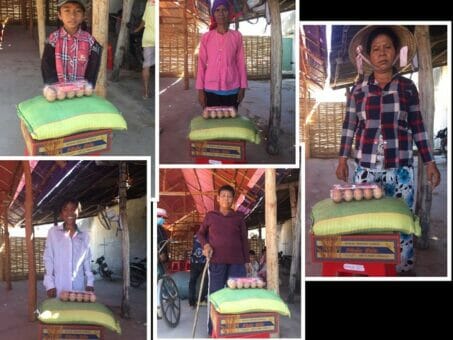
Despite the violent clashes in Myanmar, through the work of the “Drop after Drop” (Goccia dopo Goccia) association, the Focolare community continues to bear witness to universal fraternity during a time of pandemic and revolution. Here is the account of the journey undertaken by the focolarini in that area at the beginning of March. (All activities were carried out in accordance with the Covid regulations in the country) Myanmar is still living through a revolution that began last February on the 22nd of the month: it is called ‘22222’. This country, made up of different ethnic groups and rich in natural beauty and raw materials, experienced the longest civil war in human history from 1947 to 2010. Among the various revolutions that have occured in the past, there was the one that took place on 8 August 1988 called ‘8888’, resulting in thousands of deaths and another in 2007, known as the ‘saffron-coloured’ revolution because of the large number of Buddhist monks who began the protest and lost their lives. During the clashes in 1988, thousands of people began to migrate towards the border with Thailand, to the province of Tak, to the town of Mae Sot, then in Mae Hong Song, and even further south, towards Kanchanaburi. Today, 32 years later, nine refugee camps are still active: millions of Burmese people who are working in Thailand are living in them. 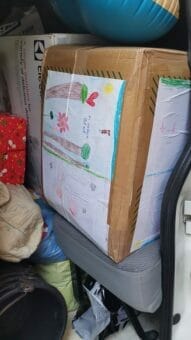 The focolarini who have been in the area since 1988 have begun to help many young people who they first met a few years ago in Rangoon and Bassein. “Our contact with them,” says Luigi Butori, a focolarino who lives in Ho Chi Min in Vietnam and who has been travelling in those areas for years, “went on until Father Justine Lewin, a priest linked to the Focolare Movement, arrived in Mae Sot. He helped these people who lived not only in the refugee camps, like the most famous one in Mae La with 50,000 people, but also scattered across the countryside, often close to the factories where they worked, or in the cornfields close to the town of Mae Sot. About twenty years ago we started small projects in the Mae La camp and gradually in the town of Mae Sot. The goal was to feed and clothe the people.” Beginning in 2011, a bridge of solidarity has gradually been built between Italy and Mae Sot. The Focolare community in Latina in central Italy and some students taught by Maria Grazia Fabietti, began to help the children and adults living on the border between Thailand and Myanmar. Luigi explains, “One of our Italian friends, Paolo Magli was celebrating his 50th birthday and rather than receive lots of presents, he asked for money to help these Karen ethnic groups (a population that fled Burma during the conflicts and has been forced to live as refugees on the border between Myanmar and Thailand for years, some in the Mae La refugee camp and even more in the area outside it.) This was the beginning of “Drop after Drop”. Today, this project helps more than 3300 people in three countries in South East Asia and also collaborates with the Charis association in Singapore to bring help to those affected by poverty, loneliness, disease and even the pandemic. Areas of Vietnam, Thailand and Myanmar give us the ‘possibility to love concretely’: there are people there who know the spirit of universal fraternity and today do everything to help those who are excluded, marginalized, rejected, sick and alone.” “Drop after Drop” helps everyone, people from many different ethnic groups – Karen, Bama, Kachin, Thai Yai, and Xtieng and Hmong people in Vietnam. The project also assists Muslims in need who are in contact with the focolare in Bangkok. At the beginning of March, the focolarini went to Mae Sot with a van loaded with food, clothes, toys and much more, as shown in the video you can see below. (The intiative was carried out in accordance with the covid rules in the country). Donations came from Muslims, Buddhists, Christians and many people in contact with the Focolare Movement. Luigi said, “Everyone is our brother or sister. We want to live out in our own situation one of the most beautiful reflections written many years ago by Chiara Lubich, the founder of the Focolare: ‘Lord, give me everyone who is lonely: I have felt in my heart the passion for all of the forsakeness in which the whole world is drifting.’* The latest project born helps six abandoned mothers and their fifteen children in Mae Sot. We have sent two sewing machines and 15 kg of cotton fabric which can be cut and sewn to make shirts, skirts and trousers for whoever needs them. It is a joy and a celebration to see how people help each other. Universal fraternity is a reality that takes hold, day after day, and “Drop after Drop” represents just that.”
Lorenzo Russo
https://youtu.be/xv5W3hxZInc * Reflection: “Lord give me everyone who is lonely” by Chiara Lubich – September 1949
22 Mar 2021 | Non categorizzato
It is fairly easy to Love God and our neighbours when we are well. However, when we are sick, even physically, it can become a huge challenge. Chiara Lubich tells us how we can prepare for those moments in a way that also includes the possibility of failure. As we all know our Ideal can be defined with just one word: Love. Love is the whole of our life, love is the soul of our prayer, the soul of our apostolate, of all the expressions of our existence. Love is also the “health” of our individual spiritual life, just as reciprocal love is our “health” as a community, as the “mystical body of Christ”. When we love, everything is right with us; we are before God whole and entire, whether we are enjoying physical wholeness or whether we are ill. However, when one is healthy, it is easy to love; it is easy to love God and our brothers and sisters. It is more difficult to love when you are ill. […] [I would like] to ask you and me a question. Is it really right that someone who finds themselves in such difficult moments of their earthly life should live with such commitment the marriage of their soul with Jesus forsaken, and that we who perhaps have greater physical health, live our tension to holiness in a mediocre way? Must we always allow God to permit special trials to happen to us – trials that seem to take our breath away, in order to make us decide to love Him in a total way? […] Therefore, […] we cannot waste any time. We all have the Holy Spirit in our heart, and we know what his requests and suggestions are. He tells us that here we should love Jesus Forsaken in a suffering for example, or in an effort we have to make; here we should prefer Jesus Forsaken in a virtue, in brotherly love for example. Here, again, we should choose him in an aspect of the Movement or of the Church or of humanity… We must make a resolution to love Jesus Forsaken day by day, always, […] with 100% commitment. And. […] repeat before each action we take “For You”. If such a committed life frightens us, […] let’s remind ourselves of the words of Jesus, “Let the burden of each day be sufficient for that day” (Mt 6, 34). Let’s concern ourselves with the face of Jesus Forsaken of today, the face of Jesus Forsaken of each moment. For tomorrow, we will have other graces. In this way, we will store away full days, all completely consecrated to Jesus Forsaken. It is with these days that we will build our holiness. If then it happens that we fail, that we betray Him, that we became blocked, we know that also beyond all these circumstances His face is there. May we be able to answer to ourselves each evening, or rather answer to Jesus who questions us in the depth of our heart about how the day went: “it went well, 100%”.. With our embracing Jesus Forsaken 100% – the Risen One shines out in us and gives witness. […]
Chiara Lubich
(from a telephonic conference call, Rocca di Papa, 16 January 1986)
19 Mar 2021 | Non categorizzato
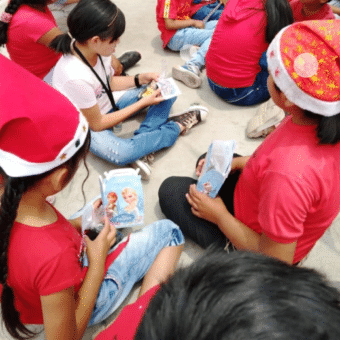
Every day, on the eastern outskirts of Lima, Peru, the Focolare community supports people living in situations of extreme poverty by sharing many things – food, material aid, literacy skills and Gospel experiences. Huaycán is located in the eastern suburbs of Lima, Peru. It has a population of approximately 200,000 and 90% are immigrants from the Andes, people who arrived to escape from poverty. They preserve their traditions and their language, Quechua, the ancient language of the Incas. The people living high up in the hills are often experiencing situations of extreme poverty. Their houses have dirt floors and consist of just one room (beds are in the kitchen), they do not have a clean water supply, electricity or a sewage system… Many of the people are street vendors. Some women do house cleaning and some men are construction workers or scrap collectors. The community in Lima has seen that these people are living in a situation that is like the “wound of Christ” and has chosen to love them in a special way. “We first visited Huaycán in 1998,” Elsa recalls, “when Tata, Carmen, Maria and Milagros and I brought the Word of Life to a community close to the ‘Fe y Alegría School’ run by the Franciscan Sisters. Then Elba, Mario, Lula, Yeri, Fernando, Cristina and Eury… joined us. We went higher up in the hills and shared Gospel experiences with the poorest of the poor. Many of the people had poor health and were suffering from a variety of different illnesses and family life was very difficult: violence, promiscuity, unemployment, drugs and hunger were part of their everyday experience.” “At first, we would sit on the ground,” Elba says, “but then as the people began to feel more secure, they would pull out their chairs and offer them to us. In the winter, they would invite us into their humble houses. There we met Olinda, the school cook, who opened her home to meet us. She is a beautiful person – the “heart” of the community for us . We suffered together when her eldest son died suddenly.” The community in Lima community has begun several initiatives to support the many needs of these people: these include material aid, educational support for children, training and literacy for adults, psychological support, follow-up and health care and the sale of second-hand clothes. “Every year we celebrate Christmas and Mother’s Day together. We also organize trips and some of the people take part in the annual Mariapolis,” Mario recalls. “One couple followed a preparation course and then got married during the Mariapolis, in the presence of their five children and other relatives. It was a turning point in their lives, just as it is for many others when they meet the God of Love.” “With the pandemic,” Cristina continues, “many people have lost their jobs and do not have enough to feed their children. Working with some families we managed to procure food and distribute it to those most in need. One woman installed an oven, which had previously been disused, to produce bread. From March to June, we distributed 140 baskets of food and 12,720 loaves of bread. We met with the poorest community, Granja Verde, because we needed a kitchen and dining area to prepare and serve food. We began to organise what we could do: they offered a piece of land and laid a concrete floor. We provided essential utensils for the kitchen and a 2,500-litre tank for drinking water. The dining room was inaugurated on 15 November 15 2020, and started working the following day. Today we produce 100 meals a day. We know, as Pope Francis reminds us, that if we forget about the poor, God will forget about us. Huaycán, Christ’s “sore spot” is our favourite place and where we most clearly experience God’s blessing.”
Gustavo E. Clariá
18 Mar 2021 | Non categorizzato
Considering “fratelli tutti” – as Pope Francis says – helps us broaden our horizons. “Give and it will be given to you” Father David from Kenya wrote, “I was helping a poor refugee boy I had got to know during the mission in Kakuma refugee camp in northwest Kenya by paying for his schooling but after a while I ran out of money and was no longer able to support him. I explained this difficulty to him and we said goodbye to one another. After some time, this boy sent me a message via social media asking me for help again. It was a great suffering for me not to be able to help him so I decided to sell a cow I had at my parents’ house to pay for his schooling. He was so happy to be able to go back to school again. In the new parish where I have been living for almost a year, the parishioners decided to visit me one day because they had heard that my father was not well. Among the gifts they brought were three cows. I could not believe it. It really seemed as if God wanted to say to me “a good measure, pressed down, full and overflowing will be poured into your lap”. Father David, Kenya “For my brothers and sisters in Lebanon” After the disaster of 4 August 2020 in Beirut, Lebanon, I asked myself what I could do to help this country which had already suffered so much. A few days later it would be my birthday: 40 years old. My family and friends wanted to celebrate with me, even if it was just a meal. This could be the perfect opportunity to help the people of Lebanon, I thought. So I asked all those coming to the dinner not to give me any presents but to make a donation to my project to help Beirut. At the end of the evening, I was amazed by the amount of money raised: a good 600 euros! I never imagined it would be so much, especially since there were very few guests at the dinner because of Covid restrictions. This gesture then caused a chain reaction among my friends. Emilia gave the proceeds from her graduation to another project, Francesco decided to sponsor a child in a developing country for his birthday, and then the children in the neighbourhood, when they heard about our birthday initiative, gave the proceeds of the sale of products made with recycled materials they had organised, again for Lebanon! Freely you have received, freely give… This is what we strongly believe in, always, when we receive and when we give. L., Ischia (Italy) “From a sandwich to a hundredfold for the poor”. One day I was in a sandwich shop, waiting to buy a sandwich, and I had just enough money for one. As I was coming out of the shop, I saw a lady looking at everyone who was eating. I realised she was hungry and was waiting for someone to offer her something to eat. I took out my sandwich and gave it to her. I can always eat something later, I said to myself. She was overjoyed. Then I took her to the fruit shop and asked the greengrocer if he could give her some fruit which I would pay for the next day since I had no money at that moment. The greengrocer gladly gave the lady not just one piece of fruit, but a whole bag of fruit, free of charge. I was so happy to see how a small sandwich could become a chain of the hundredfold. Mumbai (India)
Lorenzo Russo
17 Mar 2021 | Non categorizzato
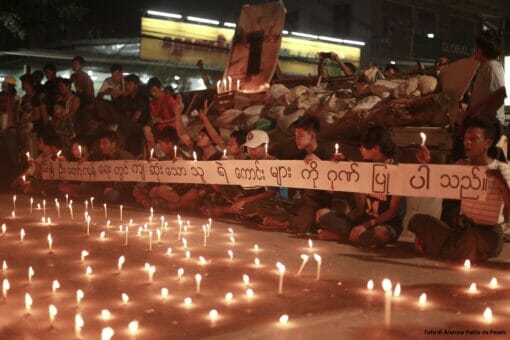
Joint Statement of SIGNIS, Pax Christi International and the Focolare Movement in Solidarity with the People of Myanmar Signis, the World Catholic Association for Communication, hears the cry of the courageous Burmese people as they nonviolently resist the Myanmar military coup overturning a legitimate and democratic election. We are joined by Pax Christi International and its members in the Asia-Pacific region who in their statement of February on the “State of Emergency” in Myanmar already expressed grave concerns about the situation in the country. Likewise, the international Focolare movement unites with us in solidarity with the Burmese people. Daily, courageous people return to the streets to protest peacefully even as soldiers beat them and shoot them, of which many young people. As a symbol of their protest, conforming to Burmese custom, a sign of the righteous anger of the people towards the military can be heard in the clatter of pots and pans banged together to protect against evil spirits, We witness the arbitrary detention on fabricated charges of members of the democratically elected government, as well as of civilian and religious leaders who have taken part in the long struggle for democracy. As truthful information is important in a democracy, we reject the disinformation campaign by Myanmar’s military justifying their actions. We call for the protection of journalists who are arrested and harassed for sharing news and information on what is happening on the ground with the rest of the world; instead they should enjoy press freedom. We deplore the extreme authoritarianism that saw fit to trample on the nation’s constitution, which in fact permitted limited democracy while maintaining much of the armed forces’ power. Despite the challenges, Myanmar was taking its first steps towards democracy, giving people hope for a new future. This hope should be restored. Above all, we listen to the message of the people of Myanmar: this coup is essentially about overthrowing them, their will. It is ultimately not about removing political opponents or supposed public order. It undoes years of patient work for the fundamental rights of citizens and crushes tenuous dreams of a free, democratic country. As Catholic organizations, we join Pope Francis and civil and religious leaders across the globe who have condemned the coup and call for “meaningful dialogue” to restore democracy. Also, we join other organizations in calling for:
- the release of Aung San Suu Kyi and other detained officials and leaders;
- the military to stop using violence and arbitrarily detention of peaceful protestors and journalists;
- justice and accountability for the atrocities committed by the army against the Rohingya people and other ethnic minorities, as well as prevention of such crimes and abuses in the future;
- members of the international community, especially in the Asia-Pacific region, to pressure the regime to step down and reestablish democracy, and not to exploit the situation for their own geopolitical interests.
We call upon the members of SIGNIS, Pax Christi International, and Focolare around the world to give voice to the cry of the Burmese people by reaching out to local and national media to report the situation, and by urging their governments to take strong diplomatic actions to oppose the coup and return democracy to Myanmar. Our mission as organizations is to promote peace. We therefore stand with the Archbishop of Yangoon, Cardinal Charles Maung Bo, President of the Asian Bishops Conferences, when he says, “Peace is possible. Peace is the only way. Democracy is the only light to that path.” Download the statement.
15 Mar 2021 | Non categorizzato
The choice to love Jesus in his abandonment on the cross and to prefer him to every other love had become like a compass for Chiara Lubich that gave direction to her life and freed her from many worries. […] We had noticed that the calling to follow Jesus Forsaken in a radical way did not happen only once, that is, only at the beginning of the Movement. In fact, from time to time, during these past years, the Lord has underlined that calling with episodes or special considerations. This happened to me in 1954. […] For the first time, a focolarino was becoming a priest, and I was going to Trent because the Archbishop there was ordaining Father Foresi. I wasn’t too well and it seemed to be wise to travel part of the way by plane. As soon as I stepped on board, a very kind flight attendant, wanting to make the trip easier for me, invited me into the cockpit. From there I was deeply struck by the beautiful panorama that could be observed, completely open in front of me because of the large windows. It was not the panorama, however, which struck me the most, but rather the brief explanation that the pilot gave me as to what is important in flying an airplane. He told me that if you want to have a good trip, you need, first of all, to set the needle of your compass in the direction of the point of arrival. Then all along the way, you must keep an eye on it to make sure that the plane does not go off course. As I was listening to this explanation, I made a comparison between an airplane trip in this world and the journey of our lives, which today I would call the Holy Journey. I had the impression of understanding that also in this instance it was necessary to decide our course at the moment of departure, that is, the pathway of our soul which is Jesus Forsaken. Then all along the journey, we need to do only one thing: to remain faithful to Him. Yes, the way to which God calls us all is this: to love Jesus Forsaken always. This means embracing all the sufferings of our lives; this means to live love by adhering always to His Will, doing away with ours. […] To love Jesus Forsaken always means to live all the virtues, which he lived very clearly in that moment in a heroic way. […] I think I can say that if we have set the needle of the compass of our souls – to use the same image – in the direction of Jesus Forsaken, we have done the best that we could do to continue and finish our Holy Journey and to do so with a certain ease. On that trip, I noticed that the pilot was very free in his movements because he had no reins, as you would need with a horse, nor steering wheel as you would need in a car. If we set the needle of our spiritual compass in the direction of Jesus Forsaken, we too will not need anything else in order to reach the goal safely. On an airplane trip, curves do not take you by surprise because the flight is in a straight line, neither do you encounter mountains because you have already reached a good altitude. In the same way, we too, on our journey, place ourselves at a certain altitude through love of Jesus Forsaken; thus, we are not frightened by unforeseen events, nor do we feel the effort of climbing. This is true because for Jesus Forsaken, surprises, efforts, and sufferings have already been foreseen and awaited. Let us set the needle of our compass in the direction of Jesus Forsaken and then let us remain faithful to Him. How? In the morning as soon as we wake up, let us direct the needle of the compass in the direction of Jesus Forsaken with our “Eccomi!” (“Here I am!”) During the day from time to time, let us glance at it; let us see if we are always on course with Jesus Forsaken. If we find that we are not, then with another “Eccomi!” (“Here I am!”) let us go back on the right course, and we will be able to continue the journey. […] If we proceed on the journey of life in the company of Jesus Forsaken, we too will be able to repeat that famous sentence of St. Clare, “Go safely, my soul, because you have a good companion for your journey. Go, because the one who has created you has always watched over you and has sanctified you. […]
Chiara Lubich
(From a telephone conference call, 5 January 1984)
14 Mar 2021 | Non categorizzato
Today, 14 March, marks the thirteenth anniversary of the death of Chiara Lubich, the founder of the Focolare Movement. Since that same date, 14 March 2008, the Focolare communities scattered across all the continents have been meeting to remember her and to pray together, remembering the legacy she entrusted to the Movement: ‘Be a family’. «If I should have to leave this world today and you were to ask me for a single word, one last word that sums up our Ideal, I would say – certain of being perfectly understood – ‘Be a family’». https://youtu.be/QKwgvxsUU2E
13 Mar 2021 | Non categorizzato
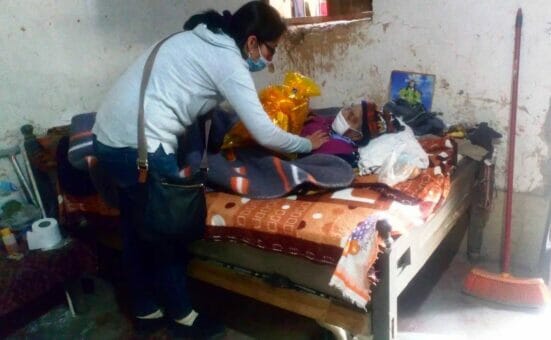
From the commitment of a small Focolare community to the most vulnerable, a Centre for the elderly has been opened in a village in the Peruvian jungle, named after the Movement’s founder. 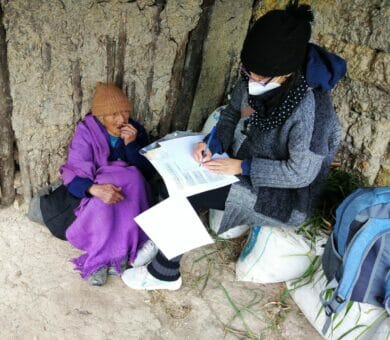 Four years ago I, Jenny, my husband, Javier, and our three daughters travelled here from Argentina to live in deepest Peru, bringing the Ideal of Unity with us. Shortly after we arrived in Lámud, a town in the middle of Amazonia, hearing that the Bishop of the Diocese was passing through, we ran to greet him and introduced ourselves as members of the Focolare Movement. “How wonderful that the focolare has arrived in Amazonia!”, he said and gave us his blessing, with his wish that we go ahead. Then we made an agreement with the parish priest who asked us to be responsible for Pastoral Care and Family Catechesis in the villages forming part of the parish. We went to the outskirts of town to understand the social reality in the area, sometimes accompanied by our daughters and discovered a hidden Lámud, one that was full of suffering. We decided to start with the least and realised that they were the elderly. Some of them did not even have a decent bed to die in. Keeping Chiara Lubich’s meditation entitled “One city is not enough” in mind, we went around the suburbs of the country looking for those who were alone, abandoned, to caress them, bring them a word of hope, food, clothes, and we asked them to pray for us as we were just beginning our adventure in these areas which were completely new to us. After a while, we began to dream of being able to give the elderly a decent home, a hot meal and, most importantly, that they would feel accompanied and no longer alone. A dream which, on the one hand seemed far away, but on the other seemed almost within reach so much so that we said to ourselves: “Yes, we can! We must do something more concrete than a simple visit.
 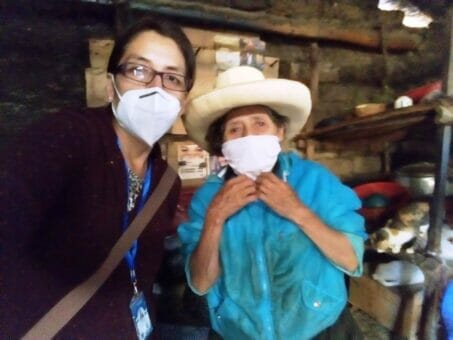 Together we drew up a plan: just a few lines but each sentence encouraged us to go ahead. We also thought about what we would call the house. We looked into each other’s eyes and decided to call it: “Hogar y Centro de Día para Adultos Mayores, Chiara Lubich” (“The Chiara Lubich Home and Day Centre for Elderly People”). Gradually, our dream started to take shape. We organised a number of events and made contact with a few people who were really enthusiastic about the project. I, Jenny, already had some experience of volunteering for different projects in Argentina and an opportunity arose for her to be employed by the Lámud District Municipality to work for the elderly! Lastly, we felt encouraged by the words of the Pope who invited us lay people to work in favour of the most vulnerable, especially during this time of pandemic. In short, there were so many beautiful coincidences that made us think that Jesus would be happy to see the birth of a Work for the least in the Peruvian wilderness, namely a dignified home for the elderly of the third age in this Amazonian province. In the meantime, we saw how everything was going ahead at a dizzying pace. So, trusting fully in God’s Providence and the power of prayer, we became increasingly aware that Jesus would not leave us on our own, and we were certain that, with our small community, we would never be alone. During that time, we signed the lease for the house and went through the legal process of setting ourselves up as a non-profit association. A group of people from the community had already joined the project on a voluntary basis. They had responded with a very strong “Yes” to committing to work for the benefit of the most vulnerable people in the village of Lámud and the Province of Luya (Dipartimento Amazonas). We started preparing the place straight away so that we could start offering the elderly one hot meal a day, provided by the municipality. And now, little by little, we are assessing each step to be taken to reach our goal of offering the elderly, who are at risk of loneliness and abandonment, food but also the possibility of permanent residence in the Centre. But more than titles, names and statutes, our desire is that the atmosphere of unity, harmony and family that Chiara Lubich left us as her legacy should reign in the house which is why the Centre bears her name. Jenny and Javier, with the community of Lámud (Dipartimento Amazonas, Peru)
Experience received and translated by Gustavo E. Clariá
12 Mar 2021 | Non categorizzato
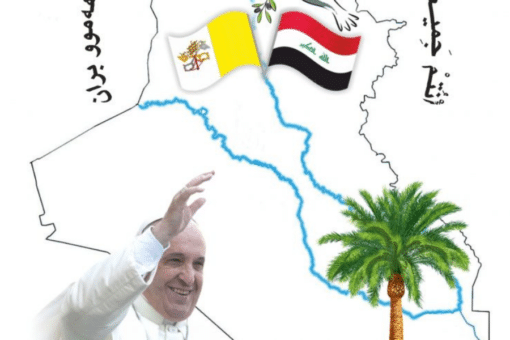
In recent days, many people have tried to take stock of Pope Francis’ trip to Iraq. I think it is difficult, if not impossible, to attempt an exhaustive one. There are too many issues involved and, above all, we are too close to this global event made up of so many other details that can only be read in the course of time. Obviously some elements more than others struck the imagination of those who followed the various events in a context that, in some ways, in its stark reality risked appearing surreal. In fact, if we think of the model of papal journeys, inaugurated with Pope John Paul II from 1979 onwards, we were accustomed to quite different scenarios and backgrounds: oceanic crowds, choreographic preparation that often bordered on perfection and, above all, events that left the image, especially in the early years of the Polish pope’s era, of a strong faith, at the centre of history, in contrast to the atheistic world from which the Polish pope came. Pope Francis, who at the beginning of his pontificate had introduced the idea of another Church, the ‘accidental’ and ‘field hospital’ Church, in recent years has been committed to transmitting this image of the Church and has done so practically everywhere he has gone. He has done so practically everywhere he has gone. From his first official trip to Lampedusa, the port and cemetery of migrants, to Bangui, where he opened the door that inaugurated his unexpected and extraordinary Jubilee, to Mosul, where the stage had only rubble and walls still perforated by bullets of various calibers as a backdrop. And we cannot forget Tacloban where he braved an impending typhoon to stand by the survivors of another catastrophic event, Lesbos where he spent unhurriedly precious time listening to the unspeakable stories of refugees of various origins. The lesson of Francis is not just about showing that the most precious face of the Church is the ‘accidental’ one. Rather, it is the way in which he shows the ‘proximity’, the warmth that needs to be felt by those who suffer in the Christian community. Above all, he is committed to projecting these communities onto the world stage to say that this is the true Church, which we should all cherish and which bears real witness to Christ. As he said on his return flight, Bergoglio is breathing at these junctures, because this is his Petrine call, the one for which the conclave elected him, without knowing and imagining where he would lead Peter’s boat. We are all seeing and experiencing this in recent years. And the voyages are probably the truest reflection of this, leaving no room for misunderstandings. On the other hand, this is nothing new. Like his predecessors, the Argentine pope has shown that he is able to read and decode the ‘signs of the times’ and offers credible testimony to the fact that the Church is a witness to its time and intercepts its problems and key issues, offering answers that are almost always against the current with respect to those that the political, international and, today, financial world impose. Faced with the reality that Francis found himself living, including the unprecedented one (at least in these terms) of the pandemic, the essential category of the pontificate, confirmed also in Iraq, is fraternity. Bergoglio’s personal and ecclesial testimony, his Magisterium and his relations, especially but not only with the Muslim world, now make fraternity a geopolitical element. This was also demonstrated by his meeting with the Grand Ayatollah al-Sistani. The implications of those forty-five minutes are fundamental. We all know, in fact, that the great knot that Islam must untie today is internal to its own world: the tension, never appeased but now dangerously acute, between the Sunni and Shiite spheres. It is here that the roots of many of the problems that Muslims experience and for which many also die must be sought. Bergoglio has shown great ‘political’ tact in wanting to meet al-Sistani, the most significant representative of Shiism, well distanced from the Iranian theocracy that since the Khomeinist revolution of the 1980s has pushed the Iranian world to be a champion of this fringe of the Muslim kaleidoscope. Al-Sistani has always distanced himself from the theocratic choice of the Iranian ayatollahs, and has been an acknowledged spiritual and religious leader for decades. Among other things, he was born in Iran. The meeting between the two leaders took place behind closed doors, but as Pope Francis described it on the return flight, it was a moment of spirituality, “a universal message. I felt the duty, […] to go and see a great, a wise man, a man of God. And only by listening to him do you perceive this. […] And he is a person who has that wisdom … and also prudence. […] And he was very respectful, very respectful in the meeting, and I felt honoured. Even in the greeting: he never gets up, and he got up, to greet me, twice. He is a humble and wise man. This meeting had a great positive impact on my soul”. Bergoglio ventured an appreciation that perhaps no pope had had the courage to say in the past: “And these wise men are everywhere, because God’s wisdom has been spread throughout the world. It is the same with the saints, who are not only those on the altars. They are the everyday saints, the ones I call ‘next door’, the saints – men and women – who live their faith, whatever it may be, with consistency, who live human values with consistency, fraternity with consistency”. All this did not go unnoticed. Positive comments poured down from many quarters, starting with the Muslim world itself. Sayyed Jawad Mohammed Taqi Al-Khoei, secretary general of the Al-Khoei Institute in Najaf, a prominent member of the Iraqi Shiite world and director of the Al-Khoei Institute which is part of the Hawza of Najaf, a religious seminary founded 1,000 years ago for Shiite Muslim scholars, was very clear in his appreciation. “Although this is the first meeting in history between the head of the Shia Islamic establishment and the head of the Catholic Church, this visit is the fruit of many years of exchanges between Najaf and the Vatican and will undoubtedly strengthen our interreligious relations. It was also a historic moment for Ira”. Al-Khoei affirmed the commitment to “continue strengthening our relations as institutions and individuals. We will soon travel to the Vatican to ensure that this dialogue continues, develops and does not stop here. The world faces common challenges and these challenges cannot be solved by any state, institution or person alone”.The AsiaNews agency also reports some of the positive comments that appeared in the Iranian press, which gave wide coverage and celebrated the historic meeting as an “opportunity for peace”. The news was the opening headline in the Islamic Republic’s newspapers and media outlets. Sazandegi, who is close to the reformist wing, emphasised that the two religious leaders are today “the standard-bearers of world peace”. He called their face-to-face meeting in the home of the Shiite spiritual leader ‘the most effective event [in the history of] dialogue between religions’.
Roberto Catalano
Source: Blog Whydontwedialogue
11 Mar 2021 | Non categorizzato
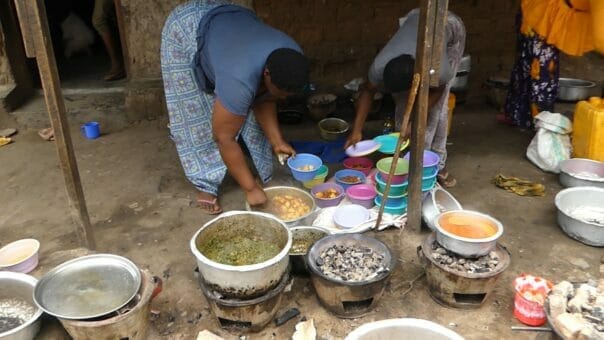
Community microcredit and microfinance to support the growth of expanding projects. Rose’s testimony on the importance of the initiative supported by Amu. BIRASHOBOKA means “IT CAN BE DONE” in Kirundi. It is from this conviction that the Community Microcredit and Microfinance project was born in Burundi (Africa). In spite of the great difficulties in which the country still finds itself – it is the second most densely populated country in Africa and one of the five countries with the highest poverty index in the world – Amu, Azione per un Mondo Unito-Onlus, a non-governmental development organisation inspired by the spirituality of the Focolare Movement, has been supporting the capacities of local communities for some time. Since 2007, in fact, in full synergy with the non-profit organisation CASOBU (Cadre Associatif des Solidaires du Burundi), it has been helping local families in a process of training and of improving their living conditions. 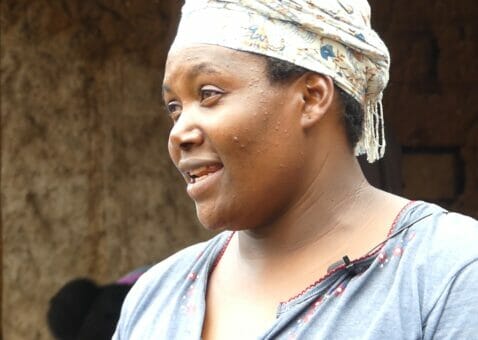 With the “It can be done!” project, it aims to create community microcredit groups whose members can support themselves to create jobs and, in a second phase, create a community microfinance group to support the growth of the expanding projects. Rose tells us: “We started our group 13 years ago. With the first loan I got, I remember very well that I didn’t do anything in particular, I bought clothes and goods that I needed, but the rest I wasted. At the beginning, I didn’t know how to start a business and what often happened was that I had difficulty paying back the loan I had received. Then I realised that I couldn’t keep taking out loans without a concrete project and I finally decided to start the restaurant project with the first 300,000 Fbu (150 €). I started buying pots and pans, dishes and gradually opened the restaurant. It was 2009, I didn’t have any workers yet. At that time, my children helped me in the kitchen and I went by bus to take the food to the city where I had my customers. As I became known, the number of customers increased and I was able to hire workers. I am proud that through the salary they receive I also participate in the fulfilment of their dreams.” Rose, who is happy to have embarked on this path, today manages to provide a salary for five other families besides her own. Now she would like to improve and expand her business, for example by renting a bigger premises, where she could cook and reduce the running costs of the restaurant and travel expenses. It is a very brave decision because there is a big investment involved and Rose does not have the collateral or the guarantees needed to access a loan from any bank. And it is for Rose and many other people who, like her, would like to expand their businesses that the AMU and CASOBU project was set up, supporting the start-up of a community microfinance institution to offer savings and credit services to people with big dreams but who still today cannot access banks. To support the project, click here
Lorenzo Russo
9 Mar 2021 | Non categorizzato
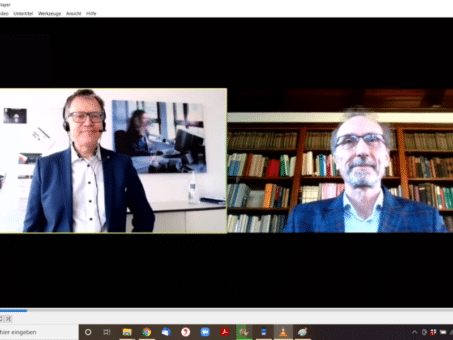
The Focolare Movement in Germany, together with other Catholic organisations, organised an online conference on the search for God in a world where He seems increasingly absent. This contributed also to the Catholic Church’s synodal process in Germany. “God disappears – and maybe, could this be necessary? God disappears – is it He perhaps who wants it this way?” These were the provocative questions that guided the programme of an online conference that was held in Germany on February 26-27. It was organized by the Focolare Movement in Germany together with the “Herder-Korrespondenz”, a monthly Catholic magazine, and the Catholic Academy of the Dresden-Meissen Diocese in the former GDR. It was meant to address one of the most urgent questions many Christians ask today: “What do we have to do and how do we have to move in a world where God seems to be no longer present?” 350 participants from Germany, Austria, Switzerland and other European countries were ready to discuss in depth the causes of an ever-increasing absence of God in society and in the lives of individuals. As Heinrich Timmerevers, the Bishop of Dresden said in his opening speech, they were even ready to ask the shocking question, “Is it perhaps the Church itself that is driving people away from God because of the crisis caused by abuse?” In a message sent to the participants, Margaret Karram, President of the Focolare Movement said that the theme of God’s absence touches the core of the Movement’s spirituality, that springs from the figure of Jesus crucified and forsaken by men and God, “the hardest moment for Jesus and at the same time the most divine, the key to contribute towards fraternity wherever it is lacking […] and to reach out to those who suffer most because of this darkness”. During these two days, there were moments of critical and stimulating reflection on all that motivates a firm faith in God, despite a growing tendency towards secularism, and also on new forms of interest – especially in young people – in something transcendent that is passed on through authentic stories, experiences of deep attractiveness and a curiosity to explore new reflections on the meaning of life. During this conference, the awareness that Churches are often no longer able to meet the new religious needs of today’s men and women, was also present. The talk delivered by the German theologian Julia Knop was very strong; it was almost shocking. She started from the debate on the abuse of power and sexual violence by clerics and consecrated persons, and then continued to show that an erosion of trust in the Church is also being felt among its most faithful members. The professor of dogmatics claimed that the Church’s crisis is closely linked to the faith crisis. Stefan Tobler, the Reformed theologian stated that the absence of God could also prove to be an opportunity. While presenting traces of the mysticism in Madeleine Delbrêl, Mother Teresa of Calcutta and Chiara Lubich, he pointed out that the experience of God that vanishes could become precisely the place where God reveals himself. “God is found precisely where he seems furthest away. It is therefore not a question of bringing him to the world, but of discovering him in the world”.
Joachim Schwind
8 Mar 2021 | Non categorizzato
On Saturday 6 March 2021, during Pope Francis’ apostolic journey to Iraq, an interreligious meeting was held in the Plain of Ur of the Chaldees. At the end of the meeting, an oration was intoned inspired by the figure of the patriarch Abraham, a common father in the faith for Christians, Jews and Muslims. Here is the text. Almighty God, our Creator, you love our human family and every work of your hands: As children of Abraham, Jews, Christians and Muslims, together with other believers and all persons of good will, we thank you for having given us Abraham, a distinguished son of this noble and beloved country, to be our common father in faith. We thank you for his example as a man of faith, who obeyed you completely, left behind his family, his tribe and his native land, and set out for a land that he knew not. We thank you too, for the example of courage, resilience, strength of spirit, generosity and hospitality set for us by our common father in faith. We thank you in a special way for his heroic faith, shown by his readiness even to sacrifice his son in obedience to your command. We know that this was an extreme test, yet one from which he emerged victorious, since he trusted unreservedly in you, who are merciful and always offer the possibility of beginning anew. We thank you because, in blessing our father Abraham, you made him a blessing for all peoples. We ask you, the God of our father Abraham and our God, to grant us a strong faith, a faith that abounds in good works, a faith that opens our hearts to you and to all our brothers and sisters; and a boundless hope capable of discerning in every situation your fidelity to your promises. Make each of us a witness of your loving care for all, particularly refugees and the displaced, widows and orphans, the poor and the infirm. Open our hearts to mutual forgiveness and in this way make us instruments of reconciliation, builders of a more just and fraternal society. Welcome into your abode of peace and light all those who have died, particularly the victims of violence and war. Assist the authorities in the effort to seek and find the victims of kidnapping and in a special way to protect women and children. Help us to care for the earth, our common home, which in your goodness and generosity you have given to all of us. Guide our hands in the work of rebuilding this country, and grant us the strength needed to help those forced to leave behind their homes and lands, enabling them to return in security and dignity, and to embark upon a new, serene and prosperous life. Amen.
8 Mar 2021 | Non categorizzato
Love for God and neighbour gains substance, depth and authenticity only if it passes through pain, if it is purified by the cross that Jesus invites us to welcome. But what cross are we talking about? Chiara Lubich’s answer in the following reflection is very precise: each of us has his or her own very particular and personal cross. […] “All things God works for good [but] for those who love Him.” (cf. Rom 8,28). To love God! We certainly do want to love Him. But, when are we sure that we are loving Him? It is not only when we give our hearts to Him in a moment when everything is going well, because that would be easy, and beautiful, but could also be just an enthusiastic reaction or one mixed with personal interest or love for ourselves, and not for Him. We can be certain we love Him if we do so also in adverse situations; furthermore, to guarantee true love for Him, we have decided to prefer Him, above all, in everything that hurts us. To love God in our obstacles and in our pains is always true, sure love. We express this kind of love with the words: to love Jesus crucified and forsaken. […] But which cross, which Jesus Forsaken, must we desire to love? Certainly not a vague cross, as if to say: I want to make my own, […] the sufferings of humanity. Not the cross which can be a product of our imagination; for example, dreams of a martyrdom that may never come about. To be His follower, Jesus said, “Whoever wants to come after me must take up his cross” (cf. Lk 9:23). His personal cross! Therefore, everyone must love their own cross, their own Jesus Forsaken. If, in fact, at a certain moment of our lives, Jesus had appeared before us and because of his great love for us had asked us to follow Him, to choose Him, to — as if to say— to take Him as our spouse, He didn’t intend to manifest Himself to us in just a vague way, but instead in a very precise way. He asked us to embrace Him in all those pains, worries, sicknesses, temptations, in those situations, persons and responsibilities that touch our very person, to the point of being able to say: “This is my cross,” or even better, “This is my Spouse!” All of us have our own personal Jesus Forsaken, which is not the one of our neighbour, nor of anyone else; but really our own. Therefore, if we learn to read beyond the trauma of our various personal sufferings, and see the love of God for each of us, life becomes magnificent, and draws us ever closer to our Jesus Forsaken, to embrace Him, as the saints have done, and to yearn to see Him transformed in us in our own personal resurrection. […] In order not to lose any time, each of us can make a brief examination of his or her own present situation, and then decide, with the help of God, to say yes to all those things to which we want to say no, but know are the will of God. […] Let’s get up in the morning with this proposal in our heart: “I will live today for the sole purpose of loving my Jesus Forsaken.” Everything else will fall into place. The Risen Lord will live in each of us and among us. […]
Chiara Lubich
(From a telephonic conference call, 16 August 1984)
5 Mar 2021 | Non categorizzato
The story of an “extended” family that is opening up to a love that is not taken for granted Bringing a child, a young person or an adult into the family is always a challenge. Complex, not obvious in any way, both in its development and in its outcome which is never concluded. Looking at these “extended families” from the outside, one feels a mixture of esteem and amazement, almost as if the serenity they show is the result of an indecipherable alchemy of love – an almost romantic vision. It is hard to imagine how complex it is to bring together different sensitivities, cultures and habits, as well as the practical considerations of needs, schedules and languages, in an alliance where the many ‘I’s’ merge into a ‘fluid We’ without friction or, better still, with well-oiled gears. To then feel like one single family is an achievement that is not without hardship, doubts and disappointments. “Welcoming Therese into our family,” said Sergio and Susanna from the focolare community in Vinovo, near Turin, Italy, “has not been easy”. Their story is straightforward, in no way sugar-coated which makes it all the more authentic. What kept them going in this decision was the desire to live their family life as a gift for others and feel the spiritual presence of Jesus as the fruit of mutual love. The decision to open their doors and hearts to a young African mother who arrived in Italy as a refugee was taken with the agreement of their daughters, Aurora and Beatrice, aged 20 and 17. The first difficulties arose when they tried to combine their various needs. “Beatrice likes to plan everything,” says Susanna. “In the mornings every minute is accounted for but sometimes Therese would get up earlier and use the bathroom. This was a problem for her, but gradually she learned to ‘create family’ with her, simply asking her to agree on the use of the bathroom. Aurora, on the other hand, immediately decided to share her wardrobe with Therese and helped her with her studies.” The main challenge is to overcome the silent, corrosive opposition between ‘us’ and ‘the other’ and welcome the other into the intimate dimension of our lives, enlarging the ‘we’. In “creating a family” there is the will to strive to “be family”: in fact, love is first and foremost a choice and this is no less demanding for adults. “In my desire to be welcoming to Therese, I often found myself talking to her until late into the night,” Susanna recalls, “but then I started to suffer from the situation. I found it difficult to explain that I had to get up early in the morning, I was afraid of hurting her. Sergio helped me to deal with it gently but firmly.” For Sergio, the difficulties arose when, rather than coming straight home from work in the evening, he had to go and pick up Therese who was studying in a neighbouring town. “Her classes finished late, and Therese didn’t know how to use public transport, so I often found myself having dinner after 9 p.m”. Here too, choosing to love meant accommodating Therese’s needs, but also looking after the family’s well-being: “We tried to teach her to be independent, as we do with our daughters, so that being available didn’t become too much of a burden for us or an obstacle to her growth. Little by little she has learned to use public transport”. They have discovered that being a family also defines the way we present ourselves to the outside world: “In the first few months that Therese was with us,” Sergio explained, “I put a photo of myself with Susanna and our daughters on my Whatsapp profile. Therese told me it wasn’t a family photo because she was missing! And this is what we discover every day: we are one family because we are children of the same Father, we care for each other and we rejoice in each other’s achievements. It is the ‘we’ which is extended and enriched by love.
Claudia Di Lorenzi
4 Mar 2021 | Non categorizzato
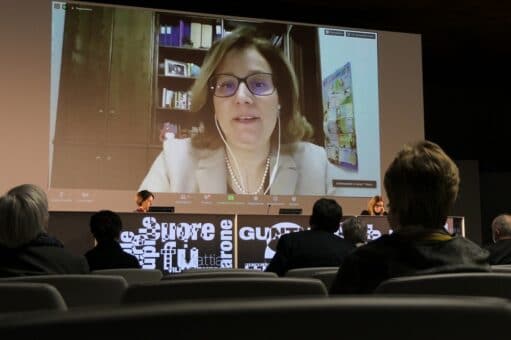
A conference on the charismatic figure of Chiara Lubich, who knew how to look to the new millennium with all its epoch-making changes, proposing the ideal of universal fraternity. 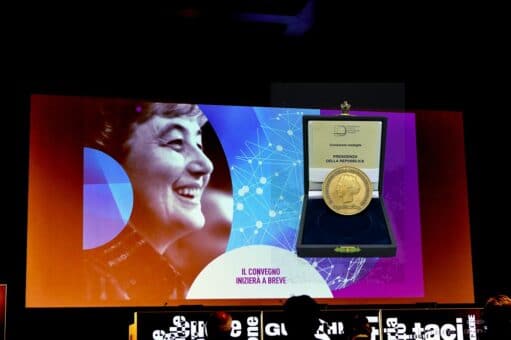 An international conference “Beyond the 20th Century. Chiara Lubich in dialogue with our time” marked the official closure of the wide-ranging series of events dedicated to the centenary of the birth of the Focolare Movement’s founder. As the title suggests, the conference studied the charismatic figure of Chiara Lubich from a dynamic perspective on one of the protagonists of the 20th Century who knew how to look to the new millennium with all its momentous changes by proposing the ideal of universal fraternity, never losing the conviction that “unity is a sign of the times”. The 2-day symposium on 18-19 February at the National Central Library of Rome, Italy, considered the figure of the Focolare Movement’s founder from different points of view. Jointly promoted by the Chiara Lubich Center at Rocca di Papa, Italy and the Central National Library of Rome, the event welcomed the collaboration of Sophia University Institute, the international New Humanity NGO and the Trentino Historic Museum Foundation. The Comune of Rome and the Vatican Dicastery for Promoting Integral Human Development offered their patronage. The President of the Italian Republic Sergio Mattarella conferred the prestigious Medaglia di Rappresentanza on the event, in recognition of its cultural value.
 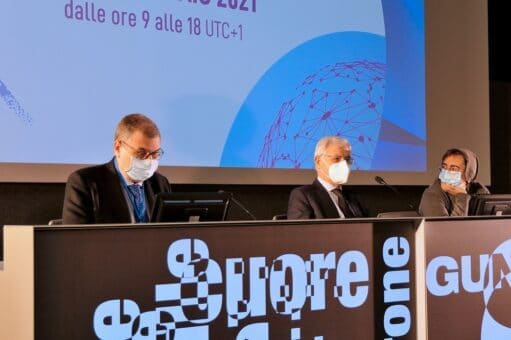 The program had four sections: historical, literary, socio-political and the fourth dedicated to other major 20th Century figures in order to analyze possible similarities and convergence with Chiara Lubich’s thought. Such a variety of perspectives, with contributions from academics of various disciplines, each with their own cultural approach, has permitted a deeper, more mature reflection and understanding of the historic experience itself and of Chiara Lubich’s thought, as well as a greater appreciation of her intellectual, spiritual and existential legacy. A comparison with other leading figures of the 20th century proved equally illuminating, covering contemporary protogonists such as Dietrich Bonhoeffer, Simone Weil, Mahatma Gandhi, Giorgio La Pira, Martin Luther King, Michail Gorbaciov. Chiara Lubich may not have met them directly, but she engaged with their writings and thought at a distance, with a shared passion for humanity and its future, revealing ideals and intuitions with evident features in common. The academic papers prepared by academics from around the world, were introduced by keynote speeches from Michel Angel Moratinos (High Representative for the United Nations Alliance of Civilizations) and historian Andrea Riccardi, founder of the Community of Sant’Egidio. Theologian and spiritual son of Chiara, Piero Coda brought the convention to a close. Donato Falmi, member of the event’s scientific committee, described their motivations. “The biography of Chiara Lubich in its temporal, spiritual and intellectual dimensions, is notably characterized by some themes which belong at the heart of contemporary life, beyond any ethnic, social or religious difference. Among the most relevant we identify are: a constant attention and openness to what is new, the capacity and disposition to dwell in situations of conflict, searching for what unites, an attitude of measuring events with the metre of the unity of opposites. Such profoundly human dimensions, which can be considered essential parts of the new era we are entering, open up possibilities of referring to others, of encounter and dialogue, which animate the whole project”. The convention, streamed live online in four languages and now available on Youtube, was also the stage for the launch of the first critical edition of Chiara Lubich’s book Meditazioni, edited by Maria Caterina Atzori. This book was first published in 1959, translated into 28 languages, with over a million copies printed. It indicates to contemporary readers the way of unity towards fulfilling the last testament of Jesus on earth “That all may be one”. As a fitting finale to the convention, on Monday 22 February the closing ceremony took place of a national educational event “One city is not enough. Chiara Lubich citizen of the world”, dedicated to the world of education, involving many secondary schools across Italy. (The winning schools).
Maurizio Gentilini
Photos by Thomas Klann
3 Mar 2021 | Non categorizzato
The Mariapolis Center in Paraguay during the pandemic, helping the needy in their neighbourhood The “Mother of Humanity” Mariapolis Centre is in Paraguay, just 20 kilometres from the capital city of Asunción, in a neighbourhood where close 200 families live in favourable economic conditions. Three focolarine live permanently at the Mariapolis Centre, along with three other married women. When the quarantine for Covid-19 began, “we didn’t want to be closed inside the Mariapolis Centre,” they say, “so we began to look at the needs of the families in our area.” In the neighbourhood, “pots of solidarity” were set up – that is, when everyone brings what they have and all together make a big pot to share with all the families. It was a good opportunity to make the big kitchen at the Mariapolis Centre available. “We wrote letters to get all of the Mariapolis Centre’s clients and vendors involved. A lot of help came immediately, so we cooked a good Bolognese sauce with pasta and rice, which was distributed to about 4,000 people in the neighbourhood. “We uncovered a lot of vulnerability: children who didn’t have a home, or had health problems, or houses without a bathroom or windows. So we started to take care of their needs.” At the same time, a WhatsApp group was created in the neighbourhood to share experiences of helping the poor and requests of all kinds. “In a short time, neighbours helped us by bringing milk, oil, clothing and cell phones, so that children could attend classes at school, as well as a refrigerator and construction materials, so we could build five bathrooms for families that did not have any.” The pandemic lingered, and with it came the problems of managing and paying expenses at the Mariapolis Centre. “Our strength was to have a well-organized kitchen, so we started offering a menu for takeaway food for sale. The main orders came from our neighbours, and this gave us the opportunity to get to know some of them better. “One day, for example, a neighbour asked us for help to confess: it had been 32 years since he had received the sacrament of reconciliation. Another neighbour, a professional cyclist, wanted to organize a race through the three main cities of Paraguay. With the proceeds we helped two ethnic groups of indigenous peoples bring electricity and drinking water to their homes.” Providence is never at a loss. “A member of the Focolare community donated a sum of money to cover four months of salaries. Then came an industrial fryer, lots of vegetables, fruit and many other things. What surprised us most was that even a car arrived so we could distribute the food. “But the gift, the greatest gift that the pandemic has given us focolarine has been the possibility to be close to our poor and to live our charism of unity to the full. We are here in this rift, where we can generate this communion between rich and poor and bring this culture of fraternity.”
Lorenzo Russo
2 Mar 2021 | Non categorizzato
The President of the Focolare Movement entrusted the new general councillors with their areas of responsibility and urged them to form a governing body characterized by a deep spirit of fraternal service born of mutual evangelical love. On Thursday 11 February, one of the central governing bodies of the Movement- the so-called “Centre of the Movement” – was completed when Noreen Lockhart (Great Britain) and Flavio Roveré (Brazil) were elected by their respective sections as responsible for the women and men focolarini. This governing body consists of the president and co-president, 22 general councillors and the two people responsible for the men’s and women’s sections. The councillors come from 17 countries and 4 continents, are are aged between 52 and 70 years: they represent the multiculturalism that distinguishes the Focolare. Many of them have lived not only in their country of origin but also in other geographical contexts: this is important in order to understand the characteristics, needs and challenges of the countries in which those who recognize themselves in the Focolare’s message of unity live. The composition, the “Centre of the Movement” should, in a certain way, be representative of the entire Movement and manifest its unity. According to the Focolare Movement’s General Statutes, the task of this body is “to ensure and increase unity throughout the Movement, directing it towards the fulfilment of its aims and taking care of coordination among its various parts.” In her second session today, Tuesday 2 March, President Margaret Karram gave the elected councillors the new areas of responsibility to follow in the life of the Movement both in its different aspects and in its different geographical areas. On this occasion she reiterated her desire that the “Centre of the Movement”, like all its governing bodies, be characterized by a profound spirit of fraternal service born of mutual evangelical love.
Communication Office
Councillors Cuneo, Chiara (Italy) Spirituality and life of prayer Escandell, Silvia (Argentina) Central delegate Gomez, Margarita (Spain) Nature and physical life Kempt, Donna Lynn (USA) Europe Kobayashi, Renata (Japan) Unity and means of communication Koller, Friederike (Germany) Witness and diffusion, Africa and Middle East Lockhart, Noreen (United Kingdom) Women focolarine Moussallem, Rita (Lebanon) Asia and Oceania Ngabo, Bernadette (RDC Congo) Americas Sanze, Geneviève (Central African Rep.) Communion of goods, economy and work Simon, Renata (Germany) Wisdom and study Zanolini, Clara (Italy) Harmony and environment Consiglieri Asprer, Ray (Philippines) Central delegate Bartol, Angel (Spain) Americas Battiston, Ruperto (Italy) Communion of goods, economy and work Brüschke, Klaus (Brazil) Witness and diffusion, Africa and Middle East Canzani, Francisco (Uruguay) Wisdom and study Dijkema, Enno (Netherlands) Harmony and environment Kenfack, Etienne (Cameroon) Nature and physical life Roveré, Flavio (Brazil) Men focolarine Salimbeni, Antonio (Italy) Asia and Oceania Schwind, Joachim (Germany) Unity and means of communication St-Hilaire, Marc (Canada) Spirituality and life of prayer Valtr, Vit (Czech Republic) Europe
1 Mar 2021 | Non categorizzato
Seeking love and fleeing from pain: this is an almost natural mechanism of human existence. With the message of the cross, however, Christianity teaches that true and deep love passes through pain. Whoever understands the cross well – says Chiara Lubich in the following text – finds in it a key to the fullness of life. “Let them take up their cross . . .” (Mt 16:24). So strange and unique are these words. Like all the words said by Jesus, they have something in them of a light that this world does not know. They are so bright that the dull eyes of human beings, including those of apathetic Christians, are dazzled and therefore made blind. … And perhaps the whole mistake lies here: in the world, love is not understood. Love is the finest of words, but it is also the most deformed and debased. … Perhaps maternal love can give us an inkling of it. For the love of a mother is not only hugs and kisses; it is above all sacrifice. Thus it is with Jesus: love impelled him to the cross, considered foolishness by many. But only this foolishness has saved humanity and has formed the saints. Saints, in fact, are people who are able to understand the cross. They are men and women who, following Jesus, the God-Man, have taken up their daily cross as the most precious thing on earth. At times they have brandished it like a weapon, as soldiers of God. They have loved it all their lives, and they have known and experienced that the cross is the key, the only key to a treasure, the treasure. The cross gradually opens souls to union with God. Then, through human beings, God once more reappears on the scene of this earth. He repeats—although in a way that is infinitely lesser, yet similar — the actions that he himself once performed when, as one human being among others, he blessed those who cursed him, forgave those who insulted him, saved, healed, preached the words of heaven, fed the hungry, founded a new society based on the law of love, and revealed the power of the One who sent him. In short, the cross is the necessary instrument by which the divine penetrates the human, and a human being participates more fully in the life of God, and is raised up from the kingdom of this world to the kingdom of heaven. But we must “take up our cross…,” wake up in the morning expecting it, and knowing that only by means of it can we receive those gifts which the world does not know: that peace, that joy, that knowledge of the things of heaven, unknown to most. … The cross, the badge of the Christian, is unwanted by the world because it believes that by fleeing it, suffering can be escaped. The world does not know that the cross opens wide the soul of the person who has understood it to the kingdom of Light and of Love: that Love which the world seeks so much, but does not have.
Chiara Lubich
Chiara Lubich, Essential Writings, New city Press, Hyde Park, New York, 2007, pp. 189.
27 Feb 2021 | Non categorizzato
“We have learned to love each other without asking for anything in return, just as God loves us.” “Little by little, we have fallen in love with each other’s souls. We find ourselves in a fullness of love that we have never experienced before, not even when we were engaged, and this is possible because now we love each other in a totally free way, without asking anything in return, as God loves us.” Nacho and Fili are from Mexico, they have been married for 30 years and have two children. They say that their love only really began after they discovered that God is Love and that he loved all human beings to the point of giving his life for them. In comprehending this great gift, they understood that they could overcome their respective limitations and heal the wounds that had torn their relationship apart. It was a discovery that gave meaning to the journey of each of their lives and made them capable of loving and freely giving to one another. Their story, up to a certain point, is similar to that of many couples. Two people feel they are in love and decide to get married: in each one there is an inner void that undermines the foundations of any project. They hope that by sharing the wounds each one feels within they will be able to fill up that emptiness but this is the premise of an abyss that leads to further disintegration. “My father had another wife and other children,” says Fili, “and that made me suffer. I wanted to get married and live a more stable family life. When I was a child, I also suffered because of my father’s absence from home and my mother’s lack of attention towards me.” Nacho continues. “Fili and I combined the loneliness that we experienced in life but we were wanting to fill up the emptiness there was within us without having known real love. We quickly realised this love between us was missing.” Problems soon began. On account of Fili’s jealousy, Nacho was forced to change jobs often and the resentment this caused created tension. The children also suffered: “We loved them a lot but we didn’t know how to teach them to love, nor how to make them love God.” Fifteen years into their marriage, the two separated: Nacho was disappointed and felt the relationship was ended; Fili could not forgive her husband. “It seemed as if nothing united us any more,” they remember, “that there was no more love.” Then something happened that changed the direction of their lives. One evening, while watching TV, Nacho was struck by a woman, Chiara Lubich, founder of the Focolare Movement, who spoke of fraternal love. He saw images of the Movement’s little town in Mexico, called El Diamante. One Sunday they went to Mass there and were invited to the Mariapolis, a meeting organised by the Focolare Movement. They do not imagine that the invitation to follow the Gospel could be revolutionary for them and bring about such a radical change: “I tell you, forgive not seven times, but seventy-seven times. ‘ (Matt. 18:21-22) is the phrase they felt called to live out in their daily lives. “They told us about Jesus forsaken on the cross,” says Fili, “how he forgave and gave his life for us. I realised that in comparison with what he had done, my sorrows were small. God had already forgiven my husband, and his will for me was that I should forgive too. I did it and experienced that it is possible to be born anew.” “We are imperfect and different,” Nacho concludes, “but I have learned to trust the God who makes everything possible.”
Claudia Di Lorenzi
23 Feb 2021 | Non categorizzato
A social centre in Bolivia offers support to 220 children and families in need. Silvio’s story: today he works for the same institution that saved him and cared for him when he was a child. Silvio lives in Cochabamba; he has 10 siblings. His father, who was a miner, died when Silvio was 10 years old. Since then, his mother brought up a family of 11 children all by herself. They lived in a 4 x 5 metre room in a neighbourhood where drugs and robbery were the main activities for children. Now, Silvio works for the Unisol Foundation, the same charitable institution that one day saved him and his brothers from the life of sreet children. This foundation is also supported by AFN Onlus (an association set up by the Focolare New Families Movement) through specific Distance Support programmes, that offer services to help with the education, nutrition and good health of children, while also seeing to their families and communities to ensure as much as possible that the children’s development takes place in a healthy environment. The implementation of these programmes is coordinated at a distance with competent local staff. But what does the foundation actually do? We put this question to Silvio, whose life story is entwined with that of Unisol, a foundation which today supports 220 children and families in need. Can you tell us something about your family and your childhood? “We are a very large family, 11 children in all. At first, we lived in Quillacollo, one of the most dangerous areas in Cochabamba (one of the most populated cities in Bolivia). My father used to work in a mine. He died of tumour when I was 10 years old, and from then on, my mother had to shoulder the full responsibility of all the family. It was the first time she had to look for a job, and she was employed as a cleaner in a school, in another town. To make life a bit easier for her, she was given the chance to live on the school premises, in the porter’s lodge: a small room of 4×5 metres, which became the living quarters for 8 of us. Although this new neighbourhood is better than our previous one, yet it is still a very dangerous one. Very often, families cannot give the care needed by their children because they work all day, and children easily get into drugs; they deal in drugs or steal to pay for their doses. Many of my schoolmates ended up in gangs, but I still tried to keep some contact with them, even with the most dangerous ones, out of fear that they might take revenge on me or my family! Some of my friends were hooked on drugs. They offered drugs to me too, but I have always refused their offer, mainly out of respect for my mother, who sacrificed all her life for us children, and I always admired her a lot. But one day something changed….. “Yes. One day some members of the Focolare Movement came to our school and they offered help to my mother. They gave us snacks and sweets, they played with us, they listened to us, they gave us what we needed. And we felt very happy. As time went by, numbers increased and this led to the idea of finding a place, rather than the street, where we could play, study and be together. Thus, the Rincón de Luz (Corner of Light) Centre in Cochabamba came into being and later, the Clara Luz (Clear Light) Centre in Santa Cruz was also set up. This changed our lives; for example, it was impossible to find a job for one of my sisters who is deaf and dumb, and we could not afford to make her study. But thanks to the help we received from the Foundation, she was able to get some training, and now she too has a profession”. In reality, what does the Unisol Foundation do? “It helps the most needy, especially families. It provides them with food, medicine and school things. It also offers educational support through after-school activities for children;. It organises recreational activities, lunches, snacks and workshops to teach practical and manual work; it promotes recycling and environmental awareness, personal training, sharing experiences,… After having experienced the care offered by the Foundation, now, you are taking care of children and families in need. What motivates you to keep on doing this? “First of all, I need to explain a bit more about our situation. In October 2019 there was the presidential election in Bolivia, and immediately afterwards a political crisis followed. This led to a substantial decrease in funds distributed to public organizations. Then, the country had to face the pandemic and the situation became worse. As many doctors and health assistants stopped working because they were afraid of the contagious virus, those who were ready to work in hospitals were offered high wages. Even I was offered a very good job and I was tempted to accept it: who wouldn’t like to have a few extra comforts? But then I realised that money would not make me happy , but living for others would. I felt I had to continue my work at Rincón de Luz…”. How has helping families changed with the pandemic? And is there anything in particular you would like to share with those who are getting to know about the Unisol Foundation? “Families are being very hardly hit by the pandemic. Many used to sell goods or food items on the streets; now they cannot do it anymore and so they stopped earning money. Many are losing hope of recovery from this situation. In addition to this, there have been quite a number of divorce cases, and the effects of this on the children we care for are many. At the moment, even my mum is taking care of a child, the son of a couple who have just separated and have practically nothing left. This is our work; we are there to answer for all the needs of these families. Unfortunately, we don’t have enough resources to cater for a larger number of people, even though this is what we would like to do. We also continue to help the families who previously were under our care. Besides other things, we also try to offer them a place where they can relax a bit, because the situation is really difficult. But there are many more people who need support, so I invite all those who are getting to know about the Unisol Foundation to offer help, starting with people who are near and maybe we do not know them, but they are the ones who need our time, our attention and our love.
Edited by Laura Salerno
Laura Salerno’s interview with Silvio (choose English subtitles): https://youtu.be/UVTztN2UoUE Contact details: www.fundacionunisol.org Facebook: @Fundaciónunisol https://www.afnonlus.org/ Facebook: @afnonlus Instagram: @afn.onlus
22 Feb 2021 | Non categorizzato
The most radical choice in Chiara Lubich’s life was to love Jesus above all in his greatest pain: his abandonment on the cross. But loving “Jesus Forsaken” means, therefore, above all loving those neighbours whom we feel most “distant” from us. “Anyone who gets angry with his brother is subjected to judgment” 1. […] Once again, love for our neighbour is underlined. And it’s useful, it’s necessary, it’s good for us to keep this in mind. The general aim of the Movement is the perfection of charity. We are called to love each brother and sister with a love than is more and more felt; a love that is ever more profound and perfected; a love that is ever more refined. At times, we feel that it is difficult to bend our heart to exercise a more refined love than the one we already have for our brother or sister: our heart is still partly made of stone; our love is rough, superficial, too hasty. Why? Because our hearts are still occupied by ourselves, by a certain consideration of ourselves. We are, even if we don’t realize it, selfish and proud. And this is demonstrated by the fact that when we undergo some severe spiritual test (which, like an earthquake, seems to eradicate everything at the root, thus having the effect of detaching us from ourselves, from our possessions and humiliating us, lowering our pride), we are aware of a more understanding love; a deeper, easier, more spontaneous love towards our brothers and sisters. That’s how it is. It therefore follows that poverty and humility are the basis of charity. Poverty and humility. How can we obtain them, how can we earn them without waiting for spiritual storms? […] It is necessary to “live the other” […] and this implies not taking account of oneself; having total poverty and total humility. […] Let us encounter our neighbours in a perfect attitude of welcoming their life in us. […] And since we are talking about neighbours, let’s ask ourselves: Whom should we love first? Whom should we love more? Whom should we have a preference for? We have chosen Jesus Forsaken. We must prefer those who, on account of their condition and because of the situations in which they find themselves, in some way remind us of his face: those who, although being Catholic, live separated from the Church; and then all those who in various ways are more or less distant from the truth that is Christ, including non-believers. Above all, we must go towards these. Do we want to keep in touch with those with whom we have shared our Ideal? Perhaps through letters, visits, or telephone calls. Let’s start with the people, who in a certain way, are furthest away from us. Let us revive our love for our brothers and sisters by making ourselves so one with them that we live – so to speak – their life. And let’s start with those who appear to us furthest from our evangelical way of thinking and living […] Jesus Forsaken awaits us there. Our place is there.
Chiara Lubich
(in a telephone conference, Rocca di Papa, February 12, 1987) 1) Mt 5,22
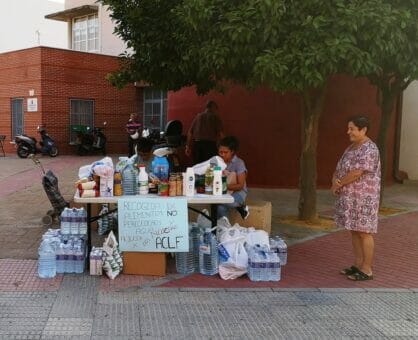
19 Feb 2021 | Non categorizzato
The commitment of a small community in the Murcia region of Spain has led to lots of activities being set up to create space for dialogue and solidarity, such as meetings between citizens and politicians, cultural events and activities responding to social and humanitarian emergencies. 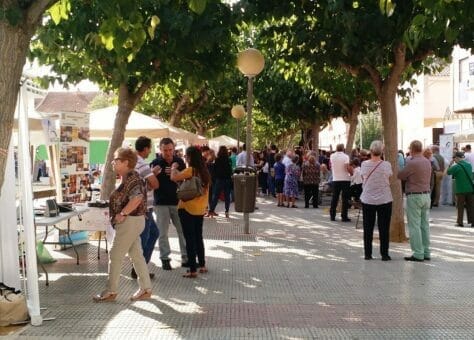 Aljucer is a small town in the Murcia region of southern Spain. Twelve years ago, members of the local Focolare community asked themselves what they could do to make their commitment to living fraternity a reality which impacts on people in the local area which is located in fertile land close to the Mediterranean Sea, but which also has its fair share of large and small emergencies. The first step was to find a way to create opportunities for participating in the life of the town which were more open and inclusive. So, in collaboration with other groups, they set up a cultural association called ‘ACLF Aljucer’. “Our first experience as an association,” they said, “was to bring together various mayors who had been in office in the city during the Spanish democratic period. Inviting them was not easy, but in the end they all agreed to participate. They had an opportunity to introduce themselves, recall the time when they held office and, in some cases, reconcile with one another. In the end, they thanked us and encouraged us to continue in this vein.”
 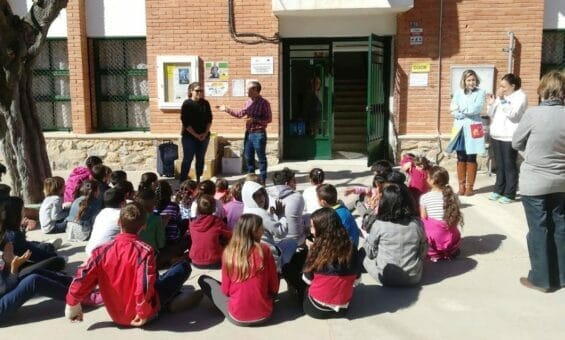 This experience led to the idea of holding a meeting every year to bring politicians and citizens closer together which is how “In Our Hands” and “The Speaker” were born. The first of these meetings which have now been running for twelve years,” they explained, “took place before the elections and offered a safe space where dialogue between citizens and candidates was encouraged. In the second event, a topical issue was chosen, and politicians and citizens were given the floor. Speeches and proposals are collected, published on the Association’s website and offered as contributions to the City Council. Some of the topics proposed have been studied in depth and, from that experience, the idea of a Cultural Centre under the authority of the Municipality arose which is now becoming a reality. The Association also puts on cultural activities, such as concerts, book presentations and exhibitions. And there is also “Aljucereños”, an event where personalities from the world of culture, music, art, literature, politics, economics and medicine talk about their life experiences and the motivation behind their choices. They also hold monthly meetings with other assocations and organise an annual Associations’ Fair. But it is also important to listen and respond to the sufferings and wounds of the local area to build fraternity. “The first step we took towards solidarity,” they continued, “was to organise a dinner in aid of the ‘Fraternity with Africa’ project which provides scholarships for young Africans who have committed to working in their home country for at least five years. This very soon became our main activity, the one for which we became known by so many. Shopkeepers and associations help organise the dinners which bring together around 200 people. Participants are updated on the project’s development at every meeting”. The Association also collaborates with initiatives promoted by other organisations that support humanitarian emergencies (Philippines, Madagascar, Croatia) and has committed to helping refugees from the war in Syria. The latest activity was a fundraiser for Lebanon, after the explosions in Beirut in August 2020. Even when there were emergencies closer to home they didn’t back down. “Last year,” they explained, “we made it our priority to provide water and food to the people affected by flooding in the area. We also organised volunteer activities and collected school supplies for a school in our area where a high number of pupils are at risk of exclusion. In the last year, we have supported three families affected by the pandemic by providing food, medicine and financial assistance. We disseminate all these activities through the Association’s website and Facebook page which help us to promote a culture of solidarity on a large scale”.
Anna Lisa Innocenti
15 Feb 2021 | Non categorizzato
If the spirituality of the Focolare, which is centered on love for one’s brother or sister, is an expression of the Gospel, then also “perfection in virtues”, as it is referred to in the Christian tradition, must be achievable in relationships with others. This is the conviction that Chiara Lubich explains in the following text. Many of us are familiar with the Imitation of Christ, a book of prayer and meditation that is rich in spirituality. In order to transform our life into a Holy Journey, and reach the goal that the book puts before us, it says that we need some attributes that are very compelling: complete contempt for the world, an ardent desire to progress in virtue, love for sacrifice, and the fervor of penance, self-denial, and knowing how to bear every adversity…. They are attributes that are necessary for all of us to possess. However, we must ask ourselves: how can we acquire them in accordance with our own spirituality? The answer is clear and certain: we have not been called by God to accomplish all this through a monastic style of life separated from the world. We are called to remain in the midst of the world and to go to God through our neighbor, which means through love for our neighbor and through reciprocal love. It is through committing ourselves to undertake this unique and evangelical path that we will discover, as if by enchantment, that we have acquired these virtues in our soul. We need to have contempt for the world. Then, there is no better contempt for something than complete disregard, forgetfulness and indifference toward its existence. If we are fully projected toward thinking of the others, toward loving the others, we no longer have concern for the world, we forget about it; therefore, we have contempt for it, even though this does not free us from doing our part in pushing aside its suggestions when they assail us. We must progress in virtue. But we can do this if we have love. Isn’t it written: “I will run the way of your commands when you give me a docile heart [a heart full of love]” (Psalm 119:32)? If in loving our neighbor we run the path of fulfilling God’s commands, it means that we are making progress. We need to love sacrifice. To love the others precisely means to sacrifice oneself in order to be dedicated to the service of others. Christian love, even though it is a source of great joy, is synonymous with sacrifice. We need the fervor of penance. It is through a life of love that we will find the greatest and principal penance to perform. We need self-denial. Love for our neighbors always implies self-denial. Finally, we need to know how to bear all adversity. Are not many sufferings in the world caused by living alongside others? We must know how to bear everyone, and to love him or her out of love for Jesus Forsaken. By doing this we will overcome many obstacles in life. Yes, in loving our neighbor we find an excellent possibility to transform our life into a “holy journey”. […]
Chiara Lubich
(From a telephone conference call, Rocca di Papa, 27 November 1986)
12 Feb 2021 | Non categorizzato
This is the title of the conference to be held on 18-19 February and promoted by the Chiara Lubich Centre and the Central National Library in Rome. Consonances and common points between the spirituality of unity and lines of thought of great figures of our times. Can we imagine what dialogue between Chiara Lubich, Dietrich Bonhoeffer, Simone Weil, Mahatma Gandhi, Giorgio La Pira, Martin Luther King or even Mikhail Gorbachev would be like? When the vision of a personality happens to be in harmony with that of other ‘great minds’ of his or her time, or of other times, such a convergence often strengthens and enriches a movement of common ideas, that can reach large patches of humanity and set a course towards a durable change. To put Chiara Lubich’s idea of unity in dialogue with different personalities who have made history, is the aim of the conference “Beyond the 20th century. Chiara Lubich in dialogue with our times”. It will be held on 18-19 February 2021, and it is being promoted by the Chiara Lubich Centre and the National Central Library in Rome. This event may be followed online on Città Nuova’s YouTube channel in Italian, English, Spanish and Portuguese. THURSDAY 18/02 ITALIANO https://youtu.be/hePSudSFdbo PORTUGUÊS https://youtu.be/91uF6G4uJ80 ENGLISH https://youtu.be/_vKWn0NNP_Q ESPAÑOL https://youtu.be/Awo4Z3sbQU0 FRIDAY 19/02 ITALIANO https://youtu.be/R1NtYaCUifA PORTUGUÊS https://youtu.be/pQKtuCs1loQ ENGLISH https://youtu.be/s8H4u-LHC70 ESPAÑOL https://youtu.be/TNFO84-RZBM During this conference, Chiara Lubich’s thought and her experience in the historical, political, economic and literary fields will be dealt with, thanks to the contribution of academics and scholars from different disciplines. Amongst these, there will be Michel Angel Moratinos, Andrea Riccardi, Piero Coda, Alessandra Smerilli, Vincenzo Buonomo, Pasquale Ferrara, Maurizio Gentilini, Giulia Paola De Nicola, Adriano Roccucci, Cristiana Freni, Lucia Tancredi, Aldo Civico, together with others from other countries, such as Andras Fejérdy from Hungary and Vinu Aram from India, just to name a few. There will be four sessions during this conference that will deal with the historical aspect, the literary aspect, the socio-political aspect, while the last one will be dedicated to some twentieth century personalities. Chiara Lubich lived through most of the twentieth century and the first years of the new millennium. She looked at this change of epoch from the perspective of universal brotherhood, convinced – as she affirmed many times – that ‘unity is a sign of the times’. The consonances that the conference aims to highlight, in fact, go far beyond the analysis of Chiara Lubich’s thought, because they place it in dialogue and in comparison with the thought of great figures who, through different ways of life and cultures, have however pointed their gaze in the same direction. Besides the Focolare Movement, the Sophia University Institute, Città Nuova, New Humanity and the Trentino History Museum Foundation are also giving their share towards this conference.
Stefania Tanesini
12 Feb 2021 | Non categorizzato
29 March 1922 – 1 November 2020. A Jesuit priest and long-standing Focolare member, he was a great educator and spiritual director. Just before dawn on the feastday of All Saints, in the infirmary of the Jesuit Fathers in Rome, Fr Paolo Bachelet left for his Father’s House. He had celebrated his 98th birthday on 29 March 2020. Fr Paolo entered the Society of Jesus on 7 December 1941. He was ordained priest on 7 July 1951 and completed his formation with solemn final vows on 3 February 1958. He got to know the Focolare Movement and the spirituality of unity in the 1950s while studying theology at the Gregorian University. Among his fellow students was Pasquale Foresi, co-founder of the Movement. Immediately a spiritual bond formed between them which never waivered. Focolare founder, Chiara Lubich “entrusted” a phrase of the Gospel for him to live in a particular way in his daily life, so that it could become his own Word of Life: “He must increase but I must decrease” (Jn 3:30). He welcomed the spirituality of the Focolare and became part of the group of religious men belonging to the Movement. For many years he worked in the regional seminary at Anagni, Italy, then in the University Chapel of La Sapienza in Rome. He was a great eduator and spiritual director. Many seminarians continued to turn to him for spiritual guidance even after they left Anagni, including those who later became bishops. In the University Chapel of La Sapienza, where he lived from 1987 to 2003, he was much loved and sought after as a spiritual accompanier by both students and academics alike. It was a constant source of edifying spiritual enrichment to live a strong spiritual relationship with him. He had a great capacity to listen. He really knew how to set himself aside in order to fully welcome the other person. When he communicated what was in his soul with the small group of other religious men who shared the life of the spirituality of unity with him, he often commented that in many conversations he would find himself faced with issues for which he had no pre-prepared answer. This never concerned him, because he would always experience how the person who was confiding a particular problem, having been listened to discreetly and attentively by Fr Paolo, would find the light and answer within themselves. He communicated this as a fruit of the spiritual presence of Jesus in that moment between him and the person speaking, according to the Gospel promise Where two or three are gathered in my name, I am there among them» (Mt 18:15-20). He was well primed in Moral Theology and Canon Law. He had a special dedication to families. In the 1990s, together with a married Focolarino and other Focolare members, he was involved in the formation of the Separated Christian Families Association. He supported the association’s branch in Rome for many years until 2017, when he was transferred to the infirmary in Via dei Penitenzieri, Rome. He followed the preparations and progress of the Synod of Bishops on the Family with close interest. And in fact some of his observations which reached the Synod General Secretary made their way into the final document, Amoris Laetitia. We recall Fr Paolo as a spiritual son of Chiara Lubich and as a true brother sharing the Spirituality of Unity. He is surely continuing to follow us from heaven.
Fr. Armando Ceccarelli S. J.
10 Feb 2021 | Non categorizzato
From Focolare communities in Croatia, Macedonia and Serbia, where they’ve been experiencing the joy of giving freely to help those in difficulty “Our communion of goods began by observing the early Christians. We saw that there they had a communion of goods, and as a result there was no one who was poor among them… “So you could say that the formula is this: if the whole world were to implement the communion of goods, then social problems, the poor, the hungry, those without a legacy, etc., would no longer exist.” This was how Focolare founder Chiara Lubich, when she launched the Economy of Communion project in 1991, explained the origins of the “communion of goods” in the movement, both material and spiritual. In 1943 in Trento, the war had destroyed the city, and many had lost their homes, jobs and families. Faced with such despair—and in light of the words of the Gospel they meditated on in the shelters—Chiara and her early friends decided to take care of those most in need. “Our goal was to implement the communion of goods as much as possible in order to solve the social problems of Trento. I thought, ‘There are two or three places where the poor people are… Let’s go there, let’s bring what we have, let’s share it with them.’ Simple logic, really: we have more, they have less. We will raise their standard of living so that we will all reach a certain equality.” Eighty years later, the communion of goods is still a vibrant reality in the movement. Each person gives freely according to his or her possibilities, often expressing gratitude for what they’ve received. Experiences are multiplying all over the world. “I went to buy 10kg of wheat for my chickens,” says one person from Croatia. “The man who sold it to me did not want money. I donated what I had saved for the communion of goods, which is extraordinary in this pandemic.” Of course, it’s not always possible to donate goods and money. Still, the commitment reinforces the value of the gesture. “I recently sold some wine to a neighbour. He gave me more money than he had to, and he didn’t want any change. I gave it for the communion of goods, but it wasn’t easy; I had to overcome my human way of thinking.” The experience of receiving after giving often happens. It is the evangelical “Give and it will be given to you” (Lk 6:38) that Chiara and her early friends tangibly experienced. “We helped some families who had lost their jobs because of the crisis caused by the pandemic, donating food, medicine and school supplies,” they write from Macedonia. “It was little help, but one of them told us that it was enough to eat for two weeks. Shortly after, another family made a donation that covered their expenses. Everything was circulating.” The joy of giving and the joy of receiving happens frequently. In Serbia, the communion of goods reached a family with children where father and mother are sick and unemployed. They live off the produce from their garden, and to pay the bills, Toni helps out in the parish. “When we went to bring him money, he was borrowing to buy wood. We explained to the family where the help was coming from, and they were moved because they felt that God, through us, ‘had looked their way.’” The communion of goods, after all, is nothing more than an instrument of divine providence.
Claudia Di Lorenzi
8 Feb 2021 | Non categorizzato
The General Statutes of the Focolare Movement, as well as the Regulations of each of its branches, contain a “premise to every other rule” a “norm of norms”: the commitment of whoever is part of the Movement to live mutual charity according to the Commandment of Jesus. In the following text, Chiara Lubich emphasizes that this commitment must be continually renewed. [In the letter to the Romans the apostle Paul] says: “Let us cast off deeds of darkness and put on the armor of light” (Rom 13:12).The “deeds of darkness” are the consequences of vices and sin. The “armor of light” is the virtues and the practice of living the Word of God in our lives. Now, we know that the New Commandment of Jesus is the synthesis of all His commands, of all His Words. Therefore, we will put on the “armor of light” by refocusing our lives on this commandment. The result—we know—is that the Risen Lord will be resplendent in the midst of our community. […] So then, the “armor of light.” The New Commandment practiced with new commitment. […] This is an invitation that I extend to all of you. And so that we can begin right away, let’s take a moment to look at our reciprocal love: let’s consider the measure of love (keeping in mind that it must be the same measure with which Jesus loves us: therefore to be ready to give our lives); let’s look at where our generosity is lacking, at our limitations in loving, so that we can overcome them; let’s see if our reciprocal love may rest too heavily on a human plane, and need therefore to be raised to a supernatural level…. If we do so, if we improve our reciprocal love in this way, Jesus, the Saint, will be among us and will make this present year the holiest of our lives.[…]
Chiara Lubich
(From a telephone conference call, Rocca di Papa, 13 November, 1986)
6 Feb 2021 | Non categorizzato
On 8 February, a prayer marathon for an economy which cares for and values the human person and nature, which includes and does not exploit the most vulnerable. The International Day of Prayer and Awareness against Human Trafficking is observed on 8 February 2021, the feast day of St Josephine Bakhita. It invites us to reflect deeply on this issue and to make the connection between our contemporary world economy and human trafficking. The Focolare Movement is closely associated with a worldwide network of concerned associations and partners, including the Dicastery for Consecrated Life, the Pontifical Council for Justice and Peace, the Pontifical Council for the Pastoral Care of Migrants and Itinerant Peoples, the Pontifical Academy of Sciences, Caritas International, and many more. It’s a joint call for an economy not underpinned by illegal trafficking or exploitation, but which promotes the life and dignity of every person and dignified work for all. Human trafficking exists because it generates huge sums of ‘easy-money’ for the traffickers. But actually, we all profit from trafficiking, in some sense, when we obtain too-low cost goods or services. We must change direction and say no to everything that destroys life. The International Day of Prayer and Awareness against Human Trafficking 2021 turns the spotlight on one of the main causes of human trafficking: our current dominant economic model, with limits and contradictions which have been accentuated by the Covid-19 pandemic. Human trafficking is an integral part of this economy. The victims of trafficking like “goods” are trapped within the chains of a globalization governed by financial speculation and low cost competition. What’s needed is a structural and global vision of trafficking to demolish all the perverse mechanisms which feed the demand for persons to be exploited. Because the whole economy is diseased to its very core. Oscar Wilde is credited with defining a cynic as someone who ‘knows the price of everything and the value of nothing’. Well, this our economy seems to be dominated by cynicism. Referring to goods, services and people, the market not only determines the price, but, even more drammatically, it’s the price that determines the value. A business falls victim to this logic by being increasingly valued by the financial markets according to the share price and not from the added value of its human capital. So trafficking is just the tip of the iceberg. It’s the magnified expression of a malaise caused by prevalent neoliberalism based on a (false) idea of economic liberty in which every ethical, social and political consideration is deemed superfluous and an obstacle. On the other hand, an economy without human trafficking is an economy which cares for and values the human person and nature, which includes and does not exploit the most vulnerable. How can we participate in the World Day of Prayer? On 8 February you can follow the prayer marathon on the special Youtube channel over seven hours, in five languages, highlighting stories of different ways of combatting human trafficking around the world. More information from: www.preghieracontrotratta.org
Lorenzo Russo
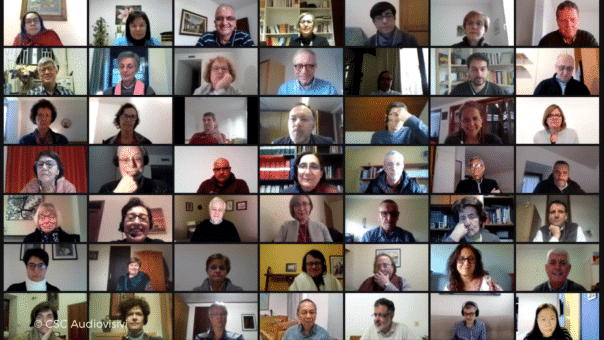
5 Feb 2021 | Non categorizzato
General Assembly – Diary12, February 5, 2021 A very intensive day of work has come to an end for the General Assembly participants. Between yesterday and today they analysed and voted on a number of motions about the future life of the Movement. A first draft of the final document has also been written. This summarises the orientations and the plan of action on the topics discussed in the various working groups. It needs to be said that time constraint and the technical conditions imposed by the telematic mode posed a challenge for the Assembly’s work. Nonetheless, every effort has been made to enable everyone to contribute, to experience unity in diversity, and to plan together a final document to be handed over to the new Government. Roughly, it has been calculated that 13 to 15 hours of work were put into each topic and a total of 3,500 working hours were invested in the first draft alone. All this work has been achieved through the help of several specialised platforms and three professional facilitators. An extraordinary appointment for tomorrow morning: Pope Francis will receive the General Assembly in a private audience at the Paul VI Hall. Some participants will actually participate in person, while most of them will follow via streaming. The outgoing president, Maria Voce, will introduce the newly elected Margaret Karram to the Holy Father. The new president will address Pope Francis, who will then speak to those present and to the Assembly participants who will follow through the link-up. Detailed information about the live broadcast, that all may follow, is available on the following link: https://www.focolare.org/en/news/2021/02/05/pope-francis-gives-audience-to-the-general-assembly-of-the-focolare-movement/
Focolare Communication Office
Text in PDF
5 Feb 2021 | Non categorizzato
How to watch English subtitles, click here https://youtu.be/oZ8kaSgOizA
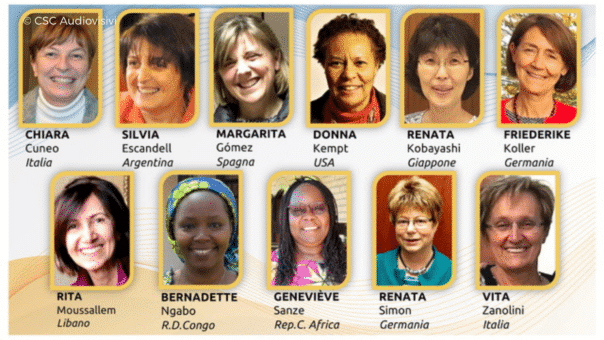
4 Feb 2021 | Non categorizzato
Diary No.11 of the General Assembly 4th February Between yesterday and today the 22 new general councilors of the Focolare have been elected. They come from 16 countries and 4 continents, their ages range from 52 -70 and they truly represent the multiculturality that is a characteristic of the Focolare Movement. Many of them have lived in various geographical areas besides their country of origin, an important factor for getting to know in depth, the characteristics, needs and challenges of the many countries in which those who identify themselves in the Focolare’s message of unity, are living. At the opening of the voting for the councilors Margaret Karram said: ”Let us ask for the Holy Spirit so that we can be guided only by him”; in fact this is only the first step towards the composition of the new “Center of the Movement”. Shortly, the newly elected President will distribute their specific tasks to each one. The intense work of today was concluded with a session dedicated to the presentation and approval of various proposals. Tomorrow the work will continue in plenary with sessions of dialogue on the plans and directions for the next 6 years. In the meantime, let’s get to know the names of the newly elected councilors and where they come from.
|
Women Councilors Cuneo Chiara (Italy) Escandell Silvia (Argentina) Gomez Margarita (Spain) Kempt Donna Lynn (USA) Kobayashi Renata (Japan) Koller Friederike (Germany) Moussallem Rita (Lebanon) Ngabo Bernadette (Dem. Rep. Congo) Sanze Genevieve (Central African Republic) Simon Renata (Germany) Zanolin Clara (Italy)
|
|
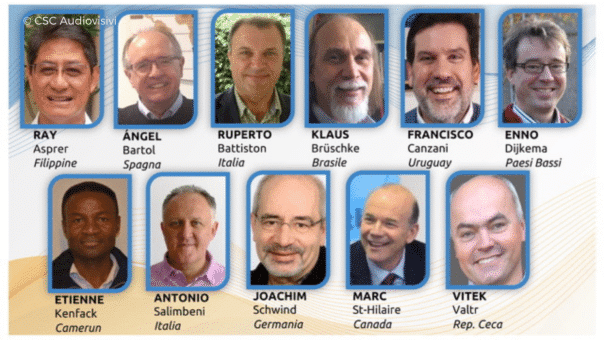
|
Men Councilors Asprer Ray (Philippines) Bartol Angel (Spain) Battiston Ruperto (Italy) Bruschke Klaus (Brazil) Canzani Francisco (Uruguay) Dijkema Enno (Holland) Kenfack Etienne (Cameroon) Salimbeni Antonio (Italy) Schwind Joachim (Germany) St-Hilaire Marc (Canada) Valtr Vit (Czechia)
|
Focolare Communications Office Text in PDF
4 Feb 2021 | Non categorizzato
How to watch English subtitles, click here https://youtu.be/01Yu21H5vbg
![Voting has started for the men and women general councilors]()
3 Feb 2021 | Non categorizzato
Diary of the General Assembly no.10, 3rd February 2021 Today’s program is dedicated once again to voting. The General Assembly has met together in a plenary session to begin the process of voting, so as to elect the men and women general councilors of the Focolare Movement and this will conclude tomorrow.

The Electoral Commission at work
3 Feb 2021 | Non categorizzato
How to watch English subtitles, click here https://youtu.be/Z0azW5nKBQU
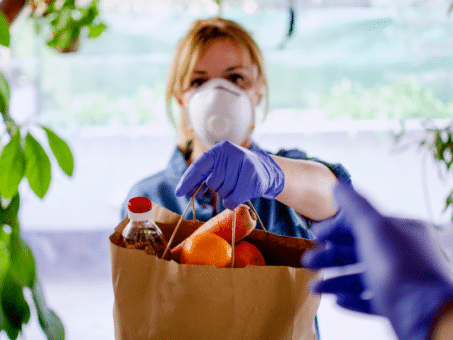
3 Feb 2021 | Non categorizzato
Despite restrictions imposed by the pandemic, the Focolare community in Toronto remains close to a sick mother and her family “I don’t feel alone on this journey, and it’s thanks to all of you who are my family!”. Susan lives in Toronto, Canada. She has five children and was diagnosed with advanced cancer about a year ago. Her journey has been a rocky one, with moments of progress and feelings of hope alternating with moments of trial when her health deteriorated. But sharing her experience with the Focolare community, of which she has been a member for a long time, has helped to relieve the burden of her suffering and echo her joy. Not even the restrictions imposed by the pandemic can stop them sharing this suffering. It must be because love can overcome the most difficult obstacles. The same is true for the fraternal relationships linking members of the community together. From the Focolare in Toronto they said: “When Susan shared the situation with all of us, she told us she felt at peace and wanted to offer her suffering for everyone affected by the pandemic. We assured her of our personal prayers, and one of our families had the idea of meeting together on Zoom to pray the Rosary for her healing”. So since last March, members of the Toronto Focolare community have been meeting on Zoom every Sunday at 4pm: “We take turns praying one decade of the Rosary, and leave Susan and her family to pray the fifth decade”. It is such a strong moment of prayer that they feel the spiritual presence of Jesus among them, according to the Gospel which says “Where two or three are gathered in my name, there am I in the midst of them” (Mt 18:15-20). And through the intercession of Chiara Lubich, founder of the Focolare Movement, they are asking for Susan to be healed. “When we finish praying,” they continue, “Susan gives us an update on the treatment, and we all rejoice with her and Nino, her husband, if there has been progress and suffer with them in the difficult moments. She continues to tell us that she feels stronger spiritually and emotionally thanks to the spiritual presence of Jesus among us and that we are all carrying this suffering together!” Love for this mother and her family is also being expressed in very concrete gestures. If the doctors prescribe rest and advise against cooking, then the community takes it in turns to prepare a meals for the family which is different every time. “It’s incredible”, they say, “with love, you can overcome every difficulty, even those caused by the virus with the lockdown. For Susan’s family, especially the young children, it is always a great joy to see what has arrived for dinner because every time, from our multicultural community, there is a dish from a different world cuisine. This experience with its many acts of love has made us grow as a community”. It is this feeling of family that is giving Susan courage, and it is from this love for Susan that the community is rediscovering itself as a family every day.
Claudia Di Lorenzi
2 Feb 2021 | Non categorizzato
General Assembly Diary 9/ 2 February 2021 After the first ten days, the Focolare General Assembly has reached a turning point. The election of the new President Margaret Karram, and the Holy See’s confirmation today of the re-election of Co-President Jesús Morán, completes the first phase. Tomorrow, in her first official duty, the new President will establish the number of General Counsellors to be elected by the Assembly. These cannot be less than 20, in line with a recent modification to the General Statutes of the Movement. Today, as the Assembly continued working on the direction and lines of action for the next six years, greetings and congratulations to the newly elected president have been pouring in from around the world. Here are a few highlights: “With great pleasure we heard of your election as new president of the Focolare Movement. […] Being so expert in dialogue between cultures […] your nomination will strengthen the witness of unity among cultures and religions. […] In the cooperation of ‘Together for Europe’ we wish to be a trustworthy partner in contributing to a new culture of unity”. P. Heinrich Walter, Schoenstatt Movement “Dear Margaret, […] I wish to congratulate you, on behalf, also, of Andrea [Riccardi] and all the Community of Sant’Egidio on this important role. […] We’ve met on various occasions already […] particularly in our shared commitment for unity among movements and ‘Together for Europe’. […] Building bridges and links of fraternity is a real necessity for our world and a ‘vocation’ for which your own personal story, your provenance from a land of suffering and conflict, makes you partcularly sensitive. […] In this spirit of fraternity, we’ll continue our friendship between the Focolare Movement and the Community of Sant’Egidio”.
Marco Impagliazzo, President of the Community of Sant’Egidio
“The Federation of the Fellowship of Christians and Jews in Italy expresses our sincere best wishes for your new role. […] We call to mind the light and colours of your cities: Haifa, Los Angeles and Jerusalem, and we hope to collaborate for the promotion of Jewish-Christian and inter-religious dialogue”. “With great pleasure, on behalf of the Union of Islamic Communities in Italy, I extend our hearty congratulations on your nomination as President of the Focolare Movement. On behalf of the communities I represent, I renew our wish to collaborate always on the way of dialogue, of sharing, of encounter, in the hope of gathering fruits of peace.” Yassine Lafram, presidenteUCOII “The Order of the Holy Sepulchre sends our best wishes to the newly-elected President of the Focolare Movement, Margaret Karram. […] As a Catholic Arab of Haifa, you have always been intensely involved in the activities of inter-religious dialogue working for the culture of encounter in the Holy Land.” Before concluding this diary, we ask you, our dear readers, for your collaboration. Disappointingly, documents, photos and recordings of the General Assembly are already being shared on various platforms. Let us not forget that this Assembly is not a public event. Please help us to protect the reserved nature of our Assembly. Please don’t join in the improper sharing of any content which has not been authorized by this office. Grazie! Thank you!
Focolare Communications Office
Text in PDF
2 Feb 2021 | Non categorizzato
This is the second mandate for Jesús Morán, whose primary task is to fully support and collaborate with Margaret Karram, the newly elected president of the Focolare Movement. The election of the co-president was also welcomed by the Focolare Assembly with worldwide applause and today, the Dicastery for Laity, Family and Life confirmed his appointment: Jesús Morán has been re-elected co-president of the Focolare. This is his second term of office after the one just concluded alongside Maria Voce. Jesús Morán is 63 years old and was born in Navalperales de Pinares, Avila (Spain). He first came across the Gospel message proposed by the Focolare Movement during his university studies, through the witness of some of his fellow students. He graduated in Philosophy from the Autonomous University of Madrid and obtained a Licentiate in Dogmatic Theology from the Pontifical Catholic University of Santiago de Chile and a Doctorate in Theology from the Pontifical Lateran University in Rome. From 1996 to 2004 he was Focolare delegate for Chile and Bolivia, where he was ordained a priest on 21 December 2002. From 2004 to 2008 he was co-responsible for the Movement in Mexico and Cuba. At the 2008 Focolare General Assembly he was elected General Councillor and responsible for the cultural formation of the Movement’s members. In 2009 he became a member of the “Abba School”, an interdisciplinary study centre of the Focolare Movement, due to his expertise in theological anthropology and moral theology. Since 2014 he has been co-president of the Focolare Movement. The duties of the Co-President The first duty of the Co-President is full support and collaboration with the President. The Statutes of the Focolare speak of “the fullest unity with the President” in order to offer her the possibility of examining ideas and decisions, listening and searching together for the will of God. He is responsible for the priests who adhere to the Focolare and ensures that the internal life and activities of the movement are in conformity with the faith and morals of the Church.
Stefania Tanesini
1 Feb 2021 | Non categorizzato
How to watch English subtitles, click here https://youtu.be/QW3HIijcpqY
1 Feb 2021 | Non categorizzato
Elected on 31 January, she is the third President to lead the Movement after the founder, Chiara Lubich, and after Maria Voce who has just completed two terms. PRESS RELEASE – 1st February 2021 Yesterday, Margaret Karram, was elected President of the Focolare Movement with more than two thirds of the votes cast among the participants in the General Assembly of the Movement, composed of 359 representatives from all over the world. She succeeds the founder Chiara Lubich and Maria Voce who was in office for 12 years (two terms). Margaret Karram was born in Haifa, Israel in 1962 into a Palestinian Catholic family. She holds a B.A. in Jewish Studies from the American Jewish University in the United States. She has held various positions for the Focolare in Los Angeles and in Jerusalem. Her past experience includes membership of various commissions and organizations for the promotion of dialogue between the three monotheistic religions, such as the Episcopal Commission for Interreligious Dialogue, the Assembly of the Catholic Ordinaries of the Holy Land and the ICCI (Interreligious Coordinating Council in Israel). She worked for 14 years at the Consulate General of Italy in Jerusalem. Since 2014, she has been at the International Centre of the Focolare as councillor for Italy and Albania and co-responsible for Dialogue between Ecclesial Movements and New Catholic Communities. She speaks Arabic, Hebrew, Italian and English. In 2013 she received the Mount Zion Award for Reconciliation, together with the scholar and researcher Yisca Harani, for their commitment to developing dialogue between different cultures and religions. In 2016 she received the St Rita International Award for having promoted dialogue between Christians, Jews, Muslims, Israelis and Palestinians, starting from people’s everyday life. The election took place yesterday, 31 January 2021, but her appointment only became effective today, following confirmation by the Dicastery for the Laity, Family and Life, as envisaged by the General Statutes of the Focolare Movement. The document expresses the hope that the new president will be able to carry out her task “with faithfulness, in a spirit of service and ecclesial sensitivity, for the good of the members of the Movement and of the universal Church.” Duties of the Focolare President According to the Movement’s General Statutes, the President is chosen from among the focolarine (consecrated women with perpetual vows) and will always be a woman. In the Statutes we read, she “is the sign of the unity of the Movement”. This means that she represents the great religious, cultural, social and geographical variety of those who adhere to the spirituality of the Focolare in the 182 countries where the Movement is present and who identify with the message of fraternity that the founder, Chiara Lubich, drew from the Gospel: “Father, that they may all be one” (Jn 17:20-26). There are many commitments and challenges awaiting Margaret Karram in the coming years: the tasks of governing and directing a worldwide Movement like the Focolare, which is deeply immersed in local and global realities and the challenges of humanity, starting from this time of pandemic. The Statutes also indicate the “style” that should distinguish the work of the President: “Hers is to be, above all, a presidency of love – they state – because she must be the first in loving and, therefore, in serving her own brothers and sisters, remembering the words of Jesus: “Whoever wishes to be first among you must be the servant of all” (Mk 10:44). The primary commitment of the President, therefore, is to be a builder of bridges and a spokesperson for the central message of the spirituality of the Focolare, ready to practise and spread it, as we read further on, even at the cost of her own life. The next steps of the General Assembly of the Focolare are the election of the Co-President this afternoon and of the councillors on 4th February. Stefania Tanesini -Cell. +39 338 5658244 Text in PDF
1 Feb 2021 | Non categorizzato
The new president of the Focolare Movement for the next six years is Margaret Karram, born 1962 in Haifa (Israel). The election, which required a two-thirds majority of those present, took place on Sunday 31 January, and has been approved by the Dicastery for the Laity, Family and Life, in accordance with the Movement’s Statutes. The new President – who by Statute will always be a woman – is to guide the Movement through the next six years. The current General Assembly of the Focolare Movement, which elected the new President, is being conducted entirely online due to the pandemic. It began on January 24 and will conclude on February 7, 2021. It’s the third General Assembly since the death of founder Chiara Lubich. 359 people are taking part around the world. They represent some of the different cultures, generations, vocations, members of different churches and religous faiths who are part of the Focolare Movement. With the election of the President, on February 1 the Co-President will be elected, who according to the Statutes must be a Focolarino priest, then the counsellors who will collaborate in the central governance of the Movement. Press statement to follow.
Lorenzo Russo – Focolare Communications Office
1 Feb 2021 | Non categorizzato
We always have only one moment in which to love God and our brothers or sisters: the present moment. Chiara Lubich taught this concept with wisdom and simplicity. Committing ourselves to living the present moment well is a method whereby each of us can be fulfilled and achieve happiness. There are, even among us, those who finish their Holy Journey after a long wait and those who finish it in a flash, when they least expect it. And so the question arises: what will it be like for us? And the conclusion comes naturally: it is good to always be prepared. In what way? By remaining in the grace of God and living the present moment to the full. It was for this reason […] that in these last few days I focused my attention once again on that very characteristic aspect of our spirituality that consists in concentrating on living the present moment. And my thoughts turned to so many phrases taken from the saints, for example, that encourage us to put this into practice perfectly. Do you remember? St. Catherine of Siena said: “We do not possess the toil of the past, because that time has escaped us; nor the toil that is to come, because we cannot be certain of having that time.”[1] By saying this, she extended an invitation to live the present. And St. Therese of Lisieux: “You know, my God, that to love You… I only have today.”[2] Then I remembered a motto that was useful to us in the past and which we remembered very easily because each word [in Italian] began with an “s”: Sarò Santa se Sono Santa subito, (I will become a saint if I am a saint straightaway). During these few days I have often noticed that this way of living our life was precious also to other saints who recommended it warmly. St. Paul of the Cross wrote “Fortunate is the soul which rests ‘in sinu Dei,’ without thinking of the future, but manages to live moment by moment in God, with no other concern than to do his will well in all that happens.”[3] “Fortunate is that soul…” We can make this fortune our own, because it is part of our spirituality to live like this. It is by living in the present that we can fulfil all our duties well. It is by living in the present that crosses become bearable: with good reason this practice is recommended for those who are nearing death. It is by living in the present that we can grasp God’s inspirations, the impulses of his grace that come to us in the present. […] So let’s live the present moment! […] Let us live it to perfection! In the evening of each day and in the evening of life we will find ourselves full of good works that have been accomplished and acts of love offered. …
Chiara Lubich
(Taken from a telephone Conference Call, Rocca di Papa, 23 October 1986) [1] St Catherine of Siena, Her Letters, II, Paoline, Alba 1966, p. 97. [2] St. Therese of the Child Jesus, Complete Works, LEV, Vatican City 1997, p. 626. [3] Paul of the Cross, Letters, I, Pontifical Institute of Pius IX
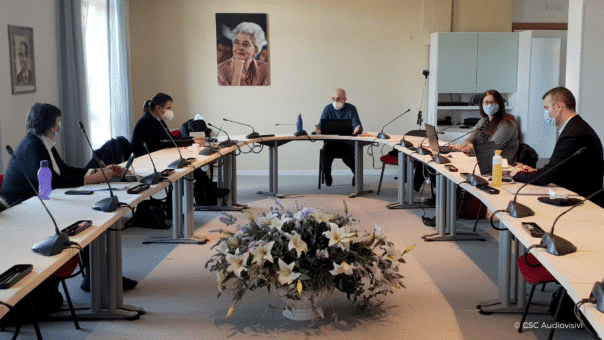
31 Jan 2021 | Non categorizzato
General Assembly Diary 8 – January 31, 2021 “Listen to the voice of the Lord today”! These words, taken from Psalm 94/95, “the thought for the day”, also known also as “Passaparola”, which reaches Focolare members worldwide daily, could not have been more appropriate. In fact, the elections for the future President of the Focolare Movement started today, and the first priority for the voters is to listen well to the voice of God to identify the right person who would be the president for the next six years.
Electoral commission
- she must be elected by at least two thirds of the eligible voters present. This fairly high proportion of voters expresses the wish of the founder, Chiara Lubich so that there would be the greatest possible consensus for this very important role. At the request of the participants, the election process can be interrupted to give space for communion in a plenary session and in small groups;
- having reached the necessary majority, the candidate must accept her election in front of the Assembly;
- then one has to wait patiently a bit more because there is the third step to be followed. Since the Movement is an association of pontifical right, the elected President – and later also the Co-President – must be confirmed by the Holy See, specifically by the Dicastery for the Laity, the Family and Life. It is only after this confirmation that the election is valid and can be communicated.
An electoral commission, presented to the Assembly and confirmed at its first plenary session on January 24, ensures that election rules are followed. The five members are all legal experts: Danilo Virdis, a married focolarino from Italy; Flavia Cerino, a focolarina from Italy, Laura Bozzi, a volunteer from Italy; Waldery Hilgeman, a volunteer from Holland and Sr. Tiziana Merletti, an Italian Franciscan. The election process will continue tomorrow, February 1. Once the President has been elected, the Co-President will be elected in the same way.
Communication Office of the Focolare Movement
Text in PDF
31 Jan 2021 | Non categorizzato
How to watch English subtitles, click here https://youtu.be/WXdE7Z4PfU0
30 Jan 2021 | Non categorizzato
General Assembly Diary 7 30 January 2021 As the Assembly continues to work on the priorities and lines of action for the next six years, today we’d like to offer a glimpse behind the scenes, to get to know the people who are keeping the “machine” working, without whom none of this could happen. The online nature of the event called for a network of collaborators and technicians specialized in different fields, indispensible not only for the efficacy of the digital platform but also to guarantee the juridical validity of this Assembly.  No less than 73 people comprise the technical team of the Focolare General Assembly. Many are physically present in the Movement’s international centre at Rocca di Papa in Italy, while others collaborate remotely from many parts of world including Brazil, the Philippines, France, Guatemala, Britain, Ireland, Italy, the Netherlands, Spain, Thailand and USA. Twenty I.T. experts are working on the web pages and various apps. 14 hosts, divided into two teams, run all the various video-conferences. 34 translators in 7 countries guarantee the participants have simultaneous translations in 5 languages (French, English, Italian, Portughese and Spanish). Then there is the 5-person squad responsible for the general coordination of all the technical teams. But it’s more than a network of collaborators or technical experts, according to Francesco Mazzarella, one of the video-conference hosting team working from Sicily. He writes:
  Behind the online Assembly, a group of people around the world, the so-called technical experts, have been ‘meeting’. We’ve been getting to know each other and creating a bond far beyond the technical aspect because there’s been a spiritual sharing among us too. It’s come about gradually, through a process of what we could call ‘techno-relationship’. Most of the time, we don’t think about all that has to happen before an event can take place. Today, the challenge goes via the internet, with the all uncertainties and challenges involved, and with all the possibilities it contains too. To manage these moments online without seeing each other face to face, without being able to physically shake each other by the hand, is the real challenge of this Assembly. But the greatest issue for the technicians is about making a gift of our own competencies, which have been acquired through much personal sweat and study. This requires a kind of exchange of trust. Let me explain myself. A technican, even those who have made a choice to follow the principles of the spirituality of unity in their work, is still a professional who takes personal pride in their work and their own skills. The willingness to share methods or procedures that have been learnt with so much personal effort and study is not automatic. It requires a real act of faith, trusting that the others are there out of love, trusting that by so giving we are contributing to building the Assembly. So it’s a connection of electronic signals and of souls which constitutes the foundation and techo-relationships of this adventure called our online Assembly. Usually, the technicians only come to our attention when something isn’t working properly. In this Assembly, it’s different. Their work and their “style” are building this event, day by day. Thanks to each one of them!
Focolare Communications Office
Text in PDF
30 Jan 2021 | Non categorizzato
The story of Irena, a doctor in Lithuania who is a member of the Focolare Movement in Eastern Europe who was infected with the Covid-19 virus. She experienced both the fatigue of illness and the strength in God’s love through prayer. “I’m inundated with messages and prayers. I don’t even know how my friends, acquaintances, colleagues hear about it. Even friends who I didn’t even know knew how to pray are praying. I had no idea that so many people could join in prayer for my health.” Irena is a hospital doctor, a member of the Focolare Movement who lives in Lithuania, in Eastern Europe. During these months that her country has been affected by the Covid-19 pandemic, her work became exhausting, and she was infected by the virus and experienced all the fatigue of the disease. But her strength, she says, has come from her trust in God’s love. Her discovery of being united with many people in prayer rewarded her personal efforts and gave energy to her healing journey. Her experience was particularly hard. At first, work on the ward continued at the usual pace, but soon the contagion spread among her colleagues. Irena found herself working alone. “I had to find places for staff to be sent to isolation,” she explains, “to settle patients who had to be discharged because there was no one to care for them and contact relatives so they could take care of them. “There were no masks for the patients, and I would hand them out my own. Once, with a colleague who stayed after hours, we examined 37 patients. Only the night was calm, and I could pray.” After days in the hospital without rest, Irena was able to return home. Yet it was with the knowledge that she had contracted the disease. She was relieved to feel the spiritual closeness of Focolare founder Chiara Lubich. “On the shelf next to my bed there was a photo of Chiara smiling, and I saw her as if for the first time. She smiled at me and I smiled at her, everything became easier.” Gradually, the symptoms of the disease became more burdensome, but Irena did not give in to the pain. “I lost my taste receptors and realized that even the sense of taste is a gift from God. I offered my suffering for my colleagues and for my country. The nights were very difficult, but Chaira was with me smiling.” When the disease became more aggressive, hospitalization became inevitable, and this brought new challenges. “I no longer had the strength to speak, and I underwent an experimental treatment. The person in charge took care of me, but the nurses forgot to bring me my medication and didn’t ask if I had the strength to take food from the cart. But I could offer these hardships as well.” Here, too, help came from those close to her. “In my room there was a lady with cancer, and she brought me food, drinks. We became friends, and when I felt better, we prayed together.” Feeling united in prayer with the many people who prayed for her allowed Irena to feel loved, by God and by her brothers and sisters. “I am grateful to God for the indescribable love that I experienced during my illness,” she says, “because I always felt him near me, and for the beautiful experience of common prayer, which has huge power, and God has allowed me to experience it live. I feel reborn.”
Claudia Di Lorenzi
30 Jan 2021 | Senza categoria
How to watch English subtitles, click here https://youtu.be/_K8Vbe0_LCk
