21 Sep 2020 | Non categorizzato
Not having preferences and not expecting anything in return: this is Chiara Lubich’s straightforward but revolutionary formula for a love that can change the world – today too. “So if anyone is in Christ, there is a new creation: everything old has passed away; see, everything has become new!” (2 Cor 5:17). [These words] speak … of the ‘new self’ that, through baptism and by adhering to the fruits of baptism, has been established in us and has a new way of seeing things, of behaving and of loving. … What is this love like? … Since it is a participation in the very love that is in God, which is God himself, it differs from human love in infinite ways. But there are two aspects, above all, in which it is different. Human love makes distinctions, it has preferences, it loves some brothers and sisters, for example blood relatives, people who are educated, rich, good looking, distinguished, healthy or young; it loves those who belong to a particular ethnicity or class, but it does not love others in the same way. Divine love, instead, loves everybody. It is universal. The second difference is the fact that, in human love, we love because we are loved. And even when love is beautiful, we love something of ourselves in the other person. There is always something selfish in human love, or that waits to love only when self-interest prompts us. So if we want to let our ‘new self’ live in us; if we want to let the flame of supernatural love burn in us, we too must love everybody and be the first to love. Basically, we must be like Jesus, other Jesuses. Jesus died on the cross for everybody: his love was universal. And with that death he was the first to love.
Chiara Lubich
Taken from a telephone conference call, Rocca di Papa, 8th January 1987
19 Sep 2020 | Non categorizzato
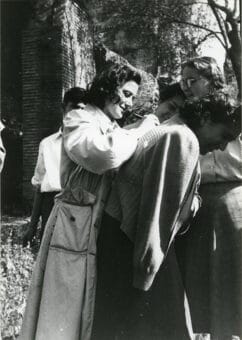
Trento, Chiara Lubich’s birthplace, will soon host a conference dedicated to the value of the Focolare founder’s texts, both spoken and written, from a linguistic and literary point of view. The event, which takes place in the Centenary of Lubich’s birth, is coordinated by an international study and research group and can be followed via web.
© CSC Audiovisivi
edited by Anna Lisa Innocenti
17 Sep 2020 | Non categorizzato
Jesus reveals that something new in the Gospel: the Father loves each of his children personally with an “overflowing” love and gives him/her the ability to enlarge their heart to their brothers and sisters. These are urgent and demanding words: to give what is ours; material goods, but also a welcome, mercy, forgiveness, and to give extensively in imitation of God. Powdered milk In a satellite city near Brasilia, there is a very poor neighbourhood where for years we have been bringing not only material aid, human promotion, but also trying to spread the good news of Jesus. It is always amazing to see how these people discover God’s love and begin to help each other, sharing what little they have with those who have even less. They even offer their own hut. Faithful to the “give and it will be given to you”, a lady to whom we had delivered powdered milk for her children told us that she shared it with her neighbour who had nothing to give her children. That same day, to her surprise and joy, she received more powdered milk. (H.I. – Brazil) The wound On certain festivals I give my four children some money to buy gifts for poor children. This year my youngest son asked me for more money: he had heard that his father was unemployed and could not give presents to his children with another woman. For me it was like a cold shower. My husband had abandoned us years earlier and the wound had remained. That night I cried a lot, I felt betrayed even by my boys. But maybe it was me who was wrong and the little one was teaching me a lesson. The next morning I increased his pocket money. Sometime later my children asked me to help their father find a job. It was the ultimate blow . They had never received a gift from him and now they were asking me to do this! Despite the painful memories, I understood that I had to put into practice Jesus’ command to love one’s enemies. It cost me but I did it. The joy I saw in the boys was indescribable. I thanked God for their generosity but also because they had given me the opportunity to remove from my heart a resentment that had tortured me for years. (C.C. – Colombia) Dismissal Some months ago, when the major computer company I work for announced the laying off of 40% of its employees, I got a real shock. Thanks to that job, we didn’t lack anything in the family, not even the extras. How were we going to meet the house payments? What about health insurance? And so on… With Jennifer and our daughters we felt more responsible about our family economy. We were ready to sell the most valuable objects and make other possible sacrifices, we assumed we would become self-employed, considering our personal skills… Above all, we entrusted ourselves to God the Father, continuing to hope. On the day of the layoffs, 6500 of my colleagues lost their jobs. I would have liked to disappear so as not to watch; but then I stayed to share that moment with those who left. I do not know how it will end for me, but one thing is certain: this trial has united us more in the family. It has created a deep bond with other couples and has opened our eyes to the problems of others. We now experience what it is that really matters in life. (Roger – USA) I forgave my son’s killer After my son was killed during a robbery, nothing made sense in my life anymore. Desperate for help, I attended a Gospel meeting. There I listened to a commentary on Jesus’ phrase: “Love your enemies”. Those words were like a rock for me. How could I forgive those who had killed my son? But in the meantime, a seed had been sown within me. As I attended that group, I felt the urge to forgive became more and more urgent. I wanted to find peace of heart. The Gospel still spoke of peace: “Blessed are the peacemakers, for they shall be called children of God”. In the midst of my family’s tragedy, the decision to forgive finally prevailed. Now I can truly call myself a “daughter of God”. Recently I was invited to meet with my son’s killer, who had been arrested. I knew him. It was hard, but grace intervened. I did not feel hatred or resentment towards him. In my heart as a mother there was only great pity and the desire to entrust him to God’s mercy. (M.A. – Venezuela)
edited by Stefania Tanesini
(taken from Il Vangelo del Giorno, Citta Nuova, year VI, n.5, September-October 2020)
16 Sep 2020 | Non categorizzato
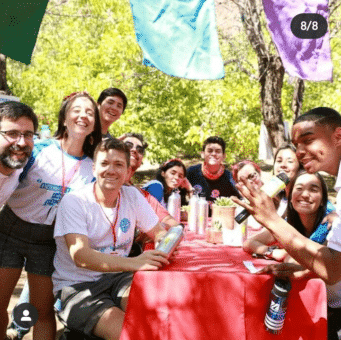
The story of Javier, a young man from Chile, starts with getting interested in the environment, an unexpected proposal and the beginning of an ecological commitment that today has reached vast proportions. I have always loved nature and had a special relationship with it. In 2017, I became aware of the serious damage that humanity is causing to the planet. “But what can a simple teenager do to change the reality of the planet?” I used to say to myself. One day, however, my aunt invited me to participate in a sustainable development forum at the headquarters of Cepal (the Economic Commission for Latin America and the Caribbean). I was surprised, but she encouraged me, saying how teenagers should take on important decisions and make their voices heard for our future. I decided to participate and got other classmates who were interested in social and environmental issues involved, with the help of the school. During the forum we were able to learn about Social Development Goals (SDS) and the actions that are being carried out in order to achieve them in some Latin American and Caribbean countries. We were also able to express our thoughts in front of the authorities present. Among the initiatives, we were impressed by “Concausa”, which is part of the America Solidale NGO. It works specifically to put an end to child poverty and trains adolescents to be true change agents. Together with two partners, we decided to propose a project at our school linked to Concausa, but we were not successful. After some time, given our interest in these issues, Concausa decided to set up a workshop in our school called “Actuators” to help us better develop our project. In classes we saw a lot of rubbish thrown on the floor, so we set out to encourage better waste management and recycling to create a pro-environmental culture. The “Eco-Education” project began. The waste was mainly tetrapacks, so we re-used them to create “eco-containers” where we could sort the waste and reuse it to make eco-blocks. Thanks to our work, many of our classmates have learned how to recycle. They have now even convinced their parents to do this in their homes. In the meantime, together with boys from the Focolare unit that I am a part of, we introduced workshops and in-depth analysis of environmental issues during our regular meetings. After a year of work with our “eco-education” project, we were chosen to represent Chile in a Concausa Continental Camp that takes place each year in our country. Project teams from all over the continent participate. I went along as well, and it was an unforgettable experience. I met people from many countries, each with their different culture. Getting to know each other made us feel the same. We were and are a family, a generation fighting for a more united and supportive future. On the last day we were invited to give a speech to officials from America Solidale, Unicef and Cepal about the different realities we have in our countries, and how we are doing our part to defend the environment. Now we continue to work together with camp participants through video calls. This is how we conceived the “1000 Actions for Change” project, which aims to spur ecological actions and mitigate the climate crisis. To achieve this, I was chosen to represent my country. Here is Javier’s testimony during the launch of the Pathway 2020–2021 “Dare to Care” campaign.
Edited by Anna Lisa Innocenti
14 Sep 2020 | Non categorizzato
Christian love is not only an inner attitude, but is shown by concrete facts, by acts that can be seen, starting simply with a smile. This is the invitation Chiara Lubich launches in the following writing. And even if during the pandemic our smile may be hidden behind a mask, there are a thousand other ways to show our love “Love one another”.[1] This is the vocation of every Christian, but we could also say it is our vocation in particular. In the last few days I was struck by what was said of the first Christians: “See how they love one another and are ready to die for one another.”[2] Therefore people could see that each of them was ready to die for the others. This might have been because in times of persecution it was not unusual for one of them to offer to die instead of another. Nonetheless, the fact remains that this measure of love among Christians could be seen. Generally speaking, we are not actually asked to die, even though we should always be ready to do so. Every act of mutual love should be based on this foundation. … May all we do show that we are ready to die for our brothers and sisters; whether it is simply a smile, or a gesture, or an act of love, a word or some advice, our appreciation, or a correction given at the right moment. May our love be seen, certainly not to show off but to make sure we have the powerful weapon of witness. We too, like the first Christians, often find ourselves in a world without God, a world that is de-Christianized. Therefore we must bear witness to Jesus.
Chiara Lubich
(Taken from a telephone conference call, Rocca di Papa, 11th May 1989) [1] Jn 13:34. [2] Tertullian, Apologeticus, 39:7.
13 Sep 2020 | Senza categoria
- Date of Death: 14/09/2020
- Branch of belonging: volunteer
- Nation:Great Britain
13 Sep 2020 | Non categorizzato
With three days of video-conferencing involving Focolare delegates in different areas of the world and the General Council, a further preparatory phase has begun towards the Focolare General Assembly to be held in January 2021. The meeting of Focolare Delegates from around the world, held this year in video-conference, ended on September 12th; a date which, under normal conditions, would also have marked the last day of Maria Voce’s (current President) term of office. However, these times – which are anything but normal – have meant an extension of the President’s term of office because, due to Covid, the General Assembly, which also has the task of electing all the governing bodies of the Focolare Movement, has been postponed from the beginning of September 2020 to January 24th – February 7th 2021. How, then, can this time of waiting be transformed into a time of grace? This is the question that initiated and guided the conference of delegates and to which Maria Voce answered in a profound and concise way: “We are called to bear witness to the possibility of Trinitarian relations! This simply means: each one does everything so that the other person may emerge”. The sessions dedicated to sharing the life of the Focolare communities in the different geographical areas of the world highlighted the global commitment to face the challenge and the new “off-spring” due to the Coronavirus pandemic: the impossibility of attending meetings in person has led to an increase in digital conferences that often reach more people and break down territorial or participatory structures which in the current situation have been identified as constraints. The economic difficulties, then, require new reflections in search of solutions for a moderate and sustainable lifestyle and in favour of suitable activities and structures. In addition, the climate of growing personal and community insecurity urgently requires a new evangelical life choice in view of a more united world. The third day of the conference marked the beginning of a further preparation for the Movement towards the 2021 General Assembly. The extra time gained will serve to encourage a more participatory and widespread preparation, a synodal journey. The members of the Movement will have until October 24th, the opportunity to deepen their knowledge of the themes gathered so far in order to identify people’s preferences which will then be included in a working document. Before Christmas, the participants in the Assembly will have the opportunity to meet possible candidates for President and Co-President. And in a series of Webinars the main themes will be deepened with the help of external experts. The preparation will then be concluded in the first weeks of January with group work among the participants.
Joachim Schwind
12 Sep 2020 | Non categorizzato
Emmanuel and Annick from the Focolare Movement dedicate their free time to the French Red Cross. Since the beginning of the health crisis caused by the coronavirus, operations have been launched throughout France to support people in need. This married couple has helped in two of them. The first operation consisted in organising the delivery of medicines or food to people who were unable to do their own shopping. Emmanuel, an engineer at the University of Strasbourg, worked almost full time as a volunteer coordinating the operation for the entire Bas-Rhin province (area around the city of Strasbourg). “Organising the teams and facilitating the flow of information,” he says, “was an immense logistical job. Even if sometimes I couldn’t get out of the house for three days, I didn’t feel alone. On the contrary I was rather frustrated given that I was working hard without hardly ever seeing the beneficiaries of my work”. During that period, demand rocketed, especially for food. In fact, many social welfare associations had to close because most of their volunteers were forced to stay at home because of their age. The other operation was launched from April 29th to July 31st 2020 by the European Parliament in Strasbourg. It decided to reopen its kitchens to prepare 500 meals a day. The Prefecture was responsible for finding the beneficiaries of the meals at a local level and the French Red Cross for the delivery. Annick, who continued her work as a nurse also volunteered. She says: “We saw people were happy to receive something. Although some were surprised and incredulous – imagining the background checking that was done – people were anxious to have those meals”. “The institutions invested enormously at the heart of the crisis,” Emmanuel notes. What does this commitment mean for Emmanuel and Annick? “I am nourished by the spirituality of the Focolare Movement, but our life is lived out in society, it is in giving (and giving of ourselves) concretely in the world,” answers Annick. Emmanuel adds: “It is important not to remain in our corner, among Focolare people, but to act in the world. In addition, the seven principles of the Red Cross which are humanity, unity, universality, neutrality, independence, impartiality and voluntary service are very much in harmony with the “art of loving” and “The Golden Rule”. “The crisis was a time of great tension and the quality of human relations between volunteers and beneficiaries in the field and in the organisation has been important. For example, I mediated between the volunteers when tensions arose. The Focolare’s charism of unity has been of great help to me in understanding situations, losing my idea, living the present moment well”, Emmanuel shares. “This crisis has brought out the good or the bad in us,” Annick notes. Her husband is pleased to see that it has generated new ideas for action, particularly in relation to the digital divide or relational poverty. “The great lesson of the pandemic for many is the awareness that we cannot live without each other,” she says. ” Interdependence was Chiara Lubich’s great battle at the end of her life … My optimism leads me to believe that more people will be involved in associations and develop their sense of volunteering”.
Émilie Tévané
Source: Nouvelle Cité, N°604, July-August 2020, p. 41.
10 Sep 2020 | Non categorizzato
The Focolare Movement’s annual conference for international delegates and members of the General Council will take place by video-conference, 10 – 12 September. We report the President, Maria Voce’s thoughts. “We should avoid thinking about ourselves and – as a Movement – be more willing to accept the sufferings of the world.” President Maria Voce’s strong appeal has given a clear direction to the participants of the Focolare’s international leadership conference that will begin this Thursday, 10 September, by video-conference. In a talk during a recent meeting with the Focolare General Council, Maria Voce spoke of her dismay at the extent of suffering that is reported each day by the media, especially during this time of pandemic. She spoke to her closest collaborators about a question she has often asked herself recently: “Who can absorb all this suffering and pain? I think God is asking us to be closer to this suffering in the world, more willing to welcome it, to love it, to pray … but also to do something more.” Her answer is a programme of both spiritual and practical action. The programme for the video conference (10 – 12 September) will be characterized by time for the participants to speak extensively about local challenges, specific to their geographical area. These challenges are often shared by others and are often linked to this particular period of pandemic which has given rise to enormous suffering but also new potential. The dialogue and sharing will provide a means of identify the specific contribution that the Focolare can make to during this time of change both now and in the future. It will certainly not be possible to exhaust this theme during this three day meeting: it will remain on the agenda in view of the next General Assembly of the Movement. This was initially scheduled for the first half of September 2020, but due to the Covid-19 emergency has been postponed until the beginning of next year: from 24 January to 7 February 2021. During the coming meeting, the delegates will also learn about the proposals drawn up by the Preparatory Commission of the General Assembly in order to make use of the time “gained” with a view to increasing involvement of all the members of the Movement in the preparation of the Assembly.
Joachim Schwind
9 Sep 2020 | Non categorizzato
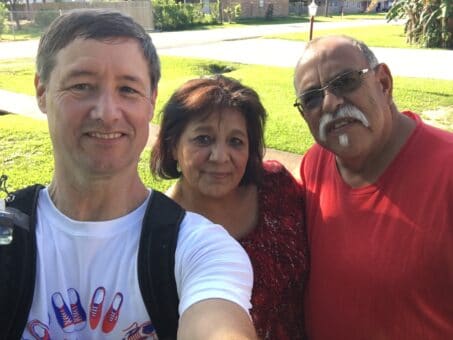
For months, every day, a priest has been travelling miles by bicycle or pickup to be close to his community. This experience, lived together with a team of parishioners, is uniting and broadening horizons, while leaving also its post-pandemic effects. If lockdown and social distancing rules oblige us to keep away as much as possible from assembly places, such as the parish church, why can’t the priest bridge the gap between us all? This is what Father Clint Ressler, a Catholic priest at the St. Mary of the Miraculous Medal Parish in Texas City, USA, is doing. Since the beginning of the pandemic, he has been travelling every day, far and wide all over the territory of his parish to visit his parishioners . Father Clint, how has life changed in your parish during this pandemic? It’s true that the pandemic dramatically changed how all of us maintain and grow our relationships. I have a greater sense of how God calls us to co-responsibility. As a pastor, I feel lifted up and surrounded by a strong and dedicated team. Perhaps because we are more focused on the essentials of our mission there is a corresponding experience of joy and gratitude in seeing these efforts and their fruits. Prior to the pandemic my days were filled with people. Sometimes I would be too focused on projects or getting to my next meeting or ministry to truly notice, greet and be present to each person. Now, also because we all need and thirst for communion, authentic relationships, I am feeling more like a human ‘being’ and not a human ‘doing’. Many parish groups and ministries are connecting to one another more personally, whether by phone, social media and brief personal visits. I have the sense that our God-given need for communion finds its own ways around the difficulties. What have you been doing to maintain a close relationship with your parishioners? Perhaps because there are fewer meetings and a greater focus on the essential mission of the parish I have not felt as rushed as before the pandemic. I have also heard God inviting me to ‘slow down’, to trust Him and to be patient. Early in the pandemic I was visiting many parishioners on a bicycle or a pick-up. During those early months I would see sometimes as many as a dozen homes in a day. Now, I am going at a slower pace, so to speak, fewer visits but staying longer. Can you share something with us about the most beautiful moment and the most difficult one you have lived during these visits? It is difficult to choose just one moment. One family had lost their home to a fire just a few days before I happened to visit them. The little children had lost their home but also all their toys. Their neighbor next door welcomed the family into their home. It was both the saddest but also the most uplifting visit. It continually strikes how this experience has suddenly changed Pope Francis’ call to be ‘missionary disciples’ from beautiful words to something that could and needed desperately to be live. Would this experience leave a positive impact on the life of your parish community, even when the pandemic is over? The pandemic brought many people to become more familiar with ‘faith online’. Parishioners have become more ‘tech savvy’ in general but also as regards to nourishing their faith. I have been personally edified by witnessing how our parishioners have cared for one another. I believe that after the pandemic we will see the fruits of this greater connectedness and concrete expressions of mutual concern. The pandemic has brought about a greater sense of solidarity, not only with the neighbors who live close but also a greater awareness and concern for the whole world. There is a universal sense that ‘we are all in this together’ and I hope that endures in the hearts and actions of everyone after the pandemic subsides. You met the Focolare spirituality and you live it. How does it influence your life as a priest and a pastor, especially now during this pandemic? Leading a parish can seem overwhelming and complex, requiring discernment and tough decisions. However, if I just try to refocus on concrete love it doesn’t seem so overwhelming. Of course, it all starts with union with God As a priest, especially as a pastor, I have been entrusted with a position of great influence and authority. At times, being the leader of others, I can fall into a ‘business approach’ that values efficiency, avoiding risks and valuing measurable ‘achievements’. The spirituality of the Focolare, and of the witness of Jesus, calls me back to service, humility and faithful patience. I have understood that the fundamental starting point for discovering God’s will is for us to live with Jesus in our midst. In other words, we have to be ‘Church’, the mystical body of Christ. As we live and grow in these mutual relationships with God’s grace, we can hear the little voice of the Holy Spirit. I think my life in the Focolare, ingrained in me over the years, a desire to bring this kind of discernment into the parish, with the parish staff, with the pastoral council, with every group and committee.
Anna Lisa Innocenti
7 Sep 2020 | Non categorizzato
We’re all connected like members of one body. If one member is weaker, the other takes over. This is the simple, but striking gospel logic that Chiara Lubich presents to us in the following text, which is more relevant today than ever In a hospital ward I once saw a man with a plaster cast. His chest and right arm were immobilized. With his left hand he tried to do everything… as best he could. The cast was extremely uncomfortable, but his left arm, although it was more tired than usual by the end of the day, grew stronger by doing twice its normal work. We are members of one another and mutual service is our duty. Jesus did not merely advise us to serve one another, he commanded us to do so. When we help someone out of charity, let us not believe we are saints. If our neighbour is powerless, we must help them and do so as they would help themself if they could. Otherwise, what kind of Christians are we? If, in future, when our turn has come and we need our neighbour’s charity, let us not feel humiliated. At the last judgement we shall hear Jesus repeat the words: ‘I was sick and you visited me … I was in prison…, I was naked…, I was hungry…[1]”. Jesus likes to hide precisely in those who are suffering and needy. Therefore at those times too, we should be conscious of our dignity, and with our whole heart thank the person who is helping us. But let us reserve our deepest gratitude for God who created the human heart to be charitable, and for Christ who, by proclaiming with his blood the Good News, and especially ‘his’ commandment, has spurred on countless hearts to help one another.
Chiara Lubich
Based on “I was sick”, in Meditations, by Chiara Lubich, New City London-Dublin 2005, p. 54 [1] Matt. 25:36
5 Sep 2020 | Non categorizzato
At work, with the family, in every situation, for Omar and Lina, who are Muslims, the values of dialogue and encounter even between different faiths are central. By Stefania Tanesini and Dalma Tímár. https://vimeo.com/430370744
3 Sep 2020 | Non categorizzato
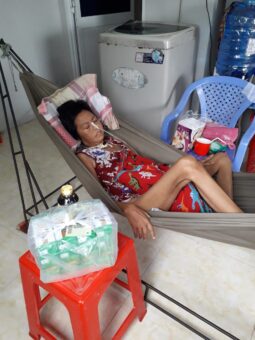
Solidarity projects initiated by the “Goccia dopo goccia” (drop by drop) Association in collaboration with other organizations operating in Southeast Asia. 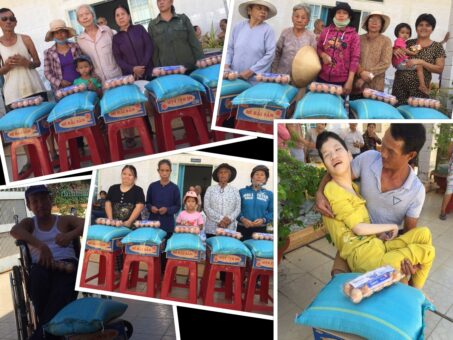 The number of victims of coronavirus around the world is still very high. But even higher is the number of people who, whilst not having contracted the virus, find themselves in conditions of extreme poverty due to the economic and social situation created by the virus; deprived, in some cases, of even the basic necessities to live. Yet even in these situations, initiatives of solidarity are multiplying which are the result of networks that are sometimes crossing national borders. In Vietnam, for example, the Long An area, south of Ho Chi Minh city, has large pockets of poverty. Here, the most vulnerable members of society have been indirectly affected by the pandemic. Many, especially among the elderly, who were living off lottery ticket sales, have had to stay in their homes, very often facing starvation. This is precisely the area where the Swiss-based association “Goccia dopo goccia” operates, coordinated by an Italian focolarino, Luigi Butori, who has lived in Asia for many years. Included amongst those who volunteer and support the project in different countries around the world are many friends of the Focolare Movement. “Goccia dopo Goaccia” has been working for some years now to implement more than 20 solidarity projects in Thailand, Myanmar and Vietnam. In Long An the association distributes about 40 rations of milk and food every month which helps many people including the elderly, those who are disabled, adults on their own, abandoned children living with grandparents and people suffering as a result of serious accidents, such as An, 14 years old, who is paralyzed and forced to live in a bed. The association has someone who intervenes at a local level whenever necessary. Thanks to these local volunteers, it tries to reach the “least of the least” bringing not only material help but also moral support that makes them feel that they are not alone in facing this dramatic period of history. For those responsible for “Goccia dopo goccia” this is a very important element of their activity: making people feel that they have not been abandoned but that there is someone who is taking care of them, starting with a smile. The Long An project has been going on for about two years and is supported with the help of schoolchildren and families in different countries around the world. They are people who send small amounts of money and who, as the name of the association says, as numerous small drops enable large quantities of help to be provided. “Goccia dopo goccia” also operates along the border between Thailand and Myanmar, with another project that supports Karen children in different villages in Mae Sot, the Mae La refugee camp and the Heavenly Home orphanage, even though during these times of pandemic, “Goccia dopo goccia” volunteers recently had to face a long journey to visit them and deliver material aid. “Three beautiful days,” they say, “during which we received much more than we gave. And finally, when Covid-19 was rapidly spreading, “Goccia dopo goccia” managed to collaborate with Caritas Singapore, Caritas Vietnam and other Associations that operate in Southeast Asia on a project aimed at distributing 1,200 food packages to families in the Binh Thanh area, in Ho Chi Minh City.
Anna Lisa Innocenti
Click here for a video about the initiative
2 Sep 2020 | Non categorizzato
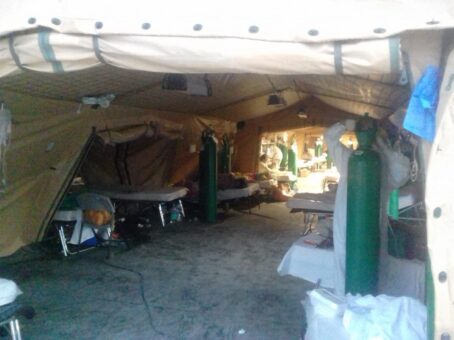
Combining fatherhood and professional life according to Gospel values: here’s the testimony of a Peruvian doctor at the forefront of the fight against COVID-19. I have been a doctor for 25 years and a father for 17, but I realise that I have not yet learned to be both and keep to the values I believe in. These pandemic times are proving to be a real lesson for me to grow in both roles, especially in parts of it that have so far been underestimated not only by me but by most people. Since the beginning of this pandemic I have worked in a Covid field hospital for patients in the city of Piura in northern Peru, the first in the city. I look after those who are hospitalised and have seen more patients die in the last 3 months than in all my 25 years of medical practice. I trained in one of the best medical schools in the country, with its academic prestige and scientific rigor. Yet this terrible disease has uncovered the limits, impotence and frustration of medical science in the face of this previously unknown virus. In spite of administering oxygen massively and the therapies provided by science, I have seen my patients suffer quite a lot and die of asphyxia. Every day we are faced with the lack of staff and equipment in a hospital like ours, in a poor country. How many times have I felt powerless and frustrated facing my patients, when the disease became aggressive! In the midst of general bewilderment, you could hear them shouting: “I am thirsty! Water please! Give me some water! Water!” Other times people would complain and, only when approaching them, asking if they wanted to drink, would they nod their heads. That’s how, in addition to my medical work, I started to give drinks to everyone who asked me, fix their pillows, hold their hands between mine, caress their foreheads, massage their backs when they asked me, or pass them the bucket to urinate. Or I would simply help them walk, pray with them or for them and, in the end, try to comfort them in their last moments. I understood that there are two dimensions to the medical profession: an authority supported by science which often heals, as well as the human dimension, based on mercy and love, which come from God and can be expressed in simple, everyday acts which often heal the soul. Science and humanity, knowledge and mercy, body and soul, man and God, reason and faith: it is a two-faced coin that makes our giving and living full. It is a delicate balance to be achieved. Between the exhausting work in the hospital, the overload of intense emotions and my weaknesses, I went home for dinner just hoping to rest and let off steam. My eldest son, in the midst of adolescence, frustrated by the lockdown and with all the energy of youth, started arguing with everyone, especially with me. He treated me like an adversary or an enemy, and at the table it was like being on a battlefield. Initially, falling victim to my passions and impulsiveness, we clashed in bitter fights with offensive tones. For the umpteenth time I saw my authority compromised. My attempts to impose it by force made things worse. I rediscovered other aspects of being a father, such as mercy and humility, and so I began to remain silent and offer God my forgiveness in the face of the offenses, as well as express it and ask forgiveness when I realized I had gone too far. I tried to read in my son’s aggressive attitude a cry for help and affection, keep silent more often and tone down the discussion, and continue praying alone and at home even when it all seemed useless. Little by little our relationship has been normalising and returning to the usual father-son dynamics. Once again, there are these two main pillars: authority and mercy. Are they not expressions of divine life?
Edited by Gustavo E. Clariá
1 Sep 2020 | Non categorizzato
The “World Day of Prayer for the Care of Creation”. The Focolare Movement supports this in two different ways – with the initiative “Time of Creation” and with a meeting in October 2020. 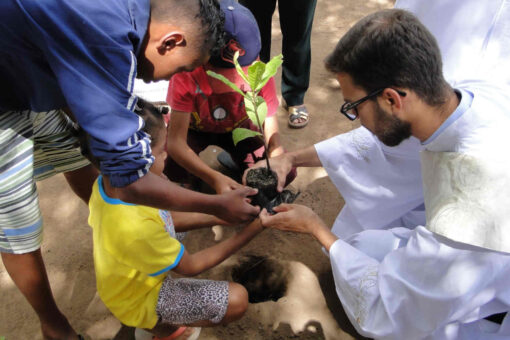 1st September is the “World Day of Prayer for the Care of Creation”. It was established by Pope Francis in 2015, the year that he launched his encyclical Laudato si. In this document, the Pope invites everyone to commit themselves to care for creation because this is our home and our most precious good. He also asks that we go beyond the current socio-economic system: we can no longer exploit planet earth as if there were unlimited natural resources. We must act quickly and find a different model of development. What can we do to be more concrete? Laudato si opens up the notion of “ecological conversion”: it speaks of change in lifestyle and trying to practise integral ecology. Therefore, the text refers not only to the environment but also to politics, economy and society. We need to start with ourselves and think about what we consume: we should choose politicians who show concern for the care of nature and who promote the production of renewable energy and decrease the use of fossil fuels. This year, the Focolare Movement is continuing to promote “Time of Creation” the annual celebration of prayer and action for our common home that begins on 1st September and ends on 4th October, the feast of St. Francis of Assisi, patron saint of ecology, greatly loved by many Christian denominations. The focolare’s global network is encouraging everyone to organize events and register them on the website. This ecumenical initiative began thirty years ago: in 1989, Dimitrios, Patriarch of the Orthodox Church of Constantinople, was instrumental in encouraging the different Christian Churches to jointly declare 1st September as “World Day of Prayer for the Care of Creation”. This year, the suggested theme is “Jubilee for the earth: new rhythms, new hope”. This theme is helpful in considering the integral relationship between the earth’s rest and ecological, economic, social and political life, particularly in the light of the far-reaching effects caused by Covid-19 pandemic. Later, from 23rd to 25th October in Castel Gandolfo, Italy, there will also be a meeting organized by EcoOne – the ecological network of the Focolare. Participants will include experts in ecology, politicians, university lecturers and representatives of organizations and associations. This meeting will examine the impact of Laudato si’ on the contemporary world and new pathways towards an integral ecology. The event aims to showcase the role that individuals and social entities can play in the care of our common home. In addition, this is also a special year because on 24th May, the fifth anniversary of the encyclical, Pope Francis announced that the coming year will be dedicated to. Laudato si . The urgency of the situation is such that it requires a concrete and immediate response involving all levels – local and regional, national and international. We need to create “a popular movement” that engages at grassroots level, an alliance between all people of good will. This is why it is important to participate in initiatives such as “Time of Creation” or the EcoOne meeting in October. As Pope Francis reminds us, “All of us can cooperate as instruments of God for the care of creation, each according to his or her own culture, experience, involvements and talents.” (LS, 14)
Lorenzo Russo
31 Aug 2020 | Non categorizzato
In many countries, restrictions imposed due to the coronavirus pandemic have also put a stop to all forms of religious gatherings for worship and prayer. However, believers’ desire to spend time with God has not diminished. What can we do? This reflection by Chiara Lubich offers an innovative solution. “And behold, I am with you always, until the end of the age” (Mt 28:20). … Jesus said these words to the disciples … (but) he was also thinking of all of us who, day after day, are living somewhat complex lives. Given that Jesus is Love incarnate, he might have thought: I’d like to be with them always, to share all their worries and give them advice; I’d like to walk down their streets with them, enter their homes and rekindle their joy with my presence. That is why he wanted to stay with us so that we can feel his nearness, his strength and his love. … If we live out what he commands, especially his new commandment, we can experience his presence even outside the walls of our churches, in the midst of a crowd, wherever there is this living presence of his, everywhere. What is asked of us is mutual love, which is made up of service and understanding, of sharing in the sufferings, anxieties and joys of our brothers and sisters. This love endures everything, forgives everything and is typical of Christianity. Let’s live like this so that everyone may have the opportunity to meet him already on this earth.
Chiara Lubich
Taken from the Word of Life for May 2002
29 Aug 2020 | Non categorizzato
The coronavirus keeps on taking away thousands of “stories” like Sher Khan’s. But his story lives on in a legacy – being one family – and in many friends like Marta and Javed. By Anita Martinez and Dalma Tímár. https://vimeo.com/430019025
27 Aug 2020 | Non categorizzato
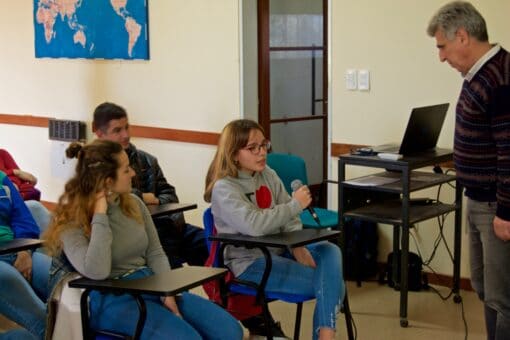
For over fifty years, the Focolare Movement’s little town in Argentina has provided training programmes for thousands of young people from all over the world: now the experience of living there has university recognition as a “vocational training programme”. Until just over a month ago, many people used to say that the experience of living in Mariapolis Lia was so rich and varied that it gave you a master’s degree, so to speak, in “life under the banner of the culture of unity”. Now the “experiencia” – the experience – as the annual course for young people is called really does have university certification. The new study programme has been drawn up thanks to the collaboration of educational teams from the Latin American Centre for Social Evangelization (CLAdeES) , the Mariápolis Lía School and the National North western University of the Province of Buenos Aires (Unnoba). The course will have the academic title “University extension and vocational training programme” and will be based upon four fundamental elements: anthropology-philosophy, history-culture, the community and the transcendent. It will take 11 months to complete and those who do so will have access to university extension and accreditation of vocational training in three different areas of choice: education, eco-responsibility and multicultural management; community leadership and development of community engagement; or art, communication and multimedia production. The training will be developed through specialized seminars, work placements and evaluation of the application of values deriving from Christian social teaching. There are also plans to integrate this course with the Latin American section of the Sophia University Institute. Mariápoli Lía, situated near the town of O’Higgins, Buenos Aires, offers young people an educational experience that integrates work, study, cultural and recreational activities, sports and specific interests. All activities are regarded as integral elements of formation. In fact, the notion of student coincides with that of citizen, therefore, it is assumed that all young people who live there are engaged in the life of the little town. A team of teachers and experts in a variety of disciplines – spirituality, anthropology, sociology and Christian doctrine – follows the young people in their learning. The 6000 young people who over the years have spent a period of time at the Mariapolis are proof of its formative value. In their later lives in a range of different environments – as managers, economists, educators, professionals, workers, parents, consecrated persons… the “experience” has remained a shining point, helping them to overcome personal and professional challenges.
Stefania Tanesini
26 Aug 2020 | Non categorizzato
How often does God use a person to draw someone else close to him? We should never forget him, because we too could one day become his instrument for someone. A new hope Having been in the U.S. to study, I decided to return to my country at the insistence of my parents. But I was stuck in quarantine at an institution near the border with about 500 people. I had the exact same feeling as if I were in jail. Fortunately, my phone kept me connected to the outside world. Whenever I met someone, I heard the same questions I had about what was happening. During that time I met a Salesian priest at a distance. Although he was as isolated as I was, he emanated a peace that neither I nor the others had. It was as if he was not surprised at anything. At first he celebrated mass alone in his small room, then I began to attend. In short, I returned to the sacraments and my previous life of faith, even if no longer as before. Even my girlfriend noticed that I had changed. Sometimes I think: if this transformation happened in me, can it be that it has also happened for others? A new hope is born within me: that the world that previously seemed to take it away from me can now refind its way in other directions. K., Slovakia Baby carriage I met a young Gypsy girl who was expecting a baby. She needed everything, from clothing to all the baby gear for the birth of her child. I had read in the Gospel, “Whatever you ask of the Father… he will give it to you”. That day with faith I asked Jesus during Mass for a baby carriage. Later at school, I committed myself more than ever to love my classmates and teachers. Back home in the evening, I learned from my mother that a neighbour, knowing that I help the poor, had left something for me. It was a baby carriage! I was moved by this prompt response from providence. C., Spain Blessing Working as a nurse for a month right during that period of the coronavirus, in the hospital where I served I shared the loneliness of several patients who passed to the other life without the comfort of their loved ones at their side. The strongest experience, however, was after I learned from my mother that, according to the pope’s words, even doctors and nurses were qualified to give a blessing to the deceased patients. I was able to draw a cross on the forehead and chest of several of them before filing the paperwork to confirm their deaths and send their bodies to the morgue. Joseph, Italy
Edited by Stefania Tanesini
25 Aug 2020 | Non categorizzato
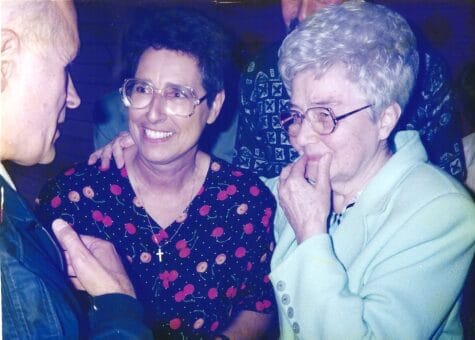
Chiara Lubich’s charism for Christian unity. Interview with Lesley Ellison who is an Anglican and the first non-Catholic focolarina to follow Chiara. Living the Gospel, Word of God together; loving one’s neighbour as Jesus did, to the point of dying for the other; living for unity among believers in Christ, beyond every affiliation and beyond all divisions. It is with these dimensions that the ecumenical potential of Chiara Lubich’s charism of unity is unfolding. “A completely ecumenical spirituality” is how Card. Kurt Koch, President of the Pontifical Council for the Promotion of Christian Unity described the charism in the preface to the book entitled “A Spirituality for Christian Unity. Selected thoughts.”, published by Città Nuova, which is a collection of speeches and answers to ecumenical questions given by the founder of the Focolare Movement, one hundred years after her birth. The introduction to the book is given by Maria Voce, President of the Focolare with a foreword offered by Rev. Olav F. Tveit, former Secretary General of the Ecumenical Council of Churches, now President of the Conference of Lutheran Bishops in Norway. Lesley Ellison, an Anglican focolarina, is the first non-Catholic focolarina to follow Chiara: Your experience has paved the way for many. Did you ever have hesitations? “I grew up in a Protestant family with prejudices against Catholics, and at that time in Liverpool the two communities were separated. Like Chiara, I also wanted to give my life to God. When I first heard her speak, in Canterbury in 1967, I had been visiting the focolarine in Liverpool for a year. We tried to live the Gospel but I didn’t know they were Catholic. Just as I did not know the community of people around the focolare. It was a shock to realize they were all Catholic but in Canterbury, listening to Chiara, I understood that God loves everyone, and that “everyone” also includes Catholics! I felt I had to take a step and put aside my prejudices. When I got to Liverpool a Catholic couple offered me a lift home. This was unheard of. “But I’m Protestant,” I said. “That’s all right! We love each other!” they said. This was my first ecumenical experience.” When did you feel that the Spirituality of unity could be yours? “In 1967 I went to visit the little town of Loppiano. During the visit there was a Catholic Mass but being an Anglican I could not receive the Eucharist. This rift between our Churches seemed absurd to me, so painful that inside I cried out to Jesus: “What can I do?” And I seemed to hear Him respond, “Give me your life for unity.”” Living the Gospel is the way that Chiara indicated for unity. Why, as an Anglican, did this proposal have an impact on you? “My formation as a young Anglican asked me to “listen to, read, take note of, learn and digest inwardly” the word of God. So the idea of “living the Gospel” which I heard for the first time in the focolare, was a complete novelty and gave my Christian life a new communitarian dimension”. Jesus asks us to love one another as He did, to the point of giving our lives for one another. What does this mean for you in your relationships with people of other Churches? “It’s in the word ‘as’ that I find the whole of Chiara’s charism, Jesus crucified and forsaken who is Life. This is the way God Himself wanted to dialogue with humanity, and it is the model He offers us for any dialogue with one another and with Him. For me, giving my life means welcoming the other, listening, putting aside my thoughts and judgments. But it also means offering my thoughts whilst being completely detached from them. This is what Chiara did with me and with every person she met. And this is how we try to live the relationships with one another in the Movement.
Claudia Di Lorenzi
24 Aug 2020 | Non categorizzato
The Coronavirus pandemic has disrupted programs, systems and procedures in all areas of human life. In every place there is a great need for creativity to find new answers to the challenges posed by this situation. Something that Chiara Lubich suggested back in 1983 is very up-to-date. God speaks in us in various ways and among these are the inspirations of the Holy Spirit. We must, therefore, serve God by following the guidance of the gentle voice of the Spirit that speaks in us. The Holy Spirit! The Third Divine Person who is God just as the Father is God and the Word of God is too! (…) The Holy Spirit is in the heart of all Christians, and therefore in my heart too. He is in the heart of my brothers and sisters. … Let’s become attentive and assiduous pupils of this great Teacher. Let’s pay great attention to his mysterious and delicate promptings. Let’s not put aside anything that might be one of his inspirations. In the early days [of our Movement] we made great progress by putting into practice the motto “Every idea is a responsibility”. Therefore, let’s remember that the ideas that come to mind in someone who has chosen to love are often inspirations of the Holy Spirit. Why does he give them to us? For our own good and for the good of the world through us, so that we can take forward our revolution of love. So let’s be attentive and consider every idea, especially if we think it might be an inspiration, as our responsibility, to be grasped and put into practice. In this way, we will have found a really good way of loving, honouring and thanking the Holy Spirit.
Chiara Lubich
(From a telephone conference call, Mollens, 1st September 1983)
22 Aug 2020 | Non categorizzato
Bintou Konaté, a Muslim, and her Christian friends have turned loss and suffering into an opportunity to help her community. By Stefania Tanesini, Egilde Verí, Marco Tursi. https://vimeo.com/430765602
21 Aug 2020 | Non categorizzato
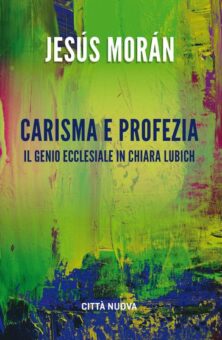
“Charism and Prophecy” is the title of the new book by Jesús Morán, co-president of the Focolare Movement. It follows on his previous book, “Creative Fidelity – The challenge of making a charism a reality”. Morán offers in this text his reflection on Chiara Lubich’s “ecclesial genius”, starting from talks he gave on the subject over the past three years. We talk about it with the author. How did the idea for this book come about? Since I had several texts that had not yet been published, I thought of honouring Chiara Lubich in the centenary year of her birth and, at the same time, I wanted to make an act of love to everyone in the Focolare Movement. Since I began several years ago to use the expression, “Chiara’s ecclesial genius,” I saw that many people liked it, that is, they grasped in it a synthetic concept that could define the marvellous synergistic unity between Chiara’s person and her charism, as “all one piece”. I am convinced that Chiara, in addition to having been endowed by God with an “ecclesial instinct” is, indeed, an “ecclesial genius”, in continuity with others in the Church who have opened new horizons, always inserted in the tradition that goes back to Jesus himself. It was right to study it more deeply during this centenary. As you yourself have explained several times, the Focolare Movement, after its charismatic phase, is living its historical phase, the one you have defined as “a period of creative fidelity”. It is therefore the phase of giving Chiara’s prophecies concrete shape in the world today. What do you think is the main contribution that the Focolare Movement can make today to fulfil these prophecies in the ecclesial sphere, in the journey towards achieving “that they all may be one”? When I say that we have entered the phase of the historical foundation of the Movement, in creative fidelity to the phase of the charismatic foundation, I do not intend to dialectically oppose the two phases. In fact, the charismatic foundation has also been historical and, therefore, the historical foundation has a charismatic element. But they are two different phases, with different emphases, which touch both the foundation and the form of things. There is no doubt that today the theme of actualizing the charism of unity acquires a particular poignancy and urgency. Creative fidelity should always be exercised, keeping in mind two principles: listening to the questions that God proposes to the world and listening to what God continues to tell us in the foundational nucleus of the charism. In my opinion, one of the questions that God poses to the Church that lives and acts within history is what we could summarize as “synodality”, which implies openness, communal decisions, being close to one another, being attentive to the dignity of the person, especially the most vulnerable. The Focolare Movement contributes to this ecclesial journey with a very special emphasis, which comes from the heart of its charism, that is, a vital and concrete experience of the Triune God who has an impact on history, without which synodality is reduced to a new organizational form deprived of the life of the Spirit. And which of these prophecies still need more time and effort in order to be actualized? I think that in order to live up to our true vocation in the Church, the members of the Movement must grow in the sensus ecclesiae, to have “the mind of the Church”. Not that they do not have it, but there is a need to grow, which means overcoming, once and for all, every attitude of self-referencing and reaching the maturity that all the recent Popes have asked of us. Moreover, we need to overcome any dualism between civil commitment and ecclesial commitment, looking at the model that we have always held as Christians: the figure of Jesus, the man-God, truly man and truly God. In the light of the reflections you offer in your book, what would you like to say, from your heart, as we draw to the end of these six years in which you were co-president of the Focolare Movement? I pray that God will give us the necessary graces to update the charism of Chiara Lubich in a vital and radical way. I think that we must begin again, reborn from the heart of the charism, from what we call “the Ideal”, and from there set in motion the necessary reforms so that the Movement, also as an institution, may better reflect the human-divine life that animates it. And rebirth means purification and conversion.
Edited by Anna Lisa Innocenti
19 Aug 2020 | Non categorizzato
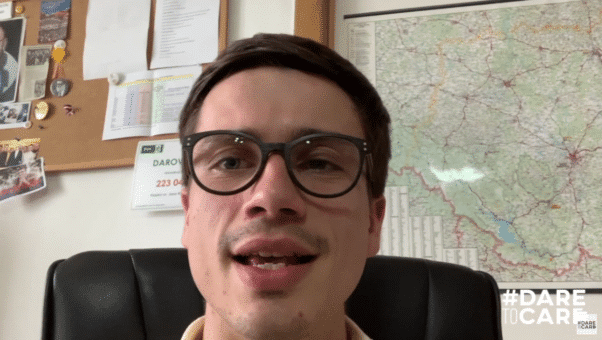
We are witnessing a period of great changes, transformations and contradictions that can open up new ways of seeking the common good. Through the new campaign #daretocare the young people of the Focolare Movement want to put the theme of care at the top of the political agenda, locally and globally. The new campaign of the youth of the Focolare Movement was launched on June 20th with the title #daretocare i.e. “dare and take care”, taking charge of our societies and the planet. The campaign is being constantly updated on the United World Project website What does #daretocare have to do with politics? Chiara Lubich, founder of the Focolare Movement, believed that there was a real vocation to politics, a personal call perceived in one’s own conscience and born out of certain circumstances, inspired by a social need that is asking for help, a human right that has been violated or the desire to do something good for one’s city or nation. But is it still valid today? 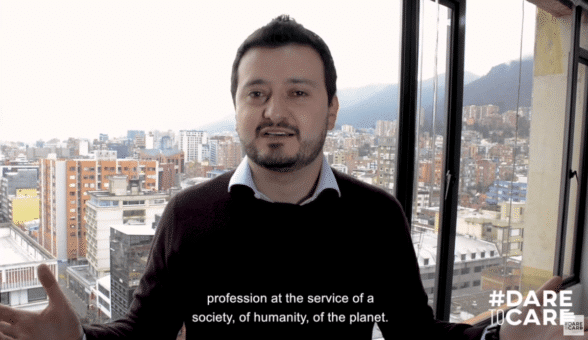 Javier Baquero from Bogotá in Colombia, Cristina Guarda from Italy and Frantisek Talíř from Zubčice in the Czech Republic help us to answer this question. They are young people from the Focolare Movement and are part of the network of the Politics for Unity Movement, an expression of the Focolare for a culture of unity in politics. Javier, who today works in the office of the mayor of Bogotá tells us: “I have worked in politics since I was 13 years old and formally in government since I was 18, and I have worked with people who have integrity, who have the capacity to deal with corruption, whose actions are transparent. So maybe there are corrupt people, but they are just a few. For me the most important principle in politics is service. Because one puts one’s knowledge, skills, professions at the service of a society, of humanity, of the planet. And you don’t do it alone but together with other people. So, the principle that should guide every politician is service, an attitude of service to meet the needs of a society. #daretocare, to dare and to take care means first of all to feel and to be close to the problems of my city but that’s not enough: it is to think and to formulate public policies to solve these problems”.
 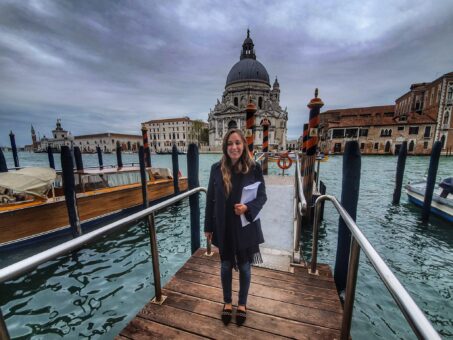 Cristina who has been in politics for the last five years adds: “Yes, I know, sometimes I feel disgusted observing the hatred created by some politicians, the conspiracy of silence, laziness or deafness in front of some complex problems. But for this reason, we and I must act and do our best. In my political action, I want to express my intense love for others by doing my best to help them live better, to lighten their worries and give them all the elements to achieve the lives they dream about”. “Politics is not bad in itself. Politics is made by politicians, who can be more or less good at it “- says František, a regional political activist. “That is why it is necessary that new politicians continue to enter this field and try to do it in the best possible way. To speak of politics as a service is what Pope Francis suggested to me when we met a year and a half ago. I think this is the recipe for good politics. The key is really to serve others. The key is my thinking: do I do politics for myself or do I do it to serve? And every time I have to make a decision – small or big – I can choose: am I putting myself first or others? And if others are put first then everything will be fine”! That’s why it’s important to network, to think and to act for the common good, to take care of everyone. To follow the events of the #daretocare campaign visit the United World Project website.
By the youth of the Focolare
18 Aug 2020 | Non categorizzato
Sophia University: teaching, research and unity What are the future prospects for Sophia University? How will it respond to the educational needs of today’s young people? We asked the Rector, Professor Giuseppe ArgiAolas, appointed on 20 February by the Congregation for Catholic Education of the Holy See. Professor Giuseppe Argiolas, who became the Rector of Sophia University Istituto universitario Sophia on 20 February, tells us about future plans for the University. Today Sophia is a university athenaeum. You have been the RECTOR of the university for a few months now. What does this mean and what changes will there be for the students? “This is Sofia’s first ‘change of guard’, and it coincides with the conferral by the Congregation for Catholic Education of the title of “Rector” to the one who was previously the Dean. It is in recognition of how Sophia has developed over the last 12 years, for which we express our gratitude. Enormous challenges have been faced. Chiara founded this University in a flash, so all the teachers, administrative staff and students who were there at the beginning and those who joined later, have done an extraordinary job. We have just set up 4 Master’s degree courses with various specializations: “Economics and management” (specialization in “Management for a Civil and Sustainable Economy”), “Political Science” (specialization in “Fraternity in the res publica. Theoretical bases and operational lines” and specialization in “Governance of common goods”), “Trinitarian Ontology” (specialization in “Theology” and specialization in “Philosophy”) and “Culture of unity” (specialization in “Pedagogy of communion for a culture of peace” and specialization in “Communication processes with intercultural and interreligious mediation”). The Doctoral School is now a consolidated reality and we are developing a post-doctoral School at the service of young researchers. Chiara Lubich saw Sophia as a global university, one single university with different locations. In Latin America we see the birth of Sophia LAC (Latin America and the Caribbean), but we are also seeing the first buds in Africa and Asia. Our task will be to consider these projects in the spirit of a unitarian Sophia that is expressed in the diversity of contexts in which it develops”. The Covid-19 emergency has had quite an impact on the lectures: how is the teaching going ahead? “Thanks to everyone’s commitment, we have been able to continue the lectures and exams and enable students to complete their academic studies using the tools currently offered by technology. We have also arranged webinars dedicated to the Pandemic which offer our contribution in terms of reflection and action on such a delicate and urgent issue, and we have started with the different scientific disciplines by initiating dialogue on an interdisciplinary, international and intergenerational level. The new academic year starts as normal in a presential form and at the same time online, for students who will not be able to go to Sophia because of the international restrictions imposed due to Covid-19”. What plans are there for the future? How do you see Sophia in 10 years? “Sophia has managed to maintain its charismatic drive and be innovative whilst remaining faithfulness to the Charism. I think that we need to continue along this path: remain faithful to the Charism with its inherent specificity to read the signs of the times. This is what Pope Francis told us with three keywords – “Wisdom, Pact, Going Out” – which he addressed to us in our meeting with him last November, giving us a clear reference for our future. So I would like to develop Sophia on three fronts: didactics – going forward in the direction undertaken but with great attention and sensitivity so as to respond adequately to the educational needs of young people; research – valuing the development of the various disciplines and fostering an ever more marked interdisciplinary approach, indispensable in current scientific research; relationship with other agencies of the Focolare Movement and with other university and cultural institutions so that the service we offer for the common good may be ever more incisive. We will try to do this, together, in unity, with all the passion that we can express. The founding phase has finished, in some respects, and the consolidation and developments phases are just beginning. What must not cease is the charismatic thrust, this must continue, indeed it must always accompany us as the Guiding Star on the journey we have just begun and which we are called to travel together with many companions and with “joy, vision and decision”.
Lorenzo Russo
17 Aug 2020 | Non categorizzato
The presence of Jesus, the Risen Lord, in the midst of two or more people gathered in his name, is one of the cornerstones of Focolare spirituality. The movement, in fact, feels called to “generate” this presence in all areas of human life. But what can you do when you find yourself alone? Chiara Lubich suggests spiritual training. In today’s world we often come across people who are honest and good but who don’t feel the need for a religious belief. Some of them would even like to have faith but being immersed in a world that should be Christian and often isn’t, they don’t find the strength to go further. They wait and categorize themselves as people who are searching. Perhaps, without realizing it, they are waiting to meet Jesus one day. And here … we note the absolute timeliness, relevance and urgency of our spirituality and the point of the spirituality that we sum up in the words: Jesus in our midst. … Jesus himself shows that he does not belong only to the past. Being faithful to his promise, “And remember, I am with you always, to the end of the age”,[1] his presence is living, shining and loving here today among his brothers and sisters. It is our duty to bring with us this presence of his. We can do so by keeping his commands that are summed up in the new commandment and by living it according to our model, Jesus forsaken. However, keeping his commands – and he told us this – means bearing a yoke that is easy and light[2]. But can it always be like this? Generally speaking, yes. But there must be two or more people united in his Name. But what about when we are alone? Or when our love for others is not reciprocated? We know that by embracing Jesus forsaken in such moments we can stand firm, in peace and even joyfully, and we can continue to work, pray, study and live with fullness in our hearts. Yet there can be times in which it seems difficult to describe the Lord’s yoke as being easy and light. There are periods in life, for example, when our health breaks down and this has an influence on our soul too, closing us in on ourselves and making it almost impossible for us to relate to our brothers and sisters. … There might be sudden deaths or accidents that leave us aghast, when we feel that no one can understand us. We might be diagnosed with an illness which we think might be fatal … and so on. These are all painful circumstances that God allows in order to work on us by means of the cross, which is indispensable in the Christian faith and which Jesus himself experienced. What should we do in these situations? We should try to be glad, at least with our will, that we are a little bit like him forsaken, and cast all our anxiety into the heart of the Father[3]. We should keep on offering up our suffering, supported by the grace of the moment, which will not be lacking, until God brings our troubled soul back to the fullness of peace. Let’s keep in mind, however, that we must always love our brothers and sisters, just as much as we can of course. We can also confide in them, at least in general terms, saying, for example: “I’m going through a difficult time”. You can say this out of love, to maintain the communion-fellowship amongst you. Moreover, communicating is always the best remedy in any situation. In this way, Jesus in our midst will keep us afloat at those times too and he will show us that always, and whatever happens, his yoke can be easy and light.
Chiara Lubich
(Taken from a telephone conference call, Rocca di Papa, 24th April 1997) [1] Mt 28:20 [2] Cf. Mt 11:30 [3] Cf. 1Pt 5:7
15 Aug 2020 | Non categorizzato
Raul and Mitali are dancers from Mumbai, India, they’re married with two daughters. They show us how dance can become a powerful instrument of mutual knowledge between different religious traditions. By Marcello Vaz.
13 Aug 2020 | Non categorizzato
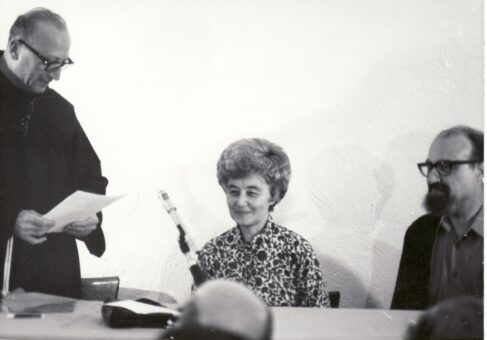
At 100 years of age, Father Bonaventura Marinelli OFMCap has died. He was the first member of a religious order to follow Chiara Lubich’s spirituality. Father Fabio Ciardi looks back on his life. On July 15 we celebrated the feast day of his namesake, Saint Bonaventure. On August 1, Fr Bonaventura Marinelli left us for heaven, where he could celebrate the centenary of his inseparable contemporary, Chiara Lubich. What a deep and faithful friendship they shared! In the years 1942 to 1946, as a young priest studying theology while living in the Capuchin monastery in Trento, he was, as he loved to say, “an eye-witness, albeit at a distance” of the beginnings of the Focolare Movement. At a distance, because in those years, no close contact was permitted. But eye-witness because he saw for himself the way those “extraordinary Third Order Franciscans” were living. “After the bombardment of 1944,” he recalled in an in-depth interview, “Chiara and her companions were always in our sight. They came to Mass, not in our church which was bomb-damaged, but in the sacristy which was even smaller and so we were brought even closer together. I remember what a deep impression they made on me every time I saw them. I’m rather shy by nature and find it hard to talk to people. But I can still remember how throughout the summer of 1943 and afterwards, when I was out almsgiving among the people, it became easier and easier for me to meet with families, children and others. This new way of seeing people came not from my nature, but from the life I saw in Chiara and her companions. In 1946, a year after I had been ordained a priest, my superiors sent me to a university in Switzerland. For the first few months I regularly received letters from my companions with whom I’d made a pact of unity. Then, suddenly, nothing, silence. The Vatican’s Holy Office (now known as the Congregation for the Doctrine of the Faith) had started investigating the Movement, but I didn’t know. Personally, I found myself slipping into unutterable desolation. Until 23 April 1948, precisely. I’d returned to Trento to vote in the elections, and that morning, before leaving to go back to Switzerland, I met Chiara. She brought joy back to me, but in a much deeper way than before. I understood that what matters is to love. I felt I was touching heaven with my fingertips. When I arrived back in Fribourg I wrote to her. That was the first letter”. So began a correspondence through which Chiara communicated what she was living in that period. It’s thanks to Fr Bonaventura that today we have such a priceless patrimony of writings, some of which have become very well known. For example the letter dated 30 March 1948, in which she confides, “the book of Light the Lord is writing in my soul has two aspects. One page shines with mysterious love: Unity. The other shines with mysterious suffering: Jesus Forsaken”. The letters demonstrate the deep relationship which sprang up between them. 11 May 1948: “Your letter confirmed for me the impression I had of your soul, so beloved of the Lord. And immediately, without delay I would like to give you all that is mine, all God has built in me, using my nothingness, my weakness and wretchedness. (…) What I wish to write to you today is that we mustn’t break the unity God has made. (…) Saint Francis will not be happy until you revive it in yourself and also in your brothers. So make a start. You can do it”. 8 September 1948: “Your letter gave me such joy. Jesus is present. I found Him in your thirst for ‘life’, in the optimism it contains, overflowing through the pages, and above all in the peace that comes from your desire to love Him more and more. You can be very sure, as long as I’m never parted from Jesus (and how could that ever be? In Paradise I’ll have Him even more), I’ll never stop following your soul with a vigilant eye and fraternal care”. 27 January 1951: “You can’t imagine how your soul is ‘penetrating’ my own (almost literally, as if I could almost feel the effect on me!)” I remember the joy whenever they met and spontaneously started talking in their Trentino dialect. They were the same age, but he felt he was a disciple and she was his mother. In one of their first letters, Chiara signed herself “s.m.”, which Bonaventura straight away interpreted as “sua madre” – “your mother”. So he replied, signing his name as “s.f.” (“suo figlio” – “your son”). And Chiara herself understood. A Focolarina remembers hearing Chiara greet him in 2000 with the words, “this is my first son who is a religious!” Fr Bonaventura lived a long life. A Professor of Sacred Scripture, a translator of German biblical commentaries, bearer of various roles of responsibility in his Order including Provincial, Formator, and in the General Definitorium. He was then invited by Chiara to lead the international Centers of Spirituality for Religious men at Castel Gandolfo, near Rome and at Loppiano, the Focolare Movement’s small town in Italy. Self-effacing and extremely humble, he knew how to witness unostentatiously and sincerely the Ideal Chiara had transmitted to him. He was, in the words of one of his confreres, “a true child of the Gospel, in wisdom and simplicity of life”. I have my own personal memories of Fr Bonaventura, from the time in 1978 we went to Canada together for a whole month, to animate a formation school for religious men. Later I lived in community with him at Castel Gandolfo. I found an entry in my diary for 10 November 1999, when he had already left to take up a new posting and came for a visit. I wrote, “Bonaventura arrived and there was a really festive atmosphere, as usual”. I was struck by that “as usual”. Perhaps my most beautiful moment of all with him was on 18 March 2008, at Chiara’s funeral in Rome, in the Basilica of Saint Paul Outside the Walls. At the end of the ceremony, he asked me to help him approach the coffin, despite infringing official protocol. He was an old man by then, and he had difficulty bending down. But he managed to kneel down in order to hug and kiss the coffin. So I too knelt down and kissed the coffin (but actually for us, it was embracing Chiara not the coffin). And with that, everyone started to surround the coffin to kiss it. But with Bonaventura it was a unique gesture of a son towards his mother. I too always felt his love for me. In one of his last letters, he wrote, “You’re in my thoughts and I’ll always remember you with gratitude. I hope to have the joy of meeting you once more in person. This morning I entrusted you especially to Saint Francis. A hug!”
Fr. Fabio Ciardi OMI
12 Aug 2020 | Non categorizzato
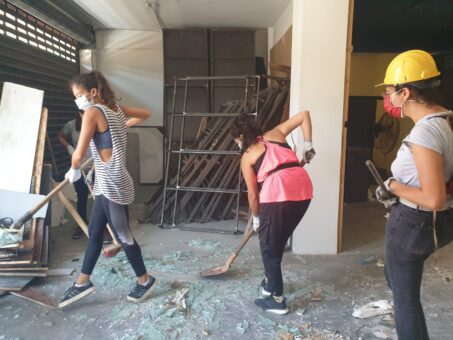
Grateful for the solidarity received and committed together with other various religious communities to help the country rise again and be a messenger of peace. We all know that Lebanon is still under a great shock. And Beirut is an unrecognizable city with apocalyptic scenes: destruction, high tensions, distress, anger and even violent episodes. A few days ago, a letter arrived from this country that has been hit with such widespread destruction. It comes from the Lebanon Focolare community and it is addressed to Focolare members worldwide. The letter reads: “With these words, each one of us would like to express a personal thank you to each one of you. We are deeply and immensely moved by the immediate closeness shown to us from all parts of the world, from old and young, far and near, through phone calls and messages”. Members of the Focolare Comunity continue to say: “Every morning, when we wake up and continue to discover the massiveness of the catastrophe, the material damage, the number of hospitals badly damaged and rendered unfunctionable, the polluted air we breathe, we feel like ‘survivors’. Each one of us could have been right there at the scene of the drama. And maybe some of us were, but a providential hand made them change place. However, we all feel that a new life has been given to us, as a young woman, just out of an elevator gutted with the explosion, said”. They continue to relate that in the streets, where everything seems to cry out despair, “many people from north to south, members of various religious communities, are working hard to clear the rubble. Each one, in his own way, is a living witness that the ‘resurrection’ will win over the death of the city, the country, the dreams of many”. They conclude: “Together with you, we want to move ahead so that a Lebanon that passes on a message of peace, unity and universal brotherhood and be a model of a united world, will be reborn”.
edited by Anna Lisa Innocenti
________________________________________ The Emergency Coordination of the Focolare Movement, which will intervene through the AMU and AFN organizations, has been activated. For those who want to collaborate, the following current accounts have been activated:
Azione per un Mondo Unito ONLUS (AMU) IBAN: IT58 S050 1803 2000 0001 1204 344 Codice SWIFT/BIC: CCRTIT2T Banca Popolare Etica
Azione per Famiglie Nuove ONLUS (AFN) IBAN: IT11G0306909606100000001060 Codice SWIFT/BIC: BCITITMM Banca Intesa San Paolo
PURPOSE: Emergency Lebanon ————————————————————– The contributions paid on the two current accounts with this purpose will be managed jointly by AMU and AFN. There are tax benefits for these donations in many countries of the European Union and in other countries of the world, according to the various local regulations. Italian taxpayers will be provided deductions from taxable income, up to 10% of the income and with the limit of € 70,000.00 per year, with the exception of donations made in cash.
11 Aug 2020 | Non categorizzato
The 100 years of Danilo Zanzucchi. A married Focolarino – one of the first in the wake of Igino Giordani – Danilo along with his wife Anna Maria, would soon become the couple leading New Families at a world level Chiara always had a predilection for that young engineer who, after having erected his first important buildings in the north of Italy (“all still standing” Danilo assures with pride), left a promising career to move to the capital, and as a family collaborate full-time for the purpose of the Movement. But Chiara’s esteem for Danilo is above all for having been able to grasp, in its entirety, the charism that the Spirit had given her. Among his first assignments was the collaboration on the construction of the Mariapolis Center in Rocca di Papa that would become the International Headquarters of the Focolare Movement. A married Focolarino – one of the first in the wake of Igino Giordani – Danilo along with his wife Anna Maria, would soon become the couple leading New Families at a world level; developing in the following decades an innovative and effective Family Pastoral Care appreciated at all latitudes for the rich spirituality from which it draws and for its openness to the demands of the contemporary world. The profound interior life of Danilo did not go unnoticed by ecclesiastical leaders who were struck by his brilliant presence, his skills. Diocesan President of Catholic men in Parma (Italy), when transferred to Rome he became consultant and, later, member of the Vatican department for the Family. These latter responsibilities, accompanied by Anna Maria, made him a guest several times in the home of Pope Wojtyla and also a testimonial of service to the Family in television broadcasts, also shown in world wide vision. When welcomed by Danilo during a visit (1984) to the International Centre of the Movement, the Polish Pontiff did not hesitate to promote him sympathetically as “Foreign Minister of the Focolare Movement “. A collaboration that also continued with Benedict XVI, and his request to the Zanzucchi couple to write the text for one of the Stations of the Cross (2012) at the Colosseum in Rome presided over by him was significant of this. Danilo is celebrating his 100th birthday with Anna Maria (90), his 5 children (two Focolarini and two married Focolarini), his 12 grandchildren and the whole Focolarino world. In particular with the countless families of the various continents for which with Anna Maria, he has been an example, a confidant, a guide, remaining a lovable and safe point of reference for each one. His psycho-physical condition remains excellent, despite the fact that many years ago Chiara herself, with all of us, feared for his health which has obviously been well recovered. He is able to go to Mass almost every day and it is not uncommon to see him participate in the periodic meetings of his Focolare and those of the Focolare-Families. Perhaps because he was invested with a special mission, the Lord preserved him in two particular episodes in the Second World War. He himself tells us that if it had not been for the providential shove of a comrade who pushed him elsewhere, he would have died under a bomb that was crashing right where he was standing. Another time, it was his knowledge of German that saved him from an already deployed firing squad . It can happen that Danilo, in order to dilute somewhat complicated moments, still decides to let everyone enjoy one of his mythical and resonant speeches in that language , putting everyone in a good mood for the various lexical licenses he grants himself. The gratitude of the entire New Families Movement for this century of Danilo’s life given to God and his brothers, goes to this great figure of a man of Faith and Works. Thank you Danilo for being a giant of righteousness and tenderness, an example of simplicity and wisdom, a temperament of leader and artist: a Saint who lives next door. Thank you also, Danilo, for having never stopped, not even now that you are a hundred years old, to impersonate the Evangelical Child that has always shone through your being, your speech, your good humour, your water colours, your countless cartoons often improvised on paper napkins, which masterfully capture and express the best that is in each of the protagonists to whom they are dedicated. HAPPY BIRTHDAY, DANILO! From the New Families website
10 Aug 2020 | Non categorizzato
The coronavirus pandemic is a trial by fire not only for healthcare systems but also for those engaged in politics, both locally and internationally. The following excerpt from a speech by Chiara Lubich can justifiably be called a “hymn to politics”. It is a challenge for politicians and can fill the hearts of ordinary citizens with gratitude towards all those who have to make courageous decisions on a daily basis. While most of the new movements take an active interest in all that is happening in the world, one of them, the Focolare Movement, has actually given rise to a political section known as the Politics for Unity Movement. Its specific aim is precisely that of promoting fraternity in politics. … First of all, we realized that a true vocation to politics exists. Believers discern the voice of God entrusting them with this task. People without formal faith also feel called to politics when, for example, they see social needs or groups of vulnerable people asking for help. Responding to the call to enter politics is, above all, an act of fraternity. In fact, people become politically active in order to work for issues that concern the general public, to help other people, wanting their good as if it were their own. In reality, the task of love in politics is to create and safeguard the conditions that enable all other types of love to blossom: the love of young people who want to get married and who need a house and jobs; the love of those who want to study and who need schools and books; the love of those who have their own business and who need roads and railways, and clear and reliable rules…. Hence politics is the love of all loves, fostering collaboration among people, bringing together needs and resources, and enabling people to trust one another. Politics can be compared to the stem of a flower that supports and nourishes the renewed blossoming of petals in the community. In the Politics for Unity Movement, we notice that, by living out our political choices as a vocation to love, we understand that other people, who have made political choices different from our own, can be motivated by a similar vocation to love. They, too, in their own way, are part of the same design, even when they become our political opponents. Fraternity enables us to recognize their task, to respect it and help them to be faithful to it – also through constructive criticism – while we remain faithful to our own. In the Politics for Unity Movement, we believe that we should live fraternity so well as to reach the point of loving the other person’s party as we love our own. We know that neither party was born by chance, but that each was the response to an historical need within the national community. Fraternity brings out the authentic values of each side and reconnects the whole tapestry of the political design of a nation. The initiatives of the members of the Politics for Unity Movement bear witness to this. They seek to create a fraternal relationship between the majority and the opposition, both on the level of the national Parliament and in municipal authorities. Their initiatives have been formulated into laws on a national level, or into local policies that have brought greater unity to the towns and cities where they were applied. Thus, those who respond to their political vocation by beginning to live fraternity, enter into a universal dimension that opens them up to the whole of humanity. They ask themselves whether the decisions they are about to make, while serving the interests of their own nation, might be detrimental to others. Politicians of unity love other people’s countries as their own.
Chiara Lubich
From Chiara Lubich, “A United Europe for a united world”. Speech given to the European Movement, Madrid (Spain), 3rd December 2002
8 Aug 2020 | Non categorizzato
A glimpse into the experience and everyday life of Somjit Suwanmaneegul, a Buddhist, from Chiang Rai in Thailand. From his meeting with John Paul II to today. By Stefania Tanesini and Lorenzo Giovanetti. https://vimeo.com/430658900
7 Aug 2020 | Non categorizzato
Anything can happen in life: easy or difficult situations, mourning, victories or defeats, but there is a common denominator for all, a common way to deal with each situation: the relationship with God. Circumstances will always be different, but He is always present; always with us. In isolation “Tomorrow,” said the doctor, “we’ll put you in an isolation ward”. I felt like someone with a bad smell. I knew someone had died from that illness. Death! I was not afraid of the pain that comes with the last battle for life. Rather I felt the detachment from my own as sharp as a sword in my heart. I had not said goodbye to them. And now… I might never see them again. I wept. And yet, to die meant meeting Jesus whom I loved. But it seemed to me that the love given and received here on earth by so many tied me down here and the flight upwards was exhausting. I knew these people on earth, the others up there I didn’t yet know well. On the other hand I had always tried to love Jesus in every neighbour: relatives, friends, acquaintances, strangers! “It was you, Jesus, whom I loved and found in everyone, the same one that – if I die now – I will meet”. This last thought slowly gave me peace. I remained for a long time in isolation, with the ups and downs associated with the illness, but enveloped more or less by a mysterious presence with the possibility of speaking to the One who listened to me and to whom I could listen. M. – Italy Rudeness at school I don’t know if I’ve aged or the generation has definitely changed. I was talking about it with my fellow teachers and we all came to the conclusion that unfortunately there is a lack of basic education. It is not only a lack of respect towards teachers, evident also in a shameless judgmental attitude towards teachers by parents, but a complete lack of a sense of attention towards each other. In one of the most difficult classes, after a regrettable incident, I pointed out that in every culture and tradition there is a basic rule of coexistence: “Do to others what you would like to be done to you”. I asked everyone if such a rule seemed acceptable to them. After a great silence one pupil started to speak, then another one… and in the end a real dialogue was created. Since that day something has changed: almost invisibly, but something has changed. Once more I had to believe again. Young people need real, firm points of reference. C. – Spain I was tempted to emigrate… I am a specialist in infectious diseases and, due to poor health facilities, poor hygiene and very low salaries, I was tempted to emigrate like many colleagues. However, after reflecting with my wife, I decided to continue my service to my brothers and sisters in our country. With the support of Christian friends abroad, it was possible to build a health facility complete with a laboratory and guarantee specific medicines even for the poorest people. In addition to the development of productive activities to improve basic nutrition, an attempt was also made to ensure psychosocial support for the sick and their families. M.- Democratic Republic of Congo
Edited by Stefania Tanesini
6 Aug 2020 | Non categorizzato
Maria Voce’s new book “Luce che avvolge il mondo” [Light that envelops the world], is published today by Città Nuova, for now only in Italian. It is a profound and courageous re-reading of the cornerstones of the spirituality of unity in the light of the questions posed by people today concerning our present times and the near future. This is probably Maria Voce’s last book as President of the Focolare Movement. In it we find her thought regarding the Movement set out clearly and powerfully more than in any previous publication during her 12 years’ leadership of the Movement. The book reveals the cornerstones of her action and her legacy, but also her experience in the very delicate time following the death of a charismatic founder like Chiara Lubich. This volume certainly deserves to be read “slowly” and meditatively, allowing time for reflection, because in it we find all Maria Voce’s spiritual, cultural and lived adherence to the charism of unity. It contains a series of talks given at various times on the twelve main points of the Focolare spirituality – God Love, the Will of God, the Word, our neighbour, mutual love, the Eucharist, Unity, Jesus Forsaken, Mary, the Church, the Holy Spirit, Jesus in the midst. These talks were given year by year during her two mandates. In the preface, Maria Voce’s friend Andrea Riccardi [founder of the Sant’Egidio community] writes: “Maria did not want to repeat but to reread Chiara’s message and charism in a Church and a world that have changed. Spiritual movements grow in a deep tension between, on the one hand, faithfulness to their origins and their charism, and, on the other, an exploration of the life and developments of the future. […] It is an outstanding and remarkable example of the creative faithfulness that is required of a founder’s followers – especially if they are leaders”. In the introduction, Jesús Morán, Co-President, asks himself with what spirit Maria Voce has written these texts and affirms it is one of actualization for our times. “She has not repeated the talks written by Chiara in the past, but has actualized them (…). She gives us her own renewed understanding of the points of the spirituality of unity that draws directly from the source of Chiara Lubich’s inspiration but also emphasizes further connotations and brings hitherto unexpressed shades of meaning to the fore. She has done this while being prompted also by the issues and concerns increasingly faced by the members of the Movement in the context of current events in the Church and in the world.” Leafing through its pages we find a variety of questions posed more or less explicitly to Maria Voce by people in the Focolare Movement. In response to the question,: “What is God asking of the people in the Movement?”, she answered: “He asks each of us to reach out to our own environment, engaging with our neighbours in a spirit of unity, but being open to everyone. At the time, Chiara herself said that that would be answer enough. Chiara emphasized very strongly that above all God asks us to make ourselves one with the person who is near us, with those who share our life’s journey and with the people we meet day by day, even – as far as possible – the ones we hear about through the media. We are called, therefore, to live unity every moment of our life, day after day, as happened from the very start.” Maria Voce also offers her reading of the lights and shadows on the progress of the Focolare Movement. She does so at a time in which the Covid pandemic has changed many things both at a personal and community level, and does so also in view of the upcoming General Assembly in 2021 during which the Movement will elect a new president and leadership: “At this time, we feel that God is urging us to sow seeds of this message of unity in new and larger fields and not worry about diminishing strength or lost ground. We should joyfully witness to the opening up of ever new horizons and the flourishing of countless living cells of the Church spread throughout the world. This happens wherever two or more are ready to love one another with mutual love and to go out towards others so that, as Pope Francis wishes, many people may meet God.” This attitude towards the current situation enables us to be enriched by an understanding of the present and look to the near future with the optimism characteristic of Maria Voce. She is certainly not naive, because she is well-grounded in the Gospel words that speak of unity and on the life that has sprung from it throughout the world.
Stefania Tanesini
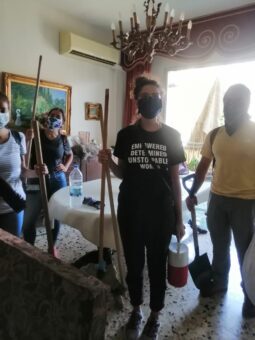
5 Aug 2020 | Non categorizzato
After the devastating explosion in Beirut on the evening of August 4th, the local Focolare community and the New Humanity association set to work to meet the most urgent needs of the people affected by the disaster. More than 100 dead and 4,000 injured caused by the huge explosion on Tuesday, August 4th at around 6.10 pm local time in the area near the port of the Lebanese capital Beirut. Glass doors and windows were broken up to a distance of 10 kilometres from the disaster area. The government speaks of about 300,000 people made homeless. Even before this catastrophe, the cedar country was already facing a severe economic crisis, which was further reinforced by the effects of the coronavirus pandemic. According to official sources more than 45% of the population lives in poverty and unemployment has risen to 35%. The explosion on August 4th was another major blow not only to Lebanon’s economy and infrastructure but also to the morale of a people who have suffered so much violence in recent decades. Like all humanitarian associations, the Focolare’s “New Humanity Movement ” has set to work to help those most affected. With the help of the local community of the Movement, the Mariapolis Centre “La Sorgente” in Ain Aar in Beirut has been made available for those who have lost their homes. Groups of young people and adults have made themselves available to help families and people most affected, putting together needs of different kinds: from food to cleaning materials . ________________________________________ The Emergency Coordination of the Focolare Movement, which will intervene through the AMU and AFN organizations, has been activated. For those who want to collaborate, the following current accounts have been activated:
Azione per un Mondo Unito ONLUS (AMU) IBAN: IT58 S050 1803 2000 0001 1204 344 Codice SWIFT/BIC: CCRTIT2T Banca Popolare Etica
Azione per Famiglie Nuove ONLUS (AFN) IBAN: IT11G0306909606100000001060 Codice SWIFT/BIC: BCITITMM Banca Intesa San Paolo
PURPOSE: Emergency Lebanon ————————————————————– The contributions paid on the two current accounts with this purpose will be managed jointly by AMU and AFN. There are tax benefits for these donations in many countries of the European Union and in other countries of the world, according to the various local regulations. Italian taxpayers will be provided deductions from taxable income, up to 10% of the income and with the limit of € 70,000.00 per year, with the exception of donations made in cash. ————————————————————– To stay up to date on fundraising for this Emergency visit the AMU and AFN websites.
4 Aug 2020 | Non categorizzato
The story of Armando, a Venezuelan who emigrated with his family to Peru: lives the Ideal of unity in the Focolare community, shares his needs and experiences the power of communion that attracts God’s providence. Three years ago because of the difficult situation in Venezuela with my wife and our two children we decided to emigrate to Peru. We used to attend the meetings of the focolare in our country and there, in Peru, the Focolare community welcomed us with a temporary home , until I found a job so as to be able to pay the rent of a house. A person from the Focolare community, without knowing us, offered us his apartment for a month while he was away visiting his son who lived in another city. As soon as we got settled in, they asked us to make a list of the things we needed to share it with everyone. So coats, pots, pans, plates, cutlery, food began to arrive, but I was missing a pair of shoes that I needed urgently… At the end of the month, since I didn’t have a job yet, we moved to another temporary accommodation. We went to thank those who, without knowing us , had lent us their house. After getting to know each other better, the gentleman said: “If there’s anything else I can help you with, tell me”. We told him that we had made a list and that the only thing missing was the shoes. “Yes, I saw the WhatsApp chat ad,” he said, “unfortunately I take a size 38 …; try them on anyway (he took his shoes off) and if they fit, they are yours”. I tried them on and they were perfect. He added, “But in the ad you said you needed sports shoes”. He went to his room and brought out a pair of sports shoes: “Take these too”. That’s how the shoes I keep wearing came from providence. One evening in a meeting with some people with whom we shared Chiara Lubich’s Ideal of unity, I was able to experience once again the strength of communion, to share the successes, the failures, the joys, the needs, taking as an example the first Christian communities that “put everything in common and there was no one in need” (Acts 4: 32-36). It was a special moment: one of the participants said that two of his children had broken a computer during an argument. His first reaction was to punish them both. I felt sorry because now those kids didn’t have the computer they were using for homework. After going through the initial phase of anger, the father of the two boys called the technician to repair the computer. However, there was no way to fix it. So he called his two sons and apologized for his initial angry reaction, so that peace was restored in that family. When he finished sharing what he experienced, one of those present said he had a computer that he didn’t use: “You can have it, we’ll see how to get it to you”. For me it was yet another confirmation of the strength of communion. I asked myself: “And if the first person did not share his concern, how could the other offer a solution?” Sometimes we don’t know how to solve a problem on our own and we get stuck in our own pain; but if we take the step of sharing it in communion with others without any hidden interest, God can find the solution precisely through those around us.
A.M. Lima, Peru (collected by Gustavo E. Clariá)
3 Aug 2020 | Non categorizzato
The following reflection by Chiara Lubich highlights a key dimension of a “spirituality of communion” – the fact of being inseparably linked to one another, which calls for endurance. The coronavirus pandemic has made us experience this interdependence in many ways, and has also called us to increase out capacity for endurance. We do not go to God alone, but with our brothers and sisters. And this is the “something more” that we have. We must tend towards holiness together with others. Practically speaking, this means helping our brothers and sisters reach holiness in the same way as we help ourselves. It’s a demanding commitment that we too easily forget, but which is the necessary condition for becoming holy. Indeed it is only by loving our brothers and sisters to this extent that we can hope to have Jesus in our midst. What is the best way to practice this demanding love for our brothers and sisters? There are a number of ways, but one of them in particular must be considered carefully and has been confirmed for me by many years of experience. I’ve already spoken about it, but it’s so important that it’s worth repeating. The community life we live, whether permanently or on a temporary basis, asks us to love our brothers or sisters all the time. This means always making ourselves one with them and it’s what we try to do. However, even if we were to commit ourselves with all our strength to doing this, we wouldn’t always succeed because we are still in this world and liable to faults and failings. Sooner or later, one or other of us messes things up. What should we do? If we were the ones who stopped loving, we should start loving again straightaway. And if it was our brother or sister’s fault, what should we do? Believe me, we would be wise to listen to what St Paul says when he emphasizes endurance regarding others, because endurance is not a lower grade of love; it is intrinsic to love, an aspect of charity, a key dimension of love. In fact, according to St Paul, love not only “bears all things, believes all things, hopes all things”, but also “endures all things”. To endure is to love, it is charity. Without it, we do not truly love. The time will come when we can make our neighbour aware of what has gone wrong; the Gospel asks us to do this too. … But we do it only out of love and certainly not to rant at our brothers or sisters about how they have wronged us. We say things with as much love as possible, knowing that if they improve, I too will gain from it, because this is what is new about our spiritual journey: I must work towards my brother or sister’s perfection if I want to reach my own. We are bound to one another. There’s no alternative.
Chiara Lubich
(Taken from a telephone conference call, Rocca di Papa, 19th June 2003)
2 Aug 2020 | Non categorizzato
A film about Chiara and the beginnings of the Focolare Movement will be aired on RAI UNO, the first channel of Italy’s national state broadcaster, in autumn. “Can the power of a girl’s dream and her faith change the world ?” This is the keynote on which the Italian director Giacomo Campiotti bases the film in which he narrates the story of Chiara Lubich, the young teacher from Trent, who in her early twenties lived the hardships and anguish caused by the Second World War. Lubich felt called to build a better world, a more united one, and since then she set herself the goal to build bridges between people, irrespective of their race, nation or religious belief. This biography TV movie, the first to be made on Chiara Lubich will focus on the early years, those between 1943 and 1950. It is a co-production by Rai Fiction and Casanova Multimedia, produced by Luca Barbareschi. Cristiana Capotondi, an established Italian actress will play Chiara in the movie, while Sofia Panizzi and Valentina Ghelfi will also be in the cast. The shooting of the film will begin in Trent in a few days’ time, and it will start with “the times when the war raged” and “everything collapsed” and only God remained, as Chiara herself related in one of the very first stories about the Focolare Movement’s beginning . In the press release issued about the movie one reads: “Today, the tenacity in a figure like Chiara makes us consider the other person as an opportunity, a gift, a bearer of a seed of truth to be valued and loved, no matter how far apart we may be. Universal brotherhood is a prerequisite for dialogue and peace. Chiara’s message does not belong only to the Catholic world. She has contributed towards the value and role of women not only in ecclesiastical institutions but also and above all outside them”. This movie will relate the story of the very first years, the foundation years, when Chiara realised that God was showing her the way to be followed and she responded, followed by an ever increasing number of people, who took roads that from Italy led to the whole world. It will also be a journey that speaks of the historical, social and ecclesial circumstances that Chiara experienced during the Second World War, the very first years after the war and the pre-conciliar years with ferments that stirred Catholicity. The director and producers intend and want to relate all about “the young revolutionary girl, who shared everything with those in need”. ANSA news stated this on July 27 and continued to say that “she read the Gospel without the presence of a priest; she was considered as harmful to the society of her time and so she was forced to report about her work to the Holy Office. She passed through the most difficult test of her life when she was asked to abandon the Focolare leadership. But the stone she threw into the pond could not be stopped and created wider circles, so years later, when Paul VI came to rehabilitate the Focolare Movement, it had already spread throughout the world”.
Stefania Tanesini
1 Aug 2020 | Non categorizzato
We are back in Loppiano, at the Sophia University Institute, an innovative academic centre and incubator of new concepts and practices in interreligious dialogue. By Anna Lisa Innocenti and Lorenzo Giovanetti. https://vimeo.com/430380293
31 Jul 2020 | Non categorizzato
Firms going under, thousands of jobs lost: lockdown has hit the European economy hard. But many entrepreneurs are trying equally hard to keep going. Andrea Cruciani in Italy asked himself what he could do to protect his workers.  How have business people coped in the emergency lockdown phase caused by Covid-19? We spoke with Andrea Cruciani, CEO of TeamDev software consultancy and Agricolus start-up, linked to the Economy of Communion project. How has the lockdown affected you? “Before lockdown things were going well. For the past 12 years, TeamDev has demonstrated 20% annual growth and we now employ a workforce of 50. Halfway through February we took steps to raise money through the bank. But the lockdown meant by the end of March we had no cash liquidity left. For the first time ever, I found myself without money or opportunities. The only option left to us was to start laying off staff. I was so unhappy about this because we have always taken particular care to invest in the welfare of the business. Not surprisingly perhaps, some of our workers took fright and lost confidence in us. To lose the trust of even one employee was extremely painful to me. Gradually, however, we found ways to meet the needs of everyone. As soon as the business started generating some income again, we immediately began to supplement their unemployment payments through a special ‘Covid fund’. At the end, we were able to give the same pay to all, and they understood there was no bad-faith on our side”. Have you learnt anything through all this? “I’ve realized how fragile authentic relationships with employees and collaborators can be. It’s so important that authentic relationships are built on trust. We’ve been amazed to see how some of our people have found new energy from the desire to contribute to the common good. In this period the true humanity within our relationships has emerged”. Do you have any advice for other businesses about caring for their human resources? “Let me tell you a story. Three years ago I decided to promote one particular employee to the management of a department. But after a short time, this person quit. I realised that what I want out of life for myself is not necessarily what everyone else wants for themselves. This employee did not want the psychological stress of that management role and was not even ambitious for an increase in salary. Following that experience we began to improve some of our processes”. Improve in what ways? “First of all, we turned to a coach to improve the team spirit among everyone working in the company. Then we began to improve working conditions with some quite simple initiatives like offering fresh fruit for break-times. We also ordered seasonal fruit from a Caritas orchard project, to give everyone the opportunity to take what they needed home, free of charge. We also launched a program of integrated welfare, developing our existing long-standing integrated retirement package and other supports such as flexible working to accommodate family commitments. In this way we protect the interests of those working in our companies. And, clearly, we strive to promote the growth of each person to be able to give the best of themselves”. How do you view the future of the economy in general? “I foresee a future where it will be ever more necessary to read the present moment and share our own perspective for the future. Chiara Lubich is a prophet for us, EoC business people, because she has taught us how to care for our employees and businesses. Some aspects are covered by the law but many other aspects are covered already by one’s conscience and commitment to love”.
by Lorenzo Russo
29 Jul 2020 | Non categorizzato
“Be a family – this was Chiara Lubich’s invitation to people eager to live the Word of God –. And wherever you go to bring the ideal of Christ, (…) the very best thing you can do is create the spirit of family with discretion and prudence but also with decisiveness. It is a humble spirit which wants the good of the other. It is not proud… it is (…) true charity.”[1] The new director In his “programmatic speech” the new director had spoken of the company as a family in which everyone was co-responsible. The atmosphere between us was light and cordial… but when the first difficulties arose, perhaps due to inexperience, he surrounded himself with those he trusted most and excluded practically everyone else from decision-making. I took courage and one day, out of love for both him and the employees, I set out to ask him what worries were crushing him. He seemed so different to how he was at the beginning, like someone who only saw enemies. Perhaps we had done something that was making him act like that? He didn’t answer and dismissed me, by saying he had an urgent commitment. A few days later he called me and apologised. He shared with me how he felt unable to support the kind of solidarity where everything slipped through his fingers. He asked me for help. I encouraged him to open up to all of us and ask whether we really wanted to be part of his project. It was a moment of great understanding. Something began to change. (H.G. – Hungary) At the post office At the beginning of the coronavirus pandemic, I went to the post office to send a package. In the queue for guesthouses, an elderly lady wearing a mask who was clearly not well, collapsed to the floor. I ran towards her but I wasn’t strong enough to lift her up. When I asked for help, I noticed a certain reticence: just one boy covered in tattoos who had witnessed the scene outside the post office responded. I sat the elderly lady down, who managed to come round apart from some pain resulting from the fall, and asked the boy to help her sort out what she needed to do, while I sent my package. Not only did he help me get her into the car, he also wanted to come with us to the lady’s house. Since she had a blood pressure machine, I took her blood pressure. As I left the building, the boy said to me, “I was laughing with my friends seeing how people driven by fear behave. What you did was great.” After a few days I wanted to visit the old woman. I was surprised and even moved when she told me that the boy had brought her some biscuits made by his mother. (U.R. – Italy) Rehabilitating the past Such a shame! My colleague was really competent in her job but she brought everyone down with her pessimism. Because she was jealous of me and other colleagues she always spoke badly about everyone. Consequently, with one excuse or another, no one wanted to work with her. What should I do? Just let things go ahead despite the bad atmosphere? Then I had an idea for her birthday. I organized a collection for her in the office. When we called her to celebrate with cakes people had made, drawings her colleagues’ children had made for her, a beautiful bag as a present, she was deeply moved and incredulous. She never said a word for days. She would just look at us like a wounded bird. Then gradually she began to talk to me about her childhood, her failed relationships, the divisions in her family… We became friends and she comes to our house to help my children with Maths and English. She’s one of the family now and it looks like her past is healing too. (G.R. – Italy)
by Stefania Tanesini
(from The Gospel of the Day, Citta Nuova, year VI, no. 4, July-August 2020) [1] C. Lubich, in Gen’s, 30 (2000/2), p. 42.
27 Jul 2020 | Non categorizzato
We have all suffered because of the coronavirus and many people are still suffering. The pandemic has caused problems and pain in all sorts of ways and we would easily feel discouraged if Jesus did not help us. In fact, we know that He, who is God made man, experienced all our sufferings and that for this reason He can be close to us and support us. … Life can be viewed as being like an obstacle race. But what are the obstacles? How can we define them? It is always a great discovery to see how each suffering or trial in life can in a certain sense be given the name of Jesus Forsaken. Are we gripped by fear? Didn’t Jesus on the cross in his forsakenness seem overwhelmed by the fear that the Father had forgotten him? In some hard trials, the obstacle we might meet is despair or discouragement. Jesus in his forsakenness seemed engulfed by the impression that in his divine passion he was without the Father’s support. It seemed that he was losing the courage to reach the end of his most painful trial, but then, he said: “Into your hands Father I commend my spirit”.[1] Are we in circumstances that make us feel disorientated? In that tremendous suffering, Jesus seemed unable to understand anything about what was happening to him, given that he cried out ‘why?’ [2] Are we being contradicted? In his forsakenness, it seems as though the Father does not approve of what the Son is doing. Are we being rebuked or accused? Jesus on the cross, in his forsakenness, perhaps had the impression of being rebuked or accused even by heaven. Furthermore, in some trials that sometimes come in relentless succession don’t we even reach the point of saying in our affliction – ‘This seems to be too much; this is beyond all measure’? In his forsakenness, Jesus drank a bitter chalice that was not only full but overflowing. His was the trial beyond all measure. And when we are surprised by a let-down, or feel injured, or have an unforeseen accident, an illness, or are in an absurd situation, we can always remember the suffering of Jesus Forsaken who experienced these trials personally and many more. Yes, he is present in everything that smacks of suffering. Every suffering is one of his names. In the world, it’s said that someone who loves calls their beloved by name. We have decided to love Jesus Forsaken. And so, in order to succeed better in this, let’s try to get used to calling him by name in the trials of our life. So we will say to him: Jesus Forsaken-loneliness, Jesus Forsaken-doubt, Jesus Forsaken-injury, Jesus Forsaken-trial, Jesus forsaken-affliction and so on. And because we call him by name, he will see that he is being discovered and recognised beneath every suffering and he will answer us with more love. By embracing him he will become our peace, our comfort, our courage and stability, our health and our victory. He will be the explanation of everything and the solution to everything. Let’s try then … to call Jesus by name when we meet him in the obstacles of life. We will overcome them more quickly and the race of our life will not be paused.
Chiara Lubich
(Taken from a telephone conference call, Mollens, 28th August 1986) [1] Lk 23:46. [2] Cf. Mt 27:46; Mk 15:34.
25 Jul 2020 | Non categorizzato
Chiara Lubich and interreligious dialogue, a way to give a soul to globalisation. https://vimeo.com/429999013
22 Jul 2020 | Non categorizzato
If we love, Jesus will recognize us as his family, as his brothers and sisters. This is a great opportunity: it surprises us; it frees us from the past, from our fears, from our plans. Thus, even our limits and fragilities can lead us to our realization, and we will make a big leap foward. Racism I was a student at the middle school; classes and homework were fine, but the relationship with my classmates wasn’t. One day, while I was finishing my science homework, I was verbally insulted by one them for being an Asian. I didn’t know how to react to his racist abuse. I did not utter a word, but a strong feeling of revenge gripped me. Then a strange thought crossed my mind: “Now is your chance”. It took me a while to understand quite clearly that it was “now my chance to love my enemies”. My first reaction was to ignore this and defend my Asian identity. Loving my enemy seemed as if I would only be contributing towards a more negative situation. I was very uncertain about what to do, but after some time I decided to keep silent. I forced my angry heart to forgive while I offered my personal wound to Jesus, who suffered so much on the cross. After forgiving my enemy, I sincerely experienced a happiness I never felt before. (James – USA) Faith Problems Our third child was born with Down syndrome and I considered this cruelty of nature as a punishment for my marital infidelities. I was ashamed to go round with this child and I carried so many unanswered questions inside me. But as F. grew up, I started to discover primordial goodness and cosmic peace in this child. I cannot explain the relationship between this and my problematic faith, but slowly I acquired other eyes and, I would say, another heart too. The relationship in my family changed as well. Strangely enough, I began to live F’s condition as a gift. I have no more problems about faith and dogmas; everything is grace. Behind the veil of misunderstanding there is innocent and pure truth. (D.T. – Portugal) Back to family life I left my family for someone I had fallen in love with at work. Blinded by passion, I didn’t realize what great hardship I was inflicting on my family. I was still in touch with my children, mainly with my eldest daughter who suffered most because of my absence. When her husband abandoned her and her three little kids and my daughter fell into a depression, I realised that the same suffering I caused was repeating itself. God gave me the grace to be fully aware of this and to repent. I did everything I could to be close to my daughter’s broken family. I looked for my son-in-law and spoke to him at length. He humiliated me when he told me off and pointed out that I had no right to judge because his wife’s traumas were partly my fault: their marriage failed precisely because of her lack of balance. I knelt and wept, asking him for forgiveness. He said that he would think about it. After a few months of anxious uncertainty, there was a ray of hope: my daughter told me that her husband was willing to try and settle into family life once again. (C.M. – Argentina)
Stefania Tanesini
(from The Gospel of the Day, Città Nuova, year VI, no. 4, July-August 2020)
21 Jul 2020 | Non categorizzato
Pasquale Foresi, the first co-president of the Focolare Movement and an avant-garde theologian was a very timid and a highly intelligent person. His first biography, edited by Michele Zanzucchi, has just been published in Italian. It relates the story of a man, the beginning of the Focolare Movement, a cross-section of history that has much to say to the Movement, the Church and society today. The first biography of Pasquale Foresi “In fuga per la verità”, who together with Igino Giordani was defined by Chiara Lubich as co-founder of the Focolari, was published on July 9, 2020. It gives a very well documented account of the first part of his life, from 1929 to 1954. Even Focolare members knew very little about this part of his life because of Foresi’s reserved character and his style of co-governance, as we would say today. It is a very interesting text, published in Italian, but versions in English, French and Spanish are in the pipeline. It is studded with unpublished facts and it flows like a novel, that speaks of Foresi’s life and recounts all about the Movement’s beginnings and Chiara Lubich, as a person, from his point of view. It also makes us reflect on the present life of the worldwide Focolare Movement, almost 80 years after its birth. But who was Pasquale Foresi? Who was he for the very young Focolare foundress? We put this question to Michele Zanzucchi, the author of the biography, a journalist and a writer, former director of Città Nuova. He was well-acquainted with Foresi, but besides, it took him two and half years of research on papers, texts, books and speeches to produce such a thorough and deep piece of work. “Foresi met Chiara Lubich during the Christmas holidays of 1949. He was then a young man in his twenties, but he had already experienced a more adult life than his age; so he was “prepared” to collaborate with the Focolari foundress. He was the son of a Livorno family; his father, a teacher and a Catholic laity leader, later became a member of parliament and his mother was a housewife. He had three brothers and sisters. Since his childhood, Pasquale showed uncommon practical-theoretical intelligence. On September 8, 1943, the day of the armistice, at the age of 14, he escaped from home “to give some service to Italy”. Soon after, he joined the blackshirts, and then, because of the Nazis themselves, he took part in combats and he even fought at Cassino. Before he escaped, he freed deserters who were condemned to death. His philosophical-religious conversion started there. He was with the partisans when the war ended, and then, immediately afterwards he entered the seminary in Pistoia. Two years later he was at the prestigious Capranica in Rome. But he left; he could not accept the incoherent way some clerics lived the Gospel. He found this coherency in Lubich and her friends. Within a month, the teacher from Trent understood that God sent this young man to help her accomplish God’s work that had just started. Foresi cooperated with her in setting up centres of community living for virgins, in the Church’s approval of the Movement, in the building of centres and small towns, in the setting up of publishing houses and launching magazines, in the inauguration of university centres….. From that day on, Lubich remained faithful to the role God entrusted to Foresi, and she never abandoned this, not even when he was struck by a serious cerebral illness in 1967, when he was barely 38 years old and he disappeared from public life. For her, Pasquale always remained one of the two co-founders of the Movement, the one with whom she confronted every decision she had to make”. What kind of priest was he? What was his vision of the Church? “With a very traditional formation on the sacraments and priestly life, I would say neo-school. Foresi helped Lubich to develop an original idea of the application of the presbyterate, the idea of “Marian priesthood” stripped of “power” and animated only by deep rootedness in the kingly priesthood of Jesus. This idea of priesthood is still being applied and experimented today. For Foresi, in particular, the priest had to be a champion in humanity, in being man-Jesus. The underlying vision of the Church is linked to a prophetically conciliar perspective: the Church as the people of God, the Church-communion, naturally synodal and one that gives value (which does not mean in any way devaluing the “sacramental” presence of Christ in his Church) to the presence of Jesus in humanity in more “lay” forms, particularly in the presence promised by Jesus in the Gospel of Matthew: “Where two or three are gathered in my name, there I am in their midst” (Mt 18:20)”. Why did Chiara Lubich entrust Foresi, and not a lay person, with the realization of some of the Focolari‘s works, the so-called “concretizations”, such as the international centre of Loppiano and the launching of the publishing house Città Nuova? “It would be great if this question is asked to the one who could really answer it… However, I note that the other co-founder of the Movement was Igino Giordani, a married lay person, a member of parliament, a journalist, an ecumenist. He met Lubich back in 1948, and the foundress saw in him the presence “of humanity” at the heart of her charism. So for Lubich, Giordani meant a radical opening to the world, following the priestly prayer of Jesus: “Let all men be one” (Jn 17:10). But in Foresi – who was of a more “concrete” nature than the “idealist” Giordani – she saw the one who would give her the practical support needed to achieve her work. We need to say that Foresi was extremely “secular” in this characteristic, even though it was very clear to him that the Movement’s mission was primarily ecclesial, and that it could not be done without the ecclesiastics”. Let’s try to guess: what would Foresi say to the Focolari and what would he invite them to aim at if he were alive today? “A real gamble. I believe he would invite the Movement to do the necessary ‘updating’ , while keeping in mind the nascent state of the Movement. Therefore, he would invite the Movement to go back to the founder’s mystical intuitions of 1949-1951, read them again and apply them. And also to look very carefully into the process of concrete realization that took place especially during 1955-1957, when Lubich received other illuminations that referred to the concretization of the previous mystical intuitions”.
Stefania Tanesini
20 Jul 2020 | Non categorizzato
The following reflection by Chiara Lubich can shed light on how to live the trial that we are all going through, on a worldwide level, according to the Gospel. Because of the pandemic, many people have lost a relative, a friend or an acquaintance and we are all called, in the most varied ways, to respond to the grief and pain that this pandemic is causing everywhere, recognizing in them the face of Jesus forsaken to love. … In the last few weeks, several people in the Movement have left this life … and we who are still here on earth ask ourselves: what did they experience in that moment of passing on to the next life? What would they tell us if they could talk to us? We know the answer: they saw the Lord. They met Jesus. They saw His face. This is a truth of our faith, a truth which is immensely consoling. There is no doubt about it. St Paul himself said “My desire is to depart and be with Christ” (Ph. 1:23). He was referring to life with Christ immediately after death, without waiting for the final resurrection (Cf, 2 Cor. 5:8). This then is the experience of those who have reached the goal to which our Holy Journey leads us: the meeting with the One who cannot help but love us if we have loved Him. We hope to have the same experience. But to ensure that we do, we need to prepare ourselves from now on; in a sense, we need to get used to it. Will we meet the Lord? Will we see His face? We will surely contemplate Him in his glory if here on earth we have recognized, loved and welcomed Him forsaken. St Paul said he knew nothing on earth except Christ, but Christ crucified. This is what we too want to practice doing: we want to seek His face. We want to search for Him forsaken. We can be sure of finding Him in the small or big personal sufferings which are never missing. We’ll find him in the faces of the people we meet, especially those who are most in need of help, advice and comfort; those who need encouragement to make progress on their spiritual journey. We will search for Him in the harder and more laborious aspects of the various activities that are the will of God for us; we will find him in all disunities whether near or far, big or small. … We will also seek His face in the Eucharist, in the depths of our heart and in religious images of Him. Furthermore, He needs to be contemplated and loved in practical ways also in all the great sufferings of the world. Yes, there too, even though we often feel powerless in front of them, but perhaps we are not. We often … hear about disasters that have already happened or that are threatening entire populations or nations! … If the charity of God dwells in our hearts these disasters weigh down on us and leave us dismayed. The reason is because we feel – notwithstanding our good will and all our activities – that we can do nothing that could actually improve these situations. And yet we must convince ourselves that we can do something. Here too, once we have discovered his face in these huge catastrophes, we can, with the strength of children of God who expect all things from their Almighty Father, unload onto Him the worries that crush us and these vast areas of humanity, so that He will move the hearts of world leaders who are still able to do something. And we must be confident that He will do something. He has done this often in the past. … So let’s make this verse from Psalm 27 resound in our hearts as often as possible: “Your face, Lord, do I seek”. Your sorrowful face so as to dry your tears and wipe away your blood as much as we can, and to see his face shining upon us when it’s time for us to have the experience of those who have already arrived.
Chiara Lubich
(Taken from a telephone conference call, Rocca di Papa, 25th April 1991)
18 Jul 2020 | Non categorizzato
What have we learned from the pandemic? Which tools can we use to build a new world? What specific contribution can each of us make? From Maria Voce’s spontaneous words to a Focolare community in Italy on 16th July. For a number of years, July 16th has been a double celebration for the Focolare communities around the world. It’s the anniversary of the special pact of unity between Chiara Lubich and Igino Giordani in 1949 and also the birthday of Focolare President, Maria Voce. Once again this year the celebration became an opportunity for spontaneous and informal dialogue – in which Maria Voce spoke from her heart about the meaning of that special day, about the life of the Focolare in recent months and the contribution the charism of unity can make at this crucial time for humanity. She had received many greetings, good wishes and much affection from all over the world and for this reason she wanted, and wants, to thank each person in a special way. We publish below part of what she said, with extracts from amateur video footage of that occasion. “… The pandemic has taught us a great lesson, hasn’t it? We must recognise this. It has made us suffer and is still making us suffer. We don’t know how many painful consequences will still come from this pandemic, do we? But it has also been a great lesson. The main lesson was telling us ‘you are all equal’. You are all equal: whether rich or poor, powerful or wretched, children, adults, immigrants … you are all equal. That’s the first thing. Second: even though you are all equal, some people are suffering more than others despite this equality. So what makes you all equal? You are all equal because God made you all equal. You are very different from each other but you are all his children. You have all been created by him with the same love, a great love. Then human beings came and began to differentiate between people, and we keep on doing this. So, yes to one person, no to another; one person is worth more, another less. This person can give me something, but that one can’t; this person is exploiting me, that one isn’t … and we start differentiating between people. What happens when we do that? The result is that there are some countries where hospitals are well-equipped and countries where they are not. There are countries where there are enough masks for everyone and others where there are not. There are places, even here in Italy, with very good internet connection and where distance schooling is possible, and other places that don’t have it. So we are all equal before God but not all equal in the eyes of other people, where real care for all is not there. Does this hold true for us too? Perhaps I too am more willing to spend time with one person than with another and I differentiate between one person and another. I’ve seen this too and so am I really living the pact if I am like that, the pact that tells us to be ready to die for one another, not only for people I like, but any person at all? Today people are saying we must create a new world, a new humanity. Everyone says that a new world must be created. However, in a small way, Chiara made a new world. Chiara’s family scattered across the globe is already a new world, at least in a small way. Of course it’s just a start, a model, a small sign, but it shows that it is possible. So, if it has been possible for this little group (which is only relatively little because it numbers hundreds of thousands around the world) to do this in a small way, I ask, is this little people, Chiara’s people, ready to tell everyone that a new world is possible? It is possible: we must be convinced that it is possible and remember the thought for today, “Believe in the power of love.” So, first of all, let’s believe that love is a powerful force. Have we experienced it? Yes, we have experienced it very often. But now, it has diminished a little; the thermometer of love has gone down. Let’s put some more mercury in the thermometer and make it rise. Let’s increase the amount of love in the world and you’ll see that everything else will rise up. We will be a reality that goes through the world doing good to all. And we’ll do this without having to say, “You know, we do things in this way; come with us because we are like this.” No, we are who we are; we are just like the others; we are poor wretches like everyone else, but we live in paradise and we don’t want to leave this paradise. But we want to be with others. We don’t want stay among ourselves in paradise. We want to bring this paradise to others and not keep it for ourselves, because it’s comfortable … and let the world get lost. No! The world must be saved; we must help save the world with our love.”
18 Jul 2020 | Non categorizzato
Dialogue with Vinu Aram, Director of the Shanti Ashram International Centre. By Marco Aleotti, Roberto Catalano, Giulio Mainenti. https://vimeo.com/430298225
17 Jul 2020 | Non categorizzato
Gen Verde’s experience during the lockdown “We were right in the middle of our tour in Spain when we received some very disturbing reports from Italy about Covid-19 and the rising number of new cases. In a very short time we had to decide whether or not we should suspend the tour and return to Italy – and to communicate that decision to the organizers. The next day we boarded the boat, which turned out to be the last passenger ferry from the port of Barcelona.” It all happened a few months ago but for Mileni from Gen Verde the memory is still very vivid and clear. In these last four months, Gen Verde has transformed this difficult situation into an opportunity: “Almost every day we were hearing from friends who had caught the virus. They were asking us to be close to them – says Annalisa – and so we asked ourselves, how can we help them? How can we let them feel they are not alone, while respecting social distancing? Then we had an idea: why not connect with them online from our home?” This is how the first live stream adventure began: with a few instruments and a not-so-stable internet connection, they decided to try even if they weren’t sure how many people would have followed. In the months that followed Gen Verde held many live streams broadcasts, as well as several dozen online appointments through zoom, Instagram, Skype… all of them an occasion to meet young people and adults all over the world: from the Philippines, Argentina, USA, Romania, Italy, Australia. These months also provided space to create new pieces, ranging from the dramatic theatrical piece called Il silenzio (The silence) to the instrumental, Tears and Light, not to mention the new videos produced to be able to celebrate the Easter Triduum together despite the distance. All that was created was shared immediately on their YouTube channel and through social media. Clearly all this required a great deal of work, maybe even more than what is required while on tour, but Gen Verde never held back, and never said no to those who asked to share a moment with them. “We are very happy – says Marita – because during these months, despite the difficulties we faced, we were able to meet hundreds of thousands of people through various on line meetings. Of course, it’s not the same as meeting in person, but I have to admit that we had never met this many people in the space of just 4 months. For those of us in Gen Verde it has been an experience way beyond our expectations.” And now, having concluded the last of this first round of live streams, Gen Verde will dedicate their time to the creation of new projects and ideas, which they will share soon. Gen Verde is always on the go, always looking ahead. What’s their secret? “We try to live not thinking of ourselves but of those around us – explains Sally. What is important to us is to build relationships based on universal fraternity. In these months of the pandemic we have received a lot of feedback after our direct streaming and these impressions are what kept us going forward, always striving to give our best. We are honest with ourselves and with everyone else: this pandemic was no joke and in many countries the situation is still very critical. However we believe that what we have done has been for many, a positive moment from which they could emerge relieved and refreshed. Now, we’re moving on to prepare new programmes, and launch new songs to give hope to a world so badly in need of it.”
Tiziana Nicastro
16 Jul 2020 | Non categorizzato
Chiara Lubich tells of the special pact of unity made with Igino Giordani (whom she called ‘Foco’) on the 16th of July 1949, the prelude to her mystical experience that summer. From an interview with journalist Sandra Hoggett in 2002 https://vimeo.com/438631561
