![Chiara Lubich: Health, Sport and Recreation]()
15 Jul 2012 | Non categorizzato
 The new book, published by Città Nuova, contains an interview with Eli Folonari who was at Chiara Lubich’s side for more than fifty years. Eli discusses several parts of Chiara’s life, many of which were unknown to most people. Here are some excerpts.
What value did Chiara give to health, sport and recreation?
She always had a very busy life and not devoid of problems, because her spirituality was new even for the Church. And such an active and intense spiritual life couldn’t but have an affect on the physical. Through her own personal experience, she could see that health and well-being – this great gift given to us by God – should be safeguarded; the body needs rest, fun, relaxation. She encouraged everyone to eat properly, to sleep sufficiently, to look after their health.
Sometimes she would interrupt her work and say: “Let’s go take a short walk in the garden, for fifteen minutes, or for a half hour.” Then she would return to work.
Did she like the mountains better than the sea?
Yes, even though at times, when we were in Rome, we would go to Torvanianica, Ostia, and Fregene. She didn’t find the seaside very relaxing. But one day – I think it was in Rimini – she observed: “The sea gives a sense of the infinite, whereas the mountains are restricting.” “But,” she went on, “they lift your spirits high.” So she did prefer the mountains. She often recalled the times she had climbed to the foot of Mount Paganella with her father, or when, once out of Trent, she and her first companions would stop under a pine tree on the slopes and have long conversations.
 Did she like walking?
She used to walk more than any of us, initially even very long walks. The she suffered from a disc hernia in 1973, because while taking a shortcut, she fell along a path that was too rugged and steep.
What about swimming?
No, she wasn’t one for the water, being a good Trentina. Although, during the vacations in Switzerland, the beautiful long boat rides on Lake Geneva or Lake Brienz were occasions to share beautiful things with her companions!
Did she find car trips restful?
Yes, she found them quite relaxing. But usually in the car she would be writing or working on something.
How did she relax in her daily life?
Occasionally she would listen to music or read a book. She rather preferred to watch films on TV, and not only religious films, but also murder mysteries! Sometimes she would follow sporting events. She didn’t cheer for a particular team, but she was always able to tell who was playing well and who wasn’t.
Did she ever organize any recreational activities?
Yes, since her life was so busy, she liked to invite her closest collaborators to spend some relaxing moments with her, which often turned out to be also quite demanding! She would say: “A few people are coming over for lunch and we need to entertain them for about two hours: try to put something together.” Someone would think up some jokes to tell whereas I would be looking through reports to see if I could find some amusing little anecdotes that could be shared…

Did she have a favorite dish?
She liked ham and she liked spaghetti. She didn’t care for meat or fish or for very elaborate dishes. She preferred simple things like potatoes. Her mother would tell us that when Chiara was still a toddler barely able to talk, she could already say “po-ta-to”. She also welcomed ice-cream.
In her diary we detect that from when she was still very young, Chiara always had the idea of death in mind. And this urged her to live more intensely the moment given to her as a preparation for the next life.
Yes, she lived it intensely. In all of her early letters we find the same recurring theme: everything passes away, life is short and we have little time. Chiara wrote to her mother: “Should I die, you must take ahead my Ideal.”
Taken from: “Lo spartito scritto in cielo. Cinquant’anni con Chiara Lubich”, Giulia Eli Folonari, Città Nuova, 2012.
Photos: © Chiara Lubich Centre (Photographic Archives)
![Chiara Lubich: Health, Sport and Recreation]()
14 Jul 2012 | Focolare Worldwide
 «Some time ago I accepted a proposal, which was also a challenge: to become a caregiver to my aunt suffering from Alzheimer’s Disease. Caregiver This is how I started to take care of her daily, by helping her with the meals and with the cleaning, besides offering her company.
Being near to her I have lived and am living with pain the slow and progressive deterioration of her identity. I accept her relying on me. In moments of lucidity, she asks me to be the one to understand each of her losses. By going through the sufferings, I experienced personally the void the solitude, the fears and the inhibitions. I have also discovered “the emptiness” of the institutions. In this situation I was strengthened by thinking of Jesus Crucified and Forsaken, who continued to love also in the suffering.
Three years ago, I asked the geriatrician, a specialist in Alzheimer and who takes care of my aunt, to deal with this disease together with me in a different way. Through this comparison patient-doctor-doctor-family, the desire to create an Association was born and which will be able to give a collective response to this suffering. At first there were only two of us: the doctor and myself. Then I contacted some friends and ten of them joined. Se we legally constituted an association: “New Humanity – “The house of dreams”. In fact there is the need of dreaming, but if one dreams on his own it is easy that the dream remains a dream. If you are in many, learning to share the sufferings and the needs, then that dream becomes a reality.
The purpose of the Association is to keep alive the attention on the problem of dementia and how to deal with it: Alzheimer is a disease, which we live as a real challenge to accept and to win, with the collaboration of all the protagonists: patients, families, society and Institutions.
Our first task is a course for volunteers and the relatives of the patients with the title: “The Alzheimer’s disease and the other dementias”. Free contribution is given by physicians, psychologists, and hospital volunteers during the meetings and in which thirty persons participate,
 At the end of the course, the idea of opening and “Alzheimer’s Café” was born: we wanted to live as a family together with the patients, not in the solitude of the four walls of the house, but in a coffee shop, a symbol of social life! Thus we accompanied them in the bar to share a hot chocolate or a fruit juice. Currently we accompany 35, of whom 20 are suffering from Alzheimer. One of them had not been out of the house for three years and another one did not want to participate because he did not have shoes, he accepted when we told him that he could even come in his slippers.
The news of this initiative soon spread in the city. Shortly after, even the Bishop wanted to pay us a visit to share the festive evening of our first anniversary of the Association, with us. He was interested in our activities even the Department of Social Services, who for a long time had sent us a car with a driver to transport our friends to meet at the Alzheimer’s Café.
In the summer of 2009, we had another idea. In the nearby town of Foggia there is an Institute for promoting horseracing. So we organized a visit to the old coach house and the stables. We have asked the parents of the patients to bring their wedding albums. The time was in fact the one in which coaches were used even for weddings. It was a success and the joy was great. We wanted to repeat the experience with a novelty the following year: we adopted some donkeys who were destined to be put to sleep, to stimulate the relational capabilities of the patients.
 Our Association also organizes annual courses for the training of health professionals and support to the patient’s relatives. These courses are increasingly improving and are an occasion to spread the Ideal. Currently we are in 70, between patients and volunteers and we are self-supporting.
Amongst the therapeutic proposals, then we take advantage of aromatherapy and music-therapy. The whole town knows about our experience and like us many are available if we need help. We even thought of offering our service to the town community by giving a training course to foreign caregivers entitled: “Taking care of lost memory.
Read more: Association “The house of dreams” – San Severo (Foggia) – Italy
www.lacasadeisogni.biz
![Chiara Lubich: Health, Sport and Recreation]()
12 Jul 2012 | Focolare Worldwide
 On 28 June 2012 – 1 July 2012 a Mariapolis was held in the hills that overlook Kicevo, halfway between the capital city of Skopje and the historic city of Ohrid in the south. The guests were welcomed at a unique hotel, a centre for meetings of artists, which was decorated with different types of artwork both inside and in the beautiful outdoor park.
There were some eighty people, especially from the Republic of Macedonia, but also from Kosovo and Serbia. The majority were Catholic and Orthodox family groups, and many Muslims.
Their four days together were devoted to the Word of God and the dialogue among religions. Dialogue was the keyword at this Mariapolis, as was underscored by Bishop Anton Cirimotic from Skopje, and by Cristina Lee and Roberto Catalano from the Focolare Movement’s Centre for Interreligious Dialogue. The dialogue that the Focolare promotes is founded on its spirituality and the centrality of love. And this finds an immediate echo in other religions and cultures, thanks to the Golden Rule: “Do to others what you would like done to you.” This often requires one to take the first step towards others, without expecting any return, an up to the point of giving one’s life.
One day was dedicated especially to the family, with a series of experiences that highlighted the challenges of a globalized world as well as local ones. The family here still holds on to significant values. Together with his wife, Professor Aziz Shehu shared what the spirit of communion signified for him as an academic. Aziz is the father of Le Perle Kindergarten, and he told of how this pilot experiment had made a great contribution to Macedonian society at a time when it was so necessary to work together for true integration.
 Another day was devoted to the youth: a presentation by the young people, followed by spontaneous impressions that were shared on the spot and sometimes quite personal. The young people were accompanied by a choir that formed the background to the whole presentation. There was a dance expressing authentic relationships despite diversity, which had been the experience of the Mariapolis.
One young Catholic woman confessed that she had undergone deep change during the days of the Mariapolis. Her Christianity was they type that allowed her to exclude Muslims, atheists and even Orthodox. But at the Mariapolis she had discovered that persons of different faiths and cultures could live together and that each person with his faith helps to bring some light. “I understood that God sends the sunlight for everyone. Not only for us Christians, and so I should act accordingly.”
Many of the other impressions made the same point: a small girl from Kosovo who came with her mother and brother, only spoke Albanian. She told the audience that she didn’t think she was going to have an experience like this and to be accepted as she had been accepted. A Muslim ministry official said that he was deeply struck by how dialogue was actually lived and now was leaving the Mariapolis convinced that this is the only solution to the problems in Macedonia.
An Orthodox woman artist said she felt perfectly at home in this environment. So too for a young teenager girl who shared how she had discovered that openness to tohers helps us not only to be better Muslims or Christians, but also true men and women.
The departure of the eighty people who attended this summer gathering in Kicevo leaves one with the certainty: This experience has given them the sense that unity between diverse types of people is possible. The left with an increased awareness of being actors in building dialogue in their land.
![Chiara Lubich: Health, Sport and Recreation]()
11 Jul 2012 | Focolare Worldwide
 «I’m a doctor and I work in a state hospital. One day the police brought us a man with two bullets in his leg. This was the type of patient that no one in the clinic wants to deal with: a thief caught in the act.
He had been seriously wounded during a clash with the police who had brought him to us.
He was motionless on the bed with no one to assist him; not even his relatives showed up, according to the custom when a person has been thieving.
In most hospitals in Africa it’s the job of the relatives to bring food for the patients, to bathe and dress them, to help them with their daily material needs. In the absence of relatives the patient is totally abandoned. The medical staff is only obliged to provide medical care.
Moreover, the other patients and the medical personnel were not very happy to have this evildoer around. And so he was finding it diffult to find something to eat and, confined immobile on his bed, the smell around him soon became unbreable.
I complained to the Commissioner of Police that they had dumped such a person on us without anyone to help him. “That’s the job of the medical personnel!” was his rude reply. It came to my mind that in other countries caring for the patient does involve the healthcare staff. I explained to my colleagues that perhaps we should take an interest in this patient, but was unable to convince them.
I tried to make the other patients aware that they needed to accept this patient, though I wasn’t very successfully to tell the truth.
At one point I asked myself: “I would exhort others? And myself?” What am I doing for him? Yes, I prescribe medications for him to take. I give him a place on the ward. But this is only what I’m obliged to do. Now I have to do what I would ask others to do, to go beyond the minimum requirement.”
 I removed him from his bed and bathed him. “Oh! I haven’t bathed in two months!” he joyfully exclaimed. “How good to feel the rays of the sun on my skin!” Then I paid one of the hospital workers to wash the patient’s clothes. Together with another colleague we changed his mattrass, since the one he had been using was in horrible condition. Finally, I left a bit of money for the patient himself, in case he was needing something.
This gesture of mine bore fruit. The workers, for example, began to take away the rubbish from his bedside. It raised compassion in the other patients also, who now share their food with him.
After a while he was able to leave the hospital. He was cheerful and in high spirits. He told me that he was going to give up thieving. He even followed my advice to go first to the police in order to accept the judgement of the court. He felt that he wanted to accept responsibility for his actions.”
Dr. H.L. (Burundi)
![Chiara Lubich: Health, Sport and Recreation]()
9 Jul 2012 | Focolare Worldwide
 “I’m an elementary school teacher. Often, I’m sent to teach in mountain villages. There are terrorist groups living in these remote areas, who call themselves liberators of the people. It happened that I ran into some of these terrorist squads, but I managed to escape by finding a hiding place in some rocks.
But one time, unfortunately, I wasn’t able to hide myself quickly enough. They caught me and brought me back to their camp. For days on end I was put through lengthy interrogations.
Despite the fear, I tried to answer as repectfully and truthfully. One of them in particular tried to indoctirnate me with their ideology. He wanted to convince me to espouse their cause. When he asked me what I thought, I didn’t want to comment. On the following day he repeated his speech. I objected that it was necessary to begin by changing ourselves if we wanted to transform the power structures that seem unjust to us.
 ‘What should change is the love we have for each other,’ I tried to explain. Perhaps my words touched something inside him, perhaps they made him recall things that he had once believed. The fact remains that after this interrogation they let me go.
Ever since that day I continued to pray for that man and his companions. Recently, to my surprise, I recognized him on television, as the news was given of a terrorist who had handed over his weapons to the military and left the terrorist group.”
Nelda, from the Philippines.
From: “Una buona notizia”, Ed. Città Nuova, Rome, pp. 56, 57.
A book that offers a positive contribution to the New Evangelization, in view of the October Synod. It contains 94 brief stories from around the world.
![Chiara Lubich: Health, Sport and Recreation]()
8 Jul 2012 | Focolare Worldwide, Senza categoria

“Our story,” recounts Lucia, “began 42 years ago when we decided to share life journey. But the more we got together, the more we saw that we didn’t think alike, especially when it came to religion: I had faith, he didn’t. At first I didn’t worry about it. I didn’t think it would influence our future together. Instead, we had the first clash came when I became pregnant. We had to decide whether or not to continue the pregnancy.”
“I was too young,” continues Tonino, “to think about becoming a father and husband. I was still a student, I had many plans for the future, and now I found myself having to make a decision that would change my life! I grudgingly accepted Lucia’s determination to continue the pregnancy and to marry with a civil ceremony. The pregnancy went well, but as soon as the child was born, I once again felt crushed by the enormous responsibility to the point that I just ran away from everything and everyone.”
“Suddenly I found myself all alone – even though my parents never abandoned me – with a little girl to raise. The following years were marked by suffering, especially when he asked for a separation.”
“I wanted to live my life,” Tonino confirms. “I obtained the separation and then the divorce. I was free again. But many times I found myself thinking of them, and this is how I began to retrace my steps. I returned to courting my ex-wife again and to visit my daughter. We soon felt the need of a house for us to live in, the need for intimacy, to rebuild the family. I also accepted to celebrate the new marriage in church.”
“At that stage, those years of anguish were a thing of the past,” recalled Lucia. “We were living a new life and also our second child, Valentina, was born. It was very peaceful phase of our life due to the fact our economic situation had become more stable and also due to my gradual acceptance of living with someone who was different from me.
After a few years, the Focolare Movement suddenly entered into our family and turned everything around! Invited by a teacher, Valentina came to know the Gen3, the children of the Focolare. It was the beginning of a different path, first for her and then for us.”
“Taking Valentina to the Gen4 meetings was my job,” says Tonino. When I went to pick her up, she was always very happy and, as soon as she got into the car, she would ask forgiveness for being late (she always made me wait at least a half hour) and then begin to tell me about the beautiful evening. Contaminate by her enthusiasm and by the festive welcome that everyone in the Movement always had for me – even though I had no religious reference – I have also become a part of this family. Initially I joined the group for the “friends of dialogue”, comprised of persons with diverse convictions.”

“A while later – curious that a Catholic movement had accepted my husband the unbeliever – I also began to attend. And as my knowledge of the Focolare’s spirituality grew deeper, many of my questions found answers.
We have done some road together: many barriers have been knocked down. I’ve learned to listen, without fear of losing myself, to give space and listening, both inwardly and outwardly, so as to accept and understand others.”
“Our diversity – not only religious – “stresses Tonino, “has not in fact impeded the course of our life together. Valentina’s decision to become a focolarina, didn’t find me unprepared, since I have come to share so much with her. The relationship between us was minimally affected; on the contrary, it was strengthened, unlike for Lucia who, at least at first, didn’t accept it so well.”
“It wasn’t so easy for me to accept Valentina’s decision at first,’’ Lucia admits. “I would have liked her to have had other experiences first: a boyfriend, for example, a job; in order to compare the two choices and be able to make a more serene decision. But she felt strongly that this was her path. She’s already been in a focolare for eight years and more convinced than ever. I’m glad I went along with her decision. Even though she’s consecrated to God, she’s never neglected her relationship with all the family.”
“I thank Chiara Lubich and the entire community that I belong to,” Tonino concludes, “because you have given me and all those who share my same idea, the opportunity of strengthening this desire for unity through following a path based on the basic values of brotherhood and love for neighbour.”
Compiled by the international Centre for Dialogue Among Persons of Non-Religious Convictions
![Chiara Lubich: Health, Sport and Recreation]()
5 Jul 2012 | Non categorizzato

“Two women, on closer acquaintance, prove to be in special harmony with the objective of reform of Benedict XVI – who is more convinced than ever that everything, both in the Church and in society, must start afresh from God as the best guarantee for surmounting the present cultural, economic and religious crisis. They are Teresa of Avila and Chiara Lubich. In different epochs they both devoted their lives to this common ideal and contributed with their writings to a more genuine understanding of Christian life. Both these women found a wide audience in the Catholic Church. Keeping them in mind today, when people are becoming aware of the urgent need to make the faith reach people’s hearts, is particularly helpful.
Among other things, their timeliness stems from their both being champions of a spiritual renewal which originated in the climate of two important reforming Councils: Teresa, following in the tracks of the Council of Trent (1545-1563) in the century of the Renaissance; and Chiara, whose intention was confirmed by the Second Vatican Council (1962-1965), in the mid-20th century. In the wake of these Councils the holy Carmelite and the foundress of the Focolare Movement founded experiences of Christian life that have been beneficial to large numbers of faithful and to the entire Church.
The most reliable teachers of spirituality converge increasingly in recognizing both the timeliness of Teresa’s and Chiara’s thought and the complementarity of the ways they suggest for the imitation of Christ and the sanctification of daily life. The force of this thinking consists in faith lived for love and with boundless love for God and for our neighbour, the only truly effective sign if the Gospel is to be credible in the eyes of our contemporaries.
For the discovery of this spiritual affinity between Teresa and Chiara we are indebted in particular to Fr Jesús Castellano Cervera, a Carmelite. He died at the beginning of the Pontificate of Benedict XVI, the Pope-theologian driven by an equal passion for the primacy of God’s love in the Church. It should now be no mystery that in his reforming action the Pope insistently asks the Catholic Church to let herself be guided and shaped by love, as embodied in Jesus, to restore efficacy to the work of evangelization.
Teresa, as is well known, is famous for her The Interior Castle, the work considered a classical path to personal sanctification. Chiara responded to the signs of our time, adding to Teresa’s platform her own spirituality of the exterior castle, that is, of holiness sought in a community form as Church: two women, two castles; not in opposition but complementary.”
(Source: Osservatore Romano, 04/07 2012)
Full text: A Spirituality That Is Always Current by Bruno Moriconi
![Chiara Lubich: Health, Sport and Recreation]()
4 Jul 2012 | Non categorizzato
 The Focolare Movement remembers Patriarch Athenagoras I with special gratitude because of privileged rapport he had with Chiara Lubich, whom he met twenty five times. On the fortieth anniversary of his passing, the Movement held ceremonies in Istanbul to remember him – during which His Holiness Patriarch Bartholomew I welcomed a numerous delegation of Focolare members – and in Padua, Italy where the Metropolitan of Italy and Malta, Gennadios, welcomed the participants with a written message. On 13 January 1972 Chiara Lubich had written in the Italian newpaper, Avvenire: “Athenagoras could be called the prototype of the Eastern Church and looking at him as one of the highest current examples of Christian leadership, he could also be seen as a symbol for all Christianity suffering for the centuries of divisions by which it has been transfixed: and he was anxious for its complete unification. He is one of the leading figures of the time, already part of the story of the Church (. . .). It was this common interest that spurred him to call me one day to Istanbul, having come to know that I worked together with the Focolare Movement for ecumenism.
  It was 13 June 1967. He welcomed me like someone he had always known. ‘’I’ve been waiting for you!’ he exclaimed, and he wanted me to tell him about the Movement’s contacts with Lutherans and Anglicans. ‘It’s such a great thing to know one another,’ he remarked, ‘we’ve lived isolated, without having any brothers, without having any sisters, and for so many centuries, like orphans! The first ten centuries of Christianity were for the dogmas and for the ordering of the Church. In the following centuries we had schisms: the divisions. The third era, the present one, is the era of love.’ He asked me to keep in touch with him. I recall that I wasn’t so struck by his words at that first meeting as I was by his figure and the supernatural atmosphere that surrounded him, which many have noticed. And above all, his heart: such a great heart, so deeply human that it made me ask myself how many other such people I had ever met in my life who were like that (. . .)”
![Chiara Lubich: Health, Sport and Recreation]()
4 Jul 2012 | Senza categoria
> “I reached my mother’s house just a few hours after the first big earthquake shock. We tried to figure out what to do, what to do that night . . . every few minutes we felt that we had better get out of there! And what about the people in my building who lived alone? And so with a bit of courage, I invited them to leave with me and settle down for the night in the welcome centre that had been set up by the public protection agency.
We were surrounded by hundreds of people with such lost looks on their faces, children and newborns weeping, elderly in wheelchairs. . . I was quiet, not a word, because those who suffer acquire a particular sensitivity that has no need of words. People feel love through small concrete acts of love and compassion. It’s what I tried to do all night long. But inside my heart was breaking.
It reached a point in which any word was useless, fragile as the bricks that crumbled so quickly in my land of Emilia. It swallowed up the life of people who only yesterday were enjoying their peaceful existence, without any tremors, in spite of the crisis. Time was relentless and slow; the night seemed like it would never end. And then during the following days, each moment seemed endless. . .
After restoring some order to my mother’s apartment, where some pieces of furniture had fallen and a few things were broken, I finally was able to convince my Mom to move away from the danger zone, to go and stay with my sister some 150 km away.
Then there was a second shock and my birthplace is now a ghost town: houses destroyed, thousands sleeping in the streets, in tents or somewhere far away. My land continues to shake.
In Modena, Italy, one teacher recounts: ‘This morning, I found myself under my desk to hold on to the arm of a boy who was close to me and was shaking with fear, while the other children were calling to me, and I could only tell them: stay calm. Twenty minutes are but a breath in the wind, but they can turn into an eternity. Some wept, but they all followed me out of the building. They grabbed on to anything they could see, to the person standing next to them. Parents began to trickle into the garden, seeking the only thing that remained unshaken in their minds through this earthquake: the faces of their children.’

Ican still see the sadness and the inconsolable grief of people whom I know from my town, the elderly especially and the children. And also priests who no longer have a church: Eucharistic Jesus was the first evacuee in each area that was hit by the quake.
There are no longer any churches made of stone, but we are the first stones for the rebuilding. The question that should be asked: is there something in life that cannot be shaken? What does the Lord mean to tell us through this earthquake. At times his handwriting is “illegible”. We need faith, and it only takes a pinch of faith to “move mountains”. We ask that it may truly “still the plains”!
Is there something that can’t be shaken? Yes, God-Love. Everything can crumble, but God remains standing.
Meanwhile, messages began to arrive from everywhere in the world, from friends and relatives: we’re with you; we’re praying for you; we are on body and when one part suffers, the entire body suffers. Yes, we are one and this gives us strength and energy and new life!
The people from Emilia are strong, tenacious and hard-working. They have a strong sense of solidarity and sharing. Just a few days after the schools closed the teachers from my area went to the welcoming camps, dressed as clowns to play with the children, their students who had spent the night in tents and cars. . .
We are living a dark moment, but there’s also hope that ruins are not the final world.
Sr Carla Casadei, SFP
![Chiara Lubich: Health, Sport and Recreation]()
3 Jul 2012 | Non categorizzato

Máté

Paola

Leandro
 |
 |
 |
The Genfest 2012 project has been funded with support from the European Commission.
This communication reflects the views only of the author, and the Commission cannot be held responsible for any use which may be made of the information contained therein.
|
30 Jun 2012 | Non categorizzato, Word of
“To anyone who has, more will be given and he will grow rich; from anyone who has not, even what he has will be taken away.” So then, what is the meaning of these words of Jesus? He is inviting us to open our hearts to the Word that he came to announce to us; indeed, at the end of our lives, he will ask us to give an account of how we lived it. The Gospel writings show us that the announcement of this Word is the focus of all of Jesus’ desires and actions. We see him going from one village to another, on the roads, in town squares, in the countryside, in homes, in synagogues announcing the message of salvation, addressing everyone, but especially the poor, the humble, those who had been relegated to the margins of society. He compares his Word to light, salt, yeast and to a net cast into the sea, to seeds sown in the field. He will give his life so that the fire contained in his Word may blaze. “To anyone who has, more will be given and he will grow rich; from anyone who has not, even what he has will be taken away.” Jesus expects the Word he announced to us to transform the world. Consequently, he does not permit us to remain neutral, lukewarm or indifferent in the face of this announcement. He does not allow such a great gift, once received, to remain idle. To underscore this demand, Jesus reaffirms a law that lies at the very foundation of all of spiritual life: if you put into practice his Word, he will introduce you ever more deeply into the riches and incomparable joys of his kingdom. If, however, you disregard this Word, Jesus will take it away and entrust it to others who will make it bear fruit. “To anyone who has, more will be given and he will grow rich; from anyone who has not, even what he has will be taken away.” Thus this Word of Life warns us against making a grave mistake — that of accepting the Gospel, perhaps making it the object of study, admiration and discussion, but without putting it into practice. Instead Jesus expects us to accept the Word and incorporate it into our lives in a practical way, making it the energy that imbues all our activities, so that through our witness, the Word may be the light, salt and yeast that gradually transforms society. During this month then, let us focus on one of the many Words of Life from the Gospel and put it into practice. We will enrich our joy with even more joy. Chiara Lubich
![Chiara Lubich: Health, Sport and Recreation]()
30 Jun 2012 | Focolare Worldwide

I am hurt by the injustice of it all and, since my culture encourages people to respond to violence with violence, I also found this violence within me and would justify it when I saw it in others.
I’ve come to study in Italy at the Sophia University Institute. I had so many questions. I’m experiencing something new here, something powerful. I took the political direction for my course of study, and I began to enter new surroundings. I discovered, for example, that the principle of fraternity can be a true and proper political category alongside freedom and equality. I’ve understood that fraternity is a choice, an answer that repairs injustice. Here you don’t only study, great importance is given to experience, and the more you live the more you understand what you are studying.
A few months back, I was enormously shocked by the news that Israel and Palestine had agreed on a prisoner exchange. I had seen it on the Internet that there would be 1 against 1027. It was incredible news! Many of these Palestinians had been in prison for thirty years. I would have desired so much to home in order to celebrate this moment with family and friends. I was really moved. I spoke at length with my fellow students about what was happening in my land and they, who are of different nationalities, feasted with me!
A few of us went to church and prayed for the freed prisoners and their families. But as we left the church one student said to me: “. . . I pray also for that Israelian prisoner.” I didn’t agree. How could she say such a thing! Exchanging one prisoner for a thousand seemed deeply unjust.
When I returned home, I took up my books again but was unable to study. I was furious. A thousand thoughts. . . then a question: what is the sense of a theoretical study of fraternity, if I don’t try to experience it? Maybe I should also pray for this one prisoner and his family. . . I had to overcome many things within me, it was difficult, it cost me much, but in the end I managed to really do it with my heart.
Now, months later I still feel so much gratitude towards those who shared that moment with me, the students and professors at SUI. I’m not merely studying fraternity, but now I’m experiencing it both in my relationship with them and within myself. Samar Bandak – Jordan”.
(Source: official website of Sophia University Institute: http://www.iu-sophia.org )
![Chiara Lubich: Health, Sport and Recreation]()
28 Jun 2012 | Non categorizzato
 This United Nations’ conference on sustainable development which took place in Rio de Janeiro, Brazil (13-22 June 2012), has been called Rio+20 because it occurs twenty years after the Earth Summit in Rio (1992). Since then all sectors of society have been invited to take part in the event, with the idea that sustainable development cannot be reached by governments alone, but requires the participation of civil society. These groups are asked to actively participate and to make concrete contributions toward the conference goals.
The Focolare Movement took part within its capacity as the NGO, New Humanity – which has consultative status in the Economic and Social Council of the U.N. (ECOSOC); with the support of the Brazilian publishing house Cidade Nova; and the New Humanity Movement. The delegation was made up of 28 experts in the fields of development, ecology, politics, art, communication, economy and sport. They came from several regions of Brazil, Argentina and Germany.
The delegation presented at four events:
- “The Power of business in the service of society” conference held at the “Social Forum on Entrepreneurship in the New Economy” (16 June) during a side event. The Economy of Communion was also presented with an experience of Brazilian entrepreneur Glaison Jose Citadin.
- At the People’s Summit (a side event promoted by the civil society at the Rio+20 Conference) on 16 June, Civitas, the Movement for Unity In Politics’ school of formation, presented the Movement for Unity in Politics and the Economy of Communion in partnership with other organisations.
- At one side even entitled “The Human Being: Heart of a Sustainable City” (19 June 2012), the more than twenty year-long experience of the NGO AVSI was presented in the urban sector of developing countries.
- Finally, on 20-22 June 2012, a series of discussions and side events at the Riocentro Convention Centre, in which the civil society dealt with priority issues in the international agenda for sustainable development. These events were held as side events to the plenary sessions and official meetings between heads of State and of governments.

Many themes were touched upon within the framework of sustainable development: poverty and the environment, the role of women, alternative energy, strategies for combating desertification, food security, unemployment, access to information, international scientific collaboration and indigenous peoples.
Several considerations were mentioned at the end of the conference: concerns about the final document, “The Future We Want” because of its unclear goals; but optimism over the involvement of civil society. “The issue of sustainability is the greatest possibility of contemporary humanity as a whole rather than as a fragmented world, in constant competition and conflict,” stated Adriana Rocha, Brazilian artist and painter, president of the NGO Afago (Sao Paulo) and member of the delegation. Andres Porta, Argentine chemist, research professor at the University de la Plata and member of EcoOne said: “What I think is still lacking is listening and dialogue between the positions of developed countries and the developing ones, between the ideas and values of capitalism and those of indigenous peoples and other minorities.” Proposed improvements: Continue to work with formation courses for young people as a basis for dialogue at international meetings on a more vast scale.
![Chiara Lubich: Health, Sport and Recreation]()
26 Jun 2012 | Focolare Worldwide
 For the first time, a year after the start of the work, 90 people in all, between authors, producers, choreographers, costume designers, technicians, artistic directors and organizing members, put together the single pieces developed by each section for Genfest 2012.
Now the programme is clear, foreseeing three days that will include a variety of activities. From a concert to the sharing of projects and experiences, from moments of prayer to a Flashmob, to the launching of the United World Project, all focused on the title of the event: “Let’s bridge!” – to activities that will actively engage those who attend in building bridges of fraternity among people.
The 12,000 seats available are practically sold out. Even if the majority of the participants come from Europe, they are also coming from the most varied places: for example, 2 young people are coming from Madagascar and 180 from the USA and Canada, 160 from Korea, 180 from Argentina and over 250 from the Middle East. The cost for those coming from countries with more economic means has been increased to permit the lowering of costs for those who are coming from countries with less means.
(http://giovaniperunmondounito.blogspot.it/)
* FRIDAY, 31 AUGUST – Welcome to the 12,000 participants on the large square of the Sports Arena with stands, artistic performances and a sports area. The evening programme will take place inside the Arena with a concert:
- 21 original songs, chosen out of 70 songs composed by young people the world over for the competition promoted by Genfest 2012;
- 6 bands, coming from Argentina, Burundi, Costa Rica, Jordan, Italy and Portugal, will play their own songs;
- 1 band formed for the occasion, with members from Austria, Brazil, Korea, Philippines, Italy and Slovakia, will play for the interpreters of the other songs.
- On a stage, in the middle of the audience, a DJ will alternate with the programme, with new remixes of the songs from the 9 previous Genfests.
* SATURDAY, 1 SEPTEMBER:
- During the day, at the Arena, the different phases of constructing a bridge will be followed: “Why?” “Take the Measurements,” “Dig into the Ground,” “Build Solid Pillars,” “Reach the Other Side,” “Many Ways” .
- Then the United World Project will be launched, a wide-ranging project in three phases, with the final goal to promote the creation of a worldwide Permanent Observatory on universal brotherhood and to have it be recognized by the UN.
- In the evening, there will be a march to the Danube River, which will conclude with a Flashmob on the Chain Bridge; the actors will be the 12,000 participants.
* SUNDAY, 2 SEPTEMBER – In the square of the Basilica of Saint Stephen, in the city centre, a Catholic Mass will be celebrated by Cardinal Péter Erdő, archbishop of Budapest. At the same time, in the various Christian churches present in the city, there will be liturgical celebrations for members of the respective churches. For the participants of other faiths and of non-religious convictions, there will be moments of sharing for them, which will take place in a place near the basilica.
There will be 3 hosts of the Genfest, according to the 3 official languages: a Hungarian young man, an Italian young man and a Kenyan English-speaking young woman. All the talks will be given in one’s own language, thanks to simultaneous translation via radio in 27 languages.
See you in Budapest! Will you be there?
Info: www.genfest.org – Area Stampa
_________________________________________________________________________
|
|
|
The Genfest 2012 project has been funded with support from the European Commission.
This communication reflects the views only of the author, and the Commission cannot be held responsible for any use which may be made of the information contained therein.
|
![Chiara Lubich: Health, Sport and Recreation]()
23 Jun 2012 | Non categorizzato
 Chiara Lubich described the Gen4 as “tiny buds” on the great tree of the Focolare Movement. She gave the go-ahead to the first international Gen4 congress in 1988. This year more than 400 Gen4 arrived, unafraid of flying in an airplane and in spite of their young age (4-9 years old). They came from Argentina, Panama, Venezuela and several European countries. It was a real congress. Two entrepreneurs from the Loppiano Prima Cooperative explained how they are living for a “new economy” and answered some questions from the Gen4. They studied the life of the early Christians, through games and quizzes. Then there was the grand “A City Invaded By Love” Game, with clowns, challenges, quizzes, bankers, mayors and everything else, all of them brought together by a single law, trying to “see Jesus in their neighbor” and understanding what the needs of such a unique city would be. The slogans of the day were being chanted in two songs that had been written for the occasion: “The person next to me is Jesus: and “You did it for me”. They sang it, acted it out in small plays and put together a musical which they presented on Friday morning to the president of the Focolare, Maria Voce. They also posed some questions to her and were anxious to hear what she would say. “Hi Emmaus, what is Heaven like, and what is Hell like?” “Why did God create the world?” “We learned about the early Christian martyrs. Should we, today, also be martyrs for Jesus?” “How did Chiara realize that Jesus is among us?” “Could you explain to me what the Focolare is?” On the first day, one of the Gen4 had this to say: “I’m so happy inside, becuase I dreamt that Jesus came to this congress, that He was here with us, in the midst of us.” It was a dream that came true over the following days. Despite the different languages and cultures, they understood one another, they talked to one another, invented games that they could play together and exchanged gifts. During the Mass on the last day, they offered their acts of love to Jesus: a hundred colourful small papers, folded inside a small basket on the stage. There were also baskets filled with the things they had brought to put in common with the poor – the Gospel come to life.
![Chiara Lubich: Health, Sport and Recreation]()
22 Jun 2012 | Focolare Worldwide
 “I’m an African studying in Northern Italy. Some time ago I read an article in a magazine in which the author spoke of a “night” that had fallen over Western culture, causing it to lose authentic Christian values. To tell the truth, I didn’t really understand the meaning of the text until something happened that opened my eyes. It was a Saturday afternoon. Some guys who live nearby invited me to to go out with them for an evening together. They wanted to do something different. There were six or seven of us. At first we went to a dance at a local place. At first it was fun, they told me that the music was in my blood and that I really knew how to dance. But I soon noticed that the people around me were dancing without any respect for themselves or for others. They weren’t dancing for the sheer enjoyment of it, but in order to taunt each other with mixed messages. I heard the subtle voice within me telling me to go against the current by dancing with dignity and with love that was sincere. A few hours later, my friends wanted to go to another place. I went along, after all, they were my friends, and I accepted their proposal. We reached a place and went in. Without any time to realize where I was, surrounded by such loud music, psychedelic lights and an acrid odour that was filling my nose, I found myself feeling quite shocked. This wasn’t a normal disco, there were young women there prostituting themselves. I felt disappointed and angry. Without saying a word I turned around and walked out. One of my friends followed me. He insulted me, calling me backward. I didn’t answer him. A few moments later another friend came up to me, not to insult me but to agree with me. Finally another friend slipped out of the place and he also agreed with me. Without saying a word about my Christian beliefs or that I believe in God, they all saw and understood. A few months passed. I never thought about the incident again. One day one of the guys came to me and apologized, telling me that he didn’t want to go to places like that. This experience helped me to more radically understand why it is necessary to risk and say “no” to certain things.” This story of Yves from Cameroon, is one of 94 stories published in “Good News” recently published in Italian by Citta Nuova, as a positive contribution to the New Evangelization. It has a preface written by Maria Voce. The protagonists of these stories are young people, families, professionals, workers, directors, consecrated religious and priests who face daily challenges with the help of the Gospel. A people that believes, lives, moves and engages others, with due respect for the beliefs and experience of all, with the awareness that every human being brings something good to the great human family. Do you have some good news to share?
![Chiara Lubich: Health, Sport and Recreation]()
20 Jun 2012 | Non categorizzato

The gardens of the Mariapolis Centre of Castelgandolfo became a great park filled with small flags, strands of colourful paper and balloons. The garden was also filled with many festive children who were moving in teams, together, everyone sweating. But if you stopped one of them to ask who they were, or where they came from, or why they were there, or if they were happy, they would look you straight in the eye and open their hearts to you without mincing any words. With them were also some slightly older children, the Gen3 and their assistants. Some mothers and fathers too.
This was a glimpse into the Gen4 congress that was held on 14-17 June. Four hundred boys from all over Italy and several other European countries, as well as a numerous representation from Korea. They really liked the meetings’ slogan, because they shouted it out so often in chorus, but also because it expressed the experience they were living: “One brother, two brothers. . . all brothers!”
The atmosphere wasn’t that of a school, but of a family. In fact, everyone had a voice in the meeting. Even on stage, the microphone was spontaneously passed from adults, to children, to teenagers. Everyone had a say, from the smallest to the biggest. Everyone contributed something: the presenters, the ones who did magic tricks, the ones who shared stories, as in a true family. Also the focolarini who work at the Mariapolis Centre took part in the game, recounting how they were working for the congress behind the scenes.
“May this be a training ground where you become champions at loving.” This was the message that Maria Voce sent to the Gen4 congress when they arrived. And indeed it was. The stakes were high, but they were willing to walk the path in four stages: discovering one another as brothers; giving a hand; beginning again; meeting Jesus in many others.
“I had built a paper kite and it came out very well,” recounts Nicolà, “Then I met a boy who didn’t have one, so I gave him mine and I felt happy.” And Marco says: “I was alone in front of the goalkeeper, but instead of making the goal, I passed the ball to another Gen4 so that he could score the goal.”
Sitting in the first row throughout the congress were some of Chiara Lubich’s first companions: Bruna Tomasi, Marco Tecilla and Bruno Venturini. There were also some older Gen from the Gen School at Loppiano. Past, present and future coming together in harmony like the branches and foliage of a tree. The Gen4 had some serious questions for them. Luca from Trent, Italy, asked: “I wish there was no more hunger or war. What can we Gen4 do about it?” And Francis from Korea asked: “Did you really meet God directly in your life?”
On the schedule, the Mass was called “The Encounter with Jesus”. And with respect for the liturgy, the priest was able to find a way for the Gen4 to present their acts of love, the animated songs and several moments for speaking with Jesus personally. One Gen4 spoke with great seriousness when we pulled him away from a football game long enough for a quick question: “Jesus is our reference point,” he spontaneously replied, “the friend who is always with us.”
The many workshops were also a great success. They had been planned with a holistic educational approach. During the working sessions in preparation for the congress, the director of the Gen4 Centre explained: “Consumerism (de)forms children from the earliest years of life. Therefore, it is necessary to focus on activities that help a person to be proactive, to express himself in a creative way, to overcome obstacles, to access his inner self and to develop a sense of the common good.” And so the proposals were to build a musical instrument and learn how to play it; to sing and dance; to experiment with different colour combinations, making a mandala; to model a piece of wood to give birth to a dolphin; to be fascinated by the endless combinations of shapes and colours in a mosaic and to use recycled materials to build airplanes, kites and parachutes.
When they returned home, the Gen4 left behind in Castelgandolfo, a concrete sign of love and solidarity: more than 4,000 toys to be given to children in war torn lands.
19 Jun 2012 | Non categorizzato
Open meeting with Maria Voce and Giancarlo Faletti.
![Chiara Lubich: Health, Sport and Recreation]()
19 Jun 2012 | Focolare Worldwide

In her concluding remarks at an open meeting held by the Focolare in the Royal Dublin Society on 16 June, Maria Voce stated: “The powerful experience lived in Ireland with this Eucharistic Congress is an extraordinary grace that can give the Church of Ireland a new start, and we are all to be the protagonists.” Just before, she and Giancarlo Faletti had met with teenagers who were concluding their Run4Unity that was held in several schools. “What is your favourite mathematical symbol?” the youngsters asked. “The equal sign,” Maria Voce responded, “because in a family, sisters and brothers are all equal.” Giancarlo Faletti preferred the “plus sign”. “Every person is a gift of God, there’s a plan of God on each one of you, and this is what is totally precious.”
The program continued in the afternoon with an open meeting for 300 people – the seating capacity of the hall, and others stood outside – with many new faces among the Irish focolarini. There were practical applications of the spirituality of communion in the family, at school, and in Church environments. Everything interspersed with pieces of music. Each musical selection was followed by a moment of dialogue on how to put the Gospel into practice and respond to the many challenges of today.
“Is it easier or more difficult to love your enemy when you become old?” on little girl asked. “I think it’s easier,” responded Maria Voce, “because God has placed a small flame in our heart, and the flame grows each time we love. Old people are much helped when they see a child who loves.”
When the word was given to some families, the discussion turned towards the economic crisis: “How can we live in a Christian way, faced with the economic problems of so many people?” Maria Voce recalled the experience of Chiara Lubich at the beginnings of the Focolare in Trent, surrounded by the misery left by the war. By setting in motion love among people, they reached the point of sharing even their material goods, or their personal needs. When they lived the words of the Gospel, ‘Ask and you will receive,’ they asked and received. The problem of one was the problem of all. God intervened through this mutual love: “And this guarantees that work and material wellbeing don’t become a myth, but a means for loving more and for growing and increasing the communion among all.”
The final round concerned the Church and the relationship with the Church authority. When asked how to live unity with the ecclesiastical authority even in face of the abuse scandal and cover-up, Giancarlo Faletti recalled that it is the authority of Jesus that must grow in every Christian. “It was important for me recently to meet many people who have been marked by this difficult situation in the Church. I met people who felt like they had been robbed of something sacred, who had invested their entire lives in the Church, and now feel betrayed. It’s like investing all your money in one bank, and this bank fails.” “For me this is a call to live the Gospel more strongly,” he continued, “(and) this enables dialogue, a climate of love, which also permits those who carry out an episcopal ministry, to serve the Church, to continue to express a word and to guide us on the way. The moral authority of Jesus lived in His word belongs to all.” Faletti pointed out the example of Saint Catherine of Siena, who lived during hard times for the Church, and had direct contact with the Pope, strongly and decisively urging him to return. But she was able to do this only because she had made room for God in her life”.
By Maria Chiara De Lorenzo
![Chiara Lubich: Health, Sport and Recreation]()
16 Jun 2012 | Non categorizzato
 Belfast, with its vivid memories of years of division: barbed wire, walls, its main thoroughfares the stage for the troubles of the 1970’s/90’s. Now against this historic backdrop, in which the political struggle was mixed in with religious struggle, the event of this 14 June has an even greater impact.
Three hundred people gathered in St Anne’s Cathedral, which is the heart of the Church of Ireland (the official denomination of the local Anglican Church), in response to the invitation extended by Reverend John Mann, Deacon of the Cathedral. It was he who had invited Maria Voce to Belfast, in order to extend the confines of the Eucharistic Congress. Also present were leaders from the four Christian denominations majorly present in Northern Ireland: Methodist President Reverend Lindsay; Anglican Bishop of Connor (the diocese of Belfast), Reverend Abernethy; Presbyterian Moderator Reverend Dr Dunlop – who worked for peace in Northern Ireland; Catholic Bishop of Down & Connor, Bishop Noel Treanor. Seeing them together spoke volumes. They made an important pact in which they signed, agreeing to love one another as Jesus has loved us. They prayed for the grace of unity, of being able to consider the sufferings of the other as their own and of sharing their joys.
This “Pact of mutual love” was then repeated by all those present. It spoke of a “sacrament of encounter”. Ruth Patterson, minister from the Presbyterian Church in Ireland described the moment in the following way: “It seemed as if what they were saying was already happening. It’s a step ahead towards reconciliation.”
 In her talk, Maria Voce proposed living a culture of trust, as a basis for the construction of brotherly/sisterly relationships: “I’ve listened to many stories during these days, known many people. Many have come to me with tears in their eyes, telling me of their desire to begin again by approaching others with this sense of trust towards them.” Maria Voce highlighted three elements from the spirituality of unity, for bringing about this culture of trust: the art of loving that is found in the Gospel; mutual love that blossoms in a pact; and Jesus Crucified and Forsaken, the Model and Key to love. Her remarks were interspersed with testimonies from Ireland and abroad.
And how was her challenge to convert to a culture of trust accepted by hear listeners? “This is the way to move beyond the barriers that we’ve imposed upon ourselves and which too often surround us,” stated Rev Mann.
Fourteen year-old Conleth remarked: “We teenagers are not so conditioned by the past, and so we can be among the first to live the culture of trust towards everyone, and build a better society. Like a phoenix being born again from its ashes, I see a real hope in this for Belfast and for Northern Ireland.”
I leave here with much gratitude towards those who have been living in this hope for years, those who have built bridges of charity, of relating,” commented Focolare co-president Giancarlo Faletti. “The work is certainly not accomplished yet, but it’s a prophetic sign; this is a symbolic place for Europe, for humankind.”
One such person who has lived this culture of trust is Gerry Burns. With his wife, Mary. In a small countryside in the far north of Ireland, they formed an association in 1990 to unite people, beyond politics and religion. They did not give up in face of the difficulties, not even in 2000 when their centre was burned to the ground, nor when they were seen as traitors by their own community. Now their centre is even larger, and people are living in peace with one another. They have many projects in progress. “From the Focolare,” recounts Gerry, “we’ve learned that not only can we overcome our differences, but that we can also benefit from our diversity.”
Compiled by Maria Chiara De Lorenzo
![Chiara Lubich: Health, Sport and Recreation]()
16 Jun 2012 | Focolare Worldwide
 In 1993,” says Maria Elena Gonzales del Paraguay, “when I first heard Chiara Lubich speaking about the Economy of Communion (EoC), I was left feeling very surprised by the fact that she was inviting businesses to divide their profits into three parts: for the needy, for the development of the business and for the formation of young people in the values of the project based on a “culture of giving” as opposed to a “culture of possessing”. It was like a tidal wave that overturned my life.
At the time I was working in a bank where the profits – as we all know – ended up in the hands of shareholders. I began to think about my managerial qualities for I would one day have to give an account to God and to my neighbor. And so I decided to join the EoC project as a way for me to say “yes” to God, placing my abilities at the service of those around me.
I spoke about it with my children who were still teenagers at the time, and they encouraged me to go ahead with the idea. I didn’t know where to begin, but the answer wasn’t long in coming. In fact, I saw many cleaning workers around, who were being badly paid, badly advised and unappreciated. . . I decided to start a small business with some of them, a cleaning business and we found our first client who is still with us today.
Our starting budget was not prepared well and we didn’t have enough money to pay all the workers. Not to lose the trust of our clients, when I finished my work at the end of the day I would put on my working clothes and finish the cleaning jobs myself. In spite of the great effort it required, I felt I was on the right path.
 The Economy of Communion places the human person at the centre according to the principle of doing to others what you would like to be done to yourself, striving – as Chiara Lubich would say – so that love may prevail over personal creativity and the finished product. Of course, there’s nothing magical about all this, it requires daily effort, striving for quality in every aspect: administrative, operative, relational, from the choice of employees who are disposed to adhere to this solidarity vision of economy, and so on.
Throughout all these years, despite countless difficulties linked to social situations and the economy in our country, every worker contributed their little share and we were able to overcome every moment of crisis. It was particularly in “stormy” moments that we felt most supported by God, our silent “partner” as we like to call Him, the “senior company shareholder”, who showed us, step by step, which path to take, through that interior voice that is always easy to hear when one is willing to listen.
“I’m very thankful for the opportunity to work. My daughter also began in Todo Brillo and has now been hired by the bank,” recounts Benita S., who has been working in the business for twelve years.
“I feel important here – concludes M. Lopez. I’ve had many problems and I’ve always found support from the business and so much understanding. I continue to have problems, but now I can handle them. I feel like I’ve grown, I see and appreciate the fruits of my work. I feel part of this large family, which is Todo Brillo” .
Currently the business “Todo Brillo” has 600 employees and we work in all the major cities of Paraguay.”
15 Jun 2012 | Focolari nel Mondo
Peter McCann was one of the first young people to met the spirituality of unity in the early 70’s. In 4 minutes he tells us his memories of those days. (more…)
![Chiara Lubich: Health, Sport and Recreation]()
14 Jun 2012 | Non categorizzato

One of the four talks by Chiara Lubich from October 4, 1976.
Download transcription of video in English
The talks have been grouped together in the book The Eucharist, published by New City London in 1979. Read the whole text – Chiara Lubich Centre website.
![Chiara Lubich: Health, Sport and Recreation]()
14 Jun 2012 | Non categorizzato
 Curryhills (Prosperous, Kildare). A 360° dialogue about topics that are particularly dear to the hearts of the Irish: the future of the new generations, the crisis in the leadership, the fulfillment of the human person and the experience of failure, dialogue. And then deeper still, there is the soured relationship with the Church and her hierarchical institutions because of the scandal of abuse of minors. We are here at Mariapolis Lieta, 35 km from Dublin. This is where Maria Voce, after having spoken at the Eucharistic Congress, together with Giancarlo Faletti, is meeting with a group of people who are close to the Focolare in Ireland. They are the persons responsible for various aspects of the Movement, around a hundred people from the community, the men and women focolarini. The first of three opportunities for experiencing that family atmosphere that is always so evident here in Ireland. When posed with the inevitable question about the relatsionship with the Church, which because of the abuse scandals was given quite a painful and pervasive blow, Maria Voce responded by widening the horizon, and recalling to everyone’s mind the experience of Chiara Lubich. During a time when the Focolare Movement was under study by the ecclesiastical authorities, and the charism given by the Holy Spirit was not “recognized”, Chiara had continued to consider the Church as her Mother, even during those years of very great personal suffering. “She had this childlike love, a filial love, which enabled her to accept even moments of suffering and to live them with trust, and to help all those who followed her to do the same, and so all of us as well.” She continued by drawing everyone’s attention to today: “We we feel this pain because we feel that we are sons and daughters. And everyone is hurt when they hear said that their mother is ugly, that she doesn’t understand, that she doesn’t know how to keep up with the times. We feel wounded in our very flesh, not in someone else’s flesh. And so as a family we suffer because of these defects, but we strive to heal them. I must make this “ugly thing” become beautiful, me through my own life. Staying inside the problem and not trying to run away from it. Suffering together and living in such a way that she will be able to become more beautiful.” Maria Voce’s invitation is to believe, with Chiara Lubich, that God is at work in His Church, beyond our inability to correspond. And copresident Giancarlo Faletti, reiterates: “Coming here we became even more aware of the great suffering this moment has been, because it is also our suffering. It’s something sacred. We feel the cry of Jesus Forsaken within us. In these errors, in these mistakes, it’s truly Him.” He Also suggested not believing everything that his transmitted by the communications media, but to do a serious study, and then work for the truth. “Perhaps the ideal of Unity has come to Ireland only for this,” he daringly stated. But “only by staying on the Cross will ever be capable of speaking the truth,” “reaching people’s hearts . . . bringing a thread of life in this very special moment.” “Even if traditional structures are shaking, this mustn’t frighten us,” Faletti concluded, “at most it should evidence the primacy of life, the need for communion.” “During these days we are taking
 a journey together to understand how to be Church,” focolarino David Hickey states. “Today we have begun a discussion that we would like to bring ahead.” And focolarina Juanita Majury adds: “The participation by the Focolare at the Eucharistic Congress is linked to this reality of faith, the belief that we have something to say and to offer. We do it because we love the Church.” During these days Cardinal Marc Ouellet, Pontifical Legate at the Eucharistic Congress, has made a pilgrimage to an historic shrine on the Irish island of Lough Derg called, “St Patrick’s Purgatory”. For more than 1000 years it has been a place of reconciliation for countless pilgrims. On that island, Cardinal Ouellet met with a group of sexual abuse victims. He spoke to them and prayed with them: “I’ve come here with the specific intention of asking forgiveness,” he said during his homily. “I repeat what the Pope wrote in the letter to the Catholics of Ireland: “It is understandable that you find it hard to forgive or be reconciled with the Church . . . At the same time I ask you not to lose hope.” The final question of the evening was along the same lines: Failing can be as constructive as succeding. What is the value of experiencing ones personal limitations? Maria Voce responds: “Woe to us if we think that we don’t make mistakes. The experience of making mistakes is good for us, and it helps us to understand the mistakes of others, and gives us the ability to love them. We obviously must avoid them, but without ever presuming that we will succeed. But we should never be discourage by them, otherwise that would mean that we didn’t place out trust in God’s love. Because we believe that he will be merciful to us in the measure that we have been merciful to others. Unlike ours, his mercy is infinite.” Recalling the carpet factories in Istanbul, she shared something she learned there: “The women who make the carpets always leave a little mistake in the design.” They do it as a metaphor of the human condition, the human being, a marvelous creature, but fragile and imperfect. It is this which allows us to experience God’s love that reaches far beyond our limits. By Maria Chiara De Lorenzo
14 Jun 2012 | Non categorizzato
Ecumenical Prayer Service, 14 June 2012
![Chiara Lubich: Health, Sport and Recreation]()
13 Jun 2012 | Focolare Worldwide

Kevin McKeague and David McConkey tell their story at a conference
Kevin McKeague and David McConkey are educators who have been working together on several projects for years. The interesting thing is that Professor McKeague is the headmaster of a Catholic school, and Professor McConkey is the headmaster of a Protestant school. And this is not quite the same if you live in Belfast, in Northern Ireland. For years, these two communities were separated, in distinct areas of the city, and during the years of unrest everyone was living in terror. “I heard Chiara Lubich say that the least developed principle of the French Revolution was that of fraternity. When I met David, I saw it as an opportunity to give an injection of love to our community,” says Kevin McKeague. And he proved it with facts. In 2009 when there was a period of peace, thanks to the political accords, the Protestant school was suddenly attacked. No one was injured, but there was much damage. Students from the Catholic school were the first to respond. With help from the young people from the Focolare Movement they put together a concert entitled, “All for all”. Next they held a peaceful demonstration at Stormont, Northern Ireland’s Parliament Building, along with a mixed encounter with the Parliament’s Education Commission. “Following this witness of unity,” David McConkey recounts, “the Minister of Education who for economic reasons had decided not to finance the reconstruction of the school, finally decided to rebuild it immediately: the only school in Northern Ireland to receive funds that year.”

Fr Brendan Leahy
The listening audience was the group of people that had joined the workshop on ecumenism on the day dedicated to this topic at the International Eucharistic Congress in Dublin (10-17 June 2012). But what kind of ecumenism are we talking about? Fr Brendan Leahy, Systematic Theology scholar at St Patrick’s College of Dublin and member of the Irish Inter-church Meeting, reminded everyone at the opening of the event: “There are many ways to enter in to the “space” of ecumenism,” he affirmed, recalling the Greek etymology of the term “oikumene” which has the same roots as “house”. “Ecumenism is building a ‘house’ together, in the one Church of Christ”. Ecumenical dialogue as life comes first, therefore. Beginning from the treasures that Christians have in common: the Scriptures, the Creed, the writings of the Fathers of the Church, the Gifts of the Spirit, the witness of living the Gospel. An ecumenism based above all on considering the other as “part of me”, as John Paul II had written in 2001, and on allowing Christ himself to live among those that are united in his name (Mt 18:20).
Many examples of ecumenical life were given. Besides the two principals from Northern Ireland who shared their touching witness, the Reverend Bronwen Carling, a woman priest from the Church of England also spoke. She is now living in Tipperary, Ireland where she animates a group of people from different Christian denominations who meet regularly for deep sharing on the Holy Scriptures, what in the Focolare Movement is known as a Word of Life Group: “By trying to live Christ’s Gospel together, we discovered that we weren’t so different. We discovered the importance of listening to each other. This is what has enabled me to take part in such a “Catholic” event today.”
 What began as a sharing among individuals, transformed into a sharing among groups and, several people from other Movements and Communities from different Churches in Belfast, shared their experience at “Together for Europe”. These included such groups as the Community of Corrymeela, Sword of the Spirit, the L’Arche Community and the Focolare Movement. “We had the feeling that this event that united more than 250 Christian movements and communities from Europe, had taken place just for Northern Ireland.” And so it was that already in 2007 a first meeting was held in the Church of Ireland with 120 participants from 7 different Churches. It was a light of hope ignited in Belfast. And from there the path continued, until last 12 May, when 4000 teens gathered precisely in Stormont. They came from schools of the Republic of Ireland and from Northern Ireland to take part in a worldwide relay race, “Run4Unity” as sign of hope and peace.
The four communities worked together in preparing for this event, involving schools, getting to know each other also through weekend activities amid Corrymeela’s splendid scenery, one community whose scope is precisely ecumenism, reconciliation and peace. “Our sharing deepened more and more, and there was a strong sense of communion. To the point that our togetherness seemed to echo the Last Supper, the Lord’s Supper, the Holy Communion,” recounts Reverend David Godfrey, who was accompanied by his wife Heather. Thomas Kerr, from the Arch Community underscored one special moment he had lived that weekend: the gesture of washing one another’s feet. This, together with the final pact to “love one another as Jesus had loved us” sealed the journey that had been taken up by the different Movements.

Moving on: After this evening at the Eucharistic Congress: “it becomes clearer that ecumenism is not for specialists, but we can live it, through the dialogue of life, wherever we may be.” These are words of Renate Komorek from the Focolare and moderated the workshop, which echo what had been lived earlier in the Arena, where Prior of Taize Brother Alois, and President of the Focolare Maria Voce, has presented on “Communion in one Baptism” “The conclusions and positions advance also among theologians are not enough, if the people are not prepared,” Maria Voce had affirmed, going on to say: “United by this spirituality, we want to be leaven among all the Churches and to contribute to accelerating their path towards the full communion, also visible, also Eucharistic Communion.”
by Maria Chiara De Lorenzo
13 Jun 2012 | Non categorizzato
Visit of Maria Voce and Giancarlo Faletto, 10-17 June 2012
![Chiara Lubich: Health, Sport and Recreation]()
12 Jun 2012 | Spiritualità
One of the four talks by Chiara Lubich from October 4, 1976.
Download transcription of video in English
The talks have been grouped together in the book The Eucharist, published by New City London in 1979. Read the whole text – Chiara Lubich Centre website.
(more…)
12 Jun 2012 | Non categorizzato
![Chiara Lubich: Health, Sport and Recreation]()
12 Jun 2012 | Focolare Worldwide
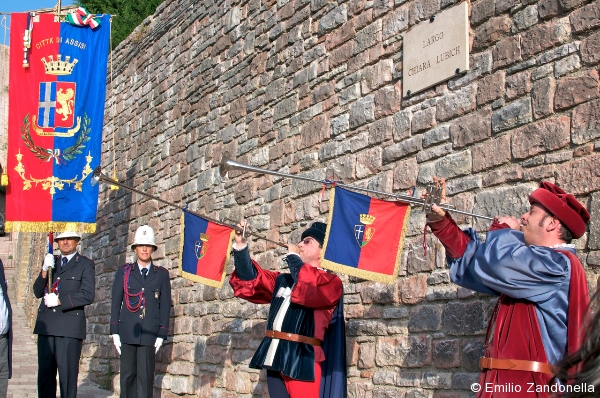 On a sunny 9 June the “Clare of Assisi and Chiara Lubich Meeting: two charisms in communion” occured, It was an event that was meant to to add something to the Clarion Year which recalls the 8th centenary of Clare of Assisi’s conversioin and consecration to God. And it was also meant to attest to the timeliness of Clare’s appeal still today. Hence the desire to deepen the relationship, or better the communion between the charism of Clare of Assisi and Chiara Lubich.
There was a very interesting panel discussion introduced by Mayor Claudio Ricci and the Archbishop of Assisi, Domenico Sorrentino, a variation on a theme in many voices. Professor P. Peter Maranesi, OFM Cap offered a passionate reflection on “Francis and Clare: One Charism, Two Faces,” dealing with its prophetic and revolutionary dimensions that challenged the customs of an era. He also underscored the disruptive innovation of categories such as “mercy” and “sharing” that emerged from Francis’ “conversion”.
He spoke of the spiritual journey of Clare who discovered her identity in the “countenance” of Francis: “… without that face I would have no face. I found God through him. “Theirs was a prophetic opening that led medieval society to discover the person as a way to reach God. The same thing but in different times, has been accomplished through Chiara Lubich. This was discussed by Professor Sister Alessandra Smerilli, F.M.A. in her “Charisms reflected in history and in society”. Charisms are not only “freely-given graces”, but they are “eyes through which those who live in disadvantage see something beautiful and great.” Then these charisms become “bulldozers that open new frontiers, pushing back the stakes” of research and involvement.
 Moreover, charisms are means for the emergence of the feminine. So it was for these two Clares: Clare of Assisi was able to receive approval for her “Highest Poverty” by the Holy See. Clare (Chiara) of Trent introduced into the Church the great novelty that the president of an ecclesial movement, containing all the vocations, will always be a woman. The accomplishments of Chiara Lubich’s charism are exquisitely secular (like the Economy of Communion), showing how much the charisms of the past and present are like the flywheels, that gradually lead us to a society that is more “humane and beautiful”.
Asthetics and beauty are inherent to the action of a charism. “Chiara of Assisi and Chiara Lubich: the Communion between Two Charisms as a Source of Light” was the theme of the presentation given by Lucia Abignente from the Focolare Movement. The relationship between these two great woman is contained in what Chiara Lubich envisioned in the charisms: a variety of flowers in the garden of the Church. Their unfolding, in unison and in response to the needs of the times, is a progressive flowering of the Word: “Christ unfolded” in time and in space.
“Holy unity and highest poverty” is the charism belonging to the first; “Unity, which has as its key the exclusive love for Jesus Forsaken”, belongs to the second.
The profound communion among the charisms of the two Clares summons us to live with faithfulness their message today.
 “Clare”, “claritas”, “clarify”, words that in the jargon coined by Chiara Lubich are an invitation to inject the light of the spiritual realm into the temporal realm. This was the belief which led, during the second act, the dedication of a large street next to the Superior Basilica of St. Francis, to Chiara Lubich, in order to remind us to “widen our vision”, as the moderator of the round table discussion reminded everyone. In giving his blessing to “Largo Chiara Lubich” Archbishop Sorrentino wished that it should be a “a reminder, a call to people everywhere to consider the streets of the world as places of encounter and dialogue with all.” And Mayor Ricci saw in this “the cobblestones of Assisi, cradle of Franciscanism, coated now in another charism whose style is being family, with economic and social implications.
The day concluded at Metastasio Theatre with the Musical “Clare of God” by Carlo Tedeschi, a lively journey of music, rhythm and dance based on the life of Clare of Assisi and performed by a dance company of young people who were living witnesses of what they performed.
By Victoria Gomez
11 Jun 2012 | Non categorizzato
11 Jun 2012 | Non categorizzato
10 –17 June 2012: On the 50th Anniversary of Vatican II, the Catholic Church in Ireland is hosting the 50th Eucharistic Congress in Dublin. Maria Voce, President of the Focolare Movement.
![Chiara Lubich: Health, Sport and Recreation]()
11 Jun 2012 | Focolare Worldwide

Participants in the 50 th International Eucharistic Congress (C) CSC Media
There has been much expectation surrounding these days in Ireland, but probably no one expected the first day of the congress to have such an ecumenical tone. Yet, it has been one of the most interesting aspects of this 50th International Eucharistic Congress (Dublin, 10-17 June 2012) that has been promoted by the Catholic Church, but also – becuase of its main theme of communion – involves and openness to dialogue with all the baptized.
Already during preceeding days, during the Theological Symposium (Maynooth, 6-9 June 2012), ecumenical dialogue had entered the field in a similar context. Leaders of several Churches, including Metropolitan Emmanual (Adamakis) from France; President of the European Conferences of Churches; and Cardinal Koch, President of the Pontifical Council for the Promotion of Christian Unity, spoke precisely about the ecumenical vision of the relationship between Eucharist and ecclesical communion.
 The presentation of Maria Voce one of the speakers at the event, was framed within this same context. Her presentation was proceeded by that of Brother Alois, the Prior of Taize who, recalling the story of Brother Roger Schutz, founder of the Community, underscored how “the passion that fills their hearts” is precisely the call to work without ceasing for “the unity of the Body of Christ”. He was followed by Reverend Jackson, Anglican Archbishop of Dublin, with the Liturgy of Water and Word, recalling our common baptism.
Maria Voce’s presentation on “Communion in one baptism” were testimonial in style, beginning from her own experience of the Gospel, which began when she was a young student in Law School. She had been fascinated by other young people who had found their fulfillment in living the Words of Jesus. This experience had begun with Chiara Lubich in 1943, and had drawn in millions of others from around the world in the rediscovery of those fascinating words. Citing Luther, Maria Voce recalled: “We must be certain that our soul can do without anything, except the Word of God.” The Word transformed into life, giving witness.
Maria Voce experienced it directly during the ten years she spent in Turkey, a land with few external signs of Christianity, but one where she was able to “experience the beauty of the family that Jesus came to create on earth.” In the 70 years of the Focolare she saw how this typically communitarian and ecumenical spirituality joins those who live it in such a way that they feel like on Christian people. It is a dialogue of life: “Positions and even the most advanced agreements among theologians are not enough, if the people are left unprepared,” Maria Voce affirmed, and she even dared to say: “United by this spirituality, we would like to be leaven among all the Churches and to contribute to accelerating their journey toward the full and visible communion, including Eucharistic Communion”.
Cardinal Ouellet, who had been sent by Benedict XVI as his representative at the Congress, also affirmed that the future of the Church passes through her witness of unity and her dialogue with all humanity. Diarmuid Martin, the Archbishop of Dublin and President of the Congress offered a word to the Irish youths, adding that “the Church in Ireland is on a path of renewal.”
The ecumenical day (11 June 2012) continued with a series of workshops. Among them was: “The dialogue of life in a new phase of ecumenism”. It was conducted by Renate Komorek from the Focolare Movement, and included various guests: Rev. Bronwen Carling, Anglican; two presidents from Northern Ireland, from a Protestant school and from a Catholic school, who have had a long history of collaboration; members of the Arche Community of Corrymeela and people from the Charismatic Community.
Wandering among the stands at the Royal Dublin Society, among 20,000 visitors who have been here over these days, brings to mind the “strength” that keeps us together; to use the words of Maria Voce: “Living in mutual love, which permits the presence of Jesus among two or more Christians who are united in his name. Jesus between a Catholic and an Anglican, between an Armenian and a Lutheran. . . This is how the Church, in a certain sense, passes beyond the confines of church buildings and, in the full communion among all, draws closer to the humanity of today in order to respond to the needs and the questions with answers that only the Gospel can give”.
By our correspondent Maria Chiara De Lorenzo
For more on the Eucharistic Congress see:
The genetic code of communion da Città Nuova online
Report of Maria Voce’s testimony at IEC2012, Monday June 11, 2012 | Download pdf
Video interview with Maria Voce
![Chiara Lubich: Health, Sport and Recreation]()
10 Jun 2012 | Focolare Worldwide
 A land rich in history with deep Christian roots that go all the way back to the earliest centuries after Christ (432), the island was evangelized through the efforts of St. Patrick. Known for its ancient Celtic traditions and its national and traditional song, with U2 and Riverdance, its great literary stars including four Nobel Prize winners, Ireland has also had some sorrowful pages among the leaves of its recent history:the drama of the independence’s war, the violence between Catholics and Protestants and the still open wounds of sexual abuse in the Catholic Church.
The words of Benedict XVI in the Letter to the Catholics of Ireland (March 2010) continue to resound: “As you face the challenges of this moment, I ask you to remember the “rock from which you were cut” (Is. 51:1). It is in this context, within this process of purification and rebirth of the Irish Church that the 50th International Eucharistic Congress (10-17 June 2012) is set.
Ireland’s soil has been irrigated with the Movement’s spirituality of unity since 1969, when a woman, Margaret Neylon, on her way back from England spread to those around her the new way of life she had just discovered: based on the love taught by Jesus. She and her son Eddie, who suffered from muscular distrophy, became the soul of the first Focolare community that led to the opening of the first focolare in Ireland in 1971, followed by a second in 1976. Currently there are five focolares in the country and a formation centre has been begun at Mariapolis “Lieta”. This Mariapolis was named after an Argentine focolarina, Lieta Betono, who lovingly devoted her life to bringing the ideal of unity among many people from Ireland, until 2002 when she died of a serious illness.
Many stories intertwine as you examine the history of the Focolare’s growth in Ireland: among them is the story of Sister Anna who decided to bring a group of Catholic and Protestant youths to an international gathering in 1973, the Genfest. Among them was Sally McAllister, who would become the first Irish focolarina. Originally from Northern Ireland, she had decided to join the armed struggle.
But then she discovered the biggest revolution in the Gospel, which gave meaning even to the pain of division and of the violent fratricides of the world.
 Today the Focolare Movement is spread at various levels and among persons of all callings. It works in collaboration with other Catholic movements, with members of other Churches and with members of the Sikh community. Since 1991 when the Economy of Communion was born, several businesses have joined the project, for example: Paul Connoly Optomerist, Nettrafic Telecommunications and the Language and Leisure International, English language school.
The Teens for Unity have carried out many projects in favor of peace and hope in the cities: a video documentary in which they present their projects to “colour” the dark corners of the cities; the worldwide baton race, ‘Run4Unity’ which was held in Belfast on 12 June 2012 in front of the Northern Ireland’s Parliament building. Together with projects promoting the Golden Rule through sport in many schools throughout the country, the cube of love for children and the Run4Unity have become part of the official programme in preparation for the Eucharistic Congress.
Chiara Lubich visited Ireland in 2004 when she met Sean Brady, the Primate of all Ireland, various bishops including Diarmuid Martin, the Archbishop of Dublin; Mary McAleese who was then President of the Republic; Bertie Ahern, who was then Taosieach (Prime Minister) and President of the European Union, and the Focolare community. On that occasion Chiara said: “We need to foster unity, unity among Christians who give witness to the faith in a different way today (. . . ) and I believe that this living witness of authentic family life and of the life of faith is one of the most important things that we have to offer for the future of our Land.”
In 2012 Maria Voce visit Ireland together with Co-President Faletti for the International Eucharistic Congress (10-17 June). There she has been asked to present her own Christian experience. Several of the Congress events are presented by the Focolare: the “Chiara Luce Youth Section”, workshops on the Economy of Communion and the Church as Communion, the open meeting, an Ecumenical gathering in the Anglican Cathedral of St Ann in Belfast on 14 June, which will give a sense of ecumenical dialogue to the entire Congress.
To see Focolare contacts in Ireland visit Focolare Worldwide!
![Chiara Lubich: Health, Sport and Recreation]()
9 Jun 2012 | Non categorizzato
 “It was a pilgrimage of Truth,” as Benedict XVI described the 2012 event in Assisi” commented one of the organizers of the event from the Focolare Movement. It brought together a hundred people – both Buddhists and Christians – from several parts of the world.
The Buddhists who came from Thailand, Japan, Taiwan, Sri Lanka, Malaysia and Korea represented different strands of Buddhism: Therevada with a group of Thai monks, Mahayana from Japan, besides the Rissho Kosei-Kai, a Buddhist association that for more than thirty years has been collaborating with the Focolare Movement. Present also were followers of the traditional schools such as Tendai-shu, the Nichiren-shu, and the Hosso-shu and the Chines Buddhism represented by the nuns who travelled from Taiwan, Sri Lanka and Malaysia, who belonged to two new associations: the Dharma Drum Mountain and the Fo Guang Shan. From Korea, there was one representative Won Buddhism.
 The Christian representatives – forty in all – were from Thailand, Japan, Korea, Taiwan, the United States, Austria, Switzerland, England and Italy, with the presence of Cardinal Jean-Louis Tauran, president of the Pontifical Council for Interreligious Dialogue, as well as the president of the Focolare, Maria Voce.
“Not only discover the common points, but build together a world full of love and of compassion, staying faithful to the identity of each religion. This is the extraordinary aspect of this syposium which is difficult to find anywhere else,” wrote Nichiko Niwano, president of the Rissho Kosei-kai in a message in which he summarized very well the atmosphere of deep trust that has been built over the years, and that enveloped all the newcomers.
The title of the gathering (“Understanding and living Scriptures as a way to universal harmony and peace”) was invented by the group of scholars who gave the presentations. Already in the preparation stages there was much collaboration both in choosing the content of the presentations and in preapring the translations in four languages. All this work permitted that after each presentation there was more time for open dialogue, which was expressed more as personal communion by each of the participants.
 The differences, not only between Christianity and Buddhism but also among the various strains of Buddhism, in this special setting of deep spirituality, did not create difficulty or tension. On the contrary, they became a precious reciprocal gift, rienforcing each one’s own faith.
“As I listened to the Scriptures of each relgion, I saw that there are some common points and some divergent ones, but this symposium was a growth of wisdom for each one of us, reciprocally,” said Phrakhru Suphan, master of Vippassana meditation and abbot of the Wat Ram Poeng Temple in Chiang Mai, Thailand.
Significant was the interest of monks from the traditional schools, in the modern Buddhist movements. Greatly appreciated was the presence among the Christians of one Anglican priest, a pastor from the Reformed Church and a Lutheran lay woman.
Throughout the gathering many spoke about the “special atmosphere” that they sensed, even recalling the words of John Paul II in 1986 with leaders of non-Christian religions in Madras, India: “May God be present in our midst, for when we open up to each other in dialogue, we open ourselves also to God.”
![Chiara Lubich: Health, Sport and Recreation]()
5 Jun 2012 | Focolare Worldwide
 “My name is Jay. I’m Jamaican and work as an accountant. This is my wife, Anna and she’s a special education teacher. And these are our six children, ranging in age from two to twelve.”
This is how the Rerrie family introduced itself to Pope Benedict XVI during the Festival of Testimonies that was broadcast over live TV from Milan on 2 June 2012.
For Jay and Anna Rerrie the spirituality of unity has helped them to maintain a solid relationship with each other, and it has united their family in times of difficulty.
In early 2006, when the labour market had entered into a severe crisis, Jay had to find a new job. In spite of the many obstacles, they agreed that they wanted to keep their mutual love alive, facing the moment with courage, even though Anna was expecting their fourth child and wondering how they would support the family when Jay was jobless.
They decided together that even though she was pregnant, she could return to teaching, and they moved to another city where a school was prepared to hire her.
Jay also found a job there, in an office where he spent many hours trying to finish the four months of work that was left undone when no one was working there. His efforts gained him the esteem of his new boss.
But it wasn’t the same at home. “My wife and small children in school: a recipe for disaster!,” Jay explained. “There wasn’t enough time to be together.” Anna found it difficult to accept, having grown up in a home where the family was always together for supper. Now Jay would often return home when the children were already in bed sleeping.
Meanwhile, the company he was now working for began to have problems and, once again, he found himself jobless. Anna’s overall reaction to this sorrowful news was comforting for Jay. It resulted in a deeper experience of unity with each other. “The next two months,” Anna recalls, “were enjoyable and unnerving at the same time. But it was fantastic to have Jay at home!”
In a few months their savings began to dwindle, but they never stopped believing. Then there was a telephone call. It was an offer of a better job, one closer to home, with hours that were compatible with the family schedule.
 “I think I understand this dilemma, “ the Holy Father told them, “So I would like to invite employers to think of the family, so that the two priorities can be reconciled. It seems to me that you naturally must be creative but, at least each day, bring some joy into the family, some attention, some giving up of your own will in order to be family together. And then there is Sunday, the feast day, the Lord’s Day, also the “human person’s day” because we are free. This comes from the Creation story, the original intention of the Creator that one day, everyone would be free. In this liberty of being one for the other, for yourselves, you are free for God. I think that this is the way for us to defend human freedom, by defending Sunday and other feast days as days of the Lord God and therefore days for the human person. Good luck to you! Thank you!”
See THE HOLY FATHER CELEBRATES WITH THE FAMILIES OF THE WORLD
![Chiara Lubich: Health, Sport and Recreation]()
2 Jun 2012 | Non categorizzato
 Saturday morning, 2 June 2012. Sesto San Giovanni in Milan welcomes 4,000 people from Lombardy and the neighbouring areas, family members who are actively involved in the Focolare Movement. Among the presentations as well as that of president Maria Voce and co-president Giancarlo Faletti.
“Over the next few days in which you will be focusing on the family,” Maria Voce began, “the question will arise: What is God’s design on the family?” She answers by quoting Chiara Lubich at the Familyfest in Rome 1981: “God created the family, he formed a family. When he was incarnated, he wanted to be surrounded by a family. When Jesus began his mission and manifested his glory, he was celebrating at a marriage feast, he was celebrating a family.”
Referring to the theme of he event: The Family: Work and Celebration, Maria Voce underscored the importance of work for its foundation and sustenance.
“In turn,” the president affirmed, “the family is important to work. As it educates us to be laborious and to absorb values that are typically instilled by the family, the spirit of cooperation and solidarity which are so proper to the family, the importance given to free giving, reciprocity and being a gift for each other – it helps in giving a solid base to society,” she affirmed stongly. “The human person is not only designed for work.
And so work should be arranged and carried out in such as way as to takes into account not only the economic needs of the people, but their total wellbeing. And so it is important that the time at work be harmonized with time in the family”.
At this point the president of the Focolare recalled that even Jesus worked (as did Mary and Joseph) and, that “besides being perfect workers, they were also a perfect example of celebration.” She mentioned their pilgrimage to Jerusalem. . . the wedding feast at Cana “where, with Mary his Mother, they went to celebrate the marriage of two newlyweds. (. . . ) In the Holy Family there was both work and celebration, which means to say a time for rest, for relating to others.”
Referring once more to Chiara Lubich, Maria Voce concluded by underscoring that “In a certain sense (Chiara) had anticipated this topic: Work and Celebration. That is, if we live the values found in the family, then even work and celebration will be imbued with such values. And we will become true witnesses and builders of a society according to the heart of God.”
Full text of Maria Voce’s talk
31 May 2012 | Non categorizzato, Word of
The ‘food that endures’ is the person of Jesus himself and it is also his teaching, since Jesus’ teaching is one and the same with his person. When we read Jesus’ other words later on, we see that this ‘bread that endures’ is also identified with Jesus’ Eucharistic body. So, we can say the ‘bread that endures’ is Jesus in person, who gives himself to us in his Word and in the Eucharist.
Do not work for the food that perishes, but for the food that endures for eternal life, which the Son of Man will give you.
The image of bread is often used in the Bible, as is the image of water. Bread and water represent the basic foods indispensable for human life. Now, by applying the image of bread to himself, Jesus means that his person, his teaching are indispensable for the spiritual life of human beings, just as bread is for the life of the body. Material bread is certainly necessary. Jesus himself provides it miraculously for the crowds. But on its own it is not enough. Human beings bear in themselves, perhaps without fully knowing it, a hunger for truth, justice, goodness, love, purity, light, peace, joy, infinity, eternity, that nothing in the world can satisfy. Jesus offers himself as the only one capable of satisfying the inner hunger of humanity.
Do not work for the food that perishes, but for the food that endures for eternal life, which the Son of Man will give you.
In presenting himself as the ‘bread of life’, however, Jesus is not limiting himself to affirming the need to feed on him, and so believe in his word, in order to have eternal life. But he wants to encourage us to have an experience of him. Indeed, when he says, ‘work for the food that does not perish,’ he gives us an urgent invitation. He means that we must be involved seriously, do every possible thing needed to have this food. Jesus does not impose himself, but he wants to be discovered, he wants to be experienced.
Certainly by their own strength alone human beings cannot reach Jesus. They can do it as a gift from God. Nonetheless, Jesus continually invites people to put themselves in a position to receive the gift of himself, which he wishes to give. And it is precisely by striving to put the Word into practice that human beings come to full faith in him, to taste his Word as one would taste sweet-smelling and flavoursome bread.
Do not work for the food that perishes, but for the food that endures for eternal life, which the Son of Man will give you.
The Word of Life is not about a specific point of Jesus’ teaching (such as forgiving offences, detachment from riches and so on), but it brings us back to the very root of Christian life, which is our personal relationship with Jesus.
I think that those who have started living the Word with commitment, and especially the commandment of love for our neighbour (the summary of all the words of God and of all the commandments) sense at least in some small way that Jesus is the ‘bread’ of their lives, able to satisfy the desires of their hearts, the source of their joy, of their light. By putting the Word into practice they have at least begun to taste it as the true answer to the problems of humanity and of the world. And, since Jesus, the ‘bread of life’, gives the supreme gift of himself in the Eucharist, they go spontaneously to receive the Eucharist with love, and it has an important place in their lives.
Those of us who have had this amazing experience must not keep it for ourselves. With the same concern that Jesus urges us to work for the ‘bread of life’, we should communicate it to others so that they may find in Jesus what their hearts have always sought. It is an enormous act of love for our neighbours because already from this earth they can know what true life is and they will have the life that does not die. And what more could anyone want?
Chiara Lubich
First published in August 1985
![Chiara Lubich: Health, Sport and Recreation]()
31 May 2012 | Focolare Worldwide
 “Mostly people felt very afraid and needed support to stay calm. We are all shocked. Closeness and sharing are the things we most want”. Maria Palladini and Franco Monaco, who are responsible for the focolare community in the Emilia region of Italy: the site of the earthquake. In the space of a week a series of quakes resulted in 17 deaths, over 350 wounded and 15000 displaced persons. The situation continues to unfold with strong aftershocks. The worst hit regions are the area between Modena and Ferrara. The earthquakes caused major damage to historic buildings, factories and many churches have been destroyed or are beyond repair. Lots of remarkable stories have come to light. For example, someone couldn’t get out of their house but this saved them as a large block of the building fell outside and could have harmed them. Another person was deeply affected, suffering by the death of fellow workers in a collapsed warehouse. Someone else was evacuated from hospital. Each one experienced “the power of how everything can change in a split second” and straight after the fist shock “a network of phone calls started to find out how everyone was”. To help us understand the situation from the aspect of humanitarian help are Adriana Magnani and Stefano Masini of the New Humanity Movement. They tell us “The Civil Protection organisation is up and running now in all the towns and villages affected and has instigated accommodation in a variety of ways (reception areas, undercover shelters, some hotels) providing some 9,000 places”. Volunteers from the Civil Protection organisation have come from all parts of Italy.
  Adriana and Stefano outline the greatest needs: “Some psychological support, because everyone has been really traumatised; any campervans or caravans for sleeping in rather than sleeping in the street, we’re working on this in this region; there is an urgent need to check the viability of large and small companies as there is the possibility of 15,000 people being out of work…” “The priority is to have technicians who can help”. We need psychologists, doctors and engineers: however, all those who want to come and help should deal directly with the local Civil Protection agencies as they are the one co-ordinating all offers of support.” Together with a small group, it is Adriana and Stefano who are the reference point for the collection of requests and availability of help “we try to match all the needs match as much as possible with the appropriate help and co-ordinate; awareness of who, in the political or social field can help to resolve the bureaucracy that can block the start of actions”. Alongside the devastation, wounds and terrible trials the people of the Emilia region have endured through this earthquake there runs a river of solidarity. Maria Palladini and Franco Monanco confirm this: “Many people have flung open their doors to welcome the homeless. Each area has a kind of competition of fraternity and solidarity which itself is spreading like oil on water. We really understand the experience of Chiara Lubich and the first focolarine during the destruction of the Second World War: everything crumbles, only God remains, only Love.” Donations/Bank details: BANK ACCOUNT: Associazione Solidarietà BANK NAME: Cariparma Crédit Agricole IBAN: IT34F0623012717000056512688 Title: Terremoto in Emilia Romagna For payment via Credit Card or PayPal visit www.solidarietaonlus.org)
![Chiara Lubich: Health, Sport and Recreation]()
31 May 2012 | Non categorizzato
 We publish an extract of an interview with Maria Voce by Lucetta Scaraffia. A complete translation will be available soon. “We were quite keen on having you for the first interview that will appear in the Roman Observer’s new section on women. You are the only woman at the head of a movement of such great importance. Does this unique position of yours ever weigh you down, interacting with ecclesiastical hierarchy? Not only does it not weigh me down, but it is a peculiarity which is more and more recognized by the Pope, cardinals and bishops, in accordance with what it signifies and was originally expressed by John Paul II: to be the guarantee and the sign of the Marian profile that tells of the primacy of supernatural love, of holiness, and is co-essential to the Apostolic-Petrine profile. These dimensions work together, Wojtyla said, in “making present the Mystery of Christ and his saving action in the world.” But for the first twenty years of our history it wasn’t like this: it was a total novelty! There was a long and tedious process behind it, involving much suffering (. . .). In recent years the Church has had to overcome great difficulties. Do you believe that a different role and a different presence of women might have facilitated the overcoming of these difficulties? It’s hard to say. I would say that we should look at today when a deep crisis is passing through not only the Church, but all humanity. If the root of the problem is a crisis of the faith, as the Pope continues to insist, then woman, wherever she may be living, has the specific vocation to be the God bearer, the bearer of supernatural love, which is the greatest value and the most useful one for renewing both the Church and society. By Lucetta Scaraffia Editorial – Roman Observer See insert in Osservatore Romano
![Chiara Lubich: Health, Sport and Recreation]()
30 May 2012 | Focolare Worldwide
 The Family: work and celebration”. This is the theme of 7th World meeting of Families which will take place from the 30th May to the 3rd June 2012 in Milan, Italy. Promoted by the Holy See through the Pontifical Council for the Family and the Archdiocese of Milan, the organization of this event mobilizes quite a number of associations, groups and movements that contribute towards the well-being of the family.
Work began on 30 May with a Congress on Pastoral Theology, with opening words from Prof. Luigino Bruni of Bicocca University of Milian. On the evening of 1 June, there was a concert at the Scala with Maestro D. Barenboim.
For Benedict XVI, this edition of the World Meeting of Families is “an opportunity to reflect about work and rest as aspects of a united family, open to life, well inserted in society and in the Church, attentive to the quality of relationtionships besides that of the household economy”.
Since the very beginning, the families of the Focolare Movement have been contributing towards the organization of this event, both as members of the Pontifical Council for the Family and also because of a longstanding presence in religious and civil institutions that contribute towards the well-being of families in Lombardy. The appointment given for Saturday morning 2nd June at Carroponte di Sesto San Giovanni will be in preparation for the evening meeting with Benedict XVI. From there they will proceed together to Bresso Airport to greet the Pope. “Relating about families while waiting for the Pope” is the programme intended for this session. Maria Voce and the couple Anna Maria and Danilo Zanzucchi, who are among those who began the New Families Movement, are expected to participate and give talks.
29 May 2012 | Spiritualità
(more…)
28 May 2012 | Focolari nel Mondo, Spiritualità
(more…)
![Chiara Lubich: Health, Sport and Recreation]()
27 May 2012 | Focolare Worldwide
 Spain has a long history. In 218 BC the Roman Empire set the stage for a cultural and territorial link between the Celtic and Iberian peoples who had already been settled there for centuries. The Basque people, however, who settled in the north-west of the country were not subjected to this influence. The Latin language evolved into Castilian – the official language – Catalan and Galician. Together with Basque these are the co-official languages of the country. In later centuries, Islam conquered most of the peninsula. The coexistence of Muslim, Christian and Jewish cultures created the necessaray conditions for the transmission of the scientific and cultural heritage of antiquity and Arabic science to the Christian West.
Today, Spain appears as a society that wants to take into account the diversity of these cultures that are contained in the Constitution, but that still have many challenges to resolve, such as the tensions between the autonomous communities and the State. It is a society that in the past has had great economic and social development, but now suffers the consequences of the social and economic crisis.

Una delle prime Mariapoli a Seo d’Urgell
The Focolare Movement arrived in Barcellona in 1959 through Piero Pasolini, an Italian focolarino. “There is a lot of God in this nation,” he would say, “and it seems to me that He has a very special love for this place.” Subsequently, people of all ages were drawn into the spirituality of unity. Mariapolises were held in Solsona, Seo d’Urgell, Avila. . . A few of the pioneers left a deep mark on this land. We remember the Italians Nunziatina Cilento and Gino Bonadimani, and the Argentinians Margarita Bavosi and Carlos Clariá.
The Focolare’s Gospel lifestyle became incarnated over the years in many social and cultural environments, giving rise to the Political Movement for Unity and to businesses that belong to the Economy of Communion. With the publication of Chiara Lubich’s first book, “Meditazioni,” publishing work was begun in 1964 with two magazines: Ciutat Nova (in Catalano) and Ciudad Nueva (in Castigliano), and several book series dealing with topics of spiriuality, theology, patristics and testimony.
There are currently some 25,000 people in Spain who live the Spirituality of Unity.
 Chiara Lubich’s two visits (1989 and 2002) were fundamental for the life and development of the Focolare Movement in Spain. The first visit was to Santiago de Compostela for WYD, where she gave one of the catecheses before an audience of thousands of youths. In the second visit she went to several cities where some of the great mystics who influenced her had lived: Teresa of Avila, John of the Cross (Segovia) and Ignatius of Loyola (Manresa). At the Monastery of Montserrat she was moved to say: “The movements can be living examples of the Gospel’s charismatic freshness. And the movements can learn much from the witness of the consecrated religious life that preserves so many treasures of experience and wisdom.” During the same visit Chiara offered a challenge to all the members of the Focolare: “In Spain you need to stress Unity, because the distinction is already there” (referring to the variety of languages and cultures).
Two permanent Mariapolises were begun: one named Loreto in Castell d’Aro (Girona) and another named Exterior Castle in Madrid. Exterior Castle quickly became a meeting place for all, where a visible witness is given of unity in diversity and multiplicity, which is characteristic of the sprituality of unity.
In 2011, during a visit of the president of the Focolare Maria Voce and co-president Giancarlo Faletti, she will reiterate how “each of these peoples that make up Spain has something to offer to all the others,” encouraging everyone to be a gift one for the other, precisely because of the unique identity of each individual.
Visit: Spain in Focolare Worldwide!
![Chiara Lubich: Health, Sport and Recreation]()
27 May 2012 | Focolare Worldwide
 “‘The Mine’ was set up in 2003 adhering to the principles of the Economy of Communion which Chiara Lubich launched in 1991. She was the one who called it ‘The Gold Mine’, in reference to the value of the people who would use it: the elderly. How it works is described by Elena Bravo and Jose Alonso, respectively director and administrator of the day centre of which, together with Miguel Monoz and Ana Vera, they are the founders: “We try to act so that at the heart of what we do is not profits but people. We do all we can so that everyone who comes feels welcomed and valued no matter what their physical or psychological state.”
This focus on the care for the older person is lived out practically in lots of ways: “One time”, says Jose Alonso, “one of our workers told us that two of our elderly visitors should be in residential care. We knew this would mean a financial loss to us if two left, but we said: ‘We must think of their needs and not ours’, and we began looking for a new residence for them’.
“We have been through difficult moments “ continues Elena Bravo, “ from illnesses to family problems, but mutual love has helped us to keep going ahead, and when necessary doing each other’s jobs”. In fact, you can feel the atmosphere of sharing and joy among the 18 staff at The Mine.
This atmosphere touches the 50 elderly at the Centre and all those who come to visit: “Recently, Elena says, various youth groups have been here with their economics teachers”. “Some of them, explains Jose, are moved by the happiness of the elderly people, by the family atmosphere and the enthusiasm of the staff. These are the very things that are important to us.”
 The existence and development of The Mine is in a great part due to its ‘secret Partner’, who ensures they lack nothing. Divine providence, in fact, always comes when there is greatest need through: office equipment, fabric, linen, sewing machines to use for teaching needlework…and other more specialised apparatus. “We needed a hoist for lifting our elderly but we didn’t have enough money to buy one. We decided to buy one anyway, thinking of the discomfort of the elderly and their helpers. On the Friday a hoist was delivered for a trial period. On the Sunday we got a phone call from the director of a centre for people with physical disabilities. He who knows how we work and offered to give us an electric hoist. I went to collect it and, with surprise, saw it was exactly the same as the one we had for a trial”
After almost 10 years of faithfulness to the principles of the Economy of Communion and to the “culture of rights”, always putting the person in the centre of our actions even in difficult moments, Elena and Jose can confirm that “In spite of all the difficulties and sharing the profit with those in need, the EdC project grows and stays in the market, even in moments of crisis.”
![Chiara Lubich: Health, Sport and Recreation]()
25 May 2012 | Focolare Worldwide
 “We have had the experience that our differences are not a reason to divide, but represent a multiplicity of gifts and a resource”. This is an extract from the Manifesto which was read in the Square Meeting Centre in Brussels, at the conclusion of the day meeting Together for Europe 2012.
More than a thousand people came together in Brussels from every part of Europe. Tens of thousands linked via satellite in 22 countries, all shared the message of hope, unity and peace for Europe.
“Together for Europe”: the underlying characteristic of this event set it apart from all other events for Europe: it was the complimented by a fine-mesh net of events simultaneous meetings held in 144 cities throughout Europe.
A mix of events, some small scale others large held in places of symbolic high profile in places. They brought collaboration between movements and ecclesial communities. These relationships show a glimpse of hope for future moves to act together for the common good of local communities: from Breslavai in Poland to Belfast in Northern Ireland, Oslo in Norway to Valletta in Malta. There were lots of initiatives involving people of all ages, walks of life and creeds.
 In Augsburg, in Germany, the programme started with a ‘flashmob’ in the central square: seven giant balloons were released each displaying one of the seven yeses which mark up to today the commitment of the movements and communities for families, life, peace and a more balanced economy.
In Breslavaia, Poland the aim was to highlight the delicate process of meeting and reconciliation between the people of Poland and Germany (to heal the hurts lingering after the Second World War) with an event called “Christians of Germany and Poland Together for Europe”.
In Ischia, Italy, a human chain ‘encircled’ the perimeter of the island as a symbolic gesture defending the environment and of welcome. Still in Italy in Florence, at the Sala dei Cinquecento, in the Old Palace, the event had a direct live link with the main event in the Square Meeting Centre in Brussels.
And if, for some of the Movements and Christian Communities the way of brotherhood of “Together for Europe” has been an experience over a number of years, for others the events in 2012 were the chance of experiencing at first hand working together and getting to know one another better. A couple from Laudau in Germany explain: “Brussels 2012 has been an excuse to get to know one another better, to take an interest in Movements we had never heard of. We are very enthusiastic and want to concentrate our strength to bolster the Christian soul of Europe starting in our own city”.

These stories of collaboration and fraternity give credence to the possibility of giving Europe the hope that Andrea Riccardi, founder of the Sant’Egidio Community, spoke of in his talk in Brussels: “The greatest European mystery is the lack of hope” Because of this “we need to generate a climate of sympathy and solidarity, a sense of a common destiny has to rise up, a social network has to be born’.
“Together for Europe – Maria Voce underlined in her talk – is a fascinating undertaking: we have the possibility, also through events such as this one today, to give witness to the men and women of our times that live on the earth in a spirit of sharing opens a future of fraternity and peace for the individual, peoples, to our continent and the whole of humanity”.
__________________________________________________________________________________
Flickr photostream: www.flickr.com/photos/together-for-europe/
![Chiara Lubich: Health, Sport and Recreation]()
23 May 2012 | Focolare Worldwide
 May 23, 1992: Italian magistrate Giovanni Falcone was killed in a Mafia bombing together with his wife and bodyguards. 57 days later, on July 19, another prosecuting magistrate, Paolo Borsellino, who was also investigating the Mafia, died in a second attack. Those sad events marked a civil re-awakening, starting from the new generations, which today is living in a new phase.
On the occasion of the 20th anniversary of the massacre, ships carrying 2000 students will arrive in Palermo. Various activities have been organised involving the local citizens, including one by the Focolare’s “Youth for Unity” who will promote the “Golden Rule” as the basis for a culture of justice in the public squares of Palermo as well at the site of the “Falcone Tree” (a magnolia tree planted in front of the magistrate’s house which has become a focal point for the anti-Mafia movement) during the solemn commemoration.
Their manifesto reads: “Our motto is the Golden Rule found in all the sacred books of the great world religions and the basis for Natural Law”.
In the Gospel it says: “Do to others whatever you would like them to do to you. “ (Mt 7:12)
In the Old Testament: “What is hateful to you do not do to others. This is the whole Law” (31st Sabbath, Babylonian Talmud)
In the Qur’an: “None of you is truly a believer until he he wishes for his brother what he wishes for himself.” (Prophet Mohammed, 13th of the 40 Hadith Nawawi)
In the Buddhist holy book: “Treat not others in ways that yourself would find hurtful.” (Udana-Varga 5.18)
“Living the Golden Rule in our cities also means abiding by the law,” continues the appeal of the Youth for Unity. It means rejecting all forms of bribery and not giving in to bullying ; it means becoming involved in civic life and refusing Mafia dealings and corruption.
The young people’s aspiration is that there be lawfulness in the city “where the underprivileged, the least in our community are looked after,” “keeping in mind the blood of the martyrs which has been shed over the years in our lands”. Their desire is that this message can reach the Youth for Unity throughout Italy and as many young people as possible so that together they can be “the answer and the fruit of the bloodshed of martyrs in order to build a better future for our country and the world”.
At the conclusion of this initiative aimed at peace and justice, the Youth for Unity will invite all the young people in the various towns and cities of Palermo and Sicily to meet on June 2nd in a symbolic place: the Brancaccio neighbourhood. This is where the Fr Pino Puglisi was killed by the Mafia. He was a priest who gave his life for his people through his mission of re-education. School materials and supplies collected on the day will be donated to the “Puglisi” high school.

22 May 2012 | Focolare Worldwide
“Together for Europe” could not be missing a session on the economy. In fact, in the prestigious headquarters of the European Parliament, at Pace de Luxembourg – in the hall after Alcide De Gasperi, the noble father and co-founder of what would become the European Union, – a group of experts, politicians, business people, youth and citizens met for a conference on: “The Economy: a Matter of Gift.” Certainly the stakes are high: the current crazy course of the financially ill market has lost its direction for the Common Good.
Hendrik Opdebeeck, professor of philospohy and economy at the University of Anwar and a member of the Ethics Center, in opening the session, described in seven points the concept of responsibility and connected it to freedom, alterity, encounter with others, the responsibility of global institutions,the limits of the market economy and to globalization.
The recent French and Greek elections, with their different societal tensions, according to the professor, pose a question: Is it the case to give merit-based salaries, according to the vision of liberalism, or to give everyone their part in conformity to their needs, according to the socialistic model? In our current European society, the economic, social, legal and financial aspects risk being shaped by egocentrical and irresponsible organized structures, at the national, international and global levels. From this point of view, Europe in crisis should look to another important future paradigm: that of responsibility.
Luigino Bruni, associate professor of Economy at the University of Milan- Bicocca and the Sophia University Institute of Loppiano, offered a clear analysis, without mercy for the current crisis, but also with a proposal: the Economy of Communion. He highlighted that right from its birth, the economy found strength and inspiration in charism, from Monastic Communities that knew how to create living laboratories from which emerged the initial categories and the first institutions to give life to a market economy. « And it is undeniable that also Christian humanisms,” he continued, “with their charitas and charis, played a decisive role.» But more than putting the economy on trial, it is the increasingly speculative finance sector that should be on the guilty bench. According to Bruni, we need «to do something» and bring back from the margins to the public square those charisms that encourage reciprocity, gratuity-gift and the common good. How? By bringing the finance sector and the economy into the public debate because «it’s too risky to leave them only in the hands of those who work in those sectors.» To begin again from the poor and to relaunch the idea of a new social pact, and to trust that the epochal changes can be a fruit also of a prophetic minority, as has already happened in the past. Finally, the young people: they are the ones who can bring a new turn to the economic and financial sector.
From the proposals, they then passed on to the supportive projects that can be carried out at a European level: a moratorium on advertising that targets children, which has to be taken away from those who seek profits: a moratorium on gambling games, a Tobin Tax, or something along that line, so that risky financial endeavors pay the right amount; finally, a strengthening, also through adequate legislative tools, of the social and civil economy in Europe.
In the presence of the Vice President of Europe, Laslo Surjan from Hungary, responsible for dialogue with the Churches, “best practices” for the economic sector were delineated: three businesses (one in Belgium and two in Croatia) shared how to convert these principles of gift into a commercial exchange where “investors”, share holders and workers, even though having different roles, have equal value. Jan De Volder, from the Community of Saint Egidio in Belgium, shared on the”revolt by gratuity,” while Claude Matz, from the Association for a United World (AMU) of Luxemburg, demonstrated the development projects sponsored and implemented throughout these years.
Steve Vanackere, federal vice-minister and Minister of the Economy in Belgium, concluded the session by highlighting some critical points in the proposals, in order to encourage a dialogue even more pertinent to current economic systems, and he dared the political establishment to give «not only answers, but the right answers.» Then addressing Professor Bruni on the importance of a prophetic mionority, he underscored: «this audience is one.»
![Chiara Lubich: Health, Sport and Recreation]()
21 May 2012 | Focolare Worldwide
 Finally, in the afternoon of Saturday, 19th, the much awaited meeting was held with Maria Voce and Giancarlo Faletti, to celebrate the big feast for all. The event was held, a few kilometres away from the capital, at the Multiversum of Schwechat, a modern multi-functional structure that hosts concerts, cultural and sports events, and fairs. Around 700 persons attended from the nine regions of Austria.
In their initial greeting, Maria Magerl and Andreas Amann, who are responsible on a national level for the Focolare Movement, expressed their joy, and most of all, their gratitude to God for Chiara Lubich and the spirituality of unity that have given to many a new profoundness and fullness in their lives. They expressed gratitude also to all those who during these fifty years have contributed, each one in his own place, to the development of the Movement. They were particularly glad that after, in some cases, years of absence, there were present at the celebration many “persons who had built and accompanied them on the journey in the past”.
During the first part of the meeting, the fundamental stages of the story of the Focolare Movement in Austria were reviewed, through historical photos and filmed witness, as though going through a family album. Up to the point, in 2001, when Chiara had passed 10 days in Austria, and had given important indications on the fields of action that the focolari community had to be committed. A video film with extracts from her speech at the Mayors Congress “1000 cities for Europe” (Innsbruck) revived memories of this special event in many of those present. This flash back was concluded with the memory, full of gratitude, of many members of the Movement, of different age and vocation, who have already reached the heavenly homeland.
The Focolare Movement in Austria “today” then followed, beginning with a presentation on the permanent Mariapolis “Giosi” and the Mariapolis Centre Am Spiegeln. From the “family treasures”, the experience of Reinhard Domig was presented, who in August 2008, was a victim of a violent robbery in his postal office, and who forgave his aggressor. There were various experiences of “dialogue” within the Catholic Church, and contacts with Christians of other Churches, and also with faithful of other faiths (mostly Muslims) and with persons without religious convictions, as the several years’ contacts with members of the Communist party. It is mostly a dialogue of life, sharing and participating in common action, such as projects for the integration of those in need, and pedagogy. Other initiatives at a more cultural level are those in the realms of economy, ecology, sport, and communication.
The young people presented the Social day for the homeless, aged, and children of refugees, the worldwide relay race for peace Run4unity, and the actions to allow ten Indonesian youths to participate at the coming Genfest in Budapest. All this is done to contribute to fraternity in Austria, a Country that is always becoming more pluralistic.
At this point, many wished to know Maria Voce personally, and she therefore gave a brief greeting. The feast then continued on stage with songs, games and artistic numbers; followed by a rich buffet.
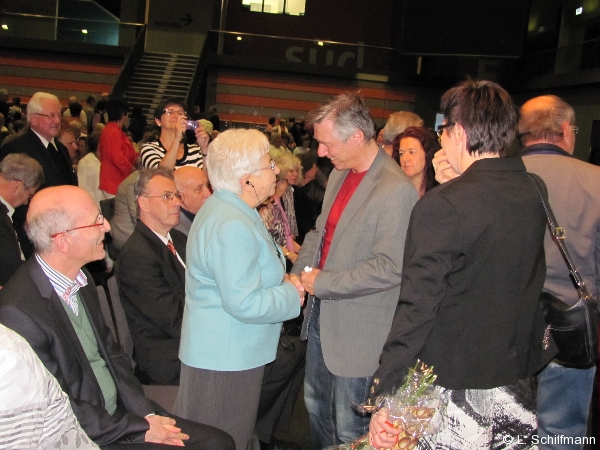 On the 20th, Sunday morning, a new appointment was held at the Multiversum, with the more committed members of the community. The programme included a Mass animated by songs from the gen, followed by a dialogue meeting with Maria Voce and Giancarlo Faletti. The replies to the questions were simple, illuminating, encouraging. The questions were made by youths and adults on themes regarding the witness to offer in today’s challenges so as to have more effective impact in the various spheres of society.
The joy of all exploded in a great applause, and the president of the Focolare concluded with this prospect: “The notion that ours is a life and not an organisation has over the years always accompanied me, and made me understand what it means to be children of God. I do not know whether I am being bold, but I would like to wish you liberty which means: be free also from the desire to be efficient, from the need to do things well, from the memory of things that did not happen as you would have wished, from the historical situation. Be free, to have the happiness of being able to say yes to God, and know that He awaits your collaboration, to make of the “ideal” Austria and example of true, profound liberty; it is a freedom that comes from recognising and accepting our limitations, from thinking that in spite of these limitations we can do good (this is more difficult!), believing that God works beyond them and with them. God acts if we say yes to him. He brings fire, that which is mentioned in the Word of Life of this month, which is drawing to a close, but we still have a few days to continue the blaze. This is my wish for you: that you are free to ignite the fire!”
By our correspondent Oreste Paliotti
![Chiara Lubich: Health, Sport and Recreation]()
21 May 2012 | Focolare Worldwide
 With 93 million inhabitants speaking in 70 dialects, spread over an archipelago of over 7 thousand islands, the Philippines- the only catholic country in south-east Asia- is amongst the most populated in the world. In spite of the human richness and natural resources, the majority of the population lives in poverty. The social structure can be compared to a pyramid: 80% of the wealth is in the hands of 5% of the population, and the middle class is almost non-existent. The Filipinos are a very hospitable, joyful, and generous people, who know how to bear and give value to suffering, thanks to their Christian roots. As far back as 1966, they welcomed the spirit of the Focolare Movement that gradually penetrated in many sectors, both religious and civil. Today there are around 5000 close members, and over 100,000 adherents and sympathizers.
  Chiara Lubich visited the Philippines twice: in 1982, she underlined what “a wellspring of spiritual fuel” the Philippines were for the rest of Asia; and in 1997, she received from the University of Saint Thomas in Manila, the Honoris Causa degree in Theology. She was the first lady and lay person to receive such an honour. This facilitated the establishment of relationships of collaboration, particularly in the field of the Economy of Communion. The centres of the Focolare Movement are present in Manila, Cebu, and Davao and the many communities of the Movement are scattered in many of the thousands of islands, and they are linked by the same way of life, in spite of the distances, and experience a real family spirit, so much in conformity with the local character. The Mariapolis Peace of Tagaytay, one of the little towns around the world, founded by Chiara Lubich in 1982, bears witness to concrete and reciprocal love also among Muslim friends, Hindus and Buddhists. It is the seat of the School for Oriental Religions where courses are held periodically to learn to dialogue in mutual respect. Not less is the lively communion of life with brothers of other Christian churches and communities. One must underscore the participation of many priests and seminarians in the life of the Focolare, and also that of several bishops, friends of the movement, thanks to the school for priests at Tagaytay. The spirit of the Focolari is also seen as a possible solution to the many social problems. One notes the experience of 6 centres of Bukas Palad, that reach thousands of the poor, the Pag-asa Social Centre at Tagaytay, Sulyap ng Pad-asa, the Focolare carpentry shop, in Cainta, one of the major projects developed by Action for a United World in the Philippines, that has trained hundreds of youths. And also the Solidarity at a Distance project, in collaboration with the New Families Movement, that brings help more than 1800 children. The concrete actions in the towns and villages are numerous, such as help after natural disasters- as for example that after the Ondoy typhoon of 2010-and interventions to promote more just laws. This is the case in the community of Antipolo, a city of around half a million inhabitants, at the far end of the capital, where a sensitization campaign is underway to protect the family and life, in response to the decree on so called “reproductive health”.

Tagaytay, 1997
Visit the Philippines in Focolare Worldwide! From the archives:
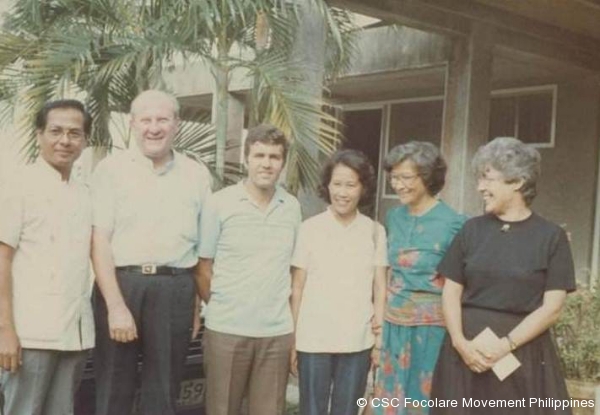
Guido Mirti (second from left) and Gio' Vernuccio (far right) with the first Focolare community of the Philippines
