Jubilee year: does it mean something only for Catholics?
The Holy Year has its spiritual roots in the Jewish tradition, where every 50 years a “jubilee” was celebrated, bringing freedom to slaves and prisoners. In the Catholic Church Pope Boniface VIII proclaimed the first Holy Year in 1300. Since then, an “indulgence” has accompanied the Holy Year, which the faithful can obtain, under certain conditions, by passing through a “Holy Door”.
However, Lutherans like me generally don’t feel comfortable with the word “indulgence,” as it brings us back to the Reformation period and the scandal of the sale of indulgences in the Catholic Church. This practice was banned by the Council of Trent and therefore no longer exists. However, I have noticed that the term “indulgence” is still loaded with misunderstandings among believers of all denominations. One of the most widespread misconceptions is that indulgences can forgive someone’s sins but according to the teaching of the Catholic Church, this is not the case. The forgiveness of sins takes place, as it does in the Lutheran Church, through confession, penance and absolution by a pastor who acts in the name of Jesus.
From my point of view, indulgences instead touch a psychological dimension of sin, the part that often remains in our memory (even after absolution), perhaps a wound or a feeling of fear or sadness… In any case, there is still psychological work to be done. That is why, in the passage through the “Holy Door”, I see an invitation to open a door in my heart to compassion and reconciliation, to let go of whatever blocks me on the path to true freedom and authentic peace. It is a conscious decision, a process that is set in motion. The fundamental thing, from the Christian point of view, is that the success of this process does not depend on me, but on the hands of the One who holds the world in His hands. Only His grace can finally heal the wounds in my life or reconcile humanity.
“In the passage through the ‘Holy Door’,
I see an invitation to open a door
in my heart to compassion
and reconciliation,
to let go of whatever blocks me
on the path to true freedom
and authentic peace”.
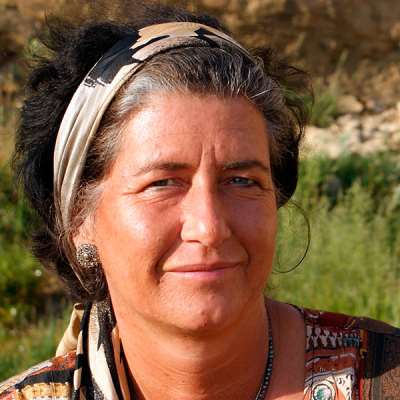
Corinna Mühlstedt
recently published, together with Abbot Notkar Wolff,
a spiritual ecumenical guide to Rome for the Holy Year.
For me, therefore, passing though through this door symbolizes the decision to follow Jesus (once again) and choose the path of true life. As He says in the Gospel of John (Jn. 10: 9): “I am the gate. Whoever enters through me will be saved”! To my great joy, the Bull of Indiction “Hope does not disappoint”, in which Pope Francis announces the 2025 Holy Year, has a clear ecumenical dimension. It starts from God’s grace, in which all human beings partake and defines the Holy Year as “an invitation to all Churches and Ecclesial Communities to persevere on the path to visible unity and in the quest of finding ways to respond fully to the prayer of Jesus: ‘that they may all be one`” (Jn 17:21).[1]
Therefore the theme of “hope” for the Holy Year 2025 has a positive resonance for all Christians. The Lutheran World Federation has chosen “Sharing Hope” as its motto for the year 2025. And the World Council of Churches, which represents the majority of Protestant and Orthodox Churches, anticipates an “Ecumenical Year” along the “path of justice, reconciliation and unity”. If goodwill leads to concrete actions, then the 2025 Holy Year could open doors for ecumenism, which could bring separated Christians closer. As Pope Francis wrote, ” Let us even now be drawn to this hope! Through our witness, may hope spread to all those who anxiously seek it.” [2]
Corinna Mühlstedt
[1] Pope Francis, Spes non confundit, Bull of Indiction of the Ordinary Jubilee of the Year 2025, 9 May 2024, 17.
[2] Papa Francesco, ibidem, 25.
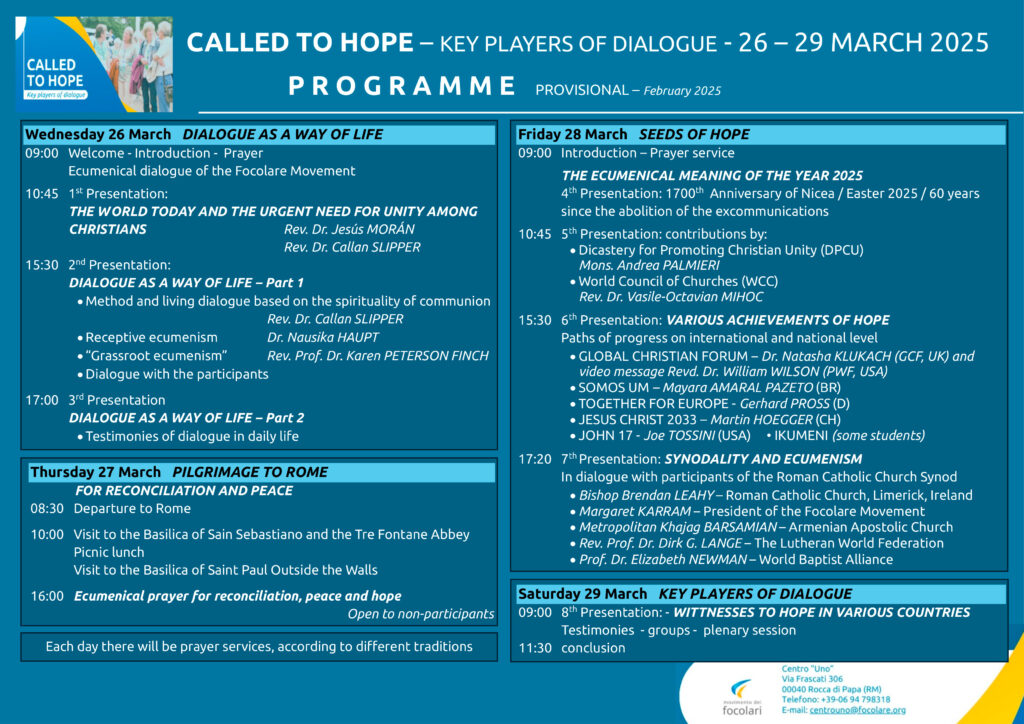
The Focolare Movement is organizing an international ecumenical conference entitled:
“Called to hope – key players of dialogue” to which all are invited.
It will take place from 26th-29th March 2025.
As Christians, in a time of divisions and great challenges, we are called together to witness the hope of the Gospel
and to be protagonists of dialogue and unity, committing ourselves to live for peace, to build fraternity, to spread hope.
Through round tables, interviews and testimonies we aim to offer method and spirituality to dialogue
together with good practices and ecumenical initiatives already underway
Link to the invitation