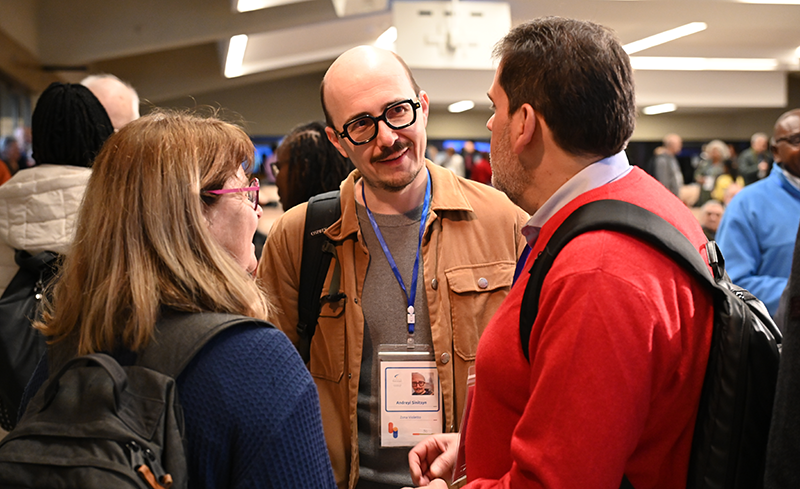
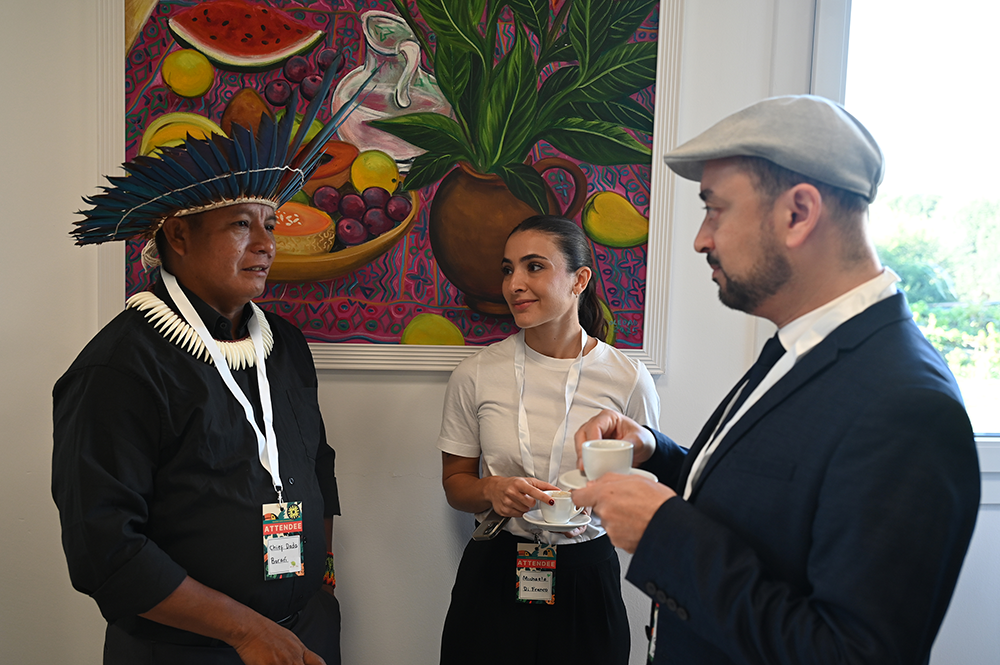
Margaret Karram and Roberto Almada met with the community in Trent (Italy) on the 25th of May 2026. They emphasised the importance of living unity together in a new way, through a genuine conversion. It was an opportunity to remain rooted in the present and look to the future.
… Unity. What is unity? Is it possible to achieve unity?
Unity is what God wants from us.
Unity is the fulfilment of Jesus’ prayer: ‘That they may all be one. As you, Father, are in me and I am in you, may they also be in us’ (Jn 17:21).
But unity cannot be achieved only through our own efforts. It can be accomplished only through a special grace which the Father grants if he finds us prepared, in accordance with a precise and necessary pre-requisite.
That is mutual love lived out as Jesus commanded.
We must love one another as he wants, which is not – as we know – simply a spiritual friendship, agreement or just understanding one another.
It means that we should love one another as he loved us, that is, to the point of the abandonment: to the point of complete material and spiritual detachment from things and persons, so that we can make ourselves one reciprocally and perfectly.
By doing so, we will have done our part and we will be in a position to receive the grace of unity, which will not be lacking, which should not be lacking.
How thankful we should be at the thought of being called to this; what an incentive to do all we can in order to obtain this gift which is lacking wherever this is not lived.
We must remember that there is an added grace in our communitarian spirituality; that heaven can be opened to us in every moment; and if we do what it asks of us, filled with this grace, we can do much, very much for the kingdom of God.
Undoubtedly, it is this grace that explains the great expansion of our Movement and many wonderful achievements linked to it.
This is why, in the beginning, conscious of this extraordinary privilege, we expressed ourselves in this way:
‘Keep one idea fixed in your head. Was alway It s one single idea that made great Saints. And our idea is this: Unity’.
‘Let everything else crumble – Unity, never! … Always have this Fire burning among you. And don’t be afraid if it means dying. You’ve already experienced that Unity demands the death of everyone, to give life to the One! … Do this as your sacred duty, even though it will bring you immense joy! Jesus promised the fullness of joy to those who live Unity! …’
During the next month, let us make every effort to obtain this gift always.
And let us not seek it solely for our own happiness, but in order to be prepared for our typical form of evangelisation. You know it: ‘That they may be one … so that the world may believe’ (Jn 17:21).
The world has a great need of faith, it needs to believe! And we are all called to evangelise. One day, St Francis said to one of the brothers: ‘Let’s go out to preach.’ Then, tucking their hands inside the sleeves of their cloaks and with their eyes cast down they walked through the city preaching through their very being, mortification and total poverty.
Let us also go out to the world and launch our way of preaching. If someone observes two or more of us united (in the focolares, in the nuclei, in the units, in our meetings, or because we happen to be together) may they be struck by a ray of our faith and believe.
May they believe in love because they have seen it. Let’s get down to work. This is what the Lord wants from us. He wants it through our charism which has been engraved in our Statutes: unity is the premise that comes before every other will of God. Then we can also speak in order to spread the Gospel… but afterwards.
Chiara Lubich (Convesazioni, Città Nuova, Roma 2019, pp 522/4
The world today lacks unity. To give just a few examples, we see this in the divisions that sometimes exist within families, among neighbours and between Churches and communities. It seems that polarisation prevails over understanding. This is a consequence of the growth of individualism that drives people to decide and act on their own behalf in a way that benefits their interests and personal prestige. This gives little value to the needs and rights of others.
And yet, it is possible to experience unity. It is a journey that always begins by taking small steps and with a “yes” that we say within: yes to welcoming, yes to forgiving, yes to living for others. It is not about grand projects but about small but faithful actions that, over time, transform a life, a community or an entire environment. And when that happens, we realise that fraternity ceases to be an ideal and becomes a visible reality and hope for all.
Martin Buber considers unity to be relationship. He states that it is the space of encounter, that exists between You and I, a sacred place where differences do not disappear but are mutually recognised. For him, unity arises when two realities allow themselves to be touched and shaped by the other and not when one imposes itself. This “between” can be understood as a space that welcomes diversity and, precisely for this reason, becomes a source of communion. Hence, for Buber, “All true life is encounter” (Ich und Du, 1923).
Therefore, in other people – whether friends, family members or just someone we meet along the way – we can discover the great ‘opportunity of relationship’. Other people ‘save us’ and enable us to go beyond our fears when we feel overwhelmed by a difficult situation. Living for unity means walking together despite our differences, transforming them into treasures rather than obstacles. It is an invitation to move from simple coexistence to encounter, where reciprocity enables what belongs to each person to become new because the relationship means it is shared. Unity, understood in this way, is not the sum of the two nor is it fragility that causes us to lean on others: it is strength that generates the hope that there is still a tomorrow. Diversity is no longer disunity, but mutual richness. It is feeling that what happens to others also resonates in me. ‘Union does not consist in equality, but in harmony,’ Rabindranath Tagore reminds us.
This month, may we experience the joy, light, life, peace and hope that come from unity that is lived
THE IDEA OF THE MONTH is currently produced by the Focolare Movement’s “Centre for Dialogue with People of Non religious Beliefs”. It is an initiative that began in 2014 in Uruguay to share with non-believing friends the values of the Word of Life, i.e. the phrase from Scripture that members of the Movement strive to put into practice in their daily lives. Currently, THE IDEA OF THE MONTH is translated into 12 languages and distributed in more than 25 countries, with adaptations of the text according to different cultural sensitivities. dialogue4unity.focolare.org