
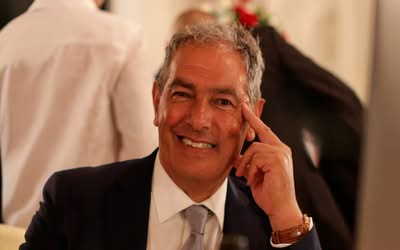
Antonio De Sanctis left us on June 21. He personified someone who, within the Focolare Movement, is known as a “volunteer of God” – someone who is committed to social and communitarian action. Tonino, as everyone called him, left us on June 21 this year. He lived in Frascati, a beautiful town in theCastelli Romani area just outside Rome, Italy. He personified someone who, within the Focolare Movement, is known as a “volunteer of God” – someone who is committed to social and communitarian action and promotes activities that benefit others. He worked sometimes alone and sometimes as part of a team in numerous projects many of which he initiated. He was a faithful and caring husband to his wife, Mary; an attentive father; a tireless worker and a committed member of the communitywhere he lived and was capable of creating truly fraternal relationships. Tonino regarded the community as a place where the presence of God and the Church could be made visible:he was not worried about what other people thought and often broke through social convention. His life is best described by the words from scripture that refer to the corporal works of mercy: these words are precepts for all Christians. “Because I was hungry and you gave me food; I was thirsty and you gave me drink; I was a stranger and you welcomed me; naked and you clothed me; sick and you visited me, imprisoned and you came to visit me…”This last phrase is particularly characteristic of Tonino because throughout his life he was dedicated to supporting prisoners and their families. This began thanks to a chance comment made by a friend. Tonino used to visit a lot of young people in prison. One day, he realised that a nun who was also a volunteer visitor was upset because of the “mountains of pornographic literature” that used to arrive. He was thinking about this on his way home when, in the main square of his town, he met a priest friend from a nearby village. He shared his concerns straightaway. The priest replied, “Next Sunday, come and tell my parishioners what you have just told me so you can collect donations to send “New City” magazines to prisoners.” This was how it began. For many years, on Sundays, at the various Masses in theCastelli Romani and southern Rome areas, Tonino’s unmistakable voice could be heard. In a shy, modest way, he used to talk about his commitment to prisoners and ask for donations to subscribe them to the Focolare magazine. He sent dozens of copies to the various prisons he visited. In February 2012, “Città Nuova”, published “The Rainbow Behind Bars” recounting, in four instalments,Tonino and his family’s many experiences. These stories are like the “little flowers” of Gospel life to which Saint Francis” often referred. Sometimes Tonino’s behaviour could seem daring – he did not mind running risks. For example, he did not hesitate to welcome prisoners into his home. He became a second father to many of them even after they were released. The excerpt from a letter written by one of the former prisoners expresses this very clearly: “In your house, I finally felt ‘at home’. I have never had this sense of belonging to a place and to people before. You were the means through which I felt Jesus’ mercytouch my heart and I understood the place God occupies in my life. He is my first thought in the morning and my last thought before I go to sleep. I am happy because God has entered my life like a great hurricane sweeping away everything else. Antonio, you and your whole family are a living witness to the Gospel, you are a work of God.” Many people attended his funeral on 22 June in the cathedral of Frascati. The Mass was concelebrated by his brother-in-law, Don Enrico Pepe, and Cardinal Joao Braz de Aviz. In their eulogy his three children, Miriam, Gabriele and Stefano, said: “You were a safe harbour at the end of a sunny day or after a storm: you were always there, ready to listen, to welcome us and to encourage us to return to the sea without fear.”
Lina Ciampi

0 Comments