
Video of High-Level Thematic Debate
What are the religions in today’s world? Many see them as obstacles to peace, the residue of ages past that today are the cause of violent extremism. What would the world really be more peaceful without the religions? The High-Level Thematic Debate on Promoting Tolerance and Reconciliation suddenly became animated. The second day of the UN meeting offered some directives. During the opening address, Secretary General Ban Ki-moon proposed an advisory committee formed by the leaders of the world’s religions, to help the United Nations find solutions to the current conflicts, often between the followers of different religions. The plenary session that followed included testimonies from 15 religious leaders. All present agreed that religions should help to build peace, moving beyond mere tolerance to mutual acceptance, with the awareness that there are already people around the world who are already living like this in their daily lives. In her talk, Maria Voce recalled the long experience lived by the Focolare Movement: “The encounter between religions and cultures is an ongoing and fruitful experience that is not limited to tolerance, mere recognition of differences, and it goes beyond reconciliation, although that is fundamental, and it creates what could be called a new broader and shared common identity.” And this takes place in contexts that have been struck by serious crises, such as in Algeria, Syria, Iraq, Lebanon, the Democratic Republic of the Congo, Nigeria and the Philippines. 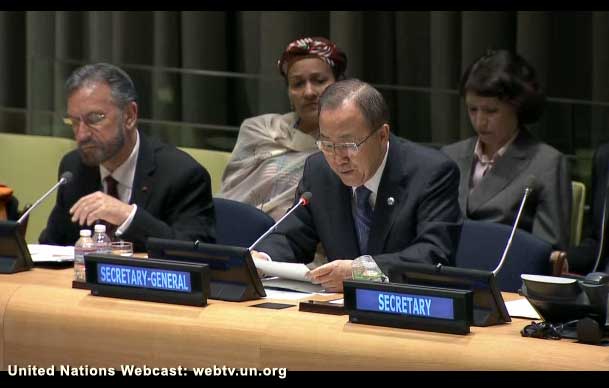 In response to the challenges and to the violence, she proposed an “extremism in dialogue,” that is, a dialogue requiring maximum engagement “that is risky, demanding, challenging, that aims at severing the roots of misunderstanding, fear and resentment.” Then she invited all to aim for a “a universal civilization that leads all peoples to consider themselves part of “civilization of alliance; a universal civilization which enables peoples to see themselves as part of a great happening, which is both varied and fascinating, that is humankind’s journey towards unity. She invited the UN to rethink its own calling, to reformulate its mission in order to be “an institution which truly works towards unity among nations, while respecting their strong identities.” According to Maria Voce, to say that religions are the cause of the tensions is to have a too restricted vision of the situation. What we are witnessing in many areas of the world, from the Middle East to Africa, has very little to do with religion, but has much to do with the structures marked by the culture war. From any point of view, in these cases we should not speak so much about wars of religion but more concretely, realistically and prosaically, about the religion of war. Everyone was in agreement: religions lead to peace, if not, they are instrumentalised for other ends. And so the vocation of religions is clearly stated: The Golden Rule, the foundational inspiration of all religions, which unites them, the idea of one universal human family.
 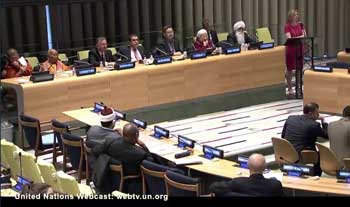 In the roundtable at the afternoon plenary, which was moderated by BBC’s, Laura Trevelyan, Rabbi David Rosen asked why so many young people feel drawn to extremism: “Perhaps because they are searching for their own identity, or for some meaning in life.” “You normally do not mention God at the United Nations,” Rabbi Arthur Schneier dared to remark: “How are we to deal with this problem – that the UN has to be neutral – when 5 of the 7 billion people on this earth belong to a religion?” For Bhai Sahib Mohinder Singh, Sikh from Birmingham: “God is omnipresent, in each one of us, therefore you cannot say that God is not here.” Maria Voce: “You speak of God when you speak of justice, sharing all the goods of the earth, sustainable development; you speak of God when you think of what we are preparing for the future generations. This is speaking of God. It is not necessary to speak of him in the abstract.” How can we preserve the integrity of interreligious dialogue? Are the religious leaders here renouncing something by coming here to the UN to talk about resolving conflicts? “I’m not renouncing anything,” affirmed Maria Voce. “I’ve come out of love, thinking about bringing my contribution of love to humanity. I’ve felt enriched by this possibility.” She concluded with a glance towards the new generations: “Returning home, what I will do will be to support the activities of the young and the very young, because I believe in their prophetic power.” Then she gave the floor to Ermanno Perotti, a young Italian had accompanied her on her visit to the United States. The twenty five year-old, with a Master’s Degree in Development Economics, used the occasion to present the l’Atlas of Universal Fraternity, a dossier of projects that promote universal fraternity in all corners of the world. Maria Voce added: “With the hope that one day even these ‘fragments of fraternity’ can be presented to the United Nations,” and that the United Nations will gather them. With this vision it becomes clear that religions have a great opportunity, but also a great task: to build peace and respond to the challenges with “extreme dialogue” rather than closing in on their own group. Susanne Janssen, New York
Video of Round Table Debate: http://webtv.un.org/high-level-thematic-debate Press Release Press Area
0 Comments