14 Mar 2024 | Non categorizzato
Today, 14 March, the day we remember Chiara Lubich’s departure for Heaven, we publish some of her words, pronounced during the meeting of the “Movement for Unity in Politics” in Bern (Switzerland) on 4 September 2004. A reflection on the kind of ‘love’ necessary for universal fraternity to be possible. Brotherhood can be achieved only through a special kind of love. It’s a love that is directed to everyone, just as God the Father sends sun and rain on the good and on the bad. It is not a love that is directed only to relatives and friends, and a few other people. It is directed to everyone, and this already requires effort. If we left here having resolved to love everyone we meet, and, if we are Christians, seeing Christ in them, because he will say: “You did it to me,” “You did it to me.” I think that would already be a great step forward because the Christian revolution would spread out from here. Then this love we need to build fraternity, is not only tolerance, although it is tolerant; it’s not only solidarity, although it is solidarity too. It’s something different because it’s the very love of God. We Christians say it is the love poured into our hearts by the Holy Spirit. This love takes the initiative without waiting to be loved; it makes the first move, taking an interest in others (without bothering them, of course). It takes the initiative and does not wait to be loved. Usually people wait to be loved before loving. Instead it is a love which is first… and this brings a revolution. In fact, our Movement has reached the ends of the earth, not because of what we did, but due to a charism from God. If we leave here determined to love everyone, always being the first to love, without waiting…. Well, this is already Gospel life. Do you understand what the Gospel is? This is Gospel. Then it’s not a sentimental or platonic love; it’s not a fleeting love, but a concrete love, which makes itself one with the person who is being loved. If someone is ill, we feel ill with him or her; if people are happy, we are happy with them; if they have achieved something, we feel their achievement is ours too. It’s a love in which… as St. Paul says, we make ourselves all things to all people, all things to all people, we make ourselves poor, or ill with others. Sharing, that’s the kind of love it is, a concrete love. So it’s a love that is directed to everyone, a love that takes the initiative, and a love that must be concrete. Then we should love others as ourselves, as the Gospel says. Therefore, my friend, Eli, who I see there in the hall, is me, because I must love her as myself, like Chiara, as I love myself. Likewise, with Clara: I must love her as myself. I must love this lady as myself; and this lady, as myself, because this is Gospel. This too is a big thing: whenever do people love others as themselves? In a way we almost transfer ourselves into the others in order to love them as ourselves. It’s also a love which, if lived by several people, becomes reciprocal. Because I love Marius and Marius loves me; I love Clara and Clara loves me. This reciprocal love is the pearl of the Gospel. Jesus said, “I give you a new commandment: love one another as I have loved you” (Jn 13:34). He said this commandment is his and new, so it sums up the Gospel, it’s the basis of fraternity. … What can we do to be brothers and sisters if not love one another, as he loved us, he who even gave his life for us? We should keep these things in mind. Mindful of what this love is like, to answer the gentleman who asked the question, how should we see our relationship with others? We should see it in terms of dialogue. I must see the other person as someone with whom I should dialogue, but in order to dialogue, I need to know that person; I need to enter into their world. I must not assert myself, but try to understand the other person and let them say what they want to say. … We need to enter into the heart and mind of the other person and allow the other person to be open, let the other person speak. They should feel that we are empty of ourselves and able to understand them. What happens then (in our experience) is that other people understand they are loved and they listen willingly to what we have to say. The Pope says something very beautiful about dialogue. That we need to share our truth, what we think, but it must be “a respectful announcement”, which means an announcement that respects the opinion of the other person, which has no intention of proselytizing, and does not want to impose on anyone. This is the dialogue that should be carried out. It’s the basis of our life, of universal brotherhood.
Chiara Lubich
https://youtu.be/yGIYKXgsY6E
6 Mar 2024 | Non categorizzato
NetOne, an international association of media and film professionals and communications operators and information technology, together with New Humanity, a Non-Governmental Organisation (NGO), realities founded on the spirit and values that animate the Focolare Movement, in collaboration with the Mission of the Holy See to the United Nations, launched the initiative “ AI: A Pathway to Global Peace and Integral Human Development”, a reflection on the ethics of artificial intelligence and its implications. On Wednesday, Feb. 21, NetOne together with the NGO New Humanity in collaboration with the Holy See Mission to the United Nations, co-organized the initiative “AI: A Pathway to Global Peace and Integral Human Development,” which took place in New York, UNHQ, Conference Room 6, from 1:15 to 2:45 p.m. and was followed online from different parts of the world. 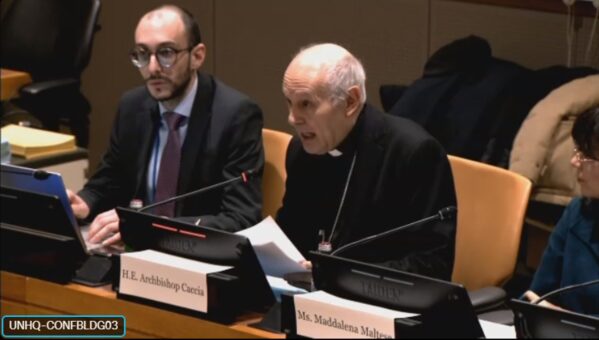 The Opening remarks by His Excellency Archbishop Gabriele Caccia, Permanent Observer of the Holy See to the United Nations, set the tone for the reflections, We stand at the precipice of a technological revolution unlike any other in human history. The emergence of AI is reshaping our world in profound and unprecedented ways. From revolutionizing industries to transforming the way we live, work, and interact, AI has become a driving force of change in the 21st century”. In recent years, digital progress has brought significant opportunities and challenges, with serious implications in all areas of society. In this era of rapid technological change, Artificial Intelligence (AI) has emerged as one of the most powerful tools with the potential to transform societies, advance peace and achieve sustainable development. However, its ethical implications remain a subject of intense debate.
 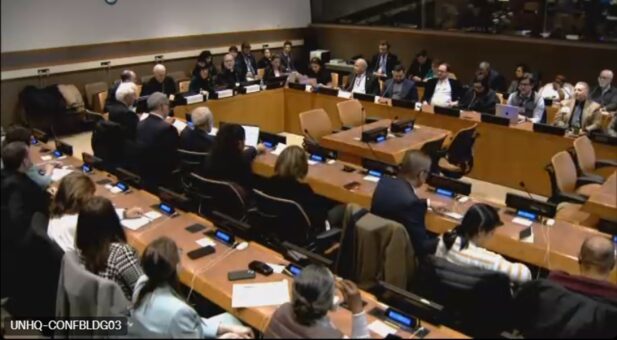 Maddalena Maltese, journalist and representative of the NGO New Humanity, moderator of the event’s panel discussion, recalled that “on January 1, Pope Francis, in his message for the International Day of Peace, raised urgent questions about AI: “What will be the consequences, in the medium and long term, of these new digital technologies? And what impact will they have on individual lives and societies, as well as on international stability and peace?” She also highlighted that Secretary-General Antonio Guterres, discussing priorities for 2024, stressed that AI will affect all of humanity, reiterating the need for a universal approach to address it. The panel discussion with multi-stakeholder dialogue on the ethical challenges posed by AI and strategies discussed the interplay between technical, ethical, political, legal and economic considerations.
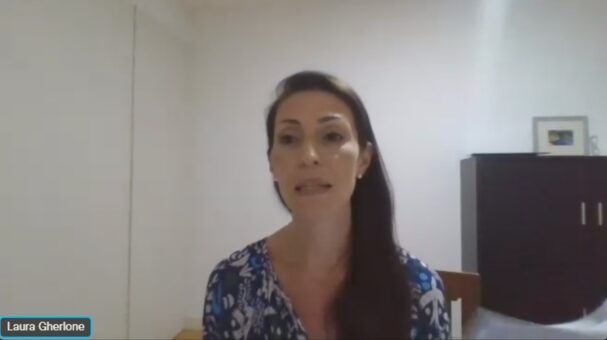
 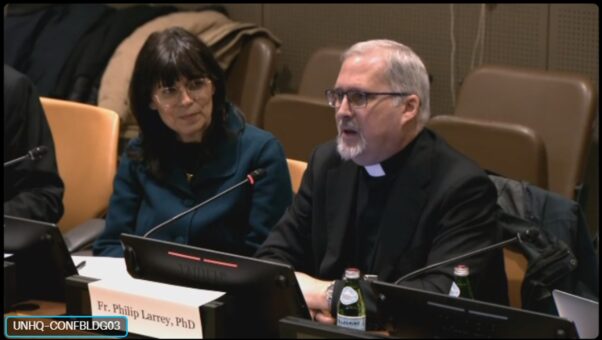 Father Philip Larrey, professor of philosophy at Boston College, former dean of philosophy at the Pontifical Lateran University, and president of Humanity 2.0. laid out a number of pressing issues starting with the theme of peace. “ChatGPT or Gemini could write a perfect peace plan, looking at the situations we are living, but would we be willing to follow its directions?” Fr. Larrey said, emphasizing the human factor as decisive in the decisions to be made, even when it comes to lethal weapons. Another central theme of his talk was the empathy that machines can demonstrate and are sometimes preferred over the human element. “Humans understand meanings. Machines don’t, as much as machines are getting very, very good at simulating what we consider meaningful,” the Boston College professor insisted, warning of the increasingly difficult challenge of discerning what belongs to humans and what belongs to technology, with machines that in the future may even be programmed to feel feelings. Laura Gherlone, a researcher in semiotics at the National Council of Scientific and Technical Research in Argentina and a professor at the Catholic University of Argentina and a member of NetOne’s International Commission, spoke about Artificial Intelligence and, more generally, digital technologies in light of the thinking of digital decolonization. She argued that: “today, post-colonial contexts are at a crossroads: either falling behind or catching up. They are obliged, in other words, to dramatically accelerate certain processes that today embody a techno-centric, supposedly universal, model of knowledge: digitization and the implementation of AI systems are among these processes.” She states that this process ” almost always comes at a very high cost, on at least three levels: at the economic and technical-structural level, at the social level and lastly, the accelerated and forced adoption of technological progress as a path towards a universal model of knowledge. She suggests: “the The ethical debate on AI could be greatly enriched through decolonial reflection, integrating, for example, the work of those collective movements committed to rethinking and redesigning technical architectures “from the South”, that is, theoretical-methodological and practical solutions that are often sidelined because they are far from profit logics”. Closing the event were two best practices from civil society. Marianne Najm, a communications engineer based in Beirut, spoke on the ethics of AI and the concept of the digital oath for engineers and anyone active in the digital world. The project started in 2019 inspired by the Hippocratic Oath, the oath that most doctors take at the end of their academic journey. Just as the Hippocratic oath aims to awaken the human obligation of doctors, similarly the digital oath aims to awaken the human obligation of digital actors by directing their work toward ethically human-centered design. Marcelle Momha, Cameroonian living in the United States, policy analyst and researcher specialized in artificial intelligence, emerging technologies and cybersecurity, had prepared an intervention on the AI 2030 community, which due to timing was not possible to illustrate, but her paper is available on this link bellow. “AI 2030 is a vibrant community of business leaders, data scientists, technical builders, and pioneering researchers dedicated to harnessing the transformative power of AI to benefit humanity while minimizing its potential negative impact.” She explained in his theme. In his message for the World Day World Peace, the Holy Father remembers that “technological developments do not lead to an improvement of the quality of life all humanity, but on the contrary aggravate the inequalities and conflicts, can never be considered a real progress.” As organizations of civil society, we want to accompany the efforts of the United Nations and all those institutions that are working for an ethical commitment in the field of technology that sustains digital developments as a contribution to the promotion of human principles of peace and fraternity. To review the live stream, you go to link: https://webtv.un.org/en/asset/k1h/ To see the speeches again and for more information, go to: https://www.net-one.org/ia-una-via-per-la-pace-globale-e-lo-sviluppo-umano-integrale/
Source https://www.net-one.org
4 Mar 2024 | Non categorizzato
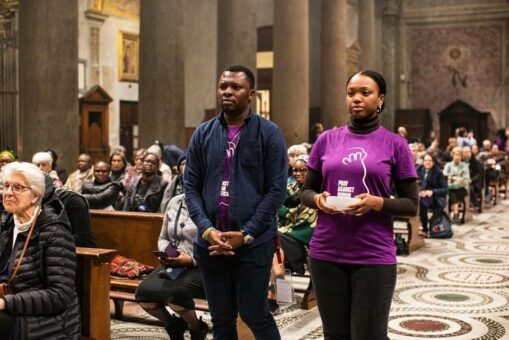
From February 2 to 8, 2024, a week of mobilization and prayer against human trafficking. In Rome (Italy) the meeting of 50 young people from all continents including some boys and girls of the Focolare Movement. Human trafficking is the process by which people are coerced or lured by false prospects, recruited, relocated and forced to work and live in exploitative or abusive conditions. It is a phenomenon, as the recent United Nations Reports warn, that is constantly and dramatically evolving. . 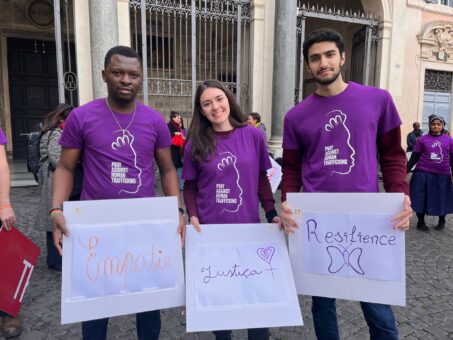 From Feb. 2-8, 2024, the Week of Prayer Against Human Trafficking took place. Established by Pope Francis in 2015, the week always includes Feb. 8, the feast of St. Bakhita, a Sudanese nun who as a young girl was enslaved, sold and abused, was a victim of trafficking and a universal symbol of the fight against this scourge of humanity. This year’s theme was Walking for Dignity. Listening, Dreaming and Acting. Thousands of people around the world gathered to reflect, pray and share their experience of engaging against this global phenomenon. In Rome, Italy, many young people from different countries-Kenya, Japan, the United States, Thailand, Albania, Canada, Mexico, France and Italy-participated in conferences, flash mobs, moments of prayer on the theme, the Angelus and the audience with Pope Francis held during the week. Among them were also some Gen2, young people of the Focolare Movement. Prisque Dipinda, from the Democratic Republic of Congo recounts, “The most significant event for me was the vigil of prayer in the Church of Santa Maria in Trastevere, in the heart of Rome. It was an important moment before
  God, the emotion in sharing it together with other young people who carry the challenge of human trafficking in their hearts. But also a responsibility to be part of the protagonists against this phenomenon. I think for the young people who attended it also served to become aware that so many in the world suffer, for various reasons: economic, political, religious. It was an opportunity to reflect and start together to design something against suffering.” Among the Gen2s present were Michel Haroun, a French-Lebanese and Miriana Dante, an Italian. “I have never had a particular commitment against human trafficking,” says Michel. “I have some experience in serving migrants who arrive in my city or at the borders between states. For example, a few years ago I was in Trieste (Italy), the arrival point of the Balkan route through which migrants from so many parts of the world devastated by conflict arrive in Italy. But I was not sufficiently aware of the fact that refugees, before arriving in Europe-but it is also valid for Latin America, the United States or other parts of the world-suffer violence and abuse in an organized manner. These days lived in Rome together with other young people from different continents, languages, cultures, belonging to various Christian churches, were a rich experience of personal relationships that I hope will last, because eventually we will face (though we are already facing) the world together, as part of the same generation.” “I was emotional getting to know the story of St. Bakhita,” said Miriana, “She had been a slave, she was sold. She later faced with courage all that she had experienced in the past, launching messages against human trafficking. I wondered where she got all that strength from. It did me a lot of good to have met so many of my peers who are committed to these issues. Not adults with long experience behind them, but young people my own age from all over the world who have dreams and hopes for a better future. We did not feel the cultural difference, because we were bound together by the unity among us through our common goal: to fight against human trafficking.”
Lorenzo Russo
1 Mar 2024 | Centro internazionale, Non categorizzato, Tutela minori
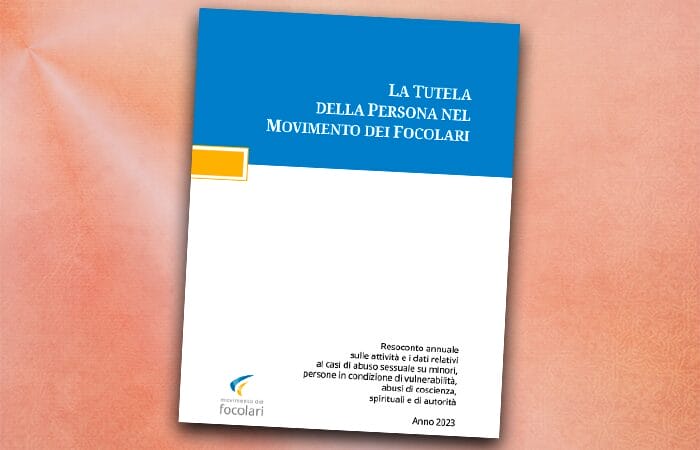
The Focolare Movement is publishing the report on its activities on safeguarding and on its data concerning abuse cases in 2023. An interview with Catherine Belzung, professor of Neuroscience and coordinator of the UNESCO Chair on Childhood Maltreatment. On 1st March, the second annual report of the Focolare Movement concerning its activities and data relating to cases of sexual abuse of minors and vulnerable adults as well as abuse of conscience, spiritual abuse and abuse of authority was published. We asked Catherine Belzung to give an evaluation of the document. Catherine is a university professor of Neuroscience in France, she is a senior member of the University Institute of France (2014) and president of the multidisciplinary research centre iBrain. Since 2022, she has been coordinator of the UNESCO Chair on Childhood Maltreatment, made up of a partnership of universities and institutions from 16 countries. She is also co-chair of the International Centre for Dialogue with Contemporary Culture of the Focolare Movement. Q: Since 2023, the Focolare Movement has decided to publish an annual report on child sexual abuse and also on abuse of conscience, spiritual abuse and abuse of authority. From your international perspective, what do you think of this decision? How do you consider this second report? 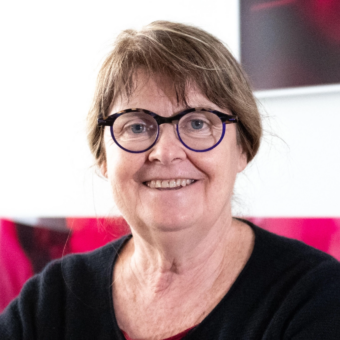 A: I believe this report represents a real step forward. In fact, the last report was criticised, mainly because the places and dates of sexual abuse were not mentioned. The new report covers cases disclosed in the last 10 years and adds these clarifications: it is stated that sexual abuses were carried out on all continents (about 20 countries), with a peak of cases between 1990 and 1999, as well as during the decade before 90 and after 2000. The offences sometimes are repeated over several decades, suggesting that these are multiple repeat offenders whose abuses have continued. Some offences happened and were dealt with around 2020, indicating that people abused were able to report abuse almost in real time, which is progress. All communicated sexual abuses were carried out by men. The opposite is true for abuses of authority, which in 77% of cases were committed by women, which is in proportion with the higher number of women among those belonging to this Movement. The report also contains a detailed and clear section on the measures implemented during the year, particularly regarding formation. It remains to be understood what the root causes of these abuses are. Beyond preventive measures and sanctions, further work should be done to identify the systemic causes that could explain these figures, in order to put in place a strategy that would prevent them. Q: In this second report, the people who abuse are identified according to precise criteria set out in the Communication Policy recently published by the Focolare Movement. What do you think of this decision? A: This is an ethical conflict. On the one hand, it is a matter of believing the experience of the people abused and taking the complaints they make seriously, as well as quickly putting measures in place so as to protect them. On the other hand, it is a question of respecting the presumed innocence of the alleged abusers, of not defaming them when no final criminal conviction has been pronounced. The issue is complex and finding a satisfactory solution will no doubt require a lot of listening and dialogue. Q: The UNESCO Chair on child abuse that you coordinate came about because you came into contact personally with a case of child abuse of which you knew both one of the people abused and the person who abused. It was a case that happened in the Catholic Church in France. In this case, the social or religious community is defined as a ‘secondary victim’. What does this mean? What are the wounds that people carry, how can they be healed at a social and community level? A: Yes, in fact, this chair was set up as a result of being in contact with a person who had been abused. A contact that left a deep mark on me: I was profoundly affected by this suffering, and my desire to do something came from this. First and foremost, abuse affects the person who has been abused, who often suffers lasting psychological consequences. Sometimes, the opening up about the facts can bring out a great vulnerability in this person, which requires specific accompaniment. In turn, this also affects the person’s relatives, such as their spouse, their children, but also their parents who feel responsible for having entrusted their child to an institution that did not protect them. The devastating effects also have an impact on the entire community, as members are often unaware that within it a repeat offender was concealed, a person with whom they may have had a bond of closeness, of friendship. We may ask ourselves: why didn’t I notice anything? Another aspect concerns the bond with the institution that may have protected the abuser, sometimes in good faith, producing in people a sense of betrayal and distrust. Finally, the community may also become divided, depending on their divergent analyses, between those who take refuge in denial, and those who want to fight to prevent these things from happening again. Rectifying all of this requires a wide range of measures: it is essential to take on the responsibility of accompanying the people who have been abused and their families, but it is also necessary to restore trust in the institution that has shown its weaknesses and where there is a sincere willingness to learn from its past mistakes. It’s the actions that matter in making this happen: the institution must promote transparency by communicating very precise information, put in place clear procedures, create places for listening, establish reparation procedures and, for communities, spaces for dialogue where even opposing opinions can be exchanged. Q: The Focolare Movement is a worldwide organisation, including people from different cultures and religions who are subject to different legal systems and adopt different lifestyles. How is it possible to implement anti-abuse practices in such a multicultural and diverse environment? A: The consequences of child sexual abuse exist in all cultures, they are universal. In addition to the ongoing psychological and social impact, those who have been abused may have biological ongoing effects, such as increased stress hormones, altering the expression of certain genes and brain morphology and brain functioning. These dysfunctions continue to be present throughout the survivor’s life and may be passed on to the next generation. So it cannot be said that there are cultural variations in the severity of the consequences on those who have been abused or that there are cultures where these people suffer less: always and everywhere, it’s devastating. It is therefore necessary to put in place measures for prevention, but also for reparation all over the world. One can see that awareness of the seriousness of these situations is increasing: for example, in the Catholic Church, national enquiry commissions have been set up in many countries in Europe, North America, Latin America, but also in Australia, India and South Africa. Although suffering does not vary, what may vary is that people resist in denouncing the facts and their ability to put in place protective and remedial measures. This may be related to the fact that in some cultures talking about sexuality is taboo. The first step is to make people aware of the consequences of abuse: there are already programmes promoted by various associations that take into account the way sexuality is considered in different cultures. For example, proposing that those who listen to the suffering of people who have been abused and belong to the same culture can understand them better. This can make people want to do something about it. Prevention can also be targeted directly at children, through education about their rights: again, there are programmes, for example, based on songs. Another thing that varies is the ability of countries and institutions to take measures of protection and reparation. A respectful and non-stigmatising dialogue with those who commit abuse is the way forward: this will enable everyone to understand the seriousness of the abuse, but also to find culturally specific ways to enable people to speak up, to implement processes of reparation and to educate members of the community. Q: Both within the Focolare Movement and also in other contexts there are those who express the conviction that the time has come to move forward; that is, that it is not necessary to continue talking only about abuses, but to focus on the ‘mission’ of the Movement and on what beautiful and positive things are being generated in the world by the living out of this charism today. What is your opinion on this? A: What do we mean by ‘mission’? Is it not to advance towards universal fraternity, towards a culture that puts the suffering of the weakest first, a culture of dialogue, openness, humility? It seems to me that the fight against all kinds of abuses is precisely a way of implementing this desire, putting those who suffer in the first place. Helping to heal the wounds of those who have been abused is a way of going towards universal fraternity. This also implies accompanying the people who have abused in order to prevent reoffending. Acknowledging one’s mistakes, one’s vulnerability, in order to create solutions, taking into account the opinions of experts in this field is precisely a way to build a culture of dialogue. Fighting with determination against abuse and accompanying those who have been abused are right at the heart of this ‘mission’. Therefore we don’t need to choose between the fight against abuse and ‘mission’, because this fight is a central element of ‘mission’. In today’s context, this is a priority which is painful but necessary.
By Stefania Tanesini
Anual report 2023: “Safeguarding of the person in the Focolare Movement” (Download PDF)
27 Feb 2024 | Non categorizzato
Christian love is a “Love” that has a specific, tangible form, which is experienced through actions, from the smallest to the largest. It means giving our lives for those around us in the image of the One who was the first to give His life for us, loving us with an immense love.
Failed Exam
When our daughter came home in tears following an unsuccessful exam for which she had worked very hard, my husband and I made a conscious decision to turn dinner into a celebration, perhaps even more so than if the exam had gone well. Our other children embraced the idea with enthusiasm. However, the most emotional moment occurred when we parents, began to openly share some of our own life failures and how we had managed to overcome them. As others at the table joined in with their “confessions”, the meal became an occasion for profound communion and mutual growth. Our daughter found solace in this unexpected turn of events and said, “Maybe this failure wasn’t just for me, but for our whole family. I never realized that setbacks could be a part of our collective growth and understanding of life. I appreciate this perspective immensely.” When we shared this experience with relations and friends, many were inspired to replicate it with their own children, using any pretext to foster similar conversations. Ultimately, a consensus emerged that trying to understand each other’s vulnerabilities within families is essential for cultivating love and shared growth. (W.R. – Netherlands)
Love that goes and returns
In my spare time and whenever needed, I willingly take on the role of babysitting for the two lovely girls of a Senegalese couple. The parents are always grateful and often say, “We would be lost without you!” Sometimes I proactively offer my assistance, not waiting for their request. Recently, I messaged the dad, notifying him of my availability for Sunday morning. He rang me almost immediately and said, “Lorenza, you have to tell me how you know what we need in advance! Your message came at exactly the right time.” I replied, “It is God who moves hearts, Tacko; we must thank Him for creating this bond of sisterhood and brotherhood.” Thanks to this family like bond between us, once when I had to leave for a trip at 1 a.m., I asked Tacko for a lift to the station, which was an opportunity for him to reciprocate the love. He not only obliged but stayed with me until the rest of the group arrived, showing genuine care. A few days ago, Tacko and his wife came to our home to share some rice and chicken cooked in their typical way. “Now we know your tastes; you’re a bit African too!” (Lorenza – Italy)
Grasp the inspiration
The opportunity to be a builder of peace through respectful dialogue with people of different cultures or faiths came up during a meeting at my workplace. The air was thick with tension and voices rang out accusingly. How could I facilitate reconciliation when talking seemed impossible and maybe even counterproductive? In the face of this challenge, I tried to listen carefully to those expressing themselves, maintaining a calm and understanding demeanour even when they were using loud and confrontational tones. It wasn’t easy and it was very exhausting. During the break, the colleague who had been the most vociferous approached me and offered a sincere apology for his behaviour. Without uttering a word, I embraced him, allowing him to continue sharing: “Yesterday, my wife received news of an incurable disease. I feel hopeless.” I urged him to consult with a doctor friend and he thanked me for the idea. I assured him of my ongoing support. When we returned to the meeting room, the atmosphere had changed. I realized that in every present moment it is important to grasp the inspiration that God gives us about how to act. (E.J. – USA)
compiled by Maria Grazia Berretta (taken from Il Vangelo del Giorno, Città Nuova, year X– no.1 January-February 2024)
