
15 Nov 2019 | Non categorizzato
Pope Francis’ words to the university institute: “I leave you with three key ideas: wisdom, the pact you make together and going out to others. I ask you to continue your journey with joy, vision and decision.” “I am happy with the road you have covered in twelve years since your life began. Push on! The journey has just begun!” These were Pope Francis’ opening words when he greeted the academic community of the Sophia University Institute today in a private audience. “In the path that lies before you, there is no shortage of reference points: there is the charism of unity from which your University was born and there are also the points that I outlined in the Apostolic Constitution Veritatis Gaudium which your academic and formative project wants to reflect. Your participation in the preparation and development of the Global Educational Pact is evidence of this.”

© Servizio Fotografico Vaticano
© Servizio Fotografico Vaticano
Tamara Pastorelli
13 Nov 2019 | Non categorizzato
“Challenging the future: men and women in dialogue”. This was the title of a meeting held at Castel Gandolfo, (Italy) from 18 to 20 October 2019, organised by the Focolare Centre for Dialogue with People with non-religious beliefs. It was an opportunity to express hopes, needs and ideals from different cultural perspectives through a wide-ranging dialogue between people without a precise religious affiliation and Catholic Christians. Two young Muslims were also present at this meeting entitled “Challenging the Future: men and women in dialogue”, held at Castel Gandolfo (Rome, Italy) from 18 to 20 October, organised by the Focolare Movement. The choice of theme stemmed from the search to understand in depth today’s women and men, adults and young people, belonging to different faiths and non-religious affiliations. What holds us all together? What is the specific contribution of male-female collaboration for a peaceful future and effective work for the common good? When does education on male-female relationship start? “Everyone is different, but at times young people are excluded because of what they look like. Real heroes don’t do this, even if it’s not always easy”. These are the opening words of the short film “Real Heroes”, by Belgian director Erik Hendriks, which opened the conference. The documentary, filmed with a cast of students, was followed by a wide range of contributions which proved to be a source of enrichment for all those attending at the three day meeting. The focus of the meeting was the Focolare’s distinctive approach to work: working together and with co-responsibility between men and women. An important contribution was made by Piero Taiti, a medical doctor and pioneer of the Focolare’s dialogue with people of non-religious beliefs, on Chiara Lubich’s prophetic message. Moreno Orazi is an architect who describes himself as a ‘troubled Christian’, still searching, with many questions about faith. He presented examples of the masculine and feminine in the social environment. “We recognise the strong influence that the difference between the feminine body and the masculine body has from a psychological point of view. At the same time I also perceive a substantial reciprocity of feelings from the point of view of existence and affectivity, at the deepest level. For both men and women, solitude and a lack of recognition of the person, of their hopes and expectations, cause deep suffering. There is an inner voice emanating from the body of women, to which men have reacted ambiguously in the past, amplifying or ignoring it according to their own interests at the time, but never perceiving it as the key to ascertaining the essence of the feminine”. For psychiatrist Giuseppe Auriemma, reciprocity, which springs from the relationship between men and women, is a valuable resource for overcoming differences. “Reciprocity calls for effort and commitment. It involves overcoming the rigidity of opposing positions, resisting the temptation to resolve differences in victory by the strongest; overcoming a mentality of taking and possessing. In reality, it is a hard journey towards liberation. Men and women must be aware of their specific characteristics, which can be gifts and a source of enrichment as well as limitations. Only in this way can they live in a relationship, a true meeting, because each will have something to give and something to receive”. Donatella Abignente, lecturer in Moral Theology, outlined a perspective from the Catholic Church: “There is a lively debate going on now in the Catholic Church. At the Synod of Bishops on Amazonia, the Pope asked for women’s ministry of the Word to be officially recognized. This was met with resistance from those who place too much importance on individual rights and particularly on the rights of the strongest; so that women only become important when they acquire enough strength to make their own rights count. Rights should be acknowledged on the basis of fellowship. As regards reciprocity, it can only be built freely, which does not mean neglecting one’s own fulfilment, voluntarism based on mortification, or altruism which resembles the search for one’s own perfection through service. It is not about becoming women or men, but of becoming persons within the free giving of fellowship, committing ourselves in a transformation that will last our whole lives”. Valuable contributions were offered by people from beyond Europe. Vania Cheng spoke about the man-woman relationship in China; Ray Asprer gave a perspective from the Philippines; Mounir Farag, Haifa Alsakkaf and Giovanna Perucca reflected on women in Islamic societies. In her talk, “Interpretative keys to interpreting the history of man-woman relationships” sociologist Giulia Paola Di Nicola presented an overview of history, outlining some of the changes which have developed over the centuries, the division of roles, hierarchies and values which over thousands of years have characterized approaches to the ordering of society.
By the editorial team
11 Nov 2019 | Non categorizzato
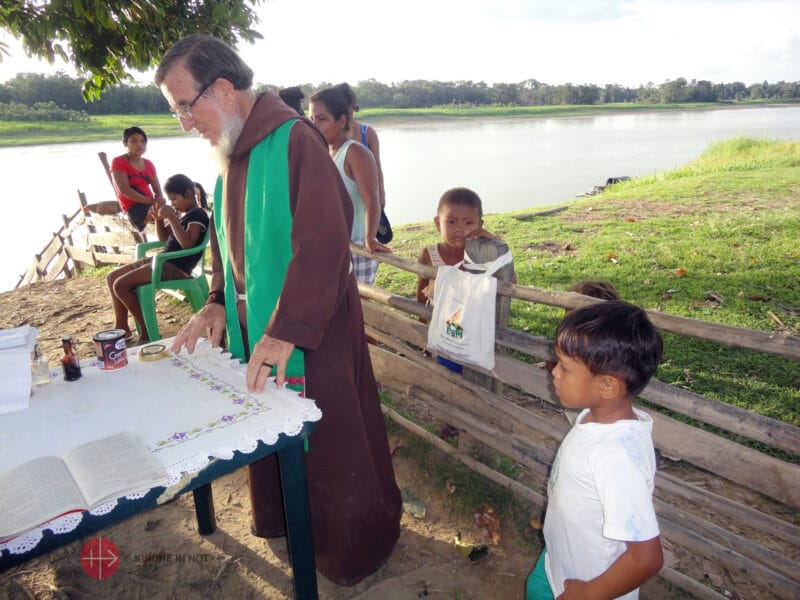
An interview with Brother Gino Alberati who has been a missionary in the Amazonian sub-continent since 1970. Now that the media spotlight upon the green lung of the earth has faded because the forest fires have been extinguished and the Catholic Church’s Synod on the Amazon has produced its final document, we feel it is important to continue to publicise news about the people who live in the Amazon and contribute to its development every day. There is a great risk that we could regard this piece of land as something from an exotic postcard and very distant from the life of our big cities. It is one of the most extensive multi-cultural workshops on the planet. This aspect of the area certainly makes less of a stir than the environmental issues with which it is associated but respect for this fact is equally central to the survival of its population. For this reason, taking up the cultural challenge in the Amazon and supporting human education and training is of vital importance.
© ACN Kirche in Not
Stefania Tanesini

10 Nov 2019 | Non categorizzato
The diocesan phase of the Cause of Canonisation and Beatification of Chiara Lubich, founder of the Focolare Movement, ended on Sunday 10th November. Over 500 people filled the Cathedral in Frascati (Rome) where the last session of the diocesan inquiry took place. Participants included Cardinal Tarcisio Bertone, the President of the Focolare Maria Voce (Emmaus) and the Co-President Jesús Morán, some relatives of Chiara Lubich, two representatives of the Orthodox Church, several mayors of towns in the Lazio region, priests, lay people, men and women religious, as well as many friends who knew Chiara and the charism of unity of the Focolare.

The last 3 of the 75 boxes are sealed
Lorenzo Russo Focolare Movement Communication Office
Text: State with greeting by Maria Voce
7 Nov 2019 | Non categorizzato
St Paul’s words “Rejoice with those who rejoice, weep with those who weep” (Rom 12:15) invite us to “make ourselves one”, to put ourselves “in someone else’s shoes”, as an effective way of living real love. When we put this into practice, we notice things starting to change around us, beginning with our family relationships, our schools, places of work and our local communities. With gratitude we discover how our love, when given freely and sincerely, sooner or later will be returned and become reciprocal. Welcome A woman with a troubled past came to live in our locality. When we realised who she was, we did not want to have anything to do with her. In fact, we discovered she had murdered her own son, and had not been sent to prison because she was pregnant and suffering from depression. Our parish priest reminded us not to condemn her, but actually every time we saw her, it was extremely difficult not to think of what she had done. As time passed, helped by the parish priest, this woman became the measure of our capacity to welcome others. And with our sustained effort to “look at the other person through new eyes”, the whole quality of our community life improved. We reflected it was precisely through this woman in need and our mercy towards her that God was giving us an important lesson from the Gospel. And we received a real gift one day when, through her tears, she shared her story with us: all her sufferings and the violence she had herself endured. She thanked us because we had proved to her that love exists and that the world is not only evil as she had known it up to then. (M.P. – Germany) Supporting deaf and dumb children Our institute is funded partially by the State and partially by our own efforts, through selling our own hand-made craft items. But there are always so many in need. One day the parent of one of our pupils came to tell us they couldn’t find the money to solve a serious problem. I took the last money we had and give it to him. Later that same day a visitor came whom we had never met before. She told us, “I saw the statue of Mary in your garden and stopped to pray. I respect what you do here, it is admirable. I don’t know what I can do for you, but maybe this will help”. And she gave us two bank notes totalling exactly double what I had given away in the morning! (J. – Lebanon) On a cruise trip I’ve never known my mother to be healthy. She has always been unwell and for decades confined to bed. My father despite his brilliant and successful career, stayed close to her, ensuring she had everything she needed. One day I was invited on a cruise trip and I accepted immediately, making any number of excuses to myself. On that trip, while my colleague was talking about his family, I realised that I had very little to say about my own, it seemed I almost felt ashamed of the ongoing suffering in my family. However, when he asked about my parents and I started talking about my father’s dedication to my mother, I found I was actually so proud to have a father like this, and I began to understand that suffering is of value. When I returned home, I immediately went to ask forgiveness from my parents, not so much for having left them to go on holiday, but because I had not been able to recognize that they needed me. With that “cruise trip” my life changed. And the last days of my mother’s life became a gift for the whole family. (S.S. – Spain) Asking forgiveness Early one morning in the kitchen, my wife and I were agitated over unresolved problems. We could see no way out and, as on other occasions, a furious argument was about to explode. I paused just for a moment and asked myself if all the promises I had made to God to make a new start were valid or had they all gone up in smoke? I went to my wife and, even if I did not find it easy, I asked her for forgiveness. Immediately, she responded, saying that she was the one to blame … By the time the children arrived in the kitchen, they found not only the breakfast ready, but their parents who were growing with them, striving to transmit to the children the right key to living well. (R.H. – Slovacchia)
edited by Stefania Tanesini (from Il Vangelo del Giorno, Città Nuova, anno V, n.6,novembre-dicembre 2019)
5 Nov 2019 | Non categorizzato
People of all ages, from East and West, had an important experience of openness, knowledge of different cultures and dialogue in Europe. https://vimeo.com/363570320
