17 Dec 2018 | Non categorizzato
Christopher Jimènez, member of the Focolare Movement community in Mexico, tells about the migrants’ long exodus from Honduras, while remaining weeks at the foot of the wall bordering the United States. “On 12th October, we received several calls through the social network—affirm Christopher Jimènez, who collaborates with the association Promozione Intergrare della Persona (PIP) — making it viral in a short time. More than thousands of Hondurans left San Pedro Sula”, a city, which until 2014, has been considered for years among the most violent on the planet. From that time on, the whole world has been witnessing what has been defined by many as a biblical exodus. “A week after the caravan crossed the border of Mexico, numerous civil society organizations and government agencies have already set out to provide humanitarian aid, first at Chiapas, then at Oaxaca and Veracruz.” At that point, it was no longer a question of a single contingent of migrants, but of different groups that proceeded in waves, on foot or by some lucky means, crossing the country for thousands of kilometres. “At the end of October – continued Christopher – when their arrival in Mexico City was imminent, an interruption of the drinking water was scheduled for the over four million inhabitants of the capital, due to a serious water problem. Yet, many civil and religious organizations, despite the hardships and intense cold, have responded to the invitation of the local Human Rights Commission, setting up a humanitarian camp to the westside of the city. The Focolare also joined. About thirty people, including doctors, nurses, students, housewives, went to the relief and meal-clothing distribution points. Also, another group organized a collection of basic necessities and a civil association, inspired by the Focolare spirit, offered technical and logistic collaborations.” On the morning of 5th November, about five thousand migrants arrived in the capital. Almost ten thousand people received hospitality, food, blankets, and clothing in the following days. “Despite the solidarity of many, their passage was not free from friction and violence. Some incidents have been on the verge of causing serious episodes of xenophobia. Now the wave of migrants is waiting impatiently under the impassable wall that separates the Mexican city of Tijuana from the United States. We are expecting days of great uncertainty. But in their passage, even amid the pitfalls of a very complex path, they have indicated, the direction by which their dream moves, to the heart of the Mexican people.”
Chiara Favotti
17 Dec 2018 | Non categorizzato
Despite the media spotlights turning on and off on the drama that continues at the border between Mexico and the U.S., there are many people and organizations, including Focolare, who have not abandoned the migrants there. In past weeks, news and images of thousands of people marching from Honduras toward the U.S. border have gone around the world. “In this region, the phenomenon of migrants is really common,” explains Sandra Garcia-Farias Herrera of the Focolare community in Northwest Mexico. “Mexicali and Tijuana are border cities, having grown because of the high number of people who have arrived here dreaming to enter the United States. Yet what we’ve witnessed in the past month is unprecedented. “The people themselves cannot understand how the phenomenon has reached these proportions, or what would have pushed so many families to leave everything behind, even during rough weather, and get on the road. “Here is where the road ends, and it seems that their dreams shatter. Streets and public places have become camps. There is a lot of confusion, and we’ve witnessed violence, the closure of border crossings into the U.S., the installation of razor wire along the wall, and a huge deployment of police forces protecting the borders, with helicopters and armed vehicles never seen before. It feels like war is about to break out. “The lack of information as to what pushed these people to move, as well as news from mainstream and social media, has caused the residents of Mexico to have mixed feelings, from hostility, resentment, to even episodes of xenophobia.” While some young people from Focolare are trying to find a way to enter into the migrant camps – for many the final destination of their Mexican journey – others have reached out to migrants in the street, trying to understand what motivates them, and especially their needs. One family drove two women with small children as far as Tijuana, so they could avoid the extremely arduous route. Others who work at an education center suggested students change their cultural attitudes to show migrants solidarity and the sense of fraternity that every person deserves. “The priority now is to oppose the rampant confusion and the intolerant acts that come from it, even among young people. We need to spread a culture of welcoming.”
Chiara Favotti
14 Dec 2018 | Non categorizzato
There is much good practice going on and prophetic experiences which engage in alternative economic models directed towards integral human development and sustainability. The Prophetic Economy event formed a network to bring together some of these experiences that want to change the world… https://vimeo.com/301634789

13 Dec 2018 | Non categorizzato
The Islamic-Christian Workshops, which took place in the little town of Loppiano and the city of Trento, deny the current narrations of hatred and mistrust between the two religions. Trento, 7 December 2018. The Week of Unity, which was organized by the Focolare Movement: Sophia University Institute (IUS) and the Center for Interreligious Dialogue, in concordance with the Risalat International Institute of Qum (Iran) has ended. The date, place and research group set-up are not casual. In Fact, the date marks the seventy-fifth anniversary of Chiara Lubich‘s choice to dedicate her life to God, leaving everything to follow him. The protagonists, majority youth, are composed of about fifty people, Shiite Muslims and Catholics, coming from various countries: Lebanon, Egypt, Iran, United Arab Emirates, USA, England, Canada, Argentina, and Italy.  This initiative took shape about less than three years ago, marking the twenty-year long path of friendship between Prof. Mohammad Shomali, his wife Mahnaz, and the Focolare Movement. From this friendship, both intellectual and personal, Prof. Shomali of the Risalat International Institute of Qum and Prof. Piero Coda of IUS, had the idea of leading a small group of Muslim and Christian academics from both institutes, to reflect on a crucial theme: unity of God and unity in God. This brought about the understanding of the Islamic sensibility of absolute monotheism that opens up to the Christian perspective of God as dialogue. There were many voices of reflections, which bring different thoughts and traditions that demonstrate and not impose the Truth, but walk together towards it. The lectures touched on key points like the world’s globalized culture and the fundamental truths proposed by the two faiths, but above all, it made an experience of hearts and minds leading to a real Shekinah, which is the presence of God’s peace among the faithful. This experience did not limit itself to the sole participants, but expanded in two precious moments of sharing. The first was in the International Centre in Incisa Val d’Arno (Loppiano), while the second was in the Mariapolis Chiara Lubich Center in Cadine (Trento). Those from Loppiano and Trento did not only listen to an experience that seems to dramatically contradict the current accounts regarding the relations between Christians and Muslims, which speak of fear, rejection, and invasion. They were able to make a profound experience of mutual enrichment, in a climate of peace that makes living and building, what Pope Francis calls, a ‘culture of encounter’ possible.
Roberto Catalano

12 Dec 2018 | Non categorizzato
The most important message from their beatification? The loyalty of these Christians to “their” people to the end.
“What do these 19 Christian martyrs teach us Algerians today? To give our lives for each other, without distinguishing by race or religion. They sacrificed their lives for us foreigners, for the Algerian people, Christians and Muslims. They also died for those who made war against them. This is why there was no question: we immediately made ourselves available and worked together for their beatification.” This was how Karima Kerzabi, a Muslim woman from the Focolare community in Algeria, responded when we telephoned her. We also called Giorgio Triulzi, one of the first focolarini to live at the Tlemcen focolare, since 1983, so we could hear insiders tell of the beatification of Christian martyrs at Orano on December 8.
It was a one-of-a-kind beatification, since this highest recognition given by the Catholic Church to its members occurred in Algeria, which is 99% Muslim. It is a country that from 1991 to 2001 – the “black decade” – saw death and destruction from Islamic fundamentalism. “Now the heroic lives of these Christians are being recognized,” explains Triulzi, “but what’s important to know is that, besides them, there were also thousands of Muslims among the population who were victims: imams, intellectuals, artists, journalists, doctors, lawyers, judges and teachers, as well as women and children. I think that the most important message that this beatification in the land of Islam can say to the world is that these martyrs stayed faithful to ‘their’ people until the end.”
Br. Christian De Chergé (left) in 1989 in Tlemcen with Bishop C. Rouault and Giorgio Triulzi
Triulzi remembers the many meetings with some of the Thibirine monks who have just risen to the honor of the altar, especially their prior, Fr. Christian De Chergé. “I got to know Christian because he often stayed with us at Tlemcen on his trips to Morocco. It was a simple rapport, as people who had given our lives to God, and for this reason we recognized each other as family. He was without a doubt a man of God, as he confirmed in writing his spiritual testament: “If one day it happens that – as it could even today – I become a victim of the terrorism that threatens to involve all foreigners who live in Algeria, I would want my community, my Church, my family to remember that my life was ‘given’ to God in this country.” “Christian and the others,”
Triulzi adds, “are saints because of the choice they made to stay among those who had become ‘their’ people. God puts us somewhere and we stay faithful to him. I must say that the beatification also confirms the lifestyle of faith of many who have stayed during this decade. It is the Church in Algeria that should be beatified, precisely because of the choice to stay faithful to the people here.” “What stays with me from this experience?” asks Karima. The fact that we can give our lives for all our brothers and sisters, and that this is something magnificent. In time we will understand the value of the gift of these lives.”
Stefania Tanesini
11 Dec 2018 | Non categorizzato
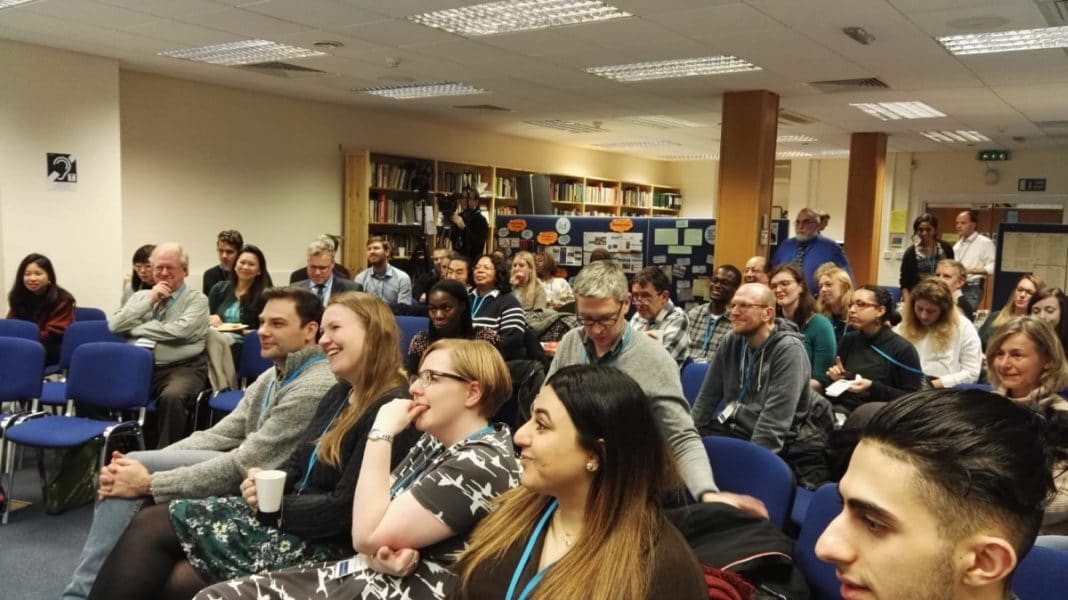
Lawyers and legal students from different Christian churches meet to encourage each other to live out the Gospel in their professional life. “The gospel has profound implications for the legal world. The Lawyers’ Christian Fellowship exists to bring the whole Good News of Jesus Christ within the legal world” (LCF website). Founded in 1852, the LCF unites Christian lawyers from all around Britain, as well as forging international links among legal professionals. It promotes three main areas of action: to live according to the “law of the Gospel” in one’s daily life; to form young legal professionals; to be active on an international level. As part of this third aspect, the LCF held a conference in November entitled: “A lawyer after God’s own heart: Lessons from Psalm 119”, inviting representatives of the “Communion and Law” international network of legal professionals and students animated by the Focolare spirituality. Elisabetta Scomazzon and Pasquale De Rosa, consultants in the field of canon law, attended for “Communion and Law”. What was the main focus of this meeting of lawyers from different Christian Churches? Elisabetta Scomazzon – Faith was at the centre: the bond which links us together most strongly, even more than the legal profession itself. Meetings like this are particularly significant because starting from being united on a personal level, we move on to find ways ahead in the legal field, for example through a clear uncompromising commitment to defend the weakest in our societies. Through choices like this, those of us active in the legal system can contribute towards building relationships that are more constructive and “fraternal”. During the conference, what points in common and what areas for future development in the legal field did you cover? Pasquale De Rosa –We have in common, above all, the shared commitment to witness to our Christian life in our profession. For example in the lawyer-client relationship and in the various environments a Christian lawyer works: to be authentic witnesses to the “good news” which every Christian carries within. Our work proceeds alongside that of our own Churches. What we have to do, is to collaborate together, starting from what Chiara Lubich called the “dialogue of life”, putting in common our experiences as legal professionals. For example, a pressing concern is that of human rights and how they are under threat in the current world situation. How can Christian lawyers and legal professionals contribute to peace and harmony within their own societies, in today’s climate characterized by divisive ideas and praxis? Elisabetta Scomazzon – Every nation and people has its own order and rules. The Law can actually be an instrument of communion which helps to find solutions to the urgent demands of our planet and to the cry of humanity subjected to injustice, exploitation and war. Christians of different churches finding solutions in the legal field does not need to be an utopian idea, but could be a great opportunity to give hope that unity is possible.
Edited by the editorial team
