11 Jul 2017 | Non categorizzato
After the rise of interest in The Day of Five Billion on July 11, 1987, the General Assembly of the United Nations decided to continue the project to increase awareness regarding the connections between population size, environment and human development. World Population Day was celebrated for the first time on July 11, 1990 in over 90 countries.
8 Jul 2017 | Non categorizzato
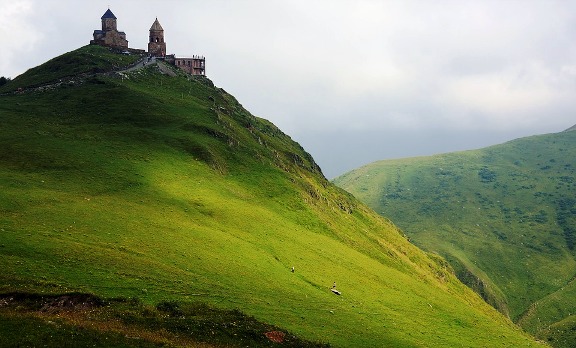
I have found you in so many places, Lord! I have felt you throbbing in the perfect stillness of a little Alpine church, in the shadow of the tabernacle of an empty cathedral, in the breathing as one soul of a crowd who loves you and who fills the arches of your church with songs and love. I have found you in joy. I have spoken to you beyond the starry firmament, when in the evening, in silence, I was returning home from work. I seek you and often I find you. But where I always find you is in suffering. A suffering, any sort of suffering, is like the sound of a bell that summons God’s bride to prayer. When the shadow of the cross appears the soul recollects itself in the tabernacle of its heart and forgetting the tinkling of the bell it “sees” you and speaks to you. It is you who come to visit me. It is I who answer you: “Here I am, Lord, I desire you, I have desired you.” And in this meeting my soul does not feel its suffering, but is as if inebriated with your love: suffused with you, imbued with you: I in you and you in me, that we may be one. And then I reopen my eyes to life, to the life less real, divinely drilled to wage your war. Chiara Lubich Essential Writings New City Press 2007 p. 91
6 Jul 2017 | Non categorizzato
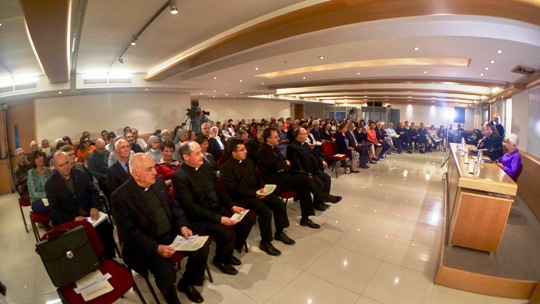
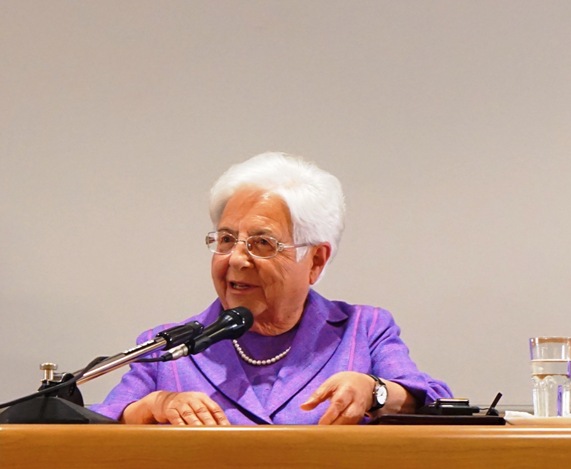 This past March 25th was the 60th anniversary of the Treaties of Rome, which gave rise in concrete terms to the “community of peoples” which Robert Schuman had already so clearly envisaged. In fact, on the 7th May 1950, he had suggested to Konrad Adenauer a “solidarity in coal and steel production”, which would make any form of war impossible between France, Germany and other countries that would have joined. It was an extraordinary step to reconcile peoples shattered by the most terrible conflict ever experienced. Europe had been devastated and over 35 million people had died. There was not only physical destruction but social, political and moral destruction too. There was absence of law, public order and public services. At the time, it would already have been an achievement to secure borders and maintain the peace agreements. How, then, could they imagine such a deep healing of wounds as to bring together many opposing peoples into one European people? Who inspired Schuman, Adenauer, De Gasperi and others? We would like to believe that God gave the ideas and the strength for Europe. God had shown his love for people to the point of dying a terrible and shameful death for them. He had identified himself with all the pain of humanity, including those resulting from violence and wars. Today too, God urges peoples to be reconciled and become a single universal family. The founders of Europe had their own experience. They did not allow themselves to be crushed by the absurdity of evil, by inhuman dictatorships, by conflict and the Shoah. Chiara Lubich, founder of the Focolare Movement, spoke of the culture that arises from profound reconciliation: “…every person can give his or her particular contribution in each field, whether it is in science, the arts, politics, communications or other areas. Each will be more effective if he or she works together with others united in the name of Christ. It is the incarnation that continues, the complete incarnation that encompasses all the members of the Mystical Body of Christ. This gives rise to and extends what we could call the “culture of Resurrection” in the world: the culture of the Risen Lord, of the new Person and in Him, of a new humanity.[1] If this was to some extent the adventure of Europe’s founders, we can – and I would say we must – aspire to continue their work. All of us are called to this. The unity of European peoples is a path to be followed simultaneously in the fields of education, culture and spirituality; and also in politics, economics, social structures and communications. Here, therefore, are some further steps that could be taken: First, we Christians are asked not only to be reconciled but also to pursue a path of shared witness, one that has recently seen historic meetings at Lund, Sweden; in Lesbos, Greece; in Cuba. All of us have the task to enable steps towards full and visible communion, knowing how decisive this will be for the unity of Europe and to better serve humanity. We also want to extend our vision to the whole of Europe – from the Atlantic to the Urals – and this means mutual recognition of values and contexts that allow collaboration between North and South, East and West. Wars, totalitarian regimes and injustices have left wounds that need healing. If we truly want to build European unity, we must be able to recognise that what we are today is the outcome of a shared history and a European destiny that we must fully own. If, then, as a result, relationships can be renewed between the European Union and European countries that are not part of the Union, this would already be an important step ahead for peace, especially in the Middle East. In Europe, there is a great need for citizens to be fully engaged in the life of their cities and of the whole continent. This means, in other words, giving new life to democracy, which began in Europe but today needs a new dimension, one that is more incisive, more engaging, more suited to our times. Furthermore, in a European context that is both multicultural and multifaith there is great need for a new capacity for dialogue. Dialogue can be founded on the “Golden Rule” which says, “Treat others as you would have them treat you”[2] (Cf Lk 6:31), a rule shared by the world’s major religions and accepted by those who do not have religious beliefs. Additionally, it will be necessary to review and apply the motto chosen for the European Union “unity and diversity” also at the level of institutions. It would be a gift for peoples in other continents who are seeking ways to unite. The founding fathers never envisaged Europe as closed in on itself, but instead they saw it open to the unity of the entire human family. It is particularly meaningful to be able to reaffirm this here in Malta, the southernmost European state, set by its very vocation, food and language, in the Mediterranean. From being a watery graveyard this sea must become once more “Mare nostrum” for a united Europe, Africa and Middle East. Many ongoing international crises give us a clear picture of the long road ahead in order truly to reach this goal. Chiara Lubich also said, “What is needed, then, is patient study, what is needed is wisdom. Above all, we mustn’t forget that ‘Someone’ is following our history, Someone who desires – if we collaborate in good will – to fulfil His plan of love for our continent and for the entire world.”[3] We can conclude that it is certainly worthwhile spending our whole lives for such a high goal. My wish is that this Forum may contribute to establishing: “Europe – a family of peoples” which, according to Pope Francis, is “A Europe capable of giving birth to a new humanism based on three capacities: the capacity to integrate, the capacity for dialogue and the capacity to generate.”[4] Maria Voce President of the Focolare Movement Malta – St John’s Cathedral, 7 May 2017 ____________________________________________ [1] Chiara Lubich, 23rd September 2006, “Jesus Forsaken and the Collective and Cultural Night”, to the Ecumenical Meeting of Bishops. [2] Lk 6:31 Do to others as you would have them to do you”. [3] Chiara Lubich to the European Movement in Spain, Madrid, 3rd December 2002. [4] Address of Pope Francis, Conferral of the Charlemagne Prize, 6th May 2016.

1 Jul 2017 | Non categorizzato
“Contemplating the immensity of the universe, the extraordinary beauty and power of nature, my mind rose spontaneously to the Creator of it all, to a new sort of understanding of the immensity of God. It made a new and strong impression on me; I felt like falling on my knees to adore, praise, and glorify God. I felt a great need of this, as if it were my actual vocation. It was as if my eyes had been opened, to understand as never before who it is that we have chosen as our ideal; or rather, who has chosen us. I saw that he is so great, so great, so great, that it seemed impossible that he thinks of us. This impression of God’s immensity stayed in my heart for several days. Now, saying, “Hallowed be thy name,” or “Glory be to the Father and to the Son and to the Holy Spirit,” is different for me: it has become a need of the heart. (Rocca di Papa, 22.1.87) “… Contemplating perhaps an endless stretch of sea, a high mountain range, an impressive glacier or the night sky dotted with stars. What majesty! The immensity of it! And through the dazzling splendour of nature, we would find our way to its author: God, the King of the universe, the Lord of the galaxies, the Infinite. … He is everywhere: beneath the sparkle of a glittering stream, within the blossoming of a flower, in a bright dawn or a red sunset, on a snow-covered peak. Nature is rarely preserved in our concrete cities, built by human hands in the midst of the noise of the world. Yet, if we want, a glimpse of blue sky between the skyscraper peaks is enough to remind us of God; a ray of sunlight, which does not fail to pierce even through the bars of a prison, is enough; a flower is enough, a meadow, a child’s face. … This will help us go back into the midst of humanity, which is where we belong, strengthened, as Jesus certainly was when having prayed all night to the Father on the mountainside under the starry sky, he went back among people to do good. (Mollens, 22.9.88) From Chiara Lubich – “Cercando le cose di lassù” [Seeking the things that are above]– Città Nuova Editrice, Roma 1992, pagg. 5 – 111,112.
