14 Jun 2017 | Non categorizzato
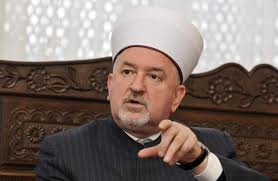
“A recipe for success doesn’t exist, but there is a recipe for failure. The recipe for failure is violence ‘in the name of Allah’”. With these words, the Grand Mufti Emeritus of Bosnia Herzogovina turned to the Muslims of Europe with an appeal. He made it on the day after the bloody attacks in London and Manchester. Like Chiara Lubich before him, and presently Maria Voce, Mustafa Ceric was once the honorary president of Religions for Peace. “This is not my faith. This is not the Allah I believe in. My faith is never the knife, it’s never terror. My Allah is Loving and Merciful. […] “I confess that I have never felt so confused and so helpless in trying to explain what is happening inside and outside my community of faith. I console myself with the thought that these are the actions of extreme minorities, just a political game by great powers to gain Muslim wealth.” The Grand Mufti had been awarded the Felix Houphouet-Boigny UNESCO Peace Prize in 2003 and the Sternberg Prize of the International Council of Christians and Jews “for his outstanding contribution to the understanding of the faith.” In 2007 he received the Theodor-Heuss-Stiftung Prize for his Contribution to the Dissemination and Strengthening of Democracy and in 2008 the Eugen Biser Foundation Prize for his efforts to promote understanding and peace between Christian and Islamic thought. Mustafa Ceric used strong words: “My faith community has many problems. The biggest one is that of delegating to others the solutions of our problems. Instead, my Community of Faith, my Ummah, must solve its problems within itself before solving the problems around it.” There are those who claim that the attacks against innocent civilians in Manchester or London are more important than the ones in Palestine, in Kabul, Mosul, Sa’an and Misurata, said Ceric. “They aren’t more important, but certainly more dangerous for the Muslims in Europe, the majority of whom have escaped from Muslim countries to seek peace and safety for their children in Europe. The peace and safety they have experienced up until now are threatened. After Manchester, London – and even before that, Berlin and Zurich – “the European Muslims have to be strong and clear not only about condemning violence ‘in the name of Allah’, but also about taking concrete measures against any form of abuse of Islam. They need to have a clear voice, a united and irrevocable voice in the struggle against the violence that is supported ‘in the name of Allah’. It is no longer a matter of individual goodwill of individuals or groups that work for interreligious dialogue. It is an existential problem for Islam and for the Muslims in Europe.” The Grand Mufti therefore launched an appeal to the Muslims of Europe to “gather together immediately around a “common word” between us and our neighbours independent of their faith, race or nationality, to swear an oath to God, to themselves and to their own neighbours in Europe: an oath to love and promote peace, security and cooperation in accordance with what we are obliged to do by our culture and Islamic faith. We must swear that we will do everything that is necessary to fight together against violence towards innocent people. We present-day generations of European Muslims owe it to our descendants who have no blame.” “This is no longer the time to hesitate!” The Mufti vehemently expressed his hope and desire for a change. “There’s no room for calculation! There are no longer excuses for putting it off, nor justifications for waiting! There is no salvation in silence! There is no future for Islam nor for Muslims in Europe if not in coexistence and in tolerance with our European neighbours!”

14 Jun 2017 | Non categorizzato
Škofja Loka
14 Jun 2017 | Non categorizzato
For your commitment to peace, promoting a series of initiatives to convert a weapons factory in the province of Iglesias” (Sardinia, Italy). The missive, dated June 3 addressed the local community of the Focolare Movement, (New Humanities section), for all the endeavours undertaken with Amnesty International, Oxfam, Fondazione Banca Etica, Opal Brescia and Italian Disarmament Network, for the “RVM reconversion” (Multinational Arms-producing Company). The Holy Father said he was “happy to know that you are concretely involved in promoting a dignified employment, as an alternative to the manufacture of arms, in a territory that is still undergoing serious employment crises.” Lastly, he expressed his “solidarity for the commitment in spreading the culture of peace.”
![The dialogue wanted by God]()
13 Jun 2017 | Non categorizzato
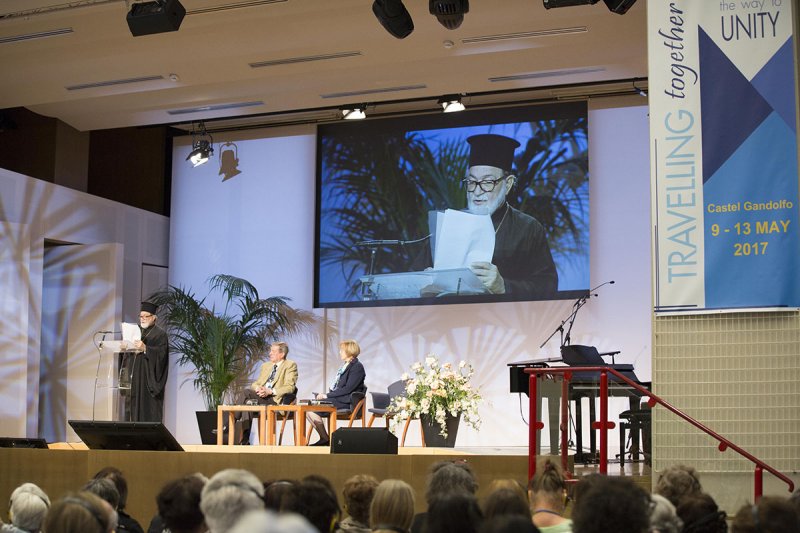 Patriarch Athenagoras and Chiara Lubich, protagonists of unity. Beginning again is never and never has been easy, especially if deep trenches have been dug over time, if certain differences have become cultural, if – to complicate matters – there is even the certainty of being in the right. It wouldn’t be far from the truth to say that this was the situation in the mid-1900s between the Catholic and the Orthodox Church, after centuries, an entire millennium, the separation was nurtured and cultivated. Then…the historic turning point. The celebrated and unforgettable and glorious memories of the initiators of the ‘dialogue of Love’, the great inventors of the dialogue of the people: Athenagoras, Ecumenical Patriarch, and Chiara Lubich, foundress of the Movement of unity. With their humble, serious and willingness, with dedication, love and prayer they were the initiators of a new ecumenical Era; they instructed the peoples, giving them courage, strength, patience, faithfulness, willingness, love and unity. Deep down the solution was simple, and the Patriarch expressed it with the following words: “We lived alone, without brothers, without having sisters for many centuries, like orphans. Why? The brother and sister are the door. There lies the secret!” The unforgettable protagonists of the ‘dialogue of love’, the great inventors of the dialogue of the people met a good 27 times, between 1967 and 1972 when the Patriarch died. There first encounter goes back to June 13th, 1967 when Lubich visited the Ecumenical Patriarchate of Constantinople, even though, until this day, that moment has never been adequately appreciated for its full value. The Patriarch approved and lovingly embraced the seriousness of the charism of Chiara, her mystical spirituality that is a spirituality of the Church, to the point that their encounter was even considered ‘an ecstasy’, and the conviction grew more and more in him that by living the words of Jesus’s Testament could lead us to the same chalice. With these touching words he remarked: ‘For me it would be a day of Paradise.’
  Not much time was needed before the Patriarch declared himself to be a “focolarino” and began to call Lubich by the name of “Tecla,” having discerned in her the same zeal as the isapostolo [equal to the Apostles]. He went on to say: ‘We are thirsty for this spirituality.’ Meanwhile, Chiara was equally touched and to her the Patriarch ‘appeared as an Archangel that struggles and fights to the end for his ideal: a man of God, proven in heroic love and heroic patience’. With her spirituality and marvellous personality, Chiara not only prepared the two principle and most important Bridges: Paul VI and Athenagoras, but she also managed to unite those two Bridges. Through encounters between Orthodox and Catholics, the bond of mutual love mitigated the sorrow of not being able to share the Eucharist; indeed, it made this cross loveable as a contribution of the Christian People to that One Chalice. “The Pope is our leader,” the Patriarch confided to Chiara. “…sometimes I see the Pope ‘in agony,’ because he knows everything that there is of negative in the world. This is why I placed myself one hundred percent at his service. I follow him, I understand him, I love him, I respect him, I admire him.” As a follow-up of this fifty-year journey, I personally proposed to Msgr Piero Coda, president of Sophia University Institute (SUI), the institution of an Ecumenical Chair in recognition of these two extraordinary protagonists of brotherhood among the Orthodox and Catholic Church. My proposal received magnanimous and cordial approval, along with the blessing of Patriarch Bartholomew and the enthusiastic support of Focolare president, Maria Voce. Let us offer from our hearts one great ‘thank you’ like beautiful flowers to Athenagoras and to Chiara who were sent by God, who gave their life above all else to the realization of God’s will: ‘Tthat all be one’, for it will given as a gift of the Holy Spirit.
Metropolitan Gennadios Zervos,
Archbishop of Italy and Malta of the Ecumenical Patriarchate of Constantinople
13 Jun 2017 | Non categorizzato
What can you do? Donate blood. Donate often. This is the slogan chosen by the World Health Organisation for the celebration of the World Blood Donor Day on 14 June. Some of the objectives of the campaign: to encourage all citizens to reinforce the efficiency of healthcare services; involve the authorities in the creation of National programmes to respond to the growing needs; favour the inclusion of transfusion services in emergency situations; guarantee the supply and reach self-sufficiency nationwide; thank the people who donate blood regularly; promote international cooperation; ensure voluntary donation and enhance security and availability of blood.
12 Jun 2017 | Non categorizzato
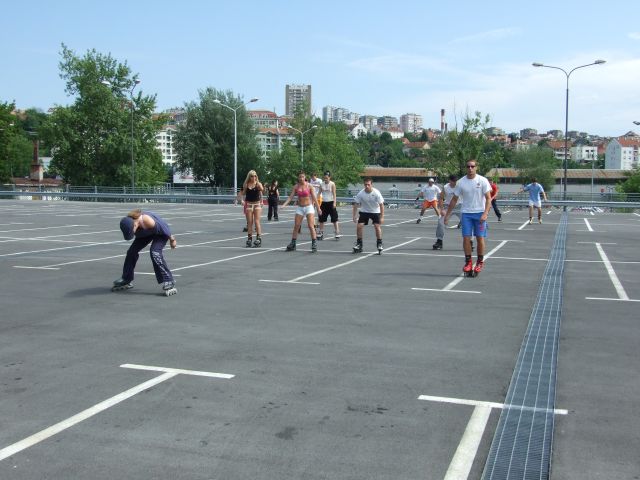 Belgrade (“the white city”) in Central Serbia, one of Europe’s oldest cities,lies at the confluence of the Sava and Danube Rivers. “Gateway to the Balkans” or “Gateway to Europe,” reborn after a recent past of wars, it is today an avant-garde capital, where new ideas, novelties and vitality brew in the fields of art, economy, architecture. and also sports. Last 12-13 May, on the occasion of the 20th anniversary of its foundation, the College of Sports and Health, a certified institution with 600 students, organised an international conference entitled “Sports, recreation, health.” Sportmeet was among the guests invited by Prof. Alexander Ivanovski, also as the expression in the world of sports of that social and spiritual renewal that originated from the experience of the Focolare: a global network of sports lovers, professional and amateur sportsmen and women, teachers, instructors, journalists, managers and operators of the sports business, who live sports as a positive reality for the discussion and exchange of ideas, and as an occasion not only to work up one’s body, but also for universal brotherhood and inclusion. Paolo Cipolli, Sportmeet President, at the conference with a Serb-Croatian delegation entitled his speech Sports moves people and moves ideas. The “sports phenomenon” is one of the more complex, interesting and compelling realities of our time, involving 800 million practitioners, five million sports associations, 205 national federations, and members of the International Olympics Committee, 208 of which belong to the International Soccer Association. Considering that “only” 192 nations are part of the UN, its weight and omnipresence, like a sort of planetary power, or as some say a “new religion” is obvious. It is an area of infinite economic interest, but sad to say, also of delinquency, while on the contrary, sports can become a “training ground” for brotherhood, unity and integration – a universal “language of gestures” that brings down barriers, obstacles and diversities. In Belgrade, the clean aspect of sports was staged. Among the many speeches on the various aspects connected to the role and potential of sports in the promotion of health, a common consideration emerged among experts and teachers from Slovenia, Croatia, Macedonia and Bulgaria: the need to define new policies for a full valorisation of sports in view of a correct lifestyle, and all the possible forms of integration, especially among the youth. The conference was the occasion to establish new relationships and an agreed protocol in view of future cooperation, giving value to important experiences already underwaysuch as the use of games in some cases of youth hospitality. After Belgrade, Sportmeet is now focused on the next steps, social inclusion, sports education, integration of the people with diverse abilities and relationship between generationsto be undertaken from 13 – 16 July in Spain. In these four days of sports testimonies, and starting from the international symposium of Barcelona (at the Palau Roberton 13 July),operators will discuss with one another, regarding theholding of a Summer School in Castel d’Aro, some hundred kilometers from the Catalunyan capital. Promoted in cooperation with other local partners, among which is the UniversitatAutònoma de Barcelona, it will be a rich programme to make people aware of inclusive sports and good sportive practice – with the dream that “sports” may really become synonymous to “encounter” at all levels.
