8 May 2016 | Non categorizzato
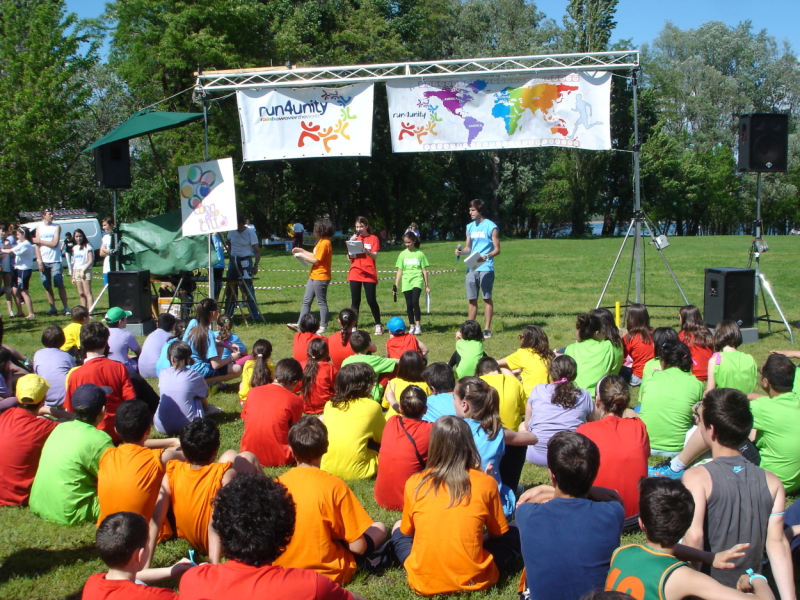
 It’s a global relay race in the name of peace and unity between peoples along the world’s most dangerous borders. From the US-Mexico border to the one separating Hungary and Austria, where were raised protective that people attempt to cross in the hope of a better future, putting their life at risk. It’s called Run4unity , promoted on Sunday May 8 by hundreds of thousands of young boys and girls from the Focolari Movement in all corners of the globe. From 11:00 to 12:00 they will follow a track by foot or by bike, with rollers, by boat. A time-out will follow, along with a minute of silence or a prayer for peace. “Youths for unity” in Mexico have decided to run across Mexicali, 3.500 km from Mexico City, on the border with the United States. They will be running along the wall that divides the two peoples, in memory of all those who lost their lives in the attempt to cross the border, finding themselves in a desert land. The initiative, included in the school program, involves 10 schools with 1500 pupils. It is promoted by a team of physical education teachers coordinated by the local school inspector. Across the ocean, Hungarian youths responded to their Mexicali “friends” with a relay race held Sunday May 1st in Sopron, on the Austria-Slovakian border. Last year the city hit world news as a destination of migrants desperately trying to enter Austria by train from Budapest. The relay took place with the participation of young Afghan refugees from a nearby refugee camp. Over 100 thousand adolescents have participated in the initiative held in previous years. From the islands of Wallis and Futuna in the Pacific Ocean to Cairo, the baton passes from time zone to time zone to kick off sporting events, solidarity actions and active citizenship experiences in places marked by loneliness, poverty, marginalization. In the city of Bari, (Italy) the initiative will take place in the Fornelli juvenile penitentiary with a four-way football tournament, while in another Italian town the young people decided to visit the reception centre for asylum-seekers. Wherever they will be running, “their flag” will bear the “Golden rule”: “Do unto others as you would have them do unto you and Do not do unto others what you would not have them do unto you.” It’s an ethical principle that is found in almost all cultures and religions – they said -. From Judaism to Islam, as well as in the most ancient African traditions. If the world stopped on Sunday, and were handed over to these young people to govern, perhaps many fears would be dispelled, tensions would ebb, many tears would be wiped off and a rainbow of peace would cross the world. Obviously, one hour is not enough to accomplish this “dream.” And from Sunday the world will start spinning as it always did. But they won’t, these young people will remain. They have learned to see the world with different eyes. They are already capable of following it going to those places where humanity is facing major historical challenges. Indeed, they are the future and represent hope. They are asking us and working towards a world where humankind will be as brothers and sisters. Perhaps it is worthwhile listening to them. Source: SIR

7 May 2016 | Non categorizzato
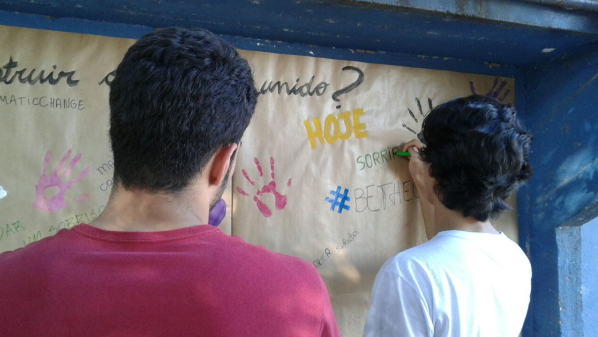
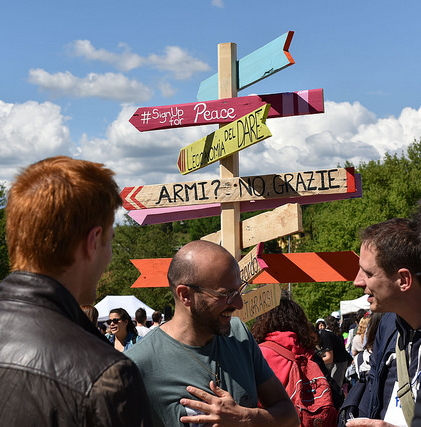 “Where was I?” was the refrain of the song inspired by the migration tragedy, and sung by the Gen Verde on the stage of the May 1 event of Loppiano (Florence). The question resounded strongly among the 1,200 participants of the feast day, but it also pertained to commitment to suffering humanity, for example in Aleppo, with the escalation of bombs and deaths which have beset the city for the last 10 days, and likewise for the populations devastated by the earthquake in Ecuador, who asked to live and return to their normal lives. It is a commitment also of the multitude of associations and initiatives operating on the front of integration in Italy. “The aim of this day – explained the Youth for a United World – is to highlight the flow of initiatives undertaken throughout Italy, in the name of reception, lawfulness, politics lived as a service, and care for the environment, which in one word means: fraternity.” “Ever since the bombings started again, a chain of solidarity has begun among the people – Tarek of Aleppo, Syria, recounted. This reveals the quality of my people, who do not give up, but whose dignity is wounded. We say, stop the war, and ask with faith for the gift of peace.» Lubna instead explains: «In Jordan there are three million refugees, half of which are Syrians. They arrive with despair in their eyes, and the absence of hope. We try to share the life of fear they have faced, by giving them love and a sense of family.» Wa’el Suleiman, Director of Caritas in Jordan, addressed the people with a heartfelt appeal in a video shoot: «Work with us to stop the war, come to the Middle East and help us rebuild our countries, so that the people do not have to escape, and emigrate. We want to live in our lands.” Nahomy and Maria are both Ecuadorians, They recounted the extraordinary strength of their people: “The pain of those who had lost all their belongings, became the suffering of all. The inmates of a prison started to build wooden coffins, people of different political ideologies teamed up together, the cooks became heroes by preparing a warm meal for everyone, and the poor shared the little they had.” A festive atmosphere and lots of music accompanied the stories of the youth who have decided to actively take part in the building of a different world. “«I am weary of clashes, and diatribes in politics and also in daily life – a boy wrote on the great “wall” on which each could leave behind that part of himself that hinders the flow of fraternity – the only things I take interest in and for which I want to live are those things that unite and not those that divide us.”
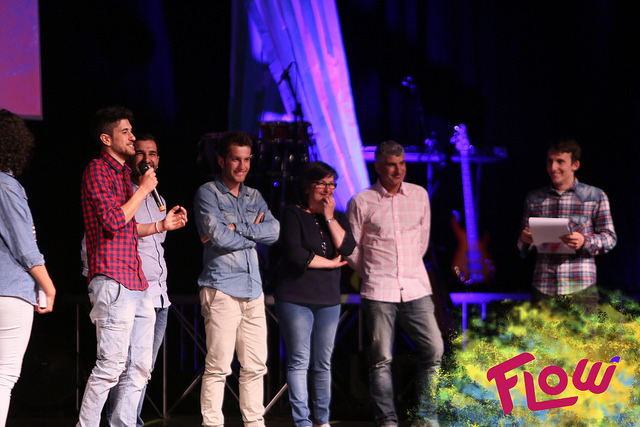
 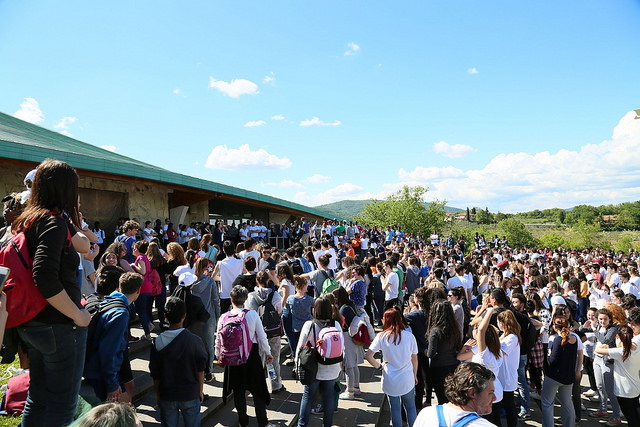 Cristina Guarda, 25, a councilor of the Venice Region, talked about the reasons that drove her to ‘go out there’: “I have always been convinced that politics is what we build when we place ourselves at the service of others. I felt that it was time to get involved.” A phrase of Chiara Lubich introduced the round table that ended the morning. “If you want to transform a city, start by uniting with those who share your ideals. Together, look for the poor, the abandoned, orphans, prisoners, those who are marginalized, and give, always give: a comforting word, a smile, your time, your goods….”. Then came an overview of a variety of ideas-projects of the Youth for a United World in Italy: in Turin, in a small dormitory; in Florence, with a group of prisoners in the Gozzini Jail; in Syracuse, with the Summer Campus that will take place next summer, and which foresees support and recreational activities with problematic children and adolescents; in Naples and Caserta, the project, “Fraternity Workshops,” which has involved hundreds of kids from the peripheries at risk. The afternoon program proceeded with the Expo of the United World Project on disarmaments, the environment, economy of communion, art, culture with the Sophia University Institute, Slotmob, against gambling, intercultural and interreligious dialogue, etc. The day ended with the “FlowRun”: a run in several stages which culminates in an explosion of joy, music and colours, as if to demonstrate that enthusiasm and joy are essential for anyone who wants to attract others in the adventure of a world that is “for” and not “against” something. Source: Focolare-Loppiano nformation Service Photos on Flickr:
2 May 2016 | Non categorizzato
 «We have to move on and be a source of light to those who are suffering. Many feel frustrated because they cannot do anything; let us give them the opportunity to help». These words were said by a young girl from Ecuador, a country hit by an earthquake on April 16 and presently living in a humanitarian state of emergency. They indicate the new rota of activities to be held during United World Week 2016. Ecuador is at the centre of this event. United World Week was started by the young members of the Focolare Movement just after the Genfest 1995. It involves the whole Movement. The preparation for the 2016 edition, which focuses its attention on Ecuador and interculturalism, so inherent in countries of the Andean region, has been going on for some time. The aim of this initiative is to give voice to the culture of fraternity which is present in the world and stimulates each person to give of his best. «On May 7, we are organizing a Peace Festival in Quito to express interculturalism. Its title is: ‘Solidarity leads to peace’. Join us and give hope; this is what is needed at the moment and we all can give it». With this appeal, the young people of Ecuador propose a global response to all those who want to offer their support, either through collecting funds or through posting a video message of fraternity and hope on Facebook (fb.com/JMUEcuador). The Peace Festival is just one of the many initiatives launched since the earthquake happened, when many immediately offered the use of their own social networks to spread official emergency information. Run4unity is another event that takes place during United World Week. Teenagers in many parts of the world organize this run from11.00 to 12.00, in different time-zones and with different sport activities. It is concluded by a time-out, a minute of silence or a prayer for peace. Among the landmarks of this event one finds: Mexicali, a Mexican town on the border with USA; here, Run4unity is held along the wall that divides the two countries; Bari, Italy with an activity at the Fornelli Juvenile Penal Institute, and Sopron, a Hungarian town on the border with Austria, where Run4unity forms part of an official sports programme in which young refugees in a refugee camp in Austria also participate (http://www.run4unity.net/2016/en/). United World Week includes also the Living Peace project promoted by El Roward American College in Cairo, Egypt and the Focolare NGO New Humanity. This project which involves a network of secondary schools, with over 50,000 students in 103 countries, aims at instilling a greater commitment to live for peace in different learning environments (http://living-peace.blogspot.it/p/english.html). Loppiano, Italy and Abrigada, Portugal hold their traditional programme for youth on May1. “We are many people living on the same planet, we are brethren. Let us live and work so that this fraternity reigns in politics, in economy, in the social and cultural fields; so that we live in a better world as one family because we are all human beings”. This is the idea that animated the preparation for the Loppiano programme, while Abrigada focused on the idea of peace to demonstrate the highest aspirations of this reality. United World Week embraces the world and local initiatives aim at this goal. Examples of this are the concert for peace at Medan, Indonesia; the visit to a home for the elderly in New Zealand, presently debating the legislation of euthanasia; the Amani Festival in Goma in the Democratic Republic of Congo and the ecumenical workshop wanted by youth and priests of the Catholic, Russian-Orthodox, Armenian, Luteran and Evangelical Churches “to go beyond prejudices”. Very significant is the video message sent from youth in Aleppo, Syria to others in Argentina (fb.com/focolaresconosur). Many of the events may be followed on http://www.unitedworldproject.org/en/ and on fb.com/uwpofficial. Messages, photos and videos may be shared by using hashtag #4peace, thus giving voice to all big and small initiatives that “build bridges of fraternity” every day. Press Release Fotogallery (May Day at Loppiano) https://vimeo.com/164901348 https://vimeo.com/164386629

2 May 2016 | Non categorizzato
Melbourne, Australia Latitude: 37° 52’ S Longitude: 145° 08’ E Tom is a tall guy, popular with friends.In 2005 he had to move with his family to a newly built neighbourhood in Melbourne, where recreation activities and venues for recreation were scarce. He could have decided to leave but he tried instead to find a way to do something for his community so that people could have opportunities to come together, share and meet. “There is nothing better than sport to bring people from various generation together? In that neighbourhood there was an empty park. So, I started spreading an idea that had come to my mind: creating a space where people could play soccer. I did not know who would join and there was a risk that I would find myself on my own. But there were many families that shared the same desire and enthusiasm. So, participants soon became so many that we could set up a team and then even a soccer club! Now we have 38 teams with more than 400 children and 40 old people. Every week we meet to play. The park has been renovated and now there are many pitches with their own lighting. But this is not the end of the story, because we also added locker rooms, a kitchen and a canteen. It’s become a real meeting place”. Source: United world project
1 May 2016 | Non categorizzato
https://vimeo.com/164386629
1 May 2016 | Non categorizzato
Work was inflicted on mankind as a discipline, but also as redemption. While work has the immediate effect of providing the daily bread, it also has an ultimate effect that is the acquisition of the Kingdom of God. Therefore it regards theology as much as it does economy; in fact man is the son of God, turned towards God even when he works. If it were merely a matter of economics, the worker would be nothing more than a machine: the dignity of a worker would be reduced to that of a mere tool. Nowadays there is so much talk about the dignity of work that it has become commonplace. But it is not said that the slave mentality is gone, nor that there is a lack of business owners, perhaps baptized, who because they pay a salary do not have the right to humiliate the ones who live on that salary, treating them with contempt and distrust, be they intellectual workers or be they semi-literate domestics. But, work is not only there to grow a salary. Work done with a desire for moral redemption and sharing in the sufferings of Christ, produces holiness. It enters into the economy of things eternal that makes machine builders, farmers, students, professionals, clerks and housewives into constructors of the integral Christ. Saint Ambrose says that every good worker is Christ’s own hand. Christ is at work in society through the hands of his workers. In other words, those who work well construct something that is heavenly on earth. The worker is the human crafter of a divine architecture. And this raises the dignity of the worker and of the work, if the work is carried out according to the spirit of the law of Christ. In this we see the divine at work in society through man, who becomes associated to the prodigy of the Incarnation. If the Incarnation was the miracle of the humanization of the Son of God, it also contains a daily miracle of the divinization of the sons of men who are therefore sons of God. It is a movement that comes from the earth and extends to the encounter with Christ who comes from Heaven. And so the life amidst these tormented streets of the earth is, yes, totally human, but also totally inserted in the divine life. It is totally divine if it is lives in the spirit of the Redemption. This dignity is not limited only to the works of the spirit, but invests the whole person, body and spirit and all that he does. The job, the profession, the office – these melancholic and at times tragic and often boring things are transfigured in a single blow into unexpected Values, into parts of our destiny. They become the means of our redemption. The work was our punishment and, through the humanity of Christ, it becomes our ransom. It is our contribution to the Redemption. You scale the heights of Heaven with the materials of the earth. Nothing is lost: not a bad pay day, not a word that is spoken, not a cup of water given in the name of Christ. The Kingdom of God is largely made up of these simple things. Most do not leave for the missions, enter a hermitage or write theological treatises: but everyone works, everyone serves. Well, if you act according to the spirit of Christ, serving men means serving God. He does not yet come to us surrounded in all his light that would blind us, but in his images, in men, in the work of his hand.” Igino Giordani, La società cristiana (Rome: Citta Nuova, 2010) p. 72-82.
