19 Apr 2016 | Non categorizzato
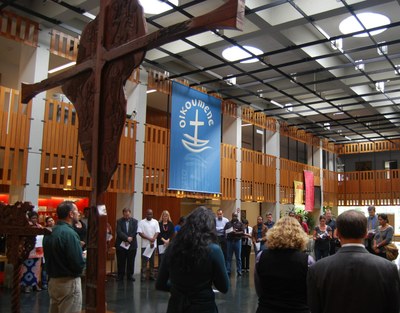
Without falling into the trap of ideological self-contained reminiscences, we shall be asking what has contributed to the idea of a “European identity”, whether it be conceived as an existing identity or as one still coming into existence, in what terms it can be described, and what has given rise to the ideal of European unity that can then be expressed in political form. Moving one step further, we shall attempt to draw, out of the historical experience of Europe, values and ideals that could enable us to surmount the present crisis and find a way forward into the future. Are there any examples and actual projects that are putting into action these values and ideals? Within a broad-minded vision of secularism, what could be a welcome contribution from churches and other religious communities? And, in this context, what is, or could be, the role of Switzerland?
Programme
A panel discussion, with audience participation, with:
- Rev. Dr Olav Fykse Tveit, general secretary of the World Council of Churches
- Mr Eric Ackermann, a member of the Jewish community in Geneva
- Ms Gaelle Courtens, a journalist associated with the Federation of Protestant Churches in Italy and the ‘nev-notizie evangeliche’ Press Agency
- Mr Pasquale Ferrara, a diplomat, and professor at the LUISS University, Rome, and the Sophia University Institute, Loppiano
- Mr Andreas Gross, a former Swiss parliamentarian, and a former member of the Parliamentary Assembly of the Council of Europe
- In the chair: Ms Marguerite Contat, former head of delegations at the International Committee of the Red Cross, and joint president of the Genevan Constituent Assembly, 2008-12
Simultaneous interpretation in English and French will be available. The event will be live streamed online.
18 Apr 2016 | Non categorizzato
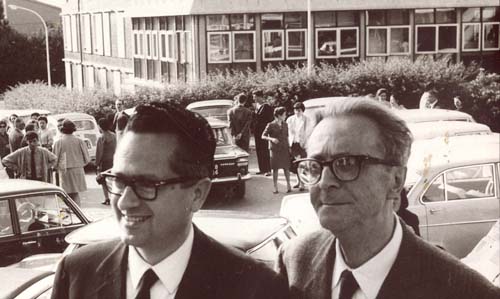
Tommaso Sorgi (left) with Igino Giordani in 1969
16 Apr 2016 | Non categorizzato
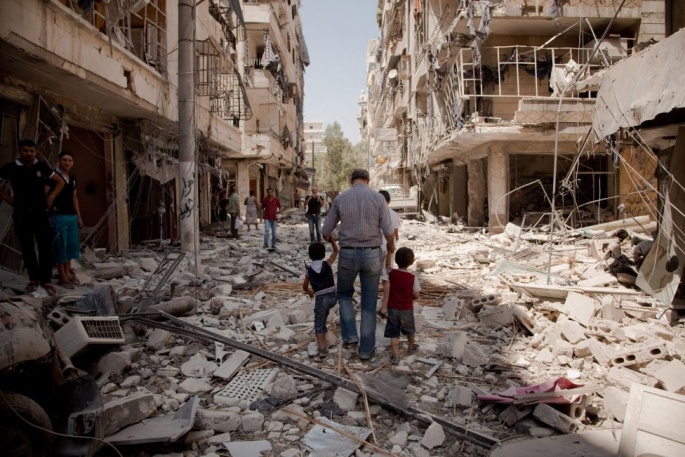
“When the conflict in Syria began, seeing that the future didn’t promise anything good, I thought it would be more prudent to leave the country. This idea was strengthened by a job offer in Lebanon. So I secured tickets and began to ready my family for the journey. But many doubts began to crop up inside me. Was it right to go and seek a better future for the family, or was it be better to remain in the country that I loved, to help my people? Talking it over with my wife, I realized that she was more inclined to stay, but she left it up to me. The only thing that mattered to her was that we keep the family together. I felt confused and upset until, one day – I was at church – I clearly felt that our place was here in Aleppo sharing the fate of our people. We are a diverse population made of many ethnic groups, different religions and confessions, but we’ve always lived together in harmony. We’re generous enough to accommodate Palestinians, Lebanese and Iraqis in recent decades, despite the embargo, offering them equal rights and job opportunities. We decided to stay. I worked on my own and earned good money. But after the bloody events that began to devastate the country, my shop was robbed and then destroyed. Nevertheless, there have still been many occasions give assistance through the Centre for the Deaf which my wife and I started to take care of. Later we also began collaboration with other humanitarian organisations to provide – with the help of Providence that has always reached out to us with miraculous assistance – basic necessities to more than 1,500 families. In these five years of war, due to the random bombings in our neighbourhoods, we saw so many families lose their loved ones and so many people left permanently disabled. One day, the driver at the Centre for the Deaf lost his wife and daughter when they were hit by mortar while walking down the street with the family. He was also seriously injured and taken to hospital in a state of shock. I was able to talk about his serious situation with a priest and when the bishop heard of it, he offered to take charge of the funeral for his wife and daughter. For my part, I began to look for money to pay for the Dad’s surgery. Seeing so many people taking an interest him the hospital lowered the costs and some doctors refused to accept payment for their service. So, not only were we able to cover all the expenses, but we had enough money left over to pay for the follow-up treatments that the driver would need. Another time I received a telephone call from a Muslim who works in the church we attend. He was asking me to help him find a house he could live in. He had seen armed rebels entering his district and was worried about his three daughters. After many attempts we finally managed to find a home for them. Once he moved into the new house, he realised he needed a gas cylinder, but could not find one. Then he called me: ‘I ask for this help from you,’ he remarked, ‘because you’re my brother, aren’t you?’ And I answered: “Of course, we are brothers.” Since the recent ceasefire we have experienced a period of apparent calm, although you hear rumblings from time to time that keep us awake at night. Regarding my activities, it’s impossible to even think about beginning them again until the weapons are silenced. The Focolare community is there to support us in the midst of our dangerous situation, along with God’s love that never abandons us. In front of every problem we never feel alone. We continue to experience peace in giving to others, a peace that remains a challenge because it is a gift that must be reconquered each day.”

14 Apr 2016 | Non categorizzato
After the two Synods on the family, Amoris Laetitia finally announces the ideas of the Pope, this Pope. He is the Pope of mercy, who gathers the approval of those who declare to have “closed” their relations with the Church, or who do not profess any faith. The recent exhortation, set out in over 100 pages, really responds to the expectations of those who hoped in change – very evident on the pastoral level. The doctrinal one has remained unchanged – also for those most bound to tradition. It is a reaching out to all, also to those who find themselves in a so-called “irregular” position. For Pope Francis “no family is a perfect reality and packaged once and for always, but requires a gradual growth of its own capacity to love” (AL 325), as if it aims to remove the tendency to distinguish between ”regulars” and “irregulars” and wants to underline that nobody is condemned and excluded beyond repair. The most significant opening of Amoris Laetitia is certainly intended for the divorced who have remarried, which provides a path of growth in the capacity for discernment, accompanied by pastors or as also cited, by “lay persons who live in the service of the Lord” (AL 312) aware that they are called to “form consciences, and not replace them” (AL 37). It is a path which in certain cases, as stated in the 351st note of the exhortation, could lead also to access to the sacraments, since, the Pope underpins that the Eucharist “is not an award for the perfect, but a generous balm and a nutriment for the weak.” But if the media’s attention is caught precisely by these ‘openings’ to the remarried, it is 4 and 5 (on the beauty of the family that draws inspiration from the Trinitarian design and nurtures on that charity St. Paul spoke about in Cor 1,13) that its merit goes beyond. The centrality of the life of the couples is presented here as never before: “It is the direct encounter face to face with a “thou” who reflects God’s love and is man’s best possession, or as the spouse of the Canticle of Canticles exclaims in a stupendous profession of love in reciprocity: ‘My beloved is mine and I am his. I am my beloved’s and my beloved is mine.” (AL 12-13). «…we often present marriage in such a way that its unitive meaning, call to grow in love and ideal of mutual assistance are overshadowed by an almost exclusive insistence on the duty of procreation.» (AL 36). We need a healthy dose of self-criticism, in our attempt to valorize the eros imbued in creatures, showing marriage in its concrete reality as a “mixture of joys and struggles, tensions and repose, suffering and liberations, satisfactions and longings, and annoyances and pleasures. » (Al 126). Every moment of daily life is highlighted, overcoming the contrast between sacred and profane, and between solemn and unimportant events, since nothing is secondary in the eyes of love and faith. The Pope also takes into account the longer life spans and the initial decision of the spouses that has to be daily renewed» (AL 163), in a continual regeneration and change as each progresses along the path of personal growth and development: «There is no guarantee that we will feel the same way all through life. Yet if a couple can come up with a shared and lasting project, they can love one another and live as one until death do them part, enjoying an enriching intimacy.» (AL 163). Thank you Pope Francis! We really needed the loving care of the Church which continues to present to spouses the high ideal and model of the Trinitarian harmony which has never been reached, and also for the fraternal hand of the Church which stands by all of us, without rejecting anyone.
11 Apr 2016 | Non categorizzato
Organised by: Psychology and Communion Topic: “Psychology’s contribution to dialogue” Participants: 50-60 young psychologists from Brazil, Argentina, Chile and Europe. (Scholarships available for young students) Info: info@psy-com.org www.psy-com.org
11 Apr 2016 | Non categorizzato
Organised by: Sportmeet and the Krizevci Kinesiology Association (a local association of physical education teachers from Croatia and Serbia). Participants: 50 teachers, young students and other professionals (Scholarships available for young students) Info: info@sportmeet.org www.sportmeet.org