6 Mar 2016 | Non categorizzato
“What should not have happened, has happened: a terrible war has begun and the whole world is holding its breath, fearing it might spread and involve other nations.” It was a few weeks after the US invasion of Iraq, which took place on 17th January 1991, in response to the Iraqi invasion of Kuwait on 2nd August 1990. Chiara Lubich wrote on the subject of peace for Città Nuova magazine. This is taken from an editorial in February 1991. “Despite so many prayers, God has permitted the war. Why? Because the will of those responsible for it did not coincide with His will, expressed by the chorus of voices of those who were in the right. The Holy Father, the world’s greatest spiritual and moral authority, summed up these voices in his own constant appeals for peace, affirming the uselessness of war in resolving problems and its inevitable disastrous consequences. We can only hope that in the mysterious plans of God and because of His infinite love, He will draw something good from this immense evil. We don’t deserve it, but we know the immensity of His mercy. For this reason and above all so that peace may return, we will not stop praying. On the contrary! Now our “time out” to pray in unity for peace at noon each day will need to be even more intense. Moreover, we must all feel called in this moment to follow with determination a life style which corrects, at least within us (and through the communion of saints in many others), the mistake that has been made. Human beings have not done the will of God, the will of the God of peace. They did their own will. We must make every effort, as never before, to carry out the will of God perfectly. “Not my will but yours be done”. Today these words of Jesus must acquire an altogether special importance for us. Compared to His word, everything else must become secondary. We shouldn’t give much importance in our lives to being healthy or sick, to studying or serving, to sleeping or praying, to living or dying. What matters is to make his will our own, to be his will lived out. This is the way we lived at the beginning of our Movement when, in the setting of another war, the Spirit gave us the light to understand the true value of things. Faced with the destruction caused by hatred, God revealed himself as the one ideal that does not pass, that no bomb could destroy. God Love, this was the great discovery, a spiritual bomb of such power that it made us literally forget all the bombs falling around us in the war. We discovered that beyond everyone and everything was God who is love, and his providence which makes all things work together for the good of those who love him. We identified the signs of his love in each circumstance, even in the pain of suffering. He loved us immensely. How could we love him in return? It is not the one who says Lord, Lord, who loves me, but the one who does my will.” We could love God by doing his will. Living like this we got used to listening with every greater attention to “the voice” within us, the voice of our conscience which emphasized the will of God expressed in different ways, through his Word, the duties of our state in life, circumstances, inspirations. We were certain that God would draw us into a divine adventure, at first unknown to us, where as both spectators and actors in his design of love, we could give the contribution of our own free will, moment by moment. A short while later he let us see something of our future, helping us see clearly the purpose for which the Movement was coming about: to fulfill Jesus’ prayer in his testament: “Father, may they all be one”, to work together to achieve a more united world. We can live like this now too. Have we experienced an aburpt and painful change? Do we have to run to air raid shelters often, just like in those far off days? Are we at times fearful, anguished, believing we are going to die? Or are we living life as we always did, with our daily tasks, far from danger? For all of us what matters is what is of most value: not one thing or the other, but God’s will. Let’s ‘listen’ putting his will in the first place in our heart, our memory, our mind; putting before all else, all our strength at his service. In this way we will rectify, at least in ourselves, the error that has been made. And Christ will stay in our hearts and we will therefore be more together, more united, more ‘one’, sharing everything, praying for one another and for peace to return.” Chiara Lubich: Attualità leggere il proprio tempo,[Current affairs: reading our own times] Città Nuova Ed., pag.85-87. Originally published in Città Nuova n. 4/1991

5 Mar 2016 | Non categorizzato
 “One day I’ll tell you, I’ve given up my happiness for you.” This is the first line of a song by Stadio, the recent winner at the Sanremo Italian Song Festival. It gives us the opportunity to think about our own happiness and that of the people around us. Society has placed the search for personal happiness at the core of own humanism, banishing to the end of the line other values, including the happiness of others – unless they are useful for increasing our happiness. And we no longer have mental categories for understanding the decisions (that still exist) of those who knowingly sacrifice their own happiness for the happiness of another. […] Happiness has had a long history. Christian humanism which innovated many elements of the Greek culture, proposed the idea of “limited happiness” wherein the pursuit of our personal happiness was never considered the ultimate goal of life, because it was subordinate to other values, such as the happiness of the community, the family or the eternal life. For centuries we believed that the only happiness worthy of being achieved was that of others, of everyone. […]
  In the modern age this ancient and deeply rooted idea of happiness went into a deep crisis and the pre-Christian idea of happiness as the ultimate and absolute goal of life, began to gain ground. […] The contemporary economy with its Anglo Saxon model was a perfect match for the idea of personal happiness. […] As far as the economy is concerned, the earth is inhabited only by people who want to achieve complete personal happiness. Such a description of human choices explains many things, but is useless or misleading when it comes to explaining those few but decisive choices that are connected to our moral and spiritual life. When Abraham headed for Mount Moriah with his son Isaac, he certainly wasn’t thinking of his own happiness […] but certainly was following a most sorrowful voice that led him on. Like him, many people still continue to climb the Mount Moriahs of their lives. There are many good things in our life that are not measured against our personal happiness, and some not even against the happiness of others. The important choices are most often tragic choices. We don’t choose between a good and an evil, but between two goods. There are other choices in which we step off the calculator. And other moments in which we are not even able to choose, but only mutter a submissive “yes”. The world is filled with people who in some decisive moments do not seek their own happiness. […] Happiness, truth, justice and faith are all primary goods that can never be reduced to only one – even if that one is happiness. We can have a clear idea of which choice will make us happier, we can include in that happiness nearly all the beautiful things of life even the highest, but in spite of this we can freely decide not to choose our happiness when other values come into play and call to us. In that case we might learn a new word: joy which, unlike happiness, never be sought but only accepted as a gift. Anybody who ever left their mark on this world wasn’t pursuing their own personal happiness. They would have considered that too little. Sometimes they found it but never stopped to grab onto it. They preferred to continue the walk following the voice that was leading them. At the end of the walk we won’t be left with the happiness we accumulated. If we’re left with anything, it will be things that are far more serious and true. We are much more than our personal happiness. […] Luigino Bruni La voce dei giorni/1 – Read Italian text (Source: Avvenire)
4 Mar 2016 | Non categorizzato
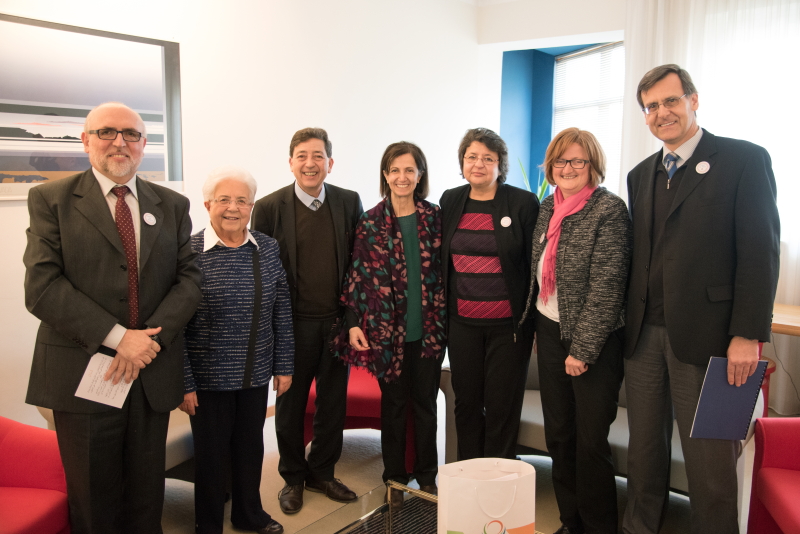
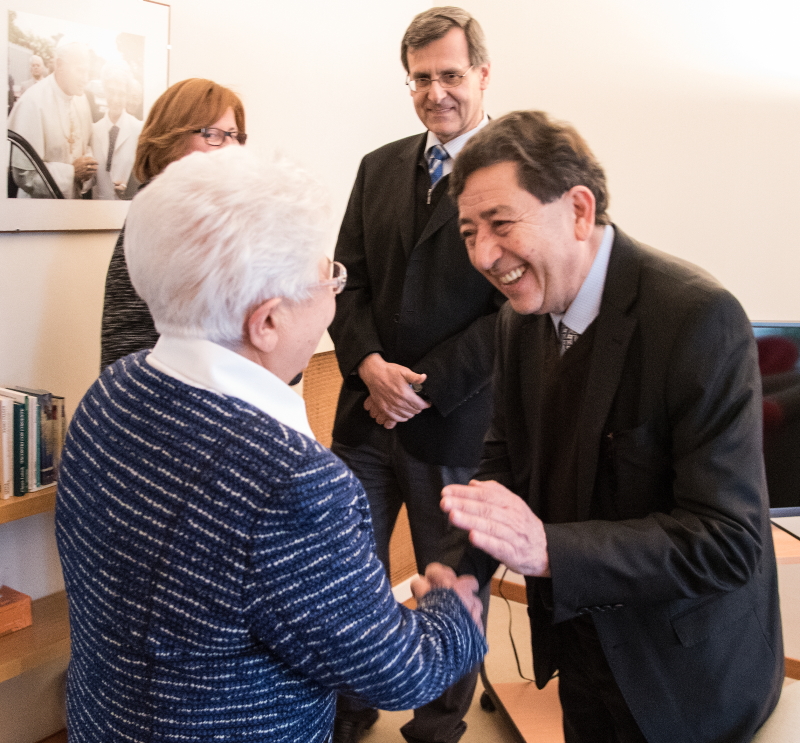 Khaled Bentounès, Sufi Master of the Alâwiiya, an Algerian born in 1949, is a man of peace. Living in France since the 1960s, he was behind many useful and worthwhile projects: from founding the Muslim Scouts of France, to l‘association Terres d’Europe; from the international talks at UNESCO for an Islam of peace, to the Alawaiya International Sufi Association which he founded, and an international mobilising campaign that the United Nations would institute a World LiveTogether Day. On February 26th, he visited the Focolare’s International Centre where he had a conversation with Focolare president, Maria Voce, and co-president Jesús Morán. During the course of the visit we had the opportunity to ask him a few questions. The first question was about his many projects over the years and now: “To give a quick answer to your question, I’m working on converting myself to the vision of a more fraternal world, more harmonious, a more just world. I work for this ‘circle’ of brotherhood, that I might see it before leaving this world, that I might see fulfilled the dream of a large portion of humanity. I don’t know if I’ll ever see it, but at least I have the assurance that I made a contribution.” When asked about the reasons for his hope in a time when brotherhood amongst peoples does not seem to have a place, Khaled Bentounès said that he found reasons to hope “first of all in the rich spritual legacy he received from his ancestors, for whom fraternity was inescapable. When I look at where I come from, I see but one uninterrupted line. “I happen to meet people involved in politics or the economy who describe a world heading to insoluble problems, and I say to them what our Masters say to us: ‘If they tell you that the world will end tomorrow, what should you do? Continue with your sowing and planting! Don’t worry too much!” So, we do what we have to do! We plant and we sow love, hope and brotherhood – whatever comes! Even if the end of the world will come tomorrow, as long as there is a minute left, you need to use it. Perhaps tomorrow will be another day, another world. And persevere!” Khaled Bentounès, who in 1986 had attended the meeting in Assisi with John Paul II and other religious leaders of the world, also has a knowledge of the Focolare that goes back to a meeting he had with Chiara Lubich in the 1980s. The relationship continued in France, up to his recent collaboration in assigning of the 2015 Chiara Lubich Fraternity Prize to the Vivre ensemble à Cannes Association which he promotes. What is your relationship with the Focolare today? What are the common ideals? The sheikh responds: “I think that time has made this relationship fertile, and today’s meeting is also a fruit of the past. The friendship has remained constant. My presence here today in the International Centre and the meeting with the president, Maria Voce and with the co-president shows that it continues. We spoke about mutual trust, about the project of bringing forward a more fraternal vision of the world around us; about how Christian and Muslim spiritual movements can operate to offer their witness to those who wish to listen to them. We do not pretend to change the world alone, but it is a fact that there are links amongst different religious traditions that must be strengthened, so that we can walk together towards a common future that must be built each of us with the other, and not against the other.” He concluded the interview by sharing a dream: “There are science academies, mathematics academies, philosophy and military academies – and there are no peace academies. Why? Spiritual effort is not enough. We need to teach it. Peace is not something that descends from heaven, it is something around which you ‘work’. It is an existential state, a vision of the world, a behaviour. There is economic peace, there is social peace, there is political peace. Peace regards everything. Ecology is a form of peace with nature. We need to learn how you make peace. I have this project at heart! How do we link peace and art, peace and architecture? Can peace be transmitted to the future generations through art? How could we, through a solid economy, create knowledge sharing and wealth sharing in a way that is just, beyond land or country? This is a sacrosanct ‘work in progress’! This academy is not just a word, it is a concrete task that must accompany our efforts in every field.” He concluded: “I think this is our spirituality, which feeds the conscience to go farther, and to include everyone.”
3 Mar 2016 | Non categorizzato
March 5, 2016, Brescia, Italy At the Catholic University: “Paul VI And Chiara Lubich, The Prophecy Of A Church That Makes Itself Dialogue Conference,” organised in collaboration with Paul VI Institute in continuation of the “Make Dialogue Days” held in Castel Gandolfo during November 2014. Among the presenters: Archbishop Vincenzo Zani, Secretary of the Congregation for Catholic Education; Lucia Albignente, who is in charge of the historical sector of the Chiara Lubich Centre; Father Angelo Maffeis, president of Paul VI Institute; Franco Monaco, politician and journalist; Alberto Lo Presti, professor of Political Theory at Sophia University Institute. March 6, 2016, Vicenza, Italy “Beyond The Borders Interreligious Conference” at Centro A. Onisto – Borgo S. Lucia, 51. Speakers: Emeritus Bishop of Aleppo, Armando Bortolaso; Imam of the Islamich community of Veneto, Dr Kamel Layachi and Rita Moussallem from the Focolare’s Centre for Interreligious Dialogue. The event will conclude with a flashmob in Piazza dei Signori. March 6, 2016, Olomouc, Czech Republic At the Catholic Chancery, a Cultural programme on the figure of Chiara Lubich as a sower of peace, followed by the celebration of the Mass by Archbishop Jan Graubner in cathedral. March 8, 2016, Ischia, Italy At the island’s Multi-Purpose Auditorium, 19:30, an evening programme on Work & Neigborhood. Civil engineer, Patience Mollè Lobè and business owner, Antonio Diana will be among the presenters. The moderator will be Carlo Cefaloni, Città Nuova journalist and expert on workplace dynamics. March 11, 2016, Caserta, Italy Music, testimonies and theater, at the Reggia di Caserta, 19:30, a reflection on the life and thought of Chiara Lubich titled: “The great attraction of the modern time”. Through the collaboration of the Diocese and the Directors of the Reggia. March 11, 2016, Rosario, Argentina A meeting at the Catholic University of Argentina (UCA) will reflect on the influence of the charism of unity on education. Presenters include: Dr Nieves Tapia, Coordinator of the Latin American Centre for Service Learning (CLAYSS). March 11-12, 2016, Fontem, Cameroon Workshop with music, drawing, poetry and theatre on “Chiara and Peace” for the students of 20 schools that belong to the Peace Education Project. Awards for the best pieces and for significant gestures of peace by the students themselves. The event will also be attended by civil authorities, traditional and religious authorities. March 12, 2016, Garden Grove, USA At Christ Cathedral, Garden Grove, holy Mass celebrated by Bishop Kevin William Vann, from the Diocese of Orange. In the afternoon, at the Academy Gym, a meeting on multiculturalism with representatives from various religions and ethnicities. March 12, 2016, Caracas, Venezuela Presentation of Chiara Lubich as a builder of dialogue and peace, who was awarded the 1996 UNESCO Peace Prize. The event will take place at the Institute For Religious Education (ITER) with people from different Churches. March 12, 2016, Brasilia, Brazil At the Paulist University (UNIP), at 15:30, 1996 UNESCO Peace Prize to Chiara Lubich. Followed by three moments of reflection: building peace in our personal relationships; in the dialogue amongst churches and religions and, in collaboration with the Institute of Immigration and Human Rights (IMDH), with mirgrants and refugees. Entrance fee: 1 kg of food for Haitian immigrants. March 12, 2016, Todi, Italy Tenth anniversary of the conferment of honorary citizenship on Chiara Lubich, at 15:30, in the Council Hall: “A Humanised Economy”, which will reflect on the Economy of Communion Project that was conceived by Chiara Lubich. Besides the Mayor of the city, interventions will be made by the President of the Region of Umbria, Cardinal Ennio Antonelli, Dr Giuseppe Argiolas and two business owners: Andrea Cruciani and Antonio Baldaccini. March 12, 2016, Castel Gandolfo, Italy At the Mariapolis Centre (Via de La Salle), 17:30, a programme of reflection on “The Culture Of Dialogue As A Means Of Peace.” The invitation is extended to ecclesiastical and civil leaders, and to the general public. Besides numerous testimonies, the keynote address will be given by Focolare president, Maria Voce. March 12, 2016, Manfredonia, Italy The 7th Edition of the Manfrodian Chiara Lubich Brotherhood Prize. In attendance: Vera Baboun, Mayor of Bethlehem and Pasquale Ferrara, diplomat and Secretary General of the European University Institute of Florence. Info March 12, 2016, Milan, Italy “Me Through You” Event, highlighting how the search for peace brings us closer to others and to our true self. The event will take place in three half-hour sections, each in a different location and at different times so that everyone can attend all the sections: at the Basilica of Saint Ambrose; Daughters of Mary Help of Christians Institute; Gonzaga Institute. Info March 12, 2016, Sarajevo, Bosnia Herzergovina An Open Day at the School of Theology dedicated to Chiara Lubich: “The Message of Dialogue and Peace.” Participants include people of Christian confessions, other faiths and people with no religious affiliation. Archbishop of Sarajevo, Cardinal Vinko Pujic, will celebrate Mass in cathedral. March 12, 2016, Genoa, Italy In the Minor Council Hall of the Piazza Ducale, a discussion on the Encyclical Letter Laudato si’ during a programme titled: “Religions Dialogue For Peace And the Environment.” Presenters will include: President of the Islamic Community of Genoa, Huseim salah; Chief Rabbi of Genoa, Giuseppe Momigliano; Buddhist monk, Gnanathilaka Mahauswewe; environmental engineer, Andrea Ponta; from the Focolare’s Centre for Interreligious Dialogue, Roberto Catalano March 12, 2016, Milan, Italy “Me Through You” Event, highlighting how the search for peace brings us closer to others and to our true self. The event will take place in three half-hour sections, each in a different location and at different times so that everyone can attend all the sections: at the Basilica of Saint Ambrose; Daughters of Mary Help of Christians Institute; Gonzaga Institute. Info March 12, 1016, Solingen, Germany At Zentrum Frieden Mariapolis Centre, “Living together in diversity”. The German Movement for Unity in Politics invites everyone to a roundtable with politicians and city administrators. It will be followed by a discussion on the integration of refugees. March 13, 2016, Kikwit, Democratic Republic of the Congo The city Mayor will the event at the Jesuit School where, in the presence of civil and religious authorities, a reflection on Peace and the Light of the Charism of Unity will be held. An event under the same title will be held the same day in Goma, Lubumbashi and in 16 cities of the Democratic Republic of the Congo March 13, 2016, Kinshasa, Democratic Republic of the Congo In the Great Hall of the Catholic University, in the presence of religious leaders from different Churches and religions, the academic and diplomatic world, a discussion on Chiara as Woman of Peace. An intervention will be given by the UNESCO representative in the Democratic Republic of the Congo. March 13, 2016, San Salvador, El Salvador Roundtable on “Peace that is born from dialogue” at the Università F. Gavidia, in the auditorium of Edificio E, 9:00 – 12:00 March 13, 2016, Lisbon, Portugal At the Franciscan Cultural Centre, a roundtable on ‘Chiara and Peace’ with members of the National Peace and Justice Commission, Dr Pedro Vaz Patto, President, Dr Graça Franco and António Marujo, journalists. March 13, 2016, Melbourne, Australia At the Mariapolis Centre, a celebration titled “Build peace in your own environment” , including testimonies on welcoming refugees. Presentation of Mark Ruse’s documentary film: “Politics for unity: making a world of difference”. Those in attendance include: Vicar General of the Diocese, Msgr Greg Bennet and leaders of ecclesial movements operating in Australia. March 13, 2016, Bujumbura, Burundi At Scheppen High School of Nyakabiga : “Merciful Like The Heavenly Father, Building Peace.” Presenters include: the Archbishop of Bujumbura, Evariste Ngoyagoye. March 13, 2016, Vung Tau, Vietnam Annual Mariapolis in Vietnam, in the presence of the Bishop, Joseph Tran Văn Toan, who will celebrate the Mass. The programme will also include the presentation of a documentary film on Chiara Lubich: Story, Charism, Culture. March 14, 2016, Houston, USA “Unity In Diversity” Interreligious Conference at 19:00 in the St. Thomas University, preceeded by the celebration of Catholic Mass in St. Basil Chapel by the Archbishop of Galveston-Houston, Cardinal Joseph Anthony Fiorenza. Presenters include: Cardinal Fiorenza; Imam Qasim Ahmed from the Islamic Institute; Rabbi Steve Morgen from the Beth Yeshurun Congregation; Therese Lee from the Focolare Movement. Info March 14, 2016, Manila, Philippines During the 50th anniversary celebration of the arrival of the Focolare in Asia, at De La Salle University, a symposium title: “The Charism Of Unity, A Timeless Legacy.” Numerous religious and civil leaders will present the reflections on Chiara Lubich’s contribution to the unity among Churches, religions, in society, an on Gospel reciprocity as a lifestyle that creates brotherhood. March 14, 2016, Rome, Italy At the Shrine of Our Lady of the Divine Love, at 18:30, Mass celebrated by Cardinal João Braz de Aviz, Prefect of the Congregation for Consecrated Life. Info March 14, 2016, Trent, Italy At the Demarchi Foundation, presenation of the book by I. Pedrini: “L’altro Novecento: nella testimonianza di Duccia Calderari.” Duccia’s biography, one of the first witness who followed Lubich in the birth of the Focolare, gives the opportunity to: Monica Ronchini, researcher; Giuseppe Ferrandi, Director of the History Museum of Trent; and Lucia Fronza Crepaz, ex-parliamentarian – to reflect on Chiara as a builder of peace. March 14, 2016, Havana, Cuba At Fray Bartolomé de las Casas Cultural Centre, a presentation of the figure of Chiara and peace, in the presence of Apostolic Nunzio, Archbishop Giorgio Lingua. Follwed by a concert by the Ars Longa Ancient Music Group. March 14, 2016, Verona, Italy At the Palazzo Gran Guardia: presentation of the “Chiara Lubich For A Culture Of Peace Brotherhood Prize, in the presence of Muslim theologian, Sharharzad Houshmand; Professor at the University of Padua, Giuseppe Milan; journalist Aurora Niosia March 16, 2016, Rome, Italy At the Chamber of Deputies, presentation of a manifesto with concrete proposals for peace, disarmament and industrial conversion.To receive it in Parliament, Youth for a United World who, with the Movement for Unity in Politics and participating schools, promoted the project, along with several deputies, the President of the Chamber, Boldrini and Exterior Minister, Gentiloni. March 16, 2016, Seville, Spain At the Metropolitan Seminary, Dr Manual Palma, vice director of the Theological Union of Seville, will speak on Jesus, Prince of Peace in the Spirituality of Chiara Lubich. Followed by a discussion on peace in Islam to be held by Imam Allah Bashar from the King Abdul Aziz Al Saud Mosque of Marbella, Malaga). He will also talk about his relationship with Chiara Lubich. March 18-20, 2016, Milan, Italy At the Fieramilanocity, during the international fair, an exposition on the Economy of Communion, presenting Lubich’s message of peace that continues to reach today’s world. Info March 19, 2016, Perth, Australia At Northbridge Square, screening of a video clip on “Peace” produced by young people, and a signature campaign appealing for peace #Signup4peace.

29 Feb 2016 | Non categorizzato
“Reinhard from Austria, aged 55, tells us his experience: «A few years ago – during my work shift at the post office – I was stabbed by a youth suffering from psychic problems: I had 27 stab wounds. The young man only stopped when certain I was about to die, I looked him in the eyes and said: “I forgive you.” It was only then that he let the knife in his hands fall to the ground. The psychologists sustained that I had not suffered any trauma. They had to operate on me and I lost a lung and can walk with the help of crutches, but I am miraculously alive. Today, many ask me to talk about the incident and why I forgave him: teachers, priests, young people, Christians, Muslim and atheists. I have met around 2,000 people as of now, and every time I can’t help but speak about the art of Loving, because for years, including that fateful day, every morning I launch the love dice. Many young people, after the meetings, tell me they want to know more about this lifestyle. Every time they invite me, it is a marvellous occasion to spread the ideal of fraternity, the Golden Rule, in the region of Vorarlberg where I live. An atheist boy, some time ago told me: “You know, I’m not interested in religion, but your way of living interests me a lot!”.” (Feldkirch, Austria ) “One evening, we spoke with Lina on the phone. She was our friend who lives in Damascus (Syria). She told us about the difficulties of living in a warring environment: the risks due to the frequent explosions of mortar shells; difficulties arising from lack of food, water and clothes, the continuous lack of electricity and heating… in short, she did not ask us for anything. But upon hearing her words, we felt deep inside that though far away, we had to do something! We immediately shared this idea with other friends… Right away, we were surprised how many things started arriving…. They gave what they could! Families, young couples, adolescents, children, communities, parishes, other associations….Without realising it, a competition of love had begun. For example, a lady sold some gold trinkets and gave us the money. A boy who had celebrated his birthday had asked his guests, in place of birthday gifts, to contribute for his Syrian brethren. A family shared its life savings because “we were keeping them for special occasions! And helping someone is one of them!”… So in a short time, we collected €20,000! With this sum we managed to help many Syrian families in need, bringing them food, clothes, the basic necessities… but above all, we brought them a hug as big as the world, making them feel that they were no longer abandoned, but part of a huge family!” (Rossana and Emanuele, Italy) Source: United World Project
26 Feb 2016 | Non categorizzato
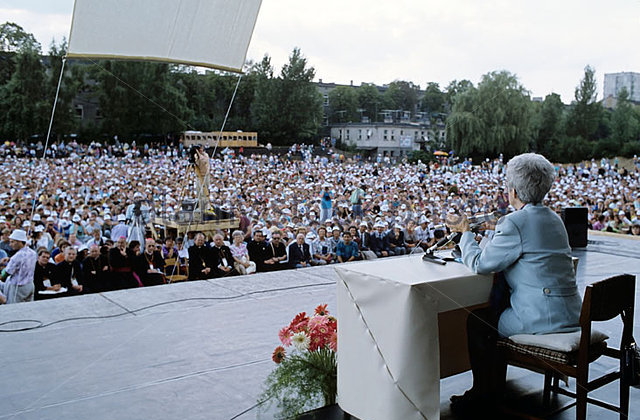
Download Call for papers Twenty years ago, in 1996, Chiara Lubich was awarded an Honorary Doctorate in Social Sciences from the Catholic University of Lublin in Poland, for having promoted dialogue as the key driving force for peacekeeping and peace-building in every context. Chiara Lubich’s ‘charism of unity’ is at the forefront of dialogue today. The theory and praxis of dialogue has influenced the lives of many people of different cultures and religions, who have committed themselves to her spiritual vision that is embodied in the culture of unity. In a world where ethnic and religious differences often lead to violent conflicts, the spread of the charism of Chiara Lubich has contributed to constructive dialogue among persons, generations, social classes and nations. Five areas of interest have been identified. 1. Dialogue among communities: between charism and institutions 2. Conflict resolution through dialogue 3. The agents of political change and participation processes 4. Individual processes, interpersonal and intergroup levels involved in conflict management and its prevention 5. Dialogue among disciplines and transdisciplinarity Preference will be accorded those contributions able to use multidisciplinary approaches, coming from psychology, economics, pedagogy, politology, sociology and communication studies. A particular characteristic of innovative submissions should consist in a disciplined effort to bridge gaps between theory and practices. Only new and unpublished papers, which can bring added value to the empirical, theoretical, prescriptive and practical understanding and creative engagement of conflict and dialogue, will be selected. The study of the methodological implications of the different forms of conflicts has provoked increasing interest in many disciplines: psychology, economics, sociology, education and media studies, management and organizational studies, human rights and so on. Today’s multi-faith and multicultural society has to cope with a global challenge: mutual understanding and resolving conflicts. In our contemporary world, dialogue is hailed as a progressive necessary force, and is heralded as the main currency of statecraft, diplomacy, negotiation, mediation and peace-building. Hence, experts from different backgrounds agreed that it is imperative to explore intercultural and interreligious dialogue as key to promote mutual understanding among people, cultures, institutions and religions. Call for papers Chiara Lubich Jubilee Conference Programme Congress Organizers Hotel Accommodation Registration Form Sponsors
Keynote speakers:
- Adam Biela, psychology and sociology (John Paul II Catholic University of Lublin, Poland)
- Catherine Belzung, neurobiologist (University François Rabelais of Tours, France)
- Mauro Magatti, sociologist (Catholic University of Sacred Heart of Milan, Italy)
- Katarzyna Olbrycht, pedagogist (University of Silesia, Katowice, Poland)
- John Raven, psychology, The University of Manchester, Scotland and John Paul II Catholic University of Lublin, Poland
- Marina Santi, pedagogist (University of Padova, Italy)
- Bogusław Śliwerski, pedagogist (Chairman of the Committee of Pedagogical Sciences PAN, Poland)
- Krzysztof Wielecki, sociologist (Cardinal Stefan Wyszynski University, Warsaw, Poland)
- Stefano Zamagni, economist (University of Bologna, Italy)
Important dates:
30th March 2016 – Deadline for submissions of abstracts and registration 20th April 2016 – Reply from the scientific committee 20th May 2016 – Deadline for submissions of extended papers and payment
Contacts:
For the congress registration and the paper submission, please email to: congresslublin2016@gmail.com web: http://www.kul.pl/art_31023.html
