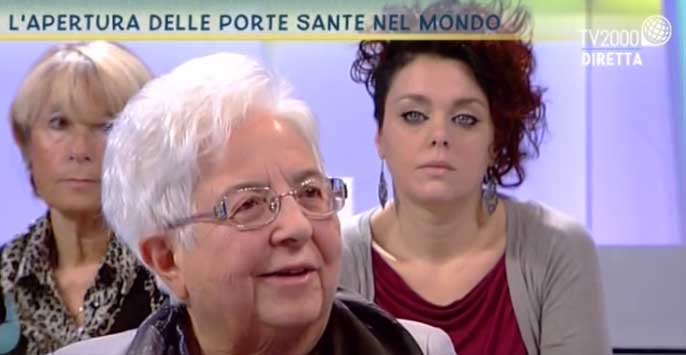
“Bel tempo si spera”, [Hoping for good times] is a programme broadcast by the Catholic Television Company TV2000. The programme on 14th December focused on subjects concerning the Jubilee, taking the viewers on a journey to several Cathedrals in the world, on the day after the opening of their Holy Doors. Maria Voce was in the studio, at the invitation of the presenter Lucia Ascione. Between one stage and another of this symbolic tour a dialogue took place on various subjects, starting with the meaning of the Jubilee. Maria Voce said, “The Year of Mercy gives us new courage to believe that God is Love. Now, when it seems that everything has become relative, we need to go back to what really matters, to believe in Love”. Later on, she added: “Unfortunately, modern culture speaks of anger, revenge, rights that have been trampled on, things that lead to sadness and despondency. We want to bring trust, forgiveness and mutual love. We want to look at the world as one family, the family of God’s children. And God is mercy, God is love.” “I like to recall – she went on – that the Pope did not open “the” Holy Door” but many holy doors. Pope Francis has said even the door of a prison cell can be a Holy Door. The door is a sign of the merciful love of the Father who is waiting for us all to come home, no-one excluded.” Lucia Ascione referred to Pope Francis’ words at the Angelus the previous day concerning the Focolare’s dialogue with Muslims. Maria Voce affirmed, “This harmonious encounter between people of different faiths that we experience did not happen yesterday, but has been built up day by day, over the years and in many places, through friendships; respecting difference.” Ascione insisted: “If it is so simple for you, why is it so hard for the world?” Maria Voce: “The Pope has said that unfortunately there is much self-interest. Instead we need to learn how to go beyond ourselves and be ready to welcome others, even if they are different. It is a love that we learn by loving, going towards others. Certainly, differences can make us fearful, that is true for everyone. It is a fear that can only be overcome with love. Taking up arms is of no use.” The presenter asked “You went to the United Nations and spoke there. What did you say to them? “I said that we need to convert ourselves, but not superficially. I said we must not see dialogue as one of many ways but as the only real way forward. It is difficult to accept this viewpoint because the “scandal of the cross” has not been understood. Mercy makes us do the part that the other should do, as Jesus did who died for each one of us.” Maria Voce explained “It is the experience that we have on a daily basis with those who knock on our doors. Recently 170 unaccompanied minors stayed in our little town in Holland and were made welcome”. Recalling the words of the press release that Maria Voce had issued after the Paris attacks, Ms Ascione asked: “What did you mean when you said we should ask ourselves whether everything that could have been done to avoid such violent reactions had been done?” “Very often we are affected by things that happen nearby, forgetting those that happen in other places where the horror of war is lived every day. We have communities in those places and we know that it is still possible to build something positive. We have doctors who don’t check to see whether a wounded person is a Christian or a Muslim; people who make their wells available to others when water is scarce, regardless of the religion they practice. Maybe we don’t know how to ask ourselves the right questions. That is why we questioned ourselves first of all. Perhaps we did not follow through with these things in the past. Being able to make an examination of conscience can open us up to hope. Seeing those who suffer, who are poor, we must not be afraid to open our hearts. We must not be afraid to empty our pockets and our wallets, to live simply and with respect for creation, seeing other people as brothers and sisters, part of the same family.”
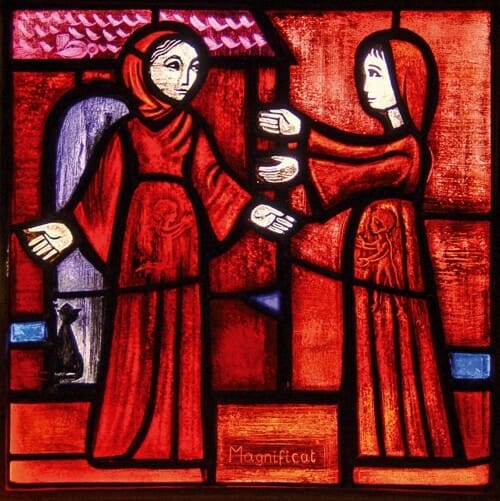
“The Magnificat” Stained Glass Window, Community of Taizé
At the centre of the Magnificat,which gathers momentum from the prophets with the promise of salvation, there is a mention of Divine Mercy that could seem like a rhetorical addition. It seems to me that the reference to the mercy of the Father, at the centre of Mary’s song, is of capital importance and contains the concise explanation for all the exuberant divine facts that give unheard of beauty and steady immediacy to the poetic outburst of the fifteen year old girl who carried and grew Jesus in her womb. In the first part, Mary exalts “the Almighty who has done great things” to His “servant” so that all generations shall call her blessed. God had done the miracle of the Incarnation of the Word, through a poor and humble girl from an obscure village of Israel; an act that will lead to the salvation of humanity of all times. Thus she observes: “His name is holy – and his mercy extends from generation to generation …”. Redemption originates in an act of compassion by the Heavenly Father towards his children. If He accomplished that prodigy of love, which only a God could accomplish, of his Son being born of a woman of the people and have him die for the sake of the people, it is all due to an act of mercy, a miracle of mercy that is love raised to its peak. This demands that we pardon our brother not only seven times, but up to seventy times seven time; that is, always, all the way to infinity; that we love him to the point of giving up our life for him. God “has helped his servant, Israel – ever mindful of his mercy. . .” Everything in the divine government everything leads back to mercy. This will be clarified and confirmed in the demeanour of Jesus – out of love for whom Mary speaks – when He will feed the crowds and cure the sick; when he will drive the sellers from the Temple and raise his voice against the Pharisees and the proud. The Magnificat is the anthem of the Christian revolution. But its most revolutionary aspect lies in its origin: mercy. This is why it does not destroy, but creates; because love for God and man does not produce anything else but good. The Magnificat gives the directives of the evolutionary process, mutation and rebirth, in which the Gospel ideal is translated socially and politically, as well as spiritually; a mutation that originates in love and is embodied in mercy. There is a new urgent need for such an ideal today. Ideologies and protests, guerrilla warfare and revolt are breaking out everywhere. They call for greater and beautiful aspirations while they introduce hateful programs of destruction. Mary teaches how to orient and construct this revolution. She is a woman, the Mother of God, who teaches both with word and life: the life of the Mother of Mercy. Her example is worth even more today, as it revalues femininity.Mary teaches us the path of mercy. By now the absurdity and uselessness of wars is acknowledge, that is, hatred, and the need for rational systems focused on dialogue, negotiation and, above all, of intervention and gifts from those who have, in favour of those who have not. We can see it: sending arms and money to help this or that population serves only to increase the conflicts in which people suffer, agonise and die; and to plant seeds of hatred against the very givers. The perspective of that young woman, who sang her Magnificat, the method of mercy, amongst the poor, is the perspective of the divine and human intelligence, the only one capable of resolving the problem of a world threatened by the ultimate definitive catastrophe, provoked by the stupidity of hatred and the drug of suicide. To have peace and wellbeing again, we need to take care of the material and moral wounds of those who suffer, from whatever side of the ocean, in Europe and in Asia, in America and in Africa, using a compassion that is the fruit of understanding; a charity that was not grow weak, but abolishes injustices and selfishness, to transform coexistence into community, and nations into a family. Jesus, the Son of Mary wants it to be so, as Mary his Mother assures. Igino Giordani, in Mater Ecclesiae, 4, 1970. www.iginogiordani.info
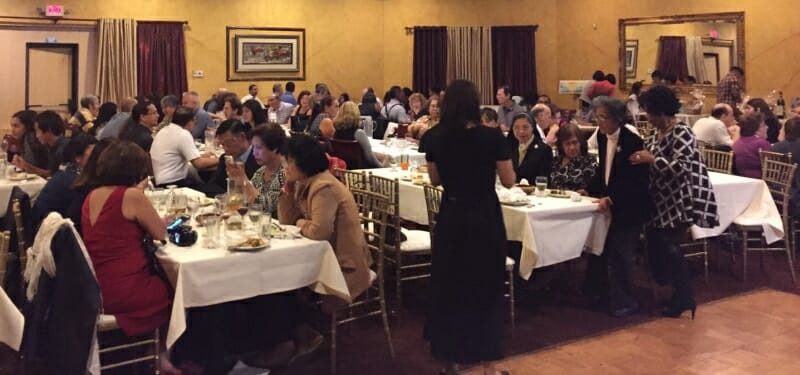
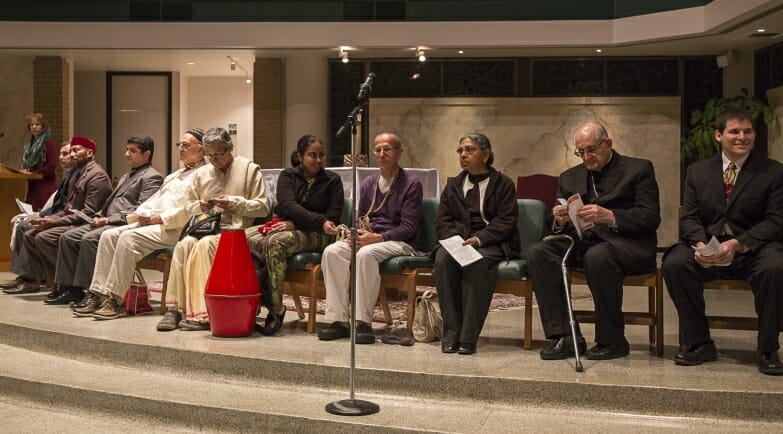
All of us here are involved in helping refugees to integrate in our coundry,” they write from Germany. “Some of us give German lessons, some provide lodging, some give of their time to be with the refugees. We are currently waiting for the arrival of 9 unaccompanied minors from Syria and Afghanistan. They’ll live for six months at our centre in Ottmaring where they will be assisted by social workers from the city.” “Here in Dallas,” they write from Texas, “we held a peace march to raise funds for Syrian refugees.” “In Houston “We got together for a day of team building. With games, work groups, and so forth we learned how to be a team. On November 22 we held an interreligious prayer for peace. It was attended by Jews, Muslims, Hindus and Christians. The Archbishop also joined us.” From California they tell us that the benefit dinner for refugees from the Middle East included a hundred people from different cultures and Churches. After praying for the victims of the terrorist attacks in Beirut and Paris, some young people presented several of their projects for refugees, from around the world, which are connected to the United World Project, an international platform for providing visibility to small and large-scale projects. Everyone agreed that through dialogue everyone can sow hope in their own corners of the world. A benefit dinner will also be held in San Francisco in December. “From October 30th, at Centro Luminosa in Spain, a community prayer service will be held every Saturday evening, animated by different groups of people each time: youth, families, priests. . .) It will be the starting point for becoming more actively involved in concrete efforts for peace. There was a very energetic response from Bahia Blanca, Argentina, following the November 20th event in the Square. The idea was to invite everyone – absolutely everyone – to learn more about building peace. The launching of the event which was covered by a local radio station, was then broadcast on social media. At 19:30 the Square began to be covered in colour and music. Banners, posters and fliers offered ideas on how to resolve conflicts through dialogue and thus generate peace: giving a smile, discussing without shouting, doing to others what you would have done to you, and so on. On stage there were songs, brief presentations and dances (one choir offered to sing because of an invitation on Facebook.) “The experience of today is only a first step, which confirms that when you are together small things become powerful. And so it is urgent that we get moving beginning with our daily life.” In Parana, Argentina, the local community organised two ecumenical evenings of prayer for peace and for the persecuted because of their faith, animated by members of the different Churches with whom they are in contact. With testimonies of refugees and the families that took them in, besides the heartfelt prayer, they wanted to give visibility to the amount of road we have already covered in learning about, welcoming and including others. From Tokyo, Japan, they report a large sum of money that was gathered at the “Syrian Cafe” (a place for encounter and dialogue), which will be sent to Damascus. And we add that in Asunción, Paraguay, on December 18-20 there will be a camp for peace, organised by Teens for Unity, one of the junior sections of the Focolare.