12 Jul 2015 | Non categorizzato
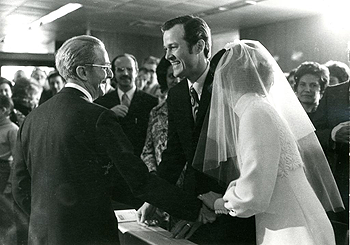
«The fundamental role of the family is to grow and multiply: give a boost to life, cooperate in the creative work of the Creator. Its unity is not interrupted but extended in its progeny, in whom the love between two spouses is incarnated. Unity becomes a person: father, mother and child make up a life in the image and resemblance, in some way, of the divinity that created and vivifies them. These are three points from which the cycle of love alone originates and is nurtured by God’s love. »(Giordani, 1942) By tracing the divine profile of the family, in a sense Giordani anticipated what the documents of Vatican II would declare upon underlining the privilege of the spouses in «cooperating in the creative work of the Creator,» and also in considering the family as a reflection of the life of the Trinity from which it inherits its design. In the 1980s this doctrine, so dear to St. John Paul II, would have become the basis of his historical catechesis on human love. Last 23 June, the Synod’s preparatory Commission diffused the Instrumentum Laboris, on which the Synod fathers would have to reflect next October, in order to propose to the Holy Father the possible solutions to be implemented in favour of the families. Focusing on the vocation and mission of the family, this document starts with an overview of the many problems besetting the family today and the serious cultural and social challenges undermining it. But the awareness of such critical factors has not only been felt in recent times. In1975 a letter of the Episcopacy of Quebec conveyed an alarming analysis to this regard. Giordani was so struck by it as to cite some passages of the letter at a certain point in his writings, in order to offer to families its luminous and prominent message: «The difficulties in life do not crush a family that is rooted in God while in too many cases,they destroy those that are established only on money. The strength of a family lies in the union of the couple, but union is the fruit of love. It is thus to their earthly and heavenly interest to love one another, and take the trials, sufferings and disillusions as a way of sanctifying themselves. Marriage not only unites the spouses to one another, but as father and mother, they are united to God. This unity in God, of man and woman, of parents and progeny, is the most profound sense of marriage and the family.» (Giordani, 1975) Prepared by the Igino Giordani Centre Excerpts from: Igino Giordani, Famiglia comunità d’amore, New City, Rome 2001 and Igino Giordani, La società cristiana, New City, Rome, 2010
9 Jul 2015 | Non categorizzato
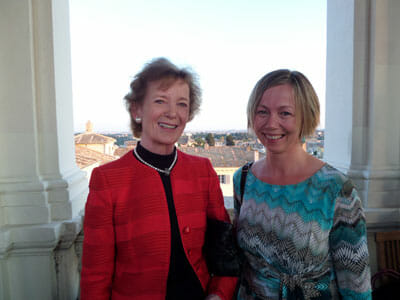
180 people from over 40 nations: activists, NGOs, social movements, scientists, religious congregations, activists from the Catholic world and beyond, together to discover concrete ways of responding to Pope Francis’s encyclical Laudato Si’. Environmental experts Lorna Gold from Ireland and John Mundell from the United States attended as representatives of the Focolare Movement and Eco-One. For over 13 years Lorna Gold has worked in the field of the environment at Trocaire-Overseas Development Agency of the Catholic Church in Ireland. John Mundell is president of an environmental consultant agency in Indianapolis, Mundell & Associates, Inc., which adheres to the Economy of Communion. “The most important thing about this conference is the diversity among the people, organisers and ethnic groups that came together to give an immediate response to the Pope’s Encyclical,” Lorna Gold says. “We’ve come here from the whole world and in the name of civil society. There are activists like Naomi Klein, a world-renowned writer on the topics concerning ecology and economy in an age of globalisation; there are people from ecological movements like the head of Greenpeace, Kumi Naido; there is the entire network of the CIDSE-NGO, Catholics who work for social and global justice.” The three-day meeting gave the sense of a movement in the act of helping to incarnate the ideals of the Si’ Encyclical. Among the examples that were presented there was also the The Earth Cube™, created by Eco-One, a network of professionals from the field of the environment who are inspired by the spirituality of unity. The difficulties and the complexities of the environmental problem were on the minds of all: a problem not only for science and of the earth, but also for the economy and politics. Often the choices in these environments go directly against nature and generate more poverty but, according to Naomi Klein, something can still be done: “We could prevent so much suffering. We can’t justify doing nothing, because it’s difficult. Don’t let perfect win good. We need difficult, but possible, instead of easy yet reprehensible. Stop making the difficult a limit for possible, and let possible be real.” The reverse route is possible if there is enough strength to face the problem. The presence of so many people directly involved on many different fronts gives much hope, and it made everyone experience what Pope Francis says in the Encyclical: the whole is more than the sum of its parts. John Mundell highlighted another novelty at the meeting: “The role of women as protagonists in the discussion and debate on climate change. In this summit we almost saw a vision of the future of the Church: open, in dialogue with the world, seeking relations with all people of good will, to bring ahead a more united world, more in contact with the planet.” Laudato Si’ invites us to rethink our lifestyle. As Naomi Klein said: “This is not only a teaching for the Catholic world, and as a secular Jewish feminist, I can say I felt this Encyclical also talking to me.” https://vimeo.com/133043698

4 Jul 2015 | Non categorizzato
«The modern world with its secularism, has moved away from God because […] it had not received sufficient explanations on the fact that man was God, had been divinised, and was not only dependent on an estranged and remote being: it was in a mysterious manner another small God, due to its participation in the divine nature through Jesus’s life, and particularly through the Eucharist. When I reconsider some of Marx’s writings, in which he negates the value of religion precisely because it alienates man, making him a stranger to his own self, exactly because it makes him depend on something that is external to himself, I think that if he had only known that man finds his divinisation and thus his independence in the trinitarian sense, he would never have come to think the way he did.[…] The same goes also for Hegel, from which Marx drew inspiration; the same can be said of the immanentists, all those who negated God in order to uphold man, up to Sartre, Camus and so on. Sartre had said: «there cannot be a God, because if so, I would not exist,» precisely because he would crush me. This is not so since God who became man, made you God, making you share his divine nature.[…] Day by day we see how none of humanity’s problems can be resolved singularly, and neither by particular groups nor national groups. The problems now have to be resolved in a collegial manner, giving rise to that unity Jesus had brought. And we know that this unity can rarely be created without a spiritual life. In short, it is by creating a community of bodies that a community of persons is created, and this is only possible if these persons are nurtured by something which harmonises them tas one. This something may, in a remote sense, be science, or the research man has initiated. But what most of all creates unity is Man par excellence, that is, Jesus. He is the one who makes us men and makes us a community. […] The Eucharist, on one hand, is an immense mystery. On the other, it is a banquet which is a natural convergence of human fraternity. […]The Eucharist is the soul, and must become the soul of this sociality.» Excerpt of: Luce che si incarna, comment on the 12 points of the spirituality, Pasquale Foresi, New City 2014, pp.107-109
30 Jun 2015 | Non categorizzato
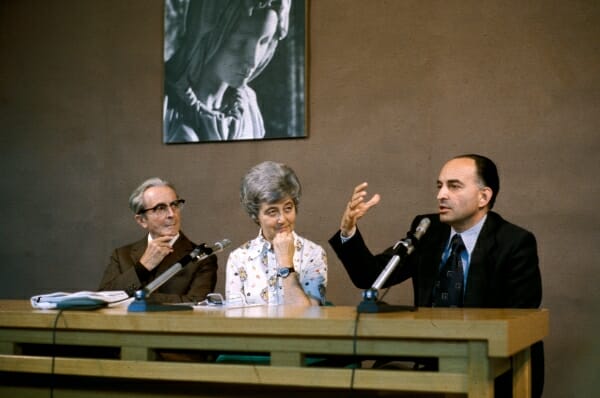
Photo CSC Media
Photo CSC Media
Photo CSC Media
28 Jun 2015 | Non categorizzato, Word of
These words conclude Jesus’s ‘Farewell Discourse’ to his disciples at the last supper, on the eve of his being handed over to those who were to put him to death. They had had an intense conversation in which Jesus had revealed the inner truth about his relationship with the Father and the mission the Father had entrusted to him. Jesus is about to leave the earth and return to the Father, while his disciples will remain in the world to carry on his work. They too, like him, will be hated, persecuted, even put to death (see Jn 15:18, 20; 16:2). Theirs will be a difficult mission just as his had been. Jesus is well aware of the difficulties and the trials his friends will have to face. He had just told them: ‘In the world you will face persecution’ (Jn 16:33). Jesus is speaking to the apostles gathered around him for the last supper, but he is thinking of all the generations of disciples who would follow him throughout the centuries, including us. It’s so true! Even while joy is spread all along the path we follow, there is no lack of ‘persecution’ and sufferings. We experience uncertainty about the future, job insecurity, poverty and sickness, suffering as a result of natural disasters and wars, violence at home and among nations. There are in addition the persecutions that come as a result of being Christians: the daily struggle to be faithful to the Gospel, the feeling of impotence before a society that seems indifferent to the message of God, mockery, scorn and sometimes open persecution by those who do not understand or oppose the Church. Jesus knows about ‘persecutions’ having experienced them at first hand. ‘Take courage; I have conquered the world!’ This statement, which is so decisive and confident, looks like a contradiction. How can Jesus say that he has conquered the world when a few minutes later he is going to be imprisoned, whipped, condemned, killed in the cruellest and most shameful manner? More than having conquered, it looks as if he was betrayed, denied, reduced to nothing, and so defeated – utterly. What is the nature of his victory? It came about, certainly, in the resurrection. Death cannot hold him. His victory is so powerful that he makes us share in it too. He makes himself present among us and he takes us with him to full life, the new creation. But even before that, his victory was the very act of his greatest love in giving his life for us. He, in defeat, triumphed fully. Penetrating every corner of death, he freed us from all that oppresses us, and he transformed all that is negative in us, our every darkness and pain, into a meeting with him, with God, Love, fullness. Paul, whenever he thought of Jesus’s victory, seemed to go mad with joy. If Jesus, he would affirm, had faced every setback, including even the supreme challenge of his death, and he had won, then we too, with him and in him, can overcome every difficulty, and indeed, thanks to his love, we are ‘more than conquerors’: ‘For I am convinced that neither death, nor life … nor anything else in all creation, will be able to separate us from the love of God in Christ Jesus our Lord’ (Rom 8:38-39; see 1 Cor 15:57). We are invited by Jesus, therefore, to fear nothing anymore: ‘Take courage; I have conquered the world!’ These words of Jesus, which we will keep in mind for the whole of this month, can fill us with trust and hope. However tough and hard may be our circumstances, we have the certainty that Jesus has already made them his own and overcome them. Even if we do not have his inner strength, we have him himself who lives and struggles in us. We can say to him when we feel crushed by difficulties, trials or temptations, ‘If you have overcome the world, you will know how to overcome this “persecution” I am going through. To me, to my family, to my colleagues at work what is happening seems like an impossible hurdle. It feels to us as if we can’t make it. But with you among us, we will find the courage and the strength to face it, until we come to be “more than conquerors”.’ It is not a matter of having a triumphalist vision of Christian life, as if it were easy and everything had been sorted out. Jesus is victorious precisely in the moment that he lives his drama of suffering, injustice, forsakenness and death. Perhaps we too, at times, like Jesus and the martyrs, will have to wait for Heaven’s response before we see a full victory over evil. Often we are scared of speaking about Paradise, almost as if the thought of it were a drug stopping us facing the difficulties with courage, an anaesthetic to lessen the pain, an excuse not to have to fight against injustice. The hope of Heaven and faith in the resurrection are instead a powerful spur to look squarely at every problem, to support others in their trials, to believe that the final word belongs to love that conquers hate, of life that defeats death. So every time we come across a difficulty of any sort – be it personal, or of the people around us, or of those we hear about in different parts of the world – let’s renew our trust in Jesus, present in us and among us, who has overcome the world, who makes us share in his own victory, who opens up Paradise where he has gone to prepare a place for us. In this way we will find the courage to face every trial. We can overcome everything in he who gives us the strength. Fabio Ciard
27 Jun 2015 | Non categorizzato
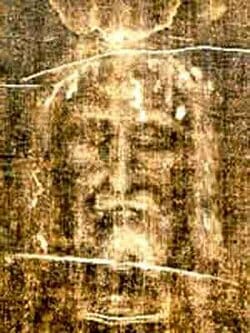
“The French magazine “Paris Match” published a long article on a very important object which can tell us something about the One we love. I read it quickly but it made a deep impression on me. During this year, since the Gen asked me, I have tried to speak about only one subject: Jesus crucified and forsaken. We want to get to know this mystery, unpack it completely. We want to see and know and understand, as far as possible, what can be thought of as the height of Jesus’s passion. The article in “Paris Match” was about studies done on a cloth – the Holy Shroud – in which Jesus’s body was wrapped when it was buried. It is kept in Turin. The studies done on this extraordinary piece of cloth lead people to think it may be truly authentic. It tells us something, indeed a great deal, about Christ when he was going through his agony up there on the cross hanging between heaven and earth. I want to speak to you about this Man, Jesus, today. I am very interested in this because it was in that body that dwelt the Soul that experienced the terrible darkness of the abandonment. The cloth, as “Paris Match” says, tells its own story: in fact the markings on the cloth tell a great deal about Christ’s holy body. It says that Jesus was a strong man and a worker: the muscles on is right arm and shoulder show this. The leg muscles show that he had walked a lot: and we know about this from the Gospel. The scourging was terrible: more than 100 lashes given in a precise order. His feet were nailed so his whole body, without any other kind of support, leant forward, being held only by the nails in his hands. The crown of thorns was not as we usually think it was. The signs of big holes in his head show that they put a whole helmet of thorns on his head. The face shows that one eye was swollen, and his face was not as bloody as the rest of his body, which confirms the meeting with Veronica which we hear about from tradition. One knee has been wounded by a heavy fall. The body had bled all over. A sword has pierced through to the heart from the base of the thorax. Pain, pain, unspeakable, unimaginable pain. Three long, eternal hours like that, without relief, without ever losing consciousness. I understood that no one in the world can say they have ever suffered like Him; and that he could say something more to anyone in the world who experiences any kind of suffering. “Why did Jesus suffer?” I was asked by a young Korean a few days ago. There is something broken between God and humankind that needs fixing. Only a price like his was able to repair it. Nowadays it seems as though the days when Christians reflected on the sufferings of Christ and followed his footsteps up to Calvary seem almost over. Certainly some practices that had become old-fashioned and emptied of meaning have been dropped, because they were no longer the expression of true love. “Women, why are you crying over me? Don’t cry over me but over yourselves” (Luke 23:28). Jesus has said this today to some Christians who don’t understand things except superficially and still go on with what seem to be pietistic sentimental practices. There are two things we need to understand before entering into the mysterious suffering of our crucified Friend, the most alive amongst those who live, for ever and ever. It is the fact that he bore all this out of love. And that we must respond to his love with our love. How can we do this? We must transform every physical suffering, whether great or small, that comes to us, into a gift to Him, so that we too, 20 centuries later, can continue his Passion for the salvation of the world. He did warn us about this in fact: “If any want to be my followers… let them take up their cross and follow me” (Mt 16:24; Mk 8:34, Lk 9:23) .” Chiara Lubich From the editorial in “Gen”, June 1970 Source: Chiara Lubich Center
