27 Jan 2015 | Non categorizzato
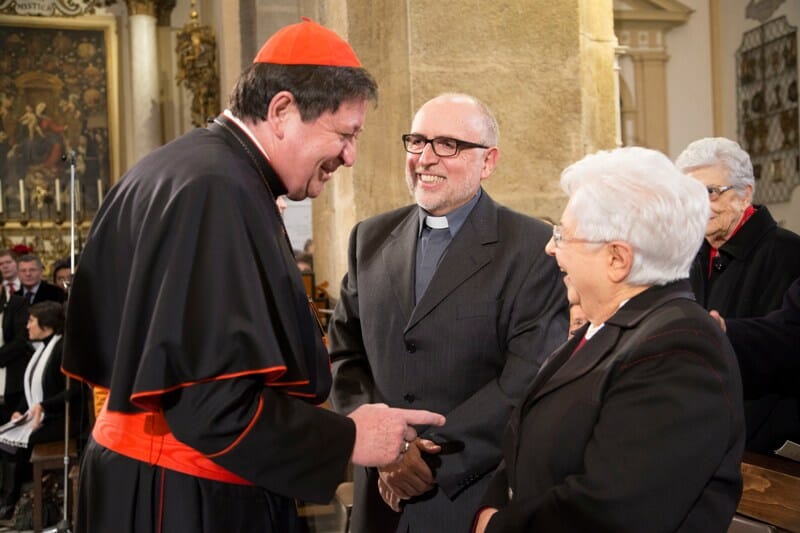
Card. João Braz De Aviz, Jesús Morán and Maria Voce Focolare President
The cathedral of Frascati was teeming with people, despite the weekday rush hour of 27 January, the day of remembrance, in which the entire world commemorates the tragedy of the Shoah along with all the other events that inflict sufferings and bloodshed on our planet. It was during these commemorations, established so that “humanity and history may register new peace developments” that Maria Voce expressed hopes for the recognition of Chiara Lubich’s example and because “her thoughts and her heart were driven by universal love, able to embrace all people beyond their differences, and aimed to fulfil the testament of Jesus, “That all may be one.”
With a long applause the Focolare members manifested its gratitude towards Pope Francis, who, in his message encouraged all “to spread to the entire people of God, the life and works of Chiara Lubich, who on answering the Lord’s call has become a new light on the road to unity.” On behalf of the movement, Maria Voce assured him of everyone’s “commitment to continue spreading that new light the Pope had referred to” on speaking of Chiara .
The event was transmitted via direct streaming, with simultaneous translations in English, French, Portuguese and Spanish. Over 18 thousand simultaneous link ups to the site were registered, connecting hundreds of people (as in the Mariapolis Ginetta in Brazil, or in the town of Loppiano in Tuscany-Italy).
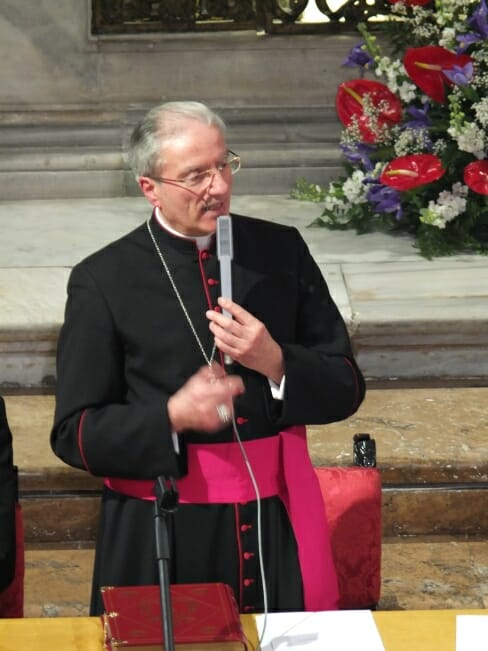
Mons. Raffaello Martinelli, Bishop of Frascati
“The task we are undertaking is not an easy one,” declared the Bishop of Frascati, Raffaello Martinelli, “but it is a service we want to render to the Church to bear witness to faith, hope and charity through the work and life of one of her daughters. ”
Also many International figures were present, such as the Cardinals Tarcisio Bertone, Ennio Antonelli, Joao Braz De Aviz, Miloslav Vlk; and Bishops, Carlos Tissera from Argentina and Brendan Leahy from Ireland; and from the ecumenical world, in the person of Archimandrite Simeon Catsinas, of the Orthodox Church of Rome, who represented the ecumenical Patriarch of Constantinople, and Fr. Gabriel, parish priest of the Romanian-Orthodox Church of Rocca di Papa, sent by Bishop Siluan of the Romanian-Orthodox of Italy.
Other friends of Chiara Lubich, founders and representatives of other movements were also present. The Muslim world did not fail to be present and testify to the determination to continue a dialogue in this critical moment, represented by the Director of the Cenap Tevere Mustafa Aydin Insitute of Turkey. From Japan, Dr. Mizumo came to represent the Buddhist Rissho Kosei-Kai Movement. Wearing their sash with the colours of Italy, various mayors of neighbouring municipalities attended, and among which was a delegation from Trent, Chiara’s native city, and a group of relatives of the new “Servant of God.”.
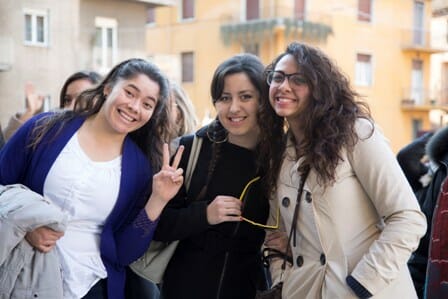 “Chiara spoke of living the Gospel and being faithful to God ,” João, a young Brazilian man said, and added: “I think we cannot be faithful without aiming to become saints, which is what God wants.” Francesca, 13 said: “I was struck by Chiara because of her great faith, which would seem difficult for kids to understand, instead she conveyed it with such simplicity.”
The ceremony. The cause for canonisation will start with a series of juridical acts, but, as the Bishop of Frascati underlined – “we want to transform it all into a meditation,” and because of this, the ceremony opened with the recital of the vespers. In a solemn atmosphere, the taking up of office of the tribunal, starting with the reading of the “supplice libello” with which the Focolare Movement, in December 2013 requested the opening of the cause. The document says – throughout the six years that followed Chiara Lubich’s death – «the common belief of the faithful regarding the purity and integrity of this Servant of God’s life, has grown in a continual and stable manner, and has spread more and more throughout the world, underlining the virtues she practiced to the point of heroism, not to mention the graces and blessings God has granted to many through her intercession. » The reading of the nulla osta of the Congregration for the Causes of Saints and constitution of the tribunal will follow .
Bishop Angelo Amati,Episcopal Delegate, will lead this phase of the diocesan investigation, and will be assisted by the Nigerian, Rev. Emmanuele Faweh Kazah, as the Promoter of Justice, and by notary Patrizia Sabatini, who had already worked in the previous months to gather the fifty testimonials, so as not to lose the testimony of those who «were allowed , from the very start, to bear witness to the beauty and possibility of tracing this path together in unity, towards an only goal,» Maria Voce said on recalling the first followers of Chiara, some of which attended the ceremony.
The postulation commission designated by the President of the Focolare is composed of the postulator, Fr. Silvestre Marques, Portuguese, and the Vice-Postulators, Lucia Abignente (Italian) and Waldery Hilgeman, (Dutch).The Tribunal has already set the next session for 12 February, to listen to the testimonial of Maria Voce, who tops a list of about 100 names.
Press release
Prayer of Intercession
Follow the event via streaming: http://live.focolare.org/reply.asp
27 Jan 2015 | Non categorizzato
It is with great joy, «multiplied by the joyful echo that arrived from the whole world» that Maria Voce, president of the Focolare Movement, welcomed the news of the opening of the Cause of Beatification of Chiara. Msgr. Raffaello Martinelli, Bishop of Frascati, made the announcement, setting January 27, 2015 for the opening ceremony of the process in the cathedral of Frascati. It’s in his diocese that Chiara Lubich lived most of her life until she passed away in 2008.
This is how Maria Voce explained it to Vatican Radio: “I immediately communicated this joy and gratitude to everyone, and also to the Bishop who was very careful in trying to bring ahead all the necessary preparatory work until it reached this moment. An enormous gratitude also goes to the Church because She allows us to show the beauty of a committed life, the life of Chiara.”
Maria Voce continues in that interview, Chiara “always dreamt of the day when we could truly speak about a sanctity of the people, because she understood that we become saints by doing God’s will, and that it is something that God asks of each person. Thus her desire was not so much of becoming a saint herself – even if she also logically had in mind that the will of God is ‘your sanctification’, as the Gospel says. Her desire was that many, many people would enter this way of holiness.» Hence, for Maria Voce, to work so that the holiness of Chiara Lubich may be recognized means «to work so that this possibility for all to become saints may be recognized.”
How is the Focolare Movement involved in this journey? With «a renewed commitment, so that the Church may see in Chiara’s followers the living witness of that model Chiara had been and continues to be for us.»
“ The testimony of love of many people for Chiara Lubich remains the same,” Vatican Radio commented.”It remains the same and continues to grow, I’d say: it’s a witness of affection that comes also from those who didn’t know her personally. Certainly those who knew her feel that this moment is a special moment of grace: I’m talking about authorities of the Church, presidents or founders of other Movements, as well as people of various religions and Churches.”
Those who will have to examine papers, speeches and videos will not have an easy task: “There is a great deal of documents and writings that have already been given for this examination. And then there are videos, there are reels of speeches that Chiara gave; letters that Chiara wrote… There is so much material and it will surely be a great commitment for the whole Court, and also our commitment in preparing these documents in the best way possible so that the Church may go ahead with its examination.”
In short, one word to explain Chiara’s holiness? “I’d say normality: we can become saints by leading an ordinary life. The extraordinary fruits of this ordinary life are fruits that come from God, from the relationship of Chiara with God and from the natural relationship of Chiara with her people. Living something extraordinary in a natural way: Chiara gave us the example of this, even if logically there were also extraordinary moments in her life, however she gave us the example of holiness in ordinary moments, not only in extraordinary moments.”
And about Chiara Lubich “woman of dialogue,” important than ever these days, Maria Voce affirmed:” think that in this field Chiara has still a lot to say in order to establish real, profound relationships between civilizations, ethnic groups and religions so as to counteract this wave of violence that seems to be invading the world. Thus it is a declaration of holiness for a person who made her life a symbol of dialogue. This could be a sign of this moment.”
Complete interview on Vatican Radio
Live streaming 27 January from 4.00 – 6.00 pm (Italian time): http://live.focolare.org.
26 Jan 2015 | Non categorizzato
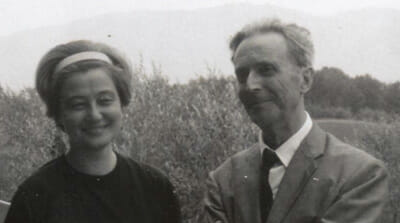
“In reading about the lives of the saints, the idea of sanctity that seemed like a difficult uphill climb reserved only for a rare group of people, became a common heritage, and I began to understand why Jesus invited all his disciples to reach perfection, in the same way as the Father: the perfection of God himself!
It all seemed old but also totally new. It was a new method, a new spirit, like discovering the key to a mystery: one that opened out to love that had been locked up, but which now broke out like a flame and spread until it became a blazing fire.
The ascent towards that remote God now seemed easy and possible for all, since all could now find the way home together, as brothers. Those terrifying acts of penance (hair shirts, chains, dark nights of the soul, renunciation) became effortless since all was done together, with the help of our brothers, with love for Christ.
It was the dawning of a a “socialised” sanctity (terms used by the Second Vatican Council and which would become popular) no longer individualistic, where you think of sanctifying yourself and meticulously cultivate your own soul, instead of forgetting yourself. A religiosity, an interior life that issued from the ranks of religious institutes, from a sort of elitism of the privileged classes –at times so distant and even against society, in reality formed by the major part of the living Church. This sanctity now reaches out to the squares, workshops and offices, the houses and fields, as also to the convents and Catholic Action associations, since in every place, one meets people who are all candidates for perfection. In short, asceticism has turned out to be a universal adventure of divine love – love that generates light.»
«Life is a unique occasion to be lived on earth which is one with eternity. And we can make the earth a foretaste of heaven, and insert it into the life of God, to bring heaven on earth. Do not spoil it with ambition and greed and do not ruin it with wrath and hostility: deify it – extend it within the heart of the Eternal – with Love. And God is where love exists. And where every moment is used for love, giving God to others: which also means absorbing God for oneself and for the others.
This means experiencing the freedom of the sons of God, for whom the spirit is not immobilized by prejudice, divisions, oppositions, and barricades to the spirit of God. Those who live this way do not focus on sanctifying themselves but on sanctifying. They are not self-centered. They sanctify by sanctifying, given that we love through loving, and serve by serving. In this way, sanctification itself takes on a social dimension: a continual giving and giving of oneself brings about the sanctification of souls, which becomes a communitarian reality.
“Be perfect as my Father is perfect,” Jesus exhorted: and we become perfect in God’s will, united as one in order to be one with Him, through Christ.”
Source: Igino Giordani Centre
![The Eucharist and divorcees in new relationship]()
24 Jan 2015 | Non categorizzato
 “We prepared ourselves for marriage certain that we would commit ourselves for the rest of our life. But already after the birth of our daughter, he started to go out alone and I, who was always exhausted due to work and maternity, aside from still being in love with him, I did not realize at once that something was wrong. What followed were 13 years of lies and quarrels, alternating with false clarifications which were followed by continuous delusions. I was exhausted and on the verge of a nervous breakdown (my weight dropped to 36 kilos) and so finally I surrendered, and gave my husband his freedom. After three years I met one of my former classmates, he too was a father and separated from his wife. Initially I tried to resist the sentiments that I felt were growing within me because, if on one hand the fact of feeling myself loved gave me much joy, on the other hand I had to face the problem of my Christian faith. They were very difficult moments. But then the doubts disappeared because, I told myself, it is true that when I got married I thought that it would be ‘forever’ but if love is no longer reciprocated, why can’t I continue with another person in that vocation of family life which I have always felt as mine? Certain of our love for one another we decided to join our two broken lives. After around two years of living together, we had a son, whom we had baptized and who we try to educate in a Christian way. For my partner – a person who is very honest and upright who considers himself as a non-believer – the problem of belonging to the Church does not exist. I, instead, continued to go to Sunday Mass and, even in suffering, I accepted the standpoint of the Church by abstaining from receiving the sacraments of Reconciliation and the Eucharist. I could have gone to a church were no one knew me, but out of obedience I didn’t do it. But after awhile, this self-exclusion began to weigh on me and so I stopped going to Mass and participating in the life of the community. In fact, I felt a strong discomfort in seeing the others going to the altar while I had to remain in my seat. I felt abandoned, rejected, guilty. After a few years, thanks to my closeness to the Focolare I started once again my journey of faith. ‘God loves you immensely’, they repeated to me. Together with them I understood that Jesus died for me too, and that He, in his infinite love, had already filled up that abyss into which I had fallen and all that he was waiting for was for me to follow Him for the rest of my life. And so I discovered that, aside from the Eucharist, there were other sources through which I could meet Jesus. He hides himself in every neighbour of mine, he speaks to me through His Gospel and is present in the community united in His name. Above all, I can find Him whenever I am able to transform the suffering of not being able to approach the Eucharist, into love. I remember when our son made his first Holy Communion. I was the only parent who did not go to the altar with him: it was a suffering that I cannot even describe. In exchange I can say that it was precisely when I lost the Eucharist that I discovered the great gift that it is, just like how you discover the value of good health when you lose it. On the day that I will present myself to the Father I hope that He will look not at my failures but rather at all my small efforts to love the others as Jesus had taught us.”
23 Jan 2015 | Non categorizzato
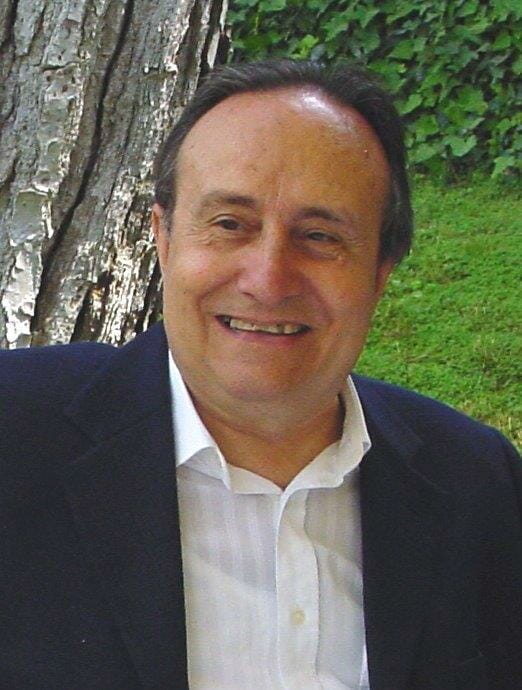
Giuseppe Maria Zanghi, one of Chiara Lubich’s first companions, passed away on 23 January 2015, after a brief illness, at the age of 85 years. Known simply as Peppuccio, he was for many years responsible for the Focolare’s Abba School cultural centre.
In conveying the news, president, Maria Voce remarked, “He often spoke to us about Heaven, and now he can fully enjoy it.”
We remember him with this excerpt from a 2009 interview in Città Nuova magazine.
You took part in the beginnings of the Gen Movement with Chiara Lubich. What made her later decide to tell the new generations about those mystical experiences known as the “Paradise of ‘49”?
“When you get right down to it, what is this ‘Paradise of ‘49’? It’s the written account that Chiara gave to Igino Giordani of what happened to her during the summer of 1949 at Fiera di Primiero. This was a period of intense contemplation during which God marked her soul, as with a branding iron, with the whole design of the just-beginning Work of Mary. God does that with all the mystics who are to be great founders in the Church. The striking thing about ‘49 is that with Chiara others, the group of focolarinas and focolarinos who were vacationing with, her partook in the experience of intense contemplation (by participation). They were merged into one by God’s love: a merging, however, that left their respective individualities intact.
It was a highly original experience also in terms of culture, because it concerns what I like to call the ‘collective’ subject. In actuality every culture is born from a subject and, in my opinion, today’s world is in search of the subject for the culture that must be born now. For me this is the greatest – and yet to be discovered – contribution Chiara makes to the birth of the new culture. But leaving that aside for now because much examination and study is still needed, the reality through which God opened to Chiara the endless depths of His Divine life while making her simultaneously understand many things about the Work of Mary that was about to be born. For her it wasn’t something merely to be remembered; it was actual life. And you could feel this when you were with her. You could feel that following the ideal of unity was not so much a matter of knowing a doctrine or hearing stories about someone’s experiences. No, it was entering into the very reality that Chiara had lived in ’49, and which continued.
Well, in her mind the young people of the Movement, the Gen, also had to get into this experience which was human and divine, spiritual and cultural.They had to stay there, develop it and bring it forward. That’s why, at a certain point, she began to give them something of this ‘Paradise.’”
Source: Città Nuova
22 Jan 2015 | Non categorizzato
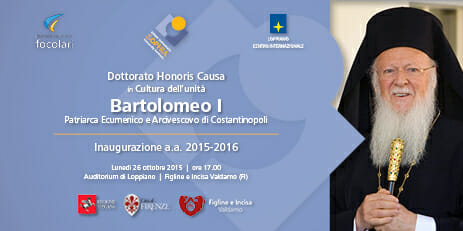
Live streaming from Loppiano, 26 October, 5.00pm (Italian time) IUS president Piero Coda explained the official reason for conferring the doctorate saying that the Patriarch is well known as a convincing and active protagonist of the ecumenical journey toward full unity among Christians, and in the dialogue with people of different religions and convictions. Moreover, he has distinguished himself in his promotion of peace and justice, respect for the natural environment, in conformity with the vision of humanity, history and the cosmos that is guarded and actualised by the spiritual and theological tradition of the Christian East. The history of the fraternal relationship between the Focolare Movement and the Orthodox had its origin in the extraordinary encounter between Chiara Lubich and Patriarch of Constantinople Athenagoras I. “It was June 13, 1967,” Chiara recounted, “He welcomed me as if he had always known me. ‘I’ve been waiting for you!,’ he exclaimed, and he wanted me to tell him about the Movement’s contacts with Lutherans and Anglicans.” Chiara and Athenagoras had twenty-five meetings. The relationship continued with Patriarch Demetrius I, and the contact continues in the same spirit with the current Ecumenical Patriarch Bartholomew I. Meanwhile the spirituality of the Movement was also welcomed by Christians of the Ancient Oriental Church, and dialogue was developed with Syro-Orthodox, Coptic Christians, Ethiopians, Armenians and Assyrians. The honorary doctorate adds another important piece to relationship of harmony and friendship with the Focolare Movement, and will be part of the events celebrating the 50th anniversary of the Focolare town of Loppiano. download invitation www.loppiano.it
