3 Feb 2015 | Non categorizzato
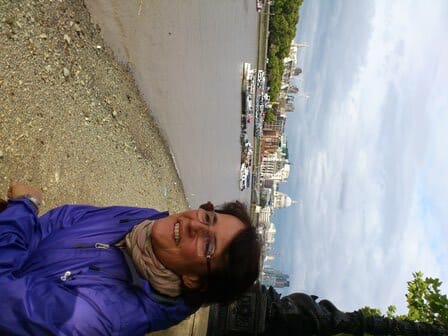
The Week of Prayer for Christian Unity and the Catholic Church’s year dedicated to the Consecrated Life. Two happy coincidences in which the vocation of German Evangelical Lutheran focolarina, Heike Vesper, becomes even more meaningful.
Heike recounts: “I was sixteen years old when my mentally handicapped twin brother died. That very sorrowful event gave birth to my desire for a life with true meaning. But I was certanily never thinking of a life of consecration to God… That monsastic lifestyle had practically disappeard in the Reformed Church. For Luther, every baptised Christian already had within them the call to follow Jesus in a total way and, essentially, this was lived out in work and in family. Luther didn’t see the consecrated state as a higher state, since all are called to a perfection that becomes attainable only through God’s love, through his mercy. Consecration to God was a totally foreign concept for me, therefore; foreign also because of the atheistic environment that surrounded me in East Germany.
A few months later, in the spring of 1977, I got acquainted with young people from the Focolare, a movement that had begun in the Catholic Church and was open to dialogue with the faithful of other Churches, religions and people of non-religious convictions. I felt strongly drawn by their evangelical choice and even became invovled in their many foramtive and social activities that were offered to us, or that we ourselves produced. Our animators were a bit older than us, the men and women focolarini. They had made a total choice of God and lived in community. Their way of life greatly fascinated me, but I saw it to be too high a calling for me, and unreachable.
At one point a misunderstanding arose between the Focolare and my pastor because of a personal decision one of us had made. It was nothing serious but enough to make me realize that it only takes a small thing to reawaken ancient prejudices and reopen wounds that had seemed to be on the mend. It was a very strong experience in which I perceived God to be calling me to offer my life as an example, and that I could do this through the focolare. I felt both happiness and shock in front of this call. I didn’t feel up to to facing up to the diversity between our churches for 24 hours a day. For two years I tried to to silence God’s invitation, but every once in a while it would forcefully resurface.
Once, when i Chiara Lubich was visiting Germany, a group of Evangelical Lutherans posed questions to her. Her answers loosened the knots within me. Her words made me realise that entering the focolare would mean living the Gospel with the help of sisters who were animated by the same radical intention: trying to live Catholics and Evangelical Lutherans together; that meant choosing as our model Jesus in the moment of his abandonment by the Father when crying out a ‘why’ which, left unanswered for him, has recomposed unity between God and men, between the peoples, between the different Churches, between us.
Then and there I didn’t think that all of this meant consecrating myself to God, but only responding to God’s call to witness with my life that unity is possible. That passion for unity marked me in heart and soul, and gave me wings even in moments of darkness and trial.
When I found myself living in the focolare in Leipzig, I often attended the Lord’s Supper at my brothers and sisters of the Christusbruderschaft. One day, one of them asked me how we could stay faithful to our churches and live such an intense spirituality with the Catholics. That’s when I understood the great value of Chiara’s great mandate: Jesus forsaken. By loving him, who became division for us, not only do we find the strength to no longer feel divided within ourselves, but to be unity for the others. In Him we discover the importance of living with Jesus spiritually present in our midst, drawn by our mutual love. This presence is not linked to any sacrament, but to the life of the Word.”
2 Feb 2015 | Non categorizzato
“Chiara Lubich’s spirituality invites us to be open to communion first of all in our own families and, once there’s unity in our own families, to open ourselves to other families. No family is an island. We all feel the need to share our spiritual and material possessions, our time and our abilities, so that a network is built that is doing something that helps the world that is waiting for a love won’t give up, and always begin again.”
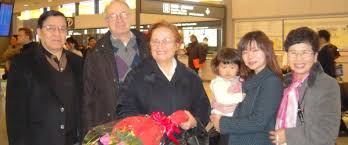
Anna and Alberto Friso sounded quite delighted as they remarked on the opening of the Cause of Beatification of Chiara Lubich last January 27, 2015 in Frascati, Italy. They knew the foundress of the Focolare Movement personally and for twelve years were in charge of the New Families Movement, one of the Movement’s first family associations. They took on that role just after marrying and travelling from Padua to Rocca di Papa to take part in a family conference with their first newborn son.
“We were very struck that a consecrated woman could have the family so much at heart and that her ideal could also be applied to our vocation as a married couple,” they recalled. Not only: “Chiara was a modern woman, pretty but not flashy, elegant but not affected, with an appealing and harmonious way of expressing herself,” the Frisos noted. “We were coming from the province, two simple working people, clumsy. With great simplicity and firm conviction she told us that Jesus was also counting on us, as individuals, but also as a family.” Lubich was indeed convinced that her spirituality was especially suited for families, because in its original design, it was a small community of people united by love.”
Currently, Alberto and Anna take care of the non-profit “Action for new families” group, which provides adoption at a distance in the world’s southern hemishpere. When they were in charge of the New Families they would meet with the foundress regularly: “She listened to the problems and the projects, but mostly she gave us the courage without which it would have proven difficult for two poor creatures like us to carry ahead a movement made of so many families, and on the global level. She offered guidelines, affirmed and dreamt with us. But most often she expressed her trust and confidence in us married people.”
Members of the Pontifical Council for the Family the Friso’s had also been invited by Chiara to give attention to separated couples, divorced and remarried people, which she described as “the face of Jesus crucified and forsaken.” Chiara’s charism continues to announce God’s divine love for each and everyone,“a conviction not only found in Scripture, but in the proofs of personal experience, from our own lives. It’s an announcement that turns out to be efficacious also for those who have perhaps lost hope or faith, or think that separation is already inevitable. If God loves me, if he gave his life for me, then I should – I can! – respond to that love by loving the person next to me. And who are more next to one another than a married couple, their children and other family members?”Alberto and Anna argued: “If we sincerely place ourselves on a ray of love that draws on the Absolute, then everything becomes possible: acceptance, service, listening, disinterested love, free-giving and forgiveness. . .”
30 Jan 2015 | Non categorizzato, Word of
The apostle Paul wanted to go to Rome on his way to Spain, and he sent a letter to the Romans before he arrived. Through their countless martyrs they were about to give witness to the sincerity and depth of their devotion to the Gospel, but among them, just as elsewhere, there was no lack of tensions, misunderstandings and even rivalries. In fact, the Christians in Rome came from a variety of social, cultural and religious backgrounds. There were some who came from Judaism and others from the Hellenic world and the ancient religion of Rome, perhaps from Stoicism or from other philosophies. They brought with them their traditions of thought and ethical convictions. Some were called ‘weak’, because they followed particular rules about eating, being, for instance, vegetarians or complying with calendars that indicated special days of fasting. Others were called ‘strong’ because, free from these kinds of conditioning, they were not bound by food taboos or specific rituals. To all of them Paul made the urgent invitation:
Welcome one another, therefore, just as Christ has welcomed you, for the glory of God.
Before this point in his letter he had already spoken about the issue, addressing first of all the ‘strong’ and inviting them to ‘welcome’ the ‘weak’, ‘without quarrelling over opinions’. Then he says that the ‘weak’ in turn should welcome the ‘strong’ without judging them, since they are ‘acceptable to God’.
Paul, indeed, is convinced that each one, even amid the diversity of opinions and ways of behaving, acts for the love of the Lord. There is no reason therefore to judge those who think differently, and even less to scandalize them by behaving arrogantly and with a sense of superiority. Instead, what is necessary is to aim at the good of all, at ‘mutual edification’, that is, the building up of the community, its unity (see Rom 14:1-23).
It is a matter of applying, in this case too, the great standard of Christian life that Paul had recalled shortly before in his letter: ‘love is the fulfilling of the law’ (Rom 13:10). No longer ‘walking in love’ (Rom 14:15), the Christians in Rome were lacking in the spirit of fraternity that ought to animate the members of every community.
As a model of mutual welcome, the apostle proposes Jesus dying on the cross when, instead of pleasing himself, he took upon himself our failings (see Rom 15:1-3). From the height of the cross he drew all to himself, and he welcomed the Jewish John together with the Roman centurion, Mary Magdalene together with the criminal crucified by his side.
Welcome one another, therefore, just as Christ has welcomed you, for the glory of God.
In our Christian communities too, even though we are all ‘God’s beloved’ and ‘called to be saints’ (Rom 1:7), there is no lack, just as in Rome, of disagreement and contrast between different cultures and ways of seeing things that are often poles apart. Often the clash is between traditionalists and innovators (to use language that is slightly simplistic but readily understandable), persons who are more open and others more closed, interested in a more social or a more spiritual form of Christianity. The divergences are fed by political conviction and by differences in social background. The current fact of immigration is present in our gatherings for worship and further in our various church groups, bringing diversity of culture and geographical origin.
The same dynamic can be seen in effect in the relations among Christians of different Churches, but also in families, in the workplace or in the political arena.
With it creeps in the temptation to judge those who don’t think like us and to feel ourselves superior, in a sterile conflict and mutual exclusion.
Paul’s model is not uniformity that flattens everything out, but a communion among contrasts that enriches. It is not by chance that two chapters earlier in this very letter he speaks of the unity of the body and diversity of its members, and of the variety of gifts that enrich and give life to the community (see Rom 12:3-13). His model is not, to use an image taken from Pope Francis, a sphere where every point is the same distance from the centre and where there are no differences between one point and another. The model is of something many-facetted with surfaces that are different from one another and not symmetrical, with particular characteristics that maintain their originality. ‘Even people who can be considered dubious on account of their errors have something to offer which must not be overlooked. It is the convergence of peoples who, within the universal order, maintain their own individuality; it is the sum total of persons within a society which pursues the common good, which truly has a place for everyone.’
Welcome one another, therefore, just as Christ has welcomed you, for the glory of God.
This Word of Life is a pressing invitation to recognize the positive that exists in the other, at the very least because Christ gave his life also for that person you feel inclined to judge. It is an invitation to listen, letting go of your defence mechanisms, to stay open to change, to welcome diversity with respect and love, to manage to form a community that is both plural and united.
This word has been chosen by the Evangelical Church in Germany to be lived by its members and to be light for them throughout 2015. If, at least in this month, the members of various Churches were to share it, this would already be a sign of mutual welcome.
Like this we could give glory to God together with one voice (Rom 15:6), because as Chiara Lubich said in the Reformed cathedral of St Pierre in Geneva: ‘Our world today asks each one of us for love; it asks for unity, communion, solidarity. And it also calls upon the Churches to recompose the unity that has been torn for centuries. This is the reform of all reforms which heaven is asking of us. It is the first and necessary step towards universal fraternity with all men and women of the world. The world will believe, if we are united.’
Fabio Ciardi
27 Jan 2015 | Non categorizzato
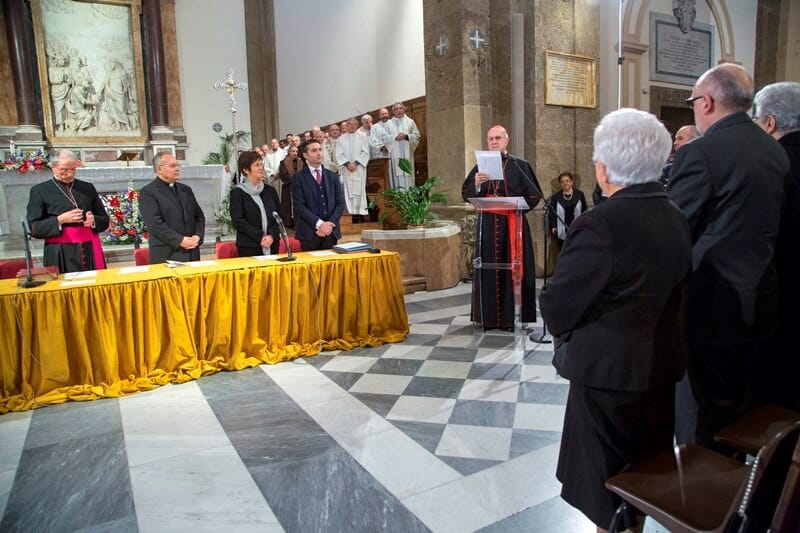
Amidst the festive atmosphere, there was also a solemn and prayerful tone. After the vespers prayer service and some songs, to the joyful surprise of all those present, the main celebrant announced the arrival of Pope Francis’ message. The Papal letter carries the signature of the Secretary of State Cardinal Pietro Parolin, and is addressed to Msgr. Raffaello Martinelli, Bishop of Frascati, as person in charge to officially open the “Process on the life, virtue, fame of holiness and signs” of Chiara Lubich. In fact, the International Centre of the Focolare Movement is in the Diocese of Frascati, where Chiara lived most of her life until she passed away on 14 March 2008.
The Pope’s message states, «On the occasion of the Opening of the Cause of Beatification and Canonization of Chiara Lubich, that is taking place at the Cathedral of Frascati, His Holiness Pope Francis sends his cordial greetings, in the hope that the luminous exemplary life of the Founder of the Focolare Movement may inspire in those who conserve her precious spiritual legacy to renew their faithful adherence to Christ and their generous service to Church unity. The Holy Father invokes abundant gifts of the divine Spirit on all those who are committed in the Postulation and exhorts you to make known to the people of God her life and works. She welcomed the invitation of the Lord and enkindled a new light for the Church on the journey towards unity. The Holy Father asks for prayers to support his universal ministry as successor of the Apostle Peter through the intercession of the Holy Virgin Mary, and grants an Apostolic Blessing to your Excellency, the Postulation, the entire Work of Mary and to all those who participate in this joyful event. From the Vatican, 27 January 2015.»
Maria Voce, on behalf of the Focolare Movement throughout the world who followed the event via internet, expressed everyone’s gratitude: «First of all we would like to express our joy, emotion and surprise for this message of the Holy Father. We would like to thank him and assure him of our prayer, which he asked of us; as well as our commitment to continue spreading that “new light” that he indicated to us as Chiara’s gift to the Church and humanity.»
The applause of those present manifested the immense joy and gratitude of the whole “people of the Focolare”.

