18 Jan 2015 | Non categorizzato
One asks today, after the murderous attacks in Paris and the massacres in Nigeria and Pakistan, whether there is need for dialogue between people of different religions and cultures.
“I beg to reverse the question”, Maria Voce says, and continues to ask: “Can we live without dialogue in a globilized world?” While speaking about the increase in the number of people who choose to emigrate and about entire populations who are forced to flee because of persecution,“uprooted from their environment and their future” and forced to live with others of different races, cultures, opinions and religions, the president of the Focolare Movement quotes the pressing question of Western Countries: how does one live with these people? “The answer is clear”, she affirms, “We either dialogue or fight with one another. But conflicts lead to destruction of both residents and immigrants, while openness and dialogue create life and lead to life”.
“I have noted this during my trips to places in the Middle East, Africa and Asia where dramatic situations are present”, she explains.“The brave commitment to dialogue is lived by children in their schools, by families in their neighbourhoods and by many people in their workplaces”.
 She reminds that the most effective dialogue is the one “built on the sharing of everyday life”, which is “not generated through an immediate confrontation of ideas” but “ through getting to know the other person – and not his religion – to be able to discover the bond of brotherhood that binds all human beings”. Maria Voce is convinced that diversity does not necessarily cause opposition, but that it can be a source of mutual enrichment. And we truly enrich one another, because God is generous and he bestows his gifts on all men, whatever religion they belong to”. She reaffirms,“When we discover this, we all become richer and freer in our mutual relationship”.
She hints at what Pope Francis is manifesting through “his words and attitudes, emphasizing warmth, empathy, listening fully to others” . And “equally valuable is the Pope’s indication not to make concessions on our identity as Christians in order to prepare ourselves for this dialogue, because we can dialogue only if we are deeply and authentically Christian”.
In her conclusion, MariaVoce states “ A Christian or a Muslim become better persons when they walk on the road of dialogue and discover that they can progress together, and that this progress leads to common initiatives, starting from peace, that contribute towards the benefit of humanity”.
Read the full text of the declaration
17 Jan 2015 | Non categorizzato
Igino Giordani presided over a conference of ecumenists in the autumn of 1967 at the headquarters of the Focolare Movement in Rocca di Papa. Archimandrite Msgr. Eleuterio Fortino participated at this conference, and later gave this testimony: “Giordani, at that conference, succeeded by his inner serenity to appease the fiery tones of the debate; and clarified the theological and pastoral aspects of the decree of Vatican II Unitatis Redintegratio (1964), thus placating the last resistance of the Italian opponents to common prayer among all Christians in the Week for the unity of the Churches.”
For his part Giordani had followed this week of Prayer for Christian Unity since 1940, which to be more precise is actually an Octave: from January 18th to 25th each year. He explains this himself in a paper he wrote that year, where among other things he explains the significance of the two dates: the feast of the Chair of St. Peter’s in Rome, the first, and the conversion of St. Paul, the second.
“The practice of the Octave for unity, because it gathers millions of Christians at the feet of the one Father to make him one, choral demand, to make everyone one again, is itself a beginning of this unity, as well as a start in the right direction.
During the preparation of the Octave this year, news had spread, to begin with a little vague, that in a Trappist monastery of nuns in Rome, they were praying with particular intensity, for the termination of the divisions among Christians, whose image – which is the image of Christ bleeding – should not let us rest.
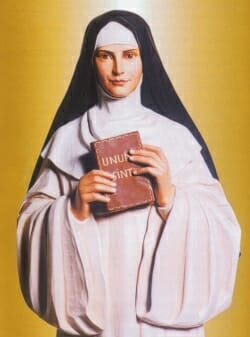
Sr Maria Gabriella Sagheddu
I came to know that, in that Trappist monastery, a humble nun, Maria Gabriella, had offered herself her life for the unity of the Church and that her sacrifice had deeply affected a community of separated brothers in England.
The news, even though vague, widened immensely – to my eyes at least – the horizon of the movement for unity and opened new perspectives, in which, like a strip of blue between the cracks of a storm, showed the face of the sky above a quarrelsome humanity. It put, in short, in its true light the Octave and its aims.
Now these nuns probably knew nothing of all those debates and commissions and committees: and in any case – no matter how great the merits of those international conferences were – they did not think it had anything to do with them. Confronted with the problem of the division, they had contemplated with simplicity, by the light of the Rule, which never changes: that is, they saw that unity has to be sought where it is to be found: at the source, at the matrix: it had in other words, to be asked of the Father, in whom – as we had been taught with the parable of the prodigal son – and only in whom brothers and sisters can be unified.
This means that these humble creatures, who we will never meet in any congress, had seen immediately what to do and had put the movement for unity back on the straight road. […]
Unity is not the work of men and women but of God: not of study, but of grace. Accept, Father, these pure offerings, first of all for your Church, that you might deign to purify it, guard it and unify it ….”
From “The ecumenical journey of Igino Giordani” by Tommaso Sorgi – excerpt from Nuova Umanita, n. 199 – January / February 2012.
14 Jan 2015 | Non categorizzato
Pope Francis is putting all his energy into his travels, as he has always done. But this trip to Asia is forecasted to be a really demanding one. Besides institutional types of events such as the interreligious meeting in Colombo upon his arrival in Sri Lanka and the canonization of the Indian Missionary, Joseph Vaz, the Pope will have to face the sultry tropical climate, but above all, an entire population that is expecting a strong message of hope from the visit.
This will be for Francis, a full immersion in one of the many peripheries of the world, so dear to his heart and marked also recently by natural calamities that have inexorably impacted on the difficult social support path in those lands.
Expectations are high and the Pope Francis excitement is building up especially in Manila where more than the five million people who officially attended the Mass of the World Youth Day celebrated by Pope John Paul II in 1995 are expected to participate. The Filipinos have been snapping their selfies beside his life-size cutout image in churches and malls, while the children are preparing to dress up as Swiss guards to welcome the Pope.
During the Christmas preparations, the youth of the Focolare went to the Tacloban and Palo regions, where the Holy Father will pay a visit on day 17, to celebrate with the schoolchildren with games, songs and gifts for the typical ”Noche Buena” or Christmas Eve vigil. This initiative was conducted also in cooperation with the youth from various parts of the world, who are living a concrete community experience in the small town of the Focolare in Tagaytay.
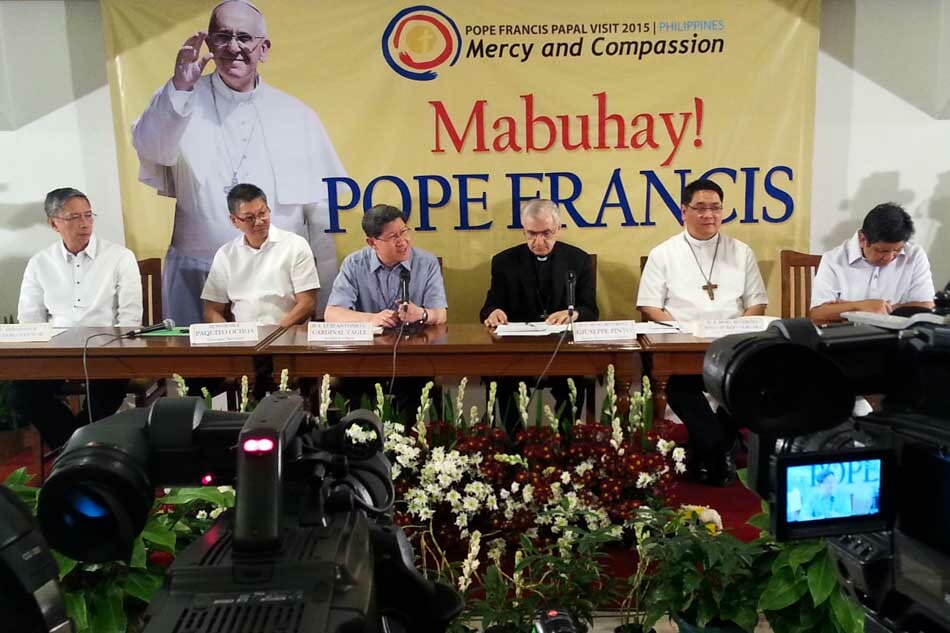 This was their concrete answer to the invitation of the Archbishop of Manila, Card. Tagle, and the President of the Philippine Bishop’s Conference, Bishop Villegas, to prepare for the Pope’s visit by intensifying the works of mercy towards the poor and outcasts. This gesture was not something new for them. Since November 2013, that is, when the country’s historically strongest typhoon Haiyan (Yolanda) wreaked its havoc, the Focolare has been organising a series of action aids for the struck population: from first aid to the distribution of food, clothing and prime necessities, repair of homes, moral support to families and those who had lost their loved ones, to the rebuilding plans with the construction of about 40 small houses. The specific program of the ”Start Again” project to help the schools, is still underway.
Besides this, the Focolare undertook to prepare the Holy Father’s visit to the Philippines through a word-of-mouth action and all the communities of Manila agreed to line the streets on January 15 from the airport to the city, to be with all the others in welcoming the Holy Father in person.
The community of Leyte took part in the Commission organizing the visit to the places where the typhoon had struck: to help in the security services during the Papal Mass in Tacloban, and also during the meeting at the Pope Francis Center for the Poor of Palo with about 200 aged people and poor children. A young Focolare member will entertain the participants before the Pope’s arrival.
But for the moment, the happiest are the survivors. Here’s what Farah says: “I am offering all my sufferings for the Pope’s safety and health.” Mark adds: “I am happy to be able to have a close view of the Pope. I feel so privileged. We are very grateful for his visit.”
About ten members of the Movement have been chosen as group leaders for the works of the New Evangelization Convention to be held from 15 to 18 January at the Pontifical University of Santo Tomas, with 5,000 enrolled delegates whom the Pope will meet on the 18th, before his departure.
Also on the last day, Pope Francis – who will start his trip to Manila with an encounter with families – will meet the youth gathered at the University’s sports field – and in the afternoon – will conclude his visit with a solemn Mass at Rizal Park.
Happy Trip Holy Father!
6 Jan 2015 | Non categorizzato
The star invites us to set out on a journey,
and wants to free us from the chains that bind
us down to our own selves, or to a pure and simple system.
It spurs us on, to undertake a journey to a place
we have never been to before.
This is what the star wants.
and the nature of this star is that it goes beyond, but also stops.
It crosses the desert and moves further, up to the most
remote places, but then it stops above a house.
And which house is it?
Could it be my school, for example, or my office,
or however, there where I usually work.
The star has stopped there and says,“This is the place: right here!”
And then, as I return home,
it stops above my home, my little world: that is where
the star has stopped.
In this place where I am right now
I have to find the precious things, the things that matter.
But I will find these precious things, the things that count,
only when I discover that the star has stopped also above my neighbour’s house.
That is where I will find Jesus.
(K. Hemmerle, The Light within things. Daily meditations. New City, Rome 1998).
3 Jan 2015 | Non categorizzato
http://vimeo.com/114750100
![Enzo Fondi, the final will of God]()
31 Dec 2014 | Non categorizzato
 «A soul in love, » Enzo «lived constantly in God’s presence, always one with Him. Always.» This was how Chiara Lubich described Enzo Fondi, just after he passed away all of a sudden, silently and serenely on 31 December 2001. «Enzo Fondi has gone to Heaven,» Chiara wrote to all the members of the Movement: «It is a great joy, even if in my lifetime […] we have never felt such great pain. The joy is because we cannot only say that Enzo has died, but that he gently passed from one “room” to the other. When they found him after the Te Deum, the expression on his face was one of great peace, without the shadow of anxiety at all, giving us the impression that he was “received” by Mary, our Mother, whom he loved in a particular way, with such tenderness. In our hearts we had the common impression that if we have been deprived here on earth, of this “gigantic figure” of the Work of Mary, we have, on the other hand, a saint in Heaven. This was how we considered him over the last few years, when his illness had refined and prepared him for this step.»
As an enthusiastic promoter of unity, he was especially guided by one particular sentence of the Gospel: “As you, Father, are in me, and I am in you may they also be one in us” (Jn 17:21).
Enzo Fondi, a doctor from an affluent family, was born in Velletri in 1927. In 1951, he joined the first Roman focolare. He was a part of the first group of Focolarini doctors who, at the start of the 1960s, crossed the confines of the socialist block to work as an assistant surgeon in the Catholic Hospital of Leipzig in Eastern Germany. From then on the spirituality of unity spread throughout Eastern Europe. In 1964 he was ordained priest at the service of the Movement, and later was assigned to the United States.
In 1977, the year in which Chiara Lubich received the Templeton Prize for the progress of religion, Enzo was assigned the task of developing interreligious dialogues of the Focolare, and with one of the first focolarine, Natalia Dallapiccola, gave his fruitful contribution to this end. On hearing the news, our Muslim friends in Algiers wrote: «With great simplicity Enzo taught us all the rules of the “art of loving” and opened our eyes to the universality of Chiara’s work and to what degree the miracle of unity is daily within our reach!» For years, Enzo was in charge – together with Natalia – of the spiritual formation of the members of the Focolare Movement. There is, therefore, a big archive of his answers, writings, and talks, with which he helped many to acquire a deeper comprehension of the charism of unity.
«Enzo had spent his last years on a cross,»  Chiara wrote again. A serious disease, in fact, had more than once led him to the brink of death. «But – we had the impression – that he had embraced Jesus Forsaken in such a perfect way. He was never impatient even for a moment, and never complained to his co-focolarini. The drama he was living was a matter between him and Jesus. Though rarely, he had confided to me about his physical condition, always with a smile on his face. And in this way, in the last period his life was an uphill, relentless climb, embellished with virtues, and God bestowed the grace of union with Him.»
This is testified to by Enzo’s last thoughts dated 15 December 2001: «My last will and testament. For me, it is the last will of God, the last thing he wants of me now. There will be no other. I must fulfill this last will to perfection, whatever it may be, and this is my last testament. I don’t know what will really be the last will of God I shall undertake in life. The only thing I am sure of is: for that last and this present moment, I will have the actual grace to help me do it, inasmuch as I have practiced in exploiting this grace, by living the present moment.»
A few days after December 31, he went from this earth accomplishing the final will of God.
