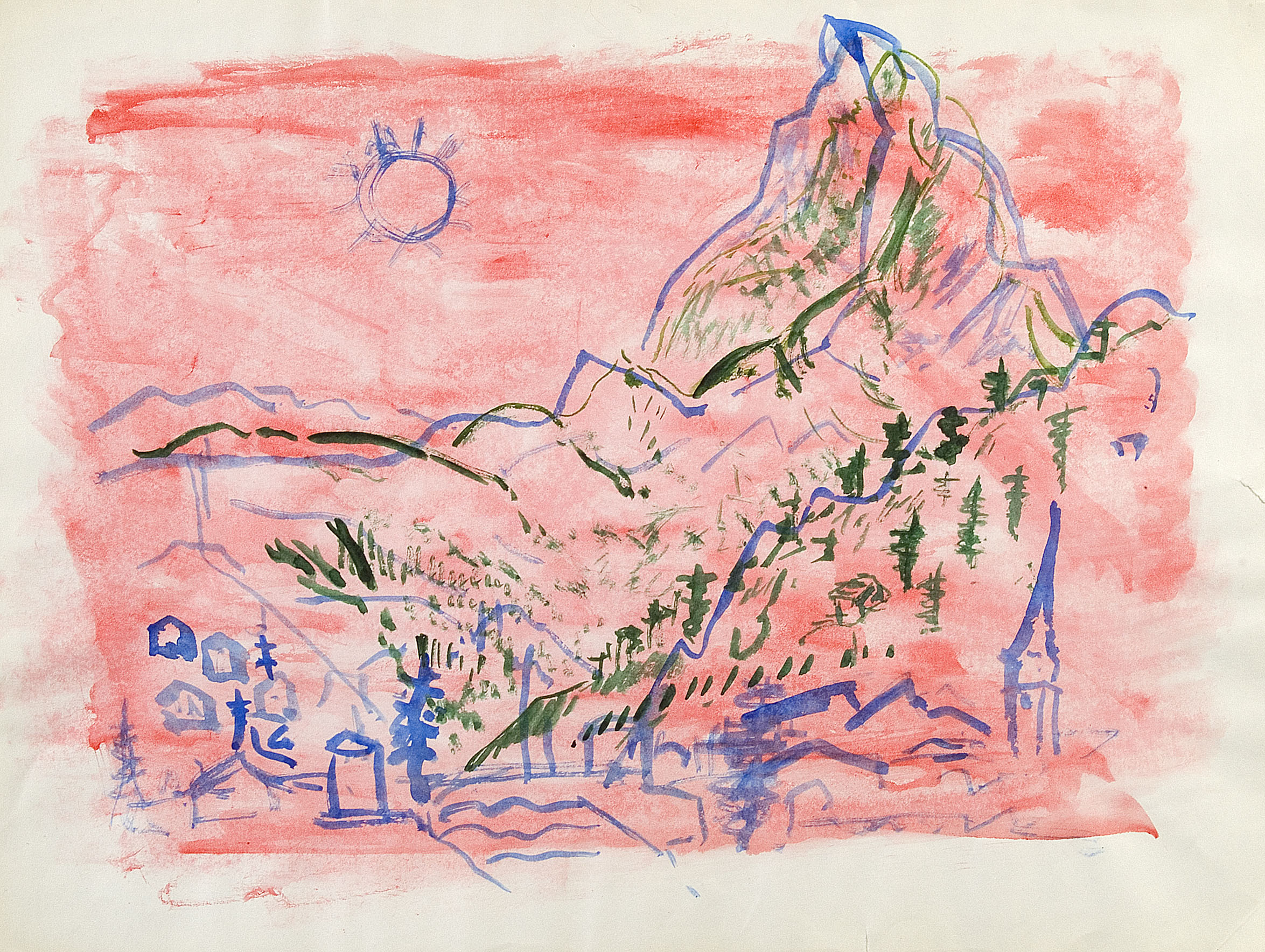
Watercolour by Klaus Hemmerle (1980 – Matterhorn mit Zermatt, Schweiz. http://www.klaus-hemmerle.de)
“During these walks, I took a road that was 2,250 metres high and wound around a peak. You could see the whole valley and the tops of the mountains. It was beautiful! I wanted to paint it all when I got back to the house. I stopped every ten metres to fix the scene in my soul. And in another five metres there would be a completely different perspective. Never in my life had I observed how quickly the perspective changes. I wouldn’t be able to say which view was more beautiful than the other. Each combination, each constellation was an entirely different event and a new surprise. And so I looked at the world in a completely different way. I saw a piece of heaven and realized that these relationships, this relating of each thing with the other, these stretches wherein the lines divide and then intersect again – all of this represents an infinite abundance of possible encounters of a single whole: this mountain, that mountain and that valley . . . but always new perspectives, so that I can’t say: this is the right perspective and that one isn’t: I have to move on letting all these perspectives and diverse lines encounter one another. So also should I see in the one God that we all believe in, the whole of creation, all the people in creation, all the things you find there for an always new intersecting, different beauties that don’t exclude but mutually include one another in a singular charm and common song to Beauty. The same thing happens among us: I need to be prepared to leave a perspective in order to have another. In God, I leave a perspective behind and it remains. Thus there is a simultaneousness that doesn’t crush me in his universality. It is a dance, a unique encounter, a different move, a new song. And I thought to myself: although there are obstacles and barriers between Churches, things that are opposed and that need to be suffered and gone through so that they can be resolved – there is also this ever-new encounter of charisms, light and grace. […] We should allow one another to touch a piece of this infinity of heaven and this heavenly and Trinitarian play of mutual relationships. The more we encounter one another in this beauty – each in the other and in appreciation of the other – the more we will draw a piece of Heaven to earth. A piece of the heavenly Jerusalem here among us is a first breath of what is still to be developed. Obviously, I also wondered where you could actually find a point in which all these different lines can meet, also where the reality of suffering and the contradictions intersect, where a meeting point could be found for all that can never be resolved with some sort of Hegelian synthesis, or also those things that remain like a cry but still must be lived and put up with. I discovered that this point of intersection is Jesus in his abandonment: He renders himself contemporaneous with what is not contemporaneous. He is acceptance and agreement with what is not accepted and does not agree. He is death of one for the other. Precisely: he is not a mere speculative idea, but a possibility of living and accepting the tensions and sufferings and all that is not resolvable.”
Klaus Hemmerle From the book
Klaus Hemmerle, innamorato della Parola di Dio by Wilfried Hagermann, (Rome: Città Nuova Ed, 2013), p 297-298.


0 Comments