I have felt you beating in the perfect stillness of a little Alpine church, in the shadow of the tabernacle of an empty cathedral, in the breathing as one soul of a crowd who love you and who fill the arches of your church with songs and love.
I have found you in joy. I have spoken to you beyond the starry firmament, when in the evening, in silence, I was returning home from work.
I seek you and often I find you.
But where I always find you is in suffering.
A suffering, any sort of suffering, is like the sound of a bell that summons God’s bride to prayer. When the shadow of the cross appears the soul recollects itself in the tabernacle of its heart and forgetting the tinkling of the bell it “sees” you and speaks to you.
It is you who come to visit me. It is I who answer you: “Here I am, Lord, I desire you, I have always desired you.”
And in this meeting my soul does not feel its suffering, but is as if inebriated with your love: filled with you, imbued with you: I in you and you in me, that we may be one.
And then I reopen my eyes to life, to the less real life, divinely trained to wage your war.
Chiara Lubich in Meditations, New City, London 2005, pages 74-75
… “I was hungry and you gave me to eat; I was thirsty and you gave me to drink…” (Mt 25:35). “When Lord?” “Every time you did this to the least of my brothers andsisters, you did it to me” (Mt 25:40).
(…)
This love for the poor was always light for us, and the Spirit made us understand the need to love not only them, but everyone else too: “Love your neighbour as yourself,” whoever he or she may be.
And from this came a wonderful idea and a decision: to transform our daily lives into a wide range of material and spiritual works of mercy: in all the contacts we made, with all the different people we met. Because here too, we could apply the words: “You did it to me.”
In each neighbour we met, we saw Christ who was asking for help, for comfort, advice, correction, instruction, light, bread, shelter, clothes, prayers….
(…)
We hope that one day, to those … who will ask Jesus: “When, Lord, did I give you to eat, to drink, and when did I console you?” he will reply: “Every time you did this to the least of my brothers and sisters, you did it to me.”
… On the 7th of December 1943 I went to church alone. There was a violent storm outside. It really gave me the impression that I had the world against me.
… A small kneeler had been prepared for me before the altar, and I had a tiny missal in my hands. The priest had me pronounce the formula to give myself completely to God forever. I was so happy that I probably didn’t even realize what I was doing, maybe because I was young. However, when I pronounced the formula, I had the impression that a bridge was falling behind me and that I could no longer turn back because now I belonged entirely to God, therefore, I could no longer choose. At this point, a tear fell on the tiny missal.
But my happiness was immense! Do you know why? I was marrying God, and I expected every possible good. It would be fantastic! It would be a divine, extraordinary adventure! I was marrying God! And then we saw that it was really like this.
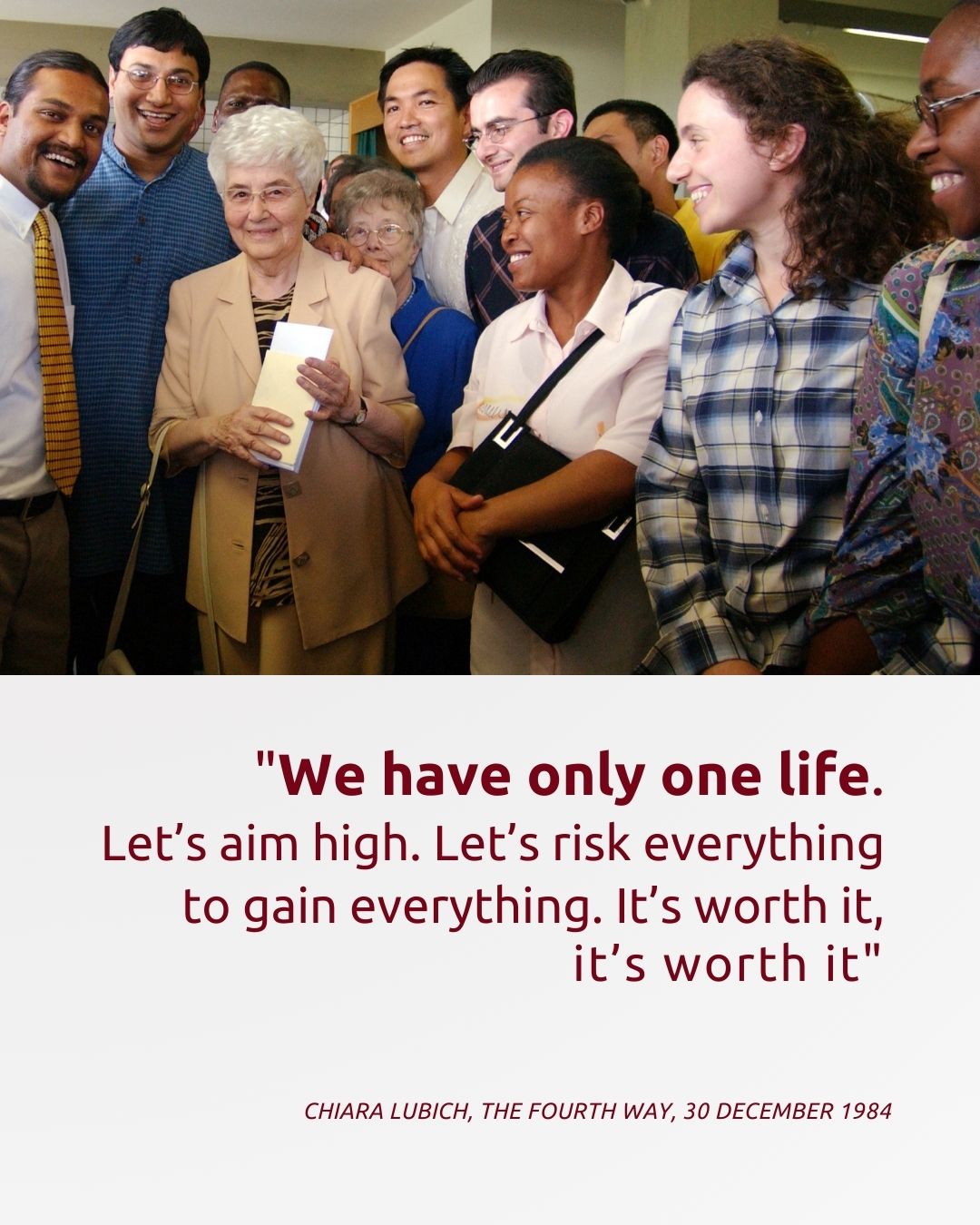
… What is my advice? I would give this advice to myself: we have only one life. Let’s aim high. Let’s aim high. Let’s risk everything to gain everything. It’s worth it, it’s worth it. … But as far as you are concerned, make this act of generosity: aim high, don’t hold back!
Let’s take a look at some scenes that are typical of today’s world. …
We can observe … in countries that have experienced recent changes, people who are rejoicing in their newfound freedom. Alongside them are people who are fearful, disappointed and depressed because they have seen their ideals collapse. …
And what if we were to see scenes of racial strife with massacres and human rights violations … Or unending conflicts like those in the Middle East, with the destruction of homes, people wounded and dying and the continuous falling of deadly bombs or other lethal weapons? … … Let us ask ourselves again: what would Jesus say in the face of such tragedies? ‘I told you to love one another. Love one another as I have loved you’.
Yes, that is what he would say looking upon these and the most dire situations of the world today.
But his words are not merely regret for what has not been done. He really and truly is repeating them to us today. For he died, but he rose again and, as he promised, he is with us every day until the end of the world.
And what he says is of immense importance. Because this sentence ‘Love one another as I have loved you’ is the true key to solve of every problem. It is the fundamental answer to overcome every human evil. … …
Jesus defined the commandment of love as ‘mine’ and ‘new’. It is typically his, having given it a unique and very new content. He said, ‘Love one another, as I have loved you.’ And he gave his life for us.
Our life is therefore at stake if we love like this. And a love ready to give our life for our brothers and sisters/neighbours is what He is also asking of us
Friendship or kindness towards others is not enough for Him; neither is philanthropy nor solidarity alone. The kind of love He asks for is not limited to non-violence.
It is something active, very active. It asks us no longer to live for ourselves, but for others. And that requires sacrifice, effort. It asks everyone to become … like little daily “heroes” who, day after day, are at the service of their brothers and sisters/neighbours, ready to give even their lives for them. …
This mutual love among you will indeed produce fruits of infinite value, because where there is love, God is there and as Jesus said: ‘Where two or three are gathered in my name (that is, in his love), I am there among them’ …
Jesus himself will work with you in your countries, because in a certain way, he will return into the world, wherever you meet, and you will make him present by your mutual love, by your unity.
And he will enlighten you about all that needs to be done, he will guide you, he will support you, he will be your strength, your ardour, your joy. …
So, keep love among you and sow love in many corners of the earth among individuals, among groups, among nations, using every means, so that the invasion of love, which we often speak of, may become a reality, and so that the civilisation of love we are all longing for, may take root, thanks also to your contribution.
This is what you are called to do. And you will see great things happen.
An Easter of hope but above all, an Easter to be lived together. In this year 2025, which marks 1,700 years since the Council of Nicaea, Christian Churches will celebrate Easter on the same day: Sunday, 20th April.
This is a wonderful coincidence that calls all Christians to take a decisive step toward unity—a call to rediscover ourselves as united in plurality.
In an age marked by divisions on every front and especially at this time that brings us closer to the mystery of the Resurrection, we would like to share what Chiara Lubich said in Palermo in 1998 about “A Spirituality for Dialogues”, specifically an “ecumenical spirituality.”
It is a direct invitation to respond to the call of mutual love, not as individuals, but together. It is an opportunity to look upon the Jesus Forsaken on the cross as a light which, even in the ultimate sacrifice, not only leads us but becomes the sure pathway along which we can take our steps.
Enable subtitles and select your preferred language.