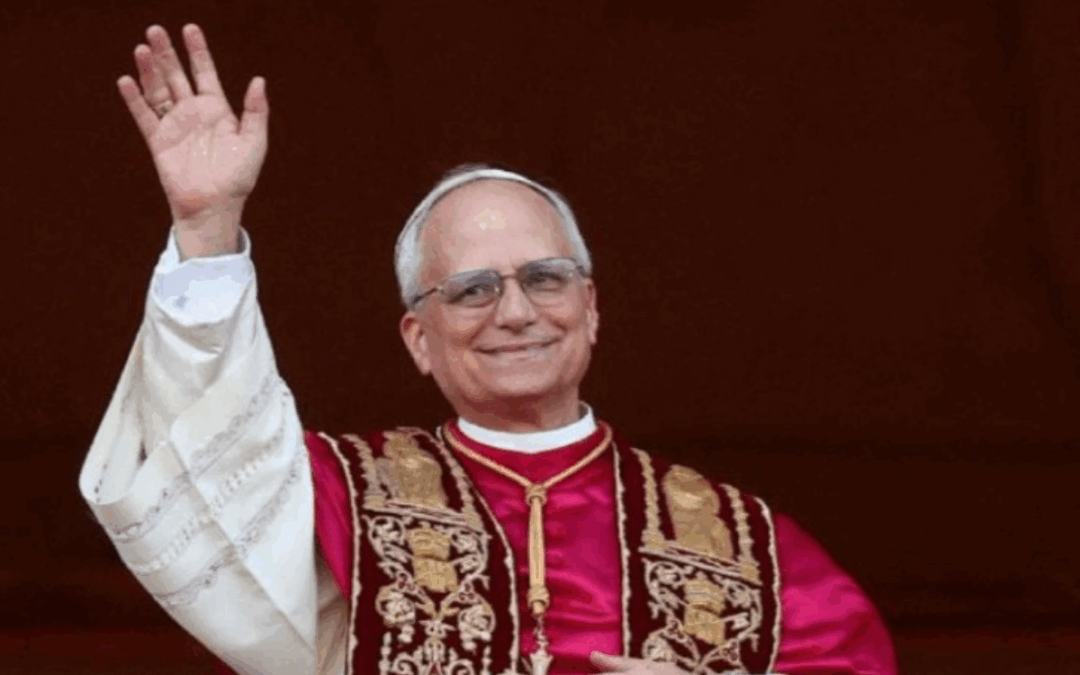
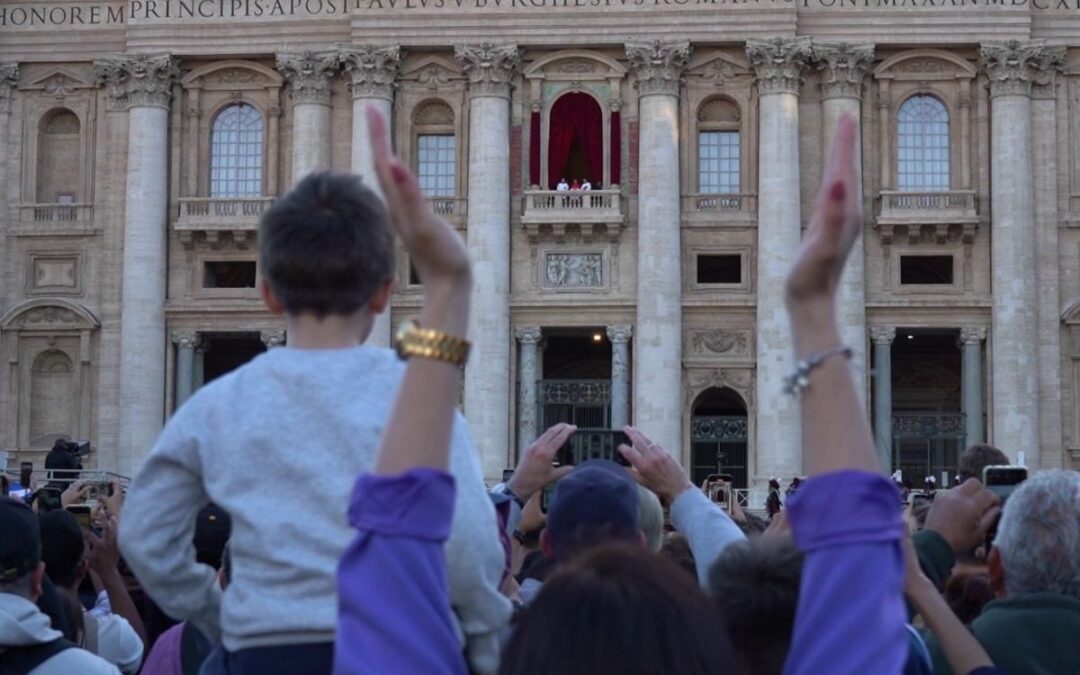
In the afternoon of October 1, at the Focolare Movement’s International Mariapolis Center in Castel Gandolfo, Rome, the Raising Hope Conference was inaugurated with the participation of His Holiness Leo XIV, alongside notable figures such as Arnold Schwarzenegger, former Governor of California, and the Hon. Marina Silva, Brazil’s Minister of Environment and Climate Change.
The session combined testimonies, spiritual and artistic moments, in thanksgiving for the 10th anniversary of the encyclical Laudato Si’. Representing the Laudato Si’ Movement, Associate Director Christina Leaño and Brazil Director Igor Bastos presided over the day’s opening.
A symbolic moment came when Pope Leo XIV touched and blessed a block of ice more than 20,000 years old, broken off due to climate change from a glacier in Greenland, as well as water brought from around the world—gestures embodying compassion and concern for the cry of the Earth and the poor.
Laudato Si’: What remains to be done?
“This Encyclical has profoundly inspired the Catholic Church and many people of goodwill,” Pope Leo began in his speech on Laudato Si’, “it opened strong dialogue, reflection groups, and academic programs.” The Pope noted how his predecessor’s encyclical spread “to international summits, to ecumenical and interreligious dialogue, to economic and business circles, to theological and bioethical studies.”
Giving thanks to the Heavenly Father “for this gift we have inherited from Pope Francis,” Leo stressed that today environmental and social challenges are even more urgent. On this anniversary we must ask ourselves: “What remains to be done? What must we do now to ensure that caring for our common home and listening to the cry of the earth and the poor do not appear as passing trends or, worse still, are seen and felt as divisive issues?” he asked.
Return to the heart: from data collection to care
“Today more than ever it is necessary to return to the heart, the place of freedom and authentic decisions,” affirmed the Pontiff, because although it “includes reason,” it also “transcends and transforms it.” “The heart is where external reality has the greatest impact, where the deepest search takes place, where the most authentic desires are discovered, where one’s ultimate identity is found, and where decisions are forged.”
In this regard, he stressed that “only by returning to the heart can a true ecological conversion take place.” “We must move from collecting data to caring; and from environmental discourse to an ecological conversion that transforms both personal and community lifestyles.”
Leo reminded those present that this experience of conversion orients us toward the living God: “We cannot love God, whom we do not see, while despising His creatures. Nor can we call ourselves disciples of Jesus Christ without sharing His vision of creation and His care for all that is fragile and wounded.”
No room for indifference or resignation
Before concluding, the Pope looked with hope to the upcoming international summits —COP30 in 2025, the World Food Security Committee session, and the 2026 Water Conference— “so that they may listen to the cry of the earth and the cry of the poor.”
He also encouraged young people, parents, and those working in administrations and institutions to contribute to “finding solutions to today’s cultural, spiritual, and educational challenges, always striving tenaciously for the common good.”
Finally, he reflected: “God will ask us if we have cultivated and cared for the world He created and for our brothers and sisters. What will our answer be?”
1.5 billion Catholics can get involved
Actor and former Governor of California, founder of the USC Schwarzenegger Institute and the Schwarzenegger Climate Initiative, Arnold Schwarzenegger, began his address by congratulating the Holy Father for installing solar panels on the roofs of the Vatican: “I am standing next to a hero,” he declared.
“There are 1.5 billion Catholics — that power and strength must be used to get involved in the climate movement,” Schwarzenegger said, urging more focus on talking about pollution: “The average person doesn’t understand when we talk about net zero or rising temperatures. Instead of speaking to the head, we must speak to the heart. We can end pollution if we work together, because God put us on this Earth to make it a better place.”
Toward the COP of hope
Next came the Hon. Marina Silva, Brazil’s Minister of Environment and Climate Change, co-chair of COP30. In her address, she expressed being inspired by Christian values in taking part in the conference.
Confidently, she stated: “I am certain that the Pope will make a great contribution so that COP30 goes down in history and becomes, as we all ardently hope, the COP of hope, to preserve and cultivate all forms of life that are part of the beautiful garden God has given us.”
From tears to hope
On stage, the Pope was joined by Dr. Lorna Gold, Executive Director of the Laudato Si’ Movement and President of the Conference Organizing Committee; theologian Margaret Karram, President of the Focolare Movement; Fr. Jesús Morán; and Yeb Saño, Chair of the Board of the Laudato Si’ Movement, who shared his own story of facing climate catastrophes in the Philippines and introduced the testimonies.
A symbolic spiritual moment followed when representatives from East Timor, Ireland, Brazil, Zambia, and Mexico brought water from their homelands, poured into a common bowl on stage. They embodied the cry of indigenous peoples, wildlife, ecosystems, future generations, migrants, the poor, and the Earth itself.
From tears to hope, with the audience on their feet, Pope Leo approached the glacial ice and proclaimed a blessing over the water and all present: “May we work for the flourishing of all creation.” Musical performances by Adenike, Gen Verde, and the Pacific Artists for Climate Justice brought joy and energy to the encounter.
A block of Greenland’s ice
The ice traveled more than 5,000 kilometers from the fjords of Nuuk, Greenland, to Castel Gandolfo, Rome. Artist Olafur Eliasson organized the transfer with the support of geologist Minik Rosing. Collected from the Nuup Kangerlua fjord, the block of ice had detached from the Greenland ice sheet due to climate change and was melting into the ocean. Greenland’s vast ice sheet is one of Earth’s most important climate regulators. Formed from compacted snow over tens of thousands of years, it contains layers more than 100,000 years old with ancient air bubbles recording the history of our atmosphere. NASA’s Earth Observatory estimates Greenland’s ice sheet is losing about 270 billion tons per year due to climate change. As the ice releases meltwater into the ocean, it reminds us that our global relationship with ice sheets is existential: they connect us to the past, shape our present climate, and —depending on our care or neglect— will determine our common future. If the ice melts completely, NASA predicts sea levels could rise by about seven meters (23 feet), reshaping coastlines and displacing millions worldwide.
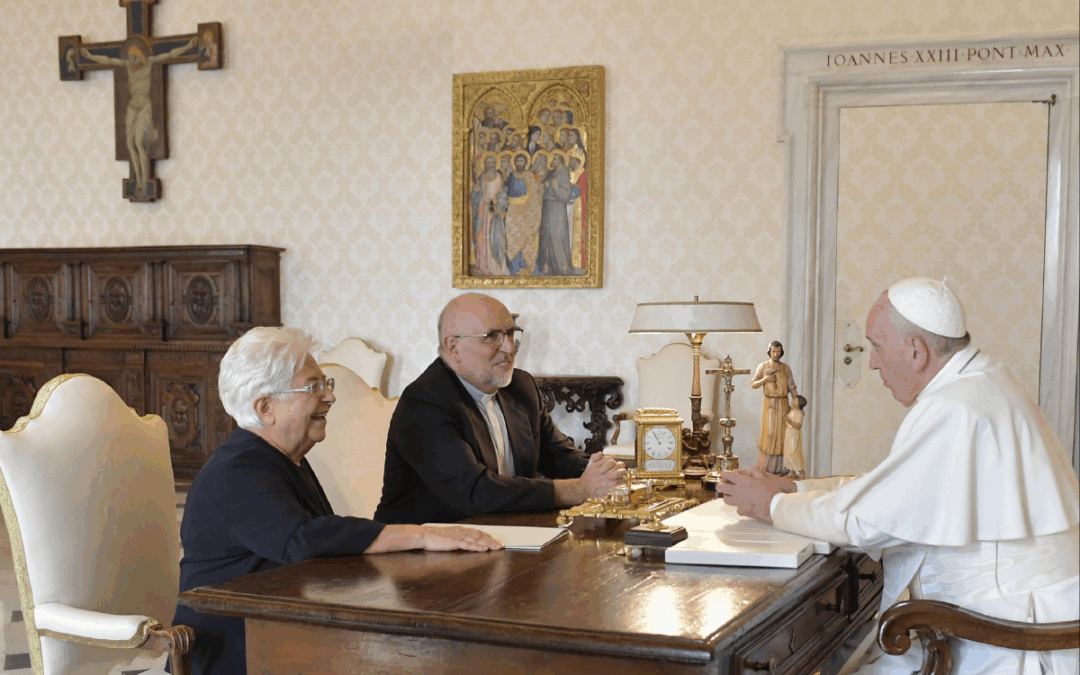
“We went to the Pope this morning to share with him the life of the Movement and to listen to what he had to say to us,” said Margaret Karram and Jesús Morán, President and Co-President of the Focolare Movement at the end of a private audience with Pope Leo XIV. “It was a meaningful, personal and fraternal meeting. He was interested to hear about our work for peace, for ecumenical and interreligious dialogue, for the dialogue with cultures and, especially, for communion between ecclesial movements. He encouraged us to continue spreading the charism throughout the world.” “At the end,” says Margaret Karram, “I asked him if we could bring his blessing to all those belonging to the Movement. ‘Certainly!’ he replied.” If you would like to follow Margaret and Jesús’s “live coverage” of this event, tune in tomorrow at 6 p.m. Italian time for the Link-up (the worldwide video conference call).
On behalf of the Focolare Movement throughout the world, I express my great joy for the election of Pope Leo XIV as the new Pontiff of the Catholic Church. We thank God for having listened to the prayers of so many people and having, with His Spirit, guided the work of the Cardinals in identifying the successor of Peter at the present time that is posing serious challenges for humanity.
Right From now, we want to assure the Holy Father of our filial closeness, our prayers and our commitment to be peacemakers, as he repeatedly emphasised in his first blessing.
Today the world is in urgent need of peace, light and hope. That is why we promise that we will continue to commit ourselves, together with the ecclesial communities in which we are inserted, to bring God’s love to all; to be open to dialogue, to be ‘one people always at peace’, bearing witness to the fact that the unity asked for by Jesus in his Testament is stronger than any division.
Moreover, we want to commit ourselves to embodying the synodal path ever more faithfully, to be able to apply it also in the various areas of society; to give our contribution so that the Church may be an open and welcoming home for every man and woman and for the new generations, especially for those who are most fragile, those who suffer most and those who are marginalised, so as to offer to all the ever new message of Christ.
Best wishes Pope Leo XIV, with all our love!
Margaret Karram – President of the Focolare Movement
It is with deep emotion that I write these lines about Pope Francis after his “flight” to the Father. I recall those many thoughtful and meaningful moments, when I was able to shake his hand and feel the warmth of his smile, the tenderness of his gaze, the strength of his words, the beating of his heart ready for a fatherly welcome. And I find it hard to believe that these encounters will no longer have a “tomorrow” or an “again” in my life.
I do not propose to make a thematic summary of Francis’ pontificate. To this end, it will be enough to review the many articles that have been published in recent days, especially the special issue of L’Osservatore Romano – just a few hours after his death – and the more or less exhaustive evaluations that will surely be published in the near future.
What moves me from within is to find that the golden thread that weaves his mission in guiding the Church, to try to be in tune with the centre of his heart and soul. And, from there, to relive the relationship he had with the Work of Mary during these twelve years.
To do this, I meditated deeply on his most recent talks, because I feel that this is where Pope Francis gave the best of himself and where you can find the key to all his thinking and to all his actions.
In the text he prepared for the Easter Mass, there is a quote from the great French theologian Henri de Lubac, who is also a Jesuit, that cannot simply be rhetorical: “it should be enough to understand this: Christianity is Christ. No, truly, there is nothing else but this.”
In my opinion, if we want to understand Francis, we must refer to this absolute: Christ, and only Christ, all Christ. From this we can understand the profound content of his encyclicals and apostolic exhortations, the choice of his journeys, his preferred options, the meaning of the reforms he undertook, his gestures, his words, his homilies, his meetings, and above all his love for those who are excluded, for those who are rejected, for women, for the elderly, for children and for creation.
‘No, there really is nothing else’. That is why one can say – using a pleonasm – that the Catholicism of Pope Francis is simply a “Christian Catholicism”. The new impulse he wanted to give the Church is based on this approach: the transparency of Christ. Because of this, on many occasions he has gone far beyond the politically correct, or rather, the ecclesially correct, without fear of being misunderstood, and without fear of being wrong, even aware of his “contradictions”. In fact, in an interview with a Spanish newspaper he said that what he wished for his successor was not to make his same mistakes.
Because of this Christological centrality, we can acknowledge that we have indeed been living – almost without realising it – with a Pope who is profoundly mystical. After all, this is how Pope Francis has thought and lived the Church: not as a religious organisation, nor as a distributor of sacraments, much less as a centre of economic, social or political power, but as the people of God, the body of Christ, which gives hospitality to humanity in His humanity. A Church, therefore, that is open to humanity, to service, because Jesus is “the heart of the world”.
To reduce Francis to a social reformer or a Pope of disruption shows a tremendous blindness. I often stared at his face when he inserted comments in his messages, for example at the Sunday Angelus. There, with the simplicity of a shepherd who passionately loves his flock, he displayed his harmony with the divine, his wisdom, his crystal-clear and straightforward faith, his profound humility.
In my humble opinion, from the centrality of Christ derive the two fundamental pillars of his magisterium: mercy and hope. Mercy is the expression of knowing ourselves as believers rooted in history, both personal and collective, with all its tragedies; hope manifests the eschatological and salvific tension that determines it. According to the Pope’s thought, there is mercy because there is hope; and it is hope that gives us a heart of mercy. Indeed, in his homily prepared for this year’s Easter Vigil, Francis affirms that ‘the Risen Christ is the definitive turning point in human history’. The important social and ecological messages of Pope Francis are misunderstood if this eschatological tension centred on the Risen Lord is not taken into account.
Francis’ relationship with the Focolare Movement has been very deep during the twelve years of his pontificate. He addressed ten official speeches to it: to the participants at the 2014 and 2021 Assemblies; to all those belonging to the Movement on the occasion of the 80th anniversary of its birth; to the academic community of the Sophia University Institute; to the family focolares; to the participants at the meeting of the bishops of various Churches; to the participants at the meeting on the “economy of communion”; to the participants at the interreligious conference “One Human Family”; to the citizens of the little town of Loppiano; to the Mariapolis of Rome – Earth Village. Furthermore, on one occasion, he granted a private audience to Maria Voce, the first president of the Work of Mary after Chiara, and to myself.
What emerges from these meetings is a great love and a touching pastoral concern of Pope Francis for the Movement. In the virtual ecclesial circularity between hierarchical and charismatic gifts, we can affirm that, on the one hand, the Pope has been able to grasp, value and highlight the gift that the charism of unity, with its emphasis on the spirituality of communion and its concrete achievements in very different ecclesial and civic contexts, represents for the synodal process that the whole Church is living in view of a new evangelisation. On the other hand, he has identified with extreme clarity the challenges and steps that the movement must necessarily take if it wants to remain faithful to its original charism, knowing how to go through the inevitable post-foundation crisis in a humble way, transforming it into a time of grace and new opportunities.
Pope Francis has been for the world an all-encompassing message of fraternity rooted in Christ and open to all. Fraternity is the only future that is possible. We, the people of unity, must treasure this legacy with humility, energy and responsibility.