For over two years, on the initiative of NetOne, the international network of communicators of the Focolare Movement, a group of communication professionals, has been meeting online every month to explore themes related to the Synod of Bishops, in particular on synodality and communication. Key elements during these meetings include listening, silence, testimony and fraternal communication. In addition to these regular sessions, two webinars have taken place over the past two years: the first in April 2024 (an in-depth analysis is available online here) and the second in February 2025 entitled, “What kind of communication for synodality?” (VIDEO) This event was followed in various parts of the world with the participation of numerous communication experts connected from several countries.
Alessandro Gisotti, deputy director of Vatican Media, opened the series of interventions by citing three essential terms for a good communicator: Communication, Action and Community. He said, “In this Holy Year, we need a synodal communication that is able to accompany the people who will come, without the presumption of wanting to lead them but available to listen to them, to accompany them, to share a part of the journey together”.
From the United States, Kim Daniels, Professor at Georgetown University in Washington DC, Coordinator of the Synod of Study Group 3 explained, “Mission in the digital environment – our goal is to offer actionable recommendations to the Holy Father for the improvement of the Church’s mission in this digital culture, ensuring that it remains firmly rooted in our call to meet people wherever they are, leading them towards a deeper communion with Christ and with each other”.
Pál Tóth, a Professor at the Sophia University Institute in Loppiano, spoke from Hungary, explaining that “healing the deep wounds of the globalized world requires transversal collaboration including with those whose views differ from our own. The idea of differentiated consensus promotes a new type of social relationship: we collaborate for the realization of some values while remaining on different platforms for others”.
The starting point of the Synod is those on the margins. This emerged from the experience of Muriel Fleury and Beatrice Binaghi, respectively Head of Communication and Social Media Officer at the Dicastery for Integral Human Development. “Speaking for those who are exploited or marginalized by dominant processes means making these people visible. Without these countercurrent voices, everything would favour those who dominate, because silence supports those who mistreat, enslave, exploit, or render too many men and women invisible “. Binaghi described the collaboration network created among the “border bishops” responsible for migratory pastoral care in Colombia, Costa Rica and Panama, especially to address the critical situation in Darien through which hundreds of migrants pass every day. “Dialogue and communication have created communities, and the work that was previously fragmented is now more synergistic and impactful”.
The actress Stefania Bogo was asked to give two moments of reflection through an artistic reading of selected passages from the recent encyclical of Pope Francis, Dilexit nos and Chiara Lubich’s “The attraction of modern times”.
Erica Tossani, of the Presidency of the Synodal Assembly of the Italian Church, explained how important it is to listen, that “it is not merely a passive action, a silence waiting to be filled by the words of others. It is an active attitude that involves attention, discernment and a willingness to be challenged. Without listening, communication degenerates into polarization and sterile opposition”.
The experiences of synodality included that of Paolo Balduzzi, correspondent for the Italian Rai 1 program “A sua immagine”. He explained, “The stories told arise from a dialogue shared with the entire editorial team. For me, every interview is an encounter. And synodality begins with this encounter with my interlocutor, that is, entering into their story, into their lived experience and together seeking to grasp the most essential aspects of their story”.
The story of Mariella Matera, blogger of Alumera, a space for evangelization on social media, is the story of a communicator fascinated by the idea of transmitting the Gospel through the internet. She asked herself, “How can I be a little bridge between the web and Christ? In the Calabrian (southern Italy) dialect, the word Alumera refers to the old type of oil lamp. Just as the lamp, as long as it has oil, does not go out, so too I, as long as I have the love of Christ in me, cannot be silent”.
In conclusion, Anita Tano, head of communication for United World Project-NetOne Argentina recounted the experience of Genfest 2024 in Brazil, the youth event of the Focolare Movement which had the theme Together to Care. Featuring cultural exchanges, art and workshops, the aim was to recognise communication as a tool to take care of “one’s own life, that of others and that of the planet”. A message that emphasized the difference between simply being “connected” and being truly “united.”
The live broadcast was moderated by Enrico Selleri, presenter and author of the Italian Church broadcasters Tv2000 and InBlu2000, along with Sara Fornaro, editor-in-chief of the web version of the Italian magazine Città Nuova. The event was promoted by NetOne together with the General Secretariat of the Synod of Bishops, the Dicastery for Communication, the Dicastery for the Service of Integral Human Development, Vatican Media, the Synodal Way of the Church in Italy, TV2000, InBlu2000 and SIR (of the Italian Episcopal Conference), the Sophia University Institute, Weca (Association of Italian WebCatholics), the Città Nuova Editorial Group and the Pontifical University of the Holy Cross.
Nostalgia is a very specific feeling and, in many people, it often gives riseto moral, philosophical and spiritual questions. Etymologically it means “pain of return,” and sometimes has an indeterminate sense: sometimes it is not linked to a past made up of real places, people or events but to a deep emotion that makes us yearn for something beautiful, just and universal. It is as if we know we are part of it or called to this “something”.
The theme of exile runs through the history of human thought: the voyage of Odysseus (sung in Homer’s Odyssey) is a journey that recalls the infinite because although it is unfinished and open-ended, it also conveys a sense of wisdom.
(…)
“Keep Ithaca always in your mind. Arriving there is what you are destined for. But do not hurry the journey at all. Better if it lasts for years. (…) And if you find her poor, Ithaka won’t have fooled you. Wise as you will have become, so full of experience, you will have understood by then what these Ithakas mean.”[1]
Every story of exile, whether it is taken from ancient civilizations or the present day, addresses existential questions that are fundamental to all ages: does this story have meaning? Is there a “thread” behind it all? This question can also be addressed on a personal level: is there meaning to what I am experiencing or have experienced? Why the evil, the pain, the death? These are questions that are often not asked but, according to recent studies, they are deeply felt by young people and express their real needs. Nostalgia for the infinite is often manifested in melancholy, loneliness and a search for reasons and answers. [2]
Yet these questions struggle to emerge: we are distracted by what is happening around and by the worries that torment us. Perhaps we do not pause long enough to recognise the little answers that surround us that can be a light to help us maintain a sense of purpose in life.
So let us try to look for opportunities where we can find time and space for sharing, listening and reflecting with those who travel through life with us. Let’s do so with our community, our friends and work colleagues. Let’s tackle these questions without losing faith that things can change for the better. We too will feel changed as a result.
In Christian communities all over the world, Easter is celebrated this month. The message that lies behind the “three days” that are central to this season is strong: it poses questions for all people who are ready to reflect and are open to dialogue[3]. The mystery of pain, the ability to “enter” into the wounds of humanity and the strength to begin again are the values shared by every person who accompanies us as we journey forward through difficult times.iii They are a personal guide for us at all times.
THE IDEA OF THE MONTH is currently produced by the Focolare Movement’s “Centre for Dialogue with People of Non religious Beliefs”. It is an initiative that began in 2014 in Uruguay to share with non-believing friends the values of the Word of Life, i.e. the phrase from Scripture that members of the Movement strive to put into practice in their daily lives. Currently, THE IDEA OF THE MONTH is translated into 12 languages and distributed in more than 25 countries, with adaptations of the text according to different cultural sensitivities.
[1]Konstandinos P. Kavafis. Poesie, Mondadori, Milano 1961
[2]Istituto Giuseppe Toniolo: Cerco, dunque credo? (Vita e Pensiero, 2024) cura di R. Bichi e P. Bignardi
[3]Convegno Internazionale “Il senso nel dolore?” (Castel Gandolfo, 2017) https://www.cittanuova.it/senso-neldolore/?ms=006&se=007
The exile in Babylon and the destruction of the temple in Jerusalem created a collective trauma for the people of Israel and gave rise to a theological question: they asked themselves, ‘Is God still with us or has he abandoned us?’ This month’s Word of Life is taken from the part of the book of Isaiah that endeavoured to help the people understand that God was still at work. They could trust him and would, eventually, be able to return to their homeland. In fact, the face of God the creator and saviour is clearly revealed during this experience of exile.
See, I am doing a new thing! Now it springs up; do you not perceive it?.
Isaiah reminds us of God’s faithful love for his people that remains constant and unchanged during the dramatic period of exile. Even though the promises made to Abraham seem unattainable and the covenant seems to be in crisis, the people of Israel are in the privileged position of continuing to experience God’s presence in history.
The prophetic book addresses existential questions that are still fundamental today: who determines the unfolding of history? Who determines its meaning? We can ask these questions on a personal level too. Who holds my fate in their hands? What is the meaning of what I am experiencing now or have experienced in the past?
See, I am doing a new thing! Now it springs up; do you not perceive it?.
God is working in each person’s life and is constantly, doing ‘new things.’ If we do not always notice or can understand their meaning and scope, it is because they are still springing up or because we are not ready to recognize what he is creating. Perhaps we do not pause long enough to observe these tiny shoots of life that are a certain sign of his presence because we are distracted by all that is happening around us or because thousands of thoughts and worries invade our souls and weigh us down. Nonetheless, he never forsakes us and is continually creating and recreating our lives.
“We are the ‘new thing,’ the ‘new creation’ that God has generated… We no longer look back to the past and sometimes regret what has happened to us or mourn our mistakes: we strongly believe in the action of God who can continue to work new things.”[1].
See, I am doing a new thing! Now it springs up; do you not perceive it?.
We live alongside many other people; they may be members of our community or friends or colleagues at work. Let’s approach them and try to work together without ever losing faith that things will change for the better.
The year 2025 is special because the date of Orthodox Easter coincides with that of other Christian denominations. May this shared celebration of Easter be a testimony to the willingness of the Churches to unceasingly continue to dialogue about the challenges facing humanity and to promote joint action.
Let us prepare to live this Easter season with great joy, faith and hope. Christ rose from the dead so, although we may ‘cross through the desert’, let us continue to be accompanied on our journey by the One who guides both history and our personal lives.
In this year dedicated to the Jubilee of Hope, the Gen 4 (the children of the Focolare Movement) in Rome decided to embark on a journey to discover more about the history of Christianity and understand how to live the Jubilee in their city that is welcoming millions of pilgrims from all over the world. The stages of their journey are the Vatican Basilicas in Rome: St. Peter’s, St. John Lateran, St. Paul’s Outside the Walls and St. Mary Major. They asked Father Fabio Ciardi, OMI, professor of spiritual theology and author of numerous books and publications, to be their guide.
First stop: St. Peter’s Basilica
In October 2024, two months before the Jubilee began, the group of 33 children with as many adults, learned about a very special reality before entering St. Peter’s Basilica. It is located next to the residence where Pope Francis lives. It is the Dispensary of St. Martha, a place where the Gospel becomes incarnate every day through the assistance given to hundreds of mothers and children. It’s an opportunity to explain to the Gen 4 how the Jubilee can be lived concretely by helping others.
Father Fabio explained, “It is a real family clinic, which began this work of care for poor children and their families in 1922. Today over 400 children, with their mothers, are assisted free of charge by about sixty volunteer doctors. They are mostly people without a residence permit, without health care”. Services include gynaecological and paediatric examinations as well as dental care for the homeless.
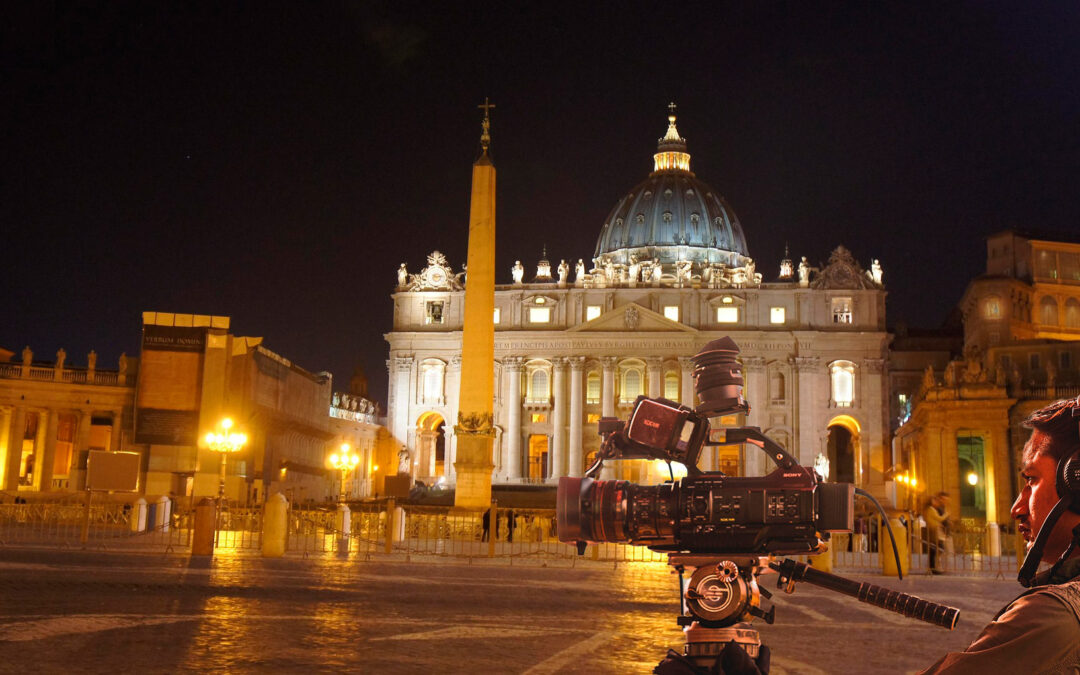
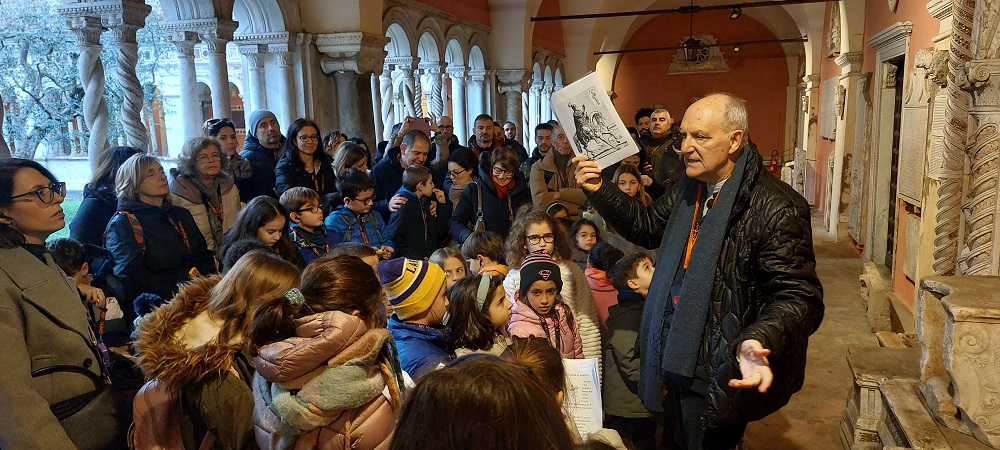
Father Fabio then linked this story with the story of Saint Peter, using some drawings. The children listened attentively to his voice through headphones: “Jesus met Simon the fisherman and invited him to follow him. ‘Come with me,’ he said, ‘I’ll make you a fisher of men.’ And he gave him a new name, he called him Peter, which means “rock”, because he wanted to build his Church on him”. And as the story continued, we moved to the Basilica to pray at the tomb of St. Peter. “Peter came to Rome. When Nero set fire to the city he blamed the Christians. Peter was killed in the circus of the emperor Caligula that Nero had renovated…and finally the tomb of Saint Peter in his Basilica”. There was an atmosphere of deep recollection among Gen 4, despite the influx of tourists on that Roman Saturday afternoon. Going towards the Holy Door you pass some masterpieces of art. In front of the Pietà, Father Fabio said, “This statue of Our Lady was very dear to Chiara Lubich. Every time she came to the Basilica she stopped here to pray to Mary”.
The stop in San Giovanni in Laterano
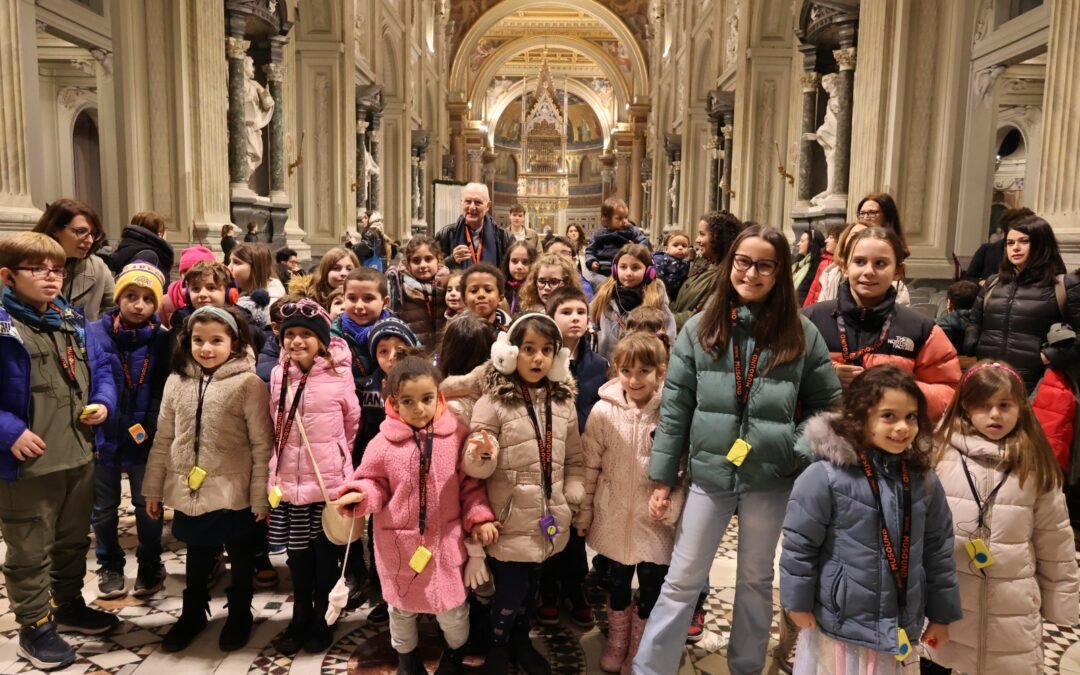
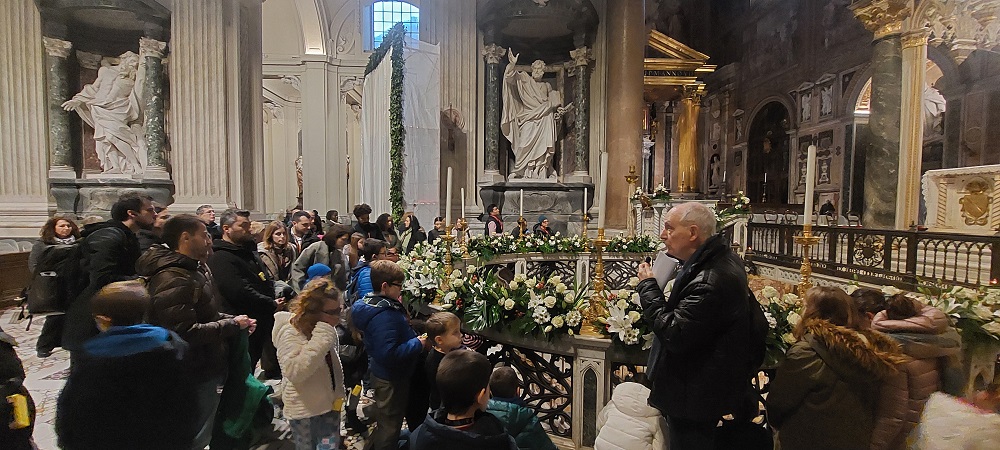
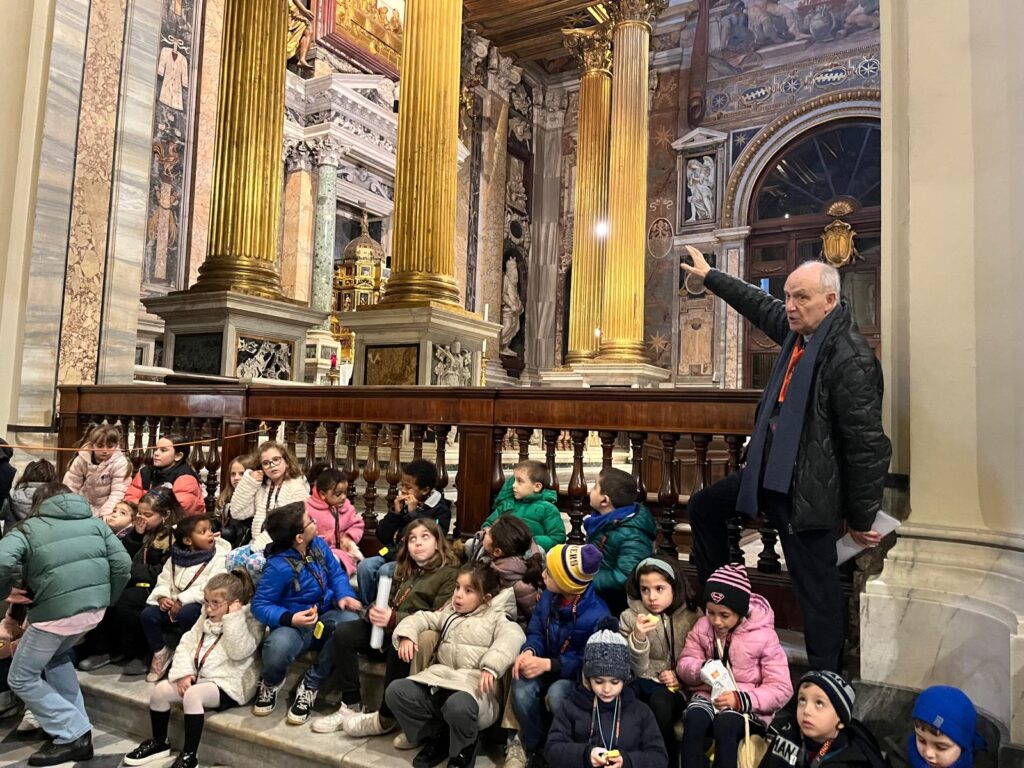
The second stage was in January 2025. This time the group was larger: 140 people including 60 children, always under the expert guidance of Father Fabio, met to discover the Basilica of St. John Lateran, full of surprises and treasures related to the history of Christianity. Attentive and curious, with headphones in their ears, for just over two hours Gen4 listened to Father Fabio’s fascinating story.
Gen4 at St. John in Lateran Gen4 at St. John in LateranGen4 at St. John in Lateran
In his blog, Father Fabio wrote, “It was wonderful to tell the story of the obelisk, it was nice to explain the meaning of the cloister, it was nice to tell the stories of St. John the Baptist and St. John the Evangelist and to let the children go and find their statues in the Basilica. It was nice to show the ancient Papal throne and the current one, on which the Pope e sits to take possession of his office. It was nice to point out the relics of the table on which Jesus celebrated the last supper and the one on which Peter celebrated here in Rome. It was good to go through the Holy Door together…It’s good to be with the children and tell them beautiful things…”
At this point, the children have built a special bond with Father Fabio. They walked beside him in the Basilica, held his hand, asked him questions to learn more. A Gen 4 asked, “What’s Heaven like?” He replied, “Imagine a busy school day. When it’s over, you go home to a beautiful, welcoming, warm house, where your parents, grandparents and friends shower you with love. You feel happy in that moment, don’t you? It’s like that in Heaven: it’s a place where you feel good, where you feel at home!” This stage also came to an end. We returned home happy and aware that for us, the Jubilee must be a time to give hope and happiness to the most disadvantaged, to our poor, to those who suffer.
The journey with other generations
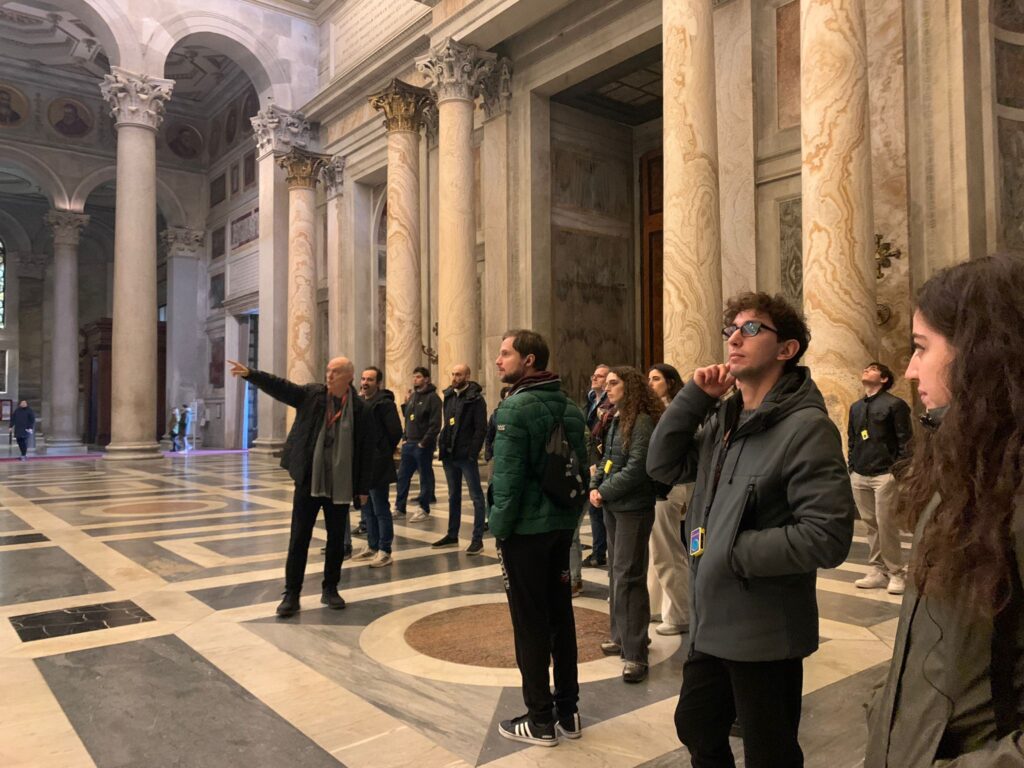
Waiting to continue this journey with the Gen 4, the Gen3 (40 teenagers), the Gen2 (30 young people) and a group of adults, fascinated by the positive experience that the children were living with Father Fabio, also wanted to follow the same journey, always guided by him.
Father Fabio wrote in his blog, “First the children, then the teens, then the young people and adults. St. John Lateran, St. Peter, St. Paul and St. Mary Major. So I keep living the Jubilee, over and over. The story of history, art and spirituality, because it is all intertwined, human and divine, past and present. These monuments live on, still speaking after hundreds of years and continue to narrate beautiful things”.
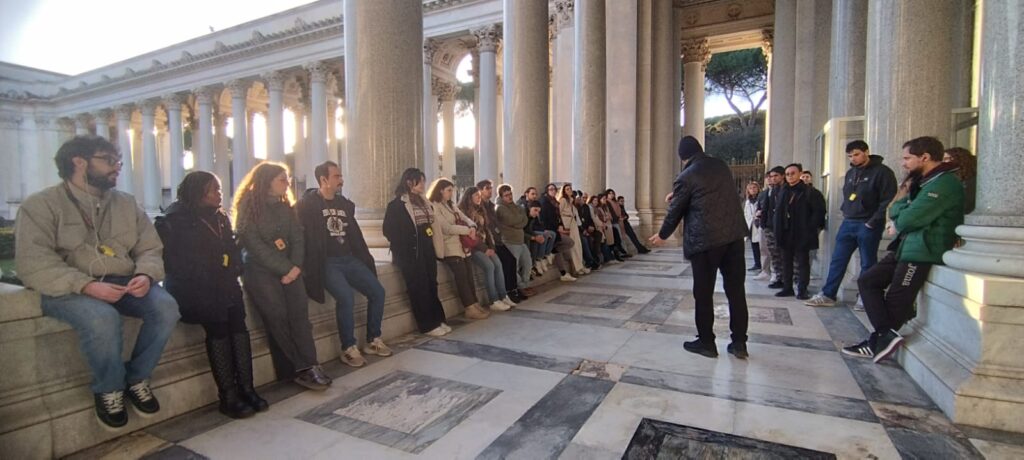
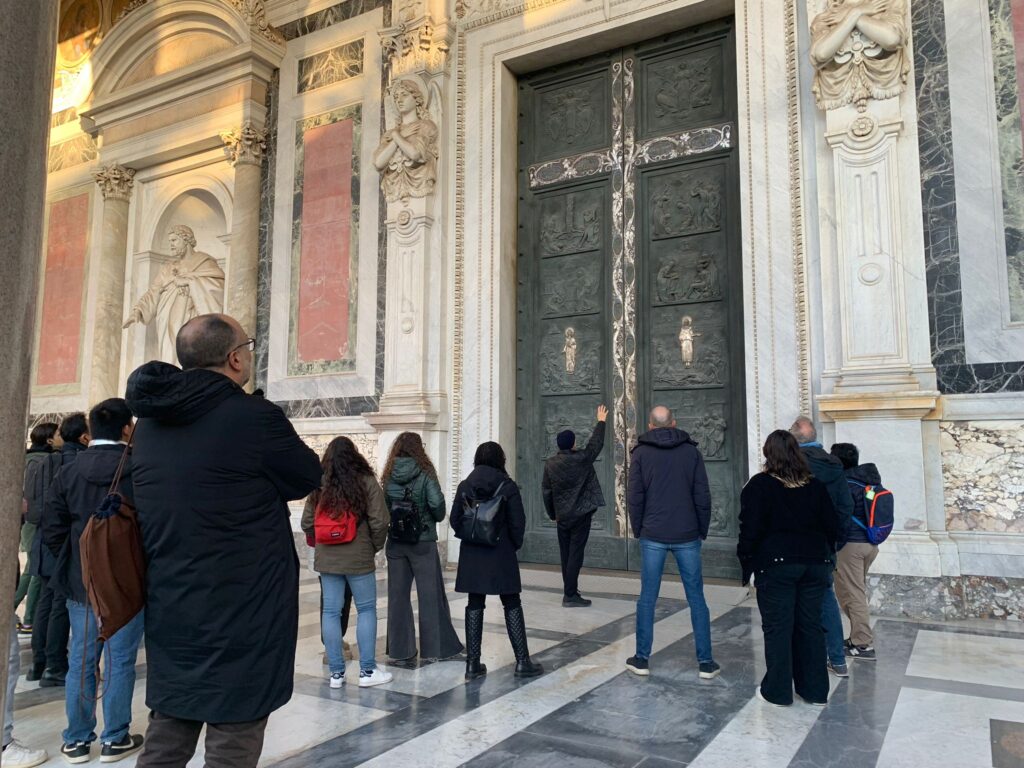
Gen 2 at St. Paul outside the WallsGen 2 at St. Paul outside the WallsGen 2 at St. Paul outside the Walls
And the young people thanked Father Fabio “for preparing our hearts for such a beautiful experience, you helped us to go through this stage of the holy year together, with meaning and joy. We really liked the atmosphere you managed to create, arousing in us the desire to visit together other places in Rome which were important for the first Christians and you gave us the desire to deepen the meaning of being pilgrims on the way to the goal of Paradise”.
Jesus had come down from the mountain where he had spent the night in prayer and then had chosen his apostles. When he reached a flat place, he began to preach to them, beginning with the proclamation of the Beatitudes.
Luke’s and Matthew’s gospels differ: in Luke’s text there are only four Beatitudes and they concern the poor, the hungry, the suffering and the afflicted, with the addition of as many admonitions against the rich, the satiated and the arrogant [1]. Jesus revealed God’s special love for the poor when he was in the synagogue at Nazareth [2] and, filled with the Spirit of the Lord, he proclaimed that his mission was to bring glad tidings to the poor, deliverance to the captives and freedom to the oppressed.
Jesus went on to exhort the disciples to love even their enemies;[3] a message that finds its ultimate inspiration in the behaviour of the heavenly Father: ‘Be merciful, as your Father is merciful’ (Lk 6:36).
This statement is also the starting point for what follows: ‘Do not judge and you will not be judged; do not condemn and you will not be condemned; forgive and you will be forgiven’ (Lk 6:37). Jesus then goes on to reprimand the listeners by using a deliberately disproportionate image:
Why do you look at the speck of sawdust in your brother’s eye and pay no attention to the plank in your own eye?’
Jesus truly knows our heart. How often in everyday life do we have the sad experience of finding it easy to harshly criticise other people for their errors and weaknesses without taking into account that in doing so, we attribute to ourselves a prerogative that belongs to God alone? The fact is that in order to ‘remove the plank’ from our own eye, we need that humility that comes from the realisation that we are sinners continually in need of God’s forgiveness. Only people who have the courage to notice their own ‘plank’ and what they personally need in order to change for the better, will be able to understand without judging or exaggerating, the frailties and weaknesses in themselves and in other people.
Nonetheless, Jesus does not invite us to close our eyes to what is happening around us and just let things run their course. He wants his followers to help each other as they progress along the path to a new life. The apostle Paul also frequently reminds us to show concern for and correct those who are idle and disruptive, to encourage the disheartened, to help the weak and to be patient with everyone [4]. Only love is capable of serving others this way.
Why do you look at the speck of sawdust in your brother’s eye and pay no attention to the plank in your own eye?’
How can we put this word of life into practice?
In addition to what has already been said, during this Lenten season we can ask Jesus to teach us to see others as he sees them, as God sees them. And God sees with the eyes of the heart because he always gazes upon us with love. To help each other even more, we could restore a practice that was decisive for the first group of Focolare girls in Trent.
Chiara Lubich once told a group of Muslim friends, ’At the beginning, it was not always easy to love in a radical way. Even among us, dust could settle on our relationships and unity could weaken. This happened, for example, when we became aware of the faults, the imperfections of others and we judged them and so our mutual love diminished. One day, we decided that we should try to counter this situation. We made an agreement among ourselves and called it a ‘pact of mercy’. We decided that every morning we would see the people we met – at home, at school, at work, etc. as new – new – not calling to mind their faults at all but covering everything with love. It was a strong and challenging commitment, made by all of us together, that helped us to always be the first to love, in imitation of the merciful God, who forgives and forgets.” [5]
Edited by Augusto Parody Reyes and the Word of Life Team