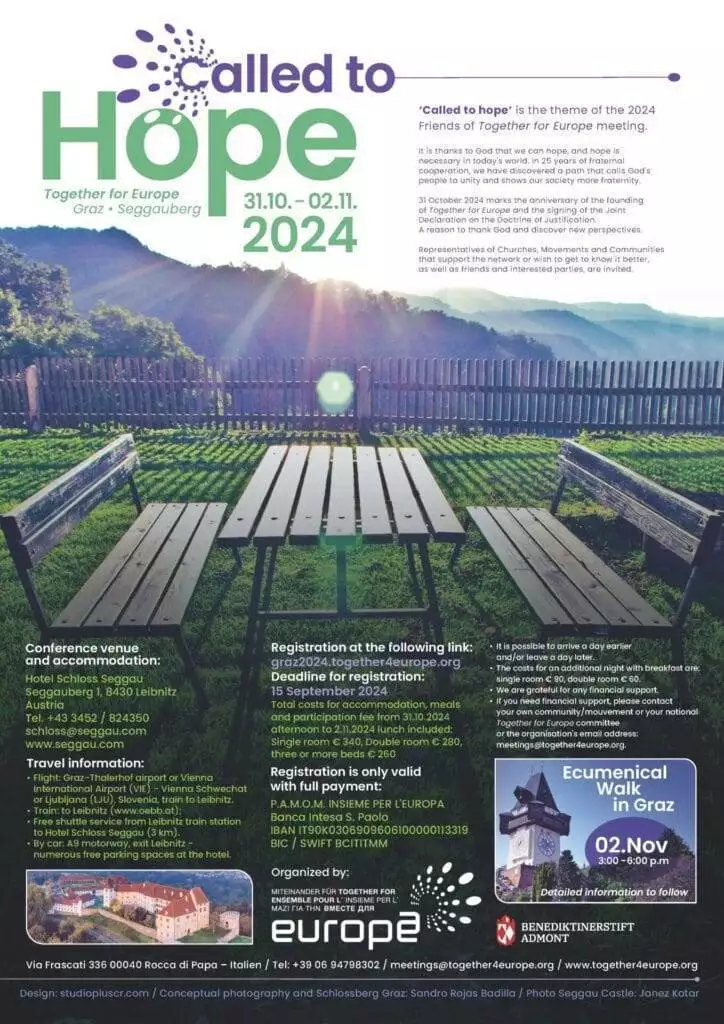
“To give a soul to Europe” is the aim of Together for Europe, a Christian network made up of over 300 Movements, Organizations and Communities from Western and Eastern Europe. It shines out as a sign of hope, especially in times of conflict and crisis.
On 31st October, Together for Europe (TfE) celebrated its 25th anniversary. This date also marked the historic 1999 Catholic-Lutheran Joint Declaration on the Doctrine of Justification in Augsburg, Germany, which healed a division of over 500 years between the two churches. In the years that followed, dialogue between them, based on mutual forgiveness, deepened, culminating in the historic Pact of Reciprocal Love in December 2001 at the Lutheran Church in Munich, attended by over 600 people.
The early promoters of TfE include Chiara Lubich, founder of the Focolare Movement, Andrea Riccardi,founder of the Community of Sant’Egidio and other founders of Italian Catholic and German Evangelical-Lutheran Movements and Communities, united by a commitment to journey together.
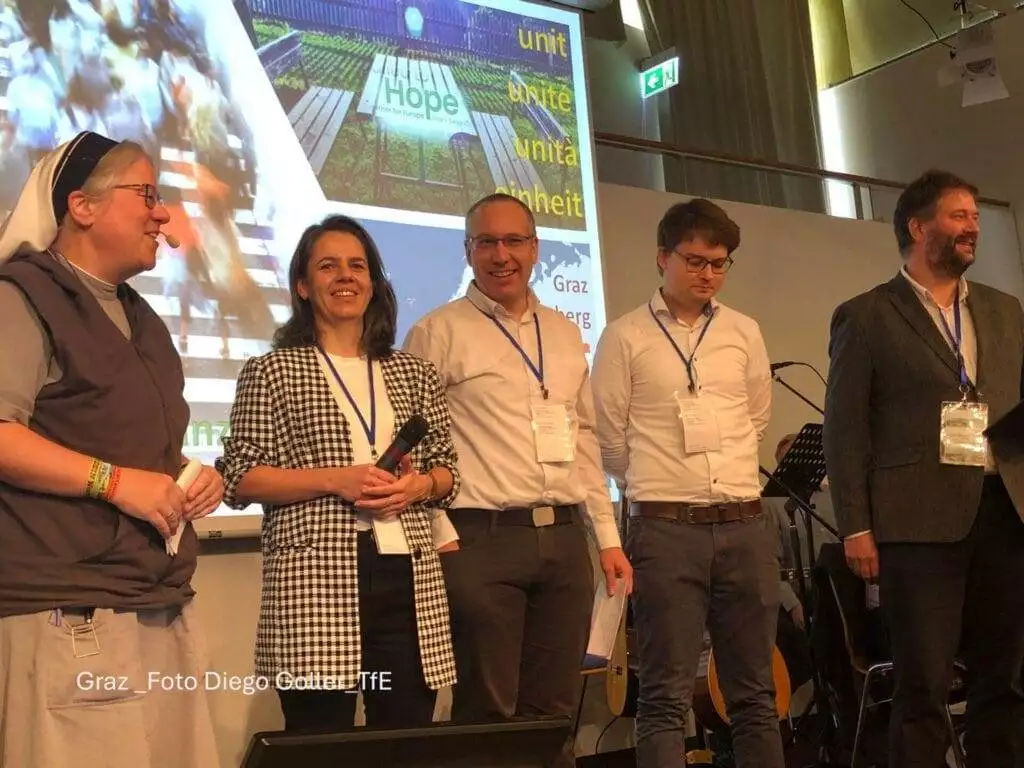
This year, from 31st October- 2nd November, more than 200 TfE representatives gathered in Graz-Seckau for the annual event, entitled “Called to Hope.” Participants represented 52 Movements, Communities and Organisations from 19 European countries and included Orthodox, Catholic, Protestant, Reformed and Free Church Christians, along with spiritual leaders, laypeople, civil authorities and political figures.
Among them were Bishop Wilhelm Krautwaschl of the host diocese, Bishop József Pál of the Diocese of Timișoara (Romania), Jesús Morán, Co-President of the Focolare Movement, Reinhardt Schink of the Evangelical Alliance in Germany, Markus Marosch of the Round Table (Austria), Márk Aurél Erszegi from the Hungarian Ministry of Foreign Affairs and former Prime Ministers Alojz Peterle of Slovenia and Eduard Heger of Slovakia. A delegation from the Interparliamentary Assembly on Orthodoxy, including Secretary-General Maximos Charakopoulos (Greece) and Advisor Kostantinos Mygdalis, also participated.
In his opening speech, Gerhard Pross (Esslingen YMCA), moderator of TfE and a witness of its beginnings, highlighted the many moments of grace experienced over the past 25 years. Bishop Christian Krause, who in 1999 was President of the Lutheran World Federation and co-signed the Joint Declaration, sent a message emphasizing the significance of this shared journey.
One participant shared, “Given the current situation in Europe, I arrived here discouraged and depressed. But these days have filled me with courage and hope.” A Ukrainian lady echoed this sentiment: “To be ambassadors of reconciliation, that is what I take away from this gathering. I live in a country at war, where reconciliation is not yet up for discussion. But I feel we can be ambassadors, because ambassadors are by definition diplomats who offer and prepare rather than imposing. This is the mission I feel called to bring where I live. I will try to do so, striving to be, as Jesús Morán said, ‘an artisan of a new culture.’”
In his address, Jesús Morán emphasized, “Change does not happen overnight. What we need are artisans and farmers of a new culture who work, sow and hope with patience. The ‘togetherness’ we speak of is not a simple union. Unlike union, unity regards participants as individuals. Its goal is community… Unity transforms those involved, because it reaches their essence without undermining their individuality. Unity is more than shared commitment; it is being united as one in commitment. While diversity in union can lead to conflict, in unity it becomes a source of richness. Ultimately, unity transcends participants and is received as a gift.”
During the gathering, participants solemnly renewed the Pact of Reciprocal Love, the foundation of their shared commitment, praying in four languages: “Jesus, we want to love one another as You have loved us.”
The event concluded with the idea of hosting a major event in 2027 to send a powerful message of unity and hope to Europe.
As a participant from the Netherlands reflected: “I am sure that work, life, love and suffering will bring good to Europe. It is very important to be ambassadors of reconciliation… Artisans are essential, to plant seeds of hope.”
This verse comes at the conclusion of chapter 12 in the Gospel of Mark. Jesus is in the Temple in Jerusalem where he is both observing and teaching. Looking at the scene through his eyes, we become aware of the involvement of many different characters: people are simply passing through, some have come to worship, some are dignitaries in long robes and some are rich people throwing their substantial offerings into the temple treasury.
But here comes a widow; she belongs to a category of socially and economically disadvantaged people. Amid general disinterest, she throws two pennies into the treasury. Jesus, however, notices her and calls the disciples to him and instructs them:
They all gave out of their wealth; but she, out of her poverty, put in everything, all she had to live on.
‘Truly I say to you…’ These words introduce important teachings; Jesus’ gaze is focused on the poor widow, and he invites us to look in the same direction because she is a model for disciples.
Her faith in God’s love is unconditional; her treasure is God himself. She surrenders all that she is and has to him and, furthermore, she wants to give all she can to support those who are poorer than her. In a way, her trusting surrender to the Father anticipates the same gift of self that Jesus will soon make through his passion and death. It is that ‘poverty of spirit’ and ‘purity of heart’ that Jesus proclaimed and lived.
This means ‘placing our trust in God’s love and in his providence but not in his riches…We are “poor in spirit” when we allow ourselves to be guided by love for others. This results in our sharing and making what we have available to those in need; it may be a smile, our time, our possessions or our skills. When we give away whatever we have out of love, we become poor, with nothing of ourselves, with a free and a pure heart.’ [1]
Jesus’ proposal turns our usual way of thinking onto its head; those who are poor, insignificant and unimportant lie at the centre of his thoughts.
They all gave out of their wealth; but she, out of her poverty, put in everything, all she had to live on.
This Word of Life invites us to renew our total trust in God’s love and consider if our vision of life compares with his: do we see beyond appearances, do we avoid judging, do we take other people’s opinions into consideration if they are different from our own and do we see the positive in other people.
It suggests that there is an evangelical logic in freely giving to others and that doing so creates a peaceful community because it urges us to care for one another. It also encourages us to live out the words of the Gospel in everyday life even when other people may not notice, to trust when we are generous to others and to share whilst maintaining an attitude of balance and clear judgement. This Word focuses our attention upon the ‘least’ and asks us to learn from them.
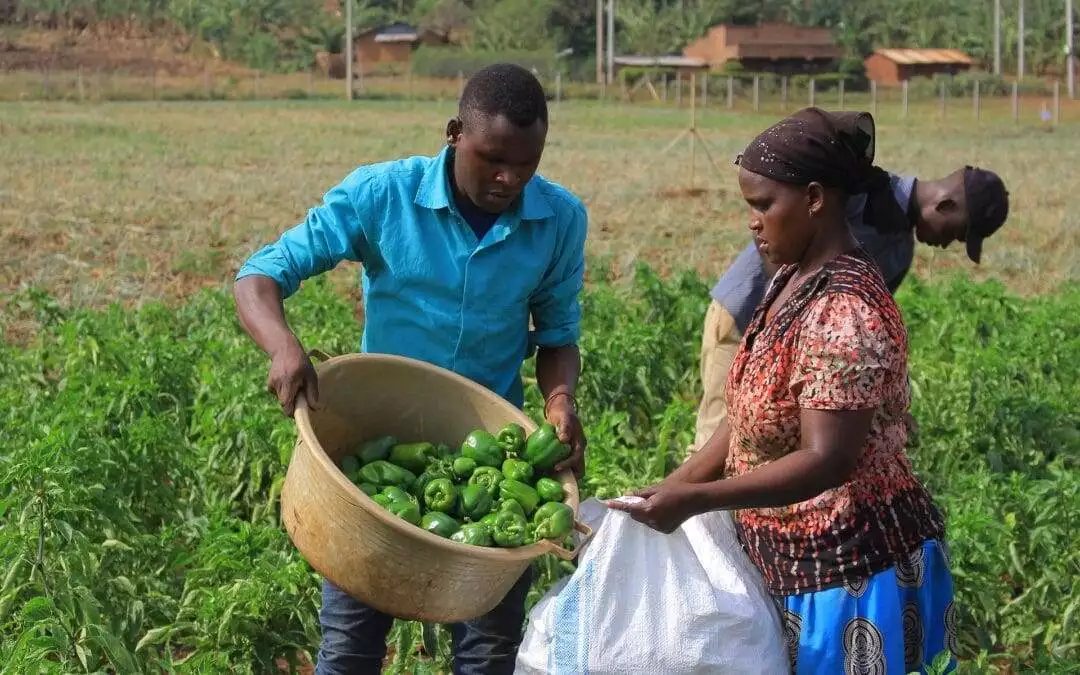
Venant was born and raised in Burundi. He recounts: ‘In the village, my family had a good farm that always produced a good harvest. My mother believed that everything was providence from heaven and so, each year, she used to gather the first fruits and distribute them to our neighbours, starting with the neediest families and then allocated only a small part of what remained to us. I learnt the value of selfless giving from her example. Thus, I understood that God was asking me to give him the “best part”, indeed to give him my whole life.’
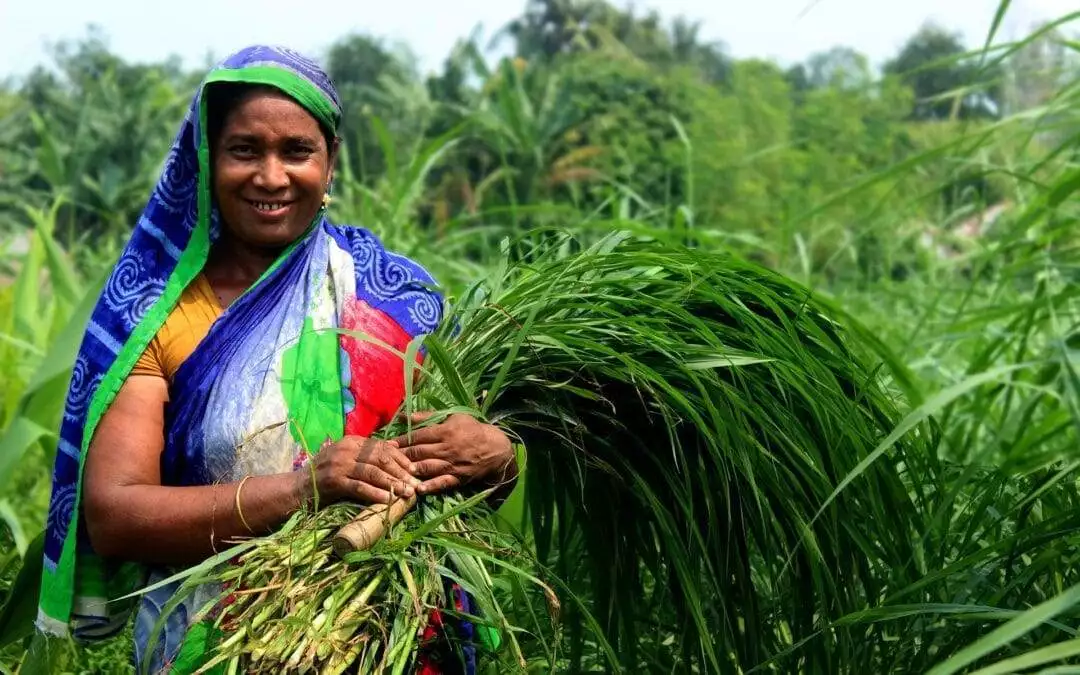
Every day we are bombarded by images that emphasise the value that our society places upon appearance. Globalization imposes a model in every part of the world whereby wealth, power and physical beauty seem to be the only values. Yet it is enough to stop and observe the people we meet daily in our cities (on trains, in the underground, on the street) to realize that there is a different reality, made up of small daily gestures of solidarity: for example, there are parents who accompany their children to school, nurses who get up at dawn to go to work alongside people who are suffering and there are workers who carry out their tasks with great commitment in factories, stores andoffices. In addition, there are countless voluntary activities.
There is a need to look truthfully at the world and go beyond appearances. We should value the positive in each person and realize that it is these small daily gestures of support and solidaritythat keep society on its feet. Even more revolutionary are the actions of those who, despite living in situations bordering on poverty, realize that they can still “give” in some way. Theywelcome others, share a meal or a room because there is always someone who has “more need” than themselves.Furthermore, they do this out of a sense of justice and with a generous and selfless heart.
We know that giving does not refer only to material things. Chiara Lubich used to tell us,: let this be the word that gives us no respite. “Let us always give; let us give a smile, understanding, forgiveness, a listening ear; let us give to others by drawing on our intelligence, our will, our availability; let us give our time, our talents, our ideas (…), our actions; let us share our experiences, our abilities and our possessions. By constantly reviewing what we no longer need and and sharing with others, we ensure everything circulates. ‘Give’ is the word that could accompany us always.”1
This idea, then, is an invitation to have a generosity that comes from within, from the purity of hearts that knows how to recognize the suffering of humanity and see themselves reflected in the disfigured faces of their neighbours. This is the very gift that makes us free and more capable of loving.
This what Etty Hillesum experienced. She was, a young Dutch woman who lived the last years of her life in a concentration camp before dying in Auschwitz. She was able to love the beauty of life till the very end and gave thanks for “this gift of being able to understand and ‘read’ others. Sometimes I see people people like houses with an open door. I go in and wander around corridors and rooms: each house is furnished differently but, basically, they are the same as one another – consecrated dwelling places” (…). And there, in those hovels, populated by crushed and persecuted men and women, I have found the confirmation of this love.” 2
There is a logic in freely giving to others because it creates a peaceful community and urges us to care for one another.It helps us focus upon profound human values in our everyday lives, without attention to outward appearance. It is a change of mindset that can become contagious.
Venant was born and raised in Burundi. He recounts, ” In the village, my family had a good farm, that always produced a good harvest. My mother believed that everything was a gift from nature and so, each year, she used to gather the first fruits and punctually distribute them to our neighbours, starting with the neediest families and then allocated only a small part of what remained to us. I learned the value of selfless giving from her example ”.
THE IDEA OF THE MONTH is currently produced by the Focolare Movement’s “Centre for Dialogue with People of NonreligiousBeliefs”. It is an initiative that began in 2014 in Uruguay to share with non-believing friends the values of the Word of Life, i.e. the phrase from Scripture that members of the Movement strive to put into practice in their daily lives. Currently, THE IDEA OF THE MONTH is translated into 12 languages and distributed in more than 25 countries, with adaptations of the text according to different cultural sensitivities. https://dialogue4unity.focolare.org/en/
A few months ago, I was diagnosed with a tumour. The doctor suggested starting with an alternative treatment and then finishing with radiotherapy.
On the first day of my radiotherapy cycle, I found myself in a large waiting room, full of patients, heads down. I checked in by presenting my magnetic card, standing because there were no more seats. That was the most intense moment, where I embraced and accepted the pain this situation caused me. On the second day, I asked God for strength and began talking first with one, then two and even three other patients, asking where they were from and how their journey had been, as they came from various places. Day by day, the waiting room became a place of joy. The atmosphere changed – love, patience and calm filled the air. We even gave each other nicknames based on famous people. On my last day of treatment, I brought sweets for everyone and we put on hats to take pictures. Finally, we placed our right hands together in the centre to make a pact of brotherhood: “until death do us part.”
The Director of the service called me to give me the report for my specialist and she said goodbye with a hug and a kiss, saying, “We’ll miss you a lot. You made us laugh so much… I could always hear you from my office.” As I left, I found myself back in the waiting room, everyone was standing and applauding me. Tears started to fall. I waved goodbye and, already out on the street, I said to myself, “How beautiful it is to put the words of the Gospel into practice. With a little love, everything is transformed.”
J.J.A
The Employee
At the factory, we needed someone to do the cleaning: the offices, kitchen, bathrooms and other shared areas.
During my working hours, I often have long phone calls and whenever I can, I take the opportunity to go for a walk to spend some time outdoors in the sun. One day, I set out determined to find someone from the area who could help with the cleaning. Just half a block away, I saw an older man who was mowing the grass in front of his house. I approached him, introduced myself and mentioned that we were looking for someone to assist with cleaning. I asked if he knew anyone looking for work.
He looked at me and said that his son could do the job. I replied, “Alright, tell him to come to see me tomorrow.” He then explained that his son had multiple sclerosis. “Tell him to come tomorrow,” I repeated.
The next day, Mauro arrived – a 36-year-old man. He told me that he was part of a research program in which he received a special medication injection once a week, which made him weak the following day. The treatment wasn’t always on the same day each week. He mentioned how hard it was for him to find a job due to this challenge.
Mauro has been with us for five months. Not only does he carry out the agreed cleaning tasks, but he also looks after the garden, maintenance, and other duties.
Reciprocity, giving and receiving, community and valuing each person is the way I want to live and work.
Jesus is on his way to Jerusalem and, for the third time, he tries to prepare his disciples for the dramatic event of his passion and death but those who have followed him most closely are very ones who seem unable to understand what is about to happen.
Infact, conflict arises among the apostles themselves: James and John ask to occupy places of honour ‘in his glory’ [1] and the other ten become indignant and start to complain. In short, the group is divided..
Then Jesus patiently calls them and repeats what he has proclaimed. His words are so new that they create a sense of shock.
Whoever wants to become great among you must be your servant, and whoever wants to be first must be slave of all.
In this phrase from Mark’s gospel, the image of the servant-slave reaches a crescendo. Jesus leads us from having an attitude of simple availability within the limited and affirming groups to which we may belong to being totally dedicated to everyone, with no exception.
This is a completely alternative and countercultural proposal when compared to the usual human understanding of authority and governance which possibly fascinated the apostles themselves and impacts upon us too.
Perhaps this is the secret of Christian love?
‘One word in the Gospel that is not emphasized enough by Christians is “serve”. It may seem old-fashioned to us, unworthy of the dignity of human beings who both give and receive. Yet it is central to the Gospel which is all about love. And to love means to serve. Jesus did not come to command but to serve. To serve, to serve one another is the heart of Christianity, and whoever lives this with simplicity – and everyone can do so – has done all that is necessary. Doing so ensures that people do not remain alone because since love is the essence of Christian life, it spreads like fire.’ [2]
Whoever wants to become great among you must be your servant, and whoever wants to be first must be slave of all.
The encounter with Jesus in his Word opens our eyes, just as it did for the blind man, Bartimaeus, whose story is found immediately after this Word of Life. [3]Jesus frees us from our narrow vision and allows us to contemplate the horizons of God himself, of his plan for ‘new heavens and a new earth.’ [4]
Jesus washed the feet of others [5] and by his example overturned the often rigid practice in society, and even in religious environments, of relegating the task of practical service to a certain class of people.
Christians, therefore, should imitate Jesus’ example and learn from him a new style of life in society. This means being a ‘true neighbour’ to each person we encounter, whatever their social or cultural condition may be.
As John Anziani, a Methodist pastor of the Waldensian Church, suggests, ‘By agreeing to place our trust and our hope in the Lord, who is the servant of many, the Word of God asks us to act in our world and in the midst of all its contradictions, as people who work for peace and justice, as bridgebuilders who facilitate reconciliation among nations.’ [6]
This is also how Igino Giordani, writer, journalist, politician and family man, lived during a time marked by dictatorship. To describe his experience, he wrote: ‘Politics is – in the most dignified Christian sense – a “servant” and must not become a “master”: nor should it abuse, dominate or dictate. Its function and dignity is to be of service to society, to be charity in action, to be the highest form of love for one’s homeland.’[7]
Through the witness of his life, Jesus proposes to us a conscious and free choice. Rather than living closed in on ourselves and our own interests, we are asked to ‘live the life of the other person,’ feeling what they feel, carrying their burdens and sharing their joys.
We all have small or large responsibilities and spheres of authority. These may be in the field of politics or in other areas of society such as within our families, schools or faith communities. Let’s take advantage of our ‘places of honour’ to put ourselves at the service of the common good, creating just and compassionate human relationships with everyone.
[1] Cf. Mc 10,37. [2] C. Lubich, Servire, in «Città Nuova» 17 (1973/12), p. 13. [3] Cf. Mc 10, 46-52. [4] Cf. Is 65, 17 e 66, 22, ripreso in 2 Pt 3,13. [5] Cf. Gv 13,14 [6] https://www.chiesavaldese.org/marco-1043-44/ [7] P. Mazzola (a cura di), Perle di Igino Giordani, Effatà editrice Torino 2019, p. 112.