11 Sep 2018 | Non categorizzato
This year’s Islamic New Year’s is celebrated on September 12th, the first month of the Muharram calendar, (المحرم in Arabic), and one of the four holy months of the year. According to some, this feast celebrates the passing of Moses as he fled from Pharoah through the Red Sea. Others say that Adam and Eve, Heaven and hell and life and death were created on the tenth day of Muharram. This feast is celebrated in different parts of the Sunni world, such as North Africa where it has a particularly joyous character. The Shiites fast during the first ten days of Muharram; whereas for the Shunni, it is a voluntary fast as it is for Ramadan.
10 Sep 2018 | Non categorizzato
“…On the day set by you, God, I will come towards you… I will come towards you, my God (…) with my wildest dream: to bring you the world in my arms.” (The Cry, New City Press). Ten years after Chiara’s death we are once more astonished by the prophetic vision for society of this extraordinary woman who, with her ideal of “may they all be one” (Jn 17:21) starting from her own town of Trent, reached the whole world. However, one cannot understand her prophetic nature without considering the historical context in which she was born and lived, and her sharing in the destiny of humanity. She was born in Trent, an existential periphery with great historical and social significance; she experienced poverty and the tragedy of world wars. Set amongst the affairs of her day, a specific charism began to manifest itself in her, the charism of unity: “Above all, each of us must keep our gaze fixed on the One Father of many children, and then consider all people as children of that One Father. Our thoughts and affections should always go beyond every human limitation and acquire the habit of aiming constantly towards being on family in our one Father: God.” In these notes, written on the 2nd December 1946, it is possible to grasp key pillars in Chiara Lubich’s prophetic vision for society. In fact, Chiara was not a social reformer, just as Jesus was not one. Her dream in fact aims higher and goes into greater depth, to the anthropological and theological foundation underlying any kind of social reform: one universal family and unity as envisaged by the man-God, Jesus. This is why we could say that the first social project that Chiara founded was in fact the first community of the Focolare that began in Trent immediately after the war. This community took the words of the Acts of the Apostles literally Acts 2:42-48). They practiced a radical communion of goods and did all they could to care for the poor and the thousands of suffering people the war had left in its wake. This underlying experience has never been lost. Indeed, it is the inspiration behind all the activities and social projects that have been undertaken over the years by Chiara herself and all those who, in following her, have made their own the Ideal of unity. In all of this Chiara’s human and ecclesial genius is clear. Her human genius is clear in the context of resolving social problems. Despite appearances and technological progress there is a scandalous and growing number of people all over the world who are deprived, marginalised and forced to flee or migrate. These ever more serious social problems are the outcomes of iniquitous systems and a type of globalisation put at the service of the dominant powers in this world. Resolving these problems does not in fact depend, according to the most enlightened minds of both past and present, on sociological strategies and actions effective only at the most superficial levels of human reality (accepting that these are relevant and necessary) but rather they are resolved through the fundamental options and the deeper values that motivate consciences. Chiara’s ecclesial genius is evident because the Church’s mission cannot be summed up in charity and care for the least (however necessary they are). Rather its mission is to proclaim, in the light of the incarnation of the Word of God, the dignity of each and every person as a child of God.Without these two driving forces, the anthropological and the ecclesial, we cannot grasp the true social dimension of Chiara Lubich’s charism, which is informed by an intrinsic sociality that develops into life, action and study (see the Social Schools of the Sophia University Institute). What are the practical consequences of this perspective, for all of us? If we want it, a story is awaiting us. We too have a story ahead of us. Chiara takes us out of anonymity to make us the main characters in a dream: all of us are main characters, no one is excluded. Guislain Lafont, a great Dominican theologian, speaks of the “principle of littleness” that in his opinion sums up the practical philosophy of Pope Francis. It concerns the belief that “salvation comes from below rather than from above”. Chiara knew how to apply this “principle of littleness” magnificently, in commitment to true social renewal, set in motion by the paradigm of unity. This is her greatness. From: Italian New City n. 6, June 2018
10 Sep 2018 | Non categorizzato
On 10-11 September, the Jewish communities worldwide celebrate the festival of the Rosh Hashanah, the Jewish New Year of the year 5779, with festivities starting on the eve, 9 September. “The atmosphere of the feast – explained the UCEI, Union of Italian Jewish Communities – differs greatly from that in force in the ’civil’” New Year. It is considered a day of reflection, introspection, self-examination and spiritual renewal. It is the day on which, according to tradition, the Lord examines all of mankind and takes into account the good or bad deeds each has done in the previous year.” In fact, the Talmud says, “During Rosh Hashanah all creation is judged before the Lord.” It is not by chance that in Jewish tradition it is also called “Yom HaDin,” Day of Judgement. Divine justice will be sealed on the day of Kippur, Day of Atonement. These two dates are separated by seven days which sum up to two of the Rosh Hashanah, and those of Kippur are the so-called “ten days of penance.” Rosh Hashanah regards the single individual, the relationship one has with one’s neighbour and with God, and each one’s intentions to improve.”
7 Sep 2018 | Non categorizzato
“The Old and the New Testaments form a single tree. The flowering comes about in the fullness of time, and the one flower is Mary. The fruit that follows from it is Jesus. The tree of humanity was created in the image of God. In the fullness of time, at the flowering, there comes about unity between heaven and earth, and the Holy Spirit weds Mary. We have therefore a single flower: Mary. And a single fruit: Jesus. But Mary, although she is one, is the whole creation in synthesis at the apex of its beauty when she is presented as bride to her Creator. […] Thus Mary is the flower blossoming upon the tree of humanity, born of God who created the first seed in Adam. She is daughter of God her son. Looking upon a small geranium plant that bloomed with a red flower, a question came to my mind and I asked: “Why are you flowering in red? Why do you change from green to red?” It seemed so strange to me! Today I understood that all of humanity flowers in Mary. Mary is the flower of humanity. She, the Immaculate – the Unstained One, is the flower of the ‘maculate’ – the stained. Sinful humanity flowers in Mary, the All Beautiful! And as the red flower is grateful to the small green plant, with its dirt-covered roots, that brought it to bloom; so is Mary because it was sin that constrained God into thinking of Mary. To her we owe our health; to us she owes her life.” Source: Chiara Lubich, Mary Flower of Humanity
5 Sep 2018 | Non categorizzato
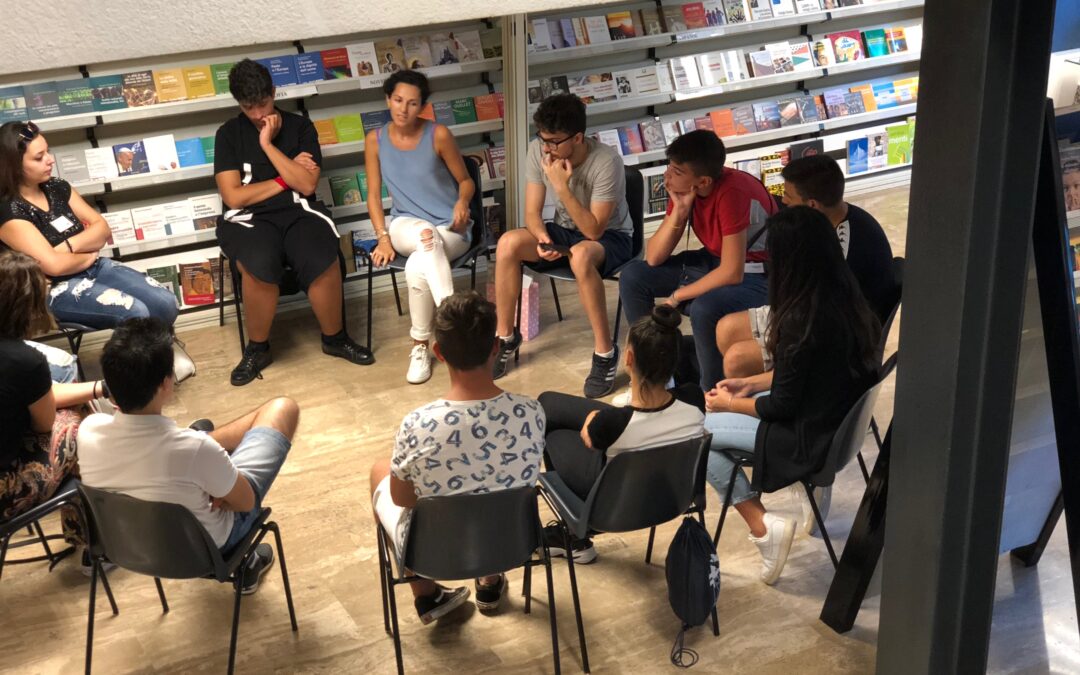
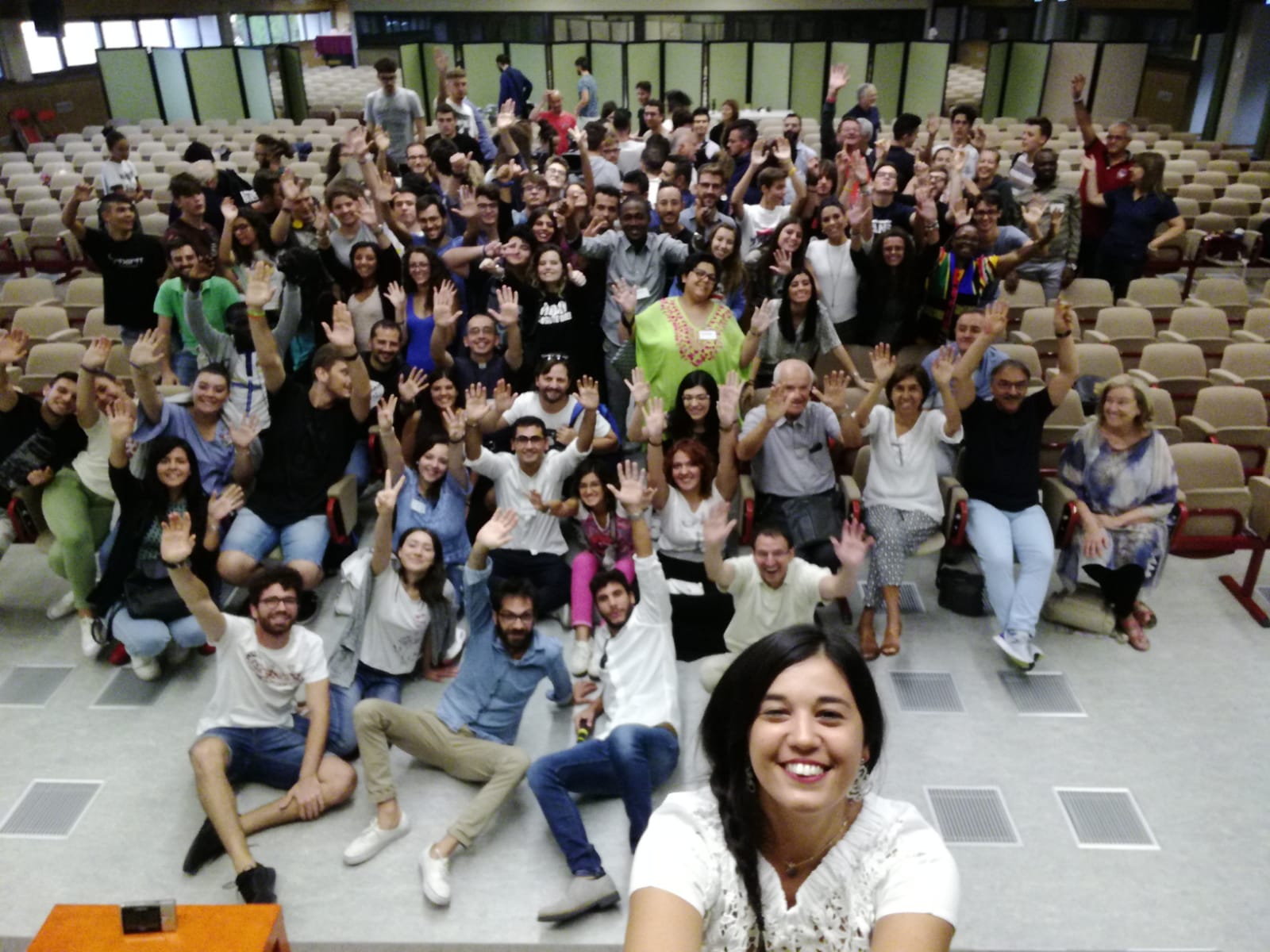 “I remembered a phrase of my friend: ’The idea of God has to grow with us.’ I haven’t tried to understand something about God for a long time now. I really needed to find out from others who knew more than me.” Three years ago, Andrea, a university student left his homeland where he had a reference group in the parish, and moved to a big city. But here he didn’t immediately find a precise reference point for his faith. In the Congress he met many. “I am still searching and am discovering new aspects of this adventure, but I have certainties, strong points. One of these is surely the awareness that the road opened out before me is a community path, to be experienced with others. At times I forget this and so I need to be corrected, but inside me I know that it shall be this,” Nicolas confirmed. “Committed to the ‘We’” was an initiative that was held in Castel Gandolfo (31 August to 2 September) and promoted by the Diocesan and Parish Movements, branches of the Focolare Movement addressing the youths active in the local Church. These movements aim to irradiate the charism of unity in the parishes and dioceses in which they offer their services, and to work together with other ecclesial organisations in the building of a “Church of communion,” as aspired to in the Novo Millennio Ineunte, the Apostolic Letter John Paul II addressed to the priests and all the laity, at the end of the grand jubilee of 2000. For this purpose, it promotes and nurtures an ever deeper unity of the faithful around the parish priests and bishops cooperating in the various dioceses and promoting a new evangelisation in the parishes, according to a community style.
 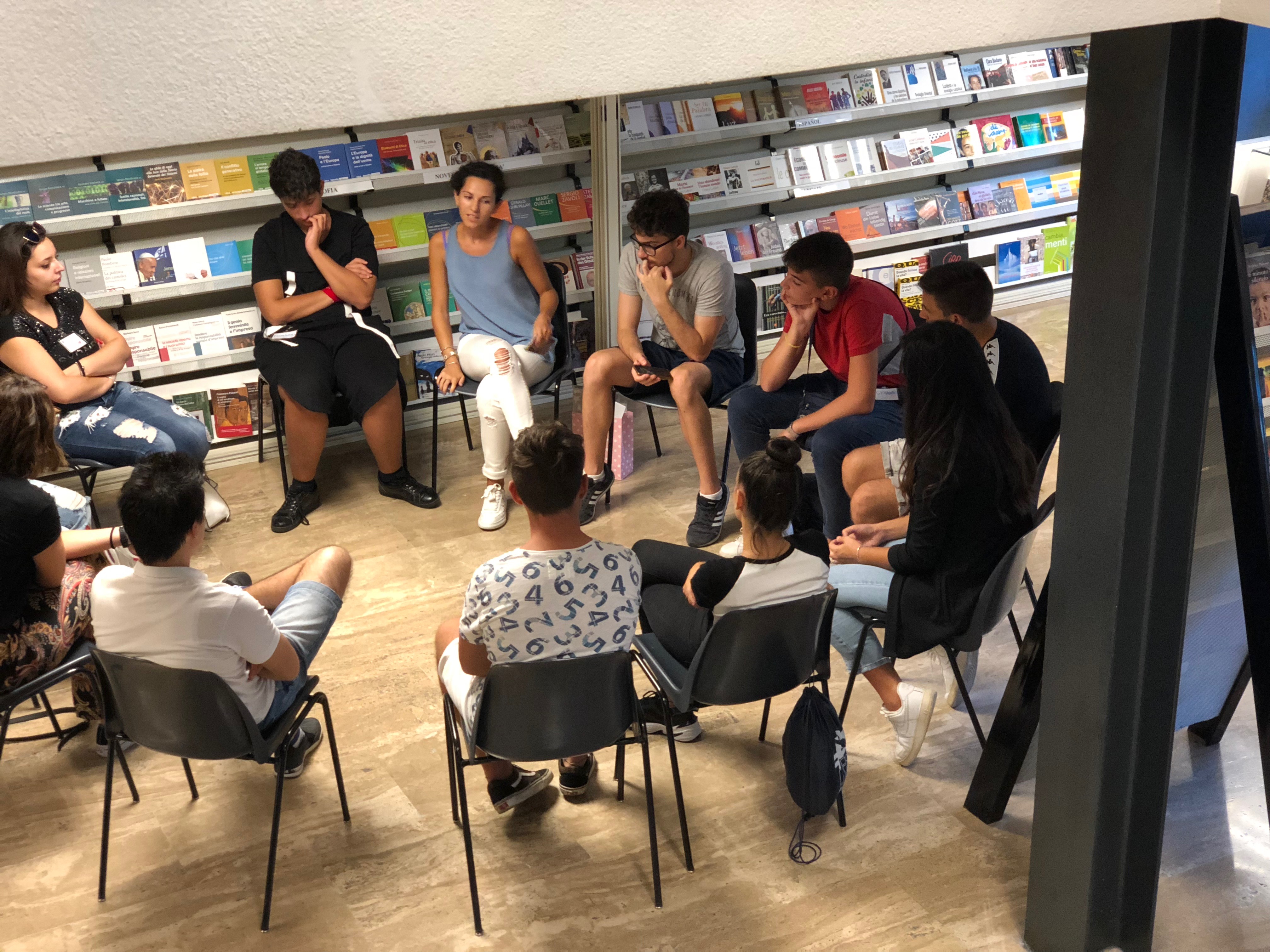 “We chose this title – the organisers pointed out – to contribute in fulfilling what Pope Francis often invites us to do: pass from the ’I’ to the ’we,’ through a community discernment which helps us to grow and make common decisions. During the days they spent together, the participants discussed their own faith, but above all the mission they feel called to, that of spreading the ’good news’ of the Gospel. The life experience based on the spirituality of Chiara Lubich acted as a background, since every charism of God is for the entire Church and humanity. The methodology was the culture of encounter: taking time to get to know one another and being together, to feel as ’people of God,’ a community in which one can grow, helped by those who are moving on with us.” The experience of the congress is fully part of the path towards the bishops’ Synod on the youths, to be held next October. “The words that Pope Francis said?? to the Italian youths gathered together last 11 August in Rome resounded strongly in us: ‘Do not be content with the cautious steps of those who settle down at the end of the line.’ We need courage to risk a leap ahead, a courageous and fearless leap to dream and fulfil, like Jesus, the kingdom of God, and commit ourselves to a more brotherly humanity. We need brotherhood: take the risk, and move ahead!”
4 Sep 2018 | Non categorizzato
Emigrants We live in a country unwilling to welcome migrants. One day, while talking about this topic in our family where we try to live the words of Jesus, we realized that even the marginalized are emigrants. Not long after, we learned of a boy who came from the world of drugs and had no one to take care of him. So we welcomed him into our home until he got stabilized, overcoming his addiction and finding a job. Even later we stayed in contact with him. Now he’s a happy father, with a happy family. R. H. – Hungary The Granary Old and childless, Marie spent many afternoons with us. One day, alluding to the barn behind our house, she told us that she would be happy to live there. We talked about it with our children and decided to make her happy. After obtaining the necessary permits, we transformed the granary into a little house connected to ours by an internal door. Not only for Marie, but for our whole family a door has opened, a new way of understanding the solitude of so many people. We feel genuinely enriched. C. J. B. – Belgium Shining For many years I have been paralyzed and bed-ridden. Last Thursday two members of the Focolare came to see me, which gave me great joy. Later, they told a friend of mine that they had found me “shining” and their comment surprised me very much. I thanked God, asking him to help me to always be like that. The next day I woke up with severe back pain. It was an opportunity to stay “shining” even in suffering. The same thing happened a few days later. This is the attitude I try to have now, even if I don’t always succeed, at least I try. N. P. – Venezuela The Milk Amidst the difficult economic conditions across the country, everything was being rationed and markets were empty. Due to a severe bone decalcification, Rosa needed to drink a lot of milk, but it was hard to find. One day a neighbour went to her house, asking for some milk for her baby who had not been drinking for days. Rosa immediately offered her what was left in the bottle, despite her own children’s protests. Just before evening, eight litres of milk arrived. With tears in her eyes, Rosa exclaimed: “God never allows himself to be outdone in generosity!” M. C. – Mexico The Mother-in-Law Rosita and I had taken in my mother-in-law who was living in a home for the elderly and had problems walking. My sister-in-law was with us too. Grateful for the beautiful sunny day, we went for a walk and to have breakfast at a restaurant in the square of a neighboring village. There was an atmosphere of joy and harmony among us. When we asked for the bill, we were told that it had already been paid by another customer who admired the way we cared for the elderly. My mother-in-law, Felice, confirmed it. R. Switzerland
