![A community that educates – a winning gamble]()
12 Oct 2011 | Focolare Worldwide
 Almost paradoxically, in a world that is always more global and in communication, there is an increase of the sense of being left out and of areas of solitude, with definitive negative consequences both at the individual and collective level, so much so that OMS has forcast that in 2030 depression in youths could become the second absolute cause of death. Yet, there is an increasing perception in all directions – as documented in the intervention prepared by the International Commission of Education for Unity – of the “need for community”(according to the expression of Z. Bauman), and starting from this radical need, one recognises the necessity to “form the man- in relationship” the key idea of Chiara Lubich in the Education area. It was underlined by her in the lectio on the occasion of the degree “honoris causa” in pedagogy (USA, 2000), and now referred to with vigour in this 5th pedagological meeting of EdU. An engaging and fascinating gamble that has involved the 270 partecipants (university professors, teachers, parents, students), together with many that have followed direct through internet, from Sicily, Albania, Malta, Slovenia right up to Colombia and other extra european countries. There were not only reflections on the essentiality of weaving autentic relationships as the foundation of the authentic community, but also the possibility of experiencing them in the entwining of the various moments of dialogue and the exchange-presentations of educational experiences. They dealt, in order to remain coherent with the theme of the meeting, with the not easy construction of the reality of community in various contexts-involving families, schools, the institutions present in the territory-beginning with the intradependence of persons capable of weaving relationships and alliances, inverting in that way the temptation to be individualistic, and injecting doses of hope, an indispensable element of any educational project. The intervention of prof. Domenico Bellantoni (Pontificia Universita` Salesiana, Rome) was very stimulating to delve into the meaning of relationship in the communitarian context. He took part for the whole day, and in particular, starting from the logotherapy of Vicktor Frankl, he delved into the idea of person-autotranscendence, open therefore to relationship and responsibility. Other interventions that will soon be available on Education for Unity website (www.eduforunity.org), were given by Maria Ricci, Michele De Beni, Teresa Boi, and Giuseppe Milan who have presented more directly the contributions regarding what has been the work, this year, of the central Commission EdU. The final dialogue was rich, solicited by open questions recognised in the group workings. The participants left with joy and renewed educational enthusiasm as evidenced by some impressions: “It’s something achievable; I go from here with new hope!” “We need to learn the grammar of relationship.” “We are ready for commitment, both individual and collective, to make constructive proposals and be ready to lose them.” “ Seeing each other new every day builds the community.” And from the messages received through Internet: “What an extraordinary possibility to build personal relationships amongst ourselves and in our communities also through the help of the means of communication” (Slovenia); “I am ready together with all to commit myself to take forward with hope this great project.” (Argentina).
![A community that educates – a winning gamble]()
11 Oct 2011 | Non categorizzato
 As usual, the meeting began with three days of spiritual retreat, focused on the Word of God, one of the points of Chiara Lubich’s spirituality which will characterize the life of the Movement’s members during the coming year. They also reflected on the New Evangelization, in view of the 2012 Synod of Bishops which will be held between 7 and 28 October. Topics were examined in the light of the Post-Synodal Apostolic Exhortation Verbum Domini of Benedict XVI and in the wake of the Lineamenta for the 2012 Synod. Some meditations of Chiara Lubich were also presented, which retraced her discovery of the Word during the Second World War, the way in which it is lived by the Movement today, and its effects: changing mentalities; making the life shine; making people free; giving joy; bringing about vocations; creating community. All of this was accompanied by personal testimonies of living the Word in very diverse settings – at times adverse settings – and by moments of sharing among the participants in small group meetings which characterize the Focolare. The work was presented by the president and co-president of the Movement, Maria Voce and Giancarlo Faletti:
- Visits to: (Spain, the Holy Land, Canada, USA, Santo Domingo, Russia, Hungary, the Czech Republic, Slovenia and England), in which the beauty of each people was highlighted and each people’s contribution to the project of a united world, together with the vast theme of inculturation.
- Dialogue. There has been more development in this area. It has changed and extended to include non-Catholics, non-Christians, and non-religious persons, who yet belong to the “family” of the Focolare.
- Prospects and Priorities: The priority of priorities is the life, illuminated by the Word of God.
 New Evangelisation. Chiara Lubich had spoken on this to a group of Bishops, taking her cue from something Pope John Paul II said regarding the Movements as being particularly suited for bringing the New Evangelisation ahead. This evangelisation is called “new” because of the new zeal, new method and new expressions it will involve. The first proclamation should be: God loves you. The New Evangelisation must create mature Christian communities. While taking embracing the entire Gospel, the word that must be underscored is: love. This means incarnating the new commandment of Jesus “in an ever more radical and authentic way.” The world is present. Each geographical zone had an opportunity to share the situation in which Focolare members live in various regions of the world. Particular attention was given to the Middle East, through a sharing on the experience of dialogue of the focolarini of these lands, a dialogue which grew precisely out of the need to find together a way of facing the new challenges of that troubled land, in which dialogue between diverse cultures seems to be blocked by insurmountable barriers. Vincenzo Buonomo, professor of International Law, then offered an in-depth look at the Middle East situation and the development of the Arab world. Then there was the African continent. The focolarini who live there presented the religious and socio-cultural history of the continent, describing each stage of the spreading of the spirituality of unity in Sub-Saharan Africa.
  Young people and Adults. One of the characteristics of this meeting was the presence of the youth, who helped to enrich the programme at various moments: on the afternoon dedicated to the Genfest (Budapest, 31 August – 2 September 2012); presenting a formation course based on YouCat; and with the presentation of a documentary entitled: “Together We Can: In the Footsteps of Carlo and Alberto” based on the lives of two Gen for whom the process of beatification has already begun. On Saturday, 8 October, the evening before the meeting’s final conclusion, Maria Voce was linked up via internet with thousands of people around the world, for some concluding remarks, in which she also shared one of her dreams: “If each of us begins now to live the Word of God with the intensity with which the first focolarine lived it with Chiara, we will truly be able to think of many lights being kindled, and rays of light filling the streets of the world.” And she added: “How can we not hope for everything and more? How can we doubt that these lights will not be bright enough to illuminate all the dark corners of this cellar that the world has become? I wish you a splendid and luminous year of light – yes – Chiara’s spiritual last testament: “Leave behind only the Gospel. . .”.
![A community that educates – a winning gamble]()
9 Oct 2011 | Non categorizzato
 At the time that Chiara and her first companions began their adventure in Trent (Northern Italy) the town had a population of about ten thousand. The girls’ actions had a real effect on the people and also on the Church. Both the elderly and the young were left speechless seeing the unusual life lived by the girls living in the ‘little house’ in Piazza Cappuccini, the first ‘focolare’. In this humble apartment the poor were at home. In fact the social problems of the city, ruined by the War, were problems the girls made their own. They believed that they could solve the problems by simply believing the truth in the words of the Gospel. By loving each neighbour one after the other. Chiara wrote: ‘Among all the Words in the gospel we noticed immediately all those for our charism concerned specifically with evangelical love towards each neighbour, not only the poor, as when we read in the Gospel that Jesus had said “Whenever you did this for one of the least important of these brothers of mine (and that means everyone), you did it for me.” (Mt 25,40). Our old way of understanding our neighbour and loving them crumbled. If Christ was in some way in everyone, discriminations couldn’t be made, nor could preferences. Our normal way of reasoning of classifying people was thrown into the air: fellow country man or foreigner, old or young, beautiful or ugly, likeable or not, rich or poor, Christ was behind each one, Christ was in each one. “Another Christ” really was each neighbour – if grace enriched his soul – or “another Christ”, a Christ proud – if he was still far from Him. Living like this, we realised that our neighbour was our way to reach God. It seemed that our neighbour was an arch we had to pass under in order to meet God. We experienced this right from the start. In the evening, during prayers or in a moment of recollection, after we had loved God in our brothers all day we had such union with God. Who gave us that consolation, that interior balm which was so new, celestial if not Christ who, from His Gospel lived “give and you shall be given”? (Lk 6,38) We had loved Him all day in those brothers and now He loved us. This inner gift was such a benefit! They were the first experiences of the spiritual life, of the reality of a kingdom which is not of this earth. So, in the marvellous way that the Spirit showed us, love for our brother was a new cornerstone of our spirituality.’ Chiara Lubich, Nascita di una spiritualità, in Enzo M. Fondi e Michele Zanzucchi, Un popolo nato dal Vangelo, San Paolo, Cinisello Balsamo 2003, p. 18
![A community that educates – a winning gamble]()
7 Oct 2011 | Non categorizzato

![A community that educates – a winning gamble]()
6 Oct 2011 | Non categorizzato
 In the eartly Paradise, God conversed with man: the father who dialogues with the son. Sin cut off the dialogue. To restore it, speech (the Word) came into the world and was made flesh: he became the mediator between men and God, and, through Him, dialogue was restored.
He gave rise to a new order, the law of which was love. And love is primarily expressed through words: love is not a monologue, it is dialogue: it does not close up within itself, but seeks the other and serves him.
(…) Christ breaks through all the barriers and restores contact with all. He talks also with lost women, also with thieves, forgives the crucifiers (…) he has come for the sinners, not for the just, that do not exist. Saint Paul, changed from a Pharisee to a Christian, risks being killed by his ex party companions, because he talks with the impure, with pagans; those pagans, with whom the zelot israelis did not talk, and from whom he was about to draw the big Church. For him, there were no jews, no greeks, no servants, no masters, no men, no women: but souls, all sons of God.
(…) Already in the second century ,there was a powerful push towards the evangelisation of the world, and therefore to the expansion of christian civilisation, with the dialogue of the greek apologists- Justin at the head-with the pagan thinkers. The former sought in the wisdom of Socrate and Plato and the sages of roman and other race, the seeds of divine Reason, and therefore the elements of solidarity, communion, and equality. Grounds were thus discovered of understanding and they engaged in dialogue,which drew closer gentiles and christians, after they had been further separated by imperial persecutions and teological controversies.
The ills of division and silence came about when religion was stirred up- and mixed- with politics: and so instead of conversing with the moslems, on the example of St. Francis, they battled them losing time, money, souls for generations(…) During all these forms of regression, dialogue was maintained alive by a group of saints.
(…) And dialogue is what, through the push of Pope John XX111 and Paul V1, has drawn closer ortodox and protestants and catholics in a few years, more than the controversies and subtleties, forgetfulness and silence of many centuries.
(…) Religion has no other preclusion but hatred, because it is love. It seeks unity and peace.
Iginio Giordani – Extract from “Ut unum sint”, 1967, n.7, pp.28-30.
![A community that educates – a winning gamble]()
6 Oct 2011 | Focolare Worldwide

Germán M. Jorge
 He thanked me and the conversation ended there. But I can assure you: The satisfaction and happiness that I experienced in that moment were worth far more than the cement. This little incident caused surprise among my employees who at first didn’t understand, and I had to explain to them that the most important thing wasn’t the incident in itself, but what can come from it, both for inside and outside our business. That month we had record sales, and right in the middle of the economic crisis we are managing to sell around 30% more compared to the same period last year. This way of dealing with people, placing ourselves at the service of others has strengthened our reputation and brought new business opportunities every day almost without having to go out in search of them anymore. I believe that if businesses were to discover the value, also the economic value that is generated by the principles of the Economy of Communion when they are applied in a radical way, they would not hesitate to put them into practice.’ By Germán M. Jorge Source: “Economy of Communion – A New Culture” n.30
![A community that educates – a winning gamble]()
2 Oct 2011 | Non categorizzato
 They lived a sentence from the Gospel and the novelty, for that time, was that Chiara and her first companions, to help one another and to grow together, told one another of the fruits they had experienced through living the Word. Chiara wrote: ‘The War was still raging. Every time the air-raid siren sounded, all we could take into the shelter with us was one small book: the Gospel. We opened it and the words, even though we already knew them quite well, because of the new charism , were lit up as if they had a candle beneath them, they enflamed our hearts and pushed us to put them into practise straightaway. We were attracted to them all and tried to live them one after another. I read for example; “Love your neighbour as yourself” (Mt 19,19). Our neighbour. Where was our neighbour? There, next to us in the all the people who had been hurt by the War, wounded, without clothes, without houses, hungry and thirsty. We immediately dedicated ourselves to them in many ways. ‘The Gospel assured us: “Ask and you shall receive.” (Mt 7,7). We asked for the needs of the poor – and, extraordinarily for war-time – we received everything we needed from God! One day, and this story is one of the first experiences we had and is often told, a poor person asked us for a pair of shoes size 42. Knowing that Jesus was in the poor person, I turned to the Lord, in the church of St Clare near to a hospital of the same name, with this prayer: “Give me a pair of shoes size 42 for you in that poor person”. I came out and a lady came up and gave me a parcel. I opened it and it was a pair of shoes size 42. ‘We read in the Gospel: “Give and you will be given” (Lk 6,38). We gave and gave and each time we received in return. We had just one apple left in the house. We gave it to the poor person who asked. And we saw the next morning, maybe from a relative, a dozen apples arrive. We gave those to others who were in need, and in the evening a whole suitcases of apples arrived. That’s how it was, all the time. ‘These events, one after the other, amazed and enchanted us. We had great joy and that joy spread. Jesus had promised and still now he keeps His promise. He is not, therefore, a reality of the past, but of the present. And the Gospel is true. This discovery gave wings to our steps on the journey we had just begun. When we explained this to people who were curious about our happiness in such sad and troubled times; they understood that they hadn’t simply found a few girls in a young Movement but Jesus alive.”
1 Oct 2011 | Non categorizzato, Word of
“Follow me”
Jesus had already said these words to Andrew, Peter, James and John on the shore of the lake. He made the same invitation, using different words, to Paul on the road to Damascus. But Jesus did not stop there; down through the centuries he has continued to call men and women of every culture and nation. He still does it today: he passes by in our lives, he meets us in quite different places and in different ways, and he makes us sense once again that invitation to follow him. He calls us to be with him because he wants to build a personal relationship with us, and at the same time he invites us to collaborate with him in his great plan to create a new humanity. He does not care about our weaknesses, our sins, our limitations. He loves us and chooses us just as we are. His love will transform us and give us the strength to answer his call and the courage to follow him as Matthew did. He has a particular love for each one of us, a plan for each person’s life, an individual call. We can feel it in our hearts through the inspiration of the Holy Spirit, through certain circumstances or through a piece of advice given by someone who cares about us. Even if manifested in different ways, his message spells out the same words:
“Follow me”
I remember when I too felt a call from God. It was a very cold winter morning in Trent. My mother asked my younger sister to go and pick up some milk at a place about a mile away from home. Since it was so cold, my sister did not feel like going. My other sister also refused to go. “I’ll go, Mom,” I said, and I picked up the bottle and left the house. Halfway there something peculiar happened: it seemed as though the skies opened up and God reached down to me with an invitation to follow him. “Give all of yourself to me,” I felt him say in my heart. It was a clear call that I wanted to answer right away. I spoke with my spiritual advisor about it, and he gave me permission to give my life to God forever. It was December 7, 1943. It is impossible to fully convey what I felt in my heart that day: I had married God. I could expect everything from him.
“Follow me”
This phrase does not only pertain to that specific moment when we make a choice for our lives. Jesus continues to ask us this every day. “Follow me,” he seems to suggest to us as we face our smallest daily chores — “follow me” in the trial we are called to face, in that temptation we have to overcome, in that act of service that needs to be done. How should we respond concretely? By doing what God wants from us in the present moment, which always comes accompanied by a particular grace. Our commitment this month will be, then, to do the will of God with decisiveness, dedicating ourselves fully to the brothers and sisters that we are called to love, our work, our studies, praying, resting, and all the different things we are supposed to do. Let us learn to listen to the voice of God deep within our hearts, which speaks to us also through the voice of our conscience: he will tell us what he wants from us in every moment, and our part is to be ready to sacrifice everything in order to do it. “Let us love you, O God, not only more each day, for the days that remain may be few, but let us love you in every present moment with all our hearts, souls and strength in whatever is your will.” This is the best way to follow Jesus. Chiara Lubich
![A community that educates – a winning gamble]()
29 Sep 2011 | Focolare Worldwide
 Benedict XVI visited the land of his birth for four intense days between 22 and 25 September. Even though the Masses – celebrated in the open at the Olympic Stadium in Berlin, in the Square in front of the Cathedral in Erfurt, in Etzelsbach, the shrine of Thuringia, and in Freiburg, in the Black Forest – marked some of the high moments of his trip, the Pope gave clear testimony, through many additional encounters, that he had not only came for the 30% of Catholics. He also met representatives of the Jewish faith and of Islam, he gave a noteworthy speech at the German Camera of Deputies and entertained guests from Orthodox Churches. He had a meeting with representatives of the Evangelical Lutheran Church in a very significant location: the Augustinian monastery in Erfurt where Martin Luther had studied theology; joined the Augustinian Order and was ordained a priest. On this occasion the Pope clearly expressed his esteem for the spirituality of Luther and for his commitment in the search for an adequate answer to the question of God, Benedict XVI invited the Christians of both Churches to “witness together to the presence of the living God, offering the world in this way, the answer it needs. May we help each other in living it. This is a grand ecumenical task which introduces us into the very heart of the Prayer of Jesus.” The President of the Evangelical Church in Germany (EK), Nikolaus Schneider showed appreciation and underscored what Benedict XVI said: The two Churches should “help each other in intensifying and in enlivening the life of the faith in our society – truly and ecumenical task.” Those who had hoped that the Pope would take concrete steps in ecumenism, and those who had hoped that Benedict would have traced a new itinerary regarding a common concelebration – especially in view of the 500 years since the Reform, which will be celebrated in 2017 – were not contented. Even for couples of different confessions, who cannot approach the Eucharistic Table together, he did not offer anything “new.” The faith is not something that you can bargain over, as you can with political agreements – this was his motivation: “Unity in the faith does not grow by weighing the advantages and disadvantages, but through a profound identification in life and in thought.” Benedict XVI did not want to offer superficial answers or concrete solutions to the ecumenical field or to the underlying questions of the Catholics. He wanted to enter into the roots of the “crises of the Churches” upon which basis he sees a crisis of the faith. He had come to encourage trust in God and to reinforce the faith in Christ, which he considers to be fundamental to change and renewal.”
![A community that educates – a winning gamble]()
26 Sep 2011 | Focolare Worldwide
 “The ‘Together for Europe’ vocation has not gone out of fashion, but is increasingly necessary because the world is heading into a deep crisis which is not only economic and structural, but a crisis of relationships,” affirmed Marco Impagliazzo during a conversation with some representatives of the group that is promoting Together for Europe, and the delegates of the Focolare for the nations of Europe who are meeting at their international centre in Rocca di Papa, Italy. He goes on: “The value of our journey is even stronger today than when we started, because Europe is even more in crisis today.” ‘Living together’ is the key-phrase that must be learnt and proposed, dreamt and realized. It is a vision which involves everyone, it involves the youth: “Precisely because of the crisis, we need to work even more.”

Marco Impagliazzo

Gerhard Pross
![A community that educates – a winning gamble]()
25 Sep 2011 | Senza categoria
 Chiara and her first companions asked themselves how they could show God that he was truly the centre of their lives. They wondered how how they could put into practice their newly found ideal: God-Love. It soon appeared obvious to them that they should return God’s love for them. Their life would no longer have any sense if it were not “a small flame of this infinite brazier burning with the flame of divine Love: love responding to Love”. And it seemed such a great and sublime gift to be able to love God that they often said: “We shouldn’t say “we must love God” but “Oh, to be able to love you, Lord! To be able to love you with this tiny heart!” They recalled a sentence from the Gospel seemed to leave no escape for anyone who wanted to live a Christian life: “Not everyone who says to me, ‘Lord, Lord,’ will enter the kingdom of heaven, but only the one who does the will of my Father who is in heaven” (Mt 17:21). Therefore, doing the will of God was their grand opportunity to love God. And God and his will coincided.Chiara wrote: “God was like the sun. And a ray of this sun was reaching out to each one of us, the divine will for me, for my friends, for everyone. There is a single sun, different rays, but always ‘rays of sun’. A single will of God different for each person, but always will of God. Our task was to walk within our ray without ever departing from it. And we had to follow along this ray in the time that was allotted us. No wandering into the past or fantasizing about a future. It was better to abandon the past to the mercy of God, since it was no longer in our possession; and the future would only be lived once it became present.

Chiara Lubich (centre) in the mountains of Tonadico with her first companions
![A community that educates – a winning gamble]()
24 Sep 2011 | Non categorizzato
 Home for the elderly. We were united with a common objective: to love. This was our only desire as we went to work. It was hard work in the middle of the summer heat: cleaning rooms for the elderly, serving at table, brightening up their evenings. But Love was flowing and you could feel it in the air. We were particularly focused on doing things together, not leaving anyone out, and being willing to lose our own ideas when necessary. Everything was done with a smile, and this made it all exceptional. The elderly trusted and encouraged us. When a paper Mache flower that adorned a bedroom wall was not perfect, or a bingo card was missing one of its buttons, everyone was able to turn a blind eye. From our side, here is what Salim from Kenya writes: “I’m happy to be at this home for the elderly. I feel at home because this kind of activity has made me want to be happy. There’s no sadness when we love like this!” Caritas (1-14 August). In order to permit the volunteers of this association to have some holiday time, we offered to bring ahead the many activities that they carry out with such dedication in our region. This time the work consisted of preparing a menu and distributing the meals to the many marginalized people of our city, and discovering their world. It was also surprising for us to discover that every day, in spite of the difficulties, our smiles never disappeared. This was an added gift, aside from the meals that we distributed to the many persons who came each day.
  The volunteers complimented us on the work we had done. And we experienced that differences of opinion are quickly worked out when you live the Golden Rule and when you keep a smile on your lips. Now, after such an active and adventurous summer, we are re-charged and ready for the coming year. Together we are aiming to show to the world the beauty the new life that is flowing, as we rush toward our big appointment next September: Genfest 2012. Compiled by Youth for a United World, Sassari, Italy
23 Sep 2011 | Non categorizzato
![A community that educates – a winning gamble]()
22 Sep 2011 | Non categorizzato

Gustavo Alvarado
21 Sep 2011 | Non categorizzato
![A community that educates – a winning gamble]()
21 Sep 2011 | Non categorizzato
 I live in a side road in Martellago, a district in Venice. Crossing this road is very dangerous because it’s very difficult to see on-coming traffic and the cars travel at high speed. The speed limit signs and the pedestrian crossing are often ignored. This results in the frequent need for brakes to be slammed on and in people overtaking in a dangerous way when others stop to let pedestrians, often children and old people, cross. I had brought this problem to the attention of the Local Council in the past but to no avail; others had filed petitions with the police but without getting any response. On more than one occasion our children were nearly knocked down. So after the umpteenth brush with near tragedy, I felt responsible for doing what I could to find a solution to this problem which wasn’t mine alone but which affected everyone in the area. So I spoke to some of the other parents from my street and neighbouring streets. One of the other parents who was also very worried about the daily risk, and I thought we would write a letter to the mayor. In order to have more impact, we thought we would ask some of the other locals to sign it too. In writing this letter we tried to emphasise the seriousness of the situation but without blaming anyone, suggesting possible solutions and mentioning positive intiatives which had been undertaken by the town council to limit the use of cars and reduce pollution, such as the introduction of a ‘pedibus’ and the use of cycling in the city. Whilst we were collecting signatures, there were those who disagreed with what we were doing, saying that there had been endless petitions and that this one too would have no effect. But, in general, both the drafting of the letter and the collection of the signatures were opportunities to build beautiful relationships with our neighbours and the other parents. We all felt more of a sense of responsibilty as we actively searched together for the solution to a problem by working ‘for’ and not ‘against something’.
  I shared what I was living with friends who, like me, try to live for fraternity in their cities and communities, receiving from them the strength and the courage to keep going. We went together to the town hall to speak to the Mayor and to give him the letter with all the signatures. One of his colleagues warned us that the Mayor would not be very pleased to receive another collection of signatures and so it turned out to be. At the start of our meeting the ‘first citizen’ expressed his aversion to these petitions. At that point I summoned up all my courage and said to him, ‘Mayor, please read the text of our request carefully.’ He did read it, understood what we were trying to do and calmed down. And so we were able to engage in a dialogue, from which several possible solutions emerged but which turned out to be too expensive and not possible to implement. And then I had an idea: in another road in our distict, a speed indicator had been installed which flashed on when approaching cars were goining at more than 30 miles an hour and the pedestrian crossing was picked out in red. So I suggested these things. The Mayor immediately seized on these ideas, saying that they had one of the indicators available and that picking out the crossing in red would not be a problem. The following Saturday, we found ourselves again with the Mayor, who was very proud to show us the plans for the project. A month later, work began in the street. From this experience, I understood the beauty and the power of living together for fraternity, being at the service of our city, our community, out of love. Luisa Busato – Venice, Italy
20 Sep 2011 | Focolare Worldwide
They are young artists who are taking part in “Arts & Culture – Reshaping Urban Life” which was organized by various partners from the worlds of art, culture, and education. They are financed by the European Union cultural program (EACEA). Among them is also the Starmacher Association, known for its Strong Without Violence program that was carried out together with Gen Rosso in many schools throughout Europe and the world. The group of urban artists has recently returned from Udine, Italy, where they worked together for ten days (24 August – 4 September) in the “Park of Cement” sharing their impressions of the city with its citizens through paintings, acoustic works, and sculpture, as in the filigree model of the city’s water tower. Udine was the itinerant project’s third stop, which foresees laboratories to be carried out in five different cities of three European states (Udine and Venice in Italy; Schwerte and Dortmund in Germany; and Sternberg in the Czech Republic). “The atmosphere among us is quite particular,” a young student from Monaco di Bavaria recounts, “It’s as if we’ve known each other for a long time. And we’re actually able to work together on a single work of art with several artists. And our hosts immediately perceive our every need and desire! This is quite an exceptional way of working!” During February, in Schwerte, Germany, the participants were joined by experts to examine the theoretical and cultural foundations of their work. The central topic was the mutual influence between urban development and artistic expression in society and in the cities of today. There is a direct link between art and city, and young people have a particular sensitivity for the place in which they live. Their works almost always reflect their birthplaces in some way. The second stop was in the Czech Republic (2-10 July) where an old and abandoned monastery in Sternbeck became the point of inspiration. Each artist could choose his or her own “art studio” in which to work. In the evenings they met to chat and know each other better, to sing and dance. Each seminar concluded with a public showing of their works that had been created during the days of the seminar, but also included some paintings or sculptures which came from their studios at home. The fourth stop is underway in Udine at a workshop with Gen Rosso ending on 23 September. Upcoming stops include: an interdisciplinary seminar with Gen Rosso in Dortmund, Germany and, finally the concluding congress in Venice on 23 February 2012.
![A community that educates – a winning gamble]()
19 Sep 2011 | Non categorizzato
A laboratory never closes but continues. Especially if its purpose is to implement practical solutions that will generate some hope for Italy’s revival. The organizers of LoppianoLab did not place the word “end” at the conclusion of this second LoppianoLab, a national laboratory lasting four days which brought together in close dialogue researchers from the fields of economy, culture, education, art and Italian communication networks not to search for a new future for Italy, but to come up with a shared idea for Italy’s present. The final assessment was positive. The Lab was confirmed in its calling to create a national meeting space for the different worlds of work, cultural agencies, citizens and institutions. The meeting gathered together 3, 000 people and 70 Italian companies. There were 56 events including panel discussions, conferences, artistic performances and Literary cafés.  One event that was particularly highlighted was the Second National Convention of the Economy of Communion twenty years following its birth. It involves economists and entrepreneurs together finding new avenues for work’s future. Alberto Ferrucci from the International EoC Commission announced that a document of proposals is to be presented at the United Nations, which the Economy of Communion project has formulated for confronting the crisis and finding a new model of development. Many stories were shared during these days by entrepreneurs who decided to not only consider the final product and profits, but the individual persons who are the true assets of the company. The Trinity a Way of life?” This was the title of an evening dialogue session between theology, philosophy and art, based on Coda’s theological volume, “Dalla Trinità” (From the Trinity). Two parts of the LoppianoLab took place at Sophia University Institute. One was the presentation of Sophia magazine, which reports on the research being carried out at the Institute; and the other was the presentation of Nuova Umanita which, for thirty years, expresses the Focolare Movement’s culture. Participants were also given the opportunity to become acquainted with the academic project of Sophia Institute, which is a path of life, study and research for the acquisition and deeper understanding of a Christianly inspired culture that is capable of illuminating many human dimensions as well various academic disciplines. The meeting of the Città Nuova Press Group gathered together regional work groups of journalists and officers, editors and collaborators who are involved with “Città Nuova” magazine. They stand on the front lines in strengthening a national network which promotes the culture of unity. The town of Loppiano, which hosted the events, offered an “Open City”, a presentation of its people and places: a fifty years of Centro Ave Arte art exhibit, dramatic readings from the writings of Igino Giordani and Fraçois Neveux, music, dance, and a taste of cultures from around the world.
  The concluding laboratory took place on the morning of September 18. It was entitled: “Hoping with Italy. A network for the common good on the 150th anniversary of Italy’s unification.” This laboratory highlighted the results that have been achieved in various settings, pointing out practical avenues for continuing reflection and experimentation, which were summarized in four proposals to make Italy hope again: support for young entrepreneurs with special attention to the South in the Expo of EoC businesses at the Bonfanti Industiral Park; the necessary openness to other networks, organizations and institutions, in the laboratories that are promoted by the Città Nuova Press Group; summer schools in Argentina and Cile with three new Masters from Sophia University Institute, which is an instrument for re-launching the new humanism: Loppiano as a permanent laboratory. What is its contribution to Italy? To demonstrate that unity in our cities is possible even in daily life.
![A community that educates – a winning gamble]()
18 Sep 2011 | Non categorizzato
 Amidst the fury of war Chiara Lubich and her first companions were in the habit of meeting each other in bomb shelters when the sirens would sound announcing new bombings. It was the desire of these young women from Trent to be together and discover new ways of being Christian and of putting the Gospel into practice, following that startling intuition that had led them to put God-Love at the center of their interests – he alone and nothing else – at the center of their young lives. “Each event touched us deeply – Chiara later said. The lesson that God was giving us through external circumstances was very clear: All is vanity of vanities, everything passes away. But at the same time, God placed a question in my heart for all of us and, with it, the answer: “But could there be an ideal that doesn’t die, that no bombs could bring down, one that we could give ourselves to?” Yes, God. We decided to make him the ideal of our lives.” God. God, who in the middle of the fury of war, which was the fruit of hatred, through the action of a special grace, manifested himself for what he truly is: Love. The leading concept upon which the Holy Spirit then constructed this entire spirituality was, therefore, God-Love (Cf. 1 Jn 4:8). What a change this truth, now understood in a totally new way, brings about in people when they come into contact with the movement! The Christian lives they were so faithfully living before, now appear overshadowed like the lives of orphans. For now a discovery has been made: God is Love, God is a Father! Our heart, which had been living an exile in the night of this life, opens and rises and unites to the one who loves it, the one who takes care of everything, the one who even counts the hairs on our head. The joyful and painful events acquire totally new meaning: Everything is foreseen and willed by the love of God. Nothing can make us fearful. This is an exciting faith which strengthens us, which makes us glory in it. It’s a faith that brings tears to the eyes of those who experience it for the first time. It’s a gift of God that makes us shout: We have believed in love (1 Gv 4,16). The choice of God who is Love, as the ideal of our life, was the first foundation that was laid, the first requirement of this new spirituality that had blossomed in our hearts. Thus we had found the one to live for: God-Love.»
17 Sep 2011 | Non categorizzato
![A community that educates – a winning gamble]()
15 Sep 2011 | Focolare Worldwide
 It was a sight to behold: from 7 August to 5 September, 470 Gen4 (children between the ages of 5 and 9) and their chaperones from more than 50 Brazilian cities travelled distances of over 2000 kilometers. Their destination was the Gen4 Congress in Recife (19-21 August), at Mariapolis Ginetta near São Paolo (26-28 August), and in the areas around Brasilia (2-4 September). With effort and imagination the Gen4 prepared themselves with acts of love and collecting money for their journey. Some sold their toys; others set up a puppet market; some started a small bakery and sold the bread to friends and neighbours. Others used their savings or found financial assistance from relatives and local community. They were welcomed into an environment that was colourfully decorated, with beautiful backdrops, dancing and clowns. The congress began with taking off on the greatest possible adventure: to discover the will of God! But how do you discover it? Beginning with the story of creation we examined how God manifested himself throughout history, always full of love and mercy, and we are also part of this story.
  Then we examined many episodes from the life of Jesus, who is the Father’s greatest gift to us. The stories about Jesus showed us how he always did the will of his Father and how we can imitate him in every moment of our lives. Of course, to know what the will of God is in the present moment, you need to open your heart and “take a moment for silently listening to the correct voice,” one Gen4 noticed. Maria Voce sent a message that was immediately put into practice: Always say “yes” to God and carry the flame of Jesus’ love to the whole world. Everyone was actively involved in creating the congress, during games in the large park, participating in group activities, tidying the rooms and dining hall, and presenting scenes from the life of Chiara Lubich and the Gospel on stage. Also during the Mass – the moment to meet Jesus – the children were actively involved with their songs and skits, and with their acts of love which they presented at the moment of the Offertory. But now we let the Gen4 speak.”
From Recife:
- “Jesus, I love you to death. You can always count on me and I always want to be faithful to you. I promise, I will never betray you like Judas did. I’m eternally grateful, that you gave your life for us. Gabriel
- I liked when we spoke about the Word of God, because now I can remember to help my Mummy more, and the new man can live in my heart. Pedro
- Jesus is my treasure in life; he’s the true man of the earth and of all of us. Abraão
From San Paulo:
- I helped my friend Ragael to carry his luggage to the room, because he’s very small and couldn’t carry it. Eduardo
- I wish my whole family were here to witness this great moment in my life. Matheus
- I sold 50 packages of biscuits to help pay expenses for the Gen4 from my city. Pedro
From Brasilia:
- Dear Jesus, I’ll never forget you. I’ll spread joy in the world and have lots of friendship with those around me. André
- I gave up the swing for my friend. I shared my snack with a friend. I shared my things with others and lent my toys. . . I love you very much, Jesus. Paulo
- Lord, I ask you for a bit of money, so I can give it to the poor. Carlos
- I know that sometimes I’m not the boy who helps everyone, but I try to do my best. I hope you understand me, your dear Gen4, André.”
Matthias Bolkart – Gen4 Centre [nggallery id=69]
![A community that educates – a winning gamble]()
11 Sep 2011 | Non categorizzato
The spirituality of unity unfolds into 12 cardinal points, leading from one to another:
- God is Love
- The Will of God
- The Word
- Our Neighbour
- Mutual Love
- Jesus in the Eucharist
- Unity
- Jesus Forsaken
- Mary
- The Church
- The Holy Spirit
- Jesus in the Midst
 In Chiara Lubich the points of the spirituality of unity were not developed through thought out plans, reflections or some theological points. Rather, this is a spirituality demanding an immediate adhesion, decisive and practical, something that brings life. In the splendid history of the Church, from its individual members, its saints and communities there has always been a clear line and result: it’s the individual that goes to God. This remains the case within the spirituality of unity, in the sense that the individual’s experience of God is unique and will never be repeated. However, the spirituality is drawn from the charism of unity, entrusted by the Holy Spirit to Chiara, and as well as this indispensible personal spiritual experience there is also a deep emphasis on the communitarian dimension of Christian life. It is not a complete novelty, the Gospel is eminently communitarian. There have been experiences in the past which have underlined the collective aspect of the journey towards God, above all in the spiritualities rising from those who had love at the base of their spiritual life. This can be seen in the example of St Basil and his community. Chiara Lubich brings her own spirituality, which is an original communitarian way of going to God: being one in Christ, according to the Gospel of John: “As you, Father, are in me and I am in you, so may they be in us.” (Jn 17,21). In Chiara this became a style of life. A “communitarian spirituality” was foretold for our epoch by contemporary theologians and is also mentioned by the Second Vatican Council. Karl Rahner, for example, speaking of the spirituality of the Church of the future, saw it as a “fraternal communion in which it is possible to make the same basic experience of the Spirit”. Vatican II, directed attention to the Church as the body of Christ and people assembled in the bond of love of the Trinity. If St Teresa of Avila, doctor of the Church, spoke of “an interior castle”, the spirituality of unity helps to build an “exterior castle”, where Christ will be present and illuminate every part of it.
![A community that educates – a winning gamble]()
10 Sep 2011 | Focolare Worldwide
 The “Arab Spring” and the complex scenario of political and juridical relationships in the medio-oriental quadrant, were at the centre of the study seminar recently concluded in the area of Trent, (27-30 August 2011), promoted by Sophia University, in collaboration with Mppu/Political Movement for unity and Ced/Communion and Law.
The initiative, that utilised the contribution of the Province of Trent and the collaboration of the local administration, represents the first edition of a more more articolated research project lasting several years directed towards young university students, to increment, within their formative courses, academics and professionals, towards a “culture of universal fraternity” between peoples and cultures.
Typical of the experience was the possibility of communicating competencies and diverse disciplinary languages to examine a mutidimensional theme, in strict interaction between teachers and students of judiciary and politics areas; the majority of them were already linked together through participation in previous initiatives (such as the summer seminars promoted by CeD/Communion and law, and the “Schools of participation” by the Mppu/Political Movement for unity).
The programme required concentration and personal commitment from each of the participants-50 persons in all, of whom 38 were youths- and at the same time,it offered, in view of the extraordinary beauty of the natural environment in which it took place, the Dolomites of Primiero,adequate time for reciprocal knowl;edge and recreation.
But it was not only the splendid scenery and the mild temperature that brought the Summer School to those mountains. Acting as catalyst was, above all, the reference to the experience of Chiara Lubich and the first group of the newborn Movement of the Focolari that, in this same valley, during the years of the 50’s, found themselves living some stages that marked its development in an indelible way. It was then that they intuited with greater clarity the charismatic force of the idea of unity and its translation into a diverse model of human sociality, illuminated by universal fraternity.
How to give continuity to this initiative? At the end , to the enthusiasm of the youths were added the concretness and project capability of the president of the Valle Community, the mayor of Tonadico, and other administrators of the territory, with whom some plans have already been drawn. It is planned that there will be the possibility that Primiero will host an annual week of international studies, proposed by the Sophia team in collaboration with other networks of experts, highlighting every year a specific team tackled in an interdisciplinary manner.
![A community that educates – a winning gamble]()
9 Sep 2011 | Focolare Worldwide
 The “chilly” month of August was unforgettable for the members of the Focolare in the city of Curitiba: the three seats of political power – the Chamber of State Members of Parliament, the local council and the Chamber of Municipal Councillors, from the 20th to 24th of August, bade tribute to the person of Chiara Lubich. Inauguration of the Memorial to Chiara Lubich: Despite the brief interruption due to some rain, Mayor Luciano Ducci – as reported in the newspapers – inaugurated on the 20th August a new cultural centre, as a “monument of initiation” in the Workers Park, in the industrial zone of the city. The idea to “ place firmly at Curitiba the memory of this woman” by dedicating to her a way, a square, and a cultural centre, goes back to an initiative by local city councillor Tito Zeglin when, in 2009, the Paranese capital was chosen as the seat of the first “city forum”. At the Legistlative Assembly of the State, during the extraordinary session of the 23rd August, upon the proposal of parliamentarian Reinhold Stephanes Junior, and the unanimous approval of parliament, a Diploma to Chiara Lubich “in memoriam” was bestowed. On this occasion, there was a surprise: Areovaldo Figueiredo, the Director of Postal Services, of the state of Paraná made an announcement. He is a member of the local Political Movement for Unity and he presented a Brazilian postage stamp, dedicated to Chiara Lubich, personalised with her photo. Archbishop Mons. Moacir Jose` Vitti, who is at Madrid for the GMG, sends a message which, amongst other things, says: Chiara, with her courage and her unshakeable faith in God, has charmed the world with her way of living and her works that continue also today.” By way of conclusion, on 24th August, during a Special Session in tribute to Chiara Lubich, at the seat of the Comunal Council, a parchment is given on the proposal of the Councillor Tito Zeglin. During each of these events, the politicians and personalities present have confirmed their adherence to what Maria Voce, president of the Focolari – proposed with her message: “These events were favourable occasions to launch towards collectivity, with a new impulse, all those positive values, that emerge from adherence to the spirit of love and fraternity, important in everyday life and in political action: seeking first of all what unites and preferring the common good to personal interest. That is seeing our environment, private, social, and political in the wider view of the human family.”
![A community that educates – a winning gamble]()
8 Sep 2011 | Non categorizzato
 The meeting has drawn 31 bishops from 18 countries, representing 15 churches. It is the 30th ecumenical meeting of its kind sponsored by the Focolare Movement, the first of which was held in 1982. This year it’s taking place in Welwyn Garden City, a town about 40 km north of London. It is truly a garden city with tree-lined boulevards, parks and lakes. The city was founded by Sir Ebenezer Howard in 1920 and has about 40,000 inhabitants. The Focolare Centre for Unity began here after a visit to England by Chiara Lubich in 1983, when she felt the need for a “cradle”, a place where activities of the Focolare could take place. These annual ecumenical meetings of bishops take place in different places, allowing participants to get to know the ecclesial realities of the host country. This year their focus is the Church of England. In particular, the proposed “Anglican Covenant”, has been a subject of great interest. It proposes a pact to sustain the Anglican Communion, and it formulates an agreement, prepared by a group of Anglican theologians, binding churches of the Anglican Communion to commit the 44 autonomous Anglican churches into recognising principles held in common. It will be an important instrument for building communion which might even become a requisite among non-Anglican churches. Adherence to the pact will always be unrestricted and there are no legal sanctions envisaged for those who change their minds. The program of the conference includes visits to symbolic places of Anglicanism such as Lambeth Palace, the seat of the Primate of the Church of England, Dr Rowan Williams, who welcomed the participants, the visit to the shrine of St Albans, where the relics of St Alban, the first English martyr, are kept, and the meeting at Westminster Cathedral with the Catholic Archbishop, Msgr Vincent Nichols. The theme chosen for this year is “The Word of God and its Transforming Power”. Maria Voce, President of the Focolare Movement, gave an impassioned speech on the ecumenical spirituality of the Focolare Movement which came to life through living the Word. She recalled how the Focolare spirituality was born in a dark shelter, when Chiara Lubich and her first companions would read the Gospel by candlelight during the bombings of the Second World War.
  “In these times, the dark shelter can represent the world with all its challenges and its search for meaning,” explains Maria Voice. “The Truth is replaced by other truths, and what prevails is economic interest; the family seems to have no significance in the scheme of things. The dark shelter challenges us to have nothing but the Gospel. This is where we can start to re-evangelize ourselves and consequently humanity which surrounds us.” “We can start off by living the Word, moment by moment, and sharing our experiences, the fruits of living this life.” Even Martin Luther wrote: “The soul can do without anything, except the Word of God.” And, at this delicate time of transition,” Maria Voce says, “as we pass from the period of foundation of the Focolare Movement to the period of renewal and development, we need to go back to the basics, keeping in mind that the explosion of life within the Focolare came about through people living the Gospel”. It was in this way that communities centred on the Word were born, that the spirituality of communion was born, and the commitment to live the Word has even paved the way for ecumenical dialogue at all levels. “The faithful embracing of the one Gospel – written in the joint declaration “Road towards Communion” drawn up by the Catholic Church and the Lutheran World Federation – is an essential step towards full unity.” The unity to be pursued is not only between Christians of different churches “but also,” adds Maria Voice, “by widening the dialogue to people of other religions and by embracing those of other convictions.” From our correspondent Aurelius Molè [nggallery id=68]
![A community that educates – a winning gamble]()
7 Sep 2011 | Non categorizzato
 In the face of the difficulties in western society, and also in other parts of the world, the bishops of various churches, friends of the Focolare Movement, upon the invitation of Cardinal Miloslav Vlk, Archbishop Emeritus of Prague, will reflect on their mission and will interrogate themselves on the impact of their pastoral work in transmitting the Gospel message. They will focus on the light and strength that emerges from the Word of God, which is the origin of the Church of Christ, in its various expressions, and which can give the Church, even today, a new vigour and illuminating power. Significant meetings are expected to take place with the Primate of the Church of England, Dr Rowan Williams, Archbishop of Canterbury, with the Catholic Archbishop of Westminster, Msgr Vincent Nichols, and with representatives of the Methodist Church and other ecclesial realities present in England. The keynote address of Maria Voce, President of the Focolare Movement, will be of particular relevance. She will underline the effects of living the Word, at the origin of the Movement, and on its spirituality that is purely ecumenical. The apex of the meeting is the “Pact of reciprocal love” that commits those present to place mutual love above all past divisions, in accordance with Jesus’ invitation to remain in his love and to love one another as he has done. On Friday 9 September, at the “Open Day” to which the Focolare Movement in Great Britain invites the Church leaders of the various churches, they will present the experience of fraternal communion lived by Bishops of various Christian churches, together with the prospect of an ever more profound and amicable unity amongst those responsible, in the spirit of the prayer of Jesus who asks for the unity of all.
Press Section: Focolare Information Service
![A community that educates – a winning gamble]()
6 Sep 2011 | Non categorizzato
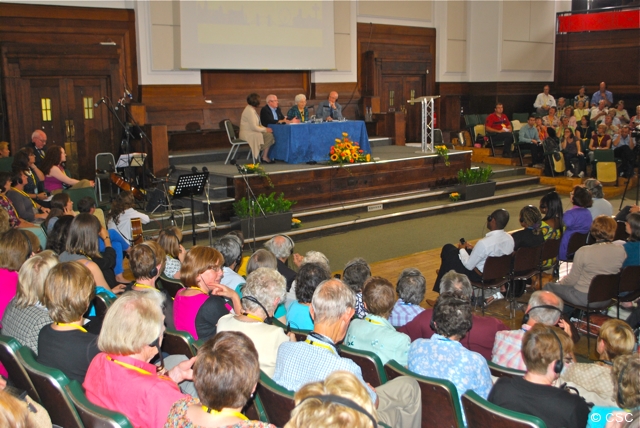 “I found the answers for my life.” “It’s a privilege to see how the charism of unity transforms people.” “Everyone was so easy-going.” It was certainly an unforgettable day in the history of the Focolare Movement in Great Britain. 500 people from England, Scotland, Wales, as well as a delegation from Ireland, gathered around Focolare President, Maria Voce, and co-President, Giancarlo Faletti, in the Quaker’s Friends House in Euston. Some participants travelled for up to 10 hours so as not to miss out on the opportunity. Lesley, an Anglican focolarina, in her introduction to a video documentary illustrating Chiara Lubich’s visit to the United Kingdom, described the shock that was experienced due to the recent riots in London neighbourhoods; she spoke of the disturbing events within the framework of a secularised culture, where the focus is only on self, leading to disastrous consequences. She then underlined how Great Britain contains the seeds of a different culture planted over 40 years ago, the roots of which penetrate profoundly through the message of Chiara Lubich who came to Liverpool in 1965. This was the first of eight visits and it left its mark in the history of the entire Focolare Movement. I twas Canon Bernard Pawley who had invited her to speak of the spirituality of unity in the Anglican Cathedral in order to move the mountains of incomprehension and to promote ecumenical dialogue. The program continued with testimonies shared by Eddie from Scotland, Lucy and David from Wales, and Ann from England. While their stories varied because of the different situations they lived in – ecumenical dialogue, interreligious dialogue, pastoral work with the elderly – they were profound and down to earth. A couple from Congo, now living in England, spoke about their adventure in fleeing from a war zone, the difficulty of settling in a new country, and how their life as a couple was resolved through the discovery of mutual love proposed by the Gospel. The climax of the afternoon’s program was the dialogue session with Maria Voce and Giancarlo Faletti who answered many questions put to them by the participants, touching on some sore points. Above all, they wanted to know to give a new push to ecumenism. “Perhaps, here we need to launch into action,” Maria Voce said, and she invited everyone to re-awaken in their own church, like a mouth-watering desire, “to experience the gift that God had given to us to reach universal brotherhood.” Throughout their trips around the world, Maria Voce and Giancarlo Faletti have found that the ecumenical movement usually goes ahead despite the differences that might exist. They recounted positive experiences in the area of ecumenism in Budapest, Chicago, and even in Tanzania, where representatives of various churches have expressed gratitude towards the Focolare for its support and commitment. The other hot topic were the riots and violence which shook London and which spread to other cities of England. After years of hard work in order to build unity in the community, to some it seemed as if all was lost, as if the violence had cancelled out all the positive that had been achieved. How is it possible to have hope in this situation? “And yet I continue to have hope,” Maria Voce responds confidently, “In my view, violence signifies a great void, a great need for love; it’s the ultimate need to be taken into consideration while resorting to the wrong means.” These episodes are challenging, “but if we respond with love, we can create a greater good”. This has happened to “people who have reacted, and who got together to transmit positive signs”. Giancarlo Faletti comments, “Society has to ask itself which values and cultural models it is putting forward. We can bring our own values. It’s an invitation to stretch the limits in our giving.”
 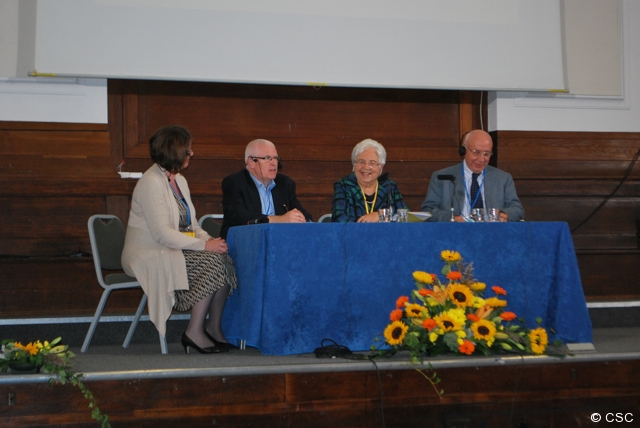 The questions seemed to go on forever. To the one relating to society’s negation of God, Maria Voce commented, “I have never found anybody who says they don’t want to be loved. God can only be given through love and we are called to live together this testimony which is for all people: for those belonging to the different religions and even for those who profess no belief in God. Those values that we deem valid can be offered to others to build the universal family.” Another important and relevant question dealt with the theme of sacrifice, the spirituality of unity’s concept of “knowing how to lose” which can have negative connotations in the Anglo-Saxon mentality. Maria Voce explains that in the Focolare spirituality “we speak of knowing how to lose, but we also speak of fulfilment. When you give something away, you lose it, but because you’ve shown love to somebody else, you are enriched. We give, but we also gain. It’s God’s arithmetic and God never lets us win in generosity.” The joy in the hall was tangible, so much so that Maria Voce wanted “the whole world to see this living cell of the Focolare in order to taste the fruits, the faithfulness and preciousness which has carried the whole Focolare Movement for over 40 years. The family of the Focolare family is alive through love, and through the presence of Jesus among us, we can take the love of God to the world.” Many gathered around Maria Voce and Giancarlo Faletti to greet them, to give them a hug, to have a photo taken with them. Here are some of their impressions: “It’s a new phase; the future is possible.” “The explanation of the meaning of personal sacrifice shed light on an incident which happened to me when I was young and which I never understood.” “At times I feel so pessimistic, but the optimism of Maria Voce and Giancarlo Faletti is catching!”; “It will be a new springtime.” from our correspondent Aurelio Molè [nggallery id=64] Press section: Focolare Information Service
6 Sep 2011 | Non categorizzato
![A community that educates – a winning gamble]()
5 Sep 2011 | Non categorizzato
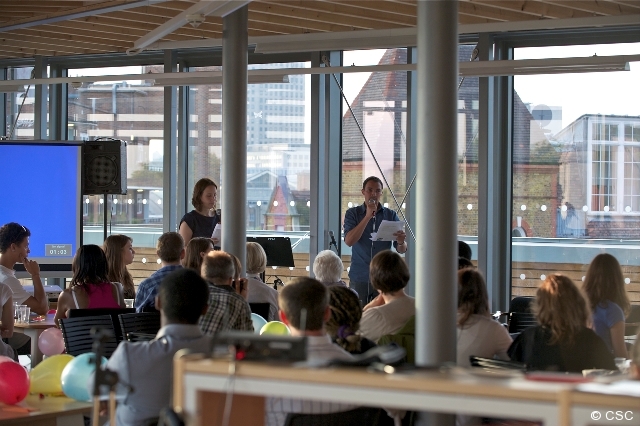 The view is breathtaking. From the fifth floor of the international headquarters of the Catholic Agency for Overseas Development (CAFOD), with a single glance one takes in the city of London’s financial district, with the Stock Exchange, the Bank of England and the distinctive “Gherkin” skyscraper. Looking from East to West, one can see the Dome of St Paul’s Cathedral, the masterpiece of architect Christopher Wren, and the “London Eye”, a giant ferris wheel situated on the banks of the River Thames from which one can admire a spectacular panorama of the city, including the Palace of Westminster, the Houses of Parliament and Westminster Abbey, the burial site of English monarchs, renowned for the celebration of Royal weddings. Yet it is not the view that strikes us, fascinating though it is, but the mix of ethnic cultures which composed the group of 85 young people, mostly Londoners, but also from other parts of Britain, who came together on the evening of Saturday, 3rd September, to discuss the theme “The Power of the Word” in the presence of Focolare President, Maria Voce, and co-president, Giancarlo Faletti. As the sun was setting on this warm day, its rays flooded the room lighting up the faces of the youth who, through games, songs and experiences, were able to amply discuss issues that were by no means simple or straightforward. The word referred to in the title of the meeting is the Word of God, which, Chris explains, “is capable of transforming our lives and the world itself”. The Gospel was proposed with courage and simplicity, without being watered down; the Word has generated life and light down the centuries, and it does so even today, in London, the city where riots recently erupted. The meeting exceeded all expectations, generating much interest and participation. “People seek the meaning of life and ask many questions,” says Joanna, a young English teacher, “but they don’t know where to get answers”. And Oliver adds, “It’s embarrassing at times to talk about religious matters with my friends because they’re so anti-religion.” But this is not so on the terrace of the CAFOD building. To hear these young people speak, and especially to see them so united, London can offer a hope for the future. There is depth, freshness and openness amongst this multi-ethnic group of young people who speak English in varying accents. “By reading the words of the Gospel in the morning and reciting prayers,” Ranjith says, “I am able to face my stressful job with more serenity and I’ve experienced a joy that I never knew before.” “Living the Gospel shaped my life without my even noticing it,” exclaims Carlos from Panama, “Some people criticise me because I give a lot of myself, but living the Gospel is not at all complicated. It is enough to love.” “I recently started a new job,” said Edel, a girl from Northern Ireland, “but I wasn’t happy. I started to live the art of loving, and after a few days the boss thanked me for being there.” Maria Voce freely shared some of her own experiences when as a young person she discovered that the words of the Gospel could be put into practice. It led her to change her life completely and she experienced joy, peace and freedom, even in difficult situations such as when she lived in Istanbul where the majority of the people were Muslims, and also in Lebanon during the war. “Living the Gospel,” she concluded, “not only changes your life, but sets in motion a revolution which was born 2000 years ago and which is not over yet. So many revolutions have taken place in history, but who remembers them? The Christian revolution is still alive because Jesus is alive, and his words are for everyone. We can embark on this wonderful adventure without fear or apprehension because Jesus is with us.” The young people then issued an invitation to the next Genfest to be held in Budapest on 2nd September 2012, and while sharing a pizza together on the balcony, they stuck several post it notes on the glass doors, some of which read: “I can always start again”, “Don’t be scared: you’re not alone” and “Think of the Gospel as a letter of love from God to you”. It is difficult to describe the joy, the warm atmosphere of unity amongst everyone and the desire to share with others the happiness experienced here. From our correspondent Aurelio Molè [nggallery id=63] Press section: Focolare Information Service
![A community that educates – a winning gamble]()
4 Sep 2011 | Non categorizzato
 An emblematic aspect of the Focolare Movement is communion, unity. This is the consequence of living the Word and sharing its effects. Chiara wrote: ‘There was a time when the Movement didn’t exist and then it did. We know what made it be born was the Holy Spirit, which worked in a very precise way. He put the first focolarine in an attitude of being able to take on, in a big way, I would say in a unique manner, the Gospel; He enlightened them through its Words and gave them the push to live them. ‘What was the effect? We know, unthinkable and marvellous: due to the Word lived radically, the Word taken seriously, a big community was quickly born, and spread rapidly throughout more than one hundred villages in the Trentino region: it was the Focolare Movement. These people used to ignore one another and then became family; Christians, previously indifferent to one another, became connected into one. Therefore the Word of God makes this miracle, can make this miracle: give life to a visible community’. “Unity” is the word which most distinguishes the Focolare Movement. Unity which is both communion and communication. Unity needs constant communication to keep up to date. The means of communication are also useful for unity. The 38 editions of the magazine ‘Citta Nuova’ which is published in 24 languages, together with other journals such as Gen’s – for those in priesthood, Unita e Carismi – for those in religious life, are helping to reach unity. As are the audiovisual productions made by the ‘Chiara Lubich Centres’. In 2000, Chiara Lubich addressed an assembly of communicators and offered them 4 ‘principles’ of communication: The first thought: ‘Communication is essential. The effort to live the Gospel in everyday life, the experience of the Word of Life, has always been indissolubly united with communicating it, describing the various steps and the results, since it is a law that we love others as ourselves. We believe that what is not communicated is lost. So life generates light, both for those speak and for those who listen, and it seems the experience is fixed in eternity. They have almost a vocation for communication. The second thought: ‘To communicate, we feel the need “to make ourselves one” as we say, with the one who is listening. So when we speak or address some topic, we do not stop at merely relating the content of our thoughts. First we feel the need to know we have before us, to know the listener or the audience, their needs, desires, problems. Likewise, we make ourselves known as well, explaining why we want to give this talk, what has led us to do it, its effects on ourselves, thereby creating a certain mutuality. In this way the message is received not only intellectually but is also shared in and taken to heart by all. A third thought: ‘Emphasize the positive. It has always been our way to put what is good into light, out of a conviction that it is infinitely more constructive to point out what is good, dwelling on the good and positive aspects, than to stop at the negative, even though whoever is in a position of responsibility has the duty at the proper moment to point out errors, shortcomings and failures. Finally: the person matters, not the media, which are merely an instrument. Bringing about unity first of all requires the indispensable means, which is the person, St. Paul’s new self, who has welcomed the mandate of Christ to be leaven, salt, light of the world.’
![A community that educates – a winning gamble]()
3 Sep 2011 | Focolare Worldwide

(from left)Fr P. Foresi, Igino Giordani, Canon Bernard Pawley & Mrs Pawley, Chiara Lubich, Eli Folonari
In the 60s, when Beatlemania was taking Liverpool by storm, the Focolare Movement’s spirituality of unity was making inroads right there. It came about through Fr Green, a Benedictine monk, who asked Chiara Lubich and Fr Pasquale Foresi that the Focolare open a house in Liverpool. The Archbishop of Westminster, Msgr John Heenan, advised them to start off from this city where Catholics had reached 40% of the population, while in the rest of Great Britain they averaged 10%. “If you succeed in Liverpool, where it’s much easier, you’ll succeed everywhere else,” said the Archbishop.
And so it was that Mari Ponticaccia and Maria Egger became the first two Focolare members to establish themselves in England in November 1963. They rented a tiny apartment which was spartan in its furnishings. In fact, the only pieces of furniture were their suitcases! But little by little, things started to arrive and eventually they moved into a proper house. From its humble beginnings in Liverpool, the Focolare Movement spread to the rest of Great Britain.
However, even prior to this, contact had been made from overseas. Some of Chiara’s first companions, such as Eli Folonari, Valeria Ronchetti and Doriana Zamboni, had already been making trips to the UK from Belgium, Holland and France in order to meet with people who had got to know the Focolare. In 1961, by means of these personal relationships, the first group of people from England participated in a Mariapolis in Belgium. And turning over the photo-album, one notices that way back in 1959, at the Mariapolis of Fiera di Primierio (in the Italian Dolomites), there was already an English participant.
Once the Focolare was eventually established in Liverpool, Mari Ponticaccia found work as a teacher of French whilst Maria Egger worked in an old people’s home. In 1965, in that small apartment composed of just two rooms, Chiara Lubich came to visit. She was invited to speak in the Anglican Cathedral of Liverpool to 50 priests in an era when ecumenism was practically non-existent. The event raised eyebrows even more so because it was promoted by a woman.
The adventure that had begun had ecumenical characteristics and the Focolare community, right from the beginnings, presented itself composed of people belonging to different churches. They were small communities built on authentic personal relationships, true friendships, mutual love, and there were meetings and annual Mariapolis gatherings which gave them formation in the new spirituality.
In 1967, a Focolare centre was opened in the heart of London because a house was made available for a year. The Movement developed steadily, and by the late 70s there were Focolare centres established also in Scotland – in Glasgow in 1976 and in Edinburgh in 1982.

Chiara Lubich with the Archbishop of Canterbury, Dr Rowan Williams.
Chiara Lubich visited England eight times and she always regarded this country as having a leading role in ecumenical dialogue.
In 1977, quite unexpectedly, Chiara was awarded the Templeton Prize for Progress in Religion at the Guildhall in London. There, Chiara shared her experience in front of various religious dignitaries and she had the profound sensation that all those present, even those of other faiths, were one family. The Focolare Movement subsequently embarked on promoting interreligious dialogue.
Chiara Lubich’s last trip to England was in 2004. She was welcomed warmly by the Archbishop of Canterbury, Dr Rowan Williams. During every visit to England, in fact, she had the opportunity to meet with the Primate of the Church of England and to dialogue personally with ecumenical leaders and leaders of other faiths. This commitment to building universal brotherhood was also extended to the political arena. During her visit in 2004, Chiara met with a group of parliamentarians from both Houses.
Today, the Focolare Movement in the United Kingdom numbers 7,000 adherents, of which 1,700 belong to churches other than the Catholic Church.
Within this historical context we would like to mention Maria Voce’s first visit to England currently taking place. Maria Voce is the current President of the Focolare Movement and her program includes meeting with the local Focolare community in London on 3 September, and an “Open Day” with ecumenical and religious leaders.
By our correspondent Aurelio Molè
See also
Focolare Information Service
From our archives – photos of Chiara Lubich in Great Britain
Below: Arrival of Maria Voce in London airport on 1 September 2011
[nggallery id=62]
![A community that educates – a winning gamble]()
1 Sep 2011 | Focolare Worldwide
 I belong to the generation of “rebels”. I was raised in the Catholic faith without understanding or living it in a coherent way. From the time I was young, I questioned many things. Above all, it took a great effort to attend mass every Sunday. I found the solution: I gave up believing, but I continued to hold on to Jesus’ message of love as my point of reference.
I met M. Angels, my wife, and a long period of transformation began for the both of us. She is a believer and a member of the Focolare Movement. Actually, as time went by, I discovered that I had married an “activist” in the Movement.
We were immediately faced with the decision concerning the rite of matrimony. We married in the Church. Nevertheless, on my side, I didn’t give up any of my ideas. I not only accepted a religious ceremony, but I actively participated with great interest and respect.
The other important concerned the education of our children. Once again we followed a simple principle which has always worked well when it came to these difficult decisions: I told my wife “a Catholic education would be to our children’s advantage. It would make them sensitive, more complete, happier.” I said to my wife, “ You have the faith, I have emptiness.”
It wasn’t all as easy as it might seem. For example, I didn’t understand my wife’s enthusiasm about Focolare events. Was it a sect? I must admit that I was a bit jealous. Little by little, with effort from the both of us, we found our balance. I was a bit curious about the Movement and she found ways of discreetly telling me about it.
A significant event was when I attended a meeting. I recall the welcome I received and the atmosphere. I began to learn the spirituality of Chiara Lubich, which I tried to make match with my personal beliefs. One significant thing was how it led me to understand the word love in a new way. This word has lost its relevance in today’s world.
This was a spirituality that centres on the message of Jesus, in an explicit and radical way, and is concretised in the small events of everyday life. My interests in the spirituality grew, and also the desire to live it with my friends, acquaintances, colleagues at work and – in the most difficult setting – in my family.
One obstacle remained. It seemed to me that the Movement was reserved for Christian believers. I was truly surprised when I learnt that it also included persons who held no religious convictions, not only: I was even invited to be actively involved.
I’ve learnt to see my neighbour as a brother and to think and act accordingly. I’ve learnt that you don’t need to be a hero. I’ve experienced that it requires constant effort, but we are helped in this by a spirituality with a high communitarian component.
In recent years I’ve had the good fortune to direct a group of young musicians. It was fortunate, because being with them has given me the opportunity to share not only in their musical growth, but also their spiritual growth. This has required a lot of hard work and much patience in adapting myself to their requests, knowledge, age and their desire to play and live.
I now look back on my life as a trajectory that allowed me to grow on spiritual ground and to fill that emptiness that I seemed to carry with me, compared to my wife’s fullness of faith. This evolution has required me to move on from being a spectator to becoming an actor.
Jordi Illa
31 Aug 2011 | Non categorizzato, Word of
“But now we must celebrate and rejoice, because your brother was dead and has come to life again; he was lost and has been found.”
These are words of invitation that God addresses to you, and to all those who believe, to rejoice with him, to celebrate and to participate in his joy at the return of the sinner who was first lost and then found again. These words in the parable are addressed by the father to his elder son who shared fully in his life. When this elder son returns home from a hard day’s work, he refuses to enter his house where they are celebrating the return of his brother who had left them to squander his inheritance. The father goes out to his faithful son, just as he went out to his lost son, and tries to convince him to join them. The contrast between the father’s sentiments and those of his elder son is evident: on one side, the father with his immeasurable love and great joy that he wanted everyone to share; and, on the other, the son full of contempt and jealousy toward his brother whom he no longer recognizes as such. He refers to his younger brother, in fact, as “your son … who swallowed up your property with prostitutes” (Lk 15:30). The love of the father and his joy at the return of his prodigal son serve to emphasize still more the ill feelings felt by the other son who had remained with his father. These ill feelings reveal, however, a cold and — one could say — false relationship between this son and the father. We can deduce from the narrative that it is work and the fulfillment of his obligations that matter most to this son; he does not love his father as a son should. Rather, we feel that he obeys his father as a hired worker would obey his boss.
“But now we must celebrate and rejoice, because your brother was dead and has come to life again; he was lost and has been found.”
With these words, Jesus points out a dangerous trap that you could fall into: that of a life lived for the sake of appearances, in search of personal perfection which can lead to judging others as less perfect than yourself. As a matter of fact, if you are “attached” to your own perfection, you concentrate on building yourself up to the point of being filled with self-admiration. You act like the son who remained at home, who enumerates his merits before his father: “Look, all these years I have served you, and not once did I disobey your orders” (Lk 15:29). <
strong>“But now we must celebrate and rejoice, because your brother was dead and has come to life again; he was lost and has been found.”
With these words Jesus goes against the attitude of those who see their relationship with God as one based only on the observance of the commandments which is not enough. Jewish tradition is also very clear on this. In this parable Jesus puts the spotlight on divine Love illustrating the fact that God who is Love takes the first step without considering whether the person deserves it or not, but with the desire that the person be open to establishing an authentic relationship of communion. As one can imagine, the greatest obstacle to God who is Love is precisely the life of those who accumulate actions and deeds while God wants their hearts.
“But now we must celebrate and rejoice, because your brother was dead and has come to life again; he was lost and has been found.”
With these words, Jesus invites you to extend the same measureless love that the Father has toward those who stray. Jesus calls you not to judge according to your own standards the love that the Father has for each and every person. In inviting his elder son to share his joy for the return of his long-lost son, the Father also asks from you a change of heart: you should welcome as brothers and sisters even those people for whom you nurture sentiments of superiority and even of scorn. This will work in you a true conversion because it will purge you of your conviction that you are “better.” It will save you from religious narrow-mindedness and allows you to welcome the salvation won by Jesus as a pure gift of God’s love. Chiara Lubich
Word of Life, March 2001, published in Living City Vol. 40 No.3, p.17.
![A community that educates – a winning gamble]()
28 Aug 2011 | Non categorizzato
 In 1940, Chiara Lubich in a letter wrote a striking passage: ‘I am a person passing through this world. I have seen many beautiful and good things and I have always been attracted only by them. One day (one indefinable day). I saw a light. It seemed to me to be more beautiful than other beautiful things, and I followed it. I realised that it was the Truth.’ Her ambitions at the time, as a recently qualified teacher, were to go to the Catholic University in Milan. Her thinking was: ’It’s Catholic, they’ll speak about God there, they’ll teach me a lot about God’. There was an entrance test which resulted in funded places for 33 candidates. Chiara came 34th. She felt she had missed a great opportunity. “Between the tears, a voice rang clearly in her troubled heart: ‘I will be your teacher!” Her understanding of study lies in the answer Jesus gave. Later, in 1980, Chiara explains further: ‘Already in ’44 Jesus had asked me to leave my studies behind and put my books in the attic (…) Thirsting for truth, I saw the absurdity of looking for it in the study of philosophy when I could find it in Jesus, the Truth Incarnate. I left my studies to follow Jesus (…) There was, in that episode, a prelude of what would come to be in time the Focolare Movement. We saw a splendid light, but this in our soul, a fruit of our life (..) Following that choice which God asked of me, the light came to us in abundance. It gave light to the spirituality that God wanted from us, it shaped day by day the Movement as it developed. We called this light ‘wisdom’. (…) We understood that wisdom was fundamentally our new way of studying, the studying of the whole Movement (…) Having left studying behind in ’43-’44, by 1950 I felt it was necessary to pick up the books again and study theology. I felt a need to base all the intuitions of that period upon a solid foundation.’ Now the Movement has many places where the culture of unity is developed for example, the ‘Abba School’, which explores the doctrine that pours out from the ‘charism of unity’, and is at the source of many initiatives permeating various fields of thought and life; the Marian University which aims to provide basic theological courses for the members of the Movement; various schools and courses based on the specific aims of the Movement; through the publishing house Citta Nuova with numerous publications in many languages, and the cultural magazine Umanita Nuova, and finally in 2008, the Sophia University Institute based in Loppiano (Incisa V. – Florence).
![A community that educates – a winning gamble]()
27 Aug 2011 | Focolare Worldwide

“…We had to wait for the appearance of three stars in the sky, the sign that Saturday had ended. Only then could we start. The appointment was in front of a large hotel in the centre of Buenos Aires, where some of the Jewish friends who came over from the United States, Europe and Israel were staying. After three hours travelling, we arrived at the Mariapoli Lia, in deep night.
“The first day of the Jewish-Christian symposium. The participants are around eighty from various parts of the world. The atmosphere is very high, with reciprocal listening, and friendly relationships. Several of us have met in previous symposiums, especially that of Jerusalem. The chosen theme is that of identity and dialogue, two realities that enter into each other: identity is the fruit of relationship. There are very profound presentations from the philosophical, anthropological, and psychological point of view, with names that are remembered: Martin Buber, Emmanuel Lévinas, Victor Frankl, Paul Ricoeur…”
“… I realise increasingly that interreligious dialogue cannot be improvised; preparation and refineness of soul are required. It is participation in the work of mediation done by Jesus between heaven and earth, and between the divisions of human beings. So as to fill every divergence and bring unity, he became that “nothing” of love that allowed unification without there being anymore any diaphragm.
“… If night in the Argentine Pampas is silent, with stars that shine mutely, the day is full of the singing of a thousand birds. Nature seems to participate in the feast among us in this symposium. We become aware of an increase compared to the previous three: a profound knowledge, more trust, and a love which is more sincere. It seems a dream. Today, next to the usual conferences, the dialogue meetings for different ambiance: the world of Justice, of communication, of education…
“… the strong affirmation of one’s identity can generate conflict. Only the reciprocal “non-being” in front of the other, as expression of love, makes “being” the other and makes one find oneself fully in the most profound religious identity: being love. Another intense day. It seems almost superfluous to speak of dialogue amongst us, so profound is the unity achieved. When the Rabbis speak one feels the wisdom of centuries.
“… I delivered my talk: the Crucified, Icon of Extreme Love. The greatest love, Jesus said, is that when one gives one’s life for one’s friends (Jn 15, 13). Thanks to this extreme love, every person becomes his friend. He gives his life also for those who are his enemies. It is the new view required to build universal brotherhood: see all as brothers and sisters for whom one is ready to give one’s life: see a friend in every person one contacts. Chiara Lubich has translated this extreme love of Jesus with a simple and demanding expression: “make oneself one” with the other, or rather understand him deeply, enter in his world, share his sentiments. It is the preamble for every dialogue. Chiara has applied this teaching of hers in the field of interreligious dialogue, placing herself in the disposition of listening to members of different religions, so as to understand them from within their culture.
“…the symposium was concluded at the seat of the Ministry of Religious Affairs, at Buenos Aires. There were present Jewish and Christian civil and religious dignitaries. It was thus highly represented. We part feeling called in person to accomplish a work of mediation between tendencies, positions and experiences that are sometimes contrasting in between themselves. The way- we have understood in these days – is to be only a presence of love, without any pretences, or judgements, being of service, until we become that “nothingness of love” that allows us to come together.”
From the diary of Fr Fabio Ciardi (OMI)
![A community that educates – a winning gamble]()
25 Aug 2011 | Non categorizzato
 Schoolmates is a project conceived and implemented in 2002 by Teens for Unity, a branch of the Focolare Movement, in collaboration with Action for a United World and New Humanity, which involved hundreds of schools over the past ten year period. Its objective is to allow boys and girls of various countries to get in touch and to know each other, as the name suggests, from one part of the world to the other . The one who participates in it contributes afterwards, through various activities, to increase a solidarity fund which allows to distribute various scholarships every year. In the last 12 months 376 scholarships were given out in 25 nations. The revamp of the website www.school-mates.org aims at improving communication, participation and interaction among classes and groups which adhere to the three phases of the project. One begins by committing himself or herself to live the “Golden Rule” which invites to “ do to others what we would like them to do to us”, a rule which is present in the sacred books of many religions. The second phase allows students to get to know each other by connecting classes and groups of boys and girls of different countries through the website. The project wants to offer a possibility of knowing other cultures creating a dialogue in which the differences may be source of enrichment for one another. In this phase we find one of the novelties of the website: the possibility of managing their own space in the website, for those who will have completed all the three phases of the project. In it boys and girls will be able to introduce their classes or groups, making their own country known to others historically, geographically, culturally and sharing their experiences and witness of their commitment in living the Golden rule. If the class or the group wants to get into contact with other classes or groups, that will be made possible through a reserved area. The third phase is characterised by sharing: in fact the classes and groups which adhere to the project commit themselves to contribute to the solidarity fund in order to support, every year, some micro projects of solidarity. The objective is to allow boys and girls to be able to go to school and to complete secondary school or professional formation, by giving them scholarships. Among the novelties of the new website there is also a section dedicated to teachers, educators and tutors, in order to allow them to share materials and pedagogical experiences made in various Countries and schools of different order and grade.
![A community that educates – a winning gamble]()
24 Aug 2011 | Focolare Worldwide
 Next Saturday 27th August 2011, the first meeting will be held of “Juntos por México”, (Together for Mexico), the fruit of many years of rapport woven with movements and associations. 500 leaders will be reunited representing around 8 million lay catholics in the whole country. A little history: in 2007, the assembly of the Episcopal Conference of Latin America (CELAM), reunited in Brazil, indicated an important stage for all the Latin American church, launching in the whole continent the so called “continental mission”. In answer to this challenge, in Mexico, a a start was made, by organizing the first meeting of all movements, at a national level. From the beginning, the event is seen as a festive meeting, that is at the same time, a witness to the lived Gospel, both on a personal level and in the various surroundings of society. At the end of 2009, a Central Commission was formed, currently composed of 8 movements together forming “The Episcopal Dimension for the Laity”. The group, that is the expression of over 30 of the main Mexican movements and associations, has worked actively to prepare the event with great enthusiasm and a spirit of communion.
  The subject chosen for this first edition is the family, studying in particular three large themes: Formation, Sociality, and Communication. It will be followed by an open dialogue with the aim of defining concrete actions to be undertaken together. Moments for youths and Holy Mass presided by Mons. Javier Navarro, President of the “Laity Dimension” will conclude the works. Many see in this meeting the possibility that new avenues will be opened among the movements and new associations. This is a novelty in the Mexican church, that can, without doubt, blossom into a greater protagonism of the laity in the various surroundings of society. From our correspondents in Mexico
![A community that educates – a winning gamble]()
23 Aug 2011 | Focolare Worldwide
 Around one hundred persons belonging to different Jewish communities in Argentina and the Focolare Movement, met, on the 15th August, to celebrate the XV Day of Peace, as is done every year in this month, at Mariapolis Lia, the little town of the Focolare in Argentina, situated 250 kms from Buenos Aires, deep in the Pampas. The initiative has the aim of strengthening the reciprocal commitment for Jewish–Christian dialogue in this country. Every year they share reflections, and most of all experiences, as well as the most awaited moment of all – meeting around the olive tree brought from Israel and planted in the citadel around 15 years ago. This tree has become the symbol of the friendship and commitment to building peace together, Jews and Christians. In a brief summary of the path followed in these years, the thrust given by Chiara Lubich was recalled when she spoke in 1998 at the seat of the International Jewish Institute B’nai B’rith. On that occasion Chiara underlined the common points existing in the spirituality of the Focolari and in the Jewish tradition.
  Concurrently, around 180 youths participated in three round tables about tolerance, peace and freedom, and subsequently communicated to all the participants the conclusions and the commitments that were undertaken. Many messages of adherence were received for the occasion, amongst which that of encouragement and applause for the initiative from the archbishop of Buenos Aires, Cardinal Jorge Mario Bergoglio, who highlighted the work of the focolari in interreligious dialogue in all the world. This edition of the Day for Peace was characterised by its internationality, by the presence of the participants of the IV Jewish–Christian symposium, programmed for the 22nd-25th August, also at Cittadella Lia. In fact, participants were present from Israel, Switzerland, Italy, United States, Messico, Perù,Uruguay, apart from those who came from different cities in Argentina.
![A community that educates – a winning gamble]()
22 Aug 2011 | Focolare Worldwide
 “On 19th August, the Way of the Cross was held in a central place in the city, at which magnificent traditional images were utilized, from the procession of Holy Week (known as “los pasos”), which were brought over from several Spanish regions. It was unbelievable, to see, hundreds of thousands of youths, who, in spite of the heat and the accumulated tiredness, arrived from everywhere, and know that on the morrow, they would continue the cathechisis in different parts of the city. A very familial moment: the lunch at the nunciature of Pope Ratzinger with 12 youths from various continents. They are happy and moved, but not withstanding this, everything happens with extreme normality. All repeat that the Pope has listened more than spoken; he wanted to know the attitude with which the youths lived the WYD, and what were their interests, and those of their age group. Well, he wanted to know from them the reality of youths from all parts of the world. Only at the end, they asked the Holy Father what did he expect from them: “ That you are witnesses to the faith each of you in in their own environment-he answered-rooted in Christ”, being always springs of enthusiasm and joy. And this is what we experienced in the evening during the get together – a moment of prayer and adoration – organised in a large church dedicated to Our Lady of Mount Carmel. It is impossible to describe the joy, and at the same time, the solemnity that reigned. Against all forecast, the Church was full, half an hour early; and therefore they had to prepare also the large crypt, linked by video. The program took place in Spanish, English, and Italian.
  The songs alternated between the Spanish band of Youths for a United World and the international group, Gen Rosso, both now well tuned together, thanks to the work done together in the last evenings. The event was introduced by Rafael of Porto Alegre and Natalia from China, who related their experiences on their commitment to live the Gospel. Then, Chiara Lubich – through a video with youths assembled at La Coruna for the WYD of 1989 – took us on another level. It was as though she was in the midst of us, speaking to us about the immense project that God has in the life of each one of us! With this very high atmosphere, it was natural to adore Jesus, present in the Eucharist, exposed by Mons. Andres Carrascosa, Nunzio of Panama. Together with songs and musical exerpts, we witnessed this marvellous intimate one to one with God. We left with the appointment to meet the following day at “Cuatro Vientos” (a military airport on the outskirts of Madrid) for the much awaited Holy Mass. It took place, as many could see, in between rain and storm, without affecting in any way, the ardour and enthusiasm of the youths, all concentrated on prayer. So much so that the Pope exclaimed: “Thank you for your joy and your resistance. Your strength has been stronger than the rain.” The TV’s of all the world transmitted the extraordinary images of that sea of youths, under the sun (around 2 million according to the organisers), attentive to the words of Benedict XVI: “Reply to Him with generosity and audacity, as is proper of a young heart like yours. Tell Him: Jesus, I know that you are the Son of God, that you gave up your life for me…you know me and love me. I trust you and put my entire life in your hands…You be the strength that sustains me, the joy that will never abandon me…communicate to others the joy of your faith.” And his invitation for the next edition of WYD in 2013 at Rio De Janeiro, in Brasil, was received with great enthusiasm. From our our correspondent Dolores Garcia
![A community that educates – a winning gamble]()
21 Aug 2011 | Focolare Worldwide
 Brussels 2012. A symbolic site, the seat of important institutions of the European Union, an important date – a European Year of Solidarity Among Generations. Brussels 2012 is also the next step in the free assembly of movements and communities who, while maintaining their own autonomy, occasionaly act together for common goals, offering the contribution of their own charisms and spiritualities. This journey began on 31 October 1999 and was entitled “Together for Europe”. Today it has become a network involving more than 250 movements and Christian communities: Catholics, Evangelicals, Anglicans, Orthodox, members of free churches and Pentecostal communities. They work together for the common good of the continent, as an accompaniment to the path of reconciliation that has been set forth. (10 years for Europe http://vimeo.com/25805381) Many events are planned for 2012 in many European cities, both in preparation for the events in Brussels and simultaneous to the events. For more information go to www.together4europe.org where you will also find many documents and the history of “Together for Europe”. Especially worthy of mention are the two major events in Stuttgart in 2004 and 2007 with their keynote addresses, known to history as the 7 SI’.

Stuttgart 2004 - Chiara Lubich with Evmenios Tamiolakis
![A community that educates – a winning gamble]()
21 Aug 2011 | Non categorizzato
 Marilen Holzhauser, one of the first focolarine explained: “For us every object we have has to have a reason or purpose”. From the start Chiara Lubich and the first followers in her adventure have had their own style in living, dressing and home furnishing which was simple and moderate. They understood that beauty revealed in the mystery of a flower that consumes only what it needs and in this way its real beauty. Beauty becomes the splendour of the Truth. The harmony reflected in simplicity makes us discover ‘the beauty which will save the world’ and that world will save beauty. In the Letter to Diogneto, referring to the first Christians we read: ‘Living in the Greek and Barbarian cities, as we each have, and adapting ourselves in each place to the customs of dressing, eating and so on, we give witness to an admirable and undoubtedly paradoxical way of living.’

Dina Figueiredo, "Eucharist" - St Clare Hospital, Trent, 2004
20 Aug 2011 | Non categorizzato
![A community that educates – a winning gamble]()
19 Aug 2011 | Focolare Worldwide
 Included in the World Youth Day’s rich cultural program was this event deemed “essential” in today’s means of communication: a musical entitled “Life, Love, Light” which depicted the life of blessed Chiara Luce Badano. 50 young people of the Focolare Movement had a very ambitious goal: to present this musical at WYD which so far had been only been performed once at Paul VI Hall in the Vatican on the occasion of the beatification of Chiara Luce, in response to the words of Pope Benedict XVI: “I invite all young people to get to know her: her life was short, but her message was great. Nineteen years full of life, of love, of faith. The last two years of her life were full of suffering, but lived with love and light, a light that she irradiated around her, a light born from within her: from her heart filled with God!” It involved months of preparation and commitment, together with a strong, deep experience of God. What seemed to be a challenge achieved only through “a miracle”, yesterday evening, at the Auditorium Pilar García Peña (Madrid), it became a splendid reality. Up until a few months ago, they were only novice artists, but on the stage yesterday they were true professionals. Before the show, a Gen from the choreography group expressed herself in these terms: “What we want to communicate is that all of us can follow Chiara Luce’s way. She was one of us.” The auditorium, which has a capacity of 5,000 persons, was completely full and many people followed the musical seated on the floor or standing. Through songs, writings and choreographies, the musical Life, love, light” depicts the milestones in Chiara Badano’s life: her childhood with her parents, her relationships with friends and with the founder of the Focolare Movement, Chiara Lubich, her hopes, achievements, failures, up to the crucial moment of her sickness. “Why, Jesus?” she asked herself when faced with this immense suffering and her own response, “If You want it, I want it too”. A special, profound and emotional moment was the live testimonies given by Maria Teresa and Ruggero Badano, Chiara Luce’s parents as well as by Chicca Coriasco, her best friend. Other young people present were also given the opportunity to share their experiences and their commitment in living the Gospel daily, like Chiara Luce. The audience was strongly moved when extracts of her letters to Chiara Lubich were read out: “I discovered that Jesus Forsaken is the key to unity with God. I chose Him as my first Spouse, and I want to prepare myself for when He arrives. I want to prefer Him.” Many people in the audience praised the beauty of the musical, the spectacular stage lighting effects, the use of modern language. Some young people who were present, while professing to be unbelievers, affirmed that they accepted the message of “love and unity” which was transmitted through the show. “I can no longer run,” Chiara Luce said shortly before she passed way, “but I would like to hand the torch over to you, as in the Olympics… because we have only one life to live, and it is worth to spend it well.” They are strong words which also reflect the atmosphere experienced during yesterday evening’s concert. Now it is up to each one of us to carry this torch. Video Clip on YouTube [nggallery id=61]
![A community that educates – a winning gamble]()
17 Aug 2011 | Focolare Worldwide
 Dear young people, The day we have all been waiting for has arrived: the inauguration of the 26th World Youth Day. After a long path of preparation you are finally here in Madrid, a beautiful modern city that will be the world capital of Catholic youth for the next few days. “Blessed is the one who comes in the name of the Lord!” (Ps. 118: 26). With the words of the psalmist I extend a cordial welcome and affectionate greeting on behalf of the Pontifical Council for the Laity, the department of the Holy See entrusted by the Pope with the organisation of world meetings of young people. I also greet your bishops, priests, religious and lay leaders who have come here with you and have guided you on your journey of spiritual preparation for this great adventure of faith that we shall experience together for the next few days.
  You have come to this meeting with the Holy Father Benedict XVI bringing with you all your plans and hopes, as well as your concerns and apprehensions about the choices that lie ahead. These will be days that you will never forget, days of important discoveries and decisions that will be decisive for your future. Our reflection and prayer over the next few days will be guided by the words of Saint Paul that you know so well: “Planted and built up in Jesus Christ, firm in the faith” (cf Col 2:7). This is very demanding because it contains a definite life plan for each one of us. Faith will be at the centre of our reflection at this time. Faith is a decisive factor in each person’s life. Everything changes according to whether God exists or not. Faith is like a root that is nourished by the lifeblood of the word of God and the sacraments. It is the foundation, the rock on which life is built, the dependable compass that guides our choices and gives clear direction to our lives. Many of us might wonder: in our world today where God is often rejected and people live as if God did not exist, is it still possible to have faith?
  Dear young people! You are gathered here in Madrid after having come from the most remote corners of the planet. You have come to say aloud to the whole world – and in particular to Europe which is showing signs of being very lost – your unwavering “yes”! Yes, faith is possible. It is in fact a wonderful adventure that allows us to discover the magnitude and beauty of our lives. This is because God, revealed in the face of Christ, does not put human beings down. God exalts us beyond all measure and beyond our wildest imaginings! For the next few days, together with the apostles, we all want to shout aloud to the Lord: “Increase our faith!” (Lk 17:5). Like Saint Anselmo, we too want to pray: Lord, “Teach me to seek you, and reveal yourself to me as I seek, because I can neither seek you if you do not teach me how, nor find you unless you reveal yourself (Proslogion 1:1).
  As we await the arrival of Pope Benedict XVI, we have welcomed a special guest this evening to WYD in Madrid. Blessed John Paul II has come back to you, the young people that he loved so much, and who was equally loved by you. He has returned as your blessed patron and as a protector in whom you can trust. He has returned as a friend – a demanding friend, as he liked to call himself. He has come to say to you yet again and with much affection: Do not be afraid! Choose to have Christ in your lives and to possess the precious pearl of the Gospel for which it is worthwhile giving everything! Dear young people! The 2011 World Youth Day in Madrid has begun! Once again I say to you: welcome to you all to Madrid!
Cardinal Stanisław Ryłko
President, Pontifical Council for the Laity
Plaza Cibeles, 16 August 2011
Photo Gallery Press Area
![A community that educates – a winning gamble]()
16 Aug 2011 | Focolare Worldwide
 On August 13, the international performing arts group Gen Rosso performed at World Youth Day to an audience of over 30,000 young people who travelled to Spain from all over the world. The concert was in preparation for the 26th occurrence of this great youth event, already underway. The Gen Rosso musicians write: “The majority of the young people staying in the host city of Barcelona have come from France, Italy, Germany, Czech Republic, Poland, Belgium, but also from Australia, Indonesia, Brazil, Canada, Uganda, Syria…”. The cardinal of Barcelona, Msgr Luis Martinez Sistach, challenged the young people present from all over the world “to love every person without distinction, but to have a preferential love for the poor”, encouraging them to imitate Jesus by following Mary’s example. “To love people indiscriminately” – state the members of the Gen Rosso band – “seemed to be the perfect admission ticket to our evening concert!” The band is not new to World Youth Days. We ask them what they expect from this one in Madrid: “Today many young people react against a system that doesn’t think about them; the WYD is another expression of rebellion, but not against something or someone, but to promote the Gospel values that Jesus left us”.
  Fresh from tours in Cuba, Jamaica, China, Morocco, we ask them to give us a brief impression: “There’s so much to say… but we have to summarise it in an SMS! A common denominator that we found, here too, is that of seeing that a united world is possible, that it is not a utopia. We found so many young people in these countries, all different, yet extremely willing to share our values and adhere to the ideals of universal brotherhood”. The concert you presented is new: “Indelible Dimension”. What is it about and what do you want to convey to spectators? “As always, Gen Rosso tries to show its identity through its concerts. ‘Indelible Dimension’ has something more: it aims to convey the indelible marks left in our souls through coming directly in contact with so many young people from all over the world. A great number of them have become part of our lives and we of theirs. This ‘dimension’ goes straight to the heart of the spectator as well“. The day after the August 13 concert, a Catalan newspaper highlighted the group’s international identity, lived in a spirit of brotherhood, as the quintessential essential element to build a cohesive society in today’s times. “Our hearts are filled with gratitude towards God” – state the ‘Genrossians’ – “for giving us this first beautiful moment with the Barcelona youth. Here we found a youthful and lively Church! Now Madrid awaits us!”
![A community that educates – a winning gamble]()
16 Aug 2011 | Non categorizzato

Video (Italian soundtrack only)
 Faith in God’s love gives all of them the strength to risk everything in life in order to be faithful to this extraordinary vocation of acting like children of God, of leading a life in union with their Father in heaven, of having the Father, God‑Love as the Ideal of their life. They have placed Him foremost in all their thoughts and have given Him first place in their hearts. And by doing so, all their aspirations have been totally fulfilled. With Him they have found the fullness of joy and happiness, that happiness which today, in every corner of the world, young people are striving to have as the ideal of their lives. But they rarely find it because they often search for it in possessions, in “having” more than in “being”, in entertainment or in purely earthly goals.
  Furthermore, because our young people know that God not only created the universe and them, but that He is present throughout the course of history and guides it, they are convinced that He has wonderful plans also for each one of them. Thus while the majority of young people today consider only their immediate future, making only short‑term decisions and putting off the more demanding choices, our young people make plans for their lives but not only from their own point of view. They seek to harmonize their personal actions with the actions of God’s providence in the world. This is why they place themselves on the ray of His divine will and live it to the fullest, fully aware that they have set out, along with many others, on a wonderful divine adventure. Chiara Lubich
15 Aug 2011 | Focolare Worldwide
“My name is Sandra, I’ve been an entrepreneur for thirty years. At present I’m the owner and director of some handicraft companies. I work in designing with tropical fabrics from Amazonia, and I do research in that region. I’ve always been sensitive to the needs of those who are less favoured. I’d say that it’s part of my nature to dedicate myself to those who are most in need of help and solidarity. As a young woman I worked with prisoners in a jail. Then I became the director of a business. I’ve always tried to use my knowledge to promote others by offering vocational training and job opportunities. In 1999 a family tragedy changed my life completely. In a single moment that marvellous “island” I was living on completely crumbled. The earth was taken from beneath my feet. I was desperate. During this dramatic period, this painful period, I deepened my relationship with some friends in the focolare, whom I had met three years earlier. I found much support in them and gradually I was able to lift myself up again. Coming to know the experience of Chiara Lubich, it was as if a reflection of her light was giving me the hope of finding a way out at the end of the tunnel. I realized that her example was contagious towards me. Thus I had the strength to begin again. In 2009 I attended the Congress on Dialogue for people with no religious conviction at Mariapolis Ginetta, the Focolare town near San Paolo. It made me feel motivated and I entered into concrete collaboration with them. A possibility was found for opening a course on making handicrafts with coconut fibre and “buriti” palms, which are native to Brazil. Coming from a family of specialists in using vegetable fibres, I create a job that not only increased the workforce, but also secured the conservation of the environment. And Project Ratan was born. At present our workshop is active three times a week and is frequented by a group of eight youths who work there. They are followed by a worker from one of my factories, and I provide the supervision and targeting of designs. The products are useful for decorations, like vases, decorated boxes, with woven designs. At the end of last year, we had a cultural afternoon during which we presented our work and sold some pieces. Quest’anno è già iniziata una seconda tappa del corso, con l’ampliamento dei lavori. Essendo un corso professionale, i giovani potranno essere inseriti poi nel mercato del lavoro. Le iscrizioni sono in crescita.This year the second phase has already begun with the expansion of the work. Since it is a professional course, the youths will be equipped to insert themselves into the work market. Enrolment is on the rise. This project has been a gift for me. I realize that I also receive so much and, at times, much more than they. I feel such enormous joy at being able to collaborate in some way. From the moment I dedicated myself to this project, I felt reborn. And for as long as I live, I hope to continue working for this cause.” S.G.
![A community that educates – a winning gamble]()
14 Aug 2011 | Focolare Worldwide, Senza categoria
 Thousands of young people from all over the world will converge on Madrid for WYD 2011. There is a lot of joy and enthusiasm among those working for this event. Everything is set to go – one has to only follow the posts on Facebook or Twitter, or keep track of what’s happening on the official website.
The Holy Father has chosen as the theme for WYD 2011 a phrase from the Apostle Paul: “Planted and built up in Jesus Christ, firm in the faith.” (Colossians, 2:7). Here are some passages from his message for WYD2011 dated 6 August 2010. But the entire document is worth a read.
Dear Friends,
(…) Now we are looking forward to the next World Youth Day, to be held in Madrid in August 2011. Back in 1989, several months before the historic fall of the Berlin Wall, this pilgrimage of young people halted in Spain, in Santiago de Compostela. (…) i would like all young people – those who share our faith in Jesus Christ, but also those who are wavering or uncertain, or who do not believe in him – to share this experience, which can prove decisive for their lives. It is an experience of the Lord Jesus, risen and alive, and of his love for each of us.
(…) Many young people experience a deep desire for personal relationships marked by truth and solidarity. Many of them yearn to build authentic friendships, to know true love, to start a family that will remain united, to achieve personal fulfilment and real security, all of which are the guarantee of a serene and happy future…. In thinking of my own youth, I realize that stability and security are not the questions that most occupy the minds of young people. True enough, it is important to have a job and thus to have firm ground beneath our feet, yet the years of our youth are also a time when we are seeking to get the most out of life. When I think back on that time, I remember above all that we were not willing to settle for a conventional middle-class life. We wanted something great, something new… Part of being young is desiring something beyond everyday life … Is this simply an empty dream that fades away as we become older? No! Men and women were created for something great, for infinity. Nothing else will ever be enough. Saint Augustine was right when he said “our hearts are restless till they find their rest in you”. The desire for a more meaningful life is a sign that God created us and that we bear his “imprint”. God is life, and that is why every creature reaches out towards life. Because human beings are made in the image of God, we do this in a unique and special way. We reach out for love, joy and peace.
 (…) You are the future of society and of the Church! As the Apostle Paul wrote to the Christians of Colossae, it is vital to have roots, a solid foundation! This is particularly true today. Many people have no stable points of reference on which to build their lives, and so they end up deeply insecure. There is a growing mentality of relativism, which holds that everything is equally valid, that truth and absolute points of reference do not exist. But this way of thinking does not lead to true freedom, but rather to instability, confusion and blind conformity to the fads of the moment. As young people, you are entitled to receive from previous generations solid points of reference to help you to make choices and on which to build your lives: like a young plant which needs solid support until it can sink deep roots and become a sturdy tree capable of bearing fruit.
In order to highlight the importance of faith in the lives of believers, I would like to reflect with you on each of the three terms used by Saint Paul in the expression: “Planted and built up in Jesus Christ, firm in the faith” (cf. Col 2:7). We can distinguish three images: “planted” calls to mind a tree and the roots that feed it; “built up” refers to the construction of a house; “firm” indicates growth in physical or moral strength. These images are very eloquent.
(…) Dear friends, build your own house on rock, just like the person who “dug deeply”. Try each day to follow Christ’s word. Listen to him as a true friend with whom you can share your path in life. With him at your side, you will find courage and hope to face difficulties and problems, and even to overcome disappointments and set-backs.
(…) “Faith is first of all a personal adherence of man to God. At the same time, and inseparably, it is a free assent to the whole truth that God has revealed” (Catechism of the Catholic Church, 150). Thus you will acquire a mature and solid faith, one which will not be based simply on religious sentiment or on a vague memory of the catechism you studied as a child. You will come to know God and to live authentically in union with him, like the Apostle Thomas who showed his firm faith in Jesus in the words: “My Lord and my God!”.
(…) “Each believer is thus a link in the great chain of believers. I cannot believe without being carried by the faith of others, and by my faith I help support others in the faith” (Catechism of the Catholic Church, 166).
(…) The victory born of faith is that of love. There have been, and still are, many Christians who are living witnesses of the power of faith that is expressed in charity. They have been peacemakers, promoters of justice and workers for a more humane world, a world in accordance with God’s plan. With competence and professionalism, they have been committed in different sectors of the life of society, contributing effectively to the welfare of all. The charity that comes from faith led them to offer concrete witness by their actions and words. Christ is not a treasure meant for us alone; he is the most precious treasure we have, one that is meant to be shared with others. In our age of globalization, be witnesses of Christian hope all over the world.… if you believe, and if you are able to live out your faith and bear witness to it every day, you will become a means of helping other young people like yourselves to find the meaning and joy of life, which is born of an encounter with Christ!
(…) The decision to believe in Jesus Christ and to follow him is not an easy one. It is hindered by our personal failures and by the many voices that point us towards easier paths. Do not be discouraged. Rather, look for the support of the Christian community (…) Dear young people, the Church depends on you!
Benedictus PP. XVI
Vatican, 6 August 2010.
![A community that educates – a winning gamble]()
14 Aug 2011 | Non categorizzato
 The Psalm says: “Teach us how short our life is, so that we may become wise.” (Ps 90,12). Wisdom is the mother who teaches us to recognise that which does not pass and all that through eternity has been shown through time. Calm fears, resolve anxiety, fills emptiness, opens hearts to neighbours.
“Sickness has healed me – a mother writes – ,
it has brought me a complete vision of existence which the course of my life had taken from me. Now I seem to know how to love my family.” Love is perpetuated through the ages in the biographies of those who have passed before us and whose stories allow their lives to reach us. This is the communion of Saints.
This aspect highlights the relationship between the person and not only life but also death. Chiara Lubich wrote in 1973: ‘Were I to leave this earth today, and were you to ask me for a final word about what our Ideal is, I would have to say, certain that it would be understood in its deepest sense: “Be a family”. Are some among you suffering from spiritual or moral trials? Be understanding to them, as a mother would, and even more. Enlighten them through your words and through your example. Do not allow them to lack the warmth of a family, but rather increase it. Are any among you in physical pain? May they be our preferred brothers and sisters. Suffer with them. Try to understand their pain completely. Share with them the fruits of your apostolic activities so that they know that, more than anyone else, they have contributed to them. Are any among you approaching their final moments of life? Imagine you are in their place, and do for them what you would want done for yourself, until their very last breath. Are any of you rejoicing because of a success, or for any other reason? Rejoice with them, that their consolation may not fade and their hearts not close, so that their joy may belong to everyone. Are some moving to another place? Do not let them leave without filling their hearts with a single inheritance: the sense of a family, so that they may take it with them wherever they go. Never place any kind of activity, whether spiritual or apostolic, before the spirit of being a family with the brothers or sisters with whom you are living.’
![A community that educates – a winning gamble]()
11 Aug 2011 | Focolare Worldwide
 The symposium’s promoters say: “It is an honour for us that Argentina, and particularly Mariapolis Lia Brunet were chosen to organise this symposium.” This year the symposium will be preceded by a series of events that will begin with the “World Day of Peace” which will take place on 15 August in the small Focolare town. These day meetings have taken place since 1997 with growing participation on the part of members of the Jewish and Christian communities of Argentina and Uruguay. Each year a new topic is examined by Jews and Christians, with moments of reflection, testimony, dialogue and recreation. These day meetings are an expression of the link that has been formed between the Focolare Movement and members of the Jewish community in Argentina.
  A second event, which is geared toward the youth and run parallel to the World day of Peace, is entitled: “I met people who want a united world. . . come and meet them too.” This event is organised by the Teens and Youth for a United World from the Focolare Movement and by the Ann Frank Center of Argentina. Teenagers and youths from each of these centres have been actively involved in putting together this event. The dynamic programme will include laboratories, games, debates, presentations and sharing. The objective of the programme is to promote the integration of respect for the social, political and religious culture of the other, with all that this implies, and to face various problems facing youths, like violence, discrimination and exclusion. This event is geared toward teens and youths who come from Argentina and other lands such as Chile, Uruguay, Mexico, the United States, Italy and Jerusalem. This series of events will culminate in the Fourth International Symposium for Jewish-Christian Dialogue, on 21-25 August under the auspices of the Minister of Cult & Worship of Argentina. There will be presentations by Jewish and Christian scholars from around the world who will delve into the topic chosen for this year: “Identity and Dialogue: an experience that continues” The Argentinian Minister of Foreign Affairs will preside at the closing events.



