18 Oct 2023 | Non categorizzato
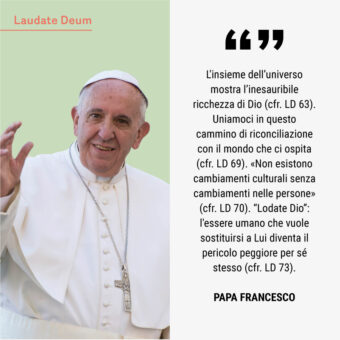
Eight years after the Encyclical “Laudato Si,” the Pontiff calls again in the Apostolic Exhortation “Laudate Deum” all people of good will to respond appropriately to the climate crisis. Still, very little has changed in the facts. The world “is crumbling and perhaps approaching a breaking point.” [2]. Last week, it was reported by the European Union’s climate observatory (Copernicus) that “September was the warmest month ever” (since 1850). Rising temperatures are certainly one of the most conspicuous symptoms of ongoing climate change. Last July, the world’s most authoritative journal in the field, “Nature,” showed that the heat waves of summer 2022 caused nearly 63,000 deaths in Europe. Certainly, we should not fall into catastrophic considerations because the margins for changing course are still possible, but we must categorically reject all irrational and unscientific negations. After decisively responding to all the most common objections against the current climate crisis, the pontiff emphasizes: “I feel compelled to make these clarifications, which may seem obvious, because of certain derogatory and unreasonable views that I find even within the Catholic Church” [14]. He distances himself from blaming the poor. “How can we forget that Africa, where more than half of the world’s poorest people live, is responsible for only a small fraction of the emissions accumulated throughout history?” [9]. Bergoglio addresses a call to each of us “to accompany this path of reconciliation with the world that hosts us and to embellish it with our own contribution” [69]. Unfortunately, some effects of the climate crisis are already irreversible: Some species have “stopped being our travelling companions and have become our victims” [15]. Yet, we cannot but “recognize […] that human life is incomprehensible and unsustainable without other creatures” [67]. All of these cannot leave us indifferent. To enable change, we need to adjust both the way we “look” at others and nature and the way we exercise power to achieve a purpose. Even small individual steps are important: they may not lead to immediate, quantifiable success, but they can act as the blueprint for cultural change and “set in motion large transformational processes that work from the depths of society.” [71]. Caring for every dimension of our planet is a collective challenge that requires a collective response. In recent years there have been many global efforts but with often disappointing results: broken promises and postponed goals. But “if we have faith in the ability of humans to transcend their small interests and think big[…], we cannot stop dreaming that COP28 will lead to a decisive acceleration of the energy transition, with effective and monitored commitments.” [54]. We also cannot give up this “dream.” It is a bet: to win all people of good will to work for a world worth living in.
Stefania Papa
https://www.youtube.com/watch?v=Pwe_bd0TUjk
13 Oct 2023 | Dialogo Interreligioso, Focolari nel Mondo, Non categorizzato
After the disastrous attack on Israel, the horrifying violence that was unleashed, the wave of fear that rocked the two peoples, the anguish for the hostages and the apprehension for the fate of the people of Gaza, we want to send you news from the Focolare communities in the Holy Land and news of a worldwide call to prayer and fasting for peace on 17th October “We have left our homes and all the Christians are taking refuge in the churches” This short message is the latest news we received this morning from some members of the Focolare community in Gaza. According to Father Gabriel Romanelli, parish priest of the Holy Family Catholic parish in Gaza, there are 1017 Christians still living in the strip and among them are several adherents of the Focolare Movement, with whom even sporadic communication is increasingly difficult. And in spite of this, a message, from one of them has been circulating over the past few days, thanking everyone for their closeness and prayers for the small community in Gaza. “You have given me the strength not to give in to evil,” he writes, “not to doubt God’s mercy and to believe that good exists. In the midst of every darkness there is a hidden light. If we are unable to pray, you pray; we offer and our work together is complete. We want the world to know that we want peace, that violence only begets violence and that our trust in God is great. But should God call us to Himself, be assured that from Heaven we will continue to pray with you and to implore Him more strongly to have compassion on His people and on you. Peace, security, unity and universal fraternity, this is what we want and this is the will of God and it’s ours too”. Margaret Karram gave us news about fraternity in the midst of hatred Saying this takes courage today when horror and violence fill the entire media coverage, but this is not the only news. There are also stories that make less noise, but which cannot be silenced, such as the worldwide network of prayer that is underway everywhere on earth, regardless of religious belief or affiliation, together with actions and words of fraternity. Margaret Karram, President of the Focolare Movement shared this at the daily briefing in the Vatican Press Office, at the ongoing Synod of the Catholic Church, in which she is participating as a special guest. She told us, ‘Jewish friends I know in Israel have called me, a Palestinian Arab, saying that they are worried about the people living in Gaza. For me, this is something very beautiful. Everyone knows the negative stories between these two peoples, but so many people, so many organisations are working to build bridges but this doesn’t make the news. They only talk about hatred, division, terrorism. We are left with images of these two peoples that do not correspond to reality. We must not forget that even today so many people are working to build bridges. It is a seed being sown, even in this difficult time’. From our Jewish friends: creating a community of prayer To confirm this, a Jewish friend wrote to us from the Tel Aviv district: “If you are in contact with the friends of the Focolare in Gaza, assure them of my love and my closeness. I hope they are all safe. These days I am at home with my family, the schools are closed and we are staying close to the shelters. The chats are filled with a constant stream of appeals and offers of help for the families who have fled, for the soldiers and their families. There are also requests for help with funerals, to honour the dead as they should be honoured. It seems that all the young men have been called up to fight and we are worried for our friends and relatives. We fear what lies ahead. I try to keep my children from being afraid, but our terror is insignificant compared to what has happened to our brothers and sisters in the South. I am thinking of my Arab friends in Israel who are running to the shelters like us. I try to pray at the same hour as my Muslim friend, so that we can be a community of prayer even though so many things divide us. Your closeness and your prayers mean so much to us, more than what I can express. What can we do? At a press conference, Margaret Karram confided to us the pain and anguish she feels for her people on both sides: ‘I asked myself what am I doing here? Should I not be doing something else right now to promote peace? But then I said to myself: here too I can join Pope Francis’ invitation and pray with everyone. With these brothers and sisters from all over the world, we can ask God for the gift of peace. I believe in the power of prayer’. Margaret went on to speak about the action ‘NO MORE WAR!!! BUILD PEACE!” that the children and young people of the Focolare Movement launched together with the association “Living Peace”. They are summoning their peers to pray for peace at 12 noon, every day and in every time zone. They are also proposing to fill the day with actions that build peace in the hearts of each person and wherever they are. They are inviting them to send messages of support to children and young people in the Holy Land and are encouraging them to ask the leaders of their countries to do all they can to achieve peace. The Focolare Movement is also joining the appeal of the Latin Patriarch of Jerusalem, Cardinal Pizzaballa, for a day of fasting and prayer for peace on 17th October: ” We could organize moments of prayer with Eucharistic adoration and the rosary to the Blessed Virgin. Probably in many parts of our dioceses, circumstances will not allow for large gatherings. However In parishes, in religious communities, in families, it will be possible to organise simple moments of prayer together”.
Stefania Tanesini
11 Oct 2023 | Non categorizzato
The Middle East continues to suffer from violence, clashes and terrorist attacks. Joseph, a young Syrian from the Focolare is one of the many young people who nourish the hope of peace in a very tormented land.
The nightmare of mass killings recurs with all its terror. The Middle East continues to be shaken by wars, terrorist attacks, violence of all kinds with one result, death.
On 6th October in Syria, drones loaded with explosives fell on a military academy in Homs during a festive ceremony. The death toll was about a hundred, of which about thirty were women and children. The next day there was another similar attack during the funeral celebrations, fortunately this time it was neutralized in time.
There was an immediate response from Syria, with a rain of bombs in Idlib, an area outside the control of the government. This escalation of violence caused the United Nations special envoy to Syria, Geir O. Pedersen, to respond by calling for an immediate ceasefire, protection for civilians and the instigation of peace negotiations.
In this scenario of war, as violence continues to intensify and there seems to be no hope for a future of peace, some young Syrians belonging to the Focolare Movement met for their annual congress.
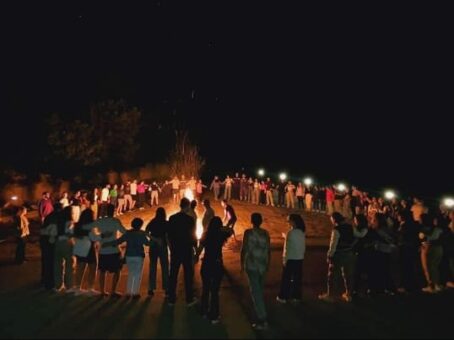 Joseph Moawwad, 24, was there. He wrote to us to share his personal experience. “I’ve been living through a very difficult period lately, a sense of half-heartedness and no enthusiasm; even for this congress, perhaps because of the strong tensions that all of us young Syrians are experiencing. For over 13 years, war and all its consequences persist with the most recent attack a few days ago in Homs. We heard about it right at the beginning of the congress. Despite this, my great surprise was to meet 90 young Focolare people from all Syrian regions. It was as if a storm had removed the ashes that covered the embers of my heart and so the “fire” burst out in me. Experiences of communion, sharing, fraternity between us and that effort to live mutual love in order to have the presence of Jesus among us (cit. “Where two or more are united in my name, I am in their midst”, Mt 18:15 -20) erased everything I felt before and made that flame had been enkindled in me again, become stronger.
At the end of the day, when we were praying together, I felt that I wanted to make a decision: to protect that “flame” that had reignited, to make it grow, to give it to the weakest and most discouraged people. I discovered that unity with the other young people of the Focolare and the mutual love that binds us, are the solution to all this hatred and the evil around us. And then the presence of Jesus in us and among us: it is he who gives us strength and will give us hope for a better future”.
Lorenzo Russo
8 Oct 2023 | Non categorizzato
The statement by the President of the Focolare Movement following the outbreak of serious violence in the Holy Land on 7 October 2023: “Justice, dialogue and reconciliation, indispensable tools for building peace”.
There are no words that can express the infinite suffering that I have in my heart for the peoples of Israel and Palestine, a suffering, brought about by this recent outburst of violence in my country. I am thinking of those who have died, the people who have been wounded, of those who are being held hostage, of those who are missing and their families. In deep faith and together with all the Focolare Movement, I am united to the appeal of Pope Francis and that of the Latin Patriarchate of Jerusalem, and to the words of peace spoken both by those who are responsible for various Christian Churches and by the leaders of the Religions -especially those from the Israeli-Palestinian region – in asking for there to be an end to arms. And as Pope Francis said at the Angelus today -that people can understand that terrorism and war don’t solve anything, but every war is a defeat. In praying to the God of Peace and of Justice, I am also united to all the people throughout the world who are offering prayers, sufferings and actions, so that peace can be victorious over hatred and terror. I want to express a special thanks to those who have written to me from places that are in conflict, like Ukraine, expressing their offerings and closeness, in spite of the tragic situation in which they themselves have been living for over a year. Let us commit ourselves to building a world of fraternity and to do all that is possible so that these peoples and all the others who are in the same conditions of instability and violence, can rediscover the pathway of respect for human rights, where justice, dialogue and reconciliation are the indispensable instruments for building peace.
8 October 2023
Margaret Karram President of the Focolare Movement
6 Oct 2023 | Non categorizzato
The 16th General Assembly of the Synod of Bishops currently taking place in the Vatican opened, on 30 September 2023, with an ecumenical prayer vigil entitled “Together – Gathering of the People of God”. Promoted by the Taizé Community in collaboration with the Secretariat of the Synod of Bishops, the Vicariate of Rome, the Dicastery for the Promotion of Christian Unity and the Dicastery for Laity, Family and Life, the Assembly was conceived and realised by representatives of various Christian Churches. We asked to three of the Bishops present: Charles May – Anglican Church of South Africa; Bertram Meier – Catholic Bishop of Augsburg (Germany); Chrysostomos of Kyrenia, Orthodox Church of Cyprus. Activate English subtitles https://www.youtube.com/watch?v=va9sdPxfovI&list=PLKhiBjTNojHqtFwgi5TYI3T7zRvAuOZiD
29 Sep 2023 | Non categorizzato
The Synod on Synodality will start on October 4th in the Vatican up to the end of the month. Among the special guests is Margaret Karram, President of the Focolare Movement. We are on the threshold of the universal stage of the 2021-2024 Synod on Synodality. On Saturday, September 30th 2023, St. Peter’s Square in Rome (Italy) will gather thousands of people from various Christian Churches for the Ecumenical Vigil, “Together – Gathering of the People of God”, promoted by the Taizé Community in collaboration with the Secretariat of the Synod of Bishops, the Vicariate of Rome, the Dicastery for the Promotion of Christian Unity and the Dicastery for Laity, Family and Life. The protagonists of this event will be young people. At the end of this moment of prayer and celebration, the 464 participants in the synodal assembly will move to Sacrofano, near Rome, for a spiritual retreat until October 3rd. They will return to the Vatican for the solemn opening of the Synod with the Mass celebrated by Pope Francis on Wednesday, October 4th. Immediately afterwards, the cardinals, bishops, religious and laity who will participate in the Synod will begin their work in the Paul VI Hall. For four weeks, the members will participate in plenary assemblies, minor circles, a pilgrimage and moments of prayer and liturgy until October 29th. The President of the Focolare Movement, Margaret Karram, who is among the 9 invited guests, sent a message to all the members of the Movement in the world, expressing what she was thinking about this historic milestone in the Catholic Church: “I cannot hide my feelings from you; above all, my happiness at being able to participate in person in this moment of grace. I am aware that I am taking with me each and every one of you from the Focolare Movement and this is also a great responsibility”. “I am sure – she continues – that many of you have already participated in a stage of the synodal journey in your local churches and have already experienced some of the fruits of the journey. You will have lived them as new opportunities for a dialogue that leads to deeper and broader communion and participation. (…) In this coming session of the Synod we are called even more to ‘walk together’ as the ‘people of God’, so that this may become a permanent and daily reality in our lives for the good of the Church and of humanity”. “This has put in my heart– she says – a great desire: that we should commit ourselves – as the Focolare Movement – to improve, to go one step further, to strengthen and refine our relationships of unity, and to be builders of fraternity in every environment in which we live or work”. And she concludes by inviting everyone to accompany “this new and promising season of the Church” with prayer: “Finally, I ask you for the most important thing: to pray! ‘Without prayer there will be no Synod, said Pope Francis, as does the Secretary General, Cardinal Grech, encouraging everyone to pray with faith and seriousness. It means listeninng to God with the kind of recollection that gives space to Him and allows our hearts and minds to be illuminated by His light. (…) also as part of all the people around the world who are praying and offering , so that the Synod – whose protagonist is the Holy Spirit – may bear the greatest fruit for humanity today and in the future”.
Carlos Mana
28 Sep 2023 | Non categorizzato
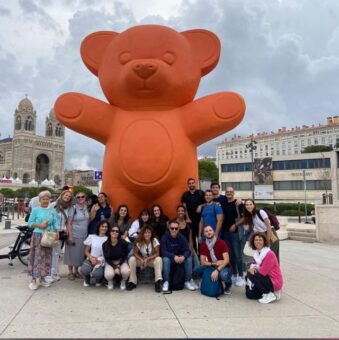
Marseille (France), a city which is a mosaic of peoples and cultures, was the backdrop to the recent “Recontres Méditerranéennes”. It was an event that, through dialogue, traced new pathways of hope for the future. At the General Audience of 27th September 2023, Pope Francis focused his meditation on his recent Apostolic Journey to Marseille, for the conclusion of the “Rencontres Méditerranéennes” (Mediterranean Meetings) that took place from 17th-24th September 2023. He said:
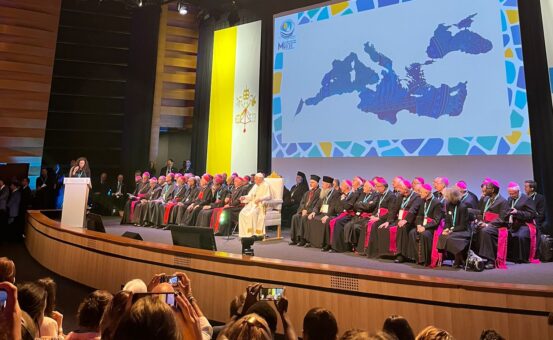
Foto: © Chiara Barbaccia
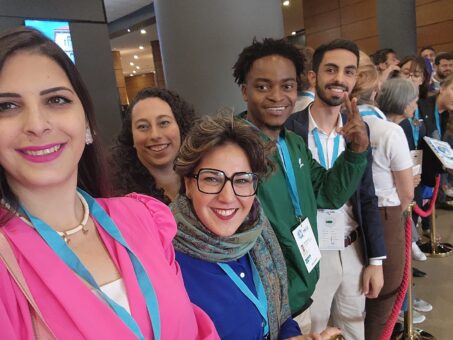
Foto: © Chiara Barbaccia
Maria Grazia Berretta
25 Sep 2023 | Non categorizzato
Looking at the gestures of love performed by others sometimes generates a pull, like magnets, attracts us, softens our hearts and awakens in us a desire to “join in,” to do the same. It is something that does not go unnoticed, capable of truly impacting many. Poems for mother With my mother, there had never been an easy relationship. She used to criticize my faith, calling me deluded. After leaving home, I maintained a relationship more with my father, who wisely knew how to balance the situation. One day he called me: my mother was in the hospital for a serious illness. As I went to visit her, I thought of what could give her joy. I knew she loved the poems of Attila József, so I got one of his audiobooks. My mother was no longer herself, transformed by her sorrow. But as soon as she began to listen to those poems, her eyes became as bright as if she was dreaming. My subsequent visits thus became a discovery or rediscovery of our national poet, but it was a great joy for me to see that she had involved other sick people in reading or listening to the poems. Because of this act of her charity toward them, I felt as if I was getting acquainted with another person: “You taught me that you have to love everyone,” she commented. And me? I was by her when she breathed her last serene and hopeful breath. (L.M.L. – Hungary) Three times a day In the usual expenditures of our family budget, we had included a sum to be made available to those in need. Only that a particular day we could not get it out because there were many expenses. It was a real disappointment for us. At this point our two little sons came with their wallets and, in front of us, poured the entire contents, all their savings, onto the table. The episode was followed up when Grandma came to visit us and the children told her what they had done. And she, looking at us puzzled, “But how, you help others when you are also in need?” Before we could react, clearing the air was the youngest who said, “But Grandma, we eat three times a day!” With that sentence, serenity returned, and a few days later Grandma also returned with an envelope in her hand: “This is my contribution that I put together with yours… After all, I too eat three times a day!” (L.R. – Italy)
Edited by Maria Grazia Berretta
(taken from The Gospel of the Day, Città Nuova, Year IX – No. 1 September-October 2023)
22 Sep 2023 | Non categorizzato
The 10th International Congress of Sportmeet for a United World was recently held in São Sebastião, Brazil – 20 years after its inception. It continues to promote a culture and practice of sport that can contribute to peace, development and universal fraternity. A worldwide network of sportspersons, sports operators and professionals, men and women of all ages, cultures, ethnicities, languages and religions who see physical and sports activities as important and positive realities for the integral growth of the human person and the community; people animated by the desire to contribute, through sport, to development, peace and building a more united world. This is the mission of Sportmeet for a United World, an expression in the world of sport of that spiritual and social renewal that the Focolare Movement wants to contribute to implementing. With a representation at the United Nations by New Humanity, an NGO accredited to UNESCO, this reality celebrated its 20th anniversary a month ago in São Sebastião, Brazil, where the 10th International Congress of Sportmeet for a United World was held. Federica Comazzi, president and international coordinator, told us all about it. Federica, who took part in this meeting and how were the activities divided out? What were the objectives and topics covered? The conference was built in collaboration with Ecoone, MPpU (the Political Movement for Unity) and the municipality of São Sebastião (Brazil) which provided the municipal theatre, accommodation and transport through its Department for Sport,. In collaborating with Ecoone and MPpU, Sportmeet felt supported by these realities that enriched the programme with their contributions, took care of relations with political and academic authorities, and offered an important contribution towards drafting the final manifesto signed at the end of the event. The objective was to initiate a process of rethinking sport with a socio-environmental perspective, starting from a reflection on the lights and shadows of contemporary sport, enlightened by a principle common to different peoples from different parts of the world, that of Well Being (Teko Porã in Guarani, the language of the indigenous peoples present in the territory of São Sebastião and other parts of South America). The congress was attended by around one hundred people from eight institutions that are active in the fields of education, recovery from addiction, and social integration in the suburbs of large metropolises and cities in Brazil, Argentina, and Colombia. The programme was developed around the presentation of several papers. Each afternoon there was room for practical activities and an in-depth study of the local culture. “Can sport, which helps build fraternity between people, also contribute to improving human existence from a socio-environmental point of view?” was one of the questions at the centre of the congress. After looking at nature and the local reality in Brazil, what was the answer to this question? It became abundantly clear that the fight against poverty and a new economic paradigm not based exclusively on the quantitative parameters of growth stand out not only as a necessity, but also as an emergency. In this context it was made very clear how play and sport constitute an irreplaceable force with enormous potential in terms of human development and the spread of a culture of sharing resources, basic elements for an integral ecology that can save humanity from environmental disasters. The definition of Well-Being helps us understand how universal fraternity and respect for nature are connected. Although it is not a closed and well-defined principle, since it is enriched by the gaze of so many peoples of the earth, Well Being is defined starting from three harmonies: with oneself, with others and with nature. Sport today, the official sport promoted by the Olympic Movement, too often has an approach based on the exploitation of natural and human resources for a single purpose: money. There is an imbalance between these harmonies, and it is clear how this has led this great container to be emptied of its values. We need to return to a sense of play, as conceived prior to the Olympic Movement itself and experienced in indigenous communities. It carries with it a deeper, symbolic value that leads us to a deeper understanding of who we are. We need to rethink a game and a sport that does not have as its primary objective the interest of the individual and therefore does not exploit resources, but permits encounter between people, nature and souls. In celebrating these 20 years of Sportmeet’s journey, what are your hopes for the future? The event in Brazil was the first international meeting after the pandemic and it highlighted and confirmed two features of Sportmeet’s mission. Firstly, the academic dimension, to be carried out with a nucleus of professors from different Universities and Institutions scattered across the different continents who found resonance in the values and experiences of Sportmeet with respect to their work. Secondly, a sphere, which is not disconnected from the first, of action for socio-cultural change in sport and through sport, with the challenge of forming a network of people from the different organisations that have expressed an interest and recognise how useful it is to have a common space – also to avoid the risk of self-referential isolation. The story of Sportmeet has highlighted a fundamental element: that culture and life must go hand in hand and that they can enrich and nourish each other.
Maria Grazia Berretta
https://youtu.be/NtwiaVAYPdY
20 Sep 2023 | Non categorizzato
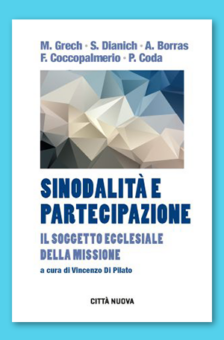
The second year of the Synodal Training Course, which began in 2022, has been launched. The Course is organized by the Sophia University Institute’s Evangelii Gaudium Centre (CEG), with the collaboration of the General Secretariat of the Synod. The second year of the Synodality Training Course will focus on being “missionary disciples” at the service of universal fraternity. The 2023/2024 Course was inaugurated on 12th September: https://www.youtube.com/watch?v=v0set08JiKY Initiated by the “Evangelii Gaudium” Centre (CEG), a theological-pastoral training centre present within the Sophia University Institute in Loppiano (Italy), with the valuable collaboration of the General Secretariat of the Synod, the lessons will begin on 6th November. To learn more about it, we interviewed Prof. Vincenzo Di Pilato, Professor of Fundamental Theology at the Pugliese Theological Faculty in Italy and Coordinator of the CEG. Professor Di Pilato, what was your experience last year and what were the results? The first year of the Online Course on Synodality, which ended last May, was very rich and, I would say, exciting. The 248 participants came from the English-speaking world (Canada, Ireland, UK, and USA), Latin America (Brazil and almost all Spanish-speaking countries), Asia (India, Korea, Malaysia, Philippines, and Singapore), Africa (Burundi, Cameroon, Congo, Kenya, Nigeria, South Africa) and almost all European countries. There were many representatives of diocesan or national churches engaged in the synodal process, including priests, religious and lay people. The majority were Catholics of all vocations: priests, nuns, consecrated persons, lay people, even a Bishop. There were also representatives of other sister Churches. Although the videos and texts of the lessons were available on a web platform (especially for those who for whom the time was inconvenient), there were students from Asia who connected live, at three in the morning (local time). It was a strong experience. Then in June, at the end of the Course, we held the fourth and final module in a face-to-face workshop, at the “Vinea mea” Spirituality Centre in Loppiano (Italy). 130 people participated. We focussed on themes such as: clericalism, participatory processes and community discernment. It is now clear that the Course, which will open for the second consecutive year, represents an attempt to respond to the call that the Holy Spirit, since the days of the first Pentecost, addresses to us to “go out”. Among the many letters received, one was from a person in charge of the diocesan level of the synodal journey in Malaysia: “Thank you very much for the wonderful sessions. I am truly grateful for the opportunity to learn so much about the origins of the synodal Church and synodality. It really opened my eyes to the great wisdom and suggestions offered by the Holy Spirit who guides the Church. Honestly, while listening to the sessions of the first module, I felt so poor, but at the same time enriched. And that’s why I’ll be signing up for the next year. ” What issues will be addressed in this new year? First of all, we will try to be in tune with what will emerge from the Synodal Assembly next October. When we looked at the basic text (Instrumentum laboris) on which the members of the Ordinary General Assembly of the October Synod will work and which is the outcome of the community discernment during the listening phase, we realized that some issues seemed more urgent than others, such as: ministry, places and method of participation, formation to become “missionary disciples” at the service of universal fraternity. Each 3-hour lesson will take place via internet from 6.00 to 9.00 pm (Italian time) on Mondays from November 2023 – May 2024. The course will be in Italian with translations into English, Portuguese and Spanish. This year too, we will conclude with a face-to-face residential meeting here in Italy, again using a workshop methodology. You can register for the Course at this link: https://www.sophiauniversity.org/en/centro-evangelii-gaudium/. The active support of the General Secretariat of the Synod in these two years encourages us to move forward in being builders of unity in the Church and in the world, according to that synodal form with which Jesus lived his human-divine existence with the Apostles and with all his disciples. The “going out” to which the Holy Spirit impels us, through the clear voice of Pope Francis, is not, in fact, equivalent to dispersing, to fragmenting, but is to lead our individual spiritual life to that of the Forsaken and Risen Jesus who embraces everything and everyone. As the title of the Working Document for the continental stage of the Synod stated, it is a matter of “widening the space of our tent” (cf. Is 54.2). You have just edited a book entitled, “Synodality and Participation, the ecclesial subject of mission”, (published by Città Nuova). It is a collection of interventions of experts from the ecclesiastical and theological world. What is the contribution of this text in the light of the documents which have emerged from the various stages of the Synodal Path and on the verge of the new universal stage? The book is a collection of the inputs of a research seminar organized by the CEG, on 24th June, 2023 at the “Vinea mea” Spirituality Centre in Loppiano (Italy). The seminar was entitled: “Participate/preside/decide. Sacramental root and communal dynamic in the journey of the people of God on mission”. Over thirty scholars participated, including theologians and canon lawyers engaged in responding to the invitation expressed in the Instrumentum laboris, to rebalance the relationship between two fundamental ecclesiological principles: that of “authority”, strongly affirmed in the current Code of Canon Law, and that of “participation”, which the current Synod is relaunching as an ordinary practice of the life of the Church. We asked the experts present at the Seminar how we can effectively enable the active participation of each member of the people of God (faithful and pastors) within our communities? Will such participation remain at an advisory level or will it have authority? Will it be a matter of negotiating for a legal “concession” or rather of “recognizing” the decision-making capacity of the collective subject of ecclesial action as it emerges from the ecclesiology of the Second Vatican Council? And will an update of the Code of Canon Law be necessary? As Card. Mario Grech, Secretary General of the Synod, said, the synodal journey has entered a new phase: it is called to become a generating, dynamic event and not simply to be reduced to a solemn celebratory transient moment. How can the Church listen to the Holy Spirit without listening to the entire holy people of God? As Card. Francesco Coccopalmerio, Severino Dianich, Alphonse Borras and P. Coda, in their dense interventions contained in the book say, the answer to this question has an impact on pastoral practice (think of the various parish, diocesan councils, etc.) and on formation, as well as on theology and canon law. (https://edizionicittanuova.it/prodotto/sinodalita-e-partecipazione/).
Maria Grazia Berretta
15 Sep 2023 | Non categorizzato
Allow our lives to be a continual praise of God by acknowledging His love and the greatness of His works in our lives. This is what this Psalm invites us to do. It is the foundation of every prayer, especially when, by loving the brothers and sisters we meet, we understand the fullness of gratitude. Concrete help for far and near The war in Ukraine brought us apprehension and fear. In response to this wave of evil, when winter arrived last year, we and other friends of the parish worked to procure heavy clothing and generators and flashlights to supplement the lack of electricity, to be sent to our neighbours close to our border. But one thing led to another and looking around, we then extended this solidarity action to the poor of our town. Without realizing it, a division had arisen in our society that we hadn’t paid enough attention to before. Someone pointed out that it took the war in Ukraine to open our eyes. Today, in addition to continuing the collections for the victims of war, we also work for those closest to us who are in need. (J.M. – Hungary) Hope In the waiting room of a bus station, I noticed a young, beautiful, elegant lady. Her face displayed signs of grim suffering. We got on the same bus. Then, at the train station, we bought tickets for the same destination. I made a bit of innocent conversation as we headed to our platform. Unfortunately, our train had just left; we had two hours of waiting ahead of us. I invited the lady to sit in the waiting room. Looking at her tense face, I put aside my problems and tiredness and decided to listen to her. While she talked to me about the trauma she had been experiencing for months, I found myself reliving an awful situation. I told her about it. Later, on the journey, our conversation was so intense that we didn’t realize that we had reached our destination. I tried to say goodbye, but she wanted to accompany me to the place where I had to go, so as not to interrupt our conversation. Her face had relaxed, her burden lightened. Then the goodbyes. Maybe I won’t see her again, but I’m sure that hope was born in her heart. (RA – England) Smiles help you keep going I am a palliative care doctor. In the morning, it is nice to be greeted with a smile and the relaxed faces of those who the night before were afraid of how they would spend the night because of the pain: yes, everything went well, and I feel better too. It couldn’t be taken for granted: opiates are still feared drugs because they are little known and needed to be discussed in a transparent doctor-patient dialogue. I observed another sick woman, whose communication was limited to movements of the eyes. I asked her, “Are you in pain?” Closing her eyelids meant yes. I wondered: how did I not notice before? I proposed a treatment which she accepted. Her frown relaxed, her eyes smiled. When I find myself facing my limits every day, I stop smiling. In those moments, others (a colleague, a family member, a worker) are like my “mirror” and help me to look inside myself. I need a good dose of humility to learn to accept myself. But then I laugh at myself and, having passed through the cloud, I see the possibility of starting to love again. (Paola – Italy)
Compiled by Maria Grazia Berretta
(taken from The Gospel of the Day, Città Nuova, year IX – no.1 September-October 2023)
8 Sep 2023 | Non categorizzato
On 8 August 2023, at the age of 99, Livia Groff (widow of Olivo Goller), a married focolarina from Trent (Italy) and part of the first Focolare community formed around Chiara Lubich, returned to the house of the Father. We remember her through a short extract in which she tells us what true conversion was for her. “If anyone is in Christ, he is a new creature” (2 Cor 5:17). This is the phrase taken from the New Testament that Chiara Lubich, founder of the Focolare Movement, gave Livia Groff as a motto for life who ended her journey on this earth on 8 August at the age of 99. Born on 25 May 1924, the third of 7 sisters, she began working as a shop assistant in Trent as a young girl. At the invitation of her friend, Doriana Zamboni, one of Chiara Lubich’s first companions, she met Chiara when she was 21 and joined the group of girls around her who took the words of the Gospel literally, put them into practice and shared with each other the effects of living those words. For Livia, this encounter was like a real thunderbolt. Discovering the love of God and discovering Jesus present in every neighbour were to become the polar star of her life and the certain guide on a journey she always shared with her husband, Olivo Goller, and her children, Diego, Maria Elena and Andrea. A witness of great fortitude and closeness to her neighbour, she faced the various trials that life put before her sustained by her faith in God and His love. For 37 years she cared for her husband Olivo who, due to an inexplicable car accident, was left paralysed in his legs and unable to walk for the rest of his life. Another great trial came for her at the age of 61 when her daughter Maria Elena died suddenly of a heart attack at the age of 33, in Predazzo, near Trento, where she taught. With great courage and concreteness Livia always tried to put Jesus at the centre of every relationship, and with extreme kindness she knew how to take care of anyone she met on her path, accompanying her sons, Diego and Andrea, both focolarini, in their life choices; supporting the sick, as an extraordinary minister of the Eucharist as she had already done with her husband; inviting many to prayer. A beauty, which many recognised in her, incarnated, which went beyond style, but which concealed within itself a secret: the ability to look at the love of Jesus on the cross who cried out his abandonment, and recognise this in the trials of life and accept it without hesitation. We share below a short extract of an interview Livia Groff gave in Trent, dated 13 December 2011, in which she tells of her first meeting with Chiara Lubich and the beginning of a journey that changed her life. Watch the video (activate English subtitles) https://youtu.be/vmFJ5v15rLg
31 Aug 2023 | Non categorizzato
The Season of Creation is a time during which Christians around the world unite in prayer and action to care for our common home. It’s a time of grace that the Christian Churches propose to encourage people to renew their relationship with the Creator and with creation, through meditation, conversion and community commitment. Each year, this period opens on 1st September with an ecumenical celebration on the occasion of the World Day of Prayer for the Care of Creation and ends on 4th October, the feast of Saint Francis of Assisi, patron saint of ecology loved by many Christian confessions. The theme chosen for this 2023 is “Let justice and peace flow“. It draws inspiration from the words of the prophet Amos, “But let justice roll on like a river, righteousness like a never-failing stream!“ (Amos 5:24). The hope, therefore, is that like a “mighty river” these two elements, justice and peace, can invade our planet with well-being and beauty. It is a challenge that certainly mobilizes us and to which everyone, as part of the people of God, is called to respond by committing ourselves on the front line and in our own small way, to create bridges of dialogue, for climate and ecological justice, listening to the communities most affected by the loss of biodiversity. There are many activities and initiatives launched around the world in preparation for the opening day, such as the one promoted by the Laudato Sì Movement, which invites us to pray for climate justice and share this prayer with all the negotiators and political leaders of COP28 (https://laudatosimovement.org/pray-with-us-for-climate-justice/). You can register for and access the Ecumenical Prayer Meeting on 1st September, through the following link: https://us06web.zoom.us/webinar/register/WN_s6x-_ULjRZWRyzUYGNAhAg#/registration. Or you can watch it on the Laudato Sì YouTube channel: https://www.youtube.com/watch?v=pv3kExaSMmI For more information visit https://seasonofcreation.org/en/. https://youtu.be/VTm53zJN6NA?si=gQpYtBQ2uznuPIpU
18 Aug 2023 | Non categorizzato
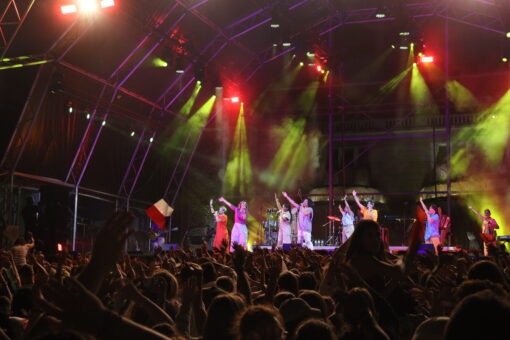
From the end of July to the beginning of August 2023, Gen Verde travelled the length and breadth of Portugal. A fortnight long tour featuring art workshops and concerts. Many young people were involved in an experience of transforming music into a means of testimony and encounter. The journey, from 23rd July-4th August, started in Braga (north Portugal), continued south to the Algarve and concluded in Lisbon, in the festive and intoxicating atmosphere of a World Youth Day (WYD). This was the itinerary of the Gen Verde International Performing Arts Group, an all women band which began in 1966 from an inspiration of Chiara Lubich, founder of the Focolare Movement. 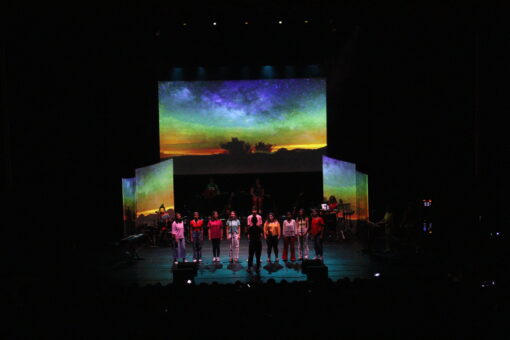 It was a demanding tour characterized by encounters and friendship. The seeds sown through words and notes yielded a rich harvest of real life experiences. One of Gen Verde’s projects is the “Start Now” workshop, a musical and artistic project which focuses on peace and dialogue education. One such workshop took place in Braga with an amazing group of young people from Spain and Portugal and included a special collaboration with Projeto Homem Braga (PHB). PHB specializes in the treatment, prevention, harm reduction and reintegration of people with addictions. After a meeting with Gen Verde, one of the PHB educators said, “We usually feel a bit anxious when we invite people from outside to get to know the users of our Centre because we don’t want to disturb their recovery process. Today we have to thank you for giving so much joy to all of us”. A Spanish boy who attended the workshop commented, “We have discovered that music, dance and art can really help us overcome many barriers, such as linguistic and cultural barriers. Sometimes it’s difficult to ‘row’ in the same direction, it takes patience because we don’t all go at the same pace, but one thing we carry with us is the joy that is transmitted, beyond the difficulties. Love makes us overcome all conflicts”. To the sound of “Girl On A Mission (Magnificat)”, the song composed by Gen Verde for the WYD, the Band moved to Faro (Algarve- Portugal) where they participated in the Dioceses’ pre-WYD preparation, concluding on 31st July, with a concert in the Algarve Stadium. Next stop was the Portuguese capital for another “Start Now” workshop with about 100 young people. At the end, on 2nd August, the young people performed with the Band in the jam-packed Auditório da Faculdade de Medicina Dentária. A Portuguese girl said, “It was very gratifying to take part in an activity like this because we can learn about and get to know others. We understood that it is important both to say our opinion and to know how to lose that idea in teamwork. The word that summarizes everything we have learned is humility, to give others the opportunity to express themselves”. Another girl spoke about learning to overcome challenges in the sense of “being able to listen, to understand others’ ideas, to learn how to interact, to let go of shyness and create something beautiful and do it together”. Marita Alvarez (Argentina), one of Gen Verde’s singers, told us: “Over the years, we have met many young people in our artistic workshops in many countries, from Slovakia, Poland, Ukraine, to Spain, Austria, Germany and Italy, to name a few. Deep, true and lasting relationships have been formed. We have seen how these young people become leaders of their communities, committed and ready to multiply joy through the “Magnificat anima mea” that God has brought about in their lives”.
 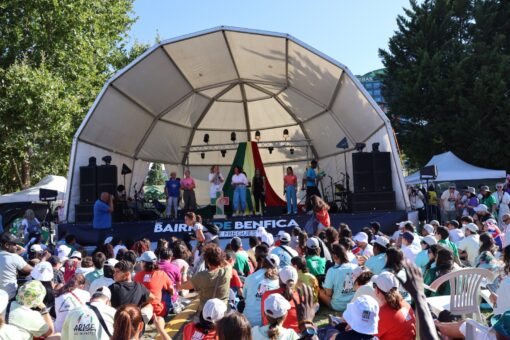 With the WYD, Lisbon gleamed with all the colours of youth. It was a unique opportunity to give witness and at the same time, experience the vivacity of a pilgrim Church which, from all parts of the globe, calls us by name. In this family spirit, Gen Verde took part in the second day of the “Rise Up” catechesis organized by the Focolare Movement. They sang and animated the Mass with over 7,000 young people. They then concluded their trip to Portugal on 4th August, with a concert in Alameda Dom Afonso Henriques, at the end of the Halleluya Festival. Jesús Morán, Co-President of the Focolare Movement was there and had this impression, “I was very struck by their unity. The young people were overjoyed. They were all taken by the rhythm and the music, but the songs include many deep moments and in those, the young people were able to pause and reflect. I thought it was like a ‘fifteenth station’ of the Via Crucis! There is no such thing and yet as everyone says and imagines, it is a sign of the Resurrection. It was a hymn to the Resurrection, to joy. I believe that this is the right way to communicate the Gospel with a musical language that young people love”.
Maria Grazia Berretta
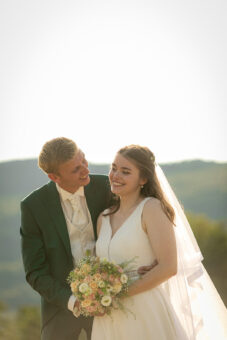
17 Aug 2023 | Senza categoria
Benoît and Chloé Mondou, a young couple from France, decided to start their married life by taking part in the World Youth Day in Lisbon (Portugal).
“Initially we thought our honeymoon would be a tour of Europe, but when the opportunity to go to WYD came up, we didn’t hesitate for a single second!” Benoît and Chloé Mondou were married in Haute-Savoie (France), a week before World Youth Day in Lisbon (Portugal). He is twenty-four years old and she is twenty-two. They met seven years ago in the scout group of which they are active members. Today they are volunteer guides. Benoît has known the spirituality of the Focolare since he was a child and, through him, Chloé began to live it too. They set off for Lisbon with a group of young people from the French speaking countries of the Movement: France, Belgium and Switzerland. They said, “We didn’t give up the trip to Europe but we thought that it was really important to go to the WYD. Now we can say that it put down an important marker for our marriage”.
In their home town, Benoît and Chloé are also involved in a social project in which they visit people in nursing homes. Chloé said, “We are lucky to have been brought up in the same religion but we are also fortunate that we like praying together. For this reason, taking part in the WYD has given an even greater dimension to the faith we both have. During the WYD, there were times when we were separated, but then we met for praise or adoration and so we had those moments to pray together”. Benoît continued, “It was very strong because in normally in daily life we don’t really have the opportunity to pray together. In Lisbon taking time together, even if you were in a group, was strong. Personally, I think it’s an experience you should have at least once in your life. And if you can do it as a couple, even better”.
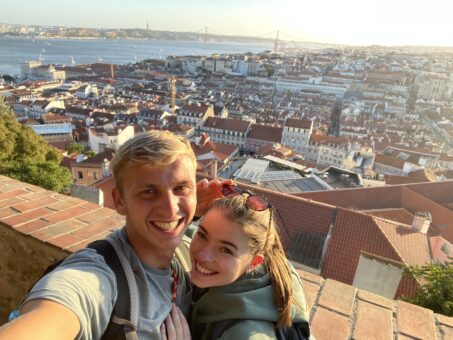 The moments with Pope Francis were fundamental. Chloé said, “For me the most important thing that the Pope said was when he reminded us that we are all loved, each person as they are, because when you are part of a group, sometimes you tend to create your own personality to stand out, to be accepted. But in places like that you realize that this is how we really live with each other, this is how we are natural and this is how God loves us more.”
Benoît continues, “From the words of the Pope I feel I am taking up a challenge that is close to my heart: to try to be Jesus. The Pope invited the one and a half million young people who were in Lisbon to return to our countries, to spread the good news, to help others and to bring others ahead with the word of Christ. “
Chloé reflected “At the WYD I discovered a new way of living my faith. I realized that there are many different ways to live faith and it doesn’t matter if one person goes to sing in the street and another prefers to be alone at the back of a church. In a family, everyone has to find their own place and their own way of praying”.
Benoît concluded, “We left Portugal with greater faith. This experience increased the desire, which we already had, to raise our children in the faith and to educate them in the Gospel. After our wedding in the Church, we needed this WYD, this pilgrimage, recollection and prayer. It was really good for us”.
Anna Lisa Innocenti
15 Aug 2023 | Non categorizzato
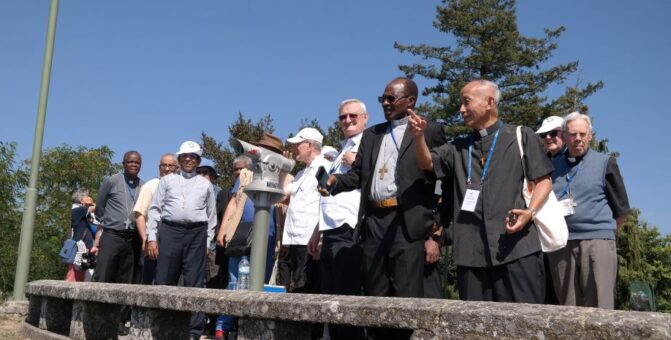
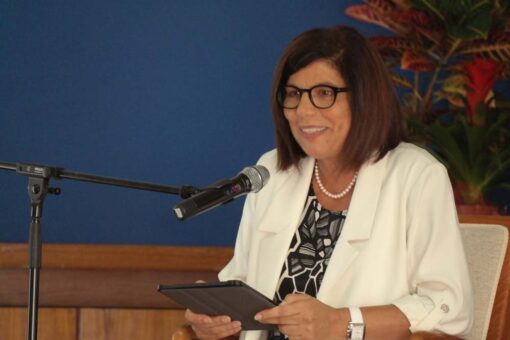
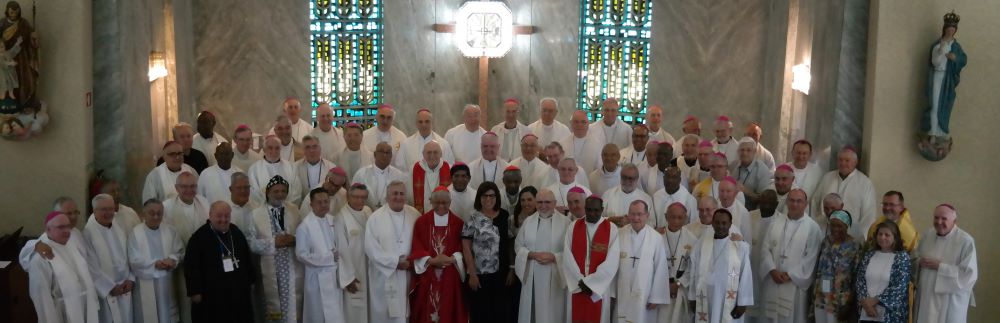
After World Youth Day in Lisbon, the International Meeting of Bishops Friends of the Focolare Movement was held from 8th-10th August 2023 in Braga, northern Portugal. In the aftermath of the World Youth Day in Lisbon, 87 bishops from 42 countries stayed on in Portugal for a meeting, organised by the 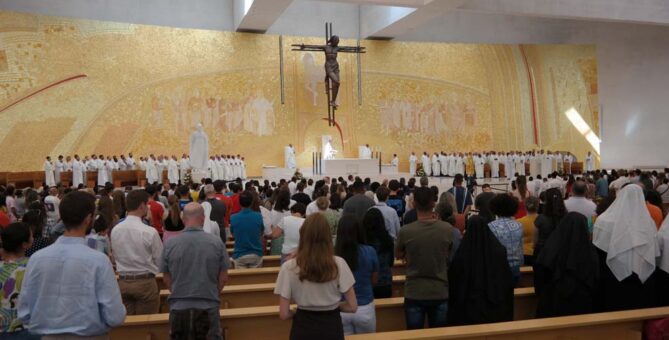 Bishops Friends of the Focolare Movement. They gathered to reflect on “The Mysticism of Encounter – Contemplation and Mission in a Changing Age“. En route to Braga, on 7th August, the first stop had to be the Shrine of Our Lady of Fatima, as it was the feast day of the two shepherd saints, Francisco and Jacinta. Recognising that massive changes are occurring, which call for an adequate response also from the Church, from 8th-10th August they reflected on and put into practice the “mysticism of we”, seen as a response to the new stage of witness and proclamation of the Gospel to which the Holy Spirit is calling the Church today. They took up once more Pope Francis words to the Focolare Movement on his visit to the little town of Loppiano in 2018, when he said that the charism of unity given to Chiara Lubich “is a providential stimulus and a powerful help to live the evangelical mysticism of ‘we’”. Margaret Karram, President of the Focolare Movement, and Jesús Morán, Co-President, attended the whole meeting and made various contributions. Margaret’s talk invited everyone to “Start from unity in order to ‘be’ and to ‘speak’ today“. Unity is the life of God, she said,
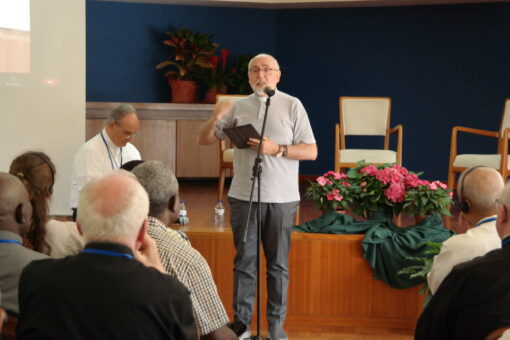
  and we who want to imitate that life are invited to live it and we have a duty to proclaim it courageously. The comments and sharing in plenary that followed highlighted a renewed faith in the importance of seeking unity in the Church and in the world; and language groups enabled further deepening of the subject.
  The various components of each day contributed to experiencing the ‘mysticism of we’, whether that was in the conversation with a group of young people who took part in WYD; in the testimonies shared by bishops on the synodal path; or insights into the daily life and suffering of particular Churches. Insights
 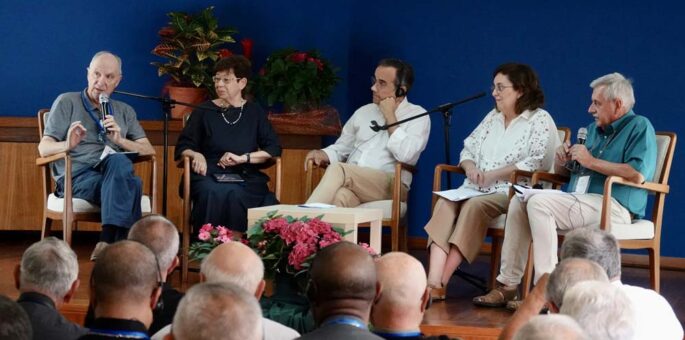 A few weeks before the Synod Assembly in October, Cardinal Mario Grech, Secretary of the Synod, and Prof. Piero Coda, a member of the Synod’s theological team, contributed to the meeting by video link. The Synod aims to help us rediscover unity in the one baptism, to equip us to live together despite our differences, and to teach us how to inhabit the tensions in which we inevitably find ourselves. A panel discussion that set out to present some answers to the pressing problems in the Church and societies today, generated much interest and led to numerous questions. Father Fabio Ciardi, OMI, emphasised the treasures to be found in charisms both old and new; Francesca Di Giovanni, former undersecretary of the Vatican State, spoke of the place of women in the Church, who must not only be valued according to roles they might have but considered in view of the ‘gift’ they are for the Church. Rosinha and Amandio Cruz, a married couple working within the Archdiocese of Braga, presented aspects of the renewal of the Church and of evangelisation which are supported in particular by families. On the last day, Father Fabio Ciardi spoke on the ‘wounds’ of the Church today, and on the light Chiara Lubich had found in the discovery-revelation of Jesus Forsaken. He is the one who took upon himself every division and who generates reconciliation; he is the foundation of the ‘mysticism of we’. There were also moments of recreation and cultural enrichment, such as the visit to the nearby Bom Jesus do Monte Shrine, where Cardinal Francis Kriengsak, Archbishop of Bangkok, presided over the Eucharistic celebration. Francis Kriengsak, Then, with a glorious sunset as a backdrop, the local Focolare community offered a typical Portuguese dinner, followed by an exhibition of traditional dances. At the conclusion of the meeting, in the Mass presided over by Cardinal Lazarus You, Prefect of the Dicastery for the Clergy, the Bishops renewed their commitment to put into practice Jesus’ commandment: “love one another as I have loved you” (Jn 15:12).
Carlos Mana
8 Aug 2023 | Non categorizzato
These were Pope Francis’ final words as he said goodbye to the young people and all the participants at the concluding Mass of World Youth Day 2023.
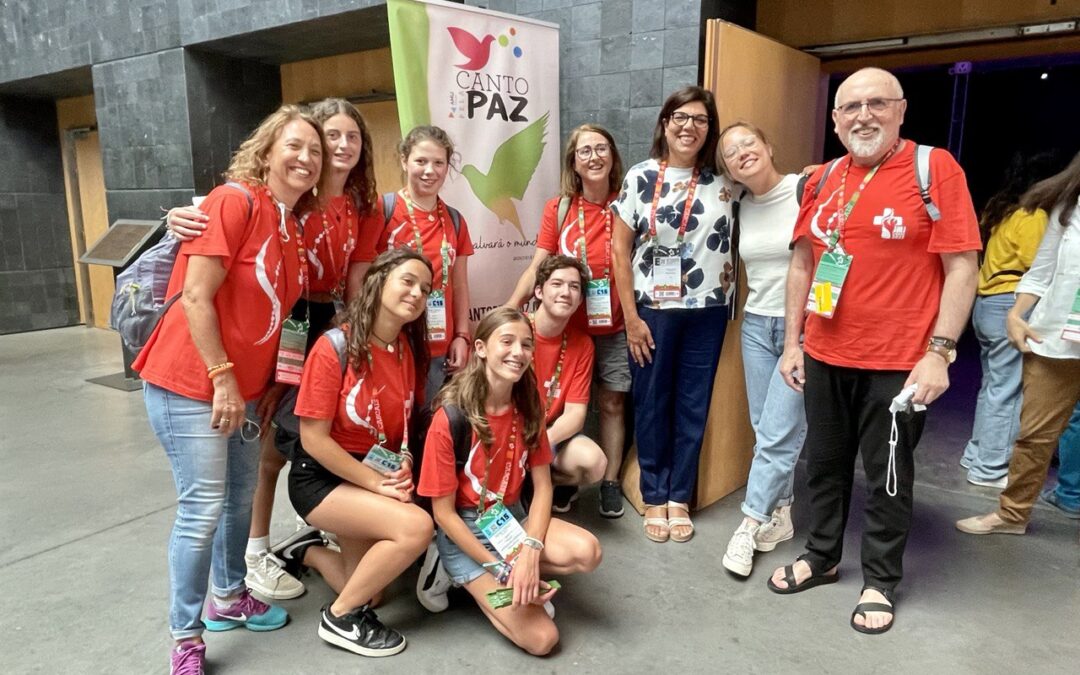
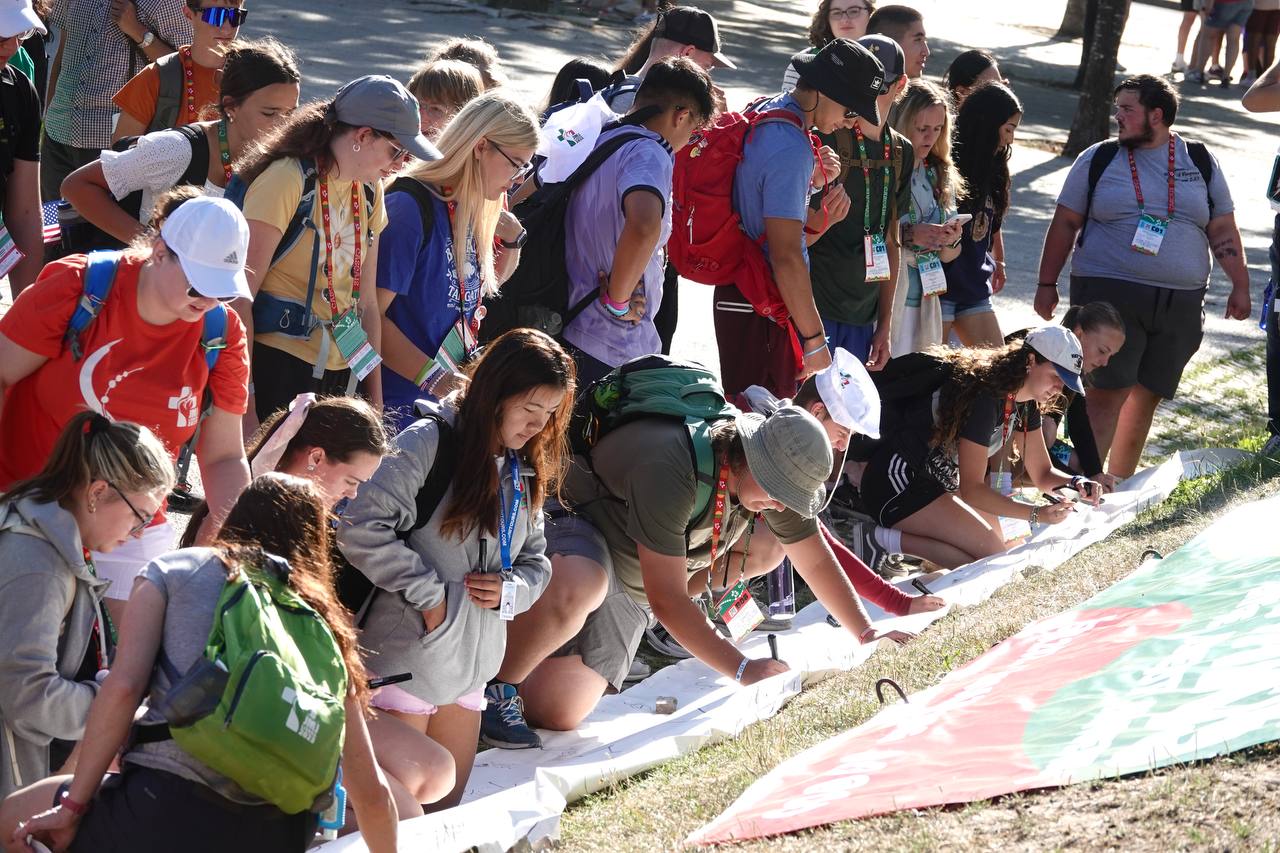
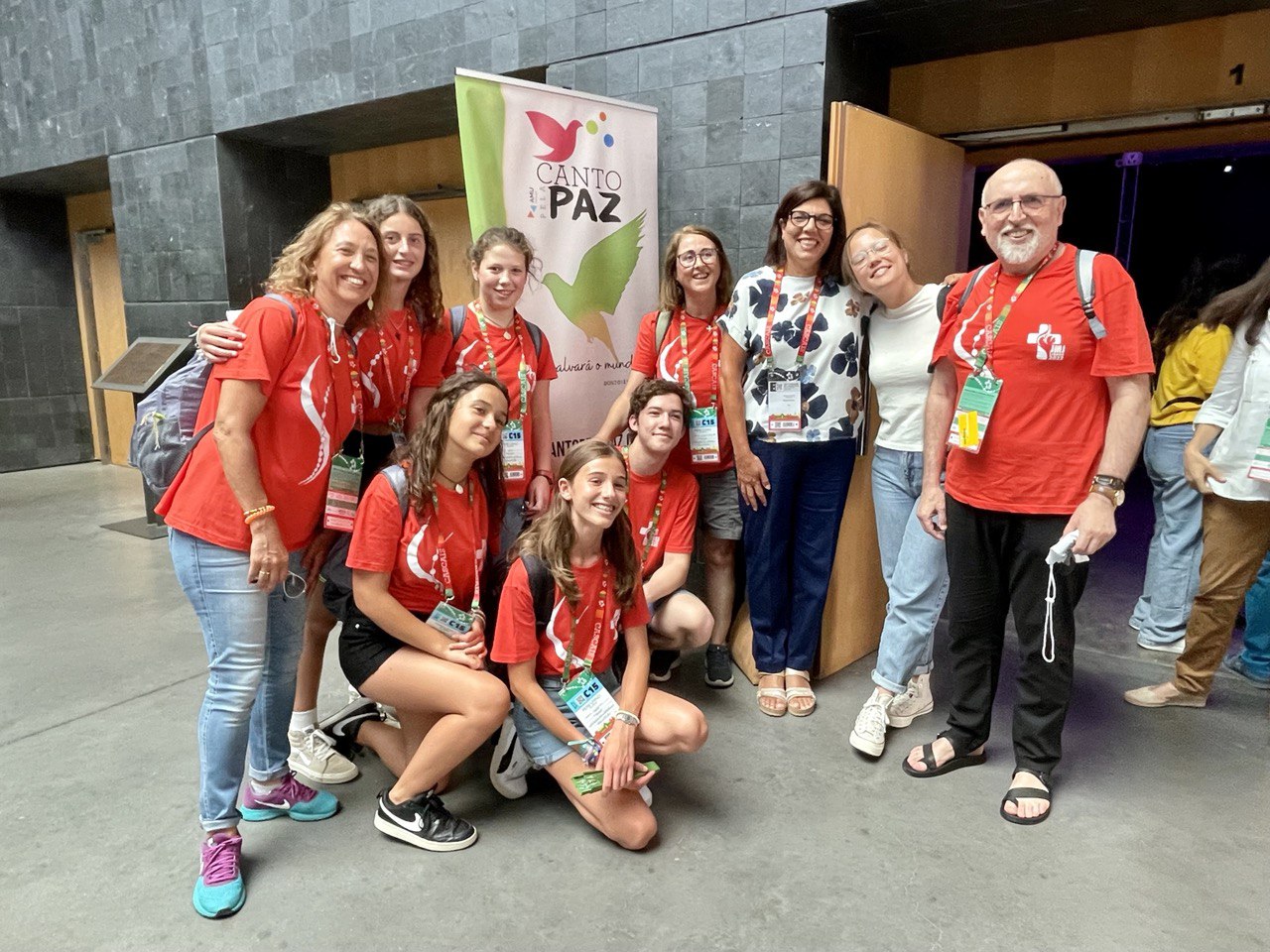 It is difficult to describe what we experienced during these unforgettable days of grace. I know it is a cliché to say that you have to experience it to understand it. But it is true! It is certainly true on this occasion. I have participated in four WYDs, the first two and the last two, and I can testify that there is something about these days that cannot be explained. A well-known Portuguese public figure, who is agnostic and a cinema lover, wrote in a newspaper article that what he contemplated on the streets of Lisbon in this scorching summer was the most beautiful film he had ever seen. It was impossible not to be uplifted by the cheerfulness and liveliness poured out in torrents by the young people who had come to the ‘city of light’ and who filled it with the other light they carried within themselves. We saw them everywhere, in the shopping malls, in the metro, on the buses, in the bars, in the parks or on the roads. They gathered in small and large groups, and were like multi-coloured, loud, talkative, multi-charismatic human rivers, with a kindliness that warmed the heart. Walking among them, I saw the inhabitants of the city; some were puzzled, some interested. If Lisbon, with its magical and indescribable beauty, was a gift for these young people, they were no less a gift for this city, which will be proud to have seen one and a half million young people come together to celebrate their faith in Christ, something previously unheard of.
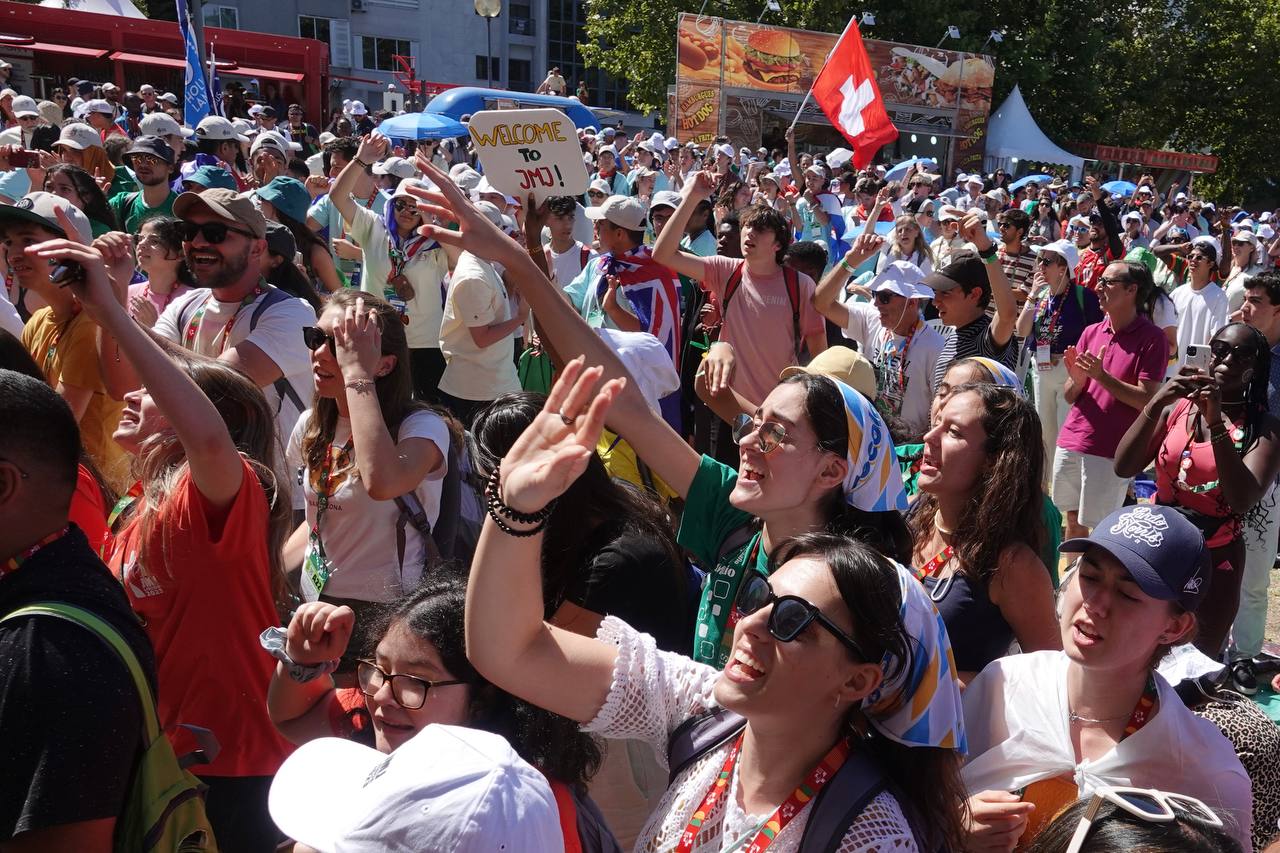 The Portuguese Church and the Dicastery for the Laity, Family and Life, the organisers of the event, together with the city and its civil authorities, did an amazing job. But there is no doubt that the prize goes to the young people. Who could have imagined this happening after three years of a serious pandemic and in the midst of an institutional crisis, such as the one the Catholic Church is going through because of abuses of various kinds?! Even though today the Spanish press gave coverage to the case of a girl with 5% visual capacity who claims to have recovered her sight in the past few days, for me the real miracle was the living faith of these young people, expressed in their own words and with a multitude of bold and even disconcerting gestures.
 In fact, while they showed an overflowing enthusiasm by singing and dancing, the most emblematic moment – indeed the real centrepiece of the event – was once again the Eucharistic adoration at the vigil: more than a million people knelt down without anyone telling them to do so, to adore in ‘deafening’ silence the One they consider the ‘heart of the world’! It was impossible not to be moved. And at that moment, the fado given to us by the singer Carminho gave us goosebumps: ‘You are the star that guides my heart/ You are the star that has lit my path/ You are the sign that I guide destiny/ You are the star, and I am the pilgrim’. And one wonders at the power of attraction that a small host can exert on such a large crowd of young people spread over a field over three kilometres long (100 football pitches).
You might think that the young people who gathered in Lisbon are good people, with an orderly life, polite young people, who do not get involved with other people’s problems. Nothing could be more mistaken. An international group of young people toiled for years to come up with an artistic framework of extraordinary beauty and visual effectiveness. They constructed a huge stage, a kind of giant scaffolding on which they moved around in an ethereal manner, letting themselves fall while securely tied to ropes, and carrying the cross from side to side, up and down. The feeling of vertigo was continuous, and the choice of this approach was not accidental: at each station, with a few words of reflection and a lot of visual impact, the ‘vertigo’ that imbues the lives of young people today was crudely expressed: addictions, lack of meaning, an uncertain future, contempt for life, toxic relationships. All motifs that the cross bore, or rather, that the crucified one bore on his shoulders, to be transfigured into new life.
Of course, the key moments of this WYD, as of the previous ones, were the meetings with the Pope. Another puzzling and characteristic feature of these events: why do young people love the popes so much, regardless of their (the popes) character, be it traditional, intellectual or reformist?
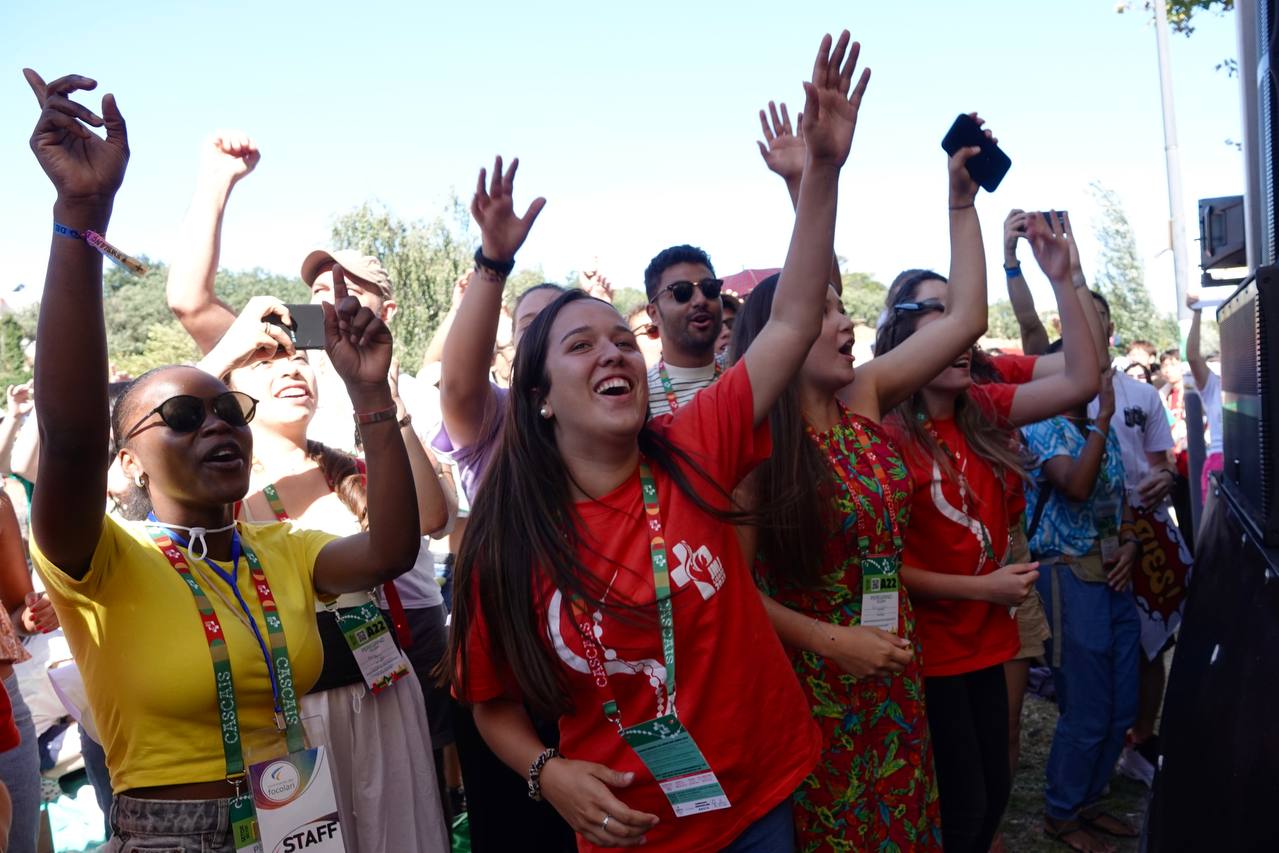 Apart from these highlights, the programme was filled with many other smaller events, but which were no less significant, such as concerts in key city locations, meetings in nationalities, sharing with people involved in the Church in parishes or associations and above all the various catecheses led by the young people themselves with bishops from different parts of the world as keynote speakers. These were all opportunities to deepen the WYD motto: Rise up.
“Have no fear, take heart, do not be afraid!” Pope Francis seemed to be speaking to the whole Church with these words. For there is no doubt that courage is needed and in this, young people are called to be in the front line. They are the present and the future of a Church renewed by the Spirit.
A Church that, as Francis has repeated several times, desires to be a home for all, without excluding anyone, and to recover the prophetic drive that permeates it. This Church walks with new confidence, the confidence it finds in itself and beyond itself, in Jesus Christ. A Church that desires to give hospitality to all humanity in the resurrected humanity of Jesus of Nazareth, as a well-known theologian says.
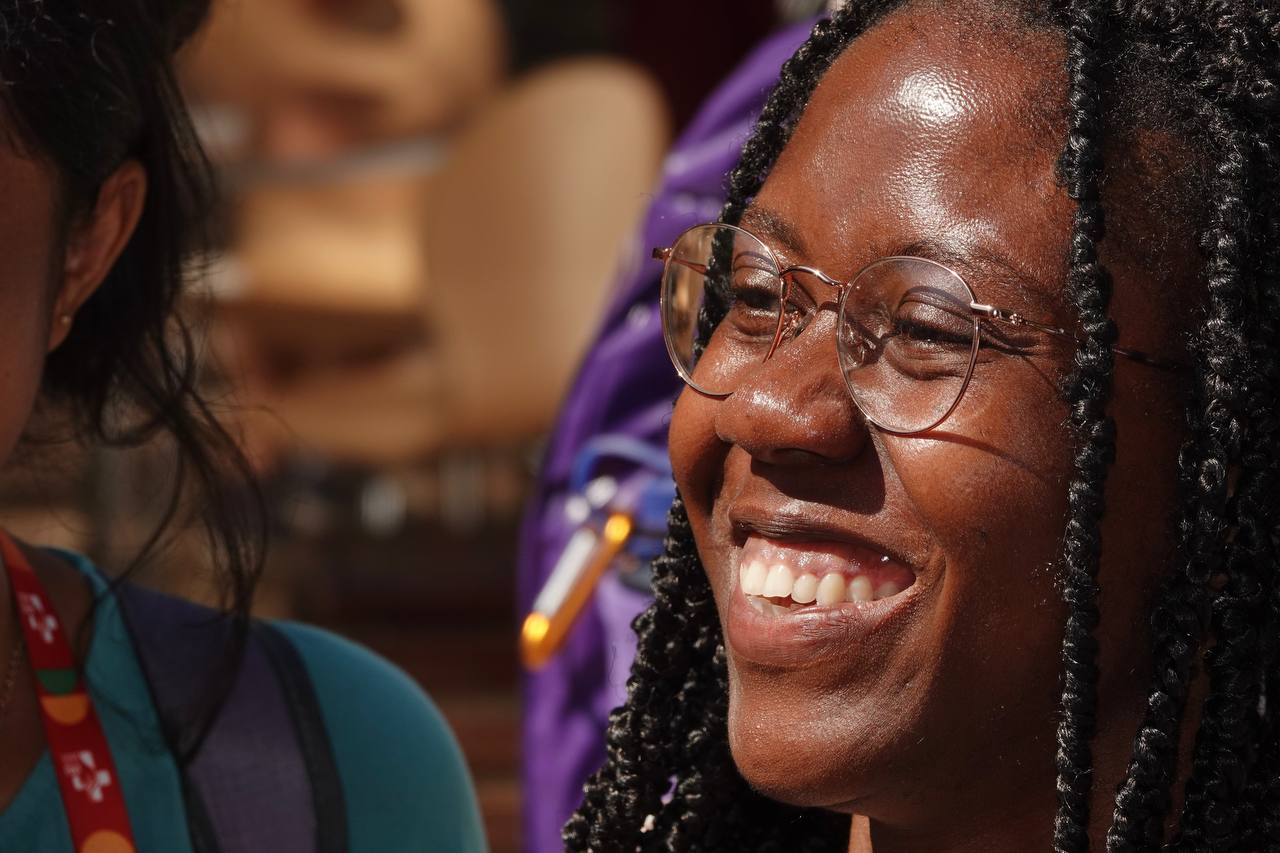 Perhaps I am too optimistic, but in these few days I have seen a young Church that has already gone a bit beyond the time of trial or is at least confident about overcoming it. The thousands and thousands of young people I met in Lisbon taught me this.
They don’t create problems; they do not become fossilised in criticism. Far from it, something (their purity, perhaps, refined in pain and uncertainty) leads them to focus on the core of faith with simple hearts. And, as the Master says, theirs is the Kingdom of Heaven (cf. Mt 5:1-12).
Three images summarise everything I want to express in this article: young people on the move, all over Lisbon (a symbol of the world), sometimes exhausted by the heat and tiredness accumulated after nights of little sleep. Young people with the ‘vertigo’ of the cross on their shoulders, on which all their sufferings are written. Young people kneeling in adoration, aware that in a piece of bread there is all of life, a life that does not pass away. The living Church, the Church of always, the Church of today, the Church of the future.
Jesús Morán
4 Aug 2023 | Non categorizzato
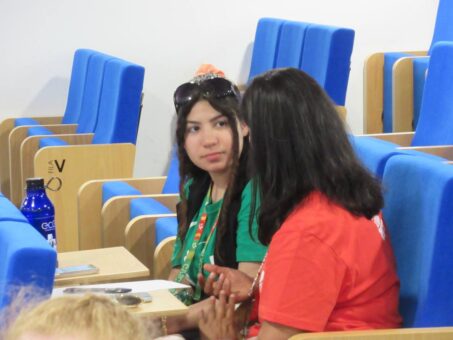
During the World Youth Day 2023 in Portugal, DIALOP’s journey goes one step further. From 20 countries, 134 young peolpe participated in the workshop “Communication in times of war” promoted by DIALOP during the WYD to discuss how social media and digital technology may become traps of conspiracy and tendentious interests during conflicts. The journey Christianity and Socialism – two movements with very different characteristics – have been for long at loggerheads with each other, but have nevertheless both shaped world history in past centuries. It is based on the idea that the biggest challenges of the world today cannot be solved alone, DIALOP fosters dialogue of good willing persons, with secular and religious backgrounds, especially between Socialist/Marxists and Christians to create a transformative transversal ethic. Bringing DIALOP to the World Youth Day is part of the “DialogUE Project” which, in collaboration with the European Community involves 14 civil society organizations, explores and develops the often challenging dialogue between different groups, in order to shape a Europe that is ever more an expression of that “unity in multiplicity”. 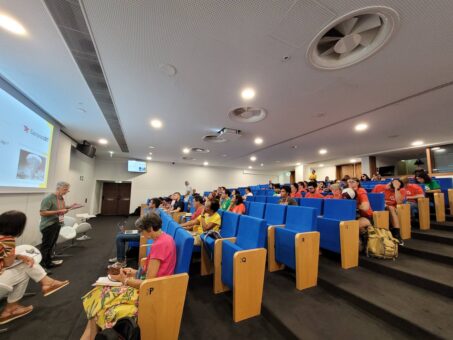 The preparation involving both Christian and Marxist-socialist experts started 6 months before the event, a committed and laborious path towards the WYD. The challenges were many, such as finding a dynamic way of mediating heavy content like conflict and communication, different languages, countries and backgrounds. “The emotion of standing before a generation that is hungry for a calming, reasoned, clear truth and hope and being able to give some of this”, Luisa Sello, one of the coordinators of the project shares her impressions. Youth in dialogue War and its destructive potential influence the structure of communication, transform the perception of facts, and instrumentalize language and mindsets. In such context, social media and digital technology may become traps of conspiracy and tendentious interests. Can we approach the truth? Can we react or are we convicted to destroy relationships with humans, countries, populations because of lies and misinformation? How can we keep making choices, build relationships, and stand with truth and justice? The workshop addressed all these challenges and engaged the youth to build on proposals for the European Union, which will be collected and presented to the EU within the European Commission funding project CERV (Citizens, Equality, Rights and Values Programme) in March 2024. After panels and dynamics discussions, the question “what can we do?” resonated among the youth. The desire of being part of a transformation as a changemaker is at the heart of each young person present.
 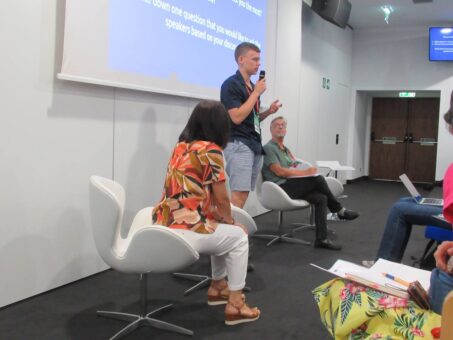 Steven, from the USA, wants to become a priest and travel overseas to help people shared his perplexities: “I can’t even tell my parents to stop reading sources of information that are problematic. When Jesus returned from Nazareth he was rejected by his family. So many of us have lost hope. Where do we get our hope back? That’s why we’re here at the WYD.” Adriana, a journalism student from Argentina felt encouraged by the workshop “Our role as the youth is very important to fight against disinformation and it can be done also in a fun way. If we create community we can be stronger.” Towards a transversal ethics The course of history depends not only on the strength of ideas but more heavily on the evolution of political and economic interests that integrate more than once only pale reflections of these ideas. The calling of Pope Francis in 2014 that inspired DIALOP to initiate a transversal dialogue continues to unfold. When asked by a young person how to create a common ethical framework when there is so much division, Walter Baier, the President of the Party of the European Left answered: “Pope Francis said that we have to accept conflict as something natural, what we need to know is what to do with the conflict. The fact that Christians and marxists coming from very different traditions, even with very different languages, can sit together and work on a common framework is an example of dialogue.” Angelina Giannopoulou, from transform!europe and José Manuel Pureza from Bloco de Esquerda also lectured besides Michele Zanzucchi and Ana Clara Giovani from Sophia University together with Maria Chiara de Lorenzo from the Focolare Movement. In the future, as part of DialogUE Project, DIALOP will hold other symposia on ecology and social policies. For more information, access https://dialop.eu
Ana Clara Giovani
4 Aug 2023 | Non categorizzato
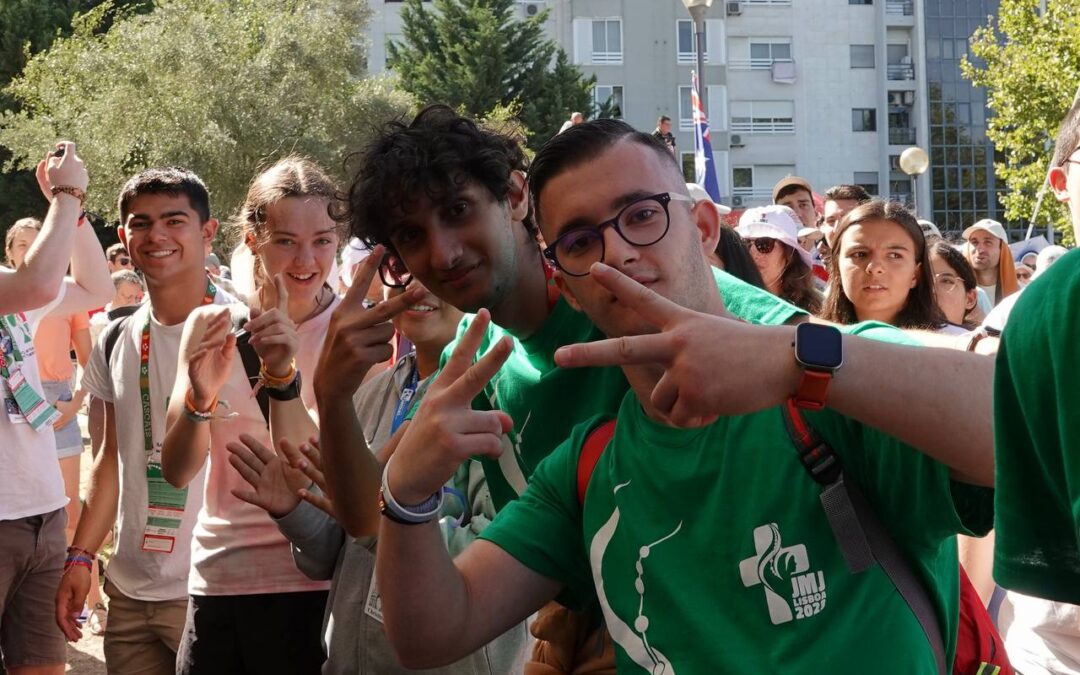
The young people who have been getting ready for the WYD for some time are excited to meet Pope Francis. In these first few days in Lisbon (Portugal), they took part in the “Rise Up” meetings.
 As the time of writing, the XXXVIII World Youth Day has just reached its halfway point. The first 4, very intense days, have permeated the life of over half a million young people who welcomed Pope Francis on 3rd August 2023 in the heart of Lisbon (Portugal). They gathered at Parque Eduardo VII, which was renamed “Hill of Encounter”, as a sign of the profound significance of this WYD, which underlines: relationship with God, with oneself and then with others, to build a peaceful, sustainable and fraternal world.
With the cry of “God loves everyone”, in a Church where there is room for everyone, Francis officially inaugurated the Portuguese World Youth Day which the media is amply covering every day.
However, what risks being overlooked is the important work of updating that the Church, in the most universal sense of the term, has carried out, so that this World Day could be a place where young people “find themselves” in their questions, in their conscious or unconscious search for God to have him as a partner in their lives; in the creation of spaces for sharing, inspiration and mutual listening. This process has involved young people, their teachers, priests and bishops, and many ecclesial realities.
“Rise Up” Meetings: spaces to think, share and be inspired
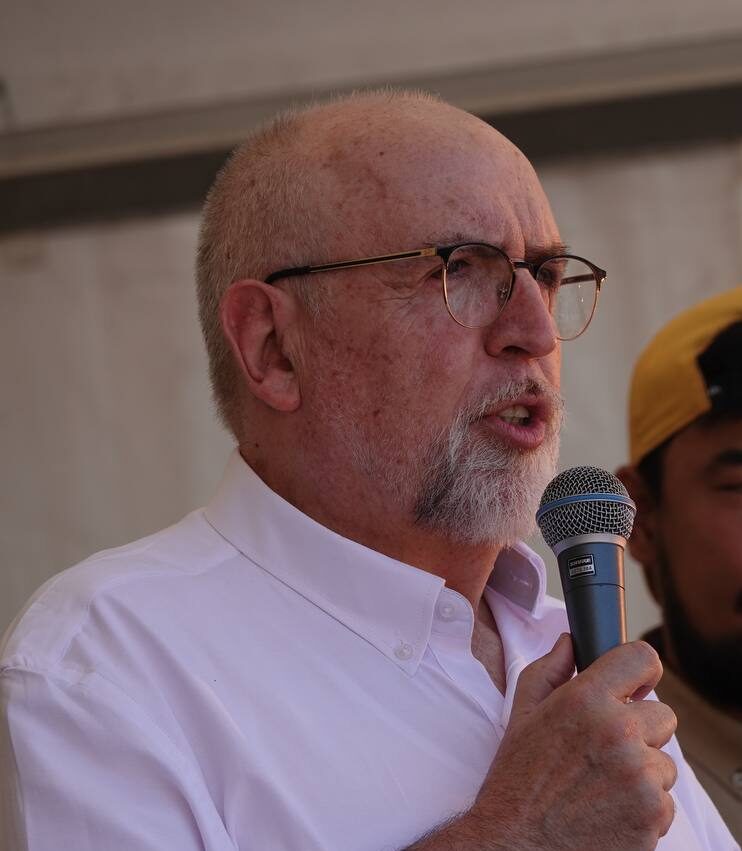 Undoubtedly one of the biggest novelties of this WYD are the “Rise Up” meetings, the new model of catechesis which invites the young people to reflect on the major themes addressed during the pontificate of Pope Francis: integral ecology, social friendship and universal brotherhood, mercy.
There are 270 meetings held in 30 languages which are all linked to the general theme of the WYD: “”Mary arose and went with haste” (Lk 1:39).
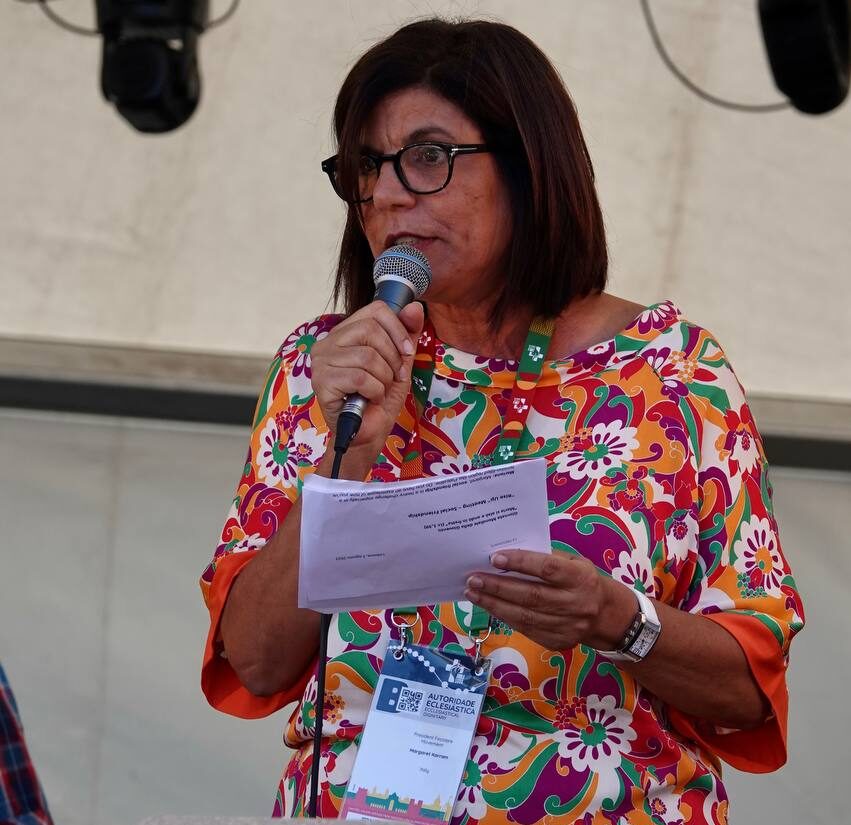
The Focolare Movement has been involved in the Rise Up meetings, offering 3 half-day appointments for English-speaking pilgrims, attended by an average of 5,000 young people a day. Eunice, a member of the organizing team told us, “I immediately felt responsible. The theme of this WYD inspires me a lot: I too feel driven to get up and go quickly, like Mary; I feel a strong motivation to give more, to overcome limits, tiredness and difficulties, as she did when she went to visit Elisabeth. She didn’t stop, but she loved”. Margaret Karram and Jesús Morán, President and Co-President of the Focolare, shared the stage with Card. Patrick O’Malley from Boston (USA), Archbishop Anthony Fisher from Sydney (Australia) and Bishop Robert Barron from Winona- Rochester in Minnesota (USA).
Teenagers at the WYD in Lisbon
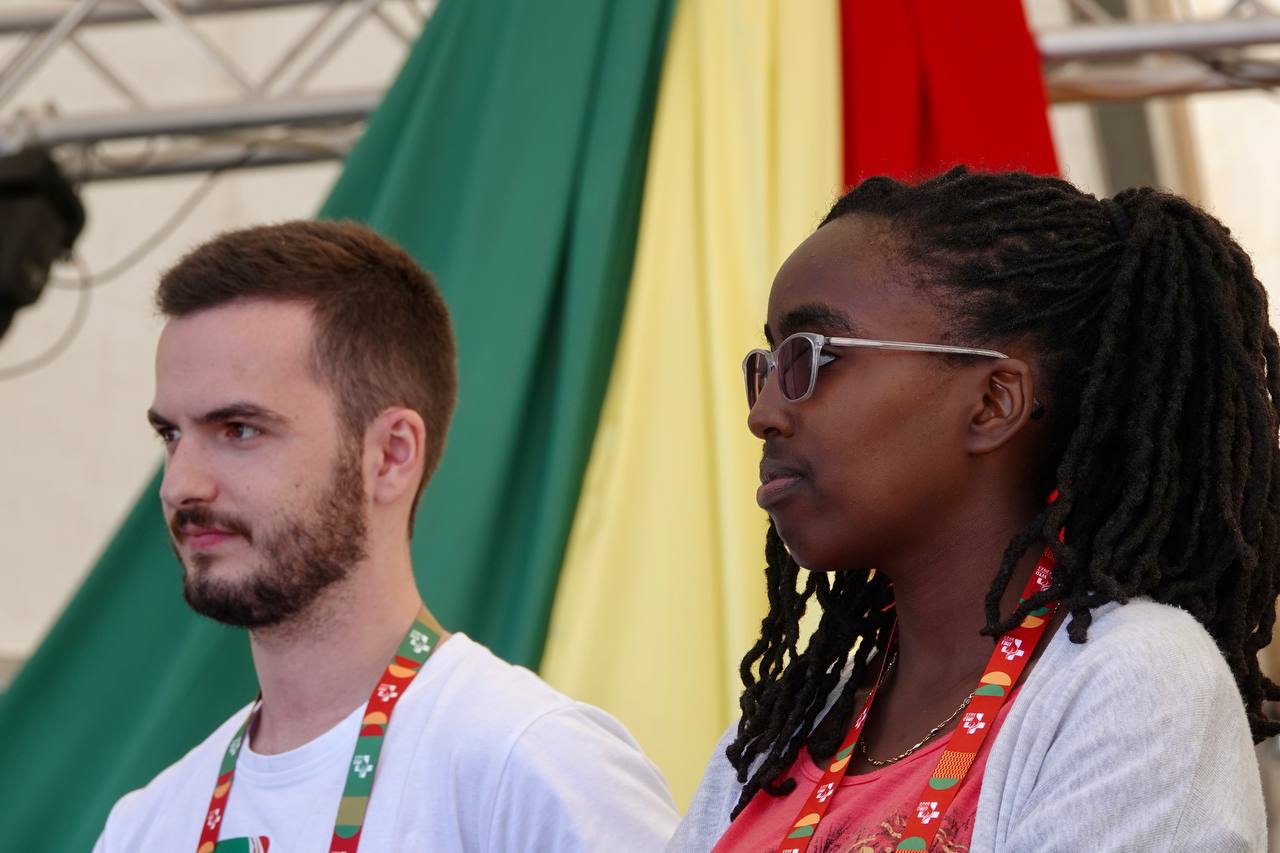 Experiencing God’s love and taking it wherever you are or feel called to be, was the thread running through the meetings enlivened by music, prayer and a lot of sharing. Pete, from the United States, at his first WYD, said, “I felt that after a year and a half of ‘isolation’, after Covid, something in me had changed. I decided to get involved and come with my diocese. I wanted to get out of my comfort zone, meet young people from other countries, see how they deal with problems. I still have many questions, I have found some answers here”.
For the young people from Slovakia it was a big decision to come and open up to people of other cultures and ways of doing things. They are greatly looking forward to what the Pope will say in the coming days. “We are sure that his words will remain in our hearts forever and will help us in the different situations of life”.
This meeting one another, recognizing each other as brothers and sisters is perhaps the most characteristic feature of this event. This is why personal stories are central to the Rise Up meetings.
Real life at the Centre of it all
For example, Lucas, who lives in the Brazilian Amazon. At the WYD in Panama he was captivated by the person of Jesus. When he went home, with about twenty young people he got involved in a project to help the indigenous communities of his country. They spent a fortnight with a team of doctors, nurses and psychologists who bring aid, treatment and support to many people who live far from treatment centres. Lucas said, “It was an incredible experience: giving myself from morning to night, without stopping. The Amazon Project has made me grow a lot as a person. The first result of all this is me: I have changed, I am no longer the same”.
Sofia, from Argentina, talked about her existential journey of searching for meaning. At one point she heard about Blessed Chiara Luce Badano whose yes to God, even in her pain, gave her the strength to dedicate her life to God, following the spirituality of the Focolare Movement.
And we could go on and on because we heard many testimonies and also the responses of the bishops and leaders to the questions of the young people.
Pat, aged 19, from Sydney, said, “I came to this WYD with a group of friends and this is important to me because I believe that we need others in order to be able to make a difference in the world and even to make personal decisions. Loneliness is a challenge for many young people of my age and I want to do something about it by starting with loving my friends. I understood here that this is the right path”.
These young people have many questions and also fears, but there’s more: they want to open up, to learn; they come from very different backgrounds and experiences, yet they are all here to meet Pope Francis, to discover God in their lives and to meet friends with whom to share this discovery. This is the essence of the WYD in Lisbon.
Stefania Tanesini
To read the full speeches:
Margaret Karram, Catechesis of 2nd August 2023, Rise up meeting, WYD Lisbon (Portugal)
Jesús Morán, Catechesis of 2nd August 2023, Rise up meeting, WYD Lisbon (Portugal)
Margaret Karram, Catechesis of 3rd August 2023, Rise up meeting, WYD Lisbon (Portugal)
Jesús Morán, Catechesis of 3rd August 2023, Rise up meeting, WYD Lisbon (Portugal)
31 Jul 2023 | Non categorizzato
A song for young people from all over the world to sing in unison. Father João Paulo Vaz, a priest from Coimbra (Portugal) wrote the lyrics of the WYD Lisbon 2023 anthem and the music was composed by Pedro Ferreira, a teacher and musician. Two young people from the Focolare Movement (Gen), Lourdes Catalán and Ivan Ho, interviewed him. World Youth Day (WYD) 2023 takes place very soon and in the streets of Lisbon (Portugal), the city hosting this global event, you can already hear the first young people to arrive singing “Há Pressa no Ar” (Feel the rush in the air), the official theme tune inspired by the words “Mary got up and went in haste” (Lk 1:39). Here we discover with Father João Paulo Vaz, a priest in the Coimbra diocese who wrote the lyrics, how the song came about. Lourdes: Father João Paulo, what does the WYD mean to you and why did you decide to enter the competition to select a theme tune for Lisbon 2023? 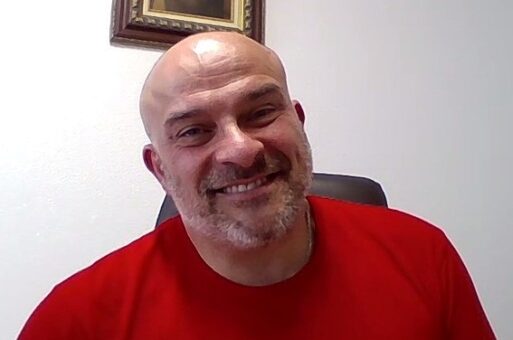 Father João Paulo Vaz: I have participated in no less than six WYDs in my life (Paris, Rome, Toronto, Cologne, Sydney and Madrid), some of them as head of youth pastoral work in the diocese. Each of them has marked my journey as a man, a Christian and a priest. They have been very intense experiences of faith and communion, and some things in particular really left their mark. One of them has always been the theme tune. When I heard we could participate in the competition for the Lisbon 2023 theme tune, I was very happy, both because of my personal experience and as a composer. I had decided to submit the lyrics but, at a certain point, I realised I had forgotten to register in time because you had to declare your intention to participate before submitting the song. When I realised this I was very sad, but God never leaves me alone. A group of participants who HAD signed up on time and only had a musical score ready asked me anyway if they could use my words and that’s how I entered the competition. Shortly afterwards, I learned with great joy that my song had been chosen. I was overjoyed because I really felt it was God’s answer to my wish. Ivan: What message did you want to convey through the song? Father João Paulo Vaz: First of all, the message I thought of addressing to each young person is “Christ is always with you, He never abandons you and with Him you will be able to love much more”. That is why, with Him, “my voice rises higher and everyone will hear it”, as the song explains, because you are no longer afraid. The whole text takes this direction and Mary, the main protagonist of this WYD, in the simplicity and humility of her figure, represents all these things: She whose voice rises first because she brings Christ with her; the first evangeliser who, with her ‘yes’ and on her way to Elizabeth, also shows us how to bring Him to others. Ivan: So many young people from all over the world are expected in Lisbon. How does it feel to think that they will all sing this song together? Father João Paulo Vaz: It’s really important to say that as soon as the song was chosen as the WYD anthem, it no longer belonged to us, it was no longer ours. It was no longer my words or Pedro Ferreira’s music. It is the theme song of WYD Lisbon 2023. I will sing it with the others: this will be the greatest joy. Lourdes: If you could sum up the theme tune in one or two words, what would they be? Father João Paulo Vaz: The first is “depth”, which means discovering who we are, discovering Christ in us and living from that discovery; the second is “courage”, to be the presence of God in the world, to announce life. It is in these two words, in my opinion, that the experience of faith flourishes. Ivan: What is your personal message for the young people of today? Father João Paulo Vaz: I would like to use the words of Pope Francis, spoken in one of the promotional videos for the WYD, in which he invites us to go ahead without fear, to build a better world and to be protagonists. We really need our young people to value the world more, to return to true values. We need to do away with fear and be aware that young people are the ones who will build a better future. So, dear young person, you can’t sit still and watch the world from your armchair. You need to get up and go, like Mary. The WYD, and this one in particular, is an opportunity to say that you believe and that you are willing to do what God asks of you; more than anything else, it is telling you that you are not alone in this. A whole world of young people and the Pope are ready to walk with you.
Lourdes Catalán e Ivan Ho
26 Jul 2023 | Non categorizzato
The 37th World Youth Day (WYD), which will be held from 31st July to 6th August 2023 in Lisbon (Portugal), is upon us and many young people are preparing to experience this global event with the Pope. Various initiatives have been organized and for months now, many people have been working with dedication on this moment of true family for the Church. Everything is ready. The sun is high on the seven hills of Lisbon (Portugal) and the ocean breeze brings with it an air of novelty and anticipation: the WYD is upon us and young people from all over the world are arriving. After months of preparation and having visited various stops throughout the country, last weekend the symbols of the Day, the Pilgrim’s Cross and the Icon of Our Lady “Salus Popoli Romani”, finally reached Lisbon and we are now ready to welcome the first young people arriving for the “Days in the Dioceses” which will take place from 26th-31st July 2023 in the 17 dioceses of mainland Portugal and the islands. A way to prepare pilgrims and host communities to get into the event and live it to the full. Father José Cardoso de Almeida, parish priest of Sátão, in the diocese of Viseu, a priest volunteer of the Focolare Movement told us, “When we were told that WYD would be held in Lisbon, we welcomed the news with immense joy. I am sure that it will be an occasion of grace for each of the participants, as well as for our country. In my case, I feel I have to be open to the surprises that the Spirit wants to communicate”.  Fr. José has experienced the anticipation and enthusiasm of several WYDs first-hand. Like many other people, he immediately felt the call to get involved in organizing this Event which was taking place in his own “backyard”, by motivating young people and welcoming those who would come from various parts of the world: “This last year has been full of meetings. A lot of activities were organized to help cover the expenses of those who had greater economic challenges to get here. As a ‘little builder’ of this WYD, together with many others, I encouraged some families to open their doors to young people from other countries for the ‘Days in the Dioceses’. In our area, we will welcome about 3,000 young people, mostly French. Then we will leave for Lisbon and I will lend a hand for the sacrament of Reconciliation, during the event.” It has been a concrete experience that shows how serving others generated countless fruits in the various communities. As Fr. José said, “For example, the discovery of the beauty of working together. I think that today’s young people need to discover that the secret of happiness lies in true love, and as Pope Francis says, in the experience of “going out of oneself” and “being with and for others.” This is true unity. ” And it is in this “going out” that we find the image of the Virgin Mary, ready to “get up and go with haste”, as the motto of this WYD announces, on the way to visit Elizabeth. Ana and José Maria Raposo told us that this is an “invitation to encounter the living Jesus in the family, at work, in social and political life”. They are from the parish of Nossa Senhora da Conceição dos Olivais Sul in Lisbon and are members of the Volunteers of God of the Focolare Movement. Ana and José have been married for 45 years, have five children and four grandchildren and are one of the many Portuguese families who will host the young people who will take part in the WYD in their own homes.
  They told us, “For young people, like Mary, to live their vocation, it is necessary to believe in them and let them lead, without forgetting the importance of inter-generationality. It is necessary to believe that the world today is already changed if hearts are changed, if the mind is free, if one leaves one’s comfort zone, if one looks around and sees Jesus in everyone; we have to believe that a united world is possible”. QQ An experience that looks at this fragile time, looks at the other and is strengthened thanks also to the concrete witness of those who, believing in love, want to put it at the service in the “welcome” that, as Ana and José say, “means to be a family for those who arrive. It was spontaneous for us to immediately join in welcoming the young pilgrims who will participate in the WYD. We have always welcomed people who needed help because they were passing through or traveling. The last few months gave us an opportunity to review things and reorganize the spaces so that the young people who arrive really feel at home.” World Youth Day continues to prove to be, even today, a great event of the Church that, around the Pope and young people from all over the world, becomes “Community”. And to be, as Father José Cardoso de Almeida stated, “a workshop of the Kingdom of God and the image of that universal fraternity that derives from the Gospel”.
Maria Grazia Berretta
25 Jul 2023 | Non categorizzato
The Word of life for this month is, “Whoever gives even a cup of cold water to one of these little ones in the name of a disciple, truly I tell you: none of these will lose their reward” (Mt 10:42). This is the mission to which each of us, just like the disciples, is called: to be credible witnesses of the Love of Christ, in the concrete gestures that are part of our daily lives; a circular Love, which you give with joy and are surprised when it returns abundantly. New Car Accident When I returned to the car park, I found that the new car that my father had lent me was scratched. What could I do? I felt bad because he would be upset and I started to think about how much it would cost to have it repaired. Then I noticed a small magnet on the dashboard holding this writing: “…cast all your worries onto Him because He cares for you”. I tried to do that. And I felt a sense of peace which is what I needed in order to try to figure out what to do. I was absorbed in these thoughts when there was a knock on the window. A lady wanted to talk to me. She was the one who had scraped the car and had left hoping to get away with it, but remorse made her come back. She gave me her phone number and agreed to look after the cost of getting the car repaired. I was amazed and grateful. I told her how I had found peace reading that sentence on the dashboard. And she thoughtfully replied, “It was Him who brought me back.” (Z.X. – Croatia) The right place When I was transferred to the Intensive Care Unit, I realized that my medical competence would be put to the test there and at the same time I felt that that was “my” place. Up until then, I had not had the opportunity to work in such a department where every day, suffering appeared in the most tragic forms: people who had serious accidents, neurological problems… and they were often young people. I wasn’t sure I was up to it. However, the idea of putting myself at the service of Jesus who was present and identified with all those people gave me strength. He said “You did it to me”. After six months, the hospital management offered me the position of head of the department. The reasons for their choice included: my ability to integrate with colleagues, my attitude of calm and peace, and my professional behaviour. The next day in the chapel, I thanked Jesus: it was his words that made me be what others needed above all there, in that place. (J.M. – Spain)
The exam I was preparing for an important exam at university when a friend who was going through a difficult time with his girlfriend came to visit me. I welcomed him and while I was preparing a meal for him, we started talking. The thought of the exam was really on my mind but I tried to set it aside to concentrate on listening to my friend, who was so upset and sad that he did not realize that time was passing and it was time to go to bed. In the end, I offered him a bed for the night. It was really late and I couldn’t even think of opening a book. The next morning the alarm woke me up and a colleague reminded me that I had to turn up for the exam. Still half asleep, I quickly got ready to go out, while my friend continued to sleep. I never dreamt I would pass that exam! I was very happy. When I went back to my room, there was a note on the table: «I don’t know how to thank you. You showed me that I mean something. You gave me new strength. Like you, I want to be “completely there for others.” (G.F. – Poland)
Curated by Maria Grazia Berretta
(taken from The Gospel of the Day, New Town, year IX – n.1° July-August 2023)
13 Jul 2023 | Non categorizzato
An interview with the author on his latest literary work – a book designed to give hope, to keep faith in the charism of unity. Some questions to the co-president of the Focolare Movement on his latest book, published by Citta Nuova, entitled ‘Dynamic Fidelity’. Jesús, let’s start with the title ‘Dynamic Fidelity’. I wanted to use the expression that Pope Francis used when he addressed participants at the Focolare Assembly in 2021. There he spoke of dynamic fidelity. In my opinion it is a very close thought to the concept of creative fidelity, with the advantage that ‘dynamic’ refers to the Greek concept dynamis, which means ‘force of movement’. Therefore, dynamic fidelity is fidelity in motion, which is not static, and this is very dear to Pope Francis. When he spoke to us on other occasions he emphasised that movements must be precisely ‘movement’. So it seemed to me that this title was closer to the reality that we are living today…. The book is divided into chapters. The first is ‘Taking the pulse of the times’. What perspectives does Chiara Lubich’s charism of unity have for today? How can we update the identity and history of the charism?  It seems to me that Chiara Lubich’s charism of unity is always topical. Regarding synodality, Pope Francis is insisting that we rediscover how we are the people of God on a journey, where we all play a lead role. Synod means ‘walking together’. He wants a Church where everyone gives their best as an integral part of the people of God, the body of Christ. Here, I think Chiara Lubich’s charism of unity can bring a lot in this sense, with her spirituality of communion, the spirituality of unity. On the other hand, today there are so many conflicts, wars, massive polarisation everywhere – in the political, moral, social spheres – and perhaps like never before we are witnessing almost irreconcilable contrasts. I believe that here too the charism of unity can contribute a great deal with the dialogue it weaves. So today the charism of unity must be modernised, rediscover its true identity, going back to the essentials, to the founding core of the charism. This modernisation requires implementing two moments, not in a chronological sense, but in a profound sense. On the one hand is listening to the signs of the times, the questions of the world, of contemporary society. On the other, going deep, fishing out all those resources that the charism has, some of which have not even been expressed. I really like this concept of expressing the unexpressed that is within us. This is how identity is updated in a dynamic fidelity. Together with the process of purifying our memory that we are going through in this post-foundational phase, I think we are ready to take this step. Modernising a charism is achieved with everyone’s contribution and a change of mentality and mindset. Besides invoking the help of the Holy Spirit, what can we do to implement this? Without a doubt, the help of the Holy Spirit is fundamental because we are in the context of a work of God. But to modernise the charism requires intelligence – not in the academic sense, but more in the sense of wisdom. It takes talent and skill to listen to the cry of humanity. What is said in the document of the General Assembly of 2021 is important: today the demands of humanity that we must listen to are the cries of Jesus Forsaken. So in addition to the Holy Spirit, we need the intelligence of the charism and the wisdom that comes from life. This is not a desk exercise, an academic exercise. One can grasp the cry of the forsaken Jesus when one is in contact with the suffering of our contemporaries. What is the ‘theology of the ideal of unity’? Why is it important for fidelity to the charism? Chiara Lubich herself said that theology would be important for the future of the Focolare Movement and the charism. This means deepening the charism of unity in the light of revelation, from where it sprang, and of theological research. It is an exercise in the intelligence of the charism that is fundamental, otherwise it is not incarnated and above all it is not universalised. Without a theology of the ideal, the charism remains within the Movement. With a theology of the ideal of unity, the charism can also go outside, as well as finding a solid foundation. The theology of the Ideal of unity helps to understand it well so that it can be passed on to future generations. Life and witness always go first, but this work is also decisive. The theology of the ideal of unity prevents possible deviations. The original kerygma, encapsulated in the Gospels, needed the arduous work of the Church Fathers, great theologians, to be saved in its integrity. Doesn’t modernisation risk causing the charism to lose its identity? Quite the contrary. It is precisely not modernising that makes the charism lose its identity, because the identity of a charism is always dynamic and creative. It is always about being the same without ever being the same. This is what I have tried to express. Being static makes a charism lose its identity because it makes it lose its connection with reality. For me this is very clear: constant updating is needed for the charism to maintain its identity. And Chiara did this throughout her life. The second chapter, ‘The house of self-knowledge’, takes its cue from a letter by Catherine of Siena. Here we discover our limitations, failures, self-consciousness, the face of Jesus Forsaken. What can we do to pass the ‘test of self-knowledge’? The second chapter is fundamental in this phase we are living through, in which we have had to come to terms with our faults, our errors in incarnating the charism. What can we do to pass the test? We must live it to the full, because it is a matter of recognising that we are not up to the charism. None of us are up to the charism. This does not give rise to a sense of dismay, but rather a new trust in God, in the Holy Spirit, the author of the charism. So the test of self-knowledge is overcome by accepting the humiliation of not being up to it and placing all our trust in God. The third chapter is ‘Discernment in the light of the charism of unity’. The pope asks us to become artisans of community discernment. How should we proceed? And above all, is Chiara Lubich’s charism of unity a charism in discernment? For Pope Francis, discernment and synodality go hand in hand, both individual and communal. It is a very delicate process, because it requires intelligence, but above all listening to the Holy Spirit. Discernment asks everything of us and everything of God. And this is not simple; it is not an exercise in consensus. It is going deep in seeking God’s will at all times. I believe that the typical dynamism of the charism of unity, which we call Jesus in the midst, that is to merit the presence of Jesus among us, is an exercise in discernment. Chiara Lubich explained it quite well: to merit this presence it takes complete detachment from ourselves, listening to the Holy Spirit. It takes mutual love. Chiara herself developed the idea of trinitarian relationships, which transform community discernment into ‘trinitarian discernment’. When we aim to have Jesus in our midst, we have a trinitarian experience, with all the weaknesses, the frailties of our humanity, physicality, psychology. But we do it, and that is where discernment happens. We can read this practice of trinitarian relationships in the light of Pope Francis’ great idea of discernment and synodality. In the book you talk about two deviations: ‘the seizure of the One’ and ‘the dissolution of the One’. What are they and how can we avoid them? These temptations are really two deviations from the spirituality of unity. In the first it happens that someone takes over the mission of the community and even the mission of each person. There is someone who centralises everything, who without realising it takes the place of the Holy Spirit in the dynamic of unity. In this case the ‘we’ is seized, which is necessary for each one to flourish and make their contribution. This is where abuses of authority, abuses of conscience, and spiritual abuses occur, and it is therefore a strong risk. In the dissolution of the One the opposite happens; the spirit of communion is lost. An exaggerated individualism prevails. If someone takes over the ‘we’ beforehand, it disappears and everyone’s individualism takes over. Community life becomes an organisation where everyone seeks their own space, their own personal fulfilment. Here too the Holy Spirit, who is the dynamism of Christian life, disappears. How to avoid these? We need a moment of self-awareness: understand the mistakes made. At the same time, we need to return to living the Gospel and an authentic life of unity. Above all, I think with humility, the ability to decentralise, love for each other, and continually thinking that the person is an absolute that cannot be annulled in any way. So I think the solution is more love, truth, transparency and concrete giving of ourselves in the life of unity, the life of communion. Unity is a gift of the spirit – no one can seize it with their power or dissolve it with their individualism. Unity is an experience of God that takes all of us. Let us realise this. Finally, what can we do to ensure that all these topics in the book do not remain the best of intentions? I think it would be useful to talk about it in the community, have moments when we read certain passages, retreats, and examine our lives in the light of these suggestions. The book is meant to give hope, to keep faith intact in the charism of unity, and if it has been lost, to recover it. I hope that by sharing experiences we can restore authentic life there where it no longer exists, because in so many places life flourishes, it generates, and there are so many beautiful things.
Lorenzo Russo
12 Jul 2023 | Non categorizzato
A theological seminar on the theme “Participate/Preside/Decide – sacramental root and communal dynamic in the journey of the people of God on mission” was held on Saturday 24th June 2023 in Loppiano (Incisa Valdarno, Florence, Italy). Over thirty academics responded to the invitation of the Evangelii Gaudium Centre (CEG) of the Sophia University Institute, to develop a proposal to revise canon law in order to rebalance, as urged by the working document (Instrumentum laboris) of the XIV Assembly of the Synod of Bishops, the “relationship between the principle of authority, which is strongly affirmed in the current legislation, and the principle of participation”. Pope Francis assures us “not all discussions of doctrinal, moral or pastoral issues need to be settled by interventions of the magisterium” (Amoris Laetizia, no. 3). It is therefore crucial to listen to the sensus fidelium of the entire People of God (clergy and faithful) with all its variety of cultures. In this way, the dialogue between theology and law is motivated by a sincere process of inculturation without which there is a real risk of laying the foundations for a practical non-observance of the general principles enunciated by the Church. Prof. Vincenzo Di Pilato, academic coordinator of the CEG commented, “The point is precisely this: how to make the active participation of all the faithful within our synodal assemblies effective? Will it just be advisory? Or will it also be deliberative? Will this mean reaching a negotiation for a juridical “concession” or “recognizing” the decision-making capacity of the collective subject of ecclesial action as it emerges from the ecclesiology of Vatican II and the post-conciliar magisterium? And therefore, will it be necessary to update the Code of Canon Law?” 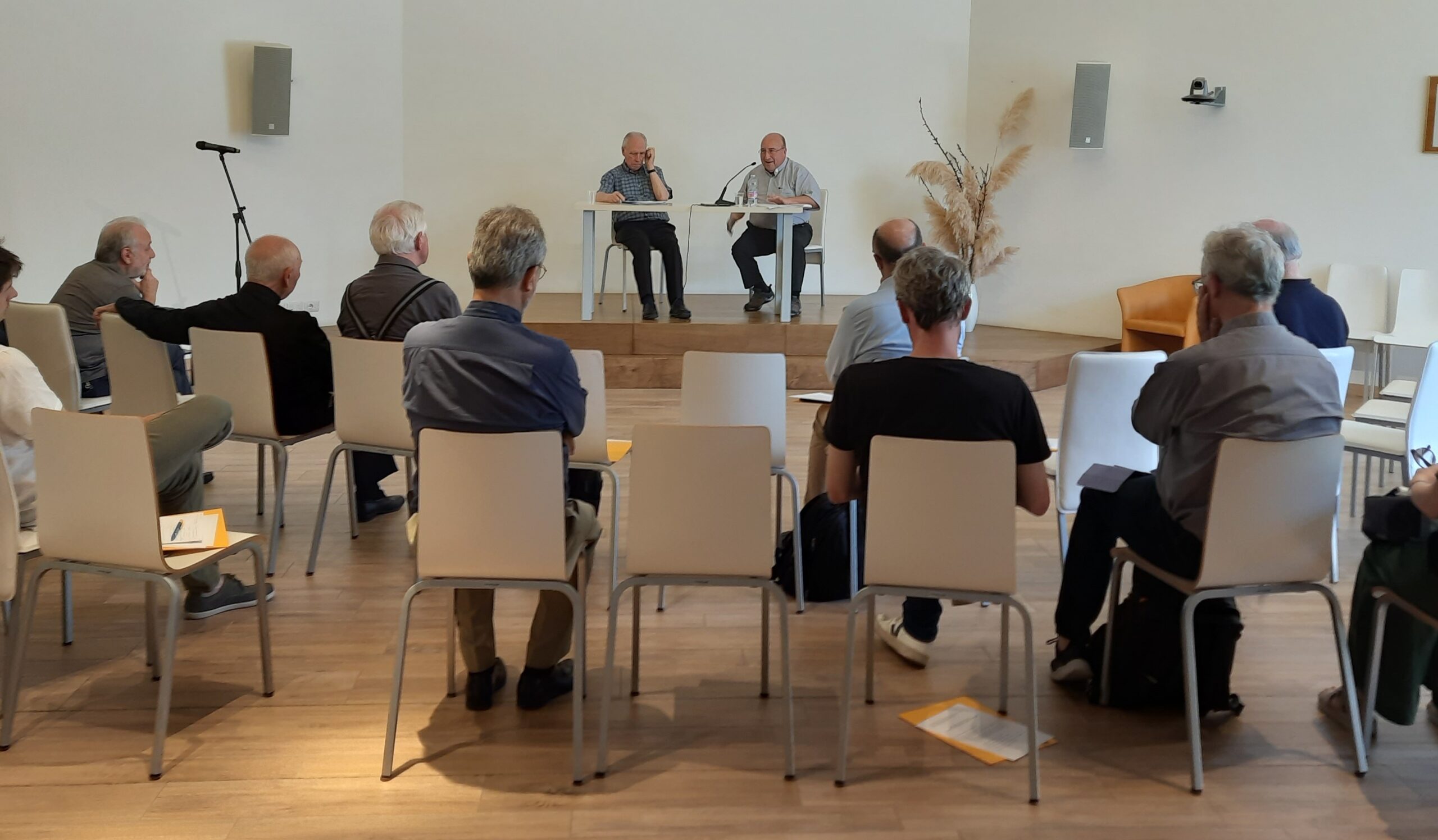 In his initial greeting to the participants, Card. Mario Grech, Secretary General of the Synod, highlighted how the synodal journey is entering a new phase: it is called to become a generative dynamic and not simply one of many events. We cannot listen to the Holy Spirit without listening to the holy people of God in that “reciprocity” that constitutes it as the “Body of Christ”. In this communal bond, the particular methodology of conversation in the Spirit, well described on the occasion of the presentation of the Instrumentum laboris, takes shape. Hence the need, referred to several times by Card. Grech, to better articulate the principle of restitution. In other words, this means that the unity of the synodal process is guaranteed by the fact that it returns to where it started, to the local Churches, and this is an important moment of the “recognition” of what has matured in listening to what the Spirit is saying to the Church today. The synodal journey seems to stand, therefore, as a significant moment in ecclesial life, capable of stimulating and activating the creative impetus and evangelical proclamation that comes from the rediscovery of the relationship with God that innervates the relationship between believers, and also as a sign for a cultural context in which it houses a silent cry of fraternity in the search for the common good. If in Prof. Severino Dianich’s report “The problems of synodality between ecclesiology and canon law” the recovery of the Pauline ecclesiology of the being-body of Christ and the enhancement of the dynamic co-essentiality of hierarchical and charismatic gifts emerged, for Prof. Alphonse Borras, this turning point requires a canonical clarification, which outlines a flexible procedural practice, capable of accompanying decision-making and participation processes through the various bodies already envisaged (episcopal council, presbytery, diocesan and parish pastoral programmes …). Cardinal Francesco Coccopalmerio, former president of the Pontifical Council for Legislative Texts, seemed to agree with this line in his speech, “Ecclesial Synodality: is a rapid transition from the consultative to the deliberative conceivable?”. In his opinion it is possible to find in canon law a clear definition of synodality, understood as “communion of clergy and faithful in carrying out the activity of recognizing what is the good of the Church and in the ability to decide how to implement such an identified good”. At the end of the seminar, many participants expressed the wish to see the speeches of the seminar published. The CEG is working to do this by September as a further contribution to the upcoming Synod.
Antonio Bergamo
11 Jul 2023 | Non categorizzato
On Sunday, 9 July 2023, Pope Francis appointed 21 new Cardinals of the Holy Roman Church, as usual to the surprise of those concerned. Among them is Archbishop Pierbattista Pizzaballa, Latin Patriarch of Jerusalem. In congratulating His Beatitude on this appointment, we joyfully share an interview with him, taken exactly one year ago in the Holy Land. Watch the video (activate English subtitles) https://youtu.be/JFjWb1-y0ug
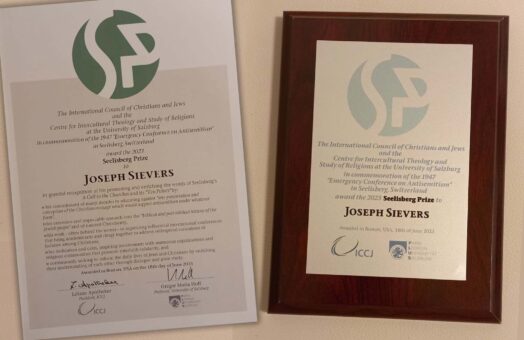
7 Jul 2023 | Non categorizzato
As part of the opening event of the International Conference of the International Council of Christians and Jews (ICCJ) in Boston, USA, on Sunday 18 June, Prof. Joseph Sievers was awarded the 2023 Seelisberg Prize. Our interview on his return to Rome. The Seelisberg Prize is inspired by and intended to commemorate the ground-breaking gathering that took place in the small Swiss village of Seelisberg from 30 July to 5 August 1947 to address Christian teachings regarding discrimination against Jews and Judaism. This event is widely recognised as inaugurating the transformation in relations between Jews and Christians. 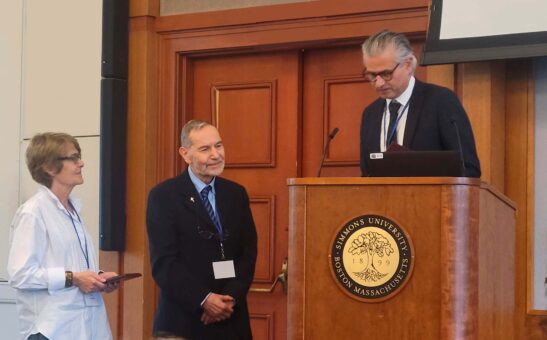 The Seelisberg Prize is awarded annually (since 2022) by the International Council of Christians and Jews (ICCJ) which originated from the Seelisberg conference, and the Centre for Intercultural Theology and Religions at the University of Salzburg. It honours individuals who have played important roles through their scholarship and teaching in promoting rapprochement between Jews and Christians. Prof. Dr. Joseph Sievers (Seelisberg Prize 2023) was born and raised in Germany and began his studies at the University of Vienna and the Hebrew University of Jerusalem. He holds a PhD in Ancient History from Columbia University (1981) and a Lic. Theol. from the Pontifical Gregorian University (1997). He has taught at CUNY, Seton Hall Univ., Fordham Univ. and other institutions in the US, Italy and Israel. From 1991 until 2023, he taught Jewish history and literature of the Hellenistic period at the Pontifical Biblical Institute in Rome, where he was a full professor. In addition, from 2003 to 2009 he was Director of the Cardinal Bea Centre for Jewish Studies at the Pontifical Gregorian University. Since 1965 he has been a member of the Focolare Movement, with whose Centre for Interreligious Dialogue he has collaborated since 1996. He has published several books and numerous articles, primarily in the areas of Second Temple history (in particular Flavius Josephus) and Christian-Jewish relations. With Amy-Jill Levine, he edited The Pharisees (Grand Rapids, MI: Eerdmans, 2021; Italian translation Milan, San Paolo, 2021; German translation planned for 2024). Professor Sievers, what does it mean to you to receive this award? It was a great surprise and when I was asked to say something about my experience, I felt a great gratitude looking back, thinking about all the moments, all the people I met, the situations in which I was able to be there and sometimes be of help. A great gratitude and, at the same time, a responsibility for the present and the future. In his speech at the award ceremony you said: “Difficulties can help us understand one another better. Difficulties can unite us”. In your long experience of this dialogue, what have been the most difficult and also the most surprising moments where you were still able to say “Anything’s possible”?
 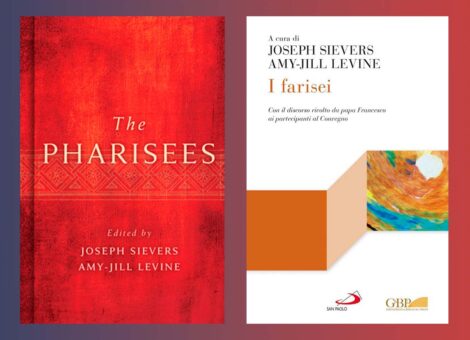 There have been various difficult moments, but one that I particularly remember is when we had to organise a meeting for dialogue in Jerusalem in 2009. It took place a few weeks after a conflict which had left many people dead or wounded. At the same time there was the situation of Bishop (Richard Nelson) Williamson denying the holocaust. There were difficulties on all sides that made open dialogue very difficult. However, we still managed to hold the meeting. We went ahead and they were very strong, spiritual moments of communion, beyond all the problems. And then you also ask me the things that were possible, despite the difficulties? It certainly was not easy to organise a conference on the Pharisees and then publish a book. There were several points where I felt the way was barred, either for financial reasons or because someone did not agree with what we wanted to do, or because it seemed impossible to have an audience with the Pope, for a conference of this type… Instead, by collaborating – and it really was a collaboration, especially with a Jewish colleague, but also with others – it was possible to solve these problems and give something that was based on serious studies but also addressed to concrete situations in churches and parishes. Certainly there was success that did not have an immediate effect everywhere, but for example one bishop wrote to me saying “now we need to change all our teaching on the Pharisees and Judaism in the seminaries”. That is already something. How has your membership of the Focolare Movement affected this experience? Without the Focolare Movement I probably would not have entered this field. The Movement gave me the impetus to study the languages of the Bible and everything else followed from that. I entered the focolare on 28 October 1965. It was a Thursday. I arrived in the focolare in Cologne (Germany) with my bicycle that I’d brought by train with my two suitcases on the same evening that the Council in Rome was approving Nostra Aetate (Declaration on the Relations of the Church with Non-Christian Religions). This has always meant a lot to me, linking commitment to the Movement with commitment to dialogue. You were also called to officially collaborate in the Catholic Church’s dialogue with the Jews… Yes. Since 2008 I have been a Consultant of the Commission for Religious Relations with Judaism, a commission of the Holy See. And I have participated in various meetings of the ILC in Buenos Aires, Cape Town or even Budapest, Madrid, Warsaw, Rome … And are steps forward being made? One step is already being open to meet and talk to each other and to overcome difficulties along the way. Sometimes it is better to face everything over dinner together than with fiery letters. Steps are being taken and certainly there is much more to be done, the network needs to be expanded. I mean, most Christians and most Jews are not involved. Sometimes they don’t even know that there are these relationships or that we are on this journey together. There is still a lot to be done to make this known and apply it. One thing I have learned a lot from my relationships with Jews is that the questions are sometimes more important than the answers. That is, I do not and cannot claim to have all the answers. So I cannot approach the other person as someone who has found all the answers and approaches him or her from a position of superiority. My position is to be a seeker together. It is this – most dramatically when dealing with the subject of the Shoah, the Holocaust – that has to be faced together sooner or later. One thing that is essential is to look at, to be as sensitive as possible to each other’s commitments and needs. And then also to be open, and if you make a mistake you can always start again if the intention is right, tiptoeing into the other person’s environment, not with the attitude of someone who says “I know everything”. Lastly, in receiving this award, apart from feeling grateful, does it inspire Joseph Sievers in any other way? Yes, indeed. For example, there are some open questions and this stimulates me to tackle them more. And maybe it even gives me some authority to address them with certain people. I don’t know if this will happen, but it is also an incentive to continue this work, which is not finished, which will never be finished, but where some steps can be taken together.
Carlos Mana
5 Jul 2023 | Non categorizzato
A theological seminar on the theme “Participate/Preside/Decide – sacramental root and communal dynamic in the journey of the people of God on mission” was held on Saturday 24th June 2023 in Loppiano (Incisa Valdarno, Florence). Over thirty academics responded to the invitation of the Evangelii Gaudium Centre (CEG) of the Sophia University Institute, to develop a proposal to revise canon law in order to rebalance, as urged by the working document (Instrumentum laboris) of the XIV Assembly of the Synod of Bishops, the “relationship between the principle of  authority, which is strongly affirmed in the current legislation, and the principle of participation”. Pope Francis assures us “not all discussions of doctrinal, moral or pastoral issues need to be settled by interventions of the magisterium” (Amoris Laetizia, no. 3). It is therefore crucial to listen to the sensus fidelium of the entire People of God (clergy and faithful) with all its variety of cultures. In this way, the dialogue between theology and law is motivated by a sincere process of inculturation without which there is a real risk of laying the foundations for a practical non-observance of the general principles enunciated by the Church. Prof. Vincenzo Di Pilato, academic coordinator of the CEG commented, “The point is precisely this: how to make the active participation of all the faithful within our synodal assemblies effective? Will it just be advisory? Or will it also be deliberative? Will this mean reaching a negotiation for a juridical “concession” or “recognizing” the decision-making capacity of the collective subject of ecclesial action as it emerges from the ecclesiology of Vatican II and the post-conciliar magisterium? And therefore, will it be necessary to update the Code of Canon Law?” In his initial greeting to the participants, Card. Mario Grech, Secretary General of the Synod, highlighted how the synodal journey is entering a new phase: it is called to become a generative dynamic and not simply one of many events. We cannot listen to the Holy Spirit without listening to the holy people of God in that “reciprocity” that constitutes it as the “Body of Christ”. In this communal bond, the particular methodology of conversation in the Spirit, well described on the occasion of the presentation of the Instrumentum laboris, takes shape. Hence the need, referred to several times by Card. Grech, to better articulate the principle of restitution. In other words, this means that the unity of the synodal process is guaranteed by the fact that it returns to where it started, to the local Churches, and this is an important moment of the “recognition” of what has matured in listening to what the Spirit is saying to the Church today. The synodal journey seems to stand, therefore, as a significant moment in ecclesial life, capable of stimulating and activating the creative impetus and evangelical proclamation that comes from the rediscovery of the relationship with God that innervates the relationship between believers, and also as a sign for a cultural context in which it houses a silent cry of fraternity in the search for the common good. If in Prof. Severino Dianich’s report “The problems of synodality between ecclesiology and canon law” the recovery of the Pauline ecclesiology of the being-body of Christ and the enhancement of the dynamic co-essentiality of hierarchical and charismatic gifts emerged, for Prof. Alphonse Borras, this turning point requires a canonical clarification, which outlines a flexible procedural practice, capable of accompanying decision-making and participation processes through the various bodies already envisaged (episcopal council, presbytery, diocesan and parish pastoral programmes …). Cardinal Francesco Coccopalmerio, former president of the Pontifical Council for Legislative Texts, seemed to agree with this line in his speech, “Ecclesial Synodality: is a rapid transition from the consultative to the deliberative conceivable?”. In his opinion it is possible to find in canon law a clear definition of synodality, understood as “communion of clergy and faithful in carrying out the activity of recognizing what is the good of the Church and in the ability to decide how to implement such an identified good”. At the end of the seminar, many participants expressed the wish to see the speeches of the seminar published. The CEG is working to do this by September as a further contribution to the upcoming Synod.
Antonio Bergamo
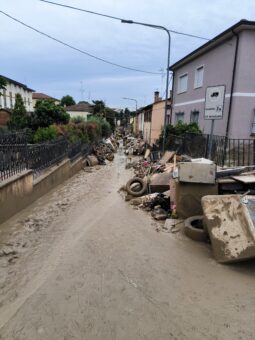
4 Jul 2023 | Non categorizzato
Almost a month and a half after the floods that hit the regions of the Marche and Emilia-Romagna (Italy), here is the story of the personal experience of Maria Chiara Campodoni, a married focolarina, a teacher and a former municipal councillor of the Municipality of Faenza, who was a victim of this disaster. The flood that hit the Marche and Emilia-Romagna (Italy) about a month and a half ago caused the loss of 15 lives, thousands of displaced people and the flooding of 23 rivers. To date, flooding has occurred in about 100 municipal regions. Numerous landslides have affected small producers, tens of square kilometres of agricultural land and farms have been destroyed by the power of water, along with bridges and roads. The contributions collected by the Emergency Coordination Committee of the Focolare movement, AMU and AFN have reached 182,000 euros. In collaboration with APS Emilia-Romagna, a social welfare association, a local emergency committee was set up to identify areas of priority intervention which include: Cesena, Sarsina, Faenza, Castel Bolognese and Ravenna. The needs of the affected populations were assessed, especially through personal contacts and through the compilation of forms in which each person declared the damage suffered and the request for assistance. Maria Chiara Campodoni, a married focolarina, teacher, Councillor for Sport from 2010-2015 and President of the Municipal Council of Faenza 2015-2020, was severely affected. She told us about the misfortune of this experience but also expressed her hope for the future. Maria Chiara, what happened to you and your family? There were two floods in Faenza. On 2nd May, the water came into our house for the first time, to a depth of 30 cms. It was in the afternoon, in daylight. My son and I were in the house. At first it was like an adventure, my husband had gone to collect the other two children from sports activities. That night we decided that they should not come home because there was much more water outside than inside and we only have windows and doors on the ground floor. Getting them back into the house would have meant letting a lot more water in. So they went to sleep with their grandparents and the two of us tried to take some things upstairs, we ate something in the bedroom and went to bed. Even the firefighters who had passed by had reassured us, telling us that the situation would not get any worse. The next day the water level between inside and outside was the same and then we decided to leave the house. A fortnight later the authorities started advising people to evacuate the ground floors because it was going to happen again. The whole city went on alert and realized that it had to get organized because something even more serious was going to happen. And what happened the second time? 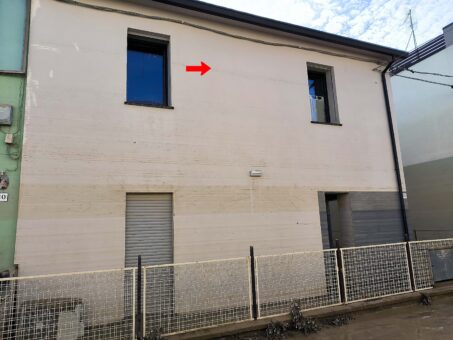 The second flood, the one from which we had to escape, came in the evening. Around 8.30 pm, the river bank just above our house collapsed. Until that moment, since we obtained a pump for inside the house, we hadn’t gone outside convinced that we could control the flow with the pumps and keep the water level down also with the help of sandbags. But within 20 minutes the water had reached the first floor, up to 3 metres in a very short time and suddenly we found ourselves trapped. We called the rescuers who immediately responded saying that they would arrive, but in the meantime, that afternoon, the Savio River in Cesena had also flooded, so the civil protection workers and the firefighters, who until the day before were all in Faenza, were already spread out in the various areas. Moreover, in my street the current was so strong that the motor vehicles only managed to get in at 04:00 at night and we would not have been able to resist until then. The firemen told us to go to the rooftops, but we don’t have a skylight, so it meant going outside, floating. The situation was really dangerous. (In the photo, the arrow indicates the level reached by the water). At one point a cousin of my husband, who saw on social media that the river had broken through the embankment beside our house, called him and asked him if we were already out. Just from our voices he could tell that we were in danger and since he is an athlete, as a boy he was a surfer, he put on his wetsuit, took his surfboard and threw himself into the current. He swam to our house and pushing the surf board, one at a time, he loaded us on it and took us to safety, to the city walls, 500 meters from our house. What did you see outside? Immersed in the current, the whole perspective changed. The water had already surpassed the street signs, so you no longer knew if you were on the street or in the garden of a house. We passed over gates, over garages and we were so high that at one point he asked me to cling to what looked like a bush, but in reality, now that I can see it, it was a tree. I was the last one to be saved. We were welcomed into the house of a lady who knows us. We were soaking wet. She gave us clean clothes. That night was very cold, terrible conditions and it was raining. We warmed up and then we were able to go the 6 kms from the city where my mother-in-law lives. We were really lucky because we were among the first to get out. We did not experience what many told us afterwards was a night of real terror in the city. Were the children aware of the danger? Yes. I have three children aged 10, 8 and 6. At one point, the youngest kept running down the stairs because we could see the water rising step by step and he said to me: “I can only see 5 steps, 4 four steps. Let’s go to the terrace, we have to run away” and we said “we need to stay here at the window, because it’s raining outside. The police are coming.” They realized and slowly had to process what was happening, especially the oldest. We feared that in just an hour we wouldn’t make it. When we arrived at grandma’s they were calmer even though when they got there they began to realize that we had lost everything. They were saying, “Mum, we don’t have schoolbags anymore, we don’t have books, now what?” I explained to them that many would help us. And so it was. How were those first days? Where did you find shelter?
 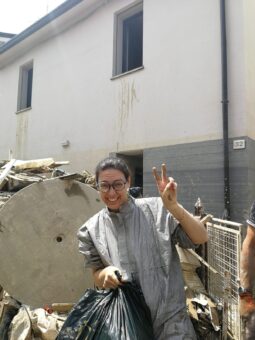 We stayed with my mother-in-law for a few days because we couldn’t move around town. Then, later, we were welcomed by an aunt of a friend of my son who lives abroad and who lent us her house in the centre for a month. It was 10 minutes’ walk from where we lived so we were able to go to our house and start clearing it. It was a tight fit, but it really was a great gift which I realized even more later, when I started hearing other people’s stories. Volunteers also began to arrive throughout the city. Because of the Focolare Movement and my husband’s contacts, we always had help. People came from Parma, from Piacenza, from Veneto even including people who themselves have been through the earthquake in Emilia some years ago. There was a beautiful atmosphere of concrete help, and it was in this climate that, slowly, I began to throw everything away but I was really serene. Shovelling mud is an all-encompassing thing at the beginning, you try to do your best, with all your strength and then you realize that it’s not the things, the objects that make up your life, but everything else. Your husband has a restaurant… Yes. He could see from the cameras that fortunately the water didn’t get in but he wanted to see in person. One day he left at six in the morning thinking of taking the motorway but even that was closed. We came up with an idea: “let’s call the deputy mayor, and let’s tell him that if the civil protection can bring you to the restaurant, you could start cooking for everyone in need.” The idea was willingly accepted because there were already many displaced people., Luckily they had been able to bring many disabled and elderly people to a hotel which is very close to my husband’s restaurant, but which does not have working kitchens. So my husband and two employees stayed the whole day at the restaurant and made 700 meals between lunch and dinner. There were 100 displaced people and then firefighters, civil protection personnel and since the restaurant is located right on Via Emilia, an access point, many of the people who had been stuck in the street, who had slept in the car without eating, came to the restaurant asking for help. The whole area of Cesena and Forlì was paralyzed. What are you going to do now? At the moment we have left that small house that we were using. We will move into a house that we have by the sea for a while and then we have rented an apartment for 18 months while we are waiting to fix up our house. The idea is to return to it in September 2024. But there are many questions, first of all to understand if there will be companies that can renovate all these houses, because there are so many of us. We’re talking about 12,000 people who are out of their houses. There are 6,000 families in our city alone and some houses, the oldest, have been declared uninhabitable. Now the houses have to dry out. We’ve already destroyed everything. We had parquet floors which we had to remove. The false ceilings on the ground floor came down on their own when the water came in. We had help to disconnect the toilets. Now every morning we go to open the windows and in the evening we go to close them and to turn on the dehumidifier. Luckily it’s summer, if this had happened in the autumn, it would have been an even greater disaster. Is help still coming? Absolutely yes and in many ways. For example, at the beginning we had thought of looking for an already furnished house so as not to have to have a double move, but we realized that people started to give everything: wardrobes, mattresses, furniture, and sofas. We decided to take an empty house so that we can begin to redecorate with this providence and then, in 18 months, bring everything back to our home, also because then there will certainly be other needs. People are really happy to help and I have to say that for me it was a lesson. I remember that one day, after the first flood, the house was upside down and the washing machine was broken. I said to myself, “I’ll prepare three bags, one of white clothes, one with coloured and one with dark ones, and then I’ll go to work. To the first colleague who asks me ‘how can I help you?’, I’ll say ‘would you be able to take all these clothes to wash’”. I was still at the door of the school and the bags were already taken. In these cases there is a stronger bond with people and above all I wasn’t too proud to ask for help. We accepted what was given to us and I feel that it is also a way to be honest about my needs and say okay, we love each other like this, just as we are. We also had a good relationship with our neighbours. We have lived there for four and a half years but I had never entered so many neighbour’s gardens, because life is hectic, we’re always in a rush. Whereas, now you go in, you greet each other, you help each other. What stage is it at now? The second phase has begun, that of establishing citizen committees to begin communicating with the municipal administration. I would immediately have excluded myself for various reasons, especially because in the past I held certain roles but then I realized that without taking on too much, by listening, by staying in the chats, by helping those responsible for these committees, I can do my part. I owe it to my children who still ask me “but do we have to go back to live there? Will we build an external staircase to the roof for the next time?” We need an active citizenship to keep an eye on the situation. I felt that I had to use my experience in the right way, building as many connections as possible, because now, as always happens with reconstruction, the greatest fear is to remain alone. Are you hopeful? Yes, absolutely. The other day we wanted to give a gift to the lady who offered us her house for the first month and, since Faenza is a city of ceramics, I bought a plaque to hang on the wall with the sentence, “The beautiful things of life are messy”. I thought, this was a huge, huge mess. We will need time to get back on track and we will make it, but I feel that I would never have had certain experiences without having gone through this difficult moment. I really feel that I have reached that point where you look at the essentials, at what really matters. It was terrible, but I can’t just think about the disaster, that the water took everything away and that was the end. There is much more to it than this.
Maria Grazia Berretta (Interview with Carlos Mana – Photo: by Maria Chiara Campodoni)
30 Jun 2023 | Non categorizzato
In Japan, a group of women of different religions has set up the ‘CommuniHeart project’, a suicide prevention project that focuses on self-awareness, communication and community support. The CommuniHeart project is organised by Religions for Peace Japan (World Conference of Religions for Peace). https://youtu.be/NPs9U3pfLZs
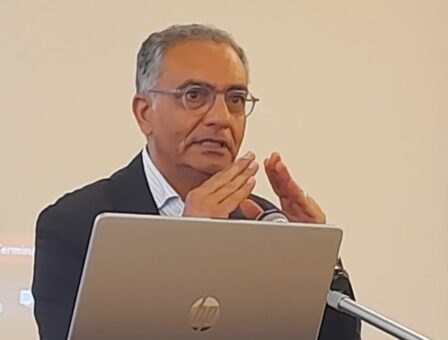
27 Jun 2023 | Non categorizzato
The level reached by artificial intelligence poses new ethical questions: how can technological development be progressed on a human scale? A Call to Action for developers and innovators in the digital world. A horizon that concerns us all. June 2023, Sophia University Institute: on the screen of the Aula Magna a digital hostess elegantly opens the seminar “Towards a Digital Oath”. We are crossing a threshold: the preparation began a long time ago, but the acceleration of recent times says something new. 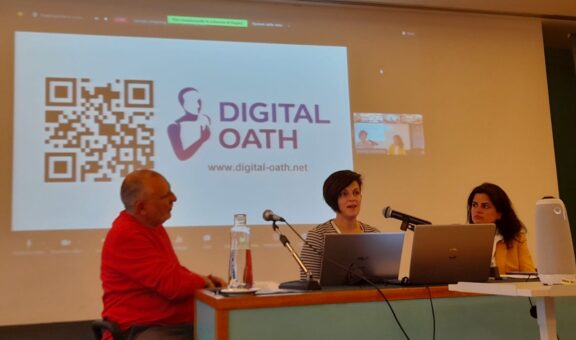 Promoted by a platform of protagonists: the Sophia Global Studies Research Centre, the Political Movement for Unity, NetOne, New Humanity and Digital Oath, the aim of the seminar is to address the pressing issues of the digital world according to different perspectives: philosophical, technological, ethical, social and political, leading up to a discussion about the proposal of an “oath”, that for professionals in the digital world would be equivalent to the Hippocratic Oath for doctors. Where does this idea come from? What are the goals? The technological world tends to change rapidly, faster than our ability to adapt. The complexity of the machines and systems that structure reality affects not only the way we live, but also the way we see the world and think about the future. The level reached by “AI – artificial intelligence”, alongside enthusiasm for its operational capabilities, presents a general concern about the new possibilities being opened up by these systems and the effects that can result from their malicious use. The recent spread of ChatGPT (November 2022) and all its spin-offs has brought AI massively closer to our daily lives, giving rise to new questions of meaning related to the understanding of what is human and what is not. In the world panorama, the evolution of these devices has produced a kind of disorientation, not only because their use appears within the reach of everyone, but above all because they
 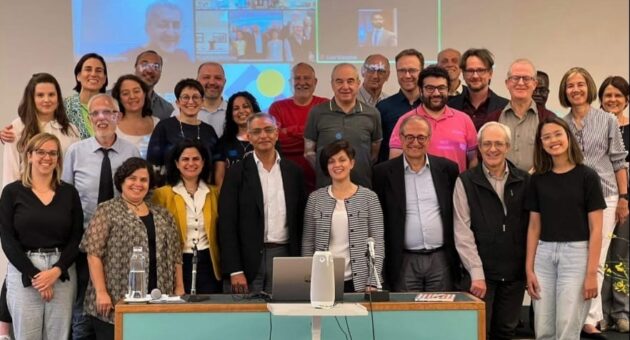 demonstrate that they do something that was previously the prerogative of human beings, with quantitatively superior capacities. The fact that we are faced with systems that are not “intelligent” in the human sense of the term and that manage their knowledge base through statistical calculations does not change the final result: the feeling of no longer being the authors of fundamental choices, of being challenged by machines that are less like “tools” and more like “colleagues”. The “Towards a Digital Oath” seminar added an important theme to these issues which is that questioning the ethics of technologies means questioning what is human. Many people consider technological development as the human activity that characterizes us most. Digital technologies, and in particular AI, are those that most accurately reflect our way of being and of understanding our existence. The crises of the last century (of values, environmental, social and political) are closely related to them and indicate that technological development must be accompanied by an equally determined educational commitment, so that every form of progress can be guided by a deeper ethical awareness. The “oath” for the digital world goes precisely in this direction. The programme of the first days of June convened a range of experts (link to the programme). After an initial broad overview of today’s digital technologies, the discussion explored the risks and regulations related to their use in Italy, the EU, the US, Brazil and China, intertwining technological solutions with political issues, philosophical reflections and social phenomena. Fadi Chehadé, former CEO of ICANN (Internet Corporation for Assigned Names and Numbers), promoter of the “oath” for an ethics of the digital world and visiting professor at the Sophia Institute, said, “We need to make a concrete and universally shared commitment to which developers, technicians and users of digital technologies can adhere and firmly anchor their work on a human centred approach”. Fadi Chehadé has been involved in this project since November 2019, when the first group met in Trent (Italy) to shape the project. Subsequently, the group involved scholars in various countries and participated in the UN-sponsored public consultation for the Global Digital Compact 2024. The purpose of the Digital Oath is precise: to suggest guidelines and ethically motivate developers and innovators of the digital world to put the dignity and quality of life of people and communities, the sense of human existence and respect for fundamental rights and the environment, at the centre. The proposal to “translate” the Hippocratic Oath for the digital world has already emerged in various international studies, which underline the urgency of the issue and the responsibility of those who create and manage digital services and administer data. It includes not only the new neural networks but also social networks and cryptocurrencies. Our work adds to that of other networks: now we need to join forces to establish a coalition between universities, the private sector and organizations committed to writing a code of ethics, a self-regulatory protocol that can benefit people, society and the environment. There is an initial wording of the oath on the new Digital Oath website and it is attracting support; suggestions and changes to the text are welcome and it will be progressively developed. The recordings and documents of the Seminar will soon be available on the website. The road is certainly uphill but there are many of us on the journey: it is a horizon that concerns us all.
Andrea Galluzzi
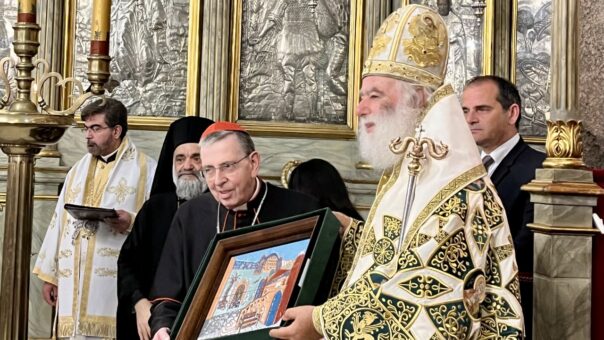
23 Jun 2023 | Non categorizzato
The Joint International Commission for Theological Dialogue between the Catholic Church and the Orthodox Church held its fifteenth plenary session from 1st-7th June 2023 in Alexandria, Egypt. It was hosted by the Greek Orthodox Patriarchate of Alexandria and All Africa. Agreement was reached on a new document entitled “Synodality and Primacy in the Second Millennium and Today”. We interviewed theologian Piero Coda, who attended the meeting. Fr. Coda, can you tell us how it went, who took part and what was the main objective? It was the 15th plenary session of the “Joint International Commission for Theological Dialogue between the Catholic Church and the Orthodox Church” which was held in Alexandria, Egypt, under the chairmanship of Metropolitan Job of Pisidia (Ecumenical Patriarchate of Constantinople) and Cardinal Kurt Koch (Dicastery for the Promotion of Christian Unity), with the cordial hospitality of Patriarch Theodoros II of Alexandria. It was a question of completing the stage of dialogue inaugurated by the document of Ravenna (2007). After developing the theological framework shared by Orthodox and Catholics about the interdependence of synodality and primacy in the life of the Church, it provided an historical examination of the situation experienced in the first millennium, proposed by the document of Chieti (2016) and reached a description of the situation experienced in the second millennium, which was the object of the document approved in Alexandria. Due to the well-known vicissitudes which torment the Orthodox world, the Patriarchate of Russia left the work of the Commission. There were no representatives of the Patriarchates of Antioch, Bulgaria and Serbia at the meeting in Alexandria, while the remaining 10 delegations of the other Patriarchates (Constantinople, Alexandria, Jerusalem, Romania, Georgia) and the autocephalous Churches (Cyprus, Greece, Poland, Albania, the Czech Republic and Slovakia) were present. In what terms is it possible to speak of Synodality in the ecumenical sense and what considerations emerged also taking the past into account? The theme is illustrated in the Introduction: “The present document considers the troubled history of the second millennium (…) It strives to give as far as possible a common reading of that history, and it gives Orthodox and Roman Catholics a welcome opportunity to explain themselves to one another at various points along the way, so as to further the mutual understanding and trust that are essential prerequisites for reconciliation at the start of the third millennium.” The result is a clearer and more shared understanding of the reasons that have led, not infrequently for reasons of a historical-political rather than theological nature, to encourage a distance that has not only prevented attempts at reconciliation made over the centuries from coming to fruition, but has exacerbated the polemical interpretation of the other party and the apologetic stiffening of its position. The enhancement of openness to a new situation marked by the rapprochement that occurred in the twentieth century must be noted: it favours a more pertinent assessment of the actual meaning and theological weight of what still prevents full and visible unity. What are the future prospects? The document emphasizes that the “return to the sources” of the faith and the strategy of the dialogue of charity between the “sister Churches” promoted, in the wake of Vatican II, by Paul VI and Patriarch Athenagoras, are significant. The Catholic Church’s commitment today, tenaciously desired by Pope Francis, to rediscover and reactivate the principle of synodality also stimulates hope. What lies ahead? The document states that, “The Church is not properly understood as a pyramid, with a primate governing from the top, but neither is it properly understood as a federation of self-sufficient Churches. Our historical study of synodality and primacy in the second millennium has shown the inadequacy of both of these views. Similarly, it is clear that for Roman Catholics synodality is not merely consultative, and for Orthodox primacy is not merely honorific”. Therefore, the interdependence between synodality and primacy, this was the firm point which was achieved, “is a fundamental principle in the life of the Church. It is intrinsically related to the service of the unity of the Church at the local, regional and universal levels. However, principles must be applied in specific historical settings (…) What is required in new circumstances is a new and proper application of the same governing principle.” This perspective paves the way for the continuation of the journey and the opening of a new phase.
Carlos Mana e Maria Grazia Berretta (photo: ©Dicastero per la promozione dell’Unità dei cristiani)
22 Jun 2023 | Non categorizzato
Entering into prayer helps us connect deeply with the presence of God in our lives. Chiara Lubich, Rev. Pasquale Foresti and Igino Giordani outline a spirituality for everyone, in daily life in towns and cities all over the world. I realized, that modern times require a rather special kind of prayer. … In the past, people thought that the world and the universe were fixed, immovable. People had to find God through the stars, through flowers, through contemplation, peace, they found union with God through moments of recollection and prayer in the church, in front of the Blessed Sacrament. Instead, nowadays, people see that the world is in evolution – it’s constantly changing. Everything is changing and human beings also find themselves in this constant movement, they too are in race towards perfection. So, people can no longer stand still and contemplate, they have to … participate with God in this evolution, in this continuing creation. So, everything you do in your job – at school, in the office, in the factory – is all part of building up the world together with God the Creator, of making the world develop. However, we have to take it ahead with the idea that we are participating in the creative work of God. Seen this way, our work is sacred. We are like the arms of God the Creator who keeps building up the world.
(Chiara Lubich, Castel Gandolfo, 25 February 1989 in “Il Respiro di Dio” [The Breath of God] edited by Fabio Ciardi, Città Nuova, 2022, p.122-123).
A very important form of prayer can be experienced in work. I am thinking especially of people working in manufacturing, of all those people who during the day are overwhelmed by a workload that almost takes away their very ability to think and so, in a certain sense, also makes it almost impossible for them to pray. If each morning, with a simple intention, we offer our daily life to God, then we will live deeply in relationship with God throughout the day. And I think that when in the evening, these people who have worked so hard, are able to recollect themselves with God, even if only for a few moments despite their tiredness, they will find unity with him: they will find it because they have worked all day in relationship with him. And this is truly the most important thing: to be in a right relationship with him. And this, after all, is what humanity wants to hear today, that the whole universe and all that happens in it, can be understood in religious terms and can be transformed into one great prayer that rises up to God from the world.
Rev. Pasquale Foresi (in “Dio ci chiama. Conversazioni sulla vita cristiana” [God calls. Talks on Christian life] Città Nuova, 2003, p.116).
This morning I felt as if I had come closer to God. I don’t think I had ever felt him so close to me. My joy was, and is, great. I feel that I have found access to Him, freely; and my intention is never to stray away from him again. By the grace of God, I have overcome the obstacles that kept me clinging to the earth. Now I am on earth, and I dwell in heaven (my ambition is huge, but His mercy is even greater. I love God so much). I am no longer hindered by the impulses of vanity, of preferences in friendships. I go directly to God, discarding these wretched things. People may betray me, slander me, even kill me: but I have God; and I love these people, without being dependent on them. I belong to God. I do not need anything else.
Igino Giordani (in “Diario di Fuoco” [Diary of Fire], Città Nuova, 1992, p.196).
Activate English subtitles https://youtu.be/nCT9WVDhcuk
16 Jun 2023 | Non categorizzato
Today, the first episode of the new podcast, produced by the United World Project, has been published. The podcast tells stories of changemakers that have decided to start a new business, inspired by a spark that pushed them to act for the improvement of their society.
A spark can inspire change
Today, on 16th of June 2023, the United World Project is happy to present to you a new podcast in english: Sparks. In every new episode we will tell stories of changemakers from different parts of the world that gave life to a project, a company or an activity, after being inspired by a “spark”: a small light that has influenced many other people. Each one of them will take us to their country, where we’ll immerse ourselves in a new culture, and tell us how their project started. We do not have to be Greta Thunberg or Gandhi to initiate change. We believe that each one of us can make a difference. Maybe, all that’s needed is just a spark.
The first episode: Giving back to society one jar at a time
Giving back to society, one jar at a time. We all have big dreams. Mabih’s was to work at the United Nations, and for years she did all she could to make it come true. But things did not go as she hoped. In 2019, she realized that what she thought was her dream to help others was maybe in fact her own personal desire for affirmation in society. So she allowed that dream to transform, and her life changed in ways she could never imagine. Today, Nji Mabih runs a small business, she is 38 years old and lives in Cameroon. To keep reading, click here. To listen to the episode immediately on Spotify, click here! If you prefer to listen to podcasts on other platforms, you can also find “Sparks” on Apple Podcast, Google Podcast, Amazon Music, Anghami and Audible. Enjoy!
Laura Salerno
16 Jun 2023 | Non categorizzato
Letting God dwell in us: this is the starting point to safeguard and give joyful witness of the inestimable value of unity and peace, in charity and truth; to enrich ourselves and be seeds of goodness and brotherhood for the world. Without measuring hatred I live in a Ukrainian town on the border with Slovakia. We are not being bombed but we experience the terrible consequences of the war: displaced people with all their needs, the demand for torches and candles, medicines, blankets… A great darkness has descended on our land. News about people who betray others, of those who get rich in these terrible situations, of those who exploit others are the order of the day: when it triumphs, evil has no rules, no limits. But in spite of everything, something else happens: the people here feel involved in the pain of others and look for solutions. The need for warmth, protection and solidarity has returned to families. I witness this paradox of a war of evil and of the triumph of good. We tell the story of Chiara Lubich and her first followers: they too began during a war and they did not measure hatred, but turned on good and then spread everywhere. The forces of evil will not prevail. Our gratitude is a true prayer that rises to heaven like a song of praise to the God who is Love. (S.P. – Ukraine) A chain of love In the waiting room of my shop, the customers usually exchange news and since I hadn’t seen Mrs. Adele, an elderly woman who sometimes came to us, for a long time, I asked one of them for her news. So I learned that Adele was seriously ill and, driven by the desire to see her again, one day I decided to visit her. I found Mrs. Adele, alone and without relatives, completely abandoned. I immediately I circulated a request for help, looking for someone who could keep her company. Three clients responded immediately. A kind of competition started until one of their sons worked hard to get her admitted to a home that provided assistance and care. I too volunteered to give my services as a hairdresser, not only for Adele but for anyone. Adele’s story has shown me that it is enough to begin with concrete acts of charity; the chain of love then unfolds quickly and effectively. (F.D.R. – Italy) A School of Solidarity In the desert, outside the city of Egypt where I live, there are 1000 people with leprosy. Until a few years ago no one knew about this colony. We went to check the situation and found that they lacked everything. No doctors visited them. We contacted Carita and we opened our group to other young Christians and Muslims with whom we go there on our days off work. Two of us are medical students and are in charge of medical care, so they brushed up on the methods of treatment for leprosy. Others gave their time to paint the houses and make them more comfortable. A young journalist has published some articles in various newspapers and magazines in order to inform as many people as possible and raise awareness of the problem. Above all, we realized that the patients of this colony need someone to listen to them, which for them is almost more important than medicine. This experience has become a real school for us: it has made us understand how each of us can give our contribution for others. (H.F.S.- Egypt)
compiled by Maria Grazia Berretta
(taken from The Gospel of the Day, New City, year IX – no. 1 May-June 2023)
14 Jun 2023 | Non categorizzato
The Meeting on Human Fraternity took place in the Vatican on 10 June 2023. The Focolare Movement together with a number of other ecclesial movements and international associations and organisations took part in this international event. It was represented by its president, Margaret Karram and a number of other focolarini including Christian Abrahao Da Silva who spoke about his impressions. The meeting had a number of aims: these included promoting and developing the process of participation, rediscovering the meaning of fraternity and building it together through dialogue, knowledge, opportunities for encounter and sharing words and actions. The gathering was promoted by the Fratelli Tutti Foundation and St. Peter’s Papal Basilica, under the patronage of Cardinal Mauro Gambetti, Archpriest of St. Peter’s Basilica in the Vatican and Vicar General of the Vatican State. It was inspired by the encyclical Fratelli Tutti and participants included several Nobel Peace Laureates and a number of well known people from the worlds of science, culture and law. They were given the task of creating a “Call to Commitment for Human Fraternity.” The document they produced was read by two Nobel Prize laureates, Nadia Murad and Muhammad Yunus, during the Festival held in St. Peter’s Square in the afternoon and was later signed by the Secretary of State, Cardinal Parolin, on behalf of Pope Francis as well as the group that drafted the document. Christian Abrahao Da Silva, a focolarino who attended the Meeting, tells us what an extraordinary moment it was. Christian, what did taking part in this event dedicated to world fraternity mean to you? First of all, it was a great honour. Margaret Karram, the Focolare president, another focolarina called Corres Kwak and I represented the entire Movement during this great event. Its goal was to promote fraternity and social friendship among people and among peoples, as an antidote to the many forms of violence and war taking place in the world. The meeting was held in two parts: the morning session took place in the ancient synod hall, with the presence of representatives of various church movements and associations. Instead, in the afternoon, a large Festival was held in St. Peter’s Square and this connected with events taking place in various squares around the world. How did the Meeting begin? During the morning, we took part in two working groups where we were asked to answer two questions: “What are we doing concretely to achieve social fraternity and environmental fraternity?” and “Is there still an ‘us’?” These were very good sessions in which everyone was involved. People talked a lot about the “garden” in reference to the Garden of Eden about which Pope Francis had written in Fratelli Tutti. The words used most often were were: compassion, responsibility (political and economic), sharing, integral promotion, recognition of every human person, care and welcome. It was a real ecclesial experience: there was great hope that this can grow and witness to the need to rediscover and strengthen human fraternity. What impressed you the most? In addition to the group of Nobel Peace Prize winners and the group of ecclesial movements and associations, there was also a group of 30 young students from various Italian schools who were accompanied by their religious education teachers. They had taken part in a competition to express the theme of the Meeting in a variety of different artistic forms. Their presence was an important sign of the commitment of the new generations to learning about fraternity. Other things that struck me were the experiences that some people shared on Festival stage in the afternoon and the artists who shared their talents so freely and joyfully.
What does the Focolare Movement take home after this event? Pope Francis relaunches fraternity as a new anthropological paradigm on which to rebuild actions and laws because “fraternity has something positive to offer freedom and equality” (Fratelli Tutti, no. 103). This notion brought to mind a talk by Chiara Lubich entitled, “Freedom, equality…what happened to fraternity?” It was one of those events that encourages us to throw ourselves more and more into the heart of our charism of unity. Moreover, Cardinal Gambetti really touched our hearts when he explained the inspiration behind the Meeting. He said it was both a “process and experience, a first step in rediscovering the meaning of fraternity and building it culturally.” He continued by saying that becausé it is not giveǹ biologically, fraternity needs encounter and dialogue, knowledge and shared words and gestures, common languages and the experience of beauty.
Maria Grazia Berretta
8 Jun 2023 | Non categorizzato
As is well known, on the 7th of June, Pope Francis underwent surgery at the Gemelli Hospital in Rome. The Pope is “in a generally good condition” and is peaceful. He is thankful for the messages of solidarity that are being sent to him from all over the world and asks people to continue praying for him. Margaret Karram has also sent him prayers and affection on behalf of the whole Focolare Movement.
Rocca di Papa, 8th June 2023
Your Holiness, dear Pope Francis,
We anxiously followed the news of the surgery you underwent yesterday and are delighted with the recent comforting reports about your health. United with the whole Church, we accompany you with the prayers and spiritual offerings of the Movement’s communities around the world. We assure you that we will continue to support you, asking the Father for your full recovery, so that you may continue your invaluable ministry.
I send you my most affectionate greetings and those of the Focolare Movement!
Your daughter in Christ,
Margaret Karram
31 May 2023 | Senza categoria
A meeting was held on the 27 and 28 May in Loppiano (Florence-Italy) to celebrate the 50th anniversary of the birth of the Loppiano Prima Cooperative. Fifty years on from the 19 May 1973, the date the cooperative was set up, the event provided a unique opportunity to recall the founding moments, take stock of the journey travelled so far and re-launch productive and commercial activities, looking ahead to the future. We would like to share with you an interview with Maria Ghislandi and Giuseppe Marvelli who were two of its founding members. “You cannot have a future without memory so it is crucial to go back to the roots, and in this break we wish to emphasize our ongoing commitment to recovering, reviving and translating into the present day context, the founding inspirations and prophetic sparks given to the Cooperative over time by Chiara Lubich”. It was with these words that Beatrice Vecchione, the current President of the Loppiano Prima Cooperative, opened the weekend of celebrations entitled Love for Creation, a prophecy on the move, a special occasion commemorating the 50th anniversary of the Cooperative’s foundation that took place on 27 and 28 May 2023 in the Auditorium of Loppiano, the Focolare Movement’s international little town near Florence in Italy. It was a weekend of exchanging and sharing ideas with a view towards integral ecology which revealed the heart of this pioneering experience of ecological agriculture during Laudato Sì Week. 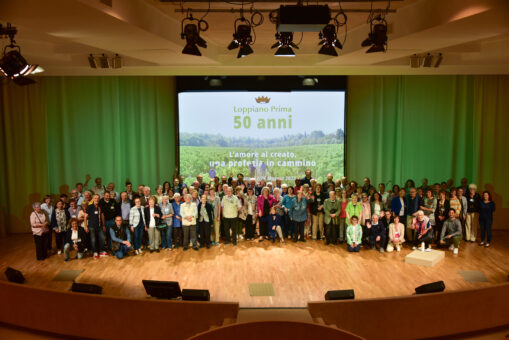 “Loppiano Prima”, Beatrice Vecchione continued, “has its own physiognomy and typical characteristics well captured by the title and because it undoubtedly reflects five decades of “love for creation and of a prophecy on the move”, a prophecy of which, going back to the roots, Raffaella Pinassi Cardinali – one of the pioneers and someone who has always been a point of reference for the agricultural cooperative that was started in 1973 on the wave of a challenge – to support the construction and development of the little town of Loppiano. Starting on 19 May of that year, with 8 founding members eager to put to good use the land in the Chianti hills of Florentine Valdarno donated to the Focolare Movement by the Folonari family, Loppiano Prima has become a cooperative with a widespread shareholding system that currently has 3,256 shareholders. As stated in its Articles of Association, “it has no speculative purpose and is governed by the principles of mutuality that prevails”. Furthermore, “its main purpose is to achieve the community’s general interest in promoting humanity and integrating its citizens in society, as well as contributing to the implementation of universal fraternity”. This is how, over the last 50 years, on uncultivated land that had been abandoned when many farmers emigrated in the post-war period, Loppiano Prima Cooperative has become the protagonist of a unique experience of ante litteram ecological agriculture which has put humanity, nature and their relationship with each other at the centre. A topic that is active and operational within Loppiano but which is also present in and for the region, the fruit of the generosity, tenacity and passion of so many volunteers of God of the Focolare Movement who felt the call to respond to Chiara Lubich’s prophecy 50 years ago, giving God through work; above all the fruit of the faith of those who believed in and wanted to take care of that dream that we have now inherited: to love creation, making of one’s own life a true witness of the Gospel. Now we will share Maria Ghislandi and Giuseppe Marvelli’s stories, two of the founding members of Loppiano Prima. https://youtu.be/IQzEiEkzwAQ
30 May 2023 | Non categorizzato
An Ecumenical Chapel was recently inaugurated at the Fiore Educational Centre in Mixco (Guatemala). The Directors Maresa Ramírez and Luis Martinez told us how the idea came about at the same time as Pentecost, which is when the Week of Prayer for Christian Unity is celebrated in the southern hemisphere.  “We don’t just focus on one Christian denomination, we look for what unites us within Christianity. That’s why our chapel is ecumenical. We want everyone to feel part of the family of our Educational Centre, we want to include each other.” With these words, Maresa Ramírez explained the objective of the new ecumenical chapel built in the Fiore Educational Centre in Mixco (Guatemala), of which she is General Director and works together with Luis Martinez, who is the Administrative Director.
 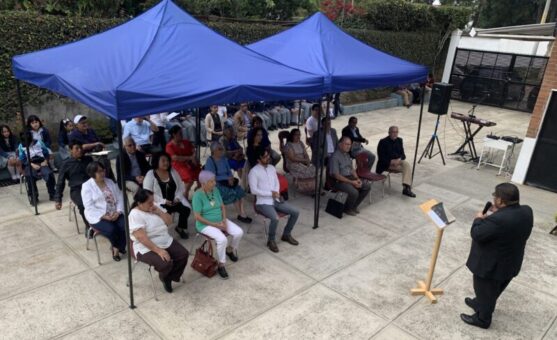 The Centre has been welcoming children from different Christian denominations for 10 years and following the pandemic, the number has gradually increased. The chapel is part of the school’s educational plan which is based on academic, physical-emotional and spiritual processes. The chapel offers several elements to try to favour a relationship with God, while taking into account the age of the children who attend the school. Luis Martinez told us: “The project of the chapel includes ideas based on play, using games to bring children closer to God and have a relationship with Him. For example, we have installed tubes that run from the entrance of the chapel towards the Cross, so that if a child wishes, they can send a secret message to Jesus. Then, the clouds create the atmosphere of the sky, because we place God in relationship with the sky. The children are the focus and when they enter this place there is immediately a relationship which is both fun and serious at the same time”. The school offers children this space where they can go when they feel they would like to spend a moment with God. In the area of education in faith and values, the children learn how to do origami, so that they can write their acts of love, and leave them there, offering them to Jesus, “on the basis of what Chiara Lubich taught children: when you do an act of love, think of it like a little parcel and send it to Heaven”. The occasion of the inauguration was a great example of collaboration, since the dialogue between the Focolare Movement in Guatemala and the Ecumenical Christian Council of Guatemala is extensive. Luis Martinez told us, “We have built a relationship with each of the members, in particular with the Catholic Bishop, Monsignor Valenzuela. When we spoke to him, we realized how important the existence of this chapel is, because in the Guatemalan ecumenical reality, dialogue is really essential”. Apart from these existing contacts based on fraternity, people from 7 Christian Churches came too and about 25 people participated in the inauguration of the chapel. The inauguration was organized by the Fiore Educational Centre and Monsignor Valenzuela and included psalms, reading of the Word and several prayers of blessing and praise. The pupils said a prayer for peace. The director, Ramírez, concluded, “It was a very good moment. Those who intervened noticed that the children are at the centre of our educational plan and that we are the first school in the country to have an ecumenical chapel“.
Diego Santizo
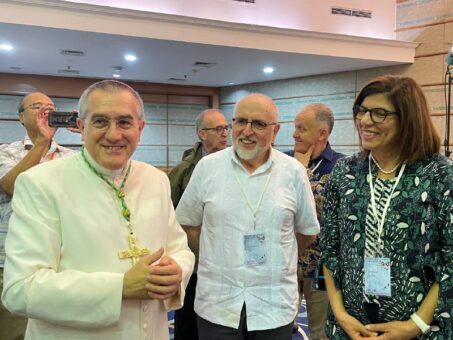
27 May 2023 | Non categorizzato
The trip to Asia and Oceania by Margaret Karram and Jesús Morán, President and Co-President of the Focolare Movement, has come to an end. Here are some updates on what they experienced on the final stage: Indonesia Panongan (Indonesia), 17th of May 2023 – It is 8 a.m. in the morning in the Catholic parish of St. Odelia, about two hours from Jakarta. Archbishop Ignatius Suharyo, Cardinal of the Indonesian capital, has arranged a meeting for representatives of the government and law enforcement agencies, the municipality, the villages, as well as Muslim, Buddhist, and Hindu religious leaders. The purpose was to tell the President and Co-President of the Focolare about a pilot social project, being conducted collaboratively by all these sectors of society, in support of the city of Tangerang/Banten. With more than two million inhabitants, this is the third most populous area west of Jakarta, the capital of Indonesia, which with all its satellite cities has almost thirty million inhabitants. It is an area where there is great development, but also economic inequality. The people living in the villages are poor, working in the rice fields, living off the land and raising chickens, goats, and a few cows. This area, with an overwhelming Muslim majority, is within the St Odelia parish. Father Felix Supranto – known as “Romo Felix” by everyone (“romo” means “father” in Bahasa, the country’s official language) is the dynamic parish priest of St. Odelia’s. He has the gift of knowing how to bring people together. He is our host along with the many parishioners he has involved in various social projects over the years.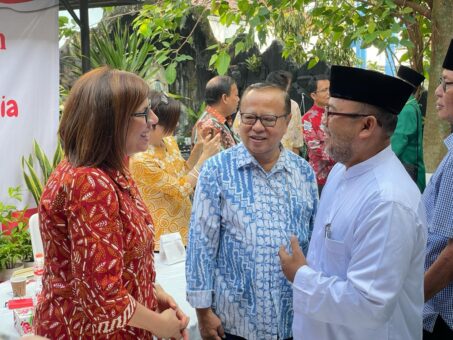 The Cardinal explained: ‘The dialogue we have here with our brothers and sisters of different religions is something concrete,’ ‘it looks at the needs of the people. There is a need for houses, to create job opportunities, to bring water to the villages. We are working on this ‘together’ and it is important that the President and Co-President of the Focolare have come here to see what could be a model of dialogue, also outside Indonesia. Our country’s motto is ‘unity in diversity’ and it very much expresses who we are, and how we face challenges.” “We are honoured to have you with us,” said Father Felix to Margaret Karram and Jesús Morán, “to share the journey we are on. So far, we have built twelve houses to help the poor and it is this working together that makes us brothers and sisters, even with our differences. The day continued with a visit to a school for children from 6 to 15 years old, to several villages where, thanks to the funds raised, it has been possible to bring water, to breed cows, goats and catfish and where the added value is the full involvement of everyone: institutions and local people. The visit to the madrassa – an Islamic school – is the last appointment of this first day of visits that shows us the supportive and communitarian character that is the real strength of this country. Bhinneka Tunggal Ika – we are different, but we are one Bhinneka Tunggal Ika, ‘We are different, but we are one’ is in fact the motto of Indonesia, inscribed on the national coat of arms depicting an ancient deity, the Javanese eagle.
 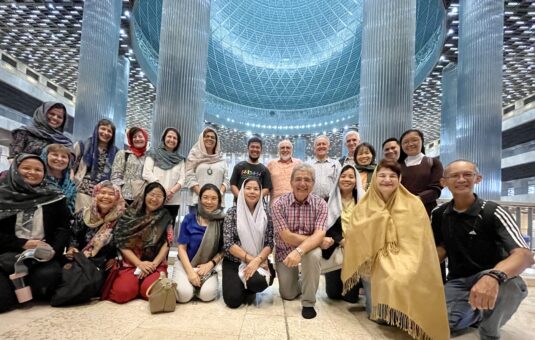 A record breaking country With its 17,000 islands and more than three hundred ethnic groups, each with its own vibrant cultural tradition, Indonesia is a country of rich diversity. And today the population proudly presents itself to the world as an example of tolerance and coexistence between diverse cultures and religions. One example among many: the Istiqlal (Independence) Mosque in Jakarta is the largest in South-East Asia. It stands directly opposite the Catholic cathedral and during major Christian celebrations, such as Christmas, the mosque gives support by providing parking spaces for Christian worshippers; it happens the other way around on Islamic feast days. Indonesia has the highest biodiversity on the planet, but deforestation and exploitation of resources are threatening the preservation of these natural environments with serious consequences. Wealth is unevenly distributed, and it is estimated that 27,000 millionaire families (0.1% of the population) own more than half of the country’s wealth. Although it is not easy to get accurate statistics, the population is estimated at 273 million, making it the fourth most populous country in the world. Indonesia has the highest Muslim population in the world (86.1 %); Christians of various Churches make up 10.53 %, and religious affiliation is recorded on identity cards. The focolarini in Southeast Asia and Pakistan Jakarta, 19th May 2023 – Seeing the focolarini from Southeast Asia and Pakistan who have arrived in Jakarta to meet with Margaret Karram and Jesús Morán, the great potential of the Asian continent comes to light. They witness to the encounter between very different peoples and cultures: from Thailand to Myanmar, from Vietnam to Indonesia, Singapore and Malaysia. Many of them were connected online, like the focolarini in Pakistan for example, but the distance does not prevent a deep communion in which we witnessed both the challenges of inculturation in individual countries and the strength of unity, which can reach the most diverse environments.
 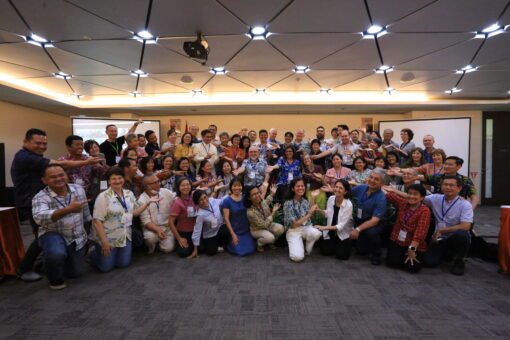 There was a very attentive atmosphere during the question-and-answer session with Margaret Karram, Jesús Morán, Rita Moussallem and Antonio Salimbeni (who are jointly responsible for the Focolare’s interreligious dialogue). The women focolarine from Ho Chi Minh City (Vietnam) asked how to spread the spirituality of unity in these times when it is difficult to interest people, and especially young people. “On this trip to Asia and Oceania,” Margaret explained, “I realised that the way we have been offering the spirituality of unity up to now has to change, because society has changed. We are all living so ‘connected’ to one another that we need to find a way of presenting the various vocations not each one on its own, but alongside one another. Perhaps we could do this when we meet as a community of the Movement at a local level; then it will be God who speaks to the heart of each one, calling them to the different paths. I see that what touches people’s hearts is caring for people personally, building true relationships, made of selfless love. People should find in each of us a brother, a sister, a friend. Only when we have built a relationship can, we invite them to get to know the spirituality of the Focolare”. “Sometimes we might think that we do not have the right means for interesting people in the spirituality of unity,” continued Jesús in the same vein, “but we must beware of giving in to the temptation to adapt what we say to the flow of the world in order to be accepted at all costs. We have to be in the world, because it is beautiful, God created it, but we should feel the contrast with the world; it is Christian to experience it, because we belong to a truth, the truth of Christ, which goes beyond the world’. Dialogue as a way of life Jakarta, 20th May-Yogyakarta, 21st May 2023 – “Since February 2021, our life in Myanmar has changed completely. My region is the one where the conflict is worst. We wouldn’t want anyone to have to hear the explosions of artillery and aerial bombings, it is not human. We are rooted in God and focused on living in the present – because we do not know if we will be here tomorrow – and we continue to bring our people love and new hope. Every day I understand more Jesús’s words: ‘Greater love has no one than this, to lay down one’s life for one’s friends’ (Jn 15:13)”. The speaker was Gennie, who is Burmese and works for an aid agency that takes care of displaced persons of whom there are more than one million since the coup. Hers is one of the testimonies that recounted the life and challenges of the Focolare communities in Southeast Asia at the forum “Dialogue as a way of life”, held in partnership with the Catholic University of Jakarta “Atma Jaya”. 290 people attended from various parts of Indonesia as well as from various countries in Southeast Asia. Another three hundred were linked by streaming from Pakistan and elsewhere. At the centre of their testimonies is the culture of dialogue that is lived in these countries in everyday life, becoming a way of life, also in the world of economics, as Lawrence Chong from Singapore recounted. Since 2004 he has been running a management consultancy company with two other partners, a Methodist and a Muslim, according to the principles of the Economy of Communion. “Today we are present in 23 countries and our work is to bring about change, to have an impact on the economic system and improve it, based on the principles of interdependence and mutual love.”
 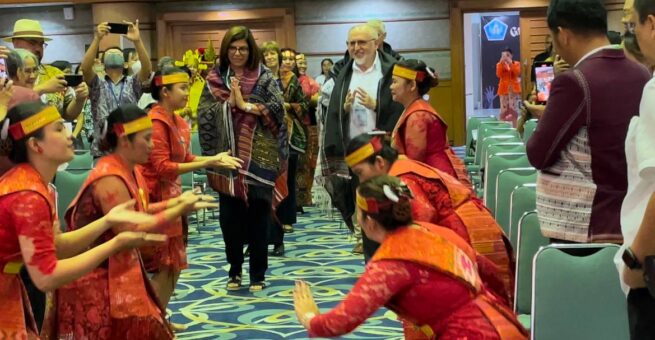 After the celebration, where the different peoples present shared their great cultural wealth and variety of traditions, Margaret and Jesús answered some questions and shared their initial impressions of this trip. “Asia is the continent where the sun rises, while we come from Europe, where the sun is setting,” said Jesús. “In Asia and Oceania, we found a very lively Church, as well as people of different religions, and we immersed ourselves in the light that we found in the deep humanity of people. We have received so much hope for the Church and for the Work of Mary. This hope will not meet with disappointment if these people remain true to themselves. Of course, we also saw the problems: the poverty, conflicts, and wars. So, it is true that the sun rises in these countries, but we also have before us a great challenge: our hope is that the Gospel can also bear a message of freedom for these peoples”. The Apostolic Nuncio, Archbishop Piero Pioppo, who came to celebrate Mass, expressed his wish that the message of unity and of communion may grow and spread in this world that is in dire need of it. The roots of the movement in Indonesia Also in Yogyakarta, Margaret and Jesús were welcomed by the Focolare community with the traditional dance of welcome. The meeting there was a journey into the extraordinarily rich Javanese culture and traditions, and an opportunity to learn about the roots and development of the Movement in Indonesia. After several trips were made from the Philippines from the late 1980s onwards, the focolare arrived in Medan in 2004. But no one will ever forget 2006, the year of the terrible earthquake that claimed thousands of lives. Its epicentre was on the island of Java, in the region of Yogyakarta, where the focolare is now located. Bapak Totok, one of the animators of the local community, tells how the people of the Focolare Movement, together with the local people, rolled up their sleeves to help build 22 “Pendopo” (community centres in twenty-two villages) as well as a social project. These centres have been a sign of peace and unity among people of different religions. Sunan Kalijaga Islamic University: in dialogue to promote fraternity Yogyakarta, 22nd May 2023 – With its 20,000 students, Sunan Kalijaga University is an important national academic centre for Islamic studies and has also had a Cultural Centre for Interfaith Dialogue since 2005. Margaret Karram, together with Rita Moussallem and Antonio Salimbeni, participated in the seminar “In dialogue to promote fraternity” with 160 students, teachers, and members of the local Focolare community. It is a subject that resonates in a special way here, where dialogue “goes beyond” university lecture halls or study forums, as it is both the challenge and the foundation of Indonesian society. “The presence of the leaders of the Focolare Movement is important,” explained Prof. Inayah Rohmaniyah, “because it allows us to take an extra step, not to look only at Indonesia, but to become together builders of a world renewed by the values of the fraternity that we are living, here, today”. The students’ questions focussed on the strategy of dialogue to combine cultural and religious diversity even in situations of social conflict. “Sometimes we talk very much about the difficulties and very little about the riches that these diversities bring in themselves” Antonio Salimbeni replied. “First of all, we are human beings, brothers and sisters, which is why it is important to be open, to understand the religion of the other from his or her perspective; to try to think as a Muslim thinks, as a Hindu thinks, to see the world as the other person sees it. The journey is ending, but a world is opening up Margaret Karram and Jesús Morán first official trip to Asia and Oceania is ending after 45 days travelling, visiting five countries, and meeting several thousand people – 1,500 in Indonesia alone. They met very different peoples and cultures, they have seen the challenges at first hand, but also the vitality of the Church in countries where Christianity is a minority. They have witnessed dialogue between people of different religions taking place in everyday life, dialogue that can give concrete answers to the social and economic problems of peoples and they have shared in the life of the Focolare communities in this part of the world. It is not easy to take stock on the spur of the moment, but nonetheless the question was asked, and Margaret shared some impressions of the recent public meetings: ‘I feel strongly that God is asking the Movement, in Asia in particular, but also worldwide, to take an important step. Dialogue must become our way of life, our way of acting, at all times. We cannot continue as before, looking only at our Movement and doing our own activities. The time has come to go outside, to work with other organisations, with people of different religions, as we are already doing here. So, let’s get going, there’s no time to lose! This journey has given me, once again the confirmation that unity and peace in the world are possible. Sometimes looking at the world today, with its wars and injustices, I have had doubts. But in all the countries we visited, I met many people committed to building a different society, to building bridges, even making great sacrifices. It is they who have given me the certainty that together we can make a difference and give our contribution”.
Stefania Tanesini
26 May 2023 | Non categorizzato
A unique opportunity to get to know each other, to share and to rediscover the beauty of being a collective witness to the Resurrection. This is what the Ecclesial Movements and the new communities in the Holy Land were able to experience on the journey they began together at Pentecost a year ago. Communion, participation and mission: these are the three key words related to the Synodal Pathway that was launched in October 2021. At its inauguration, Pope Francis invited followers of the Universal Church to listen and be close to others; this created the context of the local phase of the Synod. At the invitation of Archbishop Pierbattista Pizzaballa, the Latin Patriarch of Jerusalem, the Ecclesial Movements and the new communities present in the Holy Land were able to meet, listen to each other and work in communion in preparing the 2022 Pentecost Vigil. This was a special occasion when many people experienced the joy of feeling they were one body in the Church, enlivened and renewed by the Holy Spirit. Within the sociopolitical and cultural context of the Holy Land, there was possibility of generating “unity,” learning from each other’s charism and putting one’s own at the service of all. Archbishop Pierbattista Pizzaballa said, “I think that if we are to feel that we are one body, the first thing to do is to speak, to communicate but, above all, to listen. Listening does not mean only hearing, it means expecting to receive from the other person who becomes the subject – I am not the subject, the other person is.” Pentecost marks the time when the Church on its pilgrimage to meet the Lord, constantly receives the Spirit from him. The same Spirit gathers it in faith and charity, sanctifies it and sends it on mission. At Pentecost 2023 we share an account of this experience of communion.
Maria Grazia Berretta
Watch the video (activate English subtitles) https://youtu.be/I8aQgmAPBOg
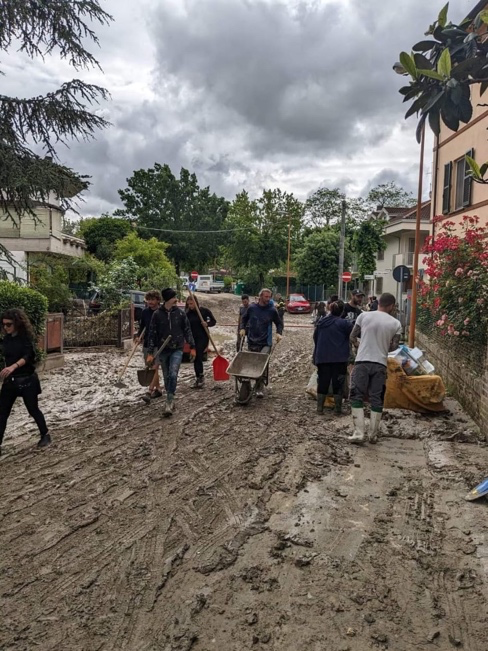
25 May 2023 | Non categorizzato
The wave of bad weather that has poured over Italy in recent weeks has specifically affected the regions of Emilia-Romagna and Marche. To date, many people continue to work in the terrible, muddy conditions to assist entire communities that have been displaced and have lost everything due to the flood. An appeal for funds has been launched by the Focolare Emergency Coordination Committee. It is a climate emergency that has hit Emilia-Romagna and Marche, two regions of central-northern Italy in recent weeks. A catastrophe that has claimed 15 victims so far and displaced about 23,000 people. Several cities have been completely brought to their knees, submerged by water due to the many flooded rivers. There is extensive damage to homes, furniture and cars, as well as to businesses, farms and crops. In Emilia-Romagna the most affected area so far has been that of Faenza which in one night ended up almost completely underwater due to the rupture of the banks of several rivers. The communities of the Focolare Movement in the area told us, “Many families have been evacuated, for example, a family with three children was rescued when the water had already reached the first floor of their home. Despite having lost everything, the next day this same family, helped by the local Civil Protection Organization, opened their family run restaurant and prepared hot lunches for hundreds of evacuated people.” A social worker from Faenza, a member of the Focolare, said: “A few nights ago, I was in the Town Hall, the headquarters of the Emergency Operations Center. It was a very emotional experience. If I think about it, I cry… I ask Jesus for the strength to do what is best for each person.” In another town, Cesena, the Savio River flooded and the adjoining houses were engulfed. Wherever possible, and thanks to a lull in the rain, the first volunteers started working. In the city of Cesenatico the situation is extremely difficult. The sea has invaded beaches, bathing establishments and streets. In the surroundings of Bologna, on the other hand, there are many small towns still flooded; the people have all been evacuated. A bridge has collapsed that has completely diverted the river bed inwards and the people are saying, “it will take time but help will certainly be necessary”. Reports from these areas say, “The water is not being absorbed by the ground. It continues to rain and is like a wave, which depending on the levels of the ground, behaves in an unpredictable way”. In the south of Romagna, between Ravenna and Rimini, the situation has also worsened in the towns of Russi and Lugo. Other members of the Focolare Movement told us: “In the town of Bagnara di Romagna, we have had water 20 cms deep; the ground floors, garages and basements are full of water, but we’re fine.” It’s a catastrophe that will have to be tackled but despite the enormous difficulties, many people fervently desire to take concrete action to rebuild. One said, “The beauty is that one of the things to manage is the infinite offers of help we are receiving. Many people are offering homes and hospitality and we are setting up a team that will deal with the numerous requests and offers. The local Islamic Community, in contact with the Focolare Movement, has also expressed willingness to welcome or carry out joint actions. The extraordinary fundraising appeal initiated by the Emergency Coordination of the Focolare Movement in support of the population of Emilia-Romagna and Marche, through the ONLUS Action for a United World (AMU) and Action for New Families (AFN) is ongoing. Contributions received will be jointly managed by AMU and AFN to initiate reconstruction actions. You can donate online on the following sites: AMU: www.amu-it.eu/dona-online-3/ AFN: www.afnonlus.org/dona/ or by transfer to the following current accounts: Action for a United World ONLUS (AMU) IBAN: IT 58 S 05018 03200 000011204344 at Banca Popolare Etica SWIFT/BIC code: ETICIT22XXX Action for New Families ONLUS (AFN) IBAN: IT 92 J 05018 03200 000016978561 at Banca Popolare Etica SWIFT/BIC code: ETICIT22XXX Reason: Emilia-Romagna and Marche Emergency Tax benefits are provided for such donations in many countries of the European Union and in other countries of the world, according to the different local regulations. Italian taxpayers will be able to obtain deductions and deductions from income, according to the legislation provided for the NGOs
23 May 2023 | Non categorizzato
Tommaso Bertolasi and Laura Salerno are the creators of “Benedetti dubbi” (Blessed doubts) a new podcast from the young people of the Focolare Movement. The first episode will be available on 23rd May, 2023. We asked Tommaso and Laura to explain how doubts can really be a “blessing”, in order to get to know ourselves and others better. What is our calling? What is the best road to follow when we come to one of the many crossroads that life throws at us? Do we know ourselves and, above all, who has the antidote for fear? Questions like these, the kind that overwhelm our daily lives, are the subject matter of “Benedetti dubbi”, the new podcast designed for young people and by young people, released (in Italian) on 23rd May. To find out more about it, we interviewed the authors of this project, long-time friends, Tommaso Bertolasi, a researcher in philosophy at the Sophia University Institute (Loppiano, Florence) and Laura Salerno, a young member of the Focolare Movement, a writer and a student of literature. Laura, how did it all start? It all started in 2018. Tommaso and I were in Argentina. We met at a conference for young people of the Focolare Movement. Since he is a philosopher, he had been invited as a speaker to talk about freedom. I listened to what he said and liked it very much. Over the years he has continued to engage in dialogue with and for young people, so much so that he has decided to compile some of the exchanges in a book, entitled “The last hour of the night”, which will be released by Città Nuova in August 2023. And then came the idea: “Well if a book is coming out, why not do a podcast that deals with the same content?” And so a few months ago I got a phone call inviting me to help him bring this project to life. Tommaso, why a podcast? Sometimes ideas are like a cocktail: they come out of the union of various things. And this is what happened with “Blessed Doubts”. At a certain point I realized that I had a lot of material for meetings, workshops and dialogues, that I had often prepared with young people. Hence the idea of not restricting important themes such as freedom, choices, fragility and vocation to just one occasion but of being able to offer them to everyone. Then I thought that other languages and themes could also be explored and so here is the podcast. I wanted to create a format more suitable for young people, who often nowadays, find reading a challenge. Or at least, they read something after you’ve convinced them it’s worth it. In all this work, an additional factor was the World Youth Day that dictated the timing of this operation a little. I thought it would be nice that the Focolare Movement could offer something to those who are preparing to go to Lisbon. It will be released on the major podcast platforms (Spotify, Apple Podcast, Google Podcast), one episode per week for 6 weeks. Laura, what age group are you targeting? Our target age range is 18-30 years. This is why the main themes are questions about fragility, freedom, relationships, trying to find one’s place in the world. It’s all about trying to see doubt as a positive thing, as a springboard to live more deeply and more consciously what happens to us.
  Tommaso, how did you determine the topics to be addressed for each episode? My initial idea was to replicate the contents of the book, paraphrasing it. Working with Laura, however, I realized that her questions led the conversation to other areas, that the young people she had in mind were also her university classmates who do not necessarily recognize themselves in any religious creed. I understood that Laura had deep questions that were partly hers and partly reflected her world of relationships: it was from those questions that we had to start to weave something suitable for young adults. What was the most difficult episode for you, Laura? I think the hardest was the first one. We were both a bit nervous, and then we had to introduce the podcast, make it clear why we think it is important to ask questions, not to exist in anxiety or submerged in paranoia. A further challenge was that a few days before we recorded the first few episodes, I had a bad cold and a high temperature. Everything always happens at the same time! But we managed to do it also thanks to the super team that supported us during the recording. Tommaso, what did you gain from this project? I learned a lot from all the people with different skills who worked on this project. Indeed, the realization of “Blessed doubts” was a collective operation. And after you listen to the podcast, we’d love to have your feedback, on Spotify, on our social networks (@Y4UW and Movimento_dei_focolari) or via email (ufficio.comunicazione@focolare.org). For further information about other projects in the pipeline, stay connected to the social channels of the Focolare Movement.
Maria Grazia Berretta
19 May 2023 | Non categorizzato
The Emergency Coordination group of the Focolare Movement has launched an extraordinary fundraising campaign to support people in Emilia-Romagna and Marche. These two regions in the centre-north of Italy are affected by serious flooding. Funds will be made available through the non-profit organisations Action for a United World (AMU in Italian) and Action for New Families (AFN). Donations will be jointly managed by AMU and AFN to begin reconstruction (many people’s homes have been damaged, as well as furniture and vehicles that are essential for transport and work activities. There has also been extensive damage to livestock and crops…) You can donate online at: AMU: www.amu-it.eu/dona-online-3/ AFN: www.afnonlus.org/dona/ Or by bank transfer to the following current accounts: Action for a United World ONLUS (AMU) IBAN: IT 58 S 05018 03200 000011204344 at Banca Popolare Etica SWIFT/BIC Code: ETICIT22XXX Action for New Families ONLUS (AFN) IBAN: IT 92 J 05018 03200 000016978561 at Banca Popolare Etica SWIFT/BIC Code: ETICIT22XXX Reason for payment: Emergency in Emilia-Romagna and Marche Tax benefits are available for such donations in many EU countries and in other countries around the world, according to different local regulations. Italian taxpayers can obtain deductions and allowances from their income, according to the regulations for non-profit organisations.
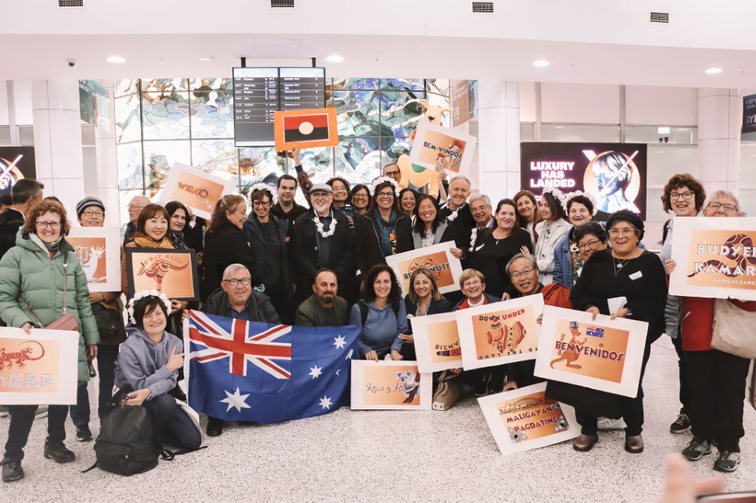
19 May 2023 | Non categorizzato
We have come to the Australian stage of THE journey BY Margaret Karram and Jesús Morán, President and Co-President of the Focolare Movement. IT IS a continent with extraordinary cultural riches and a diverse and multicultural Focolare family.
Suva to Sydney
Margaret and Jesús have certainly taken radical leaps throughout this trip. (Just think of their jump from Japan to Fiji.) The flight from Suva to Sydney 9 May was certainly similar, as the sudden shift from seeing the handful of fishing villages on the south coast of Fiji’s main island to the bright shiny jewel of a city in Australia is nothing short of extreme.
The shimmering lights of iconic Sydney harbour were on full display as our plane circled closely, almost as if to proudly show off this ‘beaut’ of a city.
Stepping into this multicultural metropolis, our diverse local community is there to welcome them in their many languages. They hail from South Korea, Philippines, China, Hong Kong, Lebanon, Sudan, Iraq, Syria, Bangladesh, Brazil, and of course Anglo-Celtic Australia. They are Catholics, Melkites, Chaldeans, Anglicans; the local Focolare region of Sydney includes Brisbane, Australian capital Canberra and their surrounding areas.
Meeting the Archbishop of Canberra
Connecting with the local Church remains top priority. During a profound yet light-hearted meeting with Archbishop Christopher Prowse, currently the archbishop of Canberra, he spotlighted the life of Mary MacKillop, Australia’s first saint.
“If Mary McKillop were alive today, she would be very comfortable with Focolare,” the archbishop said, pointing to her interfaith works.
He took us to her tomb and prayed that like her, the charism of unity would bloom like a rose, spreading its scent throughout Australia.
In through the art door
A clear window into an indigenous culture is through its art, but to know what you are looking at, having a guide is essential.
Enter Alexandra Gaffikin, an English Volunteer in Sydney with extensive experience in the museum and heritage sector. Her roles have included ‘head of interpretation’ at a museum, which certainly was handy as the group visited the Art Gallery of New South Wales for an exhibition on contemporary Aboriginal art.
Iconic bark paintings, for instance, were shown to be so much more: they are at once histories, maps, title deeds, and rulebooks even. They can be three dimensional, with underpainting showing underground water sources, for example.
In Aboriginal culture, these artworks are alive as people (and could even be painted on someone’s body). These are living collections displaying knowledge passed down through millennia.
Moments to enjoy Sydney
Amid a day full of meetings, Margaret and Jesús were able to fit in some time to take in Sydney, hopping on one of the many ferries and heading towards Circular Quay and the iconic Sydney Opera House. The views are spectacular! Happy to get behind the camera for a bit, Margaret ended up snapping quite a few pictures herself.
The upside of merging across the globe
This visit was an opportunity for focolarini from across the region – including from as far as Perth, Wellington and Fiji – to come together for some meaningful sessions. It is a time where the movement’s organisation has been merging, and now as a result exceedingly different cultures (think Korea, Japan and Chinese speaking areas, for instance) now need to adjust and collaborate directly.
“I think up until now we didn’t understand all the consequences and all the positive things, even though it has been very difficult all this process.
“But we will see the consequences, I think, in a few years. Because what it is helping us is to really break down all the barriers… first of all in our hearts, and the barriers between nations…
“If we want to have peace, we have to have peace among us focolarini and among communities. We have to look at other countries… as our own countries and discover that we can be this ‘connecting family’…
“We don’t have to give other people our richness, we have to help them to discover theirs.”
Margaret Karram
A special presence despite medical challenges
There was a particularly meaningful moment when three married focolarine who are seriously ill were able to greet everyone remotely.
“I just want to assure you of my unity. Much as I would’ve wanted, I was fully booked, but I had to change because of what God had in store for me,” said one.
“It’s been good because I feel where I’m where God wanted me to be, but it’s not where I wanted to be,” another told the group.
“Physically I can’t run, but inside I really want to run, I’m so excited,” said the third. “Enthusiasm does not have any age.”
Welcome to country
Aboriginal culture in Australia is the oldest continuous culture known, dating back at least 60,000 years. The proper protocol when beginning meetings in Australia is to have a ‘welcome to country’ from an Aboriginal elder, or a formal acknowledgement of the traditional custodians of the land.
As the Focolare community gathered from throughout Australia, we were privileged to have ‘Aunty Ali’ Golding, a Biripi elder, to welcome us all.
She grew up on an Aboriginal mission and later lived in a suburb of Sydney for over 20 years. In the 1980s, Ali was one of the first Aboriginal education assistants, and in 2004, she gained her diploma in theology.
She has contributed to various local, national and international forums, including the New South Wales Reconciliation Council and Australians for Native Title and Reconciliation. This has helped deepen public understanding of indigenous culture and history for the public.
Aunty Ali’s presence at our Focolare event with Margaret and Jesús certainly deepened our appreciation for this national treasure and her rich heritage. “It has been one of the most heartfelt welcomes that I have ever experienced,” she said. “Here I felt the Creator’s spirit.”
The best meeting of the whole trip (so far)
Margaret and Jesús had a dynamic, insightful meeting with close to 30 young people. When asked about their challenges, they did not hold back, but spoke candidly of the indifference they encounter with their peers daily. Their numbers are small; the distances are huge.
Margaret shared her early Gen life in Haifa with her sister, and how they started small, receiving the Gen magazine by mail. She was proud of how they had begun, and said she was just as proud of those present for moving forward with their Gen life.
Jesús encouraged the young people as well, making the effort to reassure them that sharing their difficulties was not negative at all. “This was the best meeting of this entire trip,” he said at the end. “I liked it a lot.”
Drawing on rich experience
Rita and Antonio, who look after the Focolare Oceania region from Rome, have also been travelling with the group. When asked how they live dialogue and fraternity in conflict situations, they reached into their own vast backgrounds.
“My experience in interreligious dialogue has been discovering that we are walking together towards God,” said Antonio.
“Dialogue is an encounter,” Rita added. “What is really important is to meet the other and discover that love drives fear away.”
How to bodysurf (spiritually)
The surf was certainly ‘up’ on the beaches around Sydney, with young and old donning their wetsuits and grabbing their boards to catch a few waves. ‘Bodysurfing’ is also popular – people ride the ocean waves without a board as well. It’s truly exhilarating.
But to get out to where the best waves are to ride, first you have to deal with the powerful ones rolling in towards you — the ones you don’t want to ride, the ones you aren’t ready for.
“Someone explained to me the dynamics of this sport, and right away what came to my mind was our love for Jesus Forsaken,” Margaret said.
Bodysurfers essentially dive deep below those incoming waves they don’t want to ride, so low that they can touch the sand at the bottom. Doing so, they avoid getting swept away by the power of the ocean. Once the wave rolls over, they come back to the surface to find a wave worth riding.
“Like those who bodysurf, you don’t fight the waves, you don’t ‘fight the trials’, but you go to the bottom of your heart, recognising Jesus in every pain, and continuing to love him, you come up again, finding the light through love.”
T. M. Hartmann
19 May 2023 | Non categorizzato
In these words of St Paul, fraternity is a call to goodness, to the life that is born from baptism, and this kinship in love allows us to see the other’s existence as a precious gift for us. The grade I was in the third year of high school and had an important physics oral exam coming up. I started studying hard knowing that I would be tested the following day (I was the only one in the whole class who didn’t have the end of term grade). Shortly afterwards, my little sister came to ask for help with her studies. At first I said no but then I was reminded of what St Paul tells us: rejoice with those who rejoice and weep with those who weep. So I started studying with my sister. It took the whole afternoon for her to feel prepared so I hardly managed to open my physics book. The following day I went to school, with my heart racing but convinced that God would intervene somehow. The teacher came in and started testing my other classmates. At the end of the lesson I asked him why he hadn’t called me. He looked at his register and said: ‘But you’ve already got the grade, and it’s a good grade’. I knew very well that I had never been tested, so maybe he put it there because of something I had said. (S.T. – Italy) How to get through the day A man in a wheelchair was begging near the supermarket trolleys. On my way out, I approached him and, after exchanging a few words with him, invited him to pick something from my shopping that he needed. He happily took some food and immediately started eating it. As I said goodbye to him, I experienced such a joy that it helped me face the challenges of a day that had got off to a difficult start. It made me realise that doing a concrete act of love is a good start to the day. I started doing this, overcoming many bad habits and surprising not only my husband, but especially the children who do not always appreciate what they have because they think everything is their due. One evening, hearing the news that an uncle was seriously ill left everyone in the family not knowing what to say until our eldest son, who goes to university, asked what we could do for him. At that point our youngest daughter replied: ‘We have to do what mum does who puts love into everything she does. That will help us discover what uncle needs’. (L. D. F. – Hungary) Adele “Bipolarity”… I never knew that my dear schoolmate, Adele, had such a serious illness. It was her mother who explained it to me. After spending some time in hospital, on certain days, when her centre seemed unstable, she herself did not understand what was happening to her. The medicines had to find a balanced effect, and it took time. But it did not change my affection and esteem for her. I was amazed the day she asked me to pray the rosary. It seemed she had perfect concentration when she prayed. From then on, we started reading spiritual books or stories with a positive content. I had the impression that my friend understood everything more deeply than I did. When we discussed certain topics, I saw in her a boundless altruism. Together we joined a volunteering group for the poor. Adele got back her life, balance and courage. She knew more than anyone else how to be close to those in need. My experience with her made it clearer to me that a person is truly fulfilled through charity. (P.A.M. – Italy)
Edited by Maria Grazia Berretta
(taken from Il Vangelo del Giorno, Città Nuova, year IX – no.1 May-June 2023)
15 May 2023 | Non categorizzato
The third award ceremony of the schools competition, “One city is not enough. Chiara Lubich, citizen of the world” took place on 12th May. There were 136 drawings entries. We spoke to Cinzia Malizia, teacher of the 1st A Class of the I.C. Camerano – John Paul II – Sirolo (Ancona-Italy) which was awarded the first prize in the primary school section.  The 2022-2023, third national competition for schools, “One city is not enough. Chiara Lubich citizen of the world”, was promoted by the Chiara Lubich Centre in collaboration with the Ministry of Education and Merit, the Fondazione Museo Storico del Trentino and New Humanity of the Focolare Movement. The title of the winning multimedia graphic essay for the primary section was “Patterns of love”. It was produced by the children of the 1st A of the I.C. Camerano – John Paul II – Sirolo di Camerano (Ancona-Italy), guided by their teacher, Cinzia Malizia. Ms. Malizia, how did you find out about this competition? As can be seen from our video, mine is a very lively class, sometimes challenging and difficult to manage. Despite being 7-year-olds, they give me a lot to do and, since they are children of the Covid era, I noticed a certain difficulty when identifying their feelings, to bring out the “good” things, positive gestures and kind words. I asked myself: “how can I get to the hearts of these children?” I started looking for some projects on Miur (Ministry of Education and Merit), some competitions that might help, especially for some personalities that could be an example. This is how I came to Chiara Lubich, a person I had heard of but knew little about. I started reading her story and, little by little, together with the children, we followed a pathway with the aim of enabling them to above all rediscover that curiosity, that amazement, that wonder that unfortunately seem lost in today’s society.
  Did you have a particular focus? I wanted to work with them on emotions, to understand what they had inside. We dealt with fear, worked on anger, joy and so many experiences came out. They started talking, expressing themselves in their own way, and what used to be the weak point of my class turned into a real strength. In our video you will hear the words, “From fear we found the courage”. The children were the first to understand how good it is for the heart to say “sorry”, to say “thank you” or “good morning”. It’s not that children have changed radically now, they are always the same, they can’t keep still, they scream, they ignore the rules, but there are beginning to be gestures that are small but at the same time great because they are part of a journey we are on together. Chiara Lubich was a guide for us, a reassuring figure, almost like a “grandmother”, who with messages of love, hope and her example really worked to create a better world. Even simply looking at each other with love, regardless of social background, religion, skin colour or culture has affected them a lot. They experienced this in the classroom, with their Muslim companion and this means nurturing good feelings, hoping for a different society. We teachers cannot give up. These children have so much to give.
  How did the children react when they learned they had won the first prize? They were elated, really happy. We worked for months and months and I really think they deserved it. Unfortunately, we were unable to find the means for us all to be able to go to Trent for the award ceremony. Some of us took part by video link while 6 children were able to go, accompanied by their families who were happy to use their own resources to finance the trip. They too were very happy with this project. We worked a lot together, so much together that at the end of the year we’ll do a play based on emotions. The parents themselves have collaborated by making most of the masks that the children will wear and we even brought some of these to the award ceremony. So our journey doesn’t end there. At the beginning, the principal, Dr. Flavia Maria Teresa Valentina Cannizzaro, said to me: “Cinzia, they are so small, do they understand what you are saying?” I hope so, if nothing else they have heard and hearing good things never hurts. I think it’s important that children understand that even before being capable, what matters is being good, having a kindness of mind that allows us to change things for the better. I think Chiara Lubich’s experience really helped them. CONCORSO NAZIONALE “Una città non basta, Chiara Lubich cittadina del mondo”! – IC “CAMERANO – GIOVANNI PAOLO II – SIROLO” (iccamerano.edu.it)
Maria Grazia Berretta
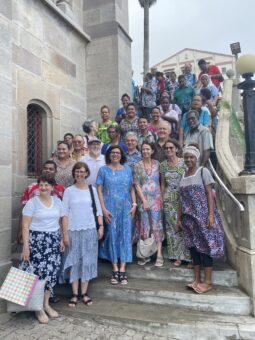
12 May 2023 | Non categorizzato
The third stage of Margaret Karram and Jesús Morán’s journey to Asia and Oceania was to Fiji. The spirituality of unity began to spread in this part of the Pacific at the end of the 1960s. The Focolare in the Pacific, one family Although Margaret Karram and Jesús Morán arrived in Fiji on 3rd May, the official start of the stage of their journey in Oceania took place two days later, with the “Sevusevu” ceremony. Over 200 people attended, including representatives of the local Church. The ceremony sealed their entry, and the delegation from the Centre accompanying them, into the Fijian community, both ecclesial and social. Sevusevu: the gift of welcome 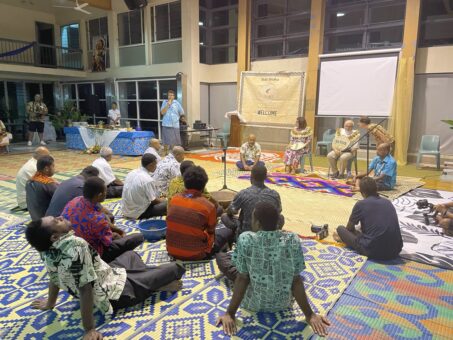 Those arriving in the archipelago are welcomed with the ceremony of ‘Sevusevu’ – meaning ‘gift’. And from that moment on they are no longer visitors, but part of the community and members, with all the rights and privileges of being on Fijian soil. The President and Co-President of the Focolare received precious garlands and the Kava root, derived from the pepper plant, which has ancestral significance. The two ‘candidates’ were presented to the community by ‘heralds’, who spoke on their behalf. They then drank the drink made from Kava in one go and received the ‘Tabua’, a whale tooth which has sacred meaning: it is the most precious object in Fijian culture, and it was offered to them as a sign of the highest esteem and honour. Traditions in the Pacific: where the present and future of peoples are rooted Right from the start, we realised that, in the Pacific, traditions feature in a significant and living way, which is relevant for today They are not relegated to a past that has nothing to do with people’s daily lives but form the foundation of their way of life. Among the values that traditions continue to hand on are respect, welcome, reciprocity, social solidarity, and a very deep and longstanding bond with nature. “Margaret Karram, Jesús Morán and the Focolare delegation have arrived at a particular time in the life of the Fiji Islands,” explained Peter Emberson, a Fijian, engaged in multilateral consultancy and a political analyst for the government of Fiji and the United Nations, who has known the movement since he was a child. “The present government is more open and democratic, and I see Margaret and Jesús’ visit as part of this process of social and political renewal. There are two questions that here in the Pacific we always ask an official delegation that lands on the shores of our islands: ‘Where are you from?’ and ‘Why have you come?’ At the ‘Sevusevu’ Margaret stood before the Fijian people and offered her commitment and that of the Focolare Movement to build unity here too. It is an identity-making response, which says a lot about the contribution that the Movement can make to our country. And this builds trust”. A region that is still too little known
  Oceania is a little-known continent and although, in a territorial sense, it is the largest on the globe, in terms of land mass it is the smallest. In addition to Australia and New Zealand, it includes the Pacific region, consisting of 26 nation states and territories. The main ethnic groups are Melanesians, Micronesians, and Polynesians. In total, the Pacific region has a population of 16 million people and in the last 100 years, the Fiji Islands (almost one million inhabitants), have become the political and economic heart of the region. There is a diverse religious landscape in which Christianity is the most practised faith, followed by Hinduism and Islam. Catholicism arrived in the 19th century and today Catholics number just over 82,000. Father Soane Fotutata, secretary of the Episcopal Conference of the Pacific (CEPAC), during a dinner in the focolare, spoke about the challenges facing society and the Church in this vast territory, where the Catholic Church has 14 dioceses. He explained that the ecological crisis threatens the very existence of people and communities. It is seen in rising sea levels, acidifying oceans, droughts, floods, and extreme weather events that have become more frequent. Then there are social wounds such as economic and climate migration from many islands; prostitution, alcoholism, and poverty, to which the local Church is trying to respond. 2022: the arrival of the focolares in Suva It was in this ecclesial context that the women’s and men’s focolares opened a year ago in Suva, the capital of Fiji. Their presence, in fact, is also linked to a project supported by Missio Scotland and Missio Australia, to collaborate in the diocesan pastoral care for young people preparing for confirmation and post confirmation with a programme that focuses on supporting the handing on of cultural riches between generations. Lourdes Rank, from Brazil, and Stephen Hall, from New Zealand explained: “On our arrival, the Archbishop asked us to be first of all at the service of the Church and to be part of its activities and projects. We got involved in catechesis, with young people and in the life of our parishes. This approach has been very positive: we are now truly part of the life of the Church and we have begun to build relationships with a number of priests, religious and lay people’. In this regard, the vicar general of the Archdiocese of Suva, Mgr Sulio Turagakacivi, expressed his gratitude for the service that the focolares give in the local Church. Thanking him, Margaret said: “We can learn from the Church here how to live the synodal process and how to maintain the freshness of the encounter between the Gospel and the local society and culture“. In Futuna the first seed of the spirituality of unity The first seed of the spirituality of unity in the Pacific was planted in the island of Futuna in the late 1960s by Sr. Anna Scarpone, a Marist missionary. The first Pacific focolare was then based in Numea (New Caledonia) from 1992 to 2008, accompanying the growth of a vibrant local community. Today, the two focolares in Fiji are ‘home’ for all the Movement’s communities in the Pacific region, which, besides New Caledonia and Fiji, are in Kiribati, Wallis and Futuna, with some people who already know about the spirituality in Papua New Guinea, Samoa and Vanuatu. Together for the first time On the occasion of Margaret Karram and Jesús Morán’ visit, the communities met in Suva for a few days. It was their first meeting in one of the Pacific Islands. Many events and customs, such as welcoming and appreciating each other, showed the extent to which everyone realised how precious those days were. For these peoples, coming together as a Focolare family does not only mean having a spiritual communion, but means contributing to daily life. This involves cooking, preparing the liturgy of the Mass, the songs and the dances – each one offering their specific human and cultural “gift” that is shared with that of the others. Margaret and Jesús met with the men and women focolarini for a morning of deep sharing and were able to spend a lot of time experiencing different aspects of the life of the community, such as meals, Mass, with many opportunities just to talk together. The sharing of experiences gave them an insight into the challenges and commitment of the Movement in the Pacific. In New Caledonia, the community is engaged at the service of the Church and, on a social level, in creating opportunities to build up unity between the different ethnic groups on the island. In Futuna and Kiribati, the Word of Life is central, generating experiences of forgiveness and reconciliation in families and also establishing social projects at the service of women and the needy. In Fiji the community is growing and shares a commitment serving the Church together with the focolarini. Run4Unity in Fiji: journeying together The 6th of May was Run4Unity day, and Margaret Karram started the worldwide relay from the Pacific, where we see the world’s first sunrise. With the Teens for Unity, she and Jesús planted two trees typical of the Fiji Islands: “the native sandalwood tree and the citrus tree, which need each other to grow,” she explained. “The sandalwood has the fragrance and the citrus, provides it with all the nutrients it needs. It is a wonderful example of mutual care found in nature. This is what the Pacific Islanders want to say to all of us: the only way to give our precious gift, unity, is to journey together, taking care of each other. In this way we can transform our world’. It is a message that highlights what is perhaps the main characteristic of these islands: living as a community. This emerged clearly in the afternoon and evening of 7th May at the meeting Margaret and Jesús Morán had with the community. “I have come here to be close to you and to share your life at least for a few days,” Margaret Karram told everyone. “What I have found here is very close to my heart and to the culture I come from, which encourages respect for other people and their language, and a sense of family. There are just a few of you, but do not worry: what matters is living the Gospel and bringing unity to those we meet. What you have shared with us during these days has impressed me greatly. Through your love, hospitality and welcome, you have given Jesus to us. But listening to you, I realised that the most precious pearl we possess is Jesus forsaken for whom we have left everything and who is the secret to loving everyone“. Jesús Morán added: “The experiences of forgiveness that you have told us have touched me deeply, and they show that you are living the Gospel, because forgiveness is the greatest newness that the Gospel contains. Forgiveness is not something merely human, only Jesus in us can forgive, and you have shown us this with a unique clarity“. When Margaret Karram was asked her hopes are for the future of the Movement in Oceania, she answered by saying what her hopes are for the whole Movement in the world: that it may become ever more a family, which is not closed in on itself, but is open to dialogue with all so as to fulfil the prayer of Jesus to the Father, which was Chiara Lubich’s dream. At the end she added: “I would like to say that in order to contribute to achieving unity, each country, culture or continent must not lose its own identity. We must remain ourselves. This would be a great gift for the whole Movement and also for the world: to be ourselves, with our riches and our challenges, and to live the charism of unity without leaving aside what we are‘. The applause that followed showed everyone’s gratitude at feeling they were understood. Having begun with the ‘Sevusevu’ ceremony, the visit could not but end with equal solemnity. The farewell ceremony, ‘I-Tatau’, seemed to close a circle. Heralds, speaking in Fijian on behalf of Margaret Karram and Jesús Morán, thanked the community and asked, on their behalf, permission to take their leave. The speaker representing the Fijian community granted them permission to leave and wished them a safe journey in the hope of seeing each other again. The concert that the Pacific communities had prepared for that evening was an extraordinary ‘expo’ of the artistic talents of the peoples present, where dances and songs spoke of their deep connection with the earth and with nature, their pride in their traditions and the desire to share them. But what will remain in everyone’s minds, we believe, were the greetings exchanged between the communities of New Caledonia and Fiji. Sitting opposite each other, they each sang their own farewell song, they waved goodbye to each other looking into each other’s eyes, as if they were leaving their own brothers and sisters. The said to Margaret Karram: “We assure you that we will be one family and, even with our weaknesses, we will do all we can to keep Jesus in the midst in Oceania.
Stefania Tanesini
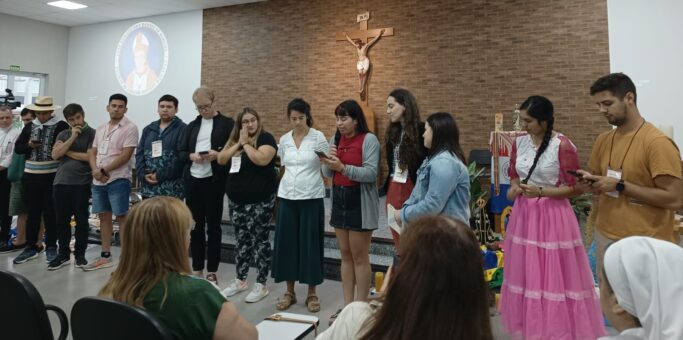
10 May 2023 | Non categorizzato
The Regional Assemblies of the continental phase of the 2021-2024 Synod concluded with the Assembly of the Southern Cone, held in Brasilia in March 2023. Here we share some reflections on this “journey” from members of the Focolare Movement who participated in the concluding Assembly. 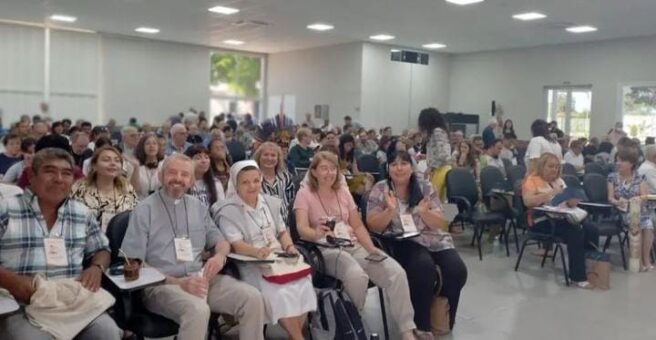 “From the moment I heard that I had been elected to participate, I felt a great joy but also the responsibility to be a true channel through which the Holy Spirit can pass.” This is what Mercedes Isola, a volunteer of the Focolare Movement, said. She was elected by the Bishops in the region of La Plata, Argentina, to be a lay participant in the Continental Assembly for the Synod of the Southern Cone that took place in Brasilia, Brazil, at the headquarters of the CNBB (National Conference of Bishops of Brazil). Mercedes continues, “There was very deep sharing among us and we rediscovered our baptismal dignity that makes us all sisters and brothers, people of God, co-responsible in mission, regardless of vocation. The ‘discernment communities’, made up of people from different experiences and vocations, were a confirmation of this reality: the Holy Spirit is at work in everyone, without distinction.”
 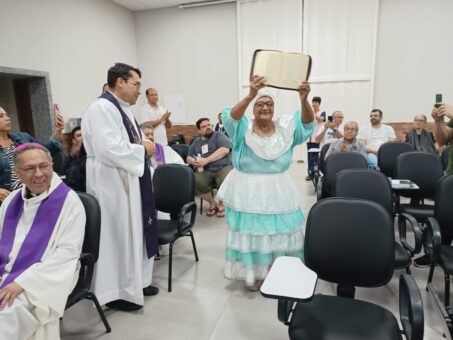 The meeting was attended by more than 200 people. It began with a procession of images of the Virgin Mary, patroness of each country, to whom the work of this Assembly was entrusted. Brazilians, Chileans, Uruguayans, Argentinians and Paraguayans were brought together. It was apparent that amid the diversity of each people, the individual in dialogue with others becomes a builder of true synodality. “Being open to a Church with greater lay participation, a Church that is inclusive, transparent, and consistent in following Jesus and is concrete in its service and mission,” are just some of the points that were addressed and deepened during the Assembly. Eliane de Carli, a married focolarina from Brazil, tells us. “This experience based upon a practice known as ‘spiritual conversion’, ensured there was very deep communion in the working groups. In addition, the richness of this internationality allowed us to get to know the challenges of the Church in each country, some of them very similar.”
 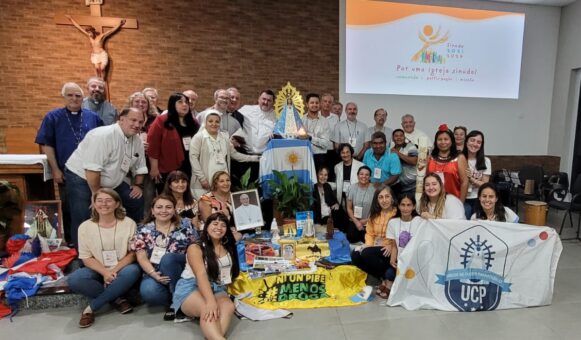 A week of intense work turned into a life experience. This can be seen in what Marise Braga, a Brazilian focolarina, said: “The day began with a short prayer led by each country in turn. The group drafted a final document on the basis of the questionnaires collected in the various countries during the local phase. They answered three questions, highlighting the lights and positive elements that emerged from those reports, highlighting the shadows, tensions and challenges of certain issues in each country, and finally, recognising the priorities to be addressed in the Synod.” The role of women in the Church was one of the recurring themes during this Continental Assembly in the Southern Cone. This is an issue that is gaining importance and, along with engagement with young people, needs to be addressed. “Before the concluding Mass of this synodal phase, the young people asked to speak,” said Mercedes Isola. “It was very powerful to hear from them why their friends are no longer in the Church. The young people themselves asked for greater openness, a Church that allows all God’s people to be protagonists, with open doors as Pope Francis says.” Father Pedro Brassesco, Assistant Secretary of CELAM (Latin American and Caribbean Episcopal Council) said that these needs unite all the continents and will push us to “learn a new way of being Church.” “The Church has called us together and is listening to us,” Marise concluded, ‘not only the Bishops, but all the people of God. We often need to invert the pyramid to know what is at the bottom, but patience is needed to see the fruits of this work. Perhaps our children, grandchildren and great-grandchildren will enjoy it. We are now planting a seed, but we must have hope. It is a first step, towards a Church that is closer to us all.”
Maria Grazia Berretta
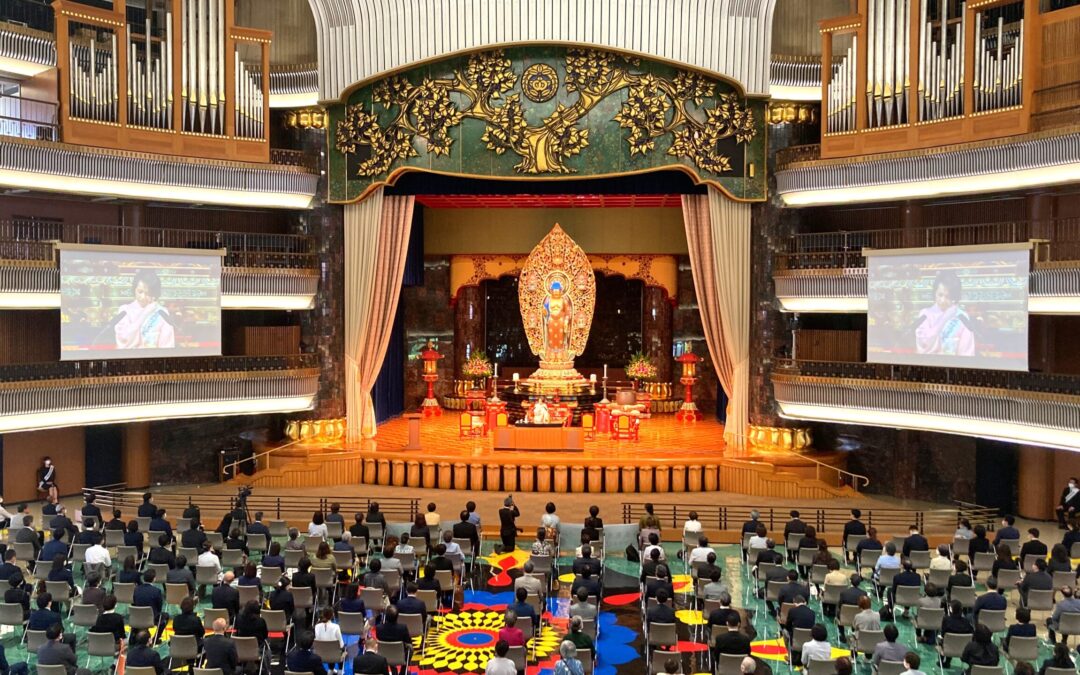
4 May 2023 | Non categorizzato
The journey in Asia and Oceania of Margaret Karram and Jesús Morán, President and Co-President of the Focolare Movement, continues towards the Fiji Islands after concluding the second stage on Japanese land. Here you find some updates on their stay in Japan. ありがとう Arigato Thank you 思いやり Omoiyari Care for others 健康 Kenko Health 平和 Heiwa Peace 美しさ Utsukushisa Beauty 正直 Shojiki” Honesty According to a survey by the Japanese national TV NHK, these six words are the ones Japanese people love most. They well describe the soul of this people and the value they place on harmony in social life and with nature. Margaret Karram and Jesús Morán, President and Co-President of the Focolare Movement, with the Focolare Centre’s delegation immersed themselves in the very rich culture of Japan for the second stage of their journey to East Asia, from 25 April to 2 May 2023. The Church in Japan: recreating community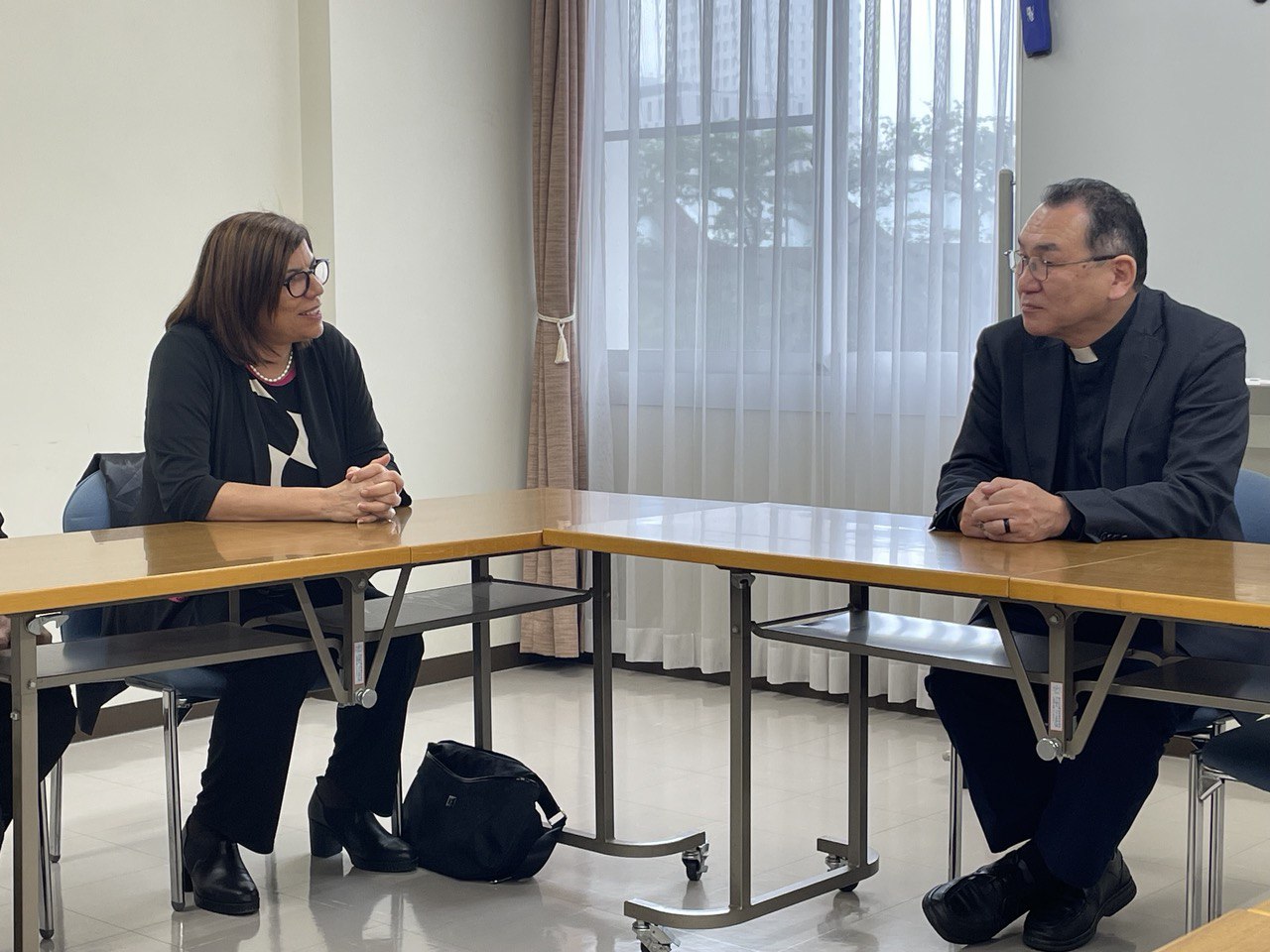 The doors to the “Land of the Rising Sun” were opened to them by the Archbishop of Tokyo, Archbishop Tarcisius Isao Kikuchi. He described the local Catholic Church as “small and silent”. There are 536,000 Christians who form 0.4% out of a population of 130 million where Buddhism and Shintoism are the majority religions. It is difficult to know which is the main one, since many Japanese follow both, and so there is a tendency to bring together different aspects of various religions. He explained that the current lifestyle is leading to a disintegration of the family, and this causes people to feel lonely and cut off. “There is a need to recreate community,” he said, “and the Focolare can help the Church do this. I encourage you to make your spirituality known to the bishops first (there are sixteen in Japan), so that through them it reaches the communities’.
 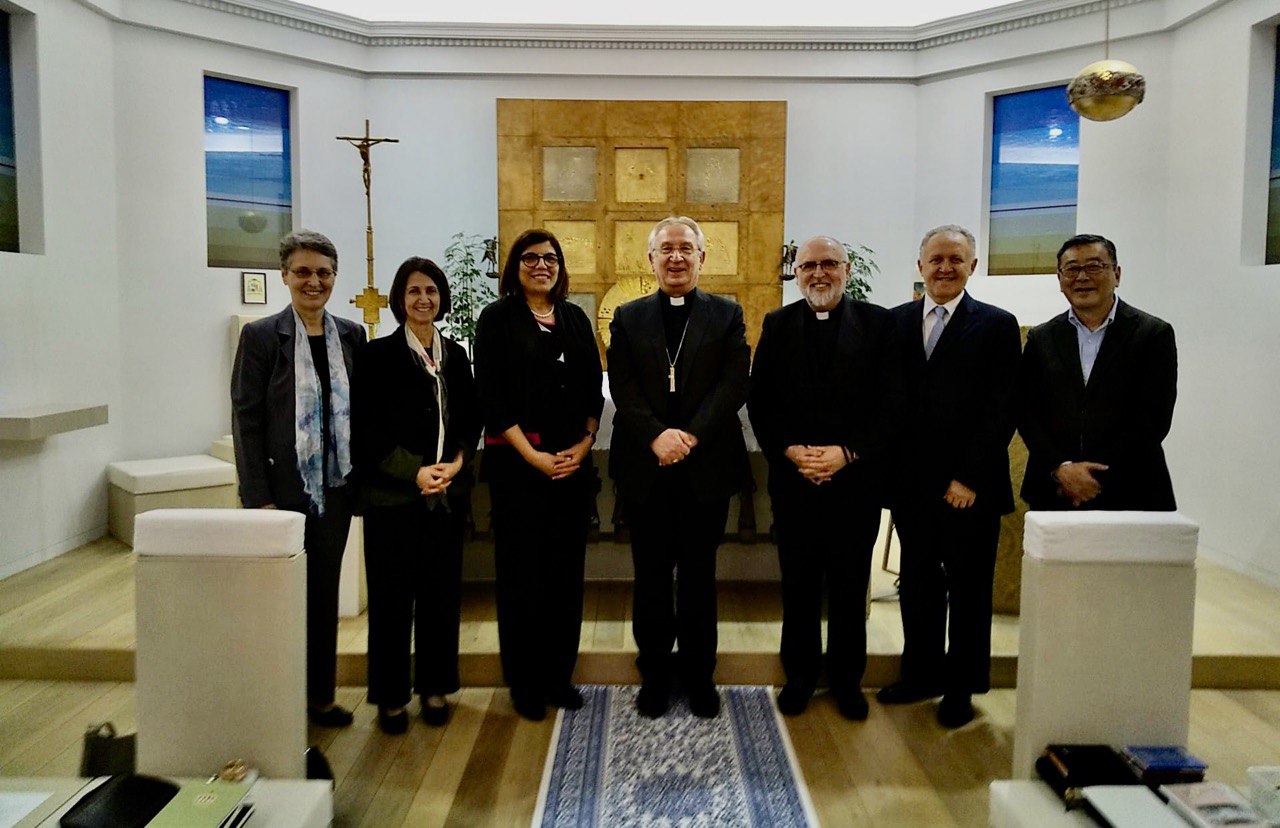 The conversation continued during the visit to Archbishop Leo Boccardi, Apostolic Nuncio in Tokyo. Christians are only 2% of the population of Asia. So, what is their role? The Nuncio too encouraged the Focolare to spread the charism of fraternity. “In Japan there is order and respect among people,” he explained, “but there is also a lot of indifference. The pandemic has left an open wound: we must rebuild relationships”. “I have seen a church being born,” Igino Giordani (Foco) wrote as early as 1959. He perceived the sacredness of this country’s Christian history when he went to Tokyo at the invitation of the Canossian Sisters. He was the one who sowed the first seeds of the spirituality of unity in this country. The focolares only arrived in 1976 and ’77 and today there are three, located in Tokyo and Nagasaki. The community numbers about a thousand people scattered over the five main islands of the Japanese archipelago. Living between modernity, tradition, and a thirst for spirituality Eight days, however, are not enough to get to know the soul of a people in depth. For Margaret Karram and Jesús Morán, every meeting and conversation was precious, as was the visit to significant places in Tokyo such as the Shintoist Menji Jingu Shrine or the ultra-modern district of Shimbuya. This is how Japan expresses its great variety: it is one of the most highly developed countries in the world yet is firmly bound to tradition. Society is very homogeneous and fosters the common good over that of the individual. This people has great sensitivity, gentleness, and pays attention to others, as well as a great capacity for work and a sense of duty.
  The Japanese are guided by the ‘feeling of the heart’ that knows how to grasp what is essential from concrete facts. And it is significant that the first meeting President and Co-President of the Focolare had was with the young people of the Movement, the Gen. They shared with one another in a harmonious atmosphere of simplicity and family. There was the same depth of relationship and sharing in their meetings with the focolarini and volunteers. Jesuits and Focolare together, a sign of hope for the world On 29 April, the Catholic university in Tokyo, Sophia University, hosted the eagerly awaited symposium “Can we be a sign of hope for the world?”, to which Margaret Karram and Jesús Morán were invited as speakers. The seminar offered an exceptional opportunity for dialogue between two charisms: the ‘historical’ one of St Ignatius, which brought Christianity to Japan in the 16th century, and the charism of Chiara Lubich. The focus was on the subjects of dialogue and unity in a social and religious context which is thirsting for spirituality. The other speakers were Fathers Renzo De Luca, the Jesuit provincial in Japan, Augustine Sali and Juan Haidar, lecturers at the university. The potential of this synergy emerged clearly from the talks. Margaret Karram began by saying that hope is what humanity needs most and it can be found if we engage in dialogue, even with those who are very different from us, without ever wearying. And she concluded: ‘The small and large efforts towards dialogue that each one of us can make, in building heartfelt and warm relationships, are the solid foundation on which to build a more fraternal world’. Fr De Luca explained how dialogue has been part of the DNA of Japanese Christians since the beginning. “During the persecutions, they did not reciprocate the violence they received with more violence, which is why the Popes have presented them to the world as a model”. Fr Sali reflected on the challenges of the Japanese Church in the face of secularisation, a church which must find new pathways for dialogue to offer Christian spirituality to people everywhere. In his talk, Jesús Morán explained that the Synodal path, that the Catholic Church is taking, can be an answer, but only if it is animated by communion-fellowship. “Communion and synodality naturally lead to a new encouragement to dialogue, which is increasingly necessary given the growing polarisation of societies at all levels”. Fr Haidar returned to the theme of hope and assured all present that “We have no reason to lose hope, because good is stronger than evil and God is always on the side of those who do good”. One of the symposium participants defined this shared reflection by Jesuits and the Focolare, as a “chemical reaction” that can produce new life. “I realised that dialogue requires courage, perseverance and patience; above all, I have to start doing it myself”.
 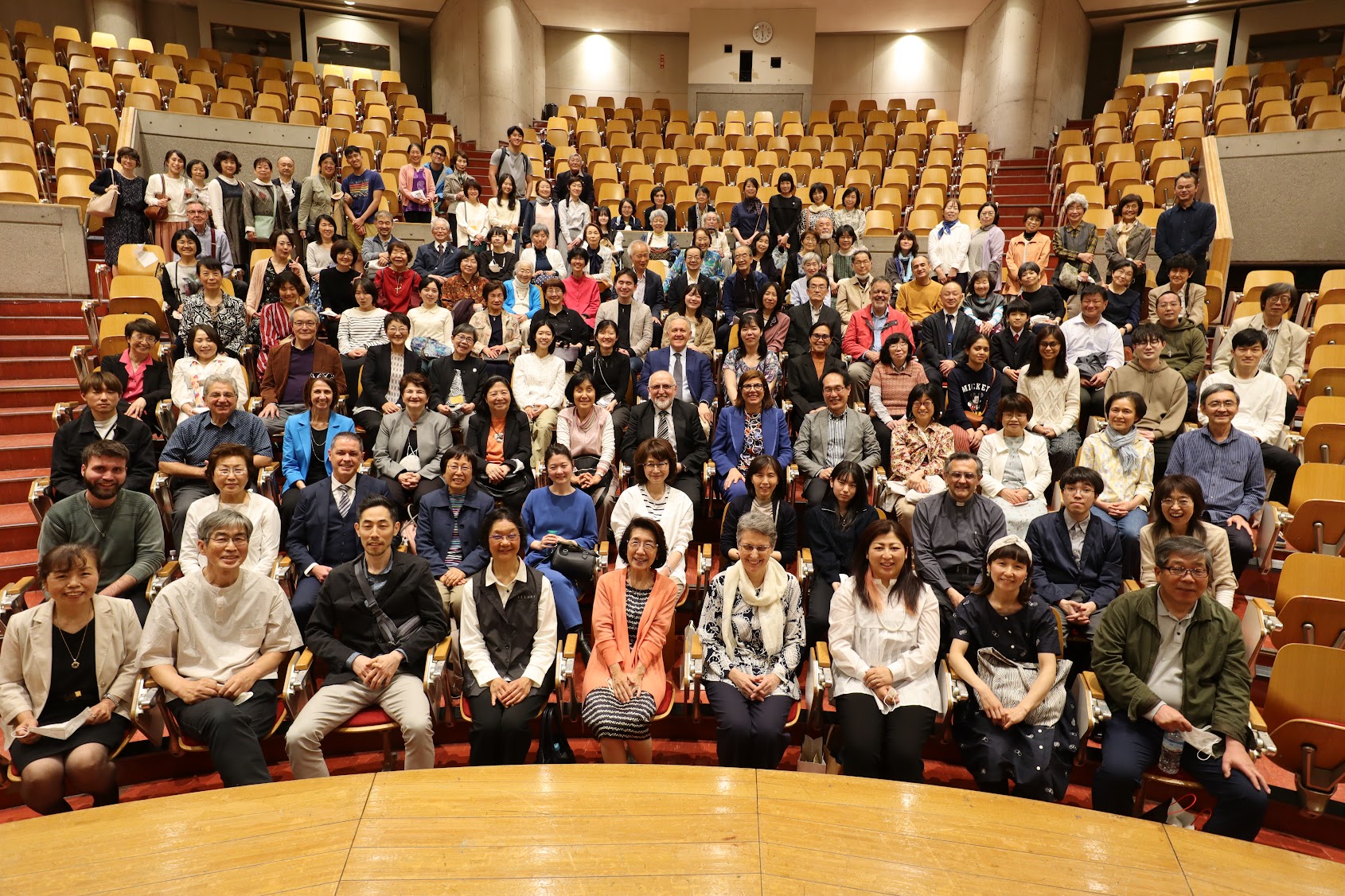 “Open your hearts to everyone”, Margaret Karram’s message for the Focolare community “We are here because we want to share what we have received as a gift from God,” said Natzumi and Masaki at the start of the meeting with the Focolare community in Japan that same afternoon. There was joy and emotion in being together in person for the first time in almost three and a half years, after the pandemic. The experiences shared spoke of great faithfulness in living the Gospel in daily life in a social context that is often hostile, due to indifference or social distance. One volunteer touched on a challenging issue for all Christians in Japan: the difficulty in handing on the faith, especially to the younger generations. “If you live the Word,” Jesús Morán replied, “you can be sure that you are giving Jesus. Usually we want to see results, but Jesus is not interested in this because He wants to touch people with His life. Let us give Him everything, then He will reap what He wants and how He wants”. “Do you have a message for the Focolare community in Japan?” This was the last question that came as a surprise for President and Co-President: “The message is dialogue,” Margaret Karram replied. “I encourage you to have a new openness of heart towards everyone. It is true that Christians are a minority here, but our vocation, as members of Focolare, is to go out to others, courageously, and to open up new paths that can help build fraternity and a peaceful world’. Jesús went on: “Our specific lifestyle is to live unity and so each one of us is fully in our vocation. We are a ‘sacrament of God’s love’ for others, as Chiara Lubich says. May no one feel alone, but go forward together, because faith is lived together’. Visiting the Rissho Kosei-kai: we are one family On 1 May, 42 years after Chiara Lubich’s visit, Margaret Karram and the Focolare delegation accompanying her, entered the large sacred hall of the Rissho Kosei-kai (RKK) Centre. It is difficult to describe the joy and emotion, visible on everyone’s faces: it was like an embrace between brothers and sisters who have been journeying together for many years. This warmth was expressed by President Nichiko Niwano and his daughter Kosho.
 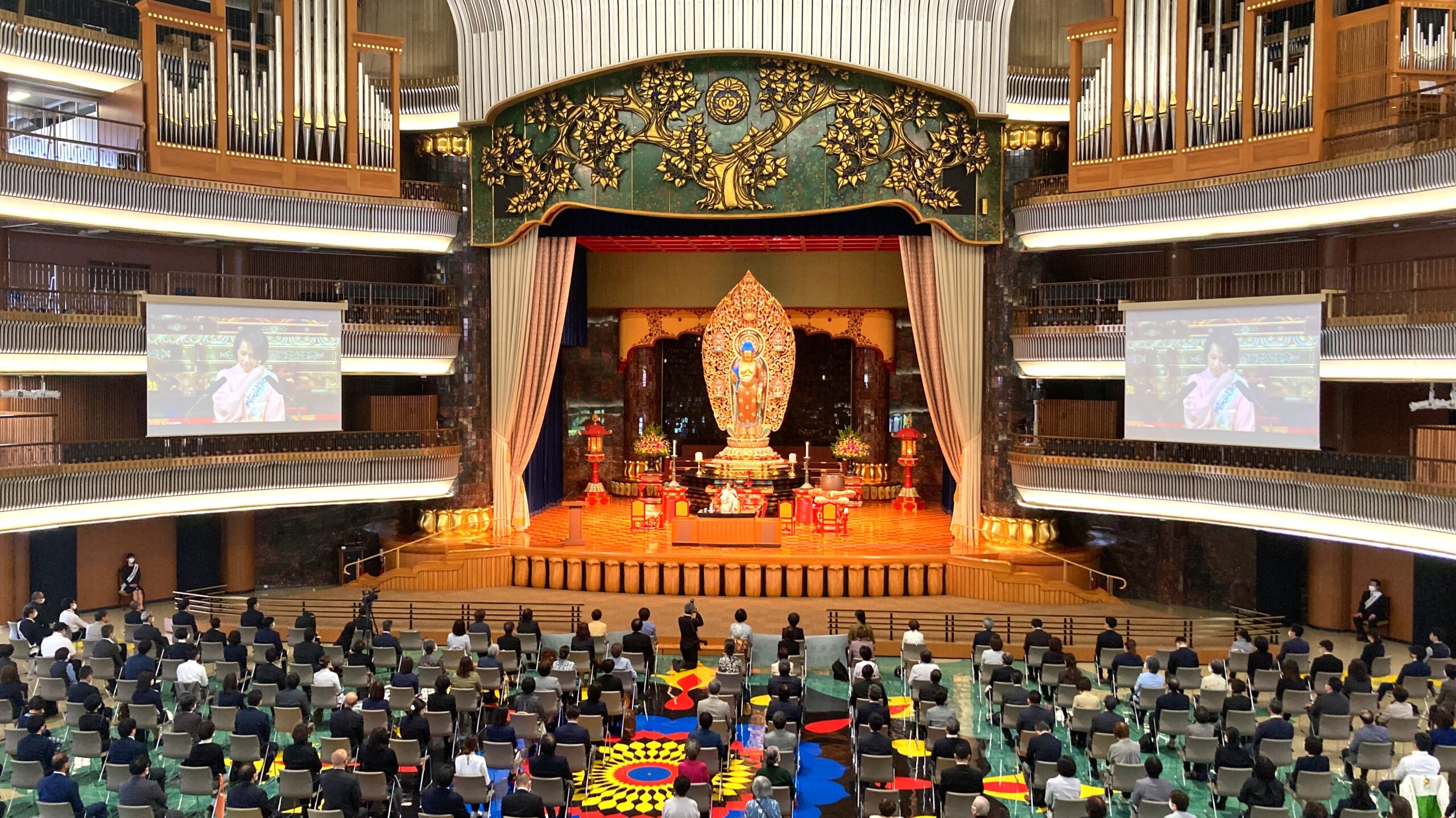 The Rissho Kosei-kai is a lay Buddhist movement founded in 1938 by the Reverend Nikkyo Niwano. It has about one million followers in Japan, and centres in several countries. It is very active in promoting peace and well-being through humanitarian and cooperative action. In 1979 Nikkyo Niwano met Chiara for the first time. Speaking of her he said, “I have met an extraordinary person with whom I can live in fellowship.” Since then, the relationship between the two movements has never been interrupted. ‘Today we are here as one big family,’ Margaret Karram said in her greeting to the many people present and those following the ceremony online, ‘What all humanity holds most dear is the supreme value of peace. (…). Together we can be a sign of hope in the world; together, as one family, our two Movements can be like small lights shining in society, living compassion and love, which are our most powerful weapons”. Nichiko Niwano responded saying, “Today is a day we will not forget; it is a day to be grateful for because our movements are meeting together. We are like members of one family, and we have so much in common. “It is the dialogue between us that makes this happen,” continued his daughter Kosho, who in the future will succeed to the RKK presidency, “I thank my grandfather Nikkyo Niwano who made dialogue and meeting others the foundation of my life. “We experienced a morning of recollection and sacredness,” Margaret Karram concluded, “and I am bringing with me what I have learnt thanks to you: to always be grateful for what I receive as a gift. I renew the Focolare’s commitment to go forward together to fulfil the dream of a better world”.
Stefania Tanesini
30 Apr 2023 | Non categorizzato
The 28th United World Week will take place from 1st-7th May 2023. It is a worldwide extravaganza of actions and initiatives to promote fraternity, unity and peace between people and peoples, organized by the communities of the Focolare Movement across the globe. The week opens on 1st May with a live transmission on YouTube from Loppiano, the international little town of the Focolare in Italy. The conclusion will be on 7th May with the worldwide relay race “Run4Unity”, supported and promoted by the Laudato Sì Action Platform of the Holy See’s Dicastery for Promoting Integral Human Development. A community in Pont-à-Mousson (France) will convert the sport and the kilometres completed into trees to be planted in their sister parish in Burkina Faso. And in Bobo Dioulasso in Burkina Faso, the Youth for a United World of the Sahel will go through the streets of the city, to collect plastic, with which they will build a symbolic “mountain of peace”. In St. Mauro Pascoli (Italy), children and adults, will promote ecological sports to raise awareness of environmental care and raise funds to provide sports equipment to young cyclists in Ukraine. In Palawan (Philippines), hundreds of people will clean public beaches to care for nature and for the health of their fellow citizens. They say, “We believe that today, more than ever, unity and fraternity can only be achieved if we take care of ourselves, if we take responsibility to look after the planet together, with concrete actions, starting wherever we are”. From Paraguay to India, through Togo, Benin, and Lebanon to Australia, there are hundreds of initiatives like these, small and large. They take place every year to celebrate United World Week: Seven days of workshops and exhibitions, promoted by the communities of the Focolare Movement throughout the world, in synergy with other movements, associations and local institutions that share its values, to raise public awareness of peace, care for the environment, ecological conversion and integral care of the person which all starts from living out concrete fraternity. The main theme of the 28th United World Week is care of humanity and of the planet: “Dare to Care: People, Planet and Our Ecological Conversion”. These issues are even more urgent in the times in which we live which suffer from the catastrophic effects of the climate crisis and the proliferation of inhumane hotbeds of war and conflict everywhere on the planet. During this week, the initiatives that are ongoing throughout the year, will be showcased in many virtual and in person appointments, different depending on the places and communities that promote them: exhibitions, cultural events, workshops of dialogue and debate, solidarity and ecological actions, sporting events. Locally we aim to influence the public opinion of our countries while internationally, the objective is to fill our Common Home with hope, starting by recognizing the persevering and tireless action of people who are committed to building fraternity. The main partner of the United World Week 2023 is the Laudato Sì Movement. The United World Week is co-funded by the European Union through the AFR.E.SH project.
International events of the United World Week
On 30th April, at 21.00 (Italian time), the United World Week will begin with a concert entitled “The reason we care”, given by the international band Gen Rosso. It will be broadcast on their official YouTube channel (https://youtube.com/@GenRossoOfficial). The concert is the result of the last few years during which the band has used music to carry out activities of welcome and education with young refugees and migrants in Bosnia-Herzegovina and Lebanon.  On 1st May at 12.00, a major show, entitled “Common Ground, me, you and us”, broadcast live from the Auditorium of Loppiano (Italy), will officially inaugurate the 28th United World Week. The challenge? To rediscover the value of care, of taking care of oneself and of others, of the relationships that connect us and of our relationship with Mother Earth. The programme will include the testimonies of young change makers from various countries of the world, who are engaged in networking, often bravely going against the current in their taking care of people and the environment, for the common good of their peoples. Like Mimmy from Burundi who, as part of the fight against plastic pollution, has been elected “zero plastic” ambassador, because, with her association, she transforms plastic into ecological tiles and plants trees in the Rusizi National Park. Or Ivan, who in Damaguete (Philippines), with his community, takes care of his people through their commitment to the marine environment and planting mangroves, because he says: “Since we are one of the poorest countries in Asia, fishing is a means of livelihood for many. Our people need the sea to survive, for everyday life.” The live stream will be available at www.unitedworldproject.org.
  On Saturday 6th May, it will be the turn of “Peace Got Talent”, an artistic event promoted by the “Living Peace International” network that, taking its cue from the well-known television format, gives space to talented young people who are committed to promoting peace through music, song and dance. Each act in the competition is an expression of informal projects of peace education. The participating schools and groups include some from Ukraine, Syria, Russia, Myanmar and Congo: Countries affected by war and armed conflicts, which are eager to contribute their songs and their voices of hope. The show will be broadcast on www.unitedworldproject.org. On Sunday, 7th May, over 200,000 teenagers, young adults and families in many countries and hundreds of cities will participate in “Run4Unity,” a global relay race that links nations, cultures and religions to build peace and plant trees. Supported and promoted by the Laudato Sì Action Platform of the Vatican’s Dicastery for the Promoting Integral Human Development, Run4Unity 2023 is led by the young people of the Focolare Movement. Participants of all ages will look after their health through physical exercise and will take care of the Earth by converting the kilometres completed or minutes of exercise to trees to be planted around the world (https://www.teens4unity.org/run4unity). Run4Unity will start from the Fiji Islands, which is in the first time zone to begin a new day and is an ecologically symbolic country because it is already strongly affected by climate change. From there, over the next 24 hours, young people will pass the virtual “baton” from one time zone to another through a series of video calls, concluding with communities in California. Participants will run, jog, walk or participate in local sporting events, some of which will be held in places symbolic for peace, for example at the borders between countries or communities in conflict or in ecologically significant places, to give a witness of unity and peace. Participants will include some of the 1,000 Laudato Sì schools around the world which are engaged in ecological education through the Laudato Sì Action Platform, as well as groups and schools that are part of the Living Peace International Project. Information about all the local events for United World Week 2023 can be found at: https://www.unitedworldproject.org/uww2023/.
Tamara Pastorelli (Photo: Pixabay)

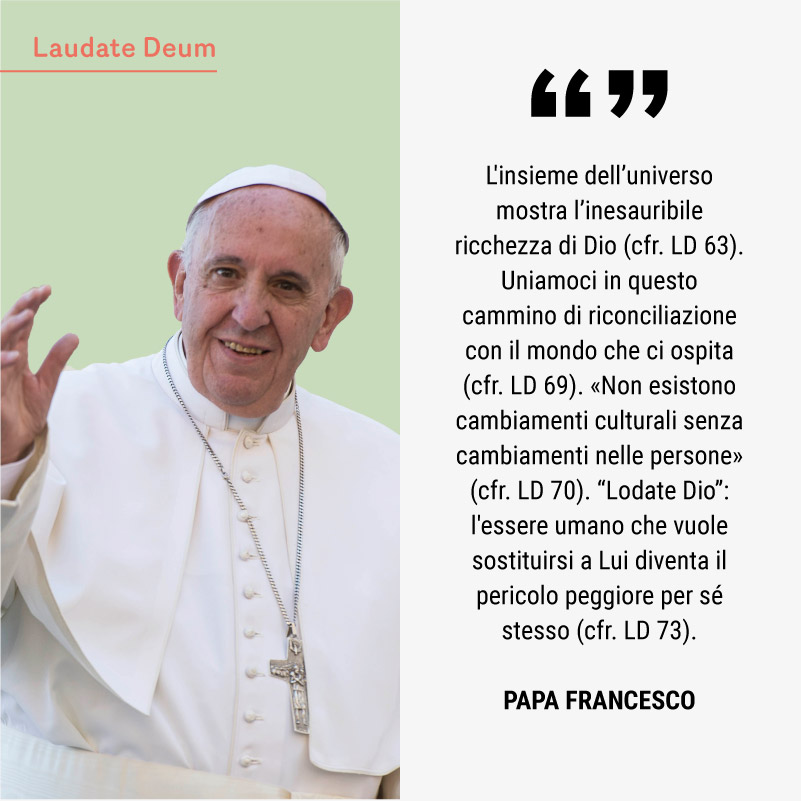 Still, very little has changed in the facts. The world “is crumbling and perhaps approaching a breaking point.” [2]. Last week, it was reported by the European Union’s climate observatory (Copernicus) that “September was the warmest month ever” (since 1850). Rising temperatures are certainly one of the most conspicuous symptoms of ongoing climate change. Last July, the world’s most authoritative journal in the field, “Nature,” showed that the heat waves of summer 2022 caused nearly 63,000 deaths in Europe. Certainly, we should not fall into catastrophic considerations because the margins for changing course are still possible, but we must categorically reject all irrational and unscientific negations. After decisively responding to all the most common objections against the current climate crisis, the pontiff emphasizes: “I feel compelled to make these clarifications, which may seem obvious, because of certain derogatory and unreasonable views that I find even within the Catholic Church” [14]. He distances himself from blaming the poor. “How can we forget that Africa, where more than half of the world’s poorest people live, is responsible for only a small fraction of the emissions accumulated throughout history?” [9]. Bergoglio addresses a call to each of us “to accompany this path of reconciliation with the world that hosts us and to embellish it with our own contribution” [69]. Unfortunately, some effects of the climate crisis are already irreversible: Some species have “stopped being our travelling companions and have become our victims” [15]. Yet, we cannot but “recognize […] that human life is incomprehensible and unsustainable without other creatures” [67]. All of these cannot leave us indifferent. To enable change, we need to adjust both the way we “look” at others and nature and the way we exercise power to achieve a purpose. Even small individual steps are important: they may not lead to immediate, quantifiable success, but they can act as the blueprint for cultural change and “set in motion large transformational processes that work from the depths of society.” [71]. Caring for every dimension of our planet is a collective challenge that requires a collective response. In recent years there have been many global efforts but with often disappointing results: broken promises and postponed goals. But “if we have faith in the ability of humans to transcend their small interests and think big[…], we cannot stop dreaming that COP28 will lead to a decisive acceleration of the energy transition, with effective and monitored commitments.” [54]. We also cannot give up this “dream.” It is a bet: to win all people of good will to work for a world worth living in.