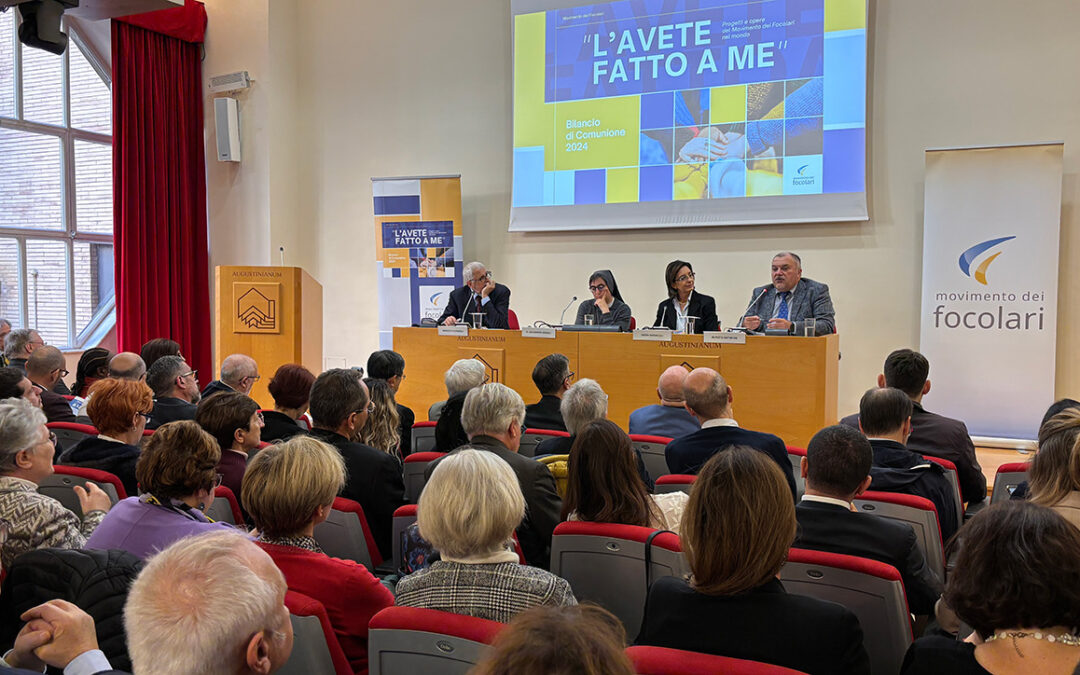
Presentation of the 2024 Assessment of Communion in Action held in Rome (Italy) on 6 November 2025. The video is in Italian with a speech in English. I sottotitoli sono stati The subtitles were generated automatically; you need to activate them and choose the language.automaticamente, occorre attivarli e scegliere la lingua.
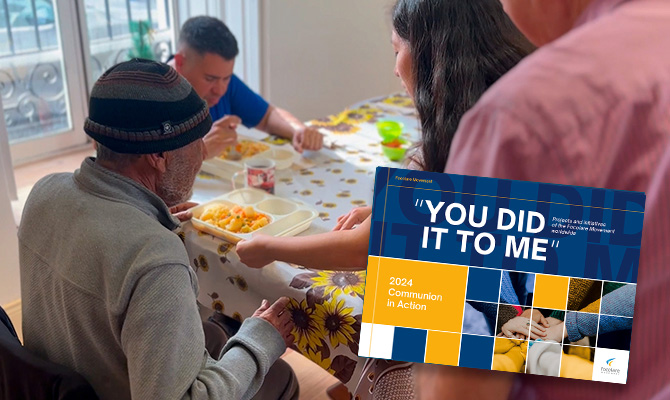
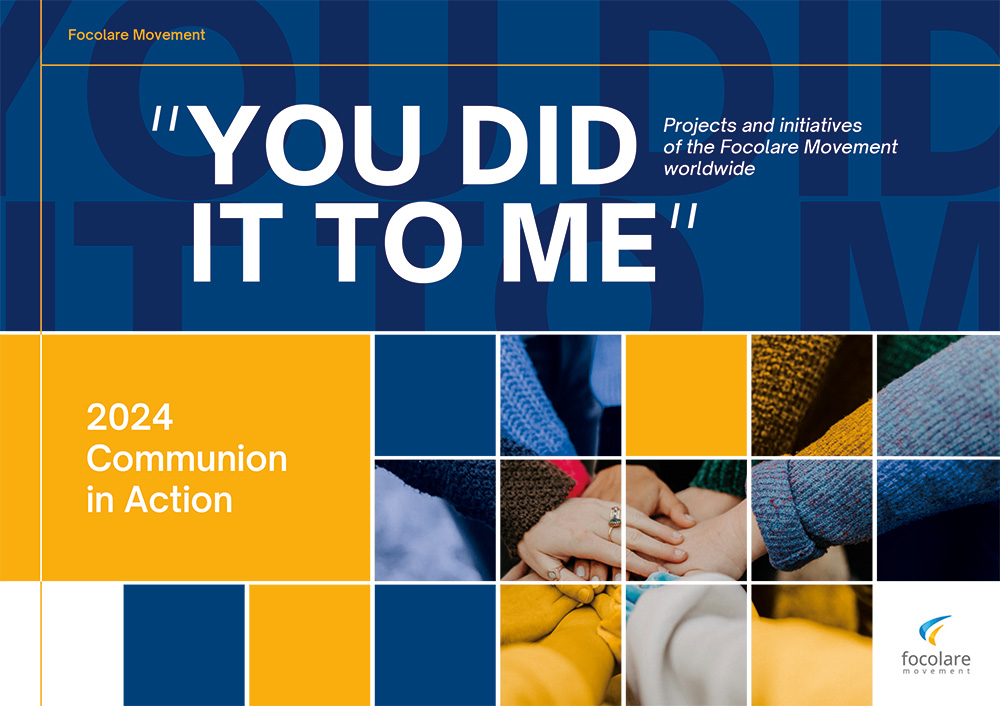
“We have chosen to tell stories of closeness and fraternity that are the fruit of the commitment of many people and communities around the world who are striving to generate trust every day.” With these words, Margaret Karram, president of the Focolare Movement, opened the event presenting the 2024 Assessment of Communion in Action, held on the 6th of November 2025 at the Augustinian Patristic Pontifical Institute in Rome. This document goes beyond a financial report and describes the ongoing projects in various countries linked to the Focolare Movement and their specific impact on individuals, communities and geographical areas. “It does not merely measure numbers, but speaks of relationships,” emphasised Sister Alessandra Smerilli, secretary of the Dicastery for Integral Human Development. “Communion is a strategic asset. It is not simply the sharing of resources, but the building of bonds that generate trust, cohesion and resilience. In economic terms, it is relational capital: it reduces exclusion costs, encourages participation and enables processes of integral human development. Where there is communion, fragility becomes an opportunity, because those who are part of networks of reciprocity have a better chance of being able to escape marginalisation. In a time of great inequality, this assessment is both a prophetic statement and good news: every single act is important.”
Margaret KarramAlessandra Smerilli – Moira Monacelli
The figures
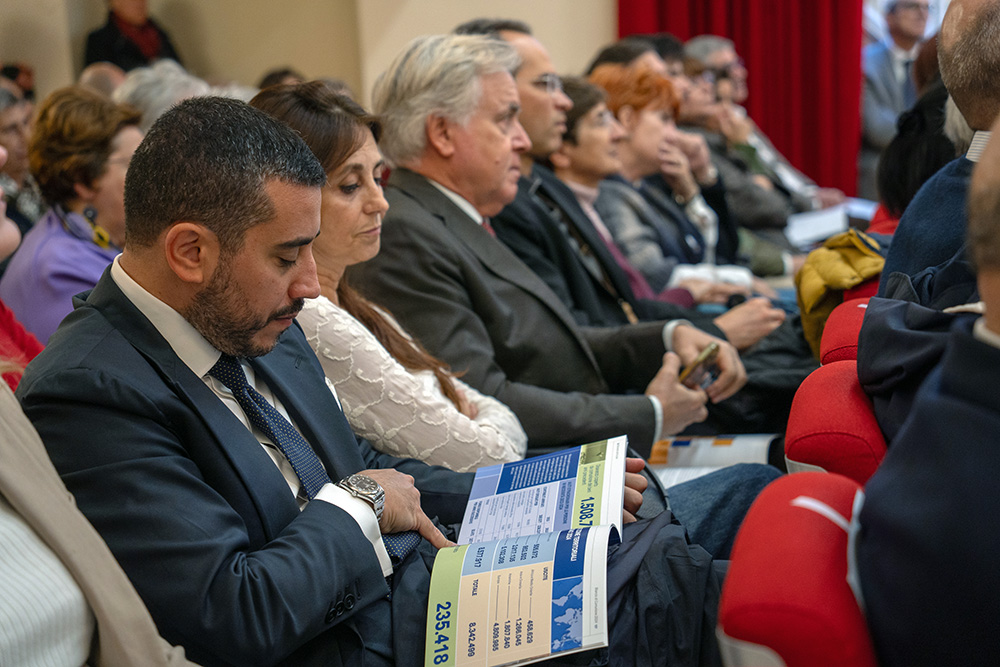
Ruperto Battiston, co-responsible for the Focolare Movement’s finances, explains the figures: “The 2024 Assessment of Communion in Action shows an income of €8.1 million from donations, from the communion of goods given freely by those belonging to the Movement and from contributions of external institutions for training projects. Expenditure amounted to €9.6 million and was allocated to initiatives that generate long-term value: local projects, little towns, social initiatives and educational and cultural programmes, as well as to support the International Centre.
Thanks to an extraordinary communion of goods of €208,568, it was possible to help people belonging to the Movement who are in situations of particular need and also the structures that help those who are poor.
In addition, the Economy of Communion distributed 394 individual grants and supported 14 projects in 13 countries, for a total of €669,566.
Among the many figures, this year we have chosen to highlight the sums allocated to structures involved in safeguarding and formation in safeguarding, as recommended in the recent report by the Pontifical Commission for the Protection of Minors.”
Five projects were presented from among those illustrated in the Assessment: Fo.Co. ONLUS – Italya social cooperative that welcomes migrants and unaccompanied minors, promoting inclusion and employment. It has reopened an abandoned convent, transforming it into a reception centre; UNIRedes – Latin America: a network of 74 organisations active in 20 countries, which reaches thousands of people every year with educational, health and cultural projects. The Focolare Medical Centre –in Man, Ivory Coast: established during the civil war, today it is a 24-hour health centre offering telemedicine and hospitalisation services. Focolare Carpentry – Philippines: a vocational training centre that has restored dignity and work to over 300 young people excluded from the school system. TogetherWEconnect – Israel and Palestine: an educational project involving 500 students in courses on dialogue, self-esteem and active citizenship.
A methodology based on the Gospel
“Communion is not welfare, but protagonism and reciprocity,” explained Moira Monacelli of Caritas International. “Being present does not only mean doing for but walking with.” The activities described in the Assessment stem from a tangible love, which translates into listening, shared responsibility, education and trust in Providence. “Giving hope is not saying it with words,” concluded Monacelli, “but building communities where fraternity becomes a reality.”
The Communion in Action Report (Bilancio di Comunione – BdC) is an instrument which began in the tradition of the Social Reports of non-governmental and non-profit organisations. It expresses a style inspired by the Gospel and is an invitation to promote relationships of reciprocity and communion and to contribute to the implementing of societies where people and nations can live with dignity, justice and in peace. For 2024, the Focolare Movement has analysed data relating to permanent and ongoing initiatives, projects and actions in many countries. The reported data does not represent a complete or exhaustive map of all the initiatives taking place but is a significant sample that expresses the commitment of over a hundred projects which, supported by the spirituality of the Focolare Movement, respond to the needs of humanity, so as to generate trust, social cohesion and a sense of community.
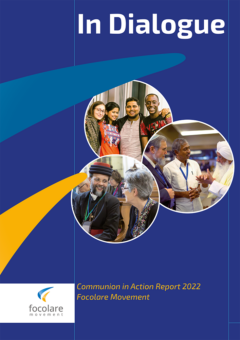
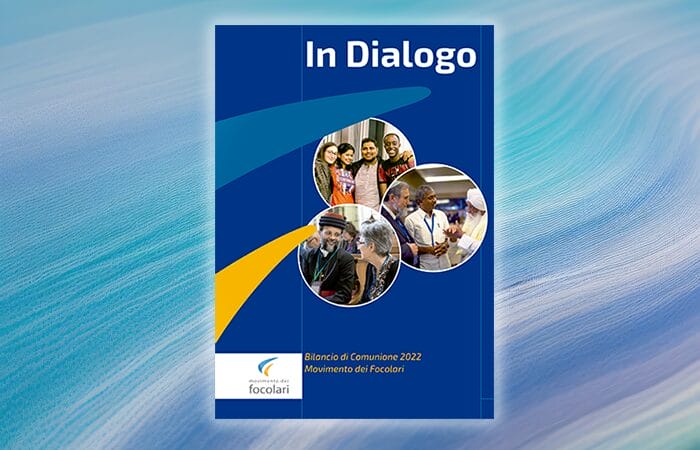
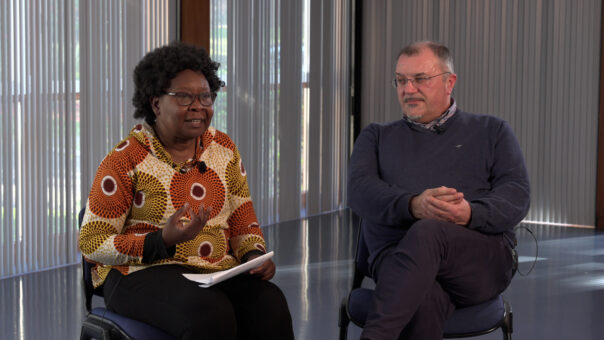
The Focolare Movement has just published its second “Communion in Action Report” or “Mission Report”. It focuses on the theme of Dialogue. To learn more about it, we interviewed Ruperto Battiston and Geneviève Sanze, Counsellors for the Economy and Work aspect of the Movement.
A year ago, in January 2023, at the “Focolare Meeting Point” in Rome, the first “Communion in Action Report” or “Mission Report” of the Focolare Movement was presented. It gave an overview of the worldwide activities and initiatives carried out by the Movement in the biennium 2020-2021. This year, the Movement is presenting a new Report for the year 2022, this time centred on the theme of dialogue. The document has emerged as a fascinating account, not only of the spontaneous sharing of goods but also of experiences and needs, inspired by a lifestyle based on evangelical love. Ruperto Battiston and Geneviève Sanze, Counsellors at the International Centre of the Movement for the aspect of Economy and Work, shared their thoughts with us.
Ruperto, what are the objectives of this document? Is there continuity with the previous one?
These mission reports exist to involve everyone and share information about the concrete achievements resulting from the communion of goods among all the members of the Focolare Movement and the contributions that we receive from individuals or institutions. It is primarily addressed to all the members of the Movement, with gratitude for the fruits that the life and work of many people around the world continue to generate; and with gratitude to God for what He has done and continues to do. It is also addressed to those who would like to know more about us and actively collaborate for a more fraternal and peaceful world. This is why we chose the standard, and in this case perhaps somewhat unusual, name of ‘Communion in Action Report’ because we feel it best expresses our experience of walking together towards a united world. This is our second Mission Report’. It refers to the activities supported by the part of the communion of goods which is shared internationally and to the financial data of the Focolare Movement’s International Centre for the year 2022. This Report follows that of 2021, which highlighted the various activities that the communities of the Focolare Movement carry out worldwide in all fields and aspects. For 2022, we focused on a more thematic document, taking the specific perspective of Dialogue and trying to offer a glimpse of what we seek to bring to society on the path towards fraternity, towards that unity in which diversities can be enriched and give rise to harmonious collaborations.
Therefore, this Report serves as an open and hands-on tool of communion to which everyone can add a page, a story or a suggestion, “In Dialogue” with humanity and with our planet.
Geneviève, how does the theme of dialogue, the heart of this text, fit into this informative tool?
It is interesting to reiterate what it says in the introduction: “Being in dialogue is the characteristic of every person and every project which is under the auspices of the Focolare Movement and which is inspired by its spirituality of communion. Not just doing, therefore, but a lifestyle which is supported and substantiated by listening, welcoming, compassion, charity and mercy, as summarized in the cardinal principle of every culture and religion: the so-called Golden Rule ‘do unto others as you would have them do unto you.'” This Mission Report aims to show how, together with many others throughout the world, we have contributed to healing the wounds of divisions and polarizations and to progressing along the path of evangelical fraternity. We express dialogue in five major areas: in the Catholic Church, among Christian Churches, in the field of interreligious dialogue, with people without a religious reference and in different cultural contexts. For us, these areas are the main ways to reach fraternity. Chiara Lubich defined dialogues as ‘highways to a united world’. It was not easy to gather and choose from the numerous initiatives, small and large but all important because they are seeds of the future and bearers of a concrete change in relationships between people, improving the atmosphere of the world. We were amazed by the quantity of initiatives and the widespread flourishing of this life, which may not make noise but which supports the world and builds new relationships between people. Being “In Dialogue” with others values diversity, highlights the characteristics of each one, requires deep mutual listening, and builds peace. Dialogue is more relevant than ever. To read the Mission Report in English, click here.



 all the members of the Movement, with gratitude for the fruits that the life and work of many people around the world continue to generate; and with gratitude to God for what He has done and continues to do. It is also addressed to those who would like to know more about us and actively collaborate for a more fraternal and peaceful world. This is why we chose the standard, and in this case perhaps somewhat unusual, name of ‘Communion in Action Report’ because we feel it best expresses our experience of walking together towards a united world. This is our second Mission Report’. It refers to the activities supported by the part of the communion of goods which is shared internationally and to the financial data of the Focolare Movement’s International Centre for the year 2022. This Report follows that of 2021, which highlighted the various activities that the communities of the Focolare Movement carry out worldwide in all fields and aspects. For 2022, we focused on a more thematic document, taking the specific perspective of Dialogue and trying to offer a glimpse of what we seek to bring to society on the path towards fraternity, towards that unity in which diversities can be enriched and give rise to harmonious collaborations.