27 Apr 2023 | Focolari nel Mondo, Non categorizzato
Margaret Karram and Jesús Morán, President and Co-President of the Focolare Movement, have just concluded the Korean step of their first official trip to Asia and Oceania. This will be followed by visits to Japan, the Fiji Islands, Australia and Indonesia, until 25 May. Here is a brief update on what happened in Korea.
“Teach us, Lord, to journey together, looking in the same direction, united by the same goal, in search of the same values towards the One who loves us and awaits us, who is the foundation of every new friendship’.
On 22nd April, this prayer was said at the start of the meeting of 160 focolarini and focolarine from East Asia (with several linked online). It expresses very well the meaning of Margaret Karram and Jesús Morán’s first official trip to Asia and Oceania. The first stop has been Korea, then they will visit Japan, the Fiji Islands, Australia and finally Indonesia. They are being accompanied by Rita Moussallem and Antonio Salimbeni, councillors of the zone and co-responsible for the interreligious dialogue of the Focolare Movement The Movement has been present In East Asia since the end of the 1960s (the zone includes Korea, Japan, and the Chinese-speaking area). In Korea, Father Francesco Shim brought the spirituality of unity in 1967 and in Hong Kong the first focolare was opened in 1970. There are about 10,000 members and adherents of the Movement living the spirituality of unity in this part of Asia.
Margaret Karram: Starting again from dialogue
“Why did you choose Asia for your first trip?”, the reporter of the ‘Catholic Chinmoon’, Korea’s leading Catholic weekly asked Margaret. “I am here to listen, to learn, but above all to love the ‘continent of hope’,” she replied. The spiritual wealth of these peoples will be a gift for all. I feel it is very important to revive the path of dialogue in the Movement; it is the most important instrument for building peace, which is the good that the world needs most today’.
Korea: between contradictions and hope for peace
The capital city, Seoul, has almost 10 million inhabitants and showcases a nation that has been running at speed for 50 years and has become one of the most advanced and technological states in the world. ‘Speed, efficiency and competitiveness are the hallmarks of modern Korean society,’ explains Matthew Choi, a Korean journalist and focolarino, ‘both economically and culturally, but this brings many contradictions with it. ‘There is a great emphasis on achievement here,’ adds Kil Jeong Woo, delegate of the Politics for Unity Movement in Korea, ‘with a highly competitive academic system and a strong work ethic. We have problems of social inequality, and efforts are underway to address this through social and political reforms, but progress is slow.”
The Korean Church, a bridge in a divided society
The Archbishop of Seoul, Archbishop Peter Chung Soon-taek, highlighted among the social challenges intergenerational conflicts and an ageing population. He explained that ‘In the Church, there is the danger of closing ourselves off in our communities. Instead, we need to open up and this is the contribution that the Focolare can bring”. Margaret Karram and Jesús Morán then met Bishop Thaddeo Cho, Archbishop of Daegu, Bishop Augustino Kim, Bishop of Daejeon and Bishop Simon Kim, Bishop of Cheng-ju. In the context of strong polarisation between progressives and conservatives, the Church is seeking to be a bridge and act as an antidote to the secularisation that is affecting young people in particular.
Dialogues and inundations: the journey has begun.
The Focolare Movement in Korea is making its contribution to ecumenical and interreligious dialogue, and also in various cultural spheres. One example was the event on 14 April in Seoul, entitled: “Dialogue is becoming the culture of the human family”. Representatives from various Christian churches, various religions, and representatives from the social fields took part, animated by a constructive spirit of cooperation for social reconciliation and peace. In her talk Margaret said: “It is very important that everyone can generate environments that open the way to the ‘dialogue of life,’ by putting into practice the teachings of their own religious faith”. Jesús Morán encouraged them to continue on this common path: “It does not matter how big or small the things you do are. The important thing is that they bring the seeds of something new. The testimonies you have presented show this clearly”. Sa Young-in, Director of the UN Office for Won Buddhism, said that as a young girl she dreamed of a “religious village” where believers of various religions could share love, grace, and mercy. “What I imagined,” she said, “I feel I can see fulfilled here today”.
Gen 2: “Courage and go ahead!”
On 15 April 80 Gen gathered at the Mariapolis Centre: 70 from Korea, 9 from Hong Kong and others were linked up from Japan and Chinese-speaking areas. They brought Margaret Karram and Jesús Morán the fruit of the work done in four workshops on how to incarnate the spirituality of unity in everyday life; relationships within and outside the Movement; the difficulties they face in finding their human and spiritual identity and their dreams for the Movement. Margaret said to them: “Our identity is one. We are not Gen first, and then become something else when, for example, we go to university. The gift of the spirituality that we have received makes us free people; it gives us the courage and strength to proclaim what we are and what we believe in, and I would also like to say to you what the Pope said to me when I was elected president: ‘courage and forward'”. One of the Gen said: ‘After Chiara’s departure,’, ‘there were moments when I felt nostalgia and darkness. Today, Margaret and Jesús’ closeness to us, their trust and listening have encouraged me a lot. They make me realise once again that Chiara’s legacy is a gift from God suitable for every age’.
The little town –armony
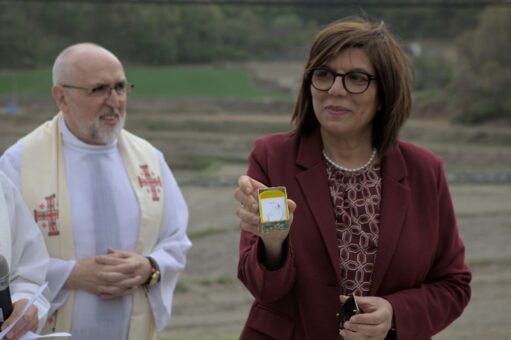
On 16 April, Margaret Karram and Jesús Morán went to the land that the Movement had received as a gift, about 70 kilometres south of Seoul, to fulfil a dream Chiara spoke of during her visit to Korea in 1982: the birth of a little town of formation and witness to Gospel life and the spirituality of unity for this part of Asia. In the presence of about 200 people – Focolare members, benefactors and friends who contributed in various ways – the land was blessed, and a medal of Mary was buried there as a seal. “Let us entrust this Work to her,” Margaret concluded, “and ask her to help us adhere to God’s plans that maybe we do not yet know, but He is greater than us and if we give Him our willingness and generosity, He will be able to work.”
Visiting Sungsimdang
It all started in 1956, with two sacks of flour used to make steamed bread to sell in front of Daejeon Station. Today, Sungsimdang has become the city’s most famous restaurant business and, with its 848 employees, has been living the spirit of the Economy of Communion (EoC) to the full since 1999. Margaret and Jesús visited it and had a joyful meeting with Fedes Im and his wife Amata Kim who are the owners and are Volunteers of the Movement. ‘I didn’t study administration or management,’ says Fedes, ‘but I followed Chiara. “Seek to do good before all people,” is the motto she gave to the business that serves 10,000 customers a day and has always lived sharing, bringing bread daily to more than 80 social assistance centres. But what is striking is the atmosphere and relationships in the workplace: “For us,” says their daughter Sole, who is head of the catering department, “all people have the same value: men and women, rich and poor, managers and employees, suppliers and customers. We try to put the person at the centre of all our decisions’. Jesús emphasised the importance of the business’s impact in the local area, an important part of companies operating in the EoC style, and Margaret compared their testimony to that of a little town of the Movement about which one can say, “come and see”. “And that,” she said, “is the greatest medicine the world is waiting for.”
Listening, knowing, sharing
Margaret Karram and Jesús Morán’ days in Korea were intense and varied, but there was also time for a tourist visit to the ancient site of Bulguksa, to learn about the roots of the national Buddhist culture. Located in beautiful parkland, with its thousand-year-old temples, they spent a truly regenerating day! There have also been many meetings with members of the Movement in this vast zone, such as the joyful afternoon with the focolarini and with some members of the Chinese-speaking area. The time with the 80 priests, and men and women religious was a ‘cenacle’ experience, with testimonies of faithfulness and authentic gospel life, in a profound conversation with Margaret and Jesús. Then, on 23 April, it was the turn of the long-awaited meeting with all the members of the Movement; 1,200 were present, with about 200 connected online from various countries. It was an amazing celebration, bringing together peoples and cultures that we would hardly ever see dancing and singing on the same stage, and rejoicing in each other’s beauty and richness. Perhaps that is why some called the event ‘a miracle’ and the seed of a society renewed by unity. 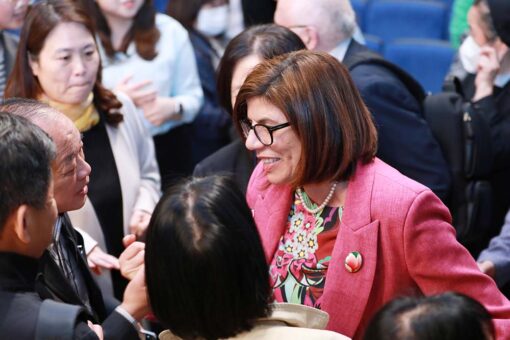 In the dialogue, Margaret Karram and Jesús Morán answered questions on a variety of topics, together with the councillors Rita Moussallem and Antonio Salimbeni. These included the ‘design’ of the Asian continent, the relevance today of dialogue between religions. To the question on how to have a deeper relationship with Jesus in the Eucharist, Jesús explained that it is not a matter of ‘feeling’ the relationship with Him, but of living it, because the Eucharist nourishes our whole person and makes us live as a body, in love for others”. Speaking of the decline in vocations in the Movement, Margaret said that for young people, personal relationships and the authentic witness of adults are important. “If our life is fruit of union with God and is coherent with the Gospel, they will be attracted, because they take inspiration from those who ‘dare’ to live for God and so they will understand where He is calling them”. To the last question on how our relationships must be in order to be able to dialogue with everyone, Margaret Karram answered with her own experience: “This year we have deepened our prayer life and our love for God, a ‘vertical’ love we might say, like those pine trees whose branches go upwards. The other day, while I was outside for a walk, I saw a tree that I liked very much: its branches were open, extending outwards; they intertwined with other trees. This is how our relationships should be: our arms should always be open, reaching out to others; we should have our hearts wide open to the joys, sorrows, and lives of all the people who pass us by.” It is ‘the hour of Asia’, Chiara Lubich wrote in 1986, during her first trip to these countries; today those words are manifesting all their relevance and prophetic value.
Stefania Tanesini
14 Apr 2023 | Centro internazionale, Non categorizzato, Sociale, Tutela minori
Joachim Schwind, a focolare and member of the General Council at the Focolare International Centre was interviewed by Adriana Masotti of Vatican News The first report on cases of the abuse of minors and vulnerable adults and on those of a spiritual nature and of authority that took place within the Movement was recently published on the Movement’s international website. In addition to the data provided, it presents the remedial measures, the new investigative procedures and the training activities to achieve the complete safeguarding of the person. In this interview, Joachim Schwind, a focolare-priest and member of the General Council, explained the process which has begun. In a letter published on the Movement’s website, President Margaret Karram and Co-President Jésus Morán presented the first report on the management of cases of abuse that have occurred within the Movement: “We are writing to give you a public account of information regarding the reports we have received and the measures we have taken as the Focolare Movement in response to the scourge of the sexual abuse of children and vulnerable adults and the abuse of conscience, spiritual abuse, and the abuse of authority regarding adults, which has also affected us”. The report, which will be issued annually, comes one year on from the engagement in 2020 of GCPS Consulting to investigate serious cases of sexual abuse by J.M.M., a former French focolarino. This case gave rise to an awareness of the problem and then to the decision to begin a process, on several fronts, to guarantee the prevention and integral safeguarding of the person in all areas and environments in which the activities of the Focolare take place and to counteract this crime. The victims are at the centre: a request for forgiveness In the letter, the President and co-President first of all ask for forgiveness from each victim on behalf of the entire Movement. They express their deep gratitude to the victims and survivors and to the families and communities involved, not only in France, but in all countries where cases of abuse have emerged. It is thanks to their collaboration and above all to their courage in facing and bringing these crimes to light, that the Movement today is more consciously pursuing new commitments and procedures regarding safeguarding. People who have been abused occupy the central and priority place in this process. Listening, the request for forgiveness, the offer of help and indicating a reparative path are the starting point. The new Central Independent Commission The report consists of several parts and presents statistics relating to abuses reported to the Commission for the Wellbeing and Safeguarding of the Person (in Italian, CO.BE.TU.) since 2014, the year of its establishment and therefore the beginning of systematic gathering of reports, until December 2022. Another section is dedicated to the measures implemented or being implemented, in response to the recommendations of GCPS Consulting’s independent investigation. The report announces that, starting from 1st May, 2023, a new Independent Central Commission will take office for the management of reports and the task of the CO.BE.TU. will end. The report also presents the “Procedures for handling cases of abuse in the Focolare Movement” and the “Guidelines on support and financial reparation in the case of the sexual abuse of minors/vulnerable adults”. Finally, there is a Supervisory Body appointed by the President and composed of at least five members external to the Movement. Some data presented in the report According to the data reported in the published text, there have been 61 reports of abuse. The victims include: 17 vulnerable adults, 28 young people aged between 14 and 18 years of age, 13 children under 14 years of age and two concerning the possession of child pornography. There are 66 perpetrators of abuse of which 63 are men and 3 are women. Twenty of those found guilty of abuse have been dismissed from the Movement, nine have been sanctioned, and there are other cases still pending. Finally, 39 cases occurred in Europe, 15 in the Americas, 3 in Asia/Oceania and 4 in Africa. With regard to the chapter on sexual abuse, the abuse of conscience and authority and spiritual abuse towards adults, there were 22 cases reported. There are 31 abusers and some more who have not yet been identified. 12 are men and 19 are women. The distribution of these reports by geographical area indicates: 16 cases in Europe, 3 in the Americas, 2 in Africa and 1 in Asia/Oceania. A network for the gathering reports and listening of victims Within the Focolare Movement, the local commissions for the wellbeing and safeguarding of minors and vulnerable people will be strengthened or established, with the presence of professionals in the fields of psychological, legal, educational and training support. They will have the task of accepting complaints and testimonies and of initiating investigative procedures. The local commissions will also be able to offer a listening point for anyone who wishes to share their experience of abuse, violence or discomfort of any kind, also providing, on request, advice for further assistance. In some countries, such as France and Germany, these listening points are already active. In addition, a central Disciplinary Commission will be established, composed mostly of external professionals, in order to assess the responsibility of the leaders of the Focolare Movement in the management of abuses of all kinds. Schwind: this is a shame that demands huge change Joachim Schwind is a priest of the Focolare Movement. He is a theologian and journalist of German origin. He is a member of the General Council of the Movement and joint director of the Commission entrusted with carrying out the recommendations of the report prepared by GCPS Consulting. He told us what has been done on the issue of abuse, since that investigation began and he described the impact on the leaders and communities of the Movement. What was the starting point of this new process for safeguarding people? I do not know whether to speak of an initial point, but rather of a decisive point. And that was undoubtedly, a year ago, with the publication of the report of the English company GCPS that investigated this case of abuse in France. This was not the starting point because measures were already in place since 2011, but they were absolutely insufficient and unsatisfactory. This report has caused a great shock and a great shame throughout the Movement, because of the extent and duration of this case, the number of victims and also because of the failure in our management of this situation, in the coordination of our organizational and governmental structures. And it was important to choose to publish this report “without ifs or buts”, even if some people were unsure about publishing some parts. For us it meant accepting the humiliation that this report contains, accepting the fact that we are no better than others. However, it must be said that the basis was the courage of the victims who had made the accusations and who had reported what had happened. It must have been very painful to learn of cases of sexual abuse within the Movement. What were the first reactions? How did the leaders of the Movement at the central level react? Of course, as I said, it was deeply painful, shocking and shameful. The first reactions were to acknowledge the facts and to ask for forgiveness. We did this in 2019 through our then President, Maria Voce and it was repeated by the current President, Margaret Karram and our co-President Jésus Morán. Then it is not easy to express the reactions of a worldwide movement, because we are spread throughout the whole world, in all cultural contexts and therefore we have experienced the full range of reactions that exist: shock, disbelief, shame, but also some sought justification. There were those who tried to explain the situation as a unique occurrence, saying that the perpetrators were sick, that these things did not affect us, or that they did not concern their own country, etc. There was the anger, the rage of parents who had entrusted their sons and daughters to the Movement. There were some people who left the Movement, others who wanted to get to the bottom of these situations, there were those who felt they had to do something and then “move on”. And in this context, what our co-President said at a meeting was very indicative, that “this page must be read to the end before turning it over”. In the face of this reality, what were the decisions taken, first of all regarding the accusations that had arrived? The first thing we did at the level of leadership was to go on a pilgrimage together and take part in a liturgy of asking for forgiveness, of reconciliation before God. We set up a Commission, of which I am a member, which has the task of specifying the measures to be taken. Many of us, starting with the President and the co-President have sought contact with the victims, and I personally must say that contact with the victims and survivors was the most valuable thing in this whole process. Perhaps the most important decision was the reform of the Independent Commission, which was tasked with investigating cases of abuse. And in that reform the most obvious and most important part is that from now on every sexual abuse will be reported to the judicial authorities. In countries where this obligation exists, it will take place immediately, as soon as we receive a report and, where the law does not provide for it, we will carry out a kind of investigation and verification of the authenticity of the claim and as soon as this is done it will be submitted to the judicial authorities. Then, with the reform of this Commission, we tried to speed up the procedures, always thinking of the victims so that they do not have to wait too long once they have taken the courage to report something. We have also tried to free this Commission from other tasks, in particular that of training, in order to ensure a faster process of all the procedures, while the aspect of training has been given to a special Commission. Then we set up listening points in many countries to make it easier to report, because it is often not so easy to take the courage to do so. Another aspect of your commitment was that of the prevention of abuses and training to favour a safeguarding culture encompassing the whole person, for all the members of the Movement. This was an important initiative… Of course, prevention is perhaps the most important point and in this context we were helped by some external experts, because after the publication of the GCPS report, we were tempted to try to achieve everything, but there was also the risk of getting a little lost in the sea of measures we intended to take. We have been advised to focus first of all on creating safe environments in the Movement, that is, that the spaces, meetings and places of the Movement are safe spaces. Of course, 100% security never exists, but we must increase at all costs everyone’s attention and awareness and this requires training, training, and training. Our choice was not only to continue the training which is already in place for the trainers, educators and animators, but to establish training courses for all the members of the Movement and we launched the very ambitious challenge that within two years, each member of the Focolare Movement must have taken at least one basic course for the prevention and safeguarding of minors against sexual abuse. Not only sexual abuse of vulnerable people, but also spiritual abuse and abuse of authority. This is also mentioned in the report. And here perhaps we enter a more subtle area, more difficult to decipher. What can you tell us about this? Have there been complaints about this and how are they expressed? It is very important to speak of spiritual abuse, of the abuse of authority, of power and of conscience. It is important because sexual abuse is almost always an abuse of power. So the underlying problem is not the question of sexuality, but precisely the abuse of conscience, spiritual abuse, the abuse of power-related addictions. And it is true, as you say, that it is very difficult to decipher what spiritual abuse is. The term is not yet clear or well defined and I think this is also reflected in the relatively low numbers of cases of this type that are included in our report. A process has started in this regard and in this, the listening points that I have already talked about will be of great help. Then there are also people who have suffered an abuse of power and who do not want to report it to a commission, but would like to talk to those who have harmed them. They ask for mediation, conversation, perhaps even a path of reconciliation. And then there are others who have not yet found the courage to denounce. In all this I think a change of culture is very important and there was a very significant moment in this regard last September when the leaders of the Movement from all over the world met with the General Council in our International Centre, and for several days we talked about our experiences. We wanted to have the courage to listen and to speak out and we tried to create a new culture of openness, of listening, of sharing. Then there is also the need for formation, to be able to distinguish the internal forum and the external forum, as the Pope advises the Church, formation in conscience, formation in the absolute prevalence of human dignity. We know that power always carries a risk, so we have started a process and we are still refining it. The procedures for choosing leaders must be reviewed and now there is much more involvement of the grassroots in the selection of candidates and then we must also ensure alternation in roles of governance. What does it mean for the Focolare Movement to publicize this information about the issue of abuse? You might have chosen not to… What message do you want to give? I wouldn’t say that we want to give a message with this report, because that might seem as if we want to save our image. I think that first of all we must ask forgiveness from every person who has suffered because of the inadequacy of our forms of governance, of control and of responsibility. And then we must thank those who have found the courage to denounce and to express their anger to us. With the publication of this report, above all we want to say that they did not do it in vain and that the path of our conversion and reparation has started and will be ongoing. And I think one of the strongest signals in this report is the simple fact that it is the beginning of a series because from now we have committed ourselves to publishing such a report every year. And this allows the victims and public opinion to follow and monitor our processes, also within our Movement, and this fact will force us to never give up.
Adriana Masotti – Vatican City
Source: Vatican News
31 Mar 2023 | Centro internazionale, Non categorizzato, Tutela minori
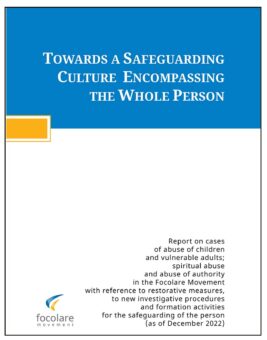
The Focolare Movement has now published the first report on cases of abuse of children and vulnerable adults; and on spiritual abuse and abuse of authority that has occurred in the Focolare Movement, with reference to reparation measures, new investigative procedures, and training in safeguarding. “We are writing to give you a public account of information regarding the reports we have received and the measures we have taken as the Focolare Movement in response to the scourge of the sexual abuse of children and vulnerable adults and the abuse of conscience, spiritual abuse, and the abuse of authority regarding adults, which has also affected us”. In an open letter, Focolare President Margaret Karram, and Co-President Jésus Morán present the first report on the handling of abuse cases within the Movement. The report, published this year on 31st March 2023, one year after GCPS Consulting‘s investigation into serious cases of sexual abuse by a former French focolarino, J.M.M., will be issued annually. The Movement has been working to take the necessary steps to ensure the prevention and all-round safeguarding of the person in all the environments in which its activities take place. Therefore, as the President and Co-President of the Focolare explain, the report being published today, is a first account of the measures of prevention, investigation, transparency, training, and change, undertaken by the Movement, to combat these crimes. First, the President and Co-President sincerely ask each victim and survivor for forgiveness, on behalf of the Focolare Movement. And they express their deep gratitude to the victims and survivors, and to the families and communities involved, not only in France, but in all countries where cases of abuse have come to light. It is thanks to their cooperation and especially their courage in facing and bringing these crimes to light, that the Movement today is more consciously pursuing new commitments and procedures regarding safeguarding. The report consists of several parts and presents figures relating to abuses reported to the Commission for the Wellbeing and Safeguarding of the Person (in Italian CO.BE.TU.) since 2014, the year of its establishment and therefore of the systematic gathering of reports, until December 2022. Information on the “foundation courses on safeguarding” carried out in the various countries where the Focolare Movement exists are also included. Another section is dedicated to the measures put in place, or being put in place, as a priority, following the recommendations of the independent Inquiry by GCPS Consulting; training courses and measures concerning safeguarding available to all members of the Movement, especially formators and those who work with children. Training events have already been held for those in positions of responsibility in the Movement at various levels, from the central leadership to those responsible for different geographical areas. The Independent Central Commission has been set up together with procedures regarding reports, accusations and investigations As of 1st May 2023, the Independent Central Commission will start work and the task of CO.BE.TU will end. The new body will deal exclusively with the handling of reports, while training will be coordinated centrally and locally by another team of experts and consultants. The report also presents the ‘Procedures for handling cases of abuse in the Focolare Movement’, the ‘Role of the Independent Central Commission’ and ‘Guidelines on support and financial reparation in the case of sexual abuse of children and vulnerable adults’.
Stefania Tanesini
Download PDF Report on the handling of abuse cases within the Focolare Movement
