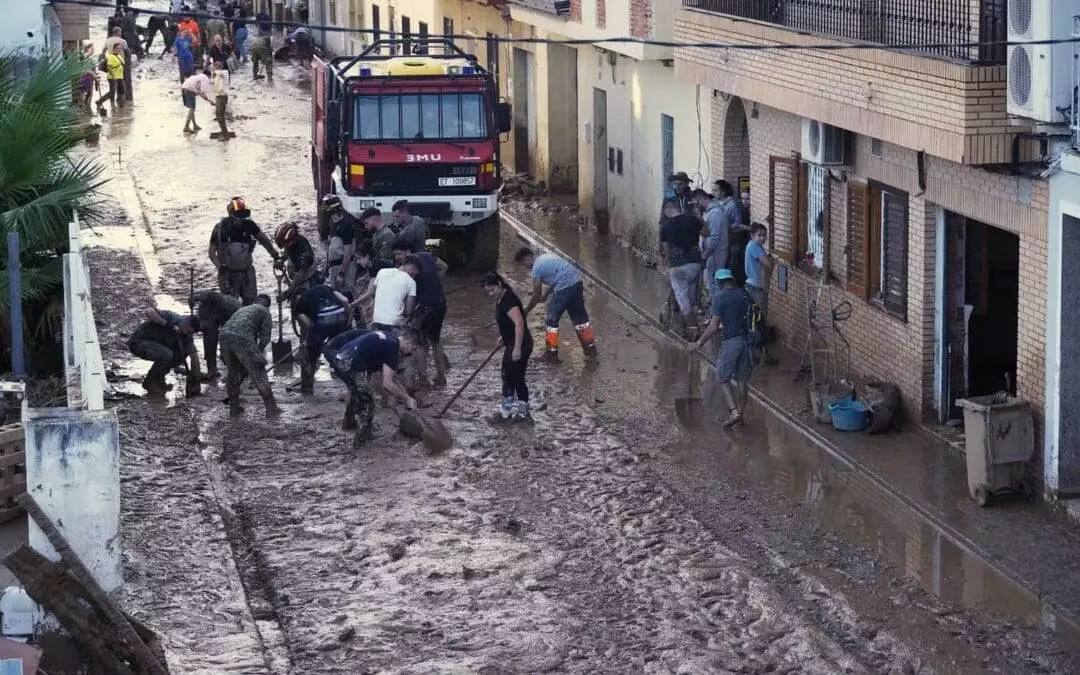
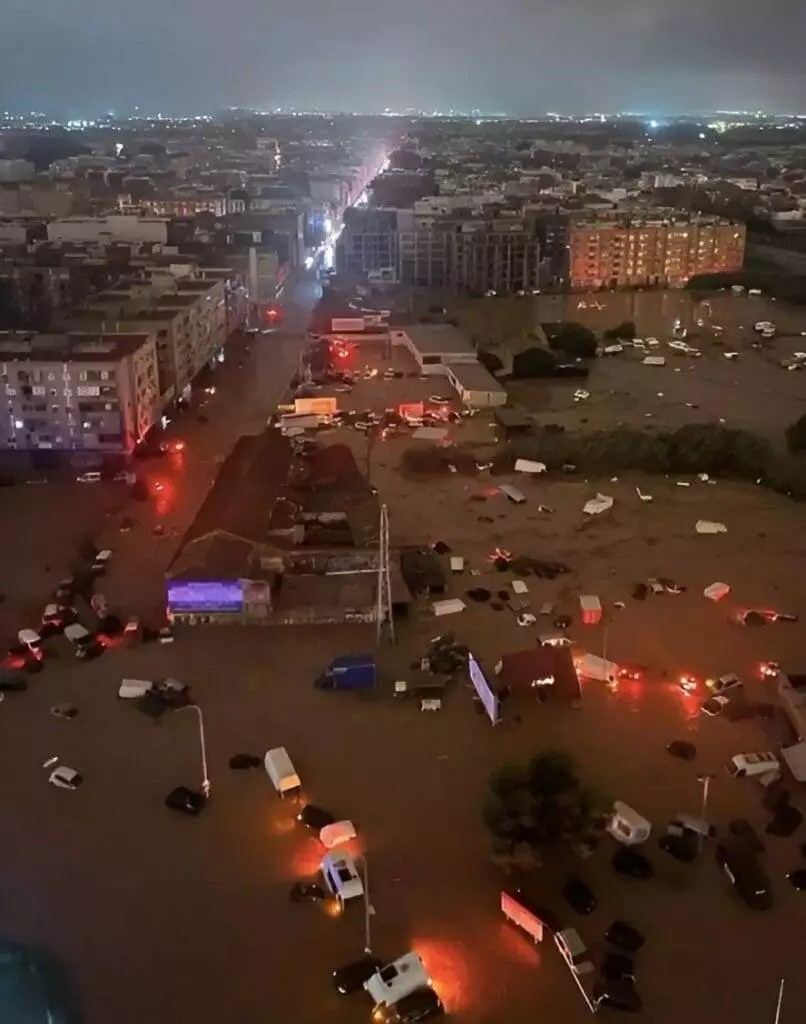
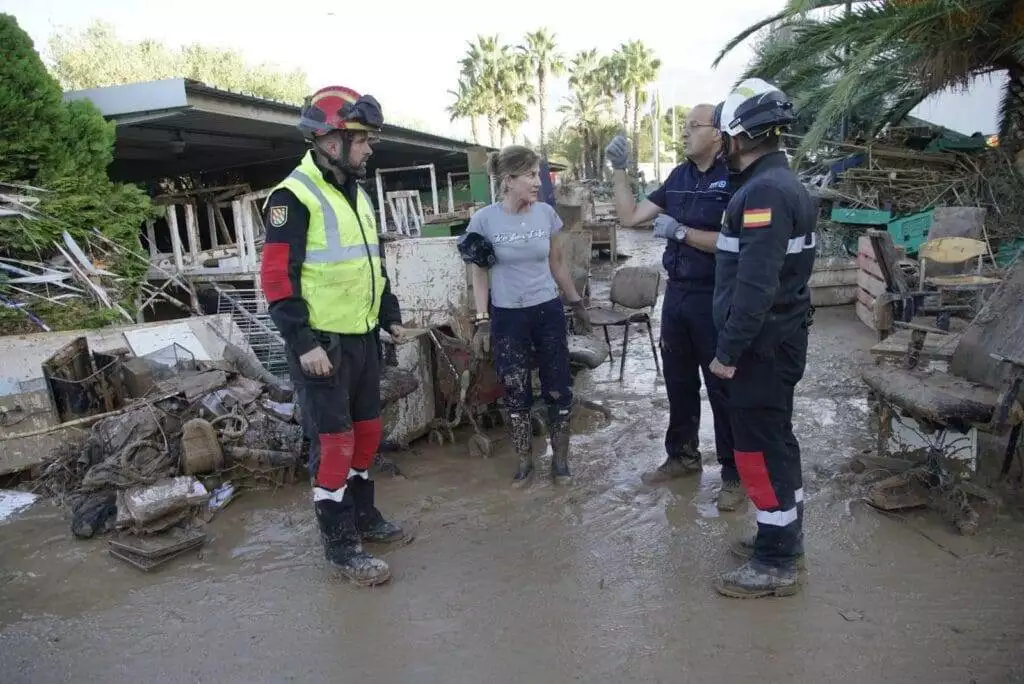
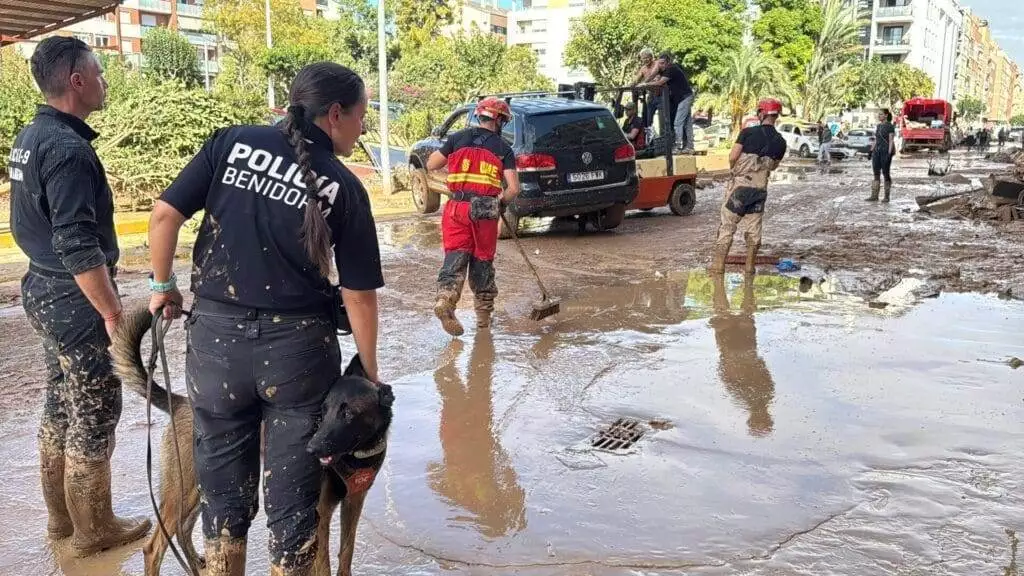
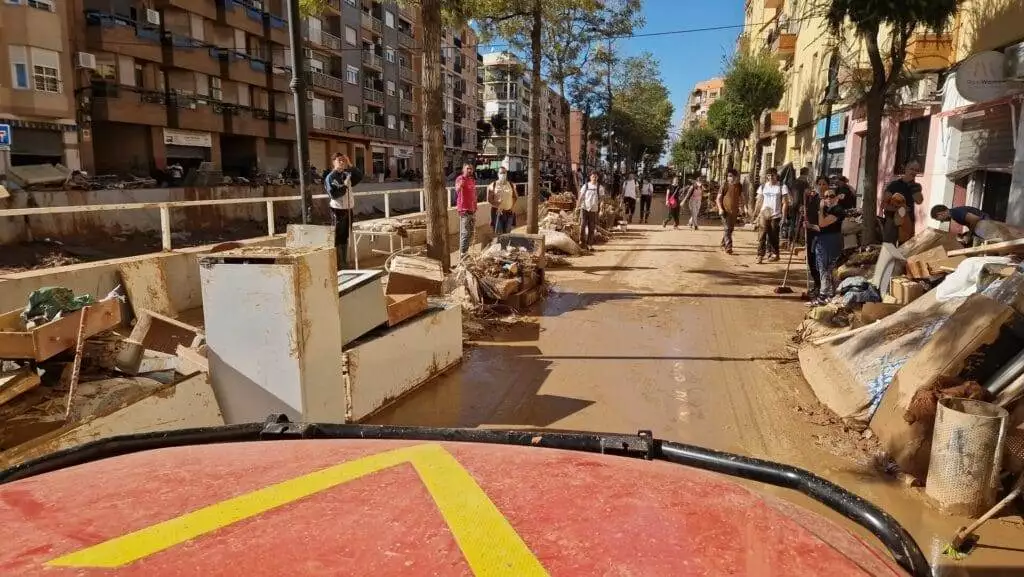
A few days ago, the Spanish province of Valencia experienced one of the greatest natural disasters in its history. Heavy rains, “DANA”, caused massive floods that swept through cities and towns in the region.
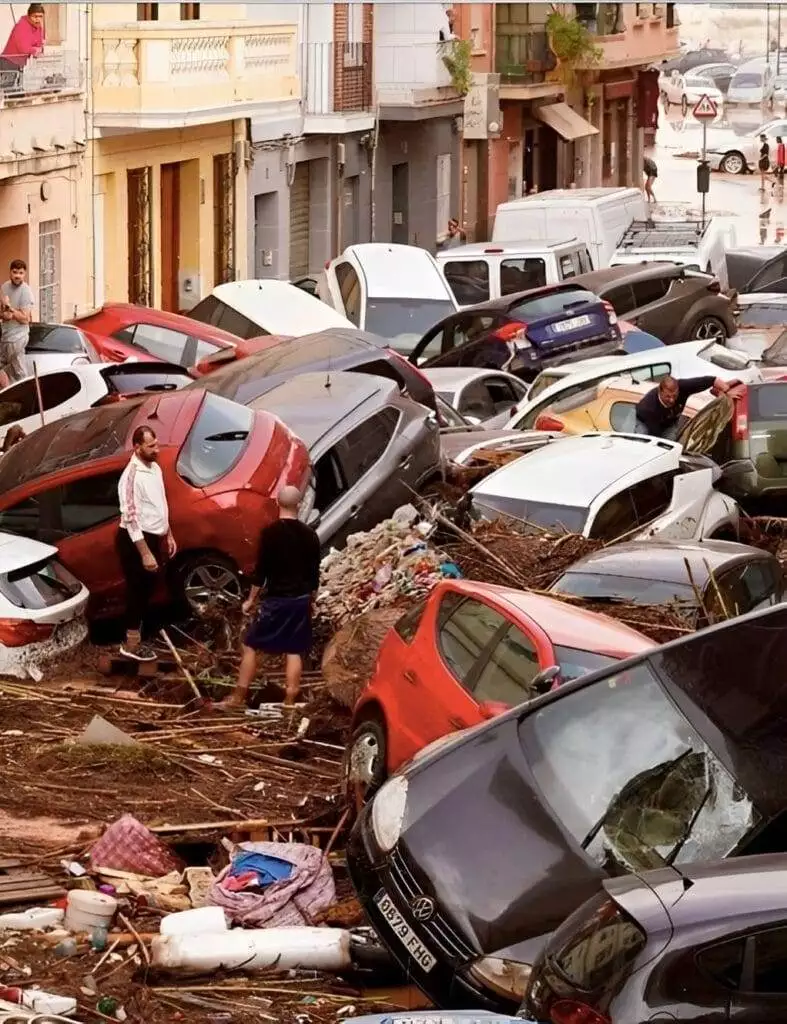
Currently, the toll is 214 dead and 32 people missing. An estimated 800,000 people, one-third of Valencia’s population, have been affected. Around 2,000 small businesses have been swamped with water and mud, losing everything. Cars floated through the streets, piling up like paper boats. The list of families who have lost their livelihoods has yet to be compiled. It is a major disaster made worse by the indefinite postponement of public works needed to prevent floods like these from occurring.
However, alongside this great disaster remarkable solidarity is being demonstrated. In the following days, as the waters receded, revealing a thick layer of mud covering everything, thousands of volunteers, mostly young people, began arriving in the affected area, armed with shovels and brushes, ready to help.
José Luis Guinot is a medical oncologist and president of the Viktor E. Frankl Association of Valencia, which provides emotional support for people affected by illness, suffering, death and other vital losses. The City Council asked him to help at a health and support centre set up for the occasion, where he could “listen and welcome those who need to share what they have experienced.” He said, “This has been and continues to be, an immense tragedy, far beyond anything we could have imagined. We couldn’t believe it was happening.”
He said that a few days later, while attending Sunday Mass, it saddened him to hear only prayers for the dead and those affected by the flood, without mention of any further support. He thought, “It’s not enough just to pray, even though we must pray a lot. We need to be close to people to give them hope. As Christians and as part of the Focolare Movement, we must offer that hope even in harsh experiences. Together and united, we can help each other overcome this situation.”
In one of the affected areas, a Focolare family with young children had their home flooded. Although they were unharmed, everything they owned was lost: washing machine, refrigerator, domestic appliances, furniture… Help from other families came quickly, someone washed their clothes, then another person gave them a new washing machine.
Eugenio, a member of the Focolare Movement who has a disability due to polio, was the President of the Federation of Adapted Sports in Valencia for many years. He couldn’t get around after the flood because of his mobility difficulty but by making phone calls he was able to contact local disabled associations asking for help. José Luis Guinot said, “We must offer ideas, help create solidarity and generate donations.” For example, these associations managed to obtain wheelchairs for those who had lost theirs in the flood.
“I think this is a wake-up call for all of society. Spain is going through a period of politically polarized conflict,” José Luis reflected. “But there’s another side of society, many young people who we think are always glued to social media, yet they’re out here in the mud, seeking a society of solidarity, a united world, a society where fraternity is real. Until now, politicians hadn’t taken this message seriously. But now, no one can deny it.”
Next weekend, the Focolare community will meet to think and plan together how they can continue serving after these emergency days. As José Luis said, everyone can and must be involved, because, “two or three months from now, there will be a need for emotional support, for a sense of belonging to something, to a community or a parish… It will be a challenge for us: we’ll need to be on the phone a lot, visit people, listen to them, encourage them despite their hardships, but letting them know that we are with them. Even if you can’t leave your home, if you’re elderly or have small children… you can talk to your neighbours, make phone calls or offer words of encouragement. We must transmit a sense of community… I won’t try to explain anything to those who have lost loved ones or their livelihood, I will give them a hug and say: ‘We will help you find the strength to move forward'”. .
The Focolare community and the Fundación Igino Giordani, has launched a fundraising campaign. The funds collected will be managed locally to support the victims. The material damage and losses are immense. Many survivors have lost beds, tables, refrigerators, washing machines, cars, work equipment…
Contributions can be made through: Fundación Igino Giordani CaixaBank: ES65 2100 5615 7902 0005 6937 Account Holder: Fundación Igino Giordani Purpose: Emergencia DANA España To claim a tax deduction, send your tax information toinfo@fundaciongiordani.org
Peace is the result of a project: a project of fraternity between peoples, of solidarity with the weakest, of mutual respect. This is how a fairer world is built; this is how war is set aside as a barbaric practice belonging to the dark phase of the history of humanity. Many years have passed since the first publication of this writing, which is still very relevant today, at a time when the world is torn apart by terrible conflicts. History, Giordani tells us, could teach us a lot.
War is murder on a grand scale, clothed in a kind of sacred cult, as was the sacrifice of the first-born to the god Baal: and this is because of the terror it incites, the rhetoric in which it is clothed, and the interests it implies. When humanity will have progressed spiritually, war will be catalogued alongside bloody rites, the superstitions of witchcraft and the phenomena of barbarity.
War is to humanity, like illness to health, like sin to the soul: it is destruction and devastation, it affects body and soul, individuals and the community.
According to Einstein, human beings have a need to hate and to destroy: and war would satisfy this. But it is not so: most human beings, entire peoples, do not manifest this need. At any rate they repress it. Reason and religion condemn it.
« All things crave peace, » according to St Thomas. In fact, they all crave life. Only the insane and the incurable can desire death. And death is war. It is not desired by the people; it is desired by minorities to whom physical violence serves to secure economic advantages or, even, to satisfy harmful passions. Especially today, with the cost of war, the dead and the ruins, war manifests itself as “useless slaughter”. A massacre, and a useless one at that. A victory over life, and one that is becoming a suicide of humanity.
[…] Human ingenuity, destined for quite different purposes, has today devised and introduced instruments of warfare of such power that they strike horror in the soul of any honest person, especially since they do not only affect armies, but often still overwhelm private citizens, children, women, the elderly, the sick, and at the same time, sacred buildings and the most distinguished monuments of art! Who is not horrified at the thought that from the recent conflict, new cemeteries will be added to the numerous existing ones and new smoking remains of villages and towns will accumulate more sad ruins? Who, indeed, does not tremble to think how the destruction of new riches, the inevitable consequence of war, may further aggravate that economic crisis, by which almost all peoples, and especially the humblest classes, are afflicted? » [1]. […]
The futility was reaffirmed by Pius XII in 1951: « Everyone has manifested with equal clarity their horror of war, and their conviction that it is not, and now less than ever, a proper means to settle conflicts and restore justice. This can only be achieved by freely and legally consented understandings. If it could be a question of popular wars – in the sense that such wars respond to the votes and will of the people – it would only be in the case of such a flagrant and destructive injustice of the essential goods of a people as to revolt the conscience of an entire nation. » [2].
Just as the plague serves to infect, hunger to starve, war serves to kill: moreover, it destroys the means of life. It is a funeral industry: a factory of destruction.
Only a fool can hope to derive benefit from a massacre: health from a fainting spell, energy from pneumonia. Evil produces evil, as the palm tree produces dates. And the facts show, even in this field, the practical inconsistency of the Machiavellian saying that « the end justifies the means ».
The end may be justice, freedom, honour, bread: but the means produce such destruction of bread, honour, freedom and justice, as well as of human lives, including those of women, children, the elderly, the innocent of all kinds, that they tragically annul the very end that is proposed.
In essence, war serves no purpose other than destroying lives and riches.
This verse comes at the conclusion of chapter 12 in the Gospel of Mark. Jesus is in the Temple in Jerusalem where he is both observing and teaching. Looking at the scene through his eyes, we become aware of the involvement of many different characters: people are simply passing through, some have come to worship, some are dignitaries in long robes and some are rich people throwing their substantial offerings into the temple treasury.
But here comes a widow; she belongs to a category of socially and economically disadvantaged people. Amid general disinterest, she throws two pennies into the treasury. Jesus, however, notices her and calls the disciples to him and instructs them:
They all gave out of their wealth; but she, out of her poverty, put in everything, all she had to live on.
‘Truly I say to you…’ These words introduce important teachings; Jesus’ gaze is focused on the poor widow, and he invites us to look in the same direction because she is a model for disciples.
Her faith in God’s love is unconditional; her treasure is God himself. She surrenders all that she is and has to him and, furthermore, she wants to give all she can to support those who are poorer than her. In a way, her trusting surrender to the Father anticipates the same gift of self that Jesus will soon make through his passion and death. It is that ‘poverty of spirit’ and ‘purity of heart’ that Jesus proclaimed and lived.
This means ‘placing our trust in God’s love and in his providence but not in his riches…We are “poor in spirit” when we allow ourselves to be guided by love for others. This results in our sharing and making what we have available to those in need; it may be a smile, our time, our possessions or our skills. When we give away whatever we have out of love, we become poor, with nothing of ourselves, with a free and a pure heart.’ [1]
Jesus’ proposal turns our usual way of thinking onto its head; those who are poor, insignificant and unimportant lie at the centre of his thoughts.
They all gave out of their wealth; but she, out of her poverty, put in everything, all she had to live on.
This Word of Life invites us to renew our total trust in God’s love and consider if our vision of life compares with his: do we see beyond appearances, do we avoid judging, do we take other people’s opinions into consideration if they are different from our own and do we see the positive in other people.
It suggests that there is an evangelical logic in freely giving to others and that doing so creates a peaceful community because it urges us to care for one another. It also encourages us to live out the words of the Gospel in everyday life even when other people may not notice, to trust when we are generous to others and to share whilst maintaining an attitude of balance and clear judgement. This Word focuses our attention upon the ‘least’ and asks us to learn from them.
Venant was born and raised in Burundi. He recounts: ‘In the village, my family had a good farm that always produced a good harvest. My mother believed that everything was providence from heaven and so, each year, she used to gather the first fruits and distribute them to our neighbours, starting with the neediest families and then allocated only a small part of what remained to us. I learnt the value of selfless giving from her example. Thus, I understood that God was asking me to give him the “best part”, indeed to give him my whole life.’
Every day we are bombarded by images that emphasise the value that our society places upon appearance. Globalization imposes a model in every part of the world whereby wealth, power and physical beauty seem to be the only values. Yet it is enough to stop and observe the people we meet daily in our cities (on trains, in the underground, on the street) to realize that there is a different reality, made up of small daily gestures of solidarity: for example, there are parents who accompany their children to school, nurses who get up at dawn to go to work alongside people who are suffering and there are workers who carry out their tasks with great commitment in factories, stores andoffices. In addition, there are countless voluntary activities.
There is a need to look truthfully at the world and go beyond appearances. We should value the positive in each person and realize that it is these small daily gestures of support and solidaritythat keep society on its feet. Even more revolutionary are the actions of those who, despite living in situations bordering on poverty, realize that they can still “give” in some way. Theywelcome others, share a meal or a room because there is always someone who has “more need” than themselves.Furthermore, they do this out of a sense of justice and with a generous and selfless heart.
We know that giving does not refer only to material things. Chiara Lubich used to tell us,: let this be the word that gives us no respite. “Let us always give; let us give a smile, understanding, forgiveness, a listening ear; let us give to others by drawing on our intelligence, our will, our availability; let us give our time, our talents, our ideas (…), our actions; let us share our experiences, our abilities and our possessions. By constantly reviewing what we no longer need and and sharing with others, we ensure everything circulates. ‘Give’ is the word that could accompany us always.”1
This idea, then, is an invitation to have a generosity that comes from within, from the purity of hearts that knows how to recognize the suffering of humanity and see themselves reflected in the disfigured faces of their neighbours. This is the very gift that makes us free and more capable of loving.
This what Etty Hillesum experienced. She was, a young Dutch woman who lived the last years of her life in a concentration camp before dying in Auschwitz. She was able to love the beauty of life till the very end and gave thanks for “this gift of being able to understand and ‘read’ others. Sometimes I see people people like houses with an open door. I go in and wander around corridors and rooms: each house is furnished differently but, basically, they are the same as one another – consecrated dwelling places” (…). And there, in those hovels, populated by crushed and persecuted men and women, I have found the confirmation of this love.” 2
There is a logic in freely giving to others because it creates a peaceful community and urges us to care for one another.It helps us focus upon profound human values in our everyday lives, without attention to outward appearance. It is a change of mindset that can become contagious.
Venant was born and raised in Burundi. He recounts, ” In the village, my family had a good farm, that always produced a good harvest. My mother believed that everything was a gift from nature and so, each year, she used to gather the first fruits and punctually distribute them to our neighbours, starting with the neediest families and then allocated only a small part of what remained to us. I learned the value of selfless giving from her example ”.
THE IDEA OF THE MONTH is currently produced by the Focolare Movement’s “Centre for Dialogue with People of NonreligiousBeliefs”. It is an initiative that began in 2014 in Uruguay to share with non-believing friends the values of the Word of Life, i.e. the phrase from Scripture that members of the Movement strive to put into practice in their daily lives. Currently, THE IDEA OF THE MONTH is translated into 12 languages and distributed in more than 25 countries, with adaptations of the text according to different cultural sensitivities. https://dialogue4unity.focolare.org/en/
‘It has been an immense grace for me, a gift from God that is not only a personal gift, but i consider it a gift for the whole Focolare Movement’ with these words President Margaret Karram opens some reflections on the Synod experience and the final document of the 16th Ordinary General Assembly of the Synod of Bishops (2-27 October 2024) “For a Synodal Church: communion, participation, mission”.