Light and giving oneself to God
(C) CSC Audiovisivi

(C) CSC Audiovisivi
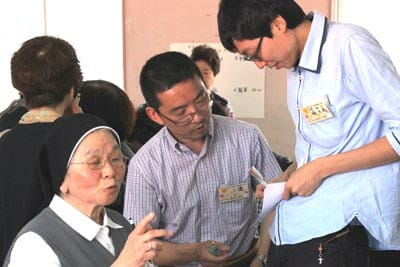
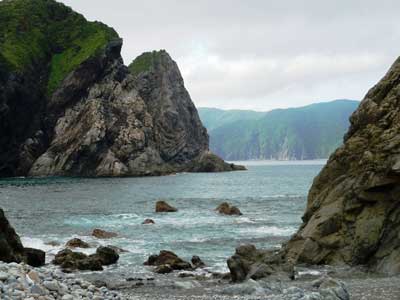 If you want to go to Okinawa from Kagoshima, midway along the route – after spending a night on the ship – you will come across the island of Amami. It is an enchanting place for its natural beauty, and the profound bond between the inhabitants themselves and with the environment. They say that in the rice planting season, the inhabitants had the custom of helping one another by going to each other’s homes when necessary. It was a lifestyle which the islanders still call the “bonding” spirit. Missionaries have landed on the Island ever since the 19th century, bringing the Christian message which took root among the population. With pride, the inhabitants of Amami boast of three bishops born on their island, besides a great number of priests, religious men and women. It was precisely one of these priests, who launched an idea in 1996 during a retreat held on the island: “Why don’t you look into the Focolare? It’s a place where people live evangelical love and unity.”
 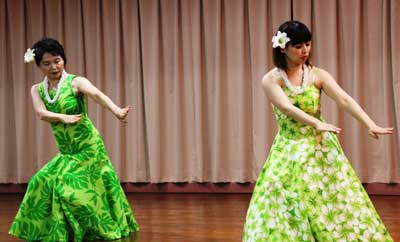 Immediately some of those present contacted the centre of Nagasaki and the following year, two of them, after a night on the ship and travel of more than five hours by car, arrived at Sasebo, two hours away from Nagasaki. A Mariapolis was then underway: a happening of a few days for those who wanted to know more about the spirituality of the Focolare. These two people certainly never imagined that 19 years later a Mariapolis would be held also in Amami! 19 years in which the road has not always been easy. Joys, new spiritual energies, but also misunderstandings and all types of suffering – overcome by mutual love intensively lived – consolidated the new community in unity. And since unity is always diffusive, the community expanded with the desire to let all know what they had discovered. They spoke with friends and acquaintances. They visited seven parishes. Last May, 150 people of the island and some from outside, participated in the Amami Mariapolis. Some of these did not frequent religious groups; others were Buddhists, and still others were of diverse beliefs. There were also five priests and the Bishop of Kagoshima, Bishop Koriyama who confirmed: “The Focolare really suits the bonding spirit of Amami.” Suddenly, sometime later, he wrote a letter of thanks to the community: “…among the fruits the Focolare brings I saw a new culture of faith take root, and the possibility also for non-Christians to freely come in contact with the Church without fear.” And he hoped that the Mariapolis would not remain an isolated event, but be repeated under some other form of activity during the year. This encouragement filled all with joy. After discussing the matter, a letter was sent to all the parish priests of Amami, communicating the bishop’s augur, and the plan to hold a one-day Mariapolis, an event which took place last 25 October. The same letter also reached the Bishop who replied: “Congratulations! I am happy about this Mariapolis day, worthy to be celebrated and go down in the history of a new faith… I urge you to build, with a sole heart, the tradition of a new faith for the evangelization of the Amami Island.”

What pushed you to become a priest? A 13-year-old girl asked Don Marco, during an informal interview on the many “anecdotes” that have dotted his life and priesthood. «I was not counting on becoming a priest. I had only asked some advice from the people who were older and had more worldly experience than me, so as to see what humanity needs most today. I could have become a teacher or an engineer. I also liked architecture, or travelling. I liked so many things, and was doing well in school. Those were the years of the economic boom and I had all the possibilities. I was uncertain since I had received a university scholarship, but I wanted to be useful. So I booked an appointment with the Bishop. I wanted to ask him what he thought, about what humanity needs most. He was so busy that he did not have time to talk to me, and I was alone for hours, so much so that I thought: “surely humanity doesn’t need me, but perhaps not even the church needs me, and whoever said that you are so important? Perhaps I am not worth anything… but I love Jesus and will love him always, even if I turned out to be useless.” Finally, when the Bishop found time to speak with me, and asked me what I wanted, I didn’t want anything anymore! And so I told him that I could probably collaborate… He was surprised, undecided, but in the end he said: “Yesterday I laid the cornerstone of a church. When this church, will be finished six years from now, it will have no priest. Would you like to be the parish priest of that church?” But my first experience had been a choice of God, first of all, and not that of becoming a priest, but to follow God and love Jesus, even if I was useless, since Jesus in the end, will make you do something. » (Fr. Marco – Italy)
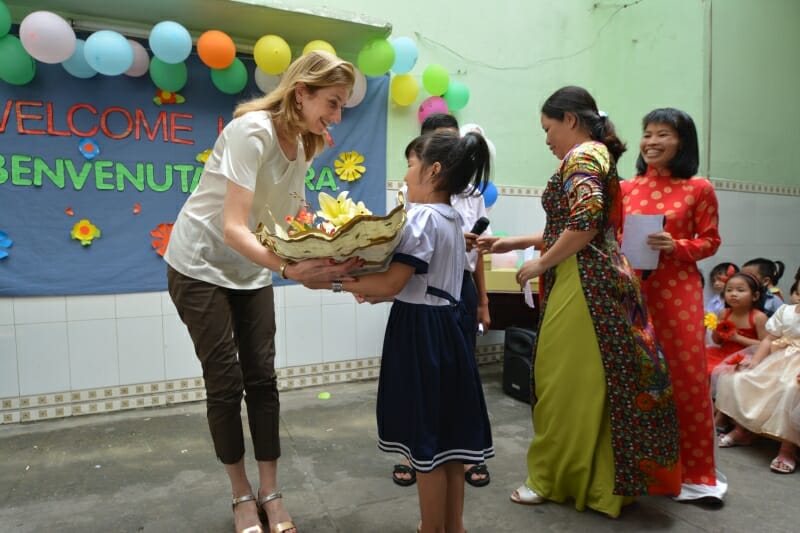
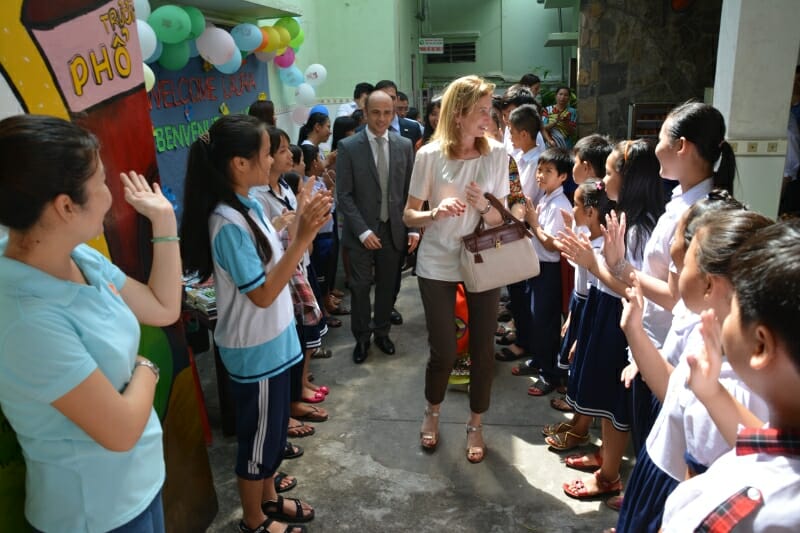 It was not at all easy to delineate a social project from the start, as it occurred for the Pho Cap School in Ho Chi Minh City, Vietnam. A few days ago, this project was honoured by the private visit of Laura Mattarella, daughter of the Italian Republic’s President, who accompanied her father on an official visit to the country. Laura Mattarella who came to visit the 100 children of the school, was welcomed simply – without protocols – by some members of the Focolare Movement, the current heads and collaborators of the School. Pho Cap School was established in 1998 by a Focolare priest, with the help of some university students who were among the first to adhere to the spirituality of unity: a project inspired by love for the poor who filled the Binh Thanh district. The school facility was an abandoned house, and once cleaned from the numerous syringes, the youth rebuilt the roof, then the toilets and electric and water systems. All was done with small donations received, and a lot of sacrifice. The youth became whitewashers, labourers, plumbers and electricians… One of them, now a Focolarino, remembers those days: “It was tough work, but the spirit of the Movement pushed us to love concretely. Also some labourers gave a hand. The project was really achieved together!” In a few weeks, the facilities became liveable and so schooling activities started. It was a matter of convincing the people to send their children, and making them understand that it was better for them to study rather than work. In fact, many of those children passed their days on the street of Saigon selling lottery tickets and did not go to school. The young people had to go from house to house to look for the “students.” After the first group was formed, soon also some girls joined in, and gave their time and enthusiasm to the project. From a small group of students who were not given any meals, the school started to hand out daily snacks, and then lunch. The project continually developed, overcoming many difficulties. It was a success and became a school of “prestige” but which remained poor and for the poor just the same, though managing to give a convincing testimonial in a difficult suburban context. Most of the children come from Buddhist families but in the eyes of the children of Pho Cap, one can see trust, serenity and zest for life. Laura Mattarella noticed this and wanted to keep the photos of this “beautiful” meeting, as she said, in its simplicity, and so full of humanity, gentleness and relationships. The school directress commented: “The visit of the daughter of the Italian Republic President encouraged us to continue in the spirit that inspires us: living fraternity among us, the collaborators, and transmitting it to the students, so they in turn become messengers of this spirit in their families and in society.”
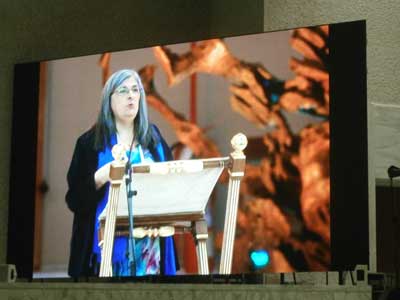
The profession of educators is a poorly paid one. This speaks volumes about the regard given to education by society and by governments. From November 18th to 21st, 2500 people gathered in Rome for a convention organised by the Congregation for Catholic Education, to commemorate the 50th anniversary of the Vatican Council II Declaration on Christian education, and the 25th of the Apostolic Constitution on Catholic Universities. “I came here with a Jewish colleague, and from India there were Catholics and a few Hindus,” said Nieves Tapia from Argentina, director of CLAYSS (Latin American Center for Service-Learning). “I felt that this was already a fruit of the Council: the Church in dialogue. With the motto, ‘Educating today and tomorrow: a renewing passion,’ we came together from all over the world, from very different situations.” The experiences from Catholic schools in frontier locations demonstrated the challenge of dialogue in action. As in Morocco, where teachers and students are Muslims; or in the Philippines, a Catholic country by majority, where the universities, also open to Muslims, encourage students to fast during Ramadan and reserve a place of prayer not only for Christians but also for Muslims. “It was an experience in a universal context,” affirmed Nieves Tapia, “not only because of our geographical origins, but also because of the types of schools and universities represented: public, private, and many schools who also work with the poor.” Pope Francis’ passion for education shone through in his address: “The pope responded to a few questions, and he spoke off the cuff, from his heart and with passion. He highlighted the need to go to the periphery, not to do charity, but because there, a new culture will be born. There we learn what profound wisdom there is in suffering. If we think about the great educational reforms (Don Bosco, Freire) we can say that they all came from the outskirts. Francis stressed furthermore the importance of working for the unity of the person, taking into account the mind, the heart, the hands; the importance of rebuilding the educational pact, that is the unity between the school and the family, the school and the community, the relationship with real life without closing oneself in the classroom. In addition, the importance of going out, which is also a response to the culture of the elite, the great danger of many educational systems, with the risk of leaving people out.” Among the subjects discussed in the convention, the pope implicitly underlined that of service learning, an educational program which actively involves the individual in the frontline… “It is a pedagogy that we have sought to enrich with the Latin American experience and with the spirituality of unity: service learning. It is necessary to allow the student to leave the classroom and begin to serve: to learn to do, to live, to be a better citizen. Research demonstrates that the learning cycle is not completed until the individual is able to practice what he has learned.” “This is confirmed when the teens learn to use their classroom knowledge to serve others. For example, in a technical school, instead of making a robot prototype, the youth construct wheelchairs for people who need them.” Service learning has been in use for almost 50 years, and there are thousands of universities and schools throughout the world that put into practice what is learned in order to serve others.” What prospects have emerged from the Convention? “The guidelines are those which the pope gave us. Above all, the necessity to renew our passion for education came into relief. ‘We must change education in order to change the world,’ said Pope Francis. We are already on the way and this is a sign of hope.”
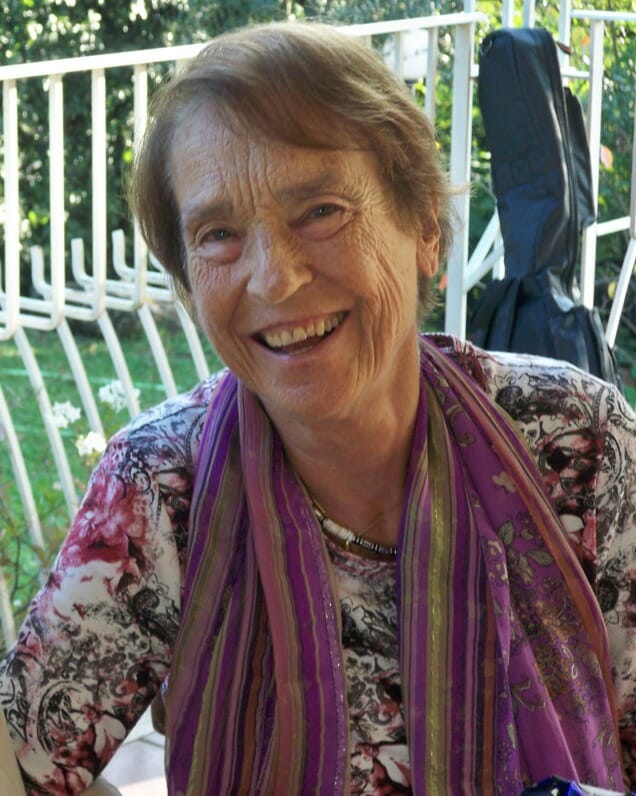 Silvana Veronesi has passed away at the age of 86. She was one of the close collaborators of the founder of the Focolare, Chiara Lubich. The news of her passing was communicated by Focolare president, Maria Voce, to the worldwide Focolare Movement: “We accompany her with the certainty that there will much rejoicing in heaven.” Her first meeting with Chiara Lubich was in 1945. She was only 16 years old and in search for something great to live for. From that moment, fascinated by the spirituality of unity, she entered the initial group that gave life to the Focolare Movement. In 1949, she moved to Florence, Italy, to attend Medical School. With great simplicity she bore witness to the novelty of her new life to young men and women, giving rise to the first Focolare community in Tuscany. She then spent some time in Turin and Milan.
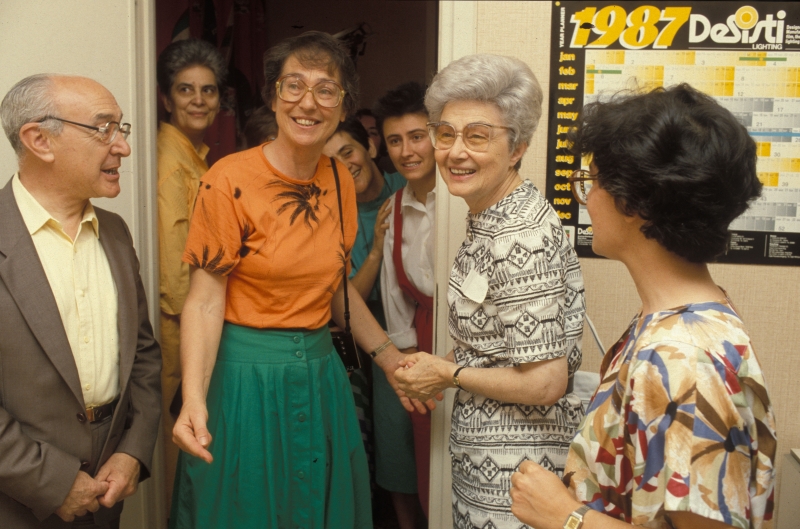
Silvana Veronesi with Chiara Lubich, International Gen Centre, Rome 1987
© CSC Audiovisivi
(C) CSC Audiovisivi
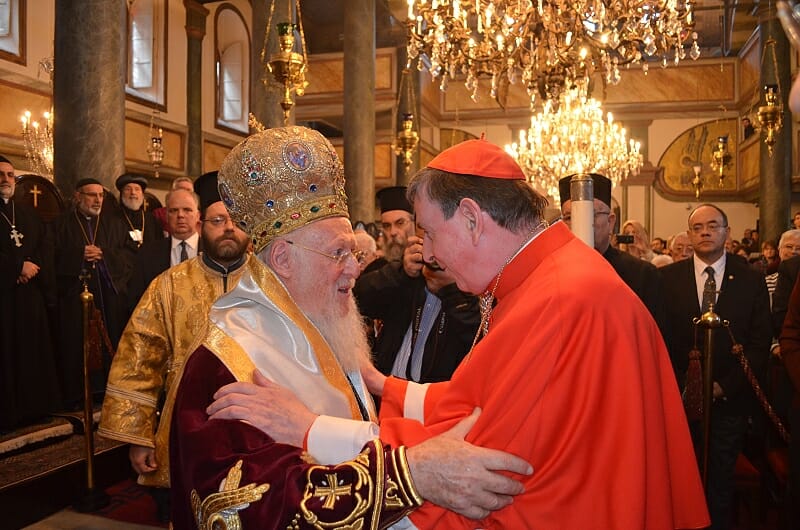
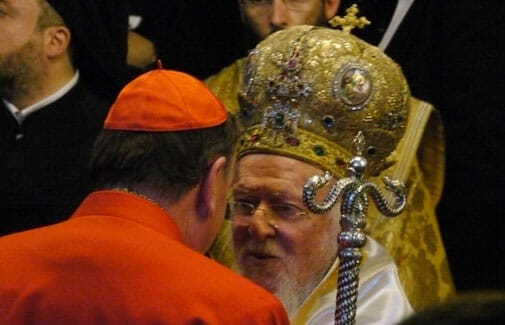
According to Pope Francis, the four tenets of the ecumenical undertaking are ecumenism of charity, concreteness, truth and spirituality. In his in-depth dissertation, Cardinal Kurt Koch, President of the Pontifical Council for the Promotion of Unity among Christians, delineated the objective of the total unity of the churches as the perspective of ecumenical dialogue. According to Pope Francis, in line with his predecessors “divisions are a scandal, and the ecumenical endeavour should, in short, target the common celebration of the Eucharist and reach unity always through the reconciliation of our differences.” Unity is a journey, and his deep conviction is based on the fact that: “Unity will not come about as a miracle, but as a journey during which the Holy Spirit will achieve unity.” The Pope places as first and foremost, fraternal dialogue in words and actions, inspired by charity: the encounter of Christians of different churches since “the truth is an encounter between persons. The truth is not concocted in a laboratory, but in concrete life, in the search of Jesus who will help us find it.” Theological dialogue is important but is always interpreted as an “exchange of gifts”, which is just a “mere theoretical exercise” but helps us to know the basics of mutual traditions so as to understand, and at times, also learn from them.” Above all, we can cooperate concretely by praying and working together in searching for peace, protecting creation, helping the poor, and defending our religious freedom, marriage and the family. But unity “is primarily a gift of God, which we must always pray for.” Today, many Christians are persecuted. Why does the Pope stress the importance of ecumenism of blood? “We have to be aware that in the world, 80% of those persecuted in the name of faith are Christians. There are more persecutions today than in the first centuries of Christianity. This fact should stir up a great solidarity between all the churches because the martyrs are not persecuted because they are Catholics, Armenians, Orthodox, Anglicans, Pentecostals, or Lutherans, but because they are Christians. Their blood does not divide but unites. The martyrs are already celebrating the first communion in heaven, which we need to find once again on earth. They will help us on our journey towards unity.” After 50 years of preparation, in 2016 the Pan-Orthodox Synod will take place. What effects will this have on the ecumenical movement? “If the Orthodox churches will regain a slightly stronger unity among them, this will be a great help also for ecumenism and for progress toward the joint celebration of the Eucharist between Catholics and the Orthodox. I am convinced the Ecumenical Patriarch Bartholomew is working with all his heart for this Pan-Orthodox Synod. And we, as the Catholic Church, want to help as much as possible and are praying intensely for it.” The 34th Convention of the Ecumenical Bishops of the Focolare has come to an end. How will these types of meetings contribute to unity among the churches? “The ministry of the bishops is a ministry of unity in their own Churches and unity among the churches is, likewise a big obligation for all Christians because this is what the Lord wants of us. And all the bishops want to fulfill God’s will. Meetings like this can help us build that unity, about which the various churches take on different concepts. The endeavour to reach a unified idea through dialogue is very important at this stage of ecumenism. And I am really grateful to the Focolare for its commitment in the field of ecumenism.”
By our correspondent Aurelio Molè
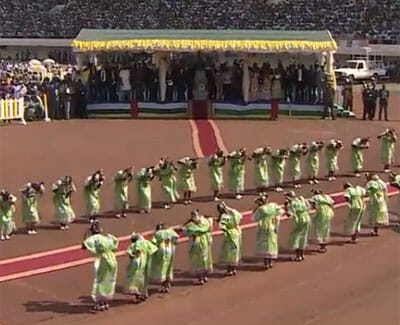
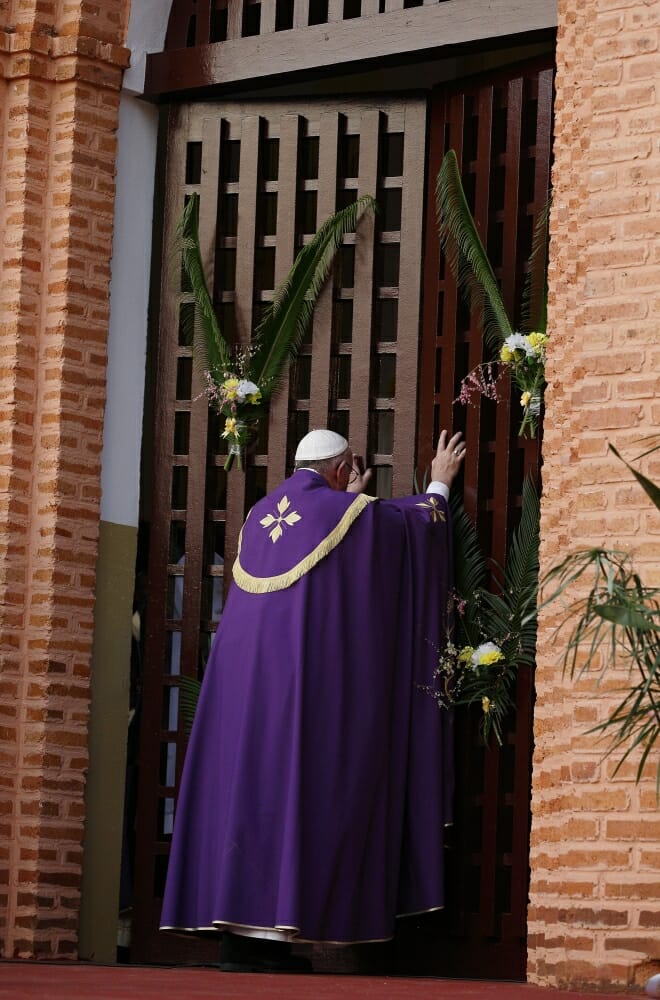 Today Bangui becomes the spiritual capital of the world. The Holy Year of Mercy is anticipated in this land, a land that suffers from several years of hatred and war, misunderstanding and lack of peace. But there are also all the lands that are bearing the cross of war. Bangui becomes the spiritual capital of the prayer to the Father for mercy. All of us ask for peace, mercy, reconciliation, pardon and love. For Bangui, for the Central African Republic, for the whole world, for the lands that suffer from war, we ask for peace!” These were the words of Pope Francis before the opening of the Holy Door in the Cathedral of Bangui, on November 29. Then, in a gesture charged with meaning, the Pope was the first to walk alone through that Holy Door. While the Pope is still on his return flight we have telephoned Bangui Geneviève Sanzé in Bangui. She is originally from the Central African Republic and is a member of the Pontifical Council for the Laity, and lends her services to the International Centre of the Focolare in Italy. “Nobody could have imagined what happened in the people,” she told us. “He brought back joy to us, peace!” Expectations were high, both on the Christian and the Muslim side: “Now, the man of God comes,” they said. “This is the supreme opportunity that God is sending.” It was a dangerous journey for security reasons, but “even though everyone was worried and the whole world discouraged it, the Pope wished to come.” “And the people feel that he came for them, not for some task or special event, but as a father who wants to encourage,” Geneviève explained. “He went to the Christians, Catholic and Protestant, but also to the Muslims. All of us prepared for his coming with enthusiasm, Christians on one side and Muslims on the other and the Pope went to everyone. Many thought it would have been better if he cancelled the visit to the Mosque located in a quarter where no Christian can enter. But he went anyway and was outstanding.”
 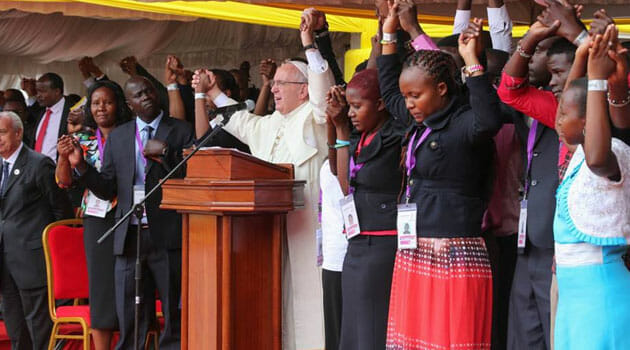 At Mass in the stadium, the Pope invited the “dear Central Africans” to “look to the future and, strengthened by the distance you have already come, resolutely determine to begin a new chapter in the Christian history of your country, to set out towards new horizons and he exhorted every person to be “an artisan of human and spiritual renewal.” The day before, he recalled: “love for our enemies which guards against the temptation of revenge and against the unending spiral of reprisal,” and also that “everywhere, especially where hatred and violence reign, injustice and persecution, Christians are called to witness to the God who is Love.” With these words in her heart, Geneviève recounted an event that she witnessed with her own eyes: A Muslim man walked in during the Mass, and he was clearly visible holding a sign with the words: “God is great.” The Christians applauded him and went up to him and embraced him. They want to live what the Pope is asking, this responsibility in love and in mercy; that open door that leads us all into that grace. And they showed it with that gesture.” “When I arrived I found hardened hearts. Seeing the change that has taken place in the people in just two days has been extraordinary. The Pope’s gesture, opening the Holy Door, was not merely a gesture but a life that he himself has testified to, in the mercy with which he reached out to everyone: he brought this love from God to everyone.” The speech by the Mayor of Bangji (and president of the state of transition),” Geneviève explained “placed before the Pope all the sins of our country, and the Mayor didn’t leave out his own responsibility. He asked for God’s pardon, asking the Pope that with his blessing he would invoke pardon upon the whole nation. With all of this in mind, watching Pope Francis open the Holy Door of Mercy was truly exceptional. He didn’t say much, but he knew how to put his finger on the weak point and launch an appeal to all the nations that produce weapons of war. And he called Bangui the spiritual capital of the world. Listening to a country that has shed so much innocent blood being called spiritual capital of the world, was like seeing God coming down to meet us.
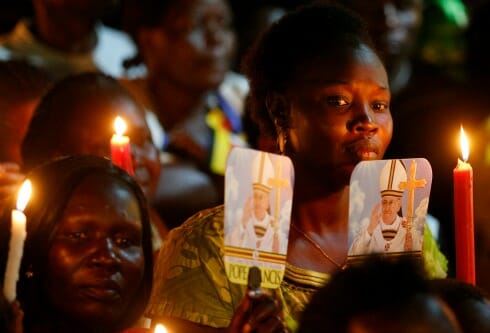
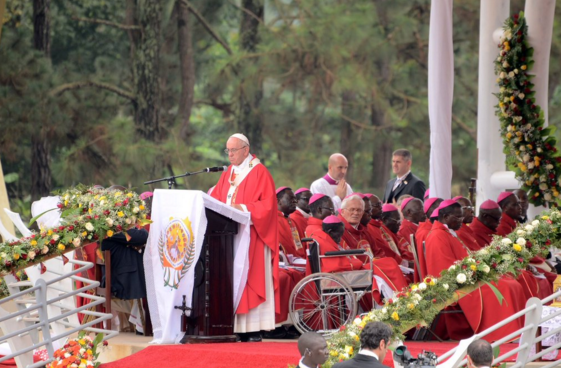
Pope Francis at Munyonyo Catholic Shrine were the first Christians were martyred.
In his sermon, the Pope, “recognized the Anglican Martyrs who gave their life’s to God’s work and the Catholic Martyrs, whose deaths for Christ testify to the ecumenism of blood. All these witnesses nurtured the gift of the Holy Spirit in their lives and freely gave testimony of their faith in Jesus Christ, even at the cost of their lives, many at such a young age,” commented Simon. “The Ugandan Martyrs are the first martyrs of contemporary Africa who give a witness, as lay people, of a simple faith that is very powerful,” Fr Lombardi, Vatican spokesperson, explains. The Pope’s draws his inspiration from them in his address to the young people when he challenges them to “transform what is negative into positive in their lives”, “hatred into love”, “war into peace”. Among the impressions gathered by Simon was that of a young person called Alinda: “With Jesus we can tear down any obstacle that might stand between us and this will transform our lives. We should not be afraid to ask for help and prayers.”
© CSC Audiovisivi – R. Meier
© CSC Audiovisivi – R. Meier
“We often have the tendency, due to the language we use, to have an inexact notion of what happened in Nazareth when the angel relayed to the Holy Virgin that the Word had become flesh. An anthropomorphic mentality makes us think of God as a distant person up there in the heavens, who sends his Son to a far-off place to become man. It is not so. God is everywhere. He is in heaven, on earth and in every place. God was thus in the little room of the Virgin in Nazareth, when the angel appeared to her. He was, however, infinitely distant from mankind due to the abyss of sin and because of their natural smallness. The instant in which the Virgin pronounced her ‘fiat,’ God espoused human nature in her pure womb, espoused the creature, and undertook an unimaginable act of bridging the divinity withthe universe. Since then, he is always in our midst. That infinite distance which our imagination expressed, almost placing God far from us, above in the heavens, has been negated: he is on earth, he is our co-citizen.” Pasquale Foresi, Theology of sociality (Teologia della socialità), Città Nuova 1963, p. 66
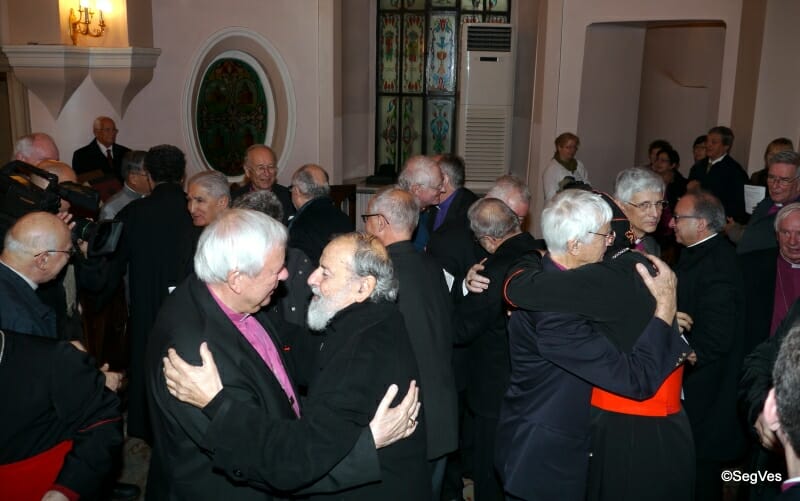
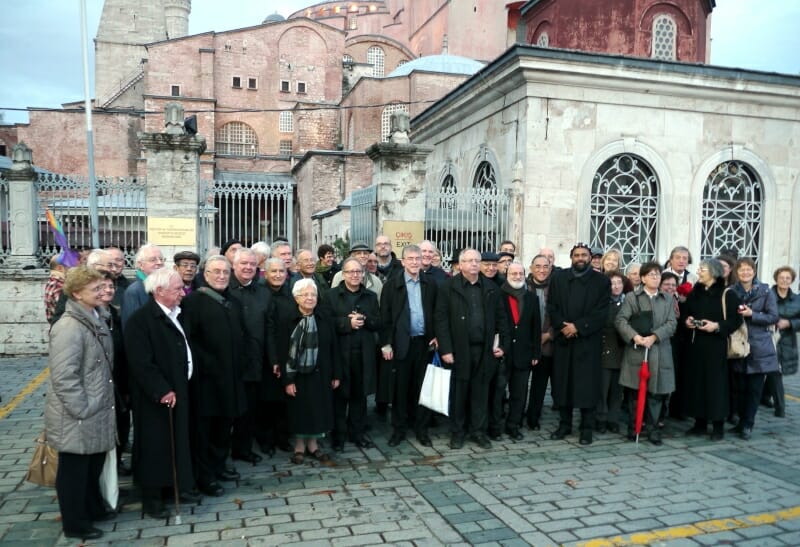
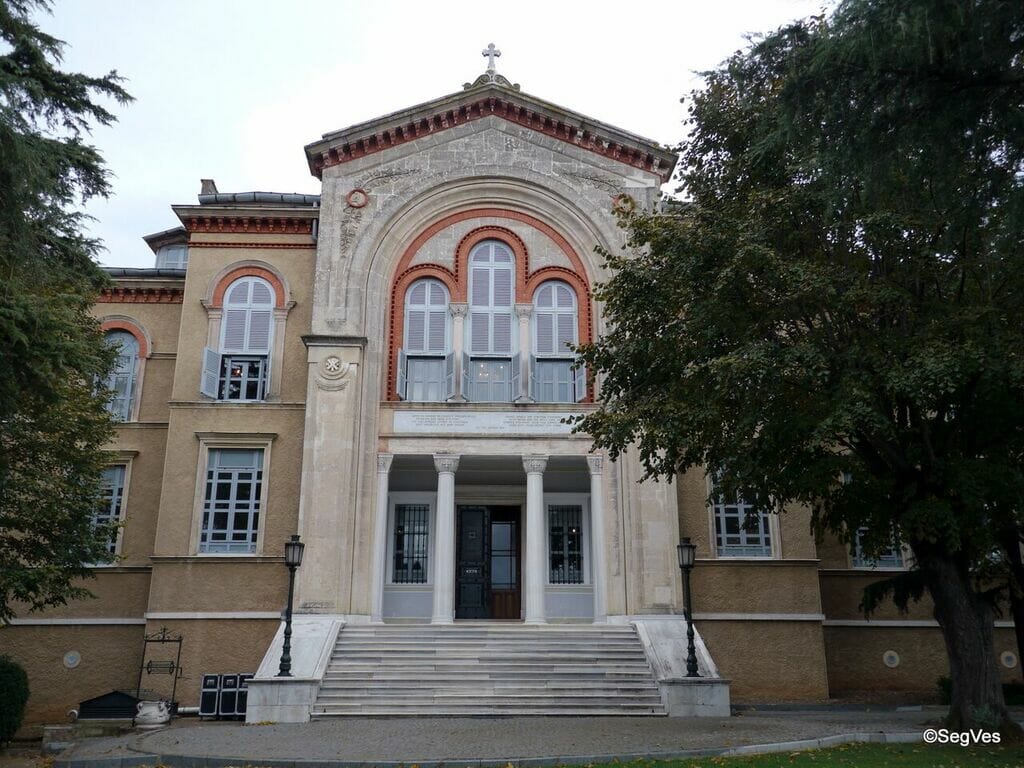 The first part of the Ecumenical Meeting of Bishop Friends of the Focolare concluded on November 27th in the Monastery of the Most Holy Trinity on Halki Island. Cardinal Francis Kriengsak evidenced how the unity amongst the different Christian Churches is at the service of the whole human family. “The diversity is a gift and a mutual enrichment,” he said “but that is possible only by listening without judgement, with the dialogue of life, with the sharing of experiences, with an acceptance that brings the different charisms into harmony.” The challenges and particularities of every church concerning pressing issues are contained in this mutual understanding.
 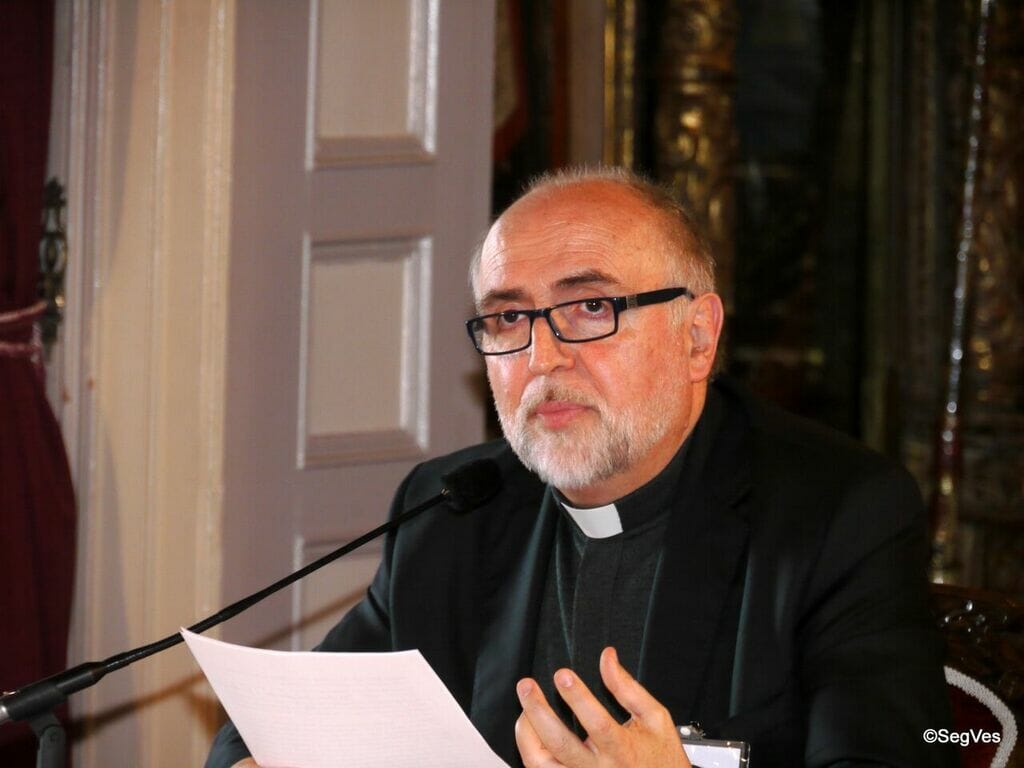 In the morning, Focolare co-president, Jesús Morán, identified several challenges of today’s world, including: globalisation, ultra-modernity, the advent of a piecemeal third world war; and he presented the answers that a culture of unity can give. Quoting from Bishop Klaus Hemmerle, who was a pioneer of the Meeting, he showed the necessity of a listening attitude in today’s world, “Teach me your thought,” Hemmerle would say, “so that I can learn my own proclamation again,” only in this way, claimed Morán, would it be possible to achieve an “inexcusable operation of purification from the religious incrustations” present in our churches. It is these that divide us; the world no longer allows us not only to be disunited, but not even to proclaim the message of Christ as we have up until now. After all, the first Christians did not proclaim a new religion, but a full life, the life they had found in Jesus.” In the dialogue that followed it was clear how deeply those words entered, and there was a strong desire to smooth the way for full and visible communion. Even though the world scene seems to point to the opposite, the co-president invited everyone to hope: “The world as it is today leads me to be more Christian because of this identification with Jesus crucified who permits me to live the deepest Trinitarian communion with my brothers and sisters.” The bishops learned the history of the Monastery of the Most Holy Trinity during their short visit. From 1844 it was a seminary for the formation of Greek Orthodox clergy until 1971 when the Turkey Constitutional Court decided that all private institutes of high education be included in the offer of free public education. The Seminary Council was opposed and the famous school of theology where theologians from around the world studied was closed. In 127 years of activity, 950 students graduated from this school; 330 became bishops; 12 were chosen to be Ecumenical Patriarchs; 2 were elected Patriarchs of Alessandria and 3 from Antioch were ordained priests. The current Abbot of the monastery, Metropolitan Elpidophoros Lambriniadis, gave a presentation titled: “The love of mercy and communion amongst Christians,” an interesting historical reading of the path of dialogue between the Church of the East and the West with a particular mentioning of the role played by Chiara Lubich, foundress of the Focolare, in the rapprochement of the two Churches.
  At the conclusion of the first part of the Meeting, the bishops embraced the appeal of Patriarch Bartholomew I, to pray that the School of Theology might be reopened. They also called for the return of the two bishops in Syria, who were kidnapped in April 2013: Greek Orthodox Bishop of Aleppo, Paul Yazigi, and Syro-Orthodox Archbishop Gregorios Yohanna Ibrahim, Bishop Friend of the Focolare and faithful participant at all their gatherings. Now the evening has come and rain is falling lightly on the island. The carts are rolling down the hills carrying a much lighter cargo: brother bishops who are committed to living mutual love so that the Risen Jesus can give his light to the world again. Compiled by: Adriana Avellaneda
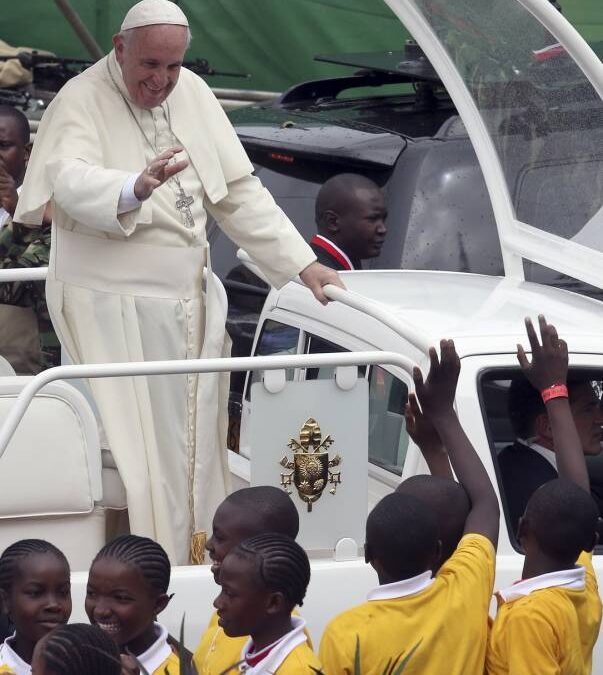
“Karibu Kenya Papa” (Wel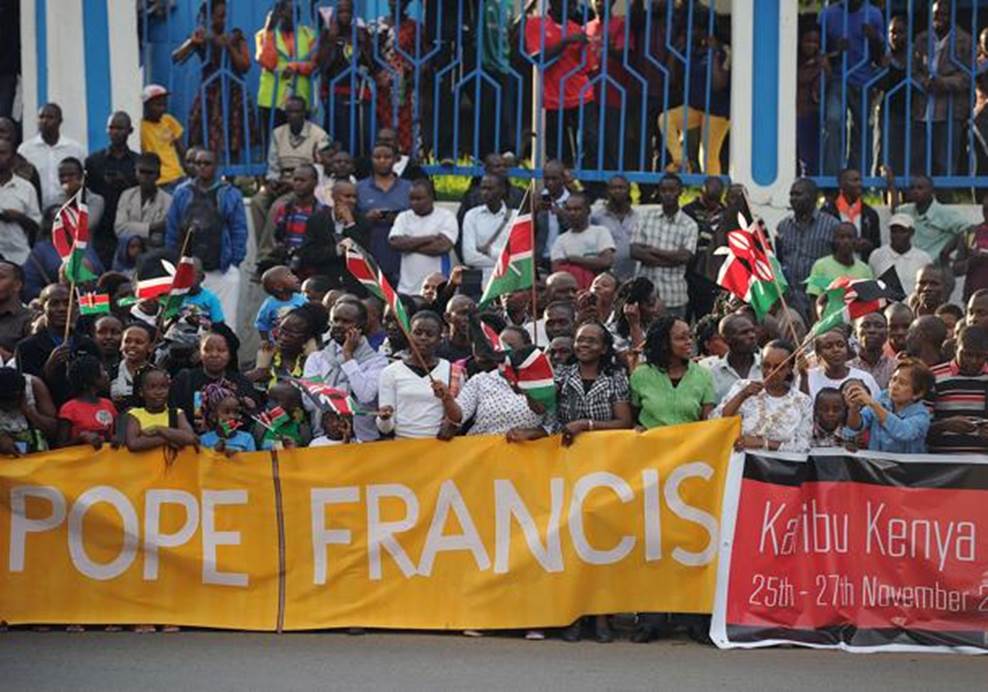 come to Kenya, Pope). Amid festive songs and dances, the Pope landed in Nairobi in the afternoon of 25 November for the first leg in Africa. From the airport and all the way to the city, two waves of crowds accompanied the papal automobile: a simple grey car. In his first greeting Francesco expressed his love for this “young and vigorous nation, a community enriched by diversity.” “Kenya has been blessed, not only with immense beauty in its mountains, rivers, lakes, forests, savannahs and semi-deserts, but also with an abundance of natural resources.” He went on to say: “In a world that continues to exploit instead of protecting our common home,” I hope that your values inspire “the endeavours of the government in promoting models of responsible economic development.” The papal agenda is full: the meeting with the clergy, to whom he gives three key words, weep, pray, and serve; and the session with the UN representatives of Nairobi, from whom he asked for a ”change of direction” so that economy and politics could be placed at the service of the person, in order to eradicate malaria and tuberculosis, be persistent in fighting against deforestation, and target fair trade and development which takes the poor into account. The meeting with the leaders of the various Churches and Muslim and Animist communities was highly significant, and where he affirmed that ecumenical and interreligious dialogue is not a luxury or an option. He then strongly stressed that phrase which echoed throughout the world: “The holy name of God must never be used to justify hatred and violence.”
 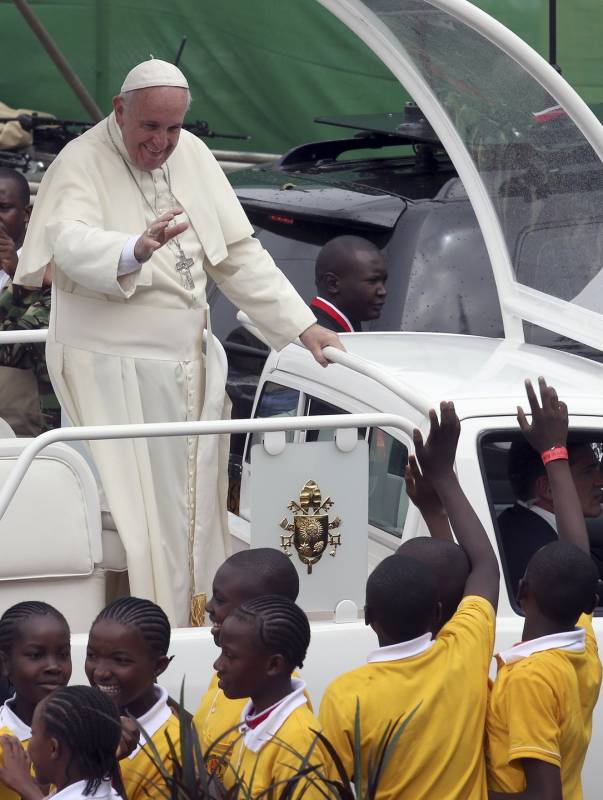 On the 27th, the last day in Nairobi, he went to Kangemi, a very poor shanty town where conditions of human and environmental downgrade have amassed, and which had specifically pushed him to denounce this situation of Kangemi before the UN. He was met there by 100,000 people who waited to welcome him with dances and songs. And Francis did not disappoint them: “I feel at home,” he said. “I share this moment with you brothers and sisters who have a special place in my life and in my choices. I feel your sufferings deeply. I know the pain you bear. How can we not denounce the injustice suffered?” Before leaving for Uganda, he met the youth in the Kasarani stadium to answer all their questions, such as: how to overcome tribalism, corruption, and enrolment of the youth. “Overcoming tribalism – he replied – is a daily task, a job for one’s ears in listening to the others, a task for the heart in opening it to the others, and a labour of the hand in reaching out towards one another.” He added that, “Corruption is something that creeps into our hearts like sugar which is sweet, pleasant, and easy to take, but then we end up in trouble.” And how can radicalisation be overcome? “The first thing we must do to prevent the enrolment of a young person is to offer education and employment.” Each of his meetings overflows with affection, closeness and love. And the people responded with gratitude, joy, and hope. Inculturation of the Gospel is one of the most important challenges in these lands and we must take into account the aspects perceived as values that pre-existed before Christianity: the vision of the family, the role of the clans, tribes, polygamy, and that of the Muslims, etc. It is a challenge which also the Focolare has faced ever since it came to Africa in the 1960s, and which it continues to sincerely undertake with the people of the place, in the spirit of reciprocity. A journey led Chiara Lubich in 1992 to found, precisely in Nairobi, a little town of witness, where specific inculturation courses are held. The next one will be held in May 2016, with the participation also of Maria Voce and Jesús Morán, President and Co-President, respectively. Watch video of the foundation of Mariapolis Piero
We are offered the possibility of meeting Jesus in our daily lives and among us. If we take it, we will experience a living Christmas. The words are spoken to me. The Lord is coming and I must be ready to welcome him. Every day I pray, ‘Come, Lord Jesus.’ And he replies, ‘Yes, I am coming soon’ (see Rev. 22:17, 20). He is standing at the door and knocking. He asks to come in (see Rev. 3:20). I cannot leave him outside my life. The invitation to welcome the Lord came from John the Baptist. It was directed to the Jewish people of his time. They were asked to confess their sins and be converted, changing their lives. He was certain that the coming of the Messiah was about to happen. Would the people, who had been waiting for him for centuries, recognize him, listen his words and follow him? John knew that to welcome him they had to get ready, hence his pressing invitation: ‘Prepare the way of the Lord, make his paths straight.’ These words are spoken to me because Jesus continues to come every day. Every day he knocks at my door and for me too, as for the Jews at the time of the Baptist, it is not easy to recognize him. So, contrary to what was commonly expected, he presented himself as a humble carpenter from Nazareth, an unimportant village. Today he presents himself under the guise of a migrant, someone with no work, an employer, a schoolmate, relatives, even of people who don’t always seem to shine with the face of the Lord, indeed where his face seems hidden. His subtle voice, which invites us to forgive, to give trust and friendship, to refuse to give in to choices against the Gospel, is often drowned out by other voices that incite us to hate, get our own back, become corrupt. This is the basis for the metaphor of tortuous and impenetrable paths that recall the obstacles hindering God’s coming into our everyday lives. It’s almost pointless to list the baseness, the egoism, the sin that dwells in our hearts and makes us blind to his presence and deaf to his voice. Each one of us, if we are sincere, knows what are the personal barriers obstructing our meeting with Jesus, with his word, with the persons with whom he identifies himself. Hence the invitation in the Word of Life that today is spoken directly to me: ‘Prepare the way of the Lord, make his paths straight.’ Correcting that judgement which makes me condemn the other person, ceasing to speak to them, so that instead I come to understand, to love and put myself at the other’s service. Correcting a twisted way of behaving that makes me betray a friendship, makes me violent, cheating civil law, and instead letting myself be converted into a person who is ready even to put up with injustice so as to be able to salvage a relationship, someone willing to pay in person the cost of encouraging fraternity in my neighbourhood. It is hard and a strong word, the one we have this month. But it is also a liberating word, one that can change my life, open me to meeting Jesus, so that he may come to live in me and it be he who acts and loves in me. This word, if it is lived, can do even more. It can give birth to Jesus among us, in the Christian community, in our families, in the groups where we are active. John spoke it to the whole of the people. And God came ‘and lived among us’ (Jn 1:14), in the midst of his people. For this reason we want, by helping one another to straighten the paths of our relationships, to wipe out any kind of distortion there may be between us, and so live out the mercy we are invited to have this year. Like this we will become, together, the home, the family, that is capable of welcoming God. It will be Christmas. Jesus will find an open highway and will be able to stay in our midst. Fabio Ciardi
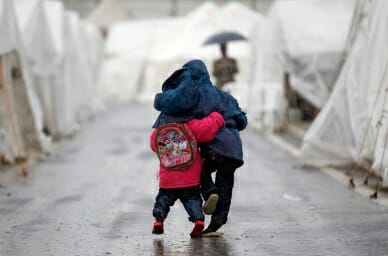
Photo: REUTERS/Murad Sezer
“While the mortar shells are falling near us, fear and worry assail us both for our lives and for the lives of those we know, Christians or Muslims, Syrians or foreigners: our common bond is our humanity, our being brothers and sisters. On the streets of Damascus we live and die together, without distinction.
The death toll of the bombing is tragic: 9 dead and 52 injured. Yet no one speaks of it. For now, Paris has the spotlight. But these are the statistics of the war on the other side of the Mediterranean, these are the statistics of today. I don’t want to intensify the horrifying nature of what is a normal daily reality for everyone. As soon as the din settles, because the noise of the bombs is deafening, I grab my cell phone and call my family and friends: “Are you ok? Where are you? Don’t move! Wait there… .” These are the recurring questions after every bombing or neighborhood shooting. We advise each other to remain where we temporarily found shelter and safety, and there we stay, not knowing where to go. The office, the kitchen, or the hall become shelters or tombs, depending on whether the bombs missed you or hit you. The questions in my head persist, like a mantra: ‘Is it normal to live with this anxiety? Is it normal that people have to live in fear, always? Why does the other side of the world keep silent? How long must this absurdity last? Is it possible that power, money, and profit can defeat the desire for peace common among peoples and communities?’ At the beginning of November, Aleppo remained 15 days without food or supplies, and all access roads were closed. The mines are another of the legacies left by this war. Each transit route must be de-mined before reopening it. A village near Homs was targeted by ISIS and there are about 3,000 displaced persons. The people want the war to end and are full of questions: ‘Who supplies the weapons to this cruel militia? Why do ammunition and explosives arrive, but no food?’ These questions lacerate us, while prayer becomes a balm, our rock. The Christian community seeks to live with a sense of normalcy, meeting for celebrations, working at many solidarity projects, but we are few. People depart inexorably, leaving a beloved homeland because they have no prospects and everything is costly, from medicines to food. But even those who leave want to return: their life is spared, but it isn’t the same as life in Syria, nor the same relationships, nor the same tastes, nor the same complicity. And yet we are not divided. We are scattered, but we continue to live together for the same peace.” Source: Città Nuova
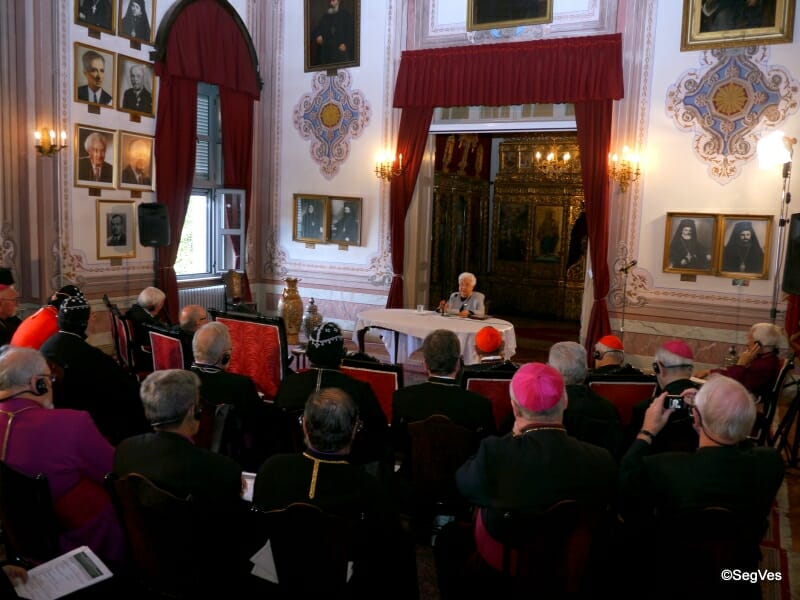
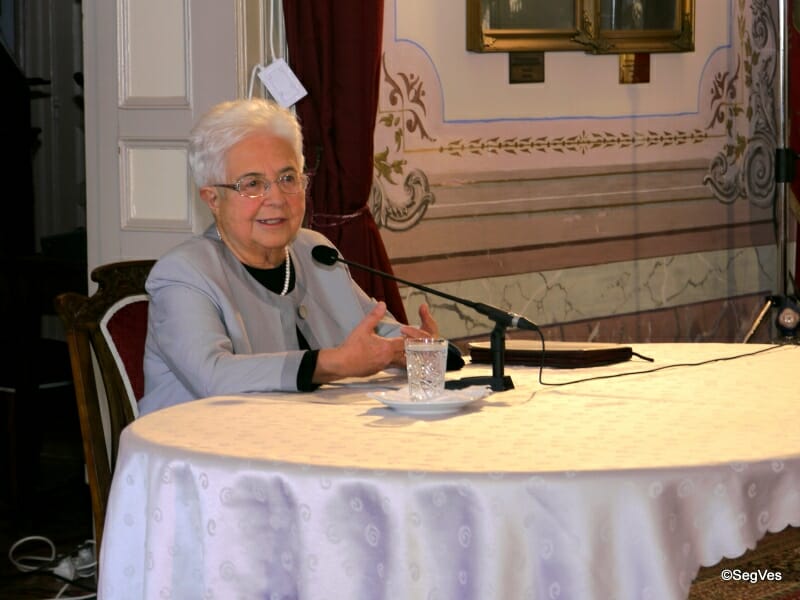 In the present context it may seem absurd or anachronistic to speak of unity. And yet the motivation which animates the bishops present at the Ecumenical Convention on the island of Heybeliada (Halki) is anything but a utopia. Their commitment to live reciprocal love among themselves and with their churches is already a vital testimony for anyone who has lost hope in dialogue and peace. On November 25th, Maria Voce spoke to the bishops about unity in her programmatic speech. Unity is not only a gift from on high, but also becomes an impelling commitment which, she assures us, allows us to “insert ourselves into the sacred history of humanity.” A sacred story in which Christians have an essential role. Unity becomes a response to the challenges of today. “In the face of powerlessness, which at times assails us even today,” she continues, “perhaps we need to take a single first step: to give ourselves to God as instruments in his hands, because he builds unity upon our nothingness. This is our first obligation, the first step we must take singularly and together.” With the dramatic social problems of today, many people, especially the young, feel the need to be visibly present next to those who suffer. But the Focolare Movement’s task does not finish here. One must understand that unity is an objective towards the goal of a united world. “We are called to unity with all, excluding no one,” stresses Maria Voce. Citing various excerpts by Chiara Lubich, she reveals to the bishops the way discovered by the Focolare foundress. “For us, the door which leads to unity is Jesus Crucified and Forsaken,” which “carried out the reunification of the human race with the Father and among men and women, and it is He, crucified and forsaken, the key to unity, which he will fulfill even today.” The task which the Focolare Movement poses is to bring the richness of unity to every corner of the world, to awaken life everywhere. “In the refugee camps, ” continues Maria Voce, “in the hospitals for the wounded by war, in the public demonstrations, in the queues of people looking for work and finding none, in the ports crowded with immigrants…everywhere, everywhere, God is asking us to light ever-greater flames.” In the subsequent dialogue several bishops related their actions in difficult situations, and the solidarity of the faithful of different churches wherever there is war and suffering. They have a strong certainty that the cross of Jesus is the common bond between them and will make lively communities blossom in the most unthinkable places. The program then took a particular look at the situation of the local churches in the Middle East, the role of Christians and their difficulties. Bishop Sahak Maşalyan, despite the complex situation of the Armenian Church in Turkey, spreads optimism, and asserts: “When Christians lose their sense of optimism, in the end they emigrate to some other place.” An appeal was also made by Bishop Simon Atallah, of the Maronite Church of Lebanon. He asked all to pray with fervor to end the war, so that Christians would not abandon their lands and could return to living in peace and harmony. At the end of the day Angela Caliaro e Carmine Donnici, representatives of the Movement, spoke about the development and the influence of the Focolare in the whole Middle Eastern area; a seed of hope which engages Christians, Muslims, and Jews and encourages them to continue on the road to reconciliation and peace. From correspondent Adriana Avellaneda
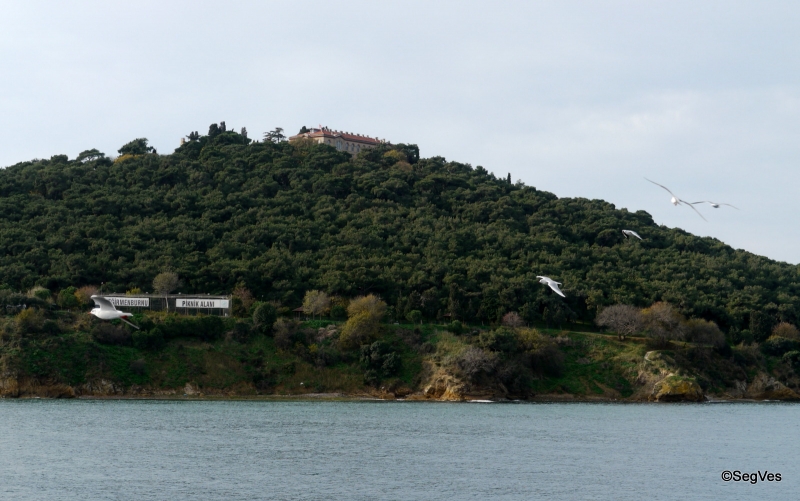 November 25th, 9 am. A light breeze blows over Heybeli Island, Halki, a small oasis of peace in the Marmara Sea near Istanbul. On the top of the island’s Hill of Hope stands the Orthodox Monastery Aya Triada (Most Holy Trinity) that is hosting this year’s 34th Meeting of Bishops from different Churches, promoted by the Focolare Movement. Founded in the 9th century, the Monastery was destroyed several times by earthquake and fire. The present construction from the 19th century is the site of a prestigious Greek Orthodox Theological Academy that contains a library with valuable ancient manuscripts and a total of 120,000 books. It was quite an unusual scene at the Monastery’s entrance: 35 bishops from 16 Churches and 19 countries in fraternal dialogue. The president and co-president of the Focolare Movement were also among them along with other members of the meeting. Ecumenical Patriarch Bartholomew I comes to the door: “I am happy at being together with you,” he says with simplicity and leads them into the Monastery. He would present the opening address of the Meeting: “Together for the common cause: the unity of the disciples of Christ in the diversity of gifts.”
 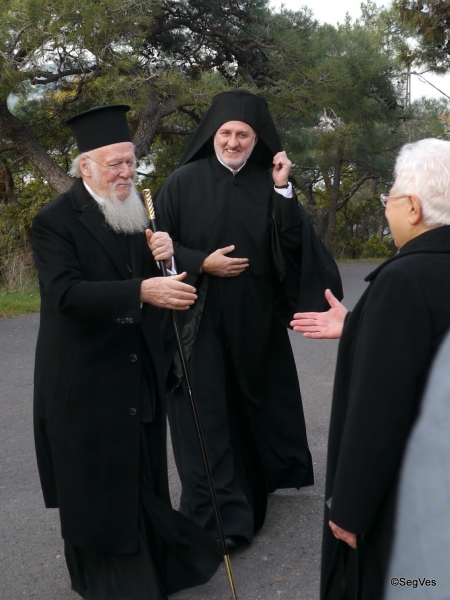 Cardinal Francis Kriengsak from Bangkok greets the Patriarch on behalf of all and thanks him for having wished to host this year’s Meeting. “Here we are in the heart of Orthodoxy with its ancient Churches and countless martyrs” he says as he introduces the members of the Meeting. The Anglican Primate, Archbishop of Canterbury, Justin Welby sent a message to the gathering: “I continue to consider the Focolare Movement as one of the beacons of hope in our divided world. With its commitment to unity through mutual respect and dialogue, it offers a characteristic path towards reconciliation beyond differences and enmities.” Bartholomew I recalls his recent visit to Loppiano for the honorary doctorate that was conferred upon him by Sophia University Institute. “An encounter,” he says “in which we experienced sincere love, without any ifs or buts. Then he speaks of the Meeting. “How can we manage to harmonise the diversity of charisms of our Churches today with the unity of the disciples of Christ and be typos (model) of unity for the world?” he asks. “Too many times the differences appear to be foundational elements and not charism and this is what we savour every day in the face of the difficulties which the human race lives out as exclusiveness and conflict”
 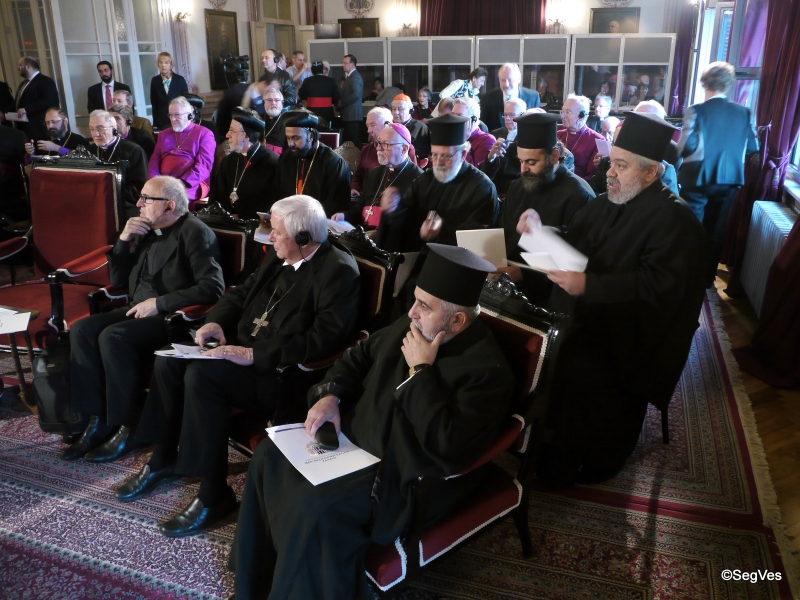 On a global landscape where discouragement, uncertainty and indifference prevail, especially in the recent days, The Patriarch looked to hope. As Christians, he emphasised: “we have to quickly recover the sense of unity as a recapitulation of the gifts [charisms],” the “wealth of the differences. . . to be offered and, in turn, received.” “The unity of the world, the respect for God’s Creation the gift of his love,” he explained, “will be given by the ability to welcome the experience of the other as an enrichment for all, as a path of unity, of respect and of reciprocity,” “free from every type of ideological, political and economic conditioning.” “I arrived here even more happy because I found you waiting for me. . . like a family,” said the Patriarch as he posed a challenge to the bishops and people entrusted to them: if as Christians we will have this experience, “we will truly be ‘salt of the earth’ and the world will begin a profound metamorphosis.” Compiled by: Adriana Avellaneda
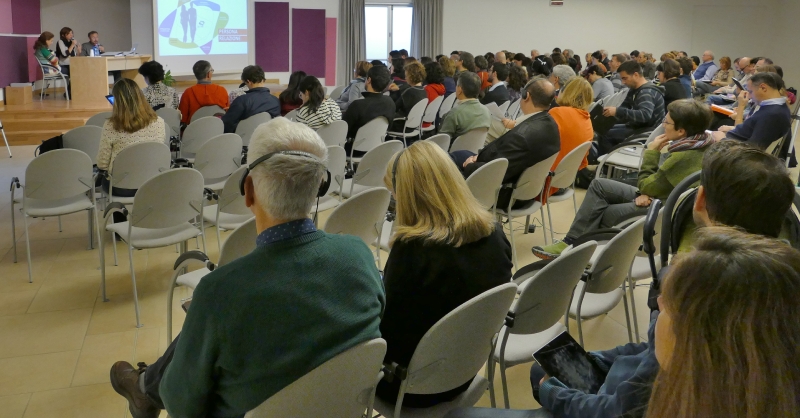
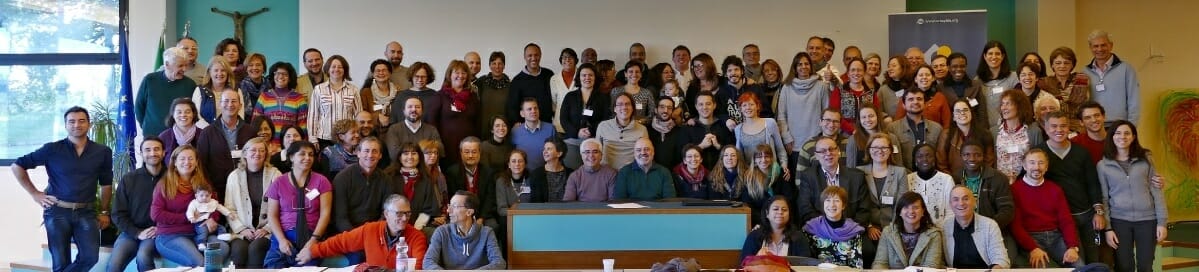 The launching of this innovative project took place recently with the first “train the tutor course”. The course gathered a hundred people at the Focolare town of Loppiano, Italy from a variety of fields: teachers, psychologists, medical doctors and youth directors from eight European countries, Brazil, Argentina, India, Burkina Faso and Cameroon. Many of them were parents or involved in child education. The prerequisite for acceptance into the course was that a man and a woman from the same region enroll together. The organisers suggested that it might be more beneficial if the topic of physical affection were presented to children and young adolescents by a man and a woman.
 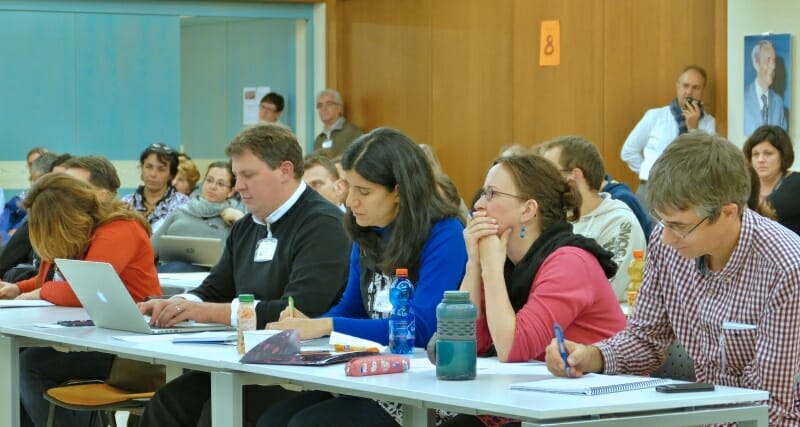 The project stems from cooperation between families, youth group leaders and experts from various fields within the framework of the Focolare, including scholars from Sophia University Institute, Loppiano. The purpose of the project is to provide a holistic program to adolescents, in which human sexuality is illuminated by a vision of the human person as someone in relationship, with his or her capacity to love and be loved, to give and to receive. The ones who are most pleased with the project are the parents who, in the face of the complexity of such topics, are feeling the need for updated tools. These were the assumptions that guided the group which came up with the content, phases and methodology of the course to create a moral conscience in the teenagers, which would help them to account for their choices and express them. The trained tutors will begin operating in January 2016. There are already children in their countries who with their parents’ consent, are already planning on attending Up2me. The course will include twelve classes for three age groups: 9-11; 12-14; 15-17. It will examine the many dimensions of the human person (corporal, emotional, intellectual, social, spiritual, historical environment); and the lessons will range from knowledge of the human body to the concept of the human person; from stereotyped images in publicity and the media, to sexual identity; from managing emotions to conflict with parents; from dangerous behaviours, to the influence of Internet. Age appropriate dynamics (role play, video clips, life experiences) will be utilised to discuss bigger topics relate to the transmission of life, contraception, abortion, pornography. This will hopefully help the children in their relationship with themselves and in the discovery of the plan for their lives. Meetings and opportunities for collaboration are also scheduled for parents. The course was tested by two pilot courses in Italy. The 2016 course will be a year-long experiment with the first group of children from other European countries. Meanwhile, experts from the continents of the world will translate and adapt the program to local needs. Based on that experience the course for tutors will be presented again so that Up2me can be taken to other regions of the world. Info: up2me@afnonlus.org
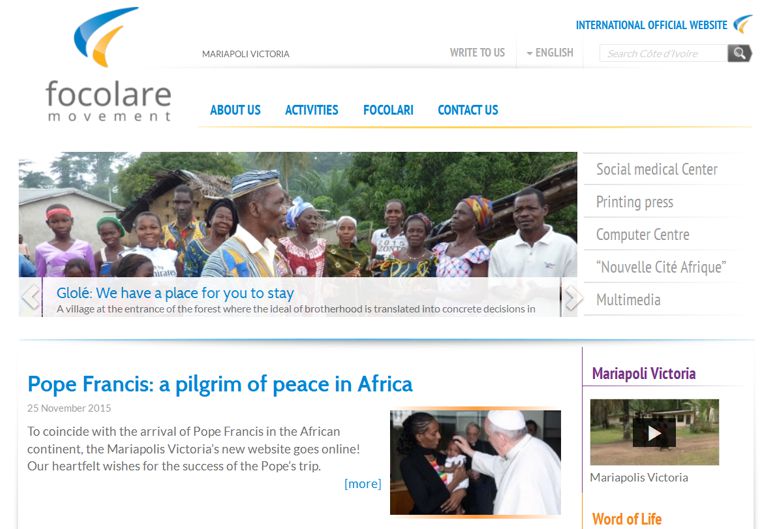 Today Pope Francis sets out on his first trip to Africa where he will be visiting Kenya and Uganda (English-speaking nations) and the Central African Republic (a French-speaking nation). It’s a particularly delicate and significant time in the Central African Republic due to it’s security situation being a country at war. “Mariapolis Victoria”, the Focolare’s little town located in the Ivory Coast, extends its best wishes for this trip and has timed the launching of its new website today to coincide with this meaningful journey of the Pope in Africa . Although West Africa is not on Pope Francis’ itinerary, we totally adhere to his message of brotherhood and peace. Many nations in West Africa, such as Mali, Niger and Nigeria, have suffered repeated attacks of terrorism. We sincerely hope that the presence of Pope Francis, which promotes dialogue, in particular interreligious dialogue, may open up pathways of fraternity in Africa. “Bon voyage” Pope Francis! Source : www.focolare.org/mariapolivictoria
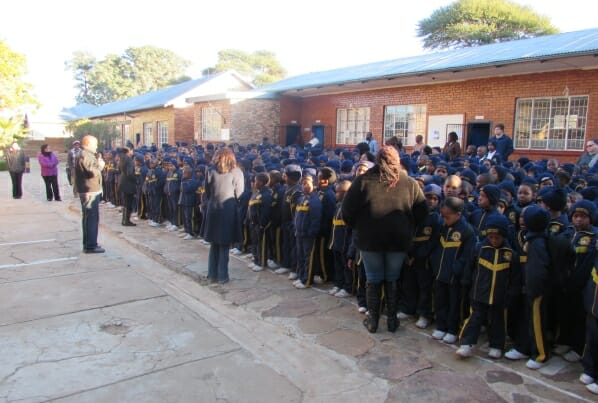
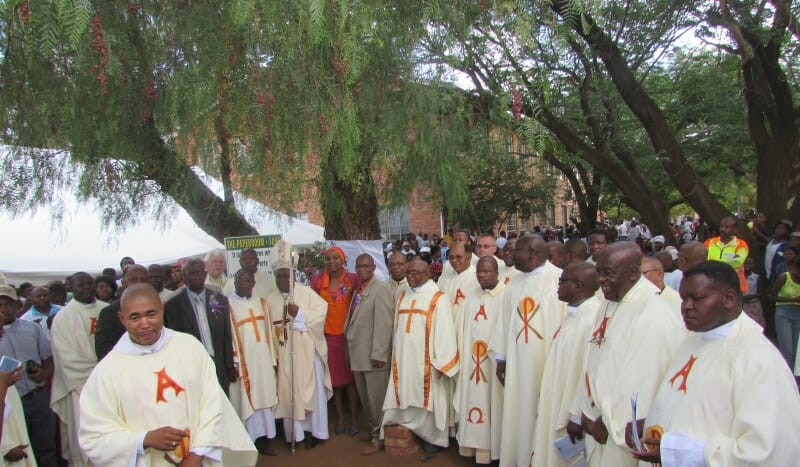 Taung forms a sole diocese with Kimberley, famous for its ancient and deactivated diamond mine. Visitors flock from all over the world to Kimberley to admire its Big Hole, the hollow that remained after the diggings, and where, surpassing the steep ravines, the bravest tourists can immerse in a really fantastic lake. But also Taung boasts its own primacy. In 1924, precisely there, the fossile of a child’s skull was found , and traced to 2.3 million years ago, a very important find for scholars and researchers, and was named the Taung Child. However, the 24 October feast was not only a geological-cultural one. Four thousand people from far-off towns and village reached Taung to celebrate the 120th anniversari of the arrival of the Catholic Church among the Tswana people of South Africa. The Prior of the Oblates and the local bishop were the honoured hosts. Also Bishop Klerksdorp and about fifty priests and religious were there. The Minister of Culture of the province represented the government. Also present was Kgosi, the traditional chief of the Tswana population – about 300,000 in all – living in the villages of Taung.
 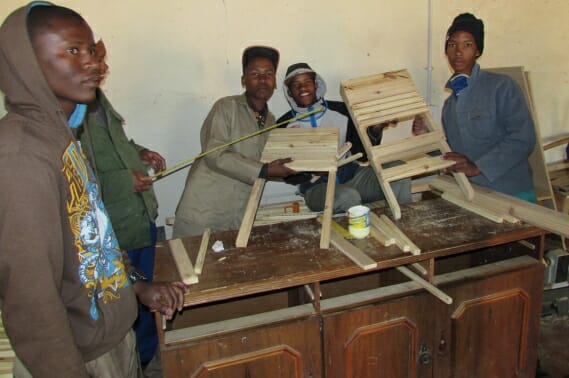 During the celebrations, great importance was given to the activities of the missions, especially those conducted by three members who live in the Focolare community: Dominic, from Cameroon, and Chris who is German and Moris from Kenya. Each of them play a key role in the mission. Dominic, who is a priest, acts as vice-parish priest. Given that he has been there for a short time, he is still learning the Tswana language, and so, during the sermon, is helped by Rapelang, father of a family who has embraced the spirituality of the Focolare and more than willingly acts as his interpreter, and often completes the sermons with his own experiences on living the Gospel. Chris has been entrusted with the two-year professional school and which certifies yearly about thirty young and promising carpenters. These are young people who had to leave for various reasons the public school, and are offered a second chance to learn a trade. Moris is the dean of the primary school with 550 students. It is really impressive to see, in the morning, this throng of kids and children line up for inspection, which is performed by the assigned students themselves every time, to check the hygiene and uniform of the students. Besides a professional education the school also offers a spiritual and moral education for their personal lives. Its innovative programme and teaching style, centred on authentic values, has earned the school its reputation as a school of excellence. It is attended not only by the children of Catholic families but also of Protestants (who represent about 30% of the entire South African population) and among whom ecumenical dialogue is always open and constructive. The Catholic Mission schools, across the 100 years of activities have formed men and women of great human and professional stature, who have played key roles in society.
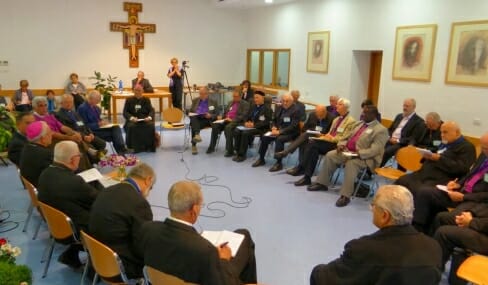
The 34th Conference of Bishops of different Churches, promoted by the Focolare Movement, will start on 25 November 2015. It will be held on the island of Heybeliada (Halki), in the sea of Marmara, near Istanbul. The 150 participants, from 9 different countries, will be hosted in the Monastery on this island, which was once the seat of the prestigious Greek-Orthodox theological Academy of Halki. The 50 participants, from 19 countries, are much awaited by His Holiness Bartholomew I, who during a recent interview, in the wake of the Honoris Causa doctorate in the Culture of Unity conferred upon him by the Sophia University Institute, affirmed that: “At Halki we will together remember Chiara Lubich and pray for the repose of her soul. We will be able to express our commitment to work for the unity of Churches. We, the Church of Constantinople are pleased to welcome these cardinals and bishops, and we are ready to exchange our experiences and give one another the kiss of peace between the East and the West”. “Together for our common home” will be the theme of this conference, which will focus on unity, as a service to the human family, through a diversity of gifts. The main speakers will be Patriarch Bartholomew I and Maria Voce, while Cardinal Francis Kriengsak, Archbishop of Bangkok will be the moderator of the conference. Various bishops from different Churches will share their reflections; among them, the Anglican Bishop Robin Smith; Åke Bonnier, Lutheran Bishop of the Swedish Church; the Catholic Bishop Brendan Leahy, Bishop Sahak Mashalyan of the Armenian Apostolic Church and the Metropolitan Elpidophoros of Halki. Jesús Morán, the co-president of the Focolare Movement will offer his reflection on “The Charism of Unity and the challenges of today’s humanity”. Gerhard Pross, an Evangelical from YMCA, Germany will speak about “Achievements and experiences on the road to unity” in the name of “Together for Europe”, the ecumenical network of movements and communities. Cardinal Kurt Koch, who will lead a Holy See delegation to Istanbul for St. Andrew’s feast, will also speak during the Conference. His talk will be about “Pope Francis and the cause of Christian Unity”. In a church of Armenian Apostolic tradition of ancient Chalcedon, the seat of the Chalcedonian Ecumenical Council of 451, the bishops will once again formulate a pact of reciprocal love, thus renewing the mutual relationship of charity that goes beyond all divisions and answers Jesus’s invitation: “Love one another as I have loved you” (Jn 15:12). In this particular context, this invitation implies the reciprocal promise “to love the Church of the other as one’s own”. The bishops are invited by Patriarch Bartholomew to participate in the celebrations at the Phanar on the 29 and 30 November on the occasion of the feast of St. Andrew, Patron of the Patriarchate of Constantinople. These meetings for bishops of different Churches, promoted by the Focolare Movement, are held annually. These meetings have been taking place since 1982, and they owe their beginning to a suggestion made by Pope John Paul II to a group of Catholic bishops, friends of the Focolare Movement, when he invited them to share their experience of “effective and affective” communion even with bishops of other churches. Promoted by Klaus Hemmerle, who was then bishop of Aaachen, Germany, and after his death by Miloslav Vlk, Cardinal of Prague, these meetings aim at offering vital spaces of communion and fraternal sharing in the light of the spirituality of unity. The venue for these meetings changes; they are held in places that are meaningful to the various Christian denominations. In 2016 the meeting will be held in Ottmaring (Augsburg – Germany).
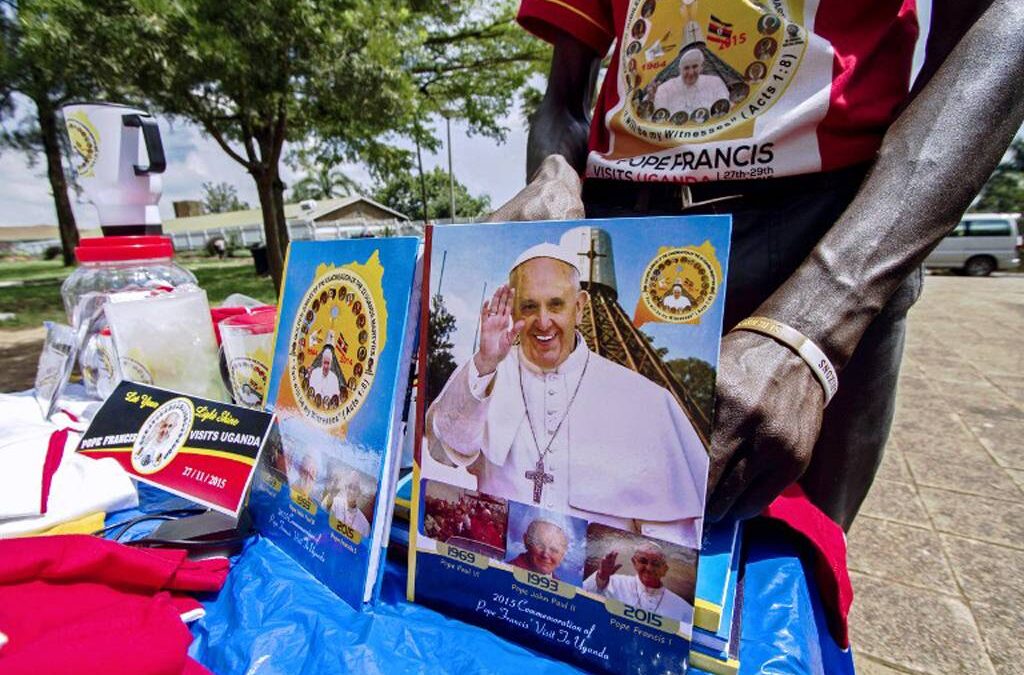
 «The key perspective of this trip will be revealed in the programme and activities the Pope will undertake,» says Liliane Mugombozi, director of New City, the magazine of the Focolare Movement in Kenya. Through her we will trace the steps of a journey which is revealing to be very important. «Pope Francis chose three countries where there are big Catholic communities afflicted by various tensions which he wishes to share as the pastor of the people, and together write a new page in the history of Africa today within a global framework and walk in search of solutions to the biggest problems and concerns of the population.» And what are the expectations? «We want his message to resound in all sectors of life, from governance to the management of goods, and from politics to education, healthcare, dialogue and interreligious relationships …». And to those who object because Pope Francis knows very little of Africa, the Archbishop of Kinshasa in the Democratic Republic of Congo, Cardinal Monsengwo replied: «This is true. But the really fantastic thing is that he goes where people suffer. If it wasn’t for the Ebola outbreak, he would have come to Africa a long time ago.» Since last 19 October when the Vatican confirmed the date of the journey, innumerable analyses accompanied this announcement: «In Kenya – Lili Mugombozi wrote – the battle against Al-shabab, responsible for the violent attacks over the last few years, is one of the biggest political challenges. Mons. Rotich, president of the secretariat in charge of the visit affirmed: «During our ad limina visit in Rome, he questioned us about the massacre in Garissa and he said that he would come to comfort the Kenyan people.» In Uganda, Pope Francis will visit the Anglican and Catholic sanctuaries to honour the memory of the young martyrs: 23 Anglicans and 22 Catholics who were killed because of their faith. «For many Uganda people – Liliane explained further – Francis’s gesture is a joyful revival of the past – when in 1969 – Paul VI, the first Pope to ever set foot on African soil, canonized the first African Saints – but it is also a new commitment to dialogue with the churches.» The Focolare in Uganda wrote: «On this anniversary we feel particularly called to live the sanctity of the people.»
  In the Central African Republic, in a tense political context which suscitates anxiety, «in order to manifest to this nation how much the Church feels and shares its afflictions, and urge all central Africans to always be testimonials of mercy and reconciliation,» on 29 November, Francis will open the holy door of the cathedral of Bangui, symbolically anticipating the start of the Jubilee Year of Mercy, and will give a very strong sign of this with his speech in the central Mosque. «In each of these countries – the New City director continued – the Pope will meet the heads of State, speak to the diplomatic corps, celebrate a public Mass where thousands of faithful will be expected, and hold various meetings with religious leaders and thousands of young people. And the poor, those who suffer will not be excluded from the meetings with him: he will meet the inhabitants of the slums of Kangemi at the outskirts of Nairobi, and the disabled in a nursing home in Nalukolongo in the Kampala district in Uganda, and in one of the refugee camps in the Central African Republic.» Also the members of the Focolare Movement will accompany the Pope’s journey to Africa with their prayers and concrete preparations. In Kenya they will be in various places: among the 10,000 volunteers of the security guards and in the delegations of universities, schools and parishes. A young woman, Mary Mutungi, will direct the choir of 600 university students during the Mass with the youth. Among the songs in the programme is also, “We can find a way to live in Peace,” written by a Filipino band on the occasion of the Genfest. In Uganda, the members of the Focolare are involved in the various preparations in the parishes. Some are in charge of the coordination activities for the Diocese. Another citizen of the Republic of Central Africa, Geneviève Sanzè, of the International Centre and a member of the Pontifical Council for the Laity, will participate in the last stage of the papal visit. Fidelia from Bangui, affirmed: «Our people so deeply hope that the Pope’s visit will help us to accomplish a deep conversion, and be predisposed towards reconciliation for an enduring peace.» Video message of the Holy Father at the Vigil of the journey to Kenya and Uganda
“For I consider that the sufferings of this present time are not worth comparing with the glory that is to be revealed to us. For the creation waits with eager longing for the revealing of the sons of God.” [Letter of St Paul to the Romans, 8] There are many wars being fought on our planet, in our cities, in our neighbourhoods. The weapons are many and varied, but all of them produce only dead or wounded people and destruction. The millennia pass, but a brother continues to repeat to his brother “we go to the fields.” But whenever we start building peace again after conflicts, Abel returns to life, Adam walks again with Elohim in the garden of the earth, we can look “eye to eye” at each other in full reciprocity and with absolute gratuitousness. Every time we build and rebuild peace, our action also extends to creation, nature, the earth. And when we stop being its “keepers” (guardians) and deny peace, then the earth, animals, plants are injured, killed, humiliated, dragged into the vortex of our violence innocently. We see this more and more clearly every day. Peace, shalom, is a great biblical word. It is among the most common, severe and exacting ones. The first covenant of Elohim with men comes to restore an original peace-happiness that was denied, in order to regenerate the primordial shalom betrayed by Cain’s sin and by those of his equally atrocious children. It took a first peacemaker, Noah, for the rainbow to shine again over the earth, to make the re-creation of the world and of men possible. Peacemakers are always builders of arks to save a failed humanity. They are righteous men who feel a call to leave their land to save the land of all. If the world still lives despite all the evil that we generate, it is because Noah has never stopped building arks. The prophets and the many “blessed ones” in history have kept the rainbow in the sky by never stopping to build peace on a ground that has always been bathed by the blood of brothers. Noah’s hand and that of the boat builders of peace has until now been far stronger and more creative than the hands of Cain and the owners of warships. Peacemakers are not promised the earth, or the vision of God, or mercy. They are promised only a name: “They shall be called sons of God.” It is, however, an immense name, the biggest of all, and only used for them. Peacemakers are conciliators, those who reunite broken relationships, those who spend their lives solving the conflicts generated by others. They leave their own peaceful life behind in order to make other people’s lives more peaceful. Peacemakers, the builders of this biblical shalom, become what they are by vocation only. It is not just a matter of generosity or altruism. One can dedicate one’ own life for the shalom of others and of all only if a strong voice calls them to do so from deep inside. Building peace is never just a job, even when the construction and reconstruction of peace is part of our job. These voices, these calls within cannot be resisted: they are highly effective. And we cannot resist even when we do not know by whom and where the voice that calls us comes from: to be peacemakers it is enough to hear and respond to it (Read more). by Luigino Bruni
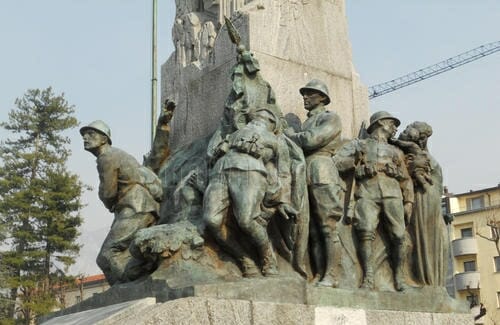
“You have heard that it was said, ‘Love your friends and hate your enemies.’ “But now I tell you: love your enemies and pray for those who persecute you, so that you may become the children of your Father in heaven” (Mt 5:43-48). This precept contains an untiring pardon that continually restores the circle of life that flows between two points: God, Me, Brother. It brings a work of peace with a view to unity wherever it has been interrupted. Peace is made with enemies, not friends. This would appear obvious, but usually it is misunderstood in a fear that makes you fear war and fear peace. While love unites, fear heaps together. One is centrifugal and generates the community by removing the roadblocks and limits; the other is centripetal and predetermines the occlusion of the communicating vessels. One illumines, the other darkens. One is a regime of freedom, the other a terrifying tyranny. Where there is love you deal in reason; where there is fear you do not understand reasons, you act instinctively: see ghosts and shoot. Social organisations that prescind the law of charity no longer see brothers and sisters, but mammals to be exploited and killed, even worse than some ancient societies were towards slaves. Where charity is lacking, people must be held by the police and enclosed in concentration camps. . . Jesus comes to put man on his feet, in freedom; and his followers should continue to apply the strength of his ideas, continually finding solutions for man in God. If not existence will unfold as a deadly search through a strenuous construction of hateful motives: a progressive hypothermia that gives the illusion of a vital process. Love drives out fear. Those who love are unafraid: their Self – the possible subject of fear – no longer exists. The Other exists, the Other with whom our Self has identified The Other dressed as a brother, is Jesus. In this way, especially now, the greatest barrier of all is removed: fear. Under the influence of fear the Self fears that it is alone: alone in the darkness, boxed in, in a box that soon resembles the walls of a tomb. If you step out of that solitude, you are free. You encounter the brother and with him place yourself in God. (Igino Giordani, Il fratello, (Rome: Città Nuova, 2011 [1954]), p. 85 – 87.
https://vimeo.com/140815700 Copyright 2015 © CSC Audiovisivi – All rights reserved
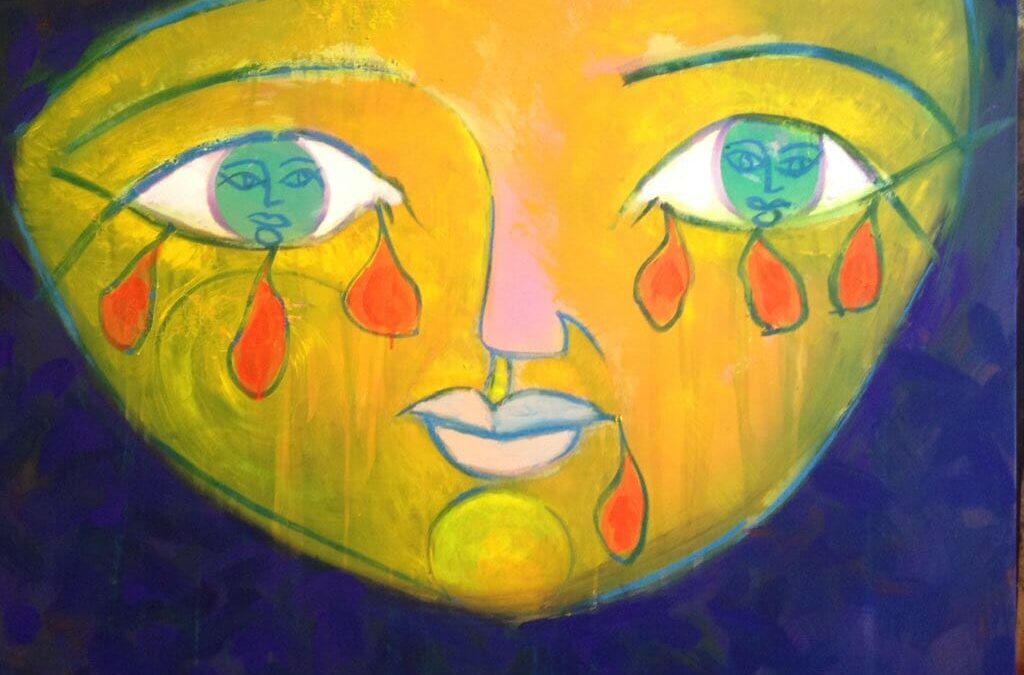
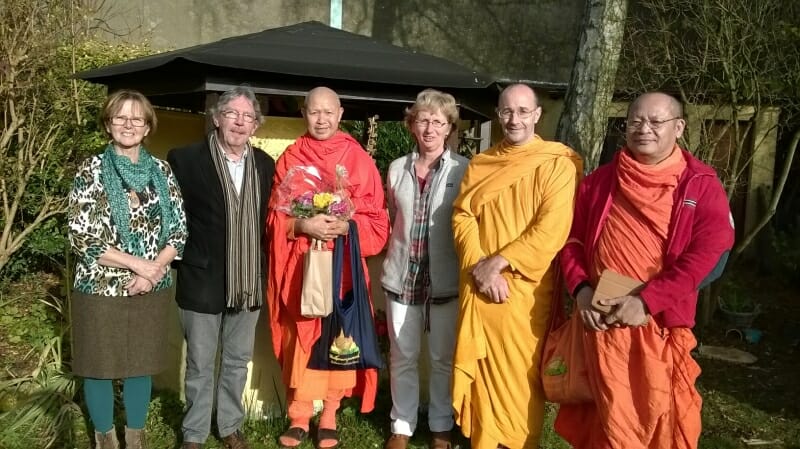 In the face of the dramatic events that took place in Paris and in many other parts of the world, “the Focolare Movement, while it weeps with those who weep, continues to believe in the path of dialogue, of acceptance and of respect for the other, whoever that may be and from whatever provenance, religious belief, and ethnicity,” Focolare president Maria Voce stated on the day after the attacks in the French capital. The Focolare, together with those with different responsibilities who work for peace even at personal risk, renews its commitment to intensify and multiply acts and gestures of reconciliation, spaces for dialogue and communion, opportunities for encounter and sharing at all levels and in all parts of the world to embrace the cry of humanity and transform it into new hope.”
  A variety of personal and collective initiatives are currently underway. In France, there was the woman from Paris who paid a visit to a Moroccan store owner and to an Algerian pharmacist to renew their friendship; the couple from Vendée who support local associations that welcome immigrants, involved in the Islamic-Christian Friends Group (GAIC) in Mulhouse; in Alsace, which has intensified its involvement in the Interreligious Week that is taking place in November; a parish priest from the Paris suburb, who wrote a common declaration of peace with Muslims from his quarter; the active participation in the interreligious festival Vivre ensemble à Cannes that was awarded the Chiara Lubich Fraternity Prize; the shared organizing of the 2cnd edition of “Muslims and Christians together with Mary” planned for April 2, 2016 at the Basilica of Longpont, Essone. In Italy, everyone is being invited to get out and meet the Muslim world that lives on Italian soil, striving to build bridges, to create relationships, to work together in concrete projects for peace. In some cities these relationships have been in place for quite a while and have already borne the fruits of brotherhood.
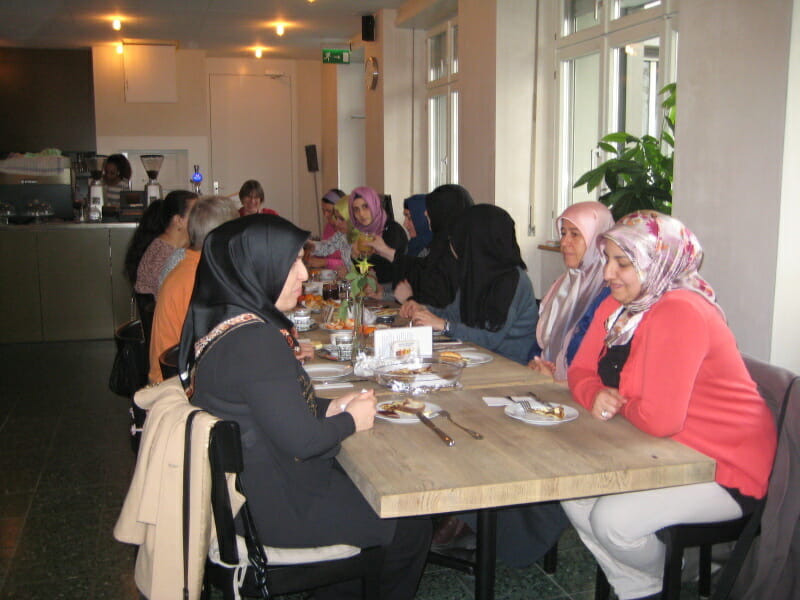
 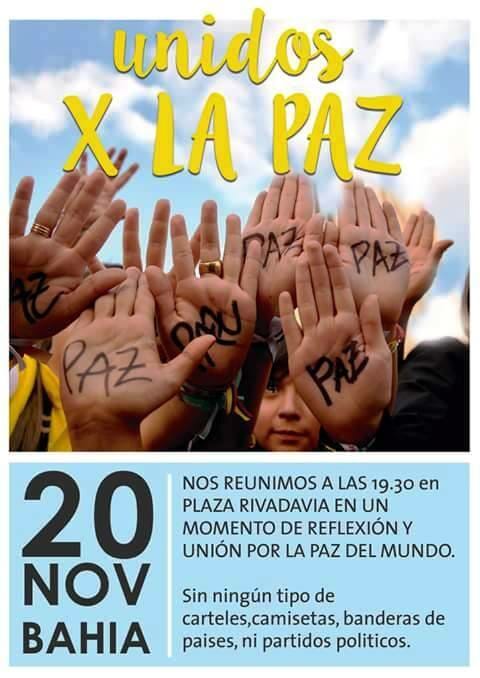 In Great Britain a prayer chain was begun for the victims of the tragedy, asking God to make them “instruments for bringing unity into their local environments.” In Ireland an evening event was held to acquaint people with the Syrian culture in view of welcoming the refugees. In Switzerland Muslim and Christian women meet every two months to share their faith. In Lugano there was an intense sharing with Imam Samir Jelassi. In Meiningen, Austria, a few days before the attack, 150 people gathered with Cenap Aydin, Director of the Tevere Institute in Rome, Italy, and Dr. Siebenrock from the University of Innsbruck, from a study group of Muslim theologians from Iran, Tunisia, Algeria and Turkey, and with Catholic theologians. In Augsburg, Germany, there was the “7 On the Dot – Augsburg Prays For Peace,” every evening at seven o’clock in one of the largest churches in the city – once in the Catholic church, once in the Lutheran church. One refugee, one expert or representative from an NGO would describe the situation of a country under siege. There was also a peace march in Loppiano, Italy and a public rally in Bahia Blanca Square in Argentina without national flags or party banners. In California a benefit dinner was held to gather funds in support of refugees, preceded by a moment of prayer for the victims of the terrorist attacks in Paris and Beirut, and a presentation of the United World Project. On November 14th in Honduras there was a peace march organized by the Focolare Movement in solidarity with Syria which gathered people from several youth movements with a message of unity and dialogue. Luigi Butori writes from Asia: “I think of the dead from the daily attacks in southern Thailand, of the Rohingya refugees. I think of the Muslim friends at the mosque in Chiang Mai. I think of Mae Sot where refugees continue to arrive from Myanmar in search of a better life.”
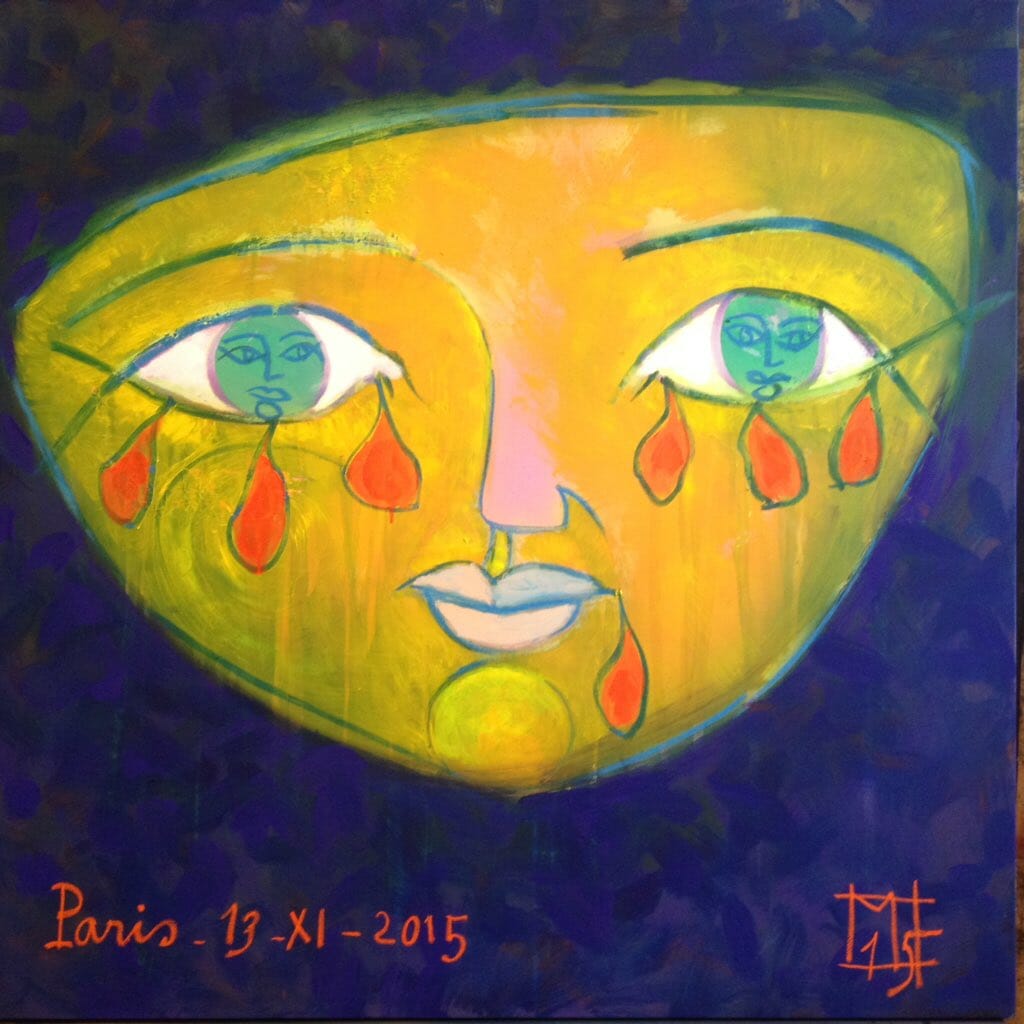
“Dieu pleure avec nous” © Michel Pochet
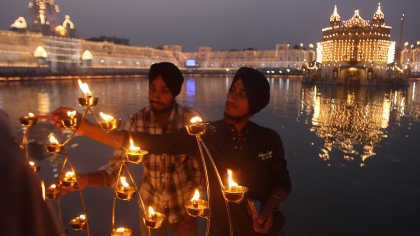
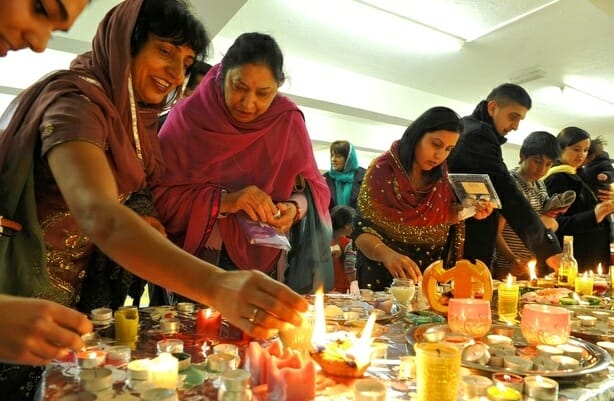 During the Ashwayuja month, which usually falls between October and November, India is clothed in celebration and light. It’s Diwali, a tradition that goes back to the ancient legend of King Rama who after 14 years of exile in the forest, returned to the city of Ayodhya where he was welcomed by a parade (avali) of lights (dipa) in his honour. Hence the name: Dipawali or Diwali.This year it was celebrated during 10-15 November. The festivities begin with a good house cleaning while many small lamps are positioned in several points of the dwelling – entrances, window sills, lounges – and in the darkness of the night the whole city is transformed into a dreamlike fairyland scene. The light symbolises knowledge and inner awareness. But like a kaleidoscope, the meanings intersect and are magnified: knowledge conquers ignorance; interiority brings peace. Good conquers evil; light triumphs over shadows of darkness, and it unleashes the life force. People look forward to the feast all year. On the third day – the actual Diwali – people put on new clothes, adorn themselves with wreathes of flowers and glittering jewelry. They exchange gifts with relatives and friends, especially sweets and homemade snacks. Everyone attends the religious services in honour of Laskshmi, the goddess of wellbeing. In an atmosphere of peace, they carry leaves, coins and religious images, chanting Vedic mantras to receive her blessing. Then there are the games: cards, especially rummy, mimes, dances, treasure hunts and fireworks. Diwali is not only a Hindu feast. It is a cultural and social event that involves the whole country, with some variations depending on the region and its dominant religion. It is celebrated by Muslims, Buddhists and Christians. For five days the Focolare houses in Mumbai, New Delhi, Bangalore, Goa and the 13 educational centres that are connected to them, are covered in light. The centres serve 1,500 children and teenagers, most of them Hindu who, thanks to financial support from a distance are provided with an education, a daily hot meal and health care (www.afnonlus.org). The Diwali rituals reveal the great sensitivity of the Indian people the way it values the family, friendship, harmony of life and respect for the natural environment. It is significant that for Diwali, you buy impersonal objects, but you give gifts that have been made by your own hands. It is also significant that along with prayers, fruits of the earth are offered as an expression of gratitude towards Nature and its gifts. This custom is echoed in Pope Francis’s Encyclical Laudato si’. It was precisely that document and the inseparable link between living in harmony with creation and with others, that inspired the Pontifical Council for Interreligious Dialogue to send the Deepavali Message from Pope Francis to the nearly billion followers of the Sanatan Dhama (what Westerners call Hinduism). Pope Francis’s Message shares the wish that: “we Hindus and Christians, together with people of all religious traditions and good will, always foster a culture which promotes human ecology.” The Message also expresses a wish that “together, we consciously give ourselves to protecting nature, defending the poor, and building networks of respect and fraternity” (Laudato Si, 201). This will anticipate “the growth of the tree of peace” for those who wish to prepare themselves well for the feast of Christmas.
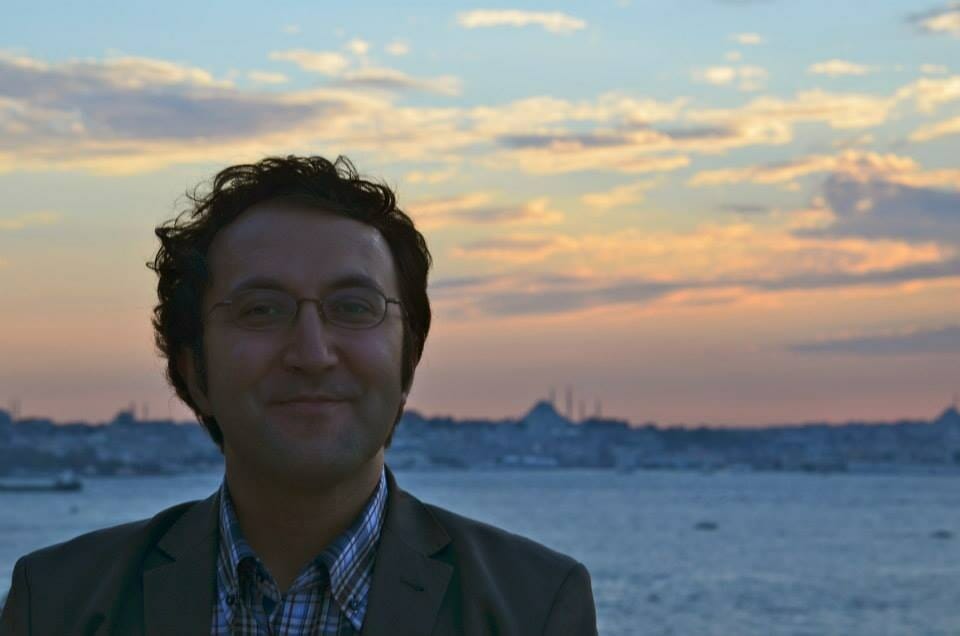
“The tragic news of the horrendous terrorist attacks in the French capital has filled us with profound sorrow. Our thoughts, solidarity and prayers go to the victims, the wounded and their families, to their loved ones and to the French people.” With these words of condolence, Mustafa Cenap Aydin, director of the Tevere Centre for Dialogue in Rome expressed his dismay over recent terrorist attacks in France. He went on: “I unite myself to the message of the learned Muslim scholar, writer and educational activist M. Fethullah Gülen: ‘Every terrorist act from whomever it comes, is a heavy blow to the peace and tranquility of all humanity. These vile acts of terrorism are attacks not only against the French people, but also against the universal values of human brotherhood’.” “We will never grow tired of condemning all those who feed violence, hatred and fear by reproachfully abusing a religion, an ideology, for cruel and inhuman goals.” Gülen, who inspires millions with his message of love and compassion, invites everyone to join him in prayer that God would lead “all of humanity to a world of peace and tranquility” and “to act in solidarity against every form of terrorism; to become involved in the realisation of universal peace”. “We shall respond to these ‘inhuman‘ acts,” Mustafa Cenap Aydin concluded, “by reinforcing even more the spirit of unity and brotherhood. These attacks cannot but convince us even more of the importance of dialogue, conciliation and brotherhood; and to increase our commitment to spreading it. We are obviously convinced that peace will prevail. Let us call upon and appeal to one and all, to unite with us in this effort.” Source: Città Nuova in Italian
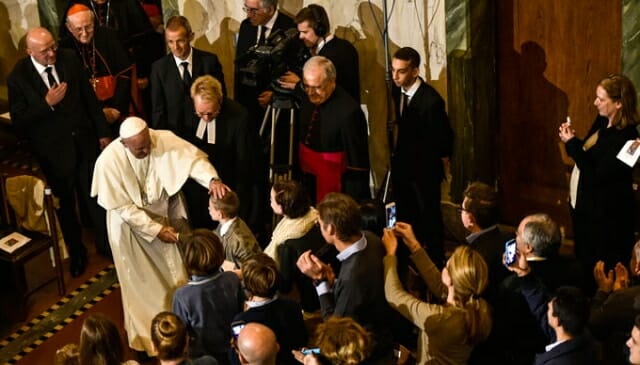
 Home of Lutherans in Rome, the Christ Church welcomed Pope Francis on Sunday, November 15. Before Francis, John Paul II was the first Pontiff to enter a Lutheran Church and, in 2010, Benedict XVI was the second. “Our 500-member community is relatively small, all of us on the front lines in the field of ecumenism. We are active as a parish at various levels in the cit, but also in our own family, with colleagues at work, with neighbours or, like me someone who has lived in a Focolare community for more than thirty years,” says Heike Vesper. She was there on Sunday along with Catholic women focolarini who often accompany her to the Sunday liturgy. Heike called the Bishop of Rome an “evangelical Pope”, a pastor who focused his remarks that day on our common witness to Jesus Christ, “both in Lutheran expressions and in Roman Catholic expressions” on the importance of life and not so much interpretation. He spoke from his heart as he confided to us what he likes: to visit the sick and the incarcerated. The meeting and the prayer service with the Pope was new in its kind, you could say that it was a lesson on what should be of importance among Christians of different Churches: dialogue and deep listening, mutual trust, sincere and truthful answers, common prayer and listening to the Gospel.” Jens-Martin Kruse, Pastor of the Evanglical Lutheran Church, gave a warm welcome while remembering the victims of the Paris attacks: “Let us trust that Jesus has conquered the world and therefore not allow ourselves to be conditioned by fear.” “My brother Pastor mentioned the tragic events in Paris,” the Pope remarked. “Even God’s name is being used to close hearts.” “Pope Francis’s freedom and sincerity was very touching,” writes Heike. “He gave his answers from the perspective of a fellow pilgrim on the same road as the listeners. He stressed the importance of following one’s conscience, of living for the neighbour; and that with faith, that is with love, all the walls will crumble.” The fraternal tone of the dialogue created a family atmosphere that was “more and more deep and encouraging.” Three questions were posed to Pope Francis: What does it mean to be Pope? What is the duty of Christians towards the needy? What must be done so that we can celebrate the Eucharist together, the Lord’s Supper, when husband and wife belong to different Churches? “Those who find themselves in this situation,” Heike explained, “suffer from the division even more. It was not easy for the Pope to answer, in fact, in spite of the steps that have already been taken, theological questions remain open concerning the Magisterium, the vision of the Church, that are still an impediment to a common celebration. The Pope mentions a few possible paths for sharing the Lord’s Supper. He referred to the Gospel, to Saint Paul: “There is one Lord, one faith, one baptism” (Eph 4:5). He invited everyone to listen to his or her own conscience, to give more importance to life, to the common journey – more than to the different interpretations. His words instilled hope and peace. Even the gift he brought had a prophetic dimension: a chalice and paten for the celebration of the Eucharist.” The Gospel of the day was the Final Judgement (Mt 23) that reminds us that we will be judged on our love for the poor and needy. The Pope brought to the attention of those who say “our books say one thing and yours say another,” the words of a Lutheran idea: “There’s the hour of reconciled diversity.” And he concluded saying: “Today we ask the grace of this diversity reconciled in the Lord, the reconciliation of that God who came amongst us to serve and not to be served.”
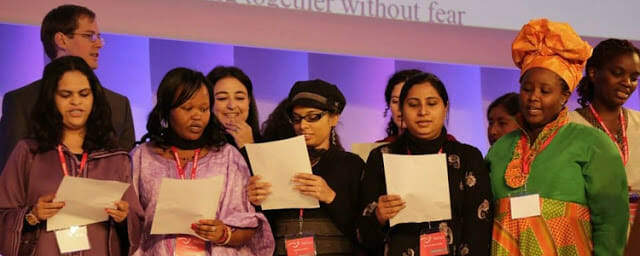
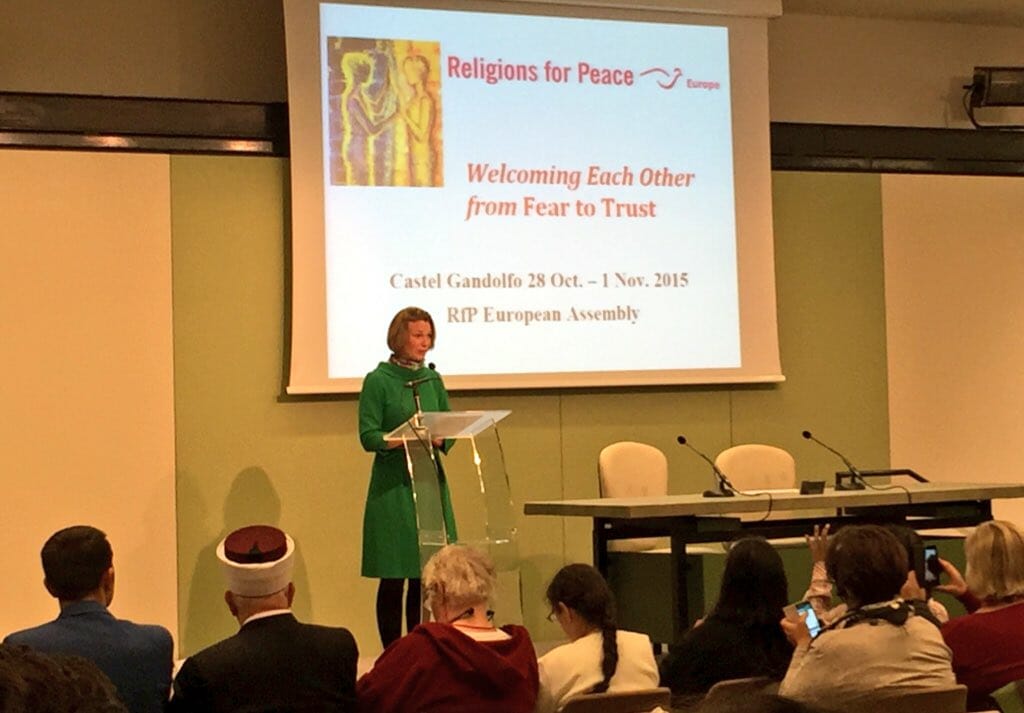
The Assembly was held on 28-31 October 2015 at the Mariapolis Centre in Castel Gandolfo (Rome, Italy).
“From fear to trust” read the title of the convention which was attended by about fifty young people and 150 adults, among whom some leading figures of the different religious traditions. The moments for sharing the so-called good practices by protagonists from different European countries were particularly effective. The work done in plenary sessions and workshops sought to respond to the challenges that the European continent faces today, both in view of the throngs of migrants, and the growth of personal and group sentiments of racist nature. Particular attention was given to the role of the media and to its negative manipulation of public opinion, increasing fears, to the detriment of the positive elements which already exist and which do not make the news. From the presentation of the young people, a multiethnic, multicultural and multi-religious cross-section of Europe emerged which is not just a futuristic projection but already a reality. The youths also expressed their commitment to work towards building constructive relationships between people of different traditions. From these four days of work, an updated role has emerged for Religions for Peace in Europe, in which the organization, now active for several decades, is called to coordinate and to work in collaboration and by networking with other agencies actively involved in the fields of interreligious and intercultural dialogue, and in the fields of welcoming and integration. A commitment which not only conveys “our fraternal support to the families and friends of the innocent victims and the entire French people, through affectionate remembrance and prayer” which is renewed in the desire to “proceed with our joint actions for justice and peace.” See also: Protagonists in building a world of peace – opening speech of Maria Voce, President of the Focolare

“This is a horrific and frightening moment. But we are also surprised at the international impact, by all the public support, and we feel responsible for responding appropriately.” Muriel Fleury is the director of the Focolare’s French magazine, Nouvelle Cité and this was her answer to Radio inBlu’s question about why such events could take place in France where the process of integration is older than in any other European country. She responded: “Although in the past we were successful at integrating other peoples, it seems that in recent years we have fallen a bit behind. We want multiculturalism, in the sense of welcoming other, but without taking their cultures into account, their values that are quite different from our own. Therefore, all the places that lend themselves to dialogue, true encounter, true cultural and religious sharing need to be developed. Our failure to have an authentic encounter has led to today’s tragic situation.” Paul Wirth, a member of the Focolare engaged in interreligious dialogue, remarked: “I belong to an Islamic-Christian Friendship Group (GAIC) in France. Every year we hold a week of meetings (the most recent beginning on November 12). We feel that it is very important to make everyone aware, so that people will make a distinction between authentic Muslims and those who claim to be Muslims but project hatred.” Speaking of the reaction of Muslim friends to attacks on Friday evening, he said: “There are many Muslim associations that have put out press releases condemning the attacks as barbaric, intolerable; they want to be close to the victims and their families. Just today I saw that many Muslim associations spoke of this as a horrible moment, and we Christians believe that these tragic events do not affect the relations of fraternal love that have been established amongst us [Christians and Muslims].” In her analysis, Muriel Fleury, director of Nouvelle Cité, pointed to other causes of the unease: “For economic reasons it seems that we have completely abandoned entire quarters of the city where even the police are at risk if they go into them. And our refusal to take care of these young foreigners, to not provide them some wholesome activity to keep them busy, to not be near to them, has led some of them to join radical pseudo-religious groups that have taken them away, many of them, and now we see the results.” From where do we begin, then, to mend such a complex fabric? “The problem,” says Fleury, “is that we are in France where, unfortunately, a spiritual void has been created. This French secularism has led to a denial of the spiritual dimension of a human being. Now we must take a new path, to develop the culture of encounter, of living together. Religions will be one of these paths, religions that are able to work with one another – even with the Republic. There are already signals in this direction that try to find solutions that include every voice from every religion.”
© Thomas Mandl
“Just try to imagine 2,000 kids rapping in unison: “Peace! Peace! War is death, peace is love.“ https://vimeo.com/148206731 And to think that all this has been happening for decades in a country torn apart by armed conflicts, the victims of which are mostly children. Now you don’t need to dream – Martine recounts – because all this really happened last 7 November in Kinshasa in the Democratic Republic of Congo.” The art of loving for peace was, in fact, the title of the day meeting which the children of the Focolare Movement in Kinshasa held with the schools of the Petite Flamme social project which had thought of organizing an event to say: no to war and yes to peace and love, and involving their friends and other 20 schools of the city in this undertaking. On Saturday morning, under a dark sky that seemed to forecast rain but which later cleared out to a burning sun, a storm of children invaded the playgrounds of the main Petite Flamme School. Songs, dances, poems and sketches then unfolded to shout to the world that Peace is love, war is death. Also the various civil authorities, diplomats and ecclesial figures who sat in the audience were overcome with enthusiasm, along with the representatives of the Italian and German Embassies, the coordinator of the evangelical schools of Kinshasa, and about 300 children, not to mention the coordinator of the Catholic schools.  “Upon casting the Dice of love and explaining its significance – continued Martine – the children demonstrated that “peace starts with ourselves.” And the many dices that brightened the stage were them solemnly delivered in the end to every school present, as a sign of a path and commitment to peace which all had initiated together. The 22 Evangelical school directors that we involved in this initiative, expressed their enthusiasm and desire to continue working with us in these types of activities. The children were the real protagonists in the preparatory activities right from the start, with their capacity to involve everyone in the rehearsals of the songs and presentations, and the courage with which they announced and presented the meeting in a TV transmission… It was all so full of joy, enthusiasm and serious work, not to mention that even God showed his benediction through his Divine Providence! In addition there was our communion of goods and presents from parents and embassies, and even a bank sponsored the event and financed the building of the stage and sound system! The event was then broadcasted on the national TV channel, the same one that had launched the initiatives some days earlier. And we, aged 0 to 99, lived this wonderful day for peace. What remained in the depth of our hearts after seeing the joy on the faces of these children? Hope. An unwavering hope. Because the future is in good hands.”

“There is an infinite number of rays, all coming from the same sun: a single will, particular for each person. The closer the rays come to the sun, the closer they come to one another. “We too . . . the closer we come to God, by doing the will of God more and more perfectly, the closer we come to one another. “Until we are all one!” (Chiara Lubich, L’unità, Città Nuova, Roma 2015, a cura di D. Falmi e F. Gillet, p. 48-49).
“In the face of the dramatic events that took place in Paris last night, in addition to those in many other areas of the world, we stand in mourning with those who have lost loved ones and with those who believe that the unity of the human family is possible. As we stand in dismay and in the firm condemnation of such acts against human life, a question becomes very clear: have we taken every step and every action possible to build the necessary conditions for preventing violence and terrorist acts – including the encouragement of equality, of more solidarity, more communion of goods? In the face of events that appear perverse, it is obvious that there is no single answer. But it is also obvious that an uncontrolled reaction to violence will not deter those who want to destroy the life forces of peoples and their aspiration to coexist in peace.  The conviction that the world can walk towards unity, and overcome confrontation and armed violence, remains alive in the spirit and in the actions of those who have love for every person and the future of the human family at heart, and want to bring it about through political action, through the right use of economy, and the rule of law. The Focolare Movement, while it weeps with those who weep, continues to believe in the path of dialogue, of acceptance and of respect for the other, whoever that may be and from whatever background, religious belief, and ethnicity. Therefore, together with all those working for peace, in various posts of responsibility and often at risk to themselves, the Focolare renews its commitment to intensify and multiply acts and gestures of reconciliation, opportunities for dialogue and communion, for encounter and sharing at all levels and in all parts of the world, so as to embrace the cry of humanity and transform it into new hope.”
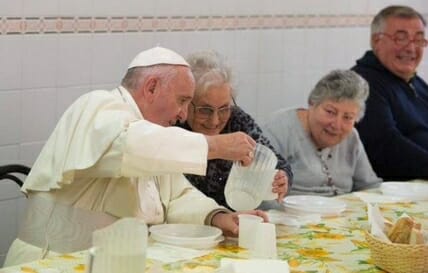
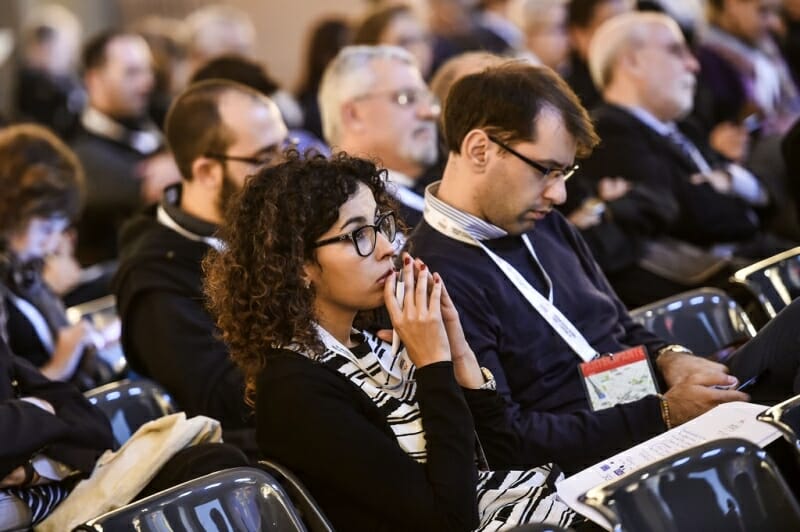
The Fifth National Ecclesial Convention in Florence, Italy, (November 9-13), Foto: Cristian Gennari/Siciliani
Pope Francis having lunch at the soup kithen. Photo: Ansa
That evening with friends I have some very close friends, most of them agnostics, with whom I had never explicitly spoken about my spiritual life. This had always left me with a certain sense of incompleteness. One evening we were taking a walk. Passing a church, I felt a strong desire to enter for a moment and greet Jesus. Being in the company of the others, this action seemed out of place, but I wanted to follow the impulse. During my brief visit in the church, I felt I had to say to Jesus: “Stay with me, because I am with you.” Shortly thereafter, at dinner, I felt I had to “reveal” myself to the others, but I didn’t know where to start! But then they spontaneously began to confront the topic of faith. It was a beautiful moment of communion. They expressed their perplexities to me, and words that even I hadn’t expected came out of my mouth. And all of this with mutual respect! Nothing of the kind could ever have happened if there hadn’t been that profound relationship between us. S. – Italy Sensitivity I am a nurse in the radiology department. In the corridors some patients wait their turn in their beds. One of them, with her arms bandaged, had been left uncovered. I greeted her, and with tact I covered her with the sheet. Years passed. One day, at a book presentation, a very elegant lady approached me: “I thank you for that day when you respected my dignity.” I almost didn’t recognize her. She continued: “It is when we suffer that we need even more to be respected as men and women. Thank you, because your service hasn’t made you insensitive.” E.M. – Hungary The embrace Seated at the desk of the charity center where I work, I was listening to a refugee whose appearance and clothing betrayed a past full of suffering. He was desperate because, having long been without work, he would be evicted from his lodging within a few days for not having paid the rent. I asked him, as I do with many like him, if he had friends here in the city who could help him. His reaction was unexpected: he burst into convulsive sobs, repeating: “I’m alone, alone! I have no one!” I was speechless, overwhelmed by a sense of powerlessness. Then, on impulse, I got up and went to embrace him. Slowly, he calmed down. He got up too, and with a tranquil tone of voice he said, “Now I know I am no longer alone,” and he made to leave, as if that simple brotherly gesture were enough to give him hope again. At that point I stopped him to show him how to procure himself clothing, make use of the Caritas dining hall and also a bed in our dormitory. By the time we separated, he was completely serene S. – Italy
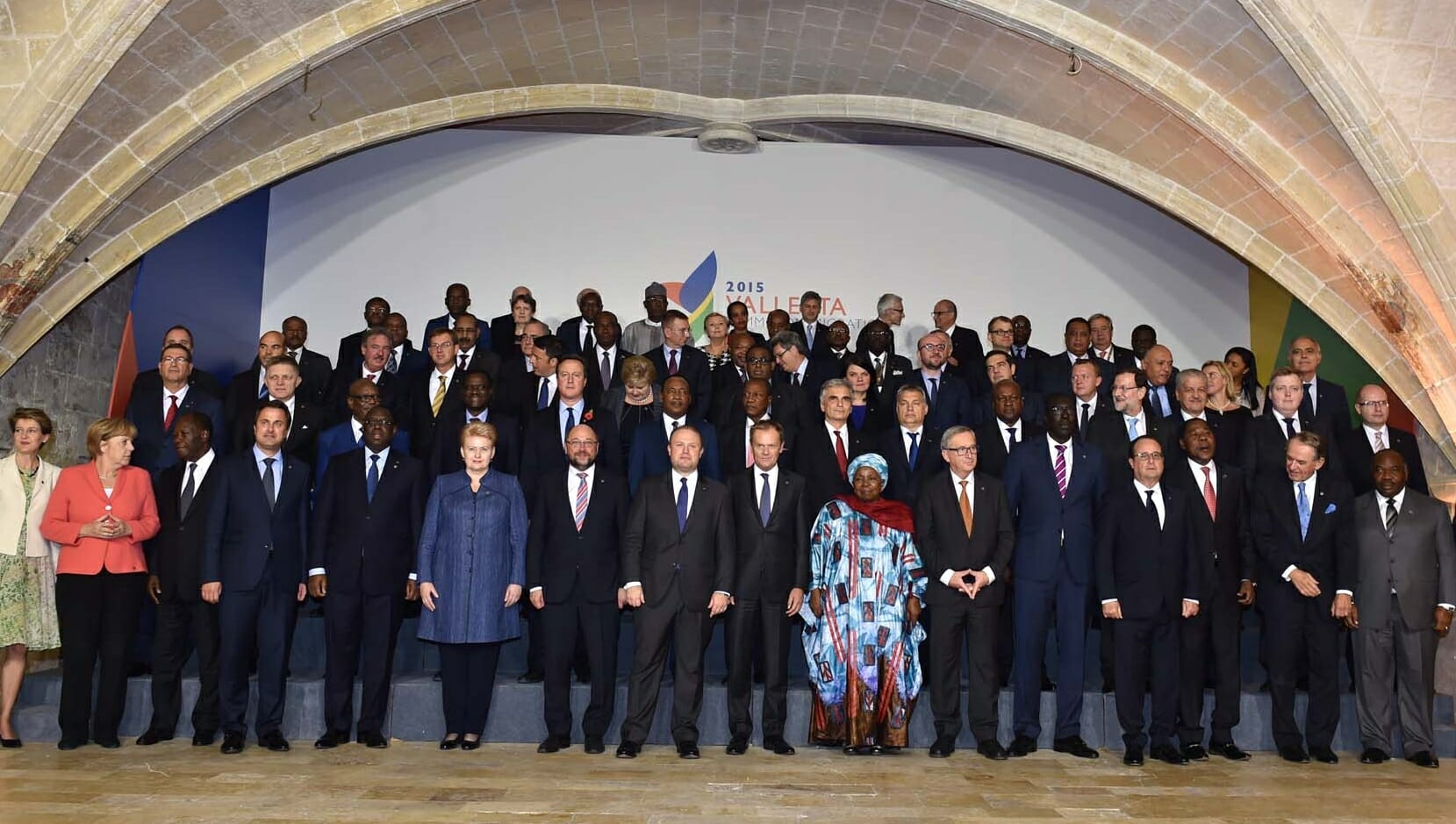
European Union and African nation leaders present at the Valletta Summit on Migration (Malta, 11-12 November 2015)
In one centre they held English classes; provided useful information about Malta; and simply spent time with the migrants. In another centre that welcomed families, they provided child care and tried to meet the basic needs of the little ones. Later, when they received permission, the Volunteers also went into the detention centres, Anna recounted: “The refugees were in rooms with bunk beds, even twelve per room, and there was not enough room for everyone. At first they were shocked, but seeing that we only wanted to befriend them, they overcame their mistrust. From English lessons we also moved on to more enjoyable moments with music and dance; and the guards remarked that they had never seen them so happy.” The young people of the Focolare Movement also became involved, inviting the refugees to events for teenagers such as the Run4Unity; and to the Mariapolis for a few days of meetings with Focolare friends and sympathisers. “Our project is beginning to gain visibility,” Anna concluded, “and we were asked to present our experience to the other Ecclesial Movements.”
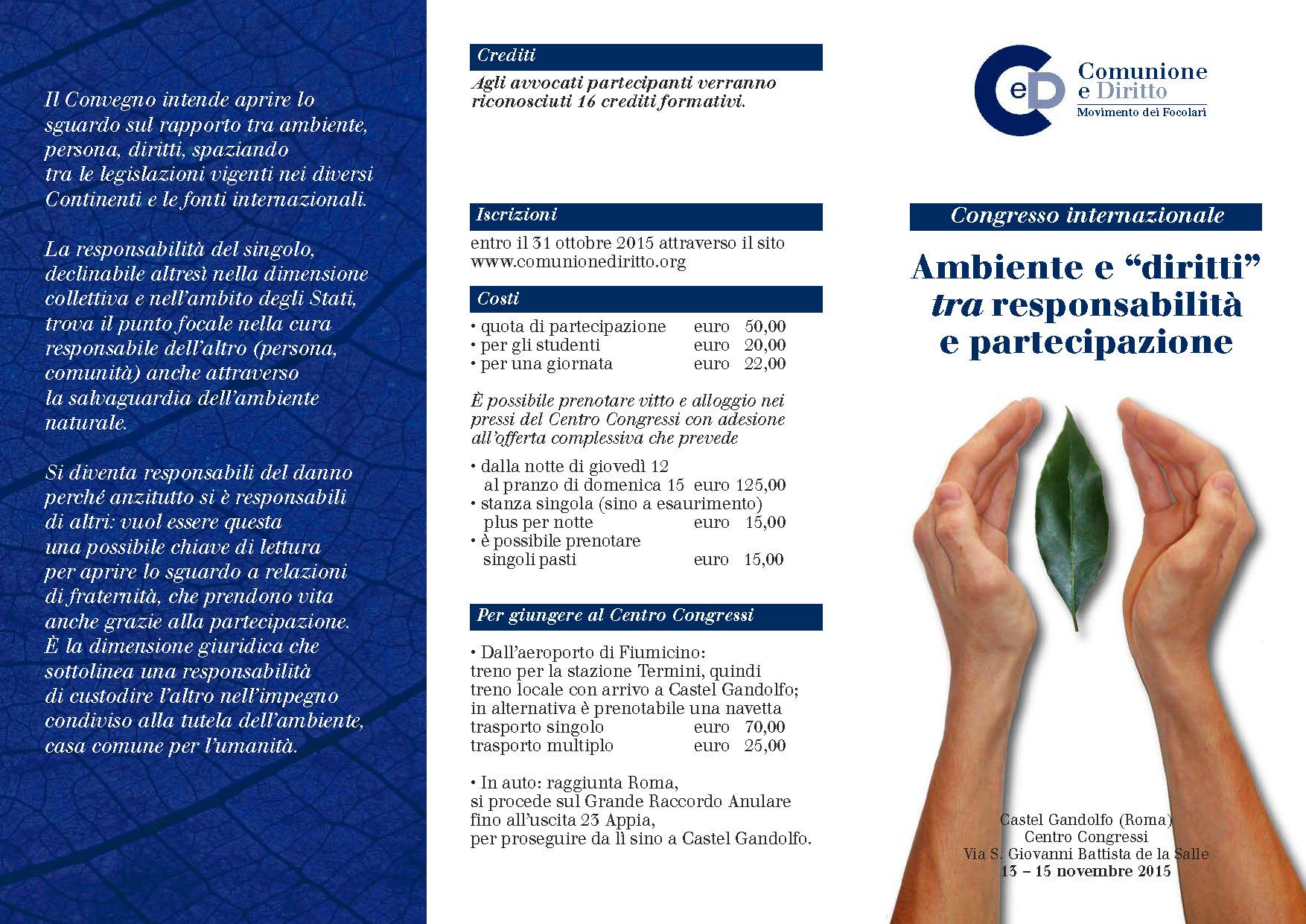 Environment and Human Rights: A very topical issue only a few months after Laudato Si’, the Encyclical of Pope Francis on the environment, and on the vigil of the COP 21, the United Nations Conference in Paris on climate change. How was the idea born? “We have been working on this project for two years, which happens to fall at an extremely favourable moment for focusing on the environment. The Congress titled “Environment and ‘Rights’ Between Responsibility and Participation”, was born from the shared experience of a judge involved for many years in the court cases that arose from the tragic consequences and serious harm caused by the irresponsible use of the natural resources. Cognizant of the far reach of the Communion and Law network that extends to all parts of the world, he thought it could be a means of sharing and giving visibility to the problems and difficulties of the most distant and forgotten regions of the world. The idea was born of doing something that would bring a positive global response.” The programme indicates a heavy involvement of young people. What was the background process? “It was all the result of the encounter between European and African young people that took place during the March 2014 International Seminar at Castel Gandolfo, Italy. Those young people studied the theme of the environment in the perspective of responsibility and participation, and they committed themselves to continue their research up until the Congress that is scheduled for November 13-15, 2015.” Those attending will come from 4 continents, representing 21 countries. Therefore, there will be an international perspective from which to examine the laws that are in force in the environmental field, but to what end? “We would like to highlight the concept of relatedness that is inherent to being human. Our relatedness to others, in a relationship of care and attention demands responsibility in our relations both with other people and with nature. If we live in this way, those relationships will enable us to also gather the relationships of Love that underpin Creation. Another goal is to reinforce the concept of participation in legislative activity. During the congress we will evaluate a proposal of popular law that moves in that direction. The proposal comes from a Sicilian regional law concerning the territory of Pachino, which reveals the contrast between ‘legislative procedure’ and ‘participatory power’. Actually, communication with the interested parties is fundamental so that they can evaluate the current legislative and regulatory proposals.” “Moreover, we would like to give a voice to near and distant lands that are also different from one another, often forgotten or in the spotlight only because of dramatic situations, like the Central African Republic, for example. The discussion will not only be theoretical but will include stories and testimonies: on-going investigations into the damage to the environment because of irregularities, ‘halts’, the powers that be in the state apparatus, the problem of deforestation and desertification in Sub-Saharan Africa.” It is also a meeting with an interdisciplinary approach. Amongst the participants is EcoOne, for example, which is a network of researches in the field of Ecology and the Environment that shows the years of attention given to the environment by the Focolare. . .
“Scholars in ecology, environmental physics, but also economists, educationists, political scientists, architects will also join us. With them particularly during the roundtable on Sunday morning, our reflection will shift to the prospect of a unitary vision that could reconcile the terms: people and nature. During the last session, there will be an address by Focolare president, Maria Voce who was one of the initiators of Communion and Law, the network of scholars and law workers that was begun in 2001 because of an intuition of Chiara Lubich. In a nutshell, Communion and Law promotes and accompanies a variety of initiatives for elaborating and spreading a new culture founded upon relatedness as a juridcal category, but also key in the relations amongst law workers. Press releases
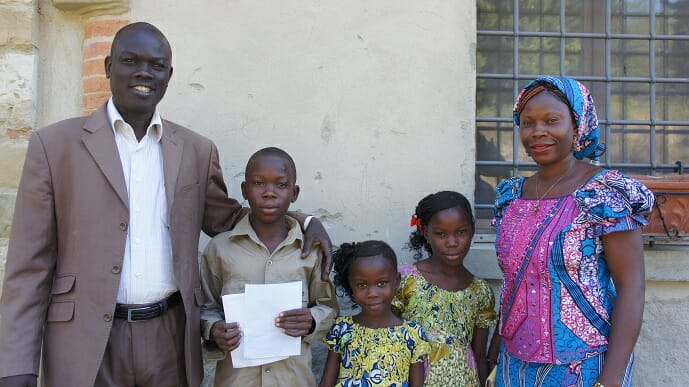
The Molu family
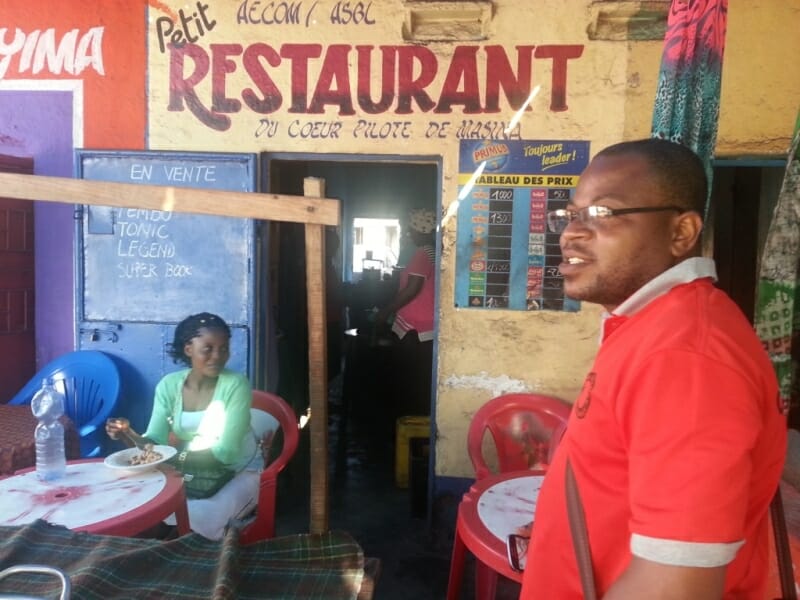
The bar and restaurant run by Émerence Kibimbwa Zolakio
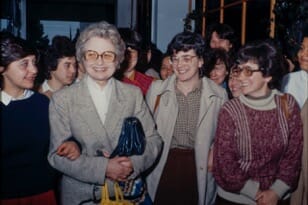
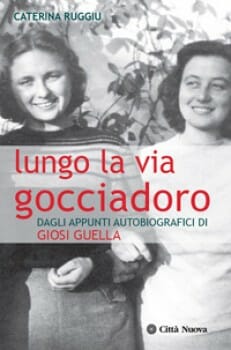 “Chiara was pointing out the stars to me along the Gocciadoro Way. I dont’recall her words. Come to think of it, it seems like she was telling me that we had to step out of our little world in order to soar in a much vaster world.” This is how Giosi Guella records her first encounters with Chiara Lubich in the spring of 1944 in Trent. Gioccadoro Way is the street where Chiara lived with her family before the bombardment of May 13, 1944 when the family home was left uninhabitable. It is also the name of the woods – now a city park – that lapped Tentino’s chief town, and it remains one of the symbolic sites of the Focolare Movement in the city where the Movement began. This is the story behind the title of the book about her life beside the Focolare’s foundress with whom she shared moments of light and of trial that accompanied the birth and the development of this new spiritual family in the Church. Amongst the first group that joined Chiara Lubich, Giosi Guella stood out for her simplicity, sincerity and concreteness. She was already living with Chiara Lubich in the autumn of 1944 at the small flat at piazza Cappuccini 2. That is where the first cell of the Focolare Movement began to form. In all the places she lived, Giosi embraced and lightened the sufferings of others, offered insightful advice, helped to find homes, employment and trust. She was the impulse for the consolidation of many focolare communities, seeing to it that joys and sorrows were shared amongst all, challenges and victories, unexpected donations that were then used to respond to requests for help. Everything contributed to the “capital of God’ that was being formed, composed of material goods, but also of needs. Giosi was the generous adminstrator of that capital. Because of her eye for the least amongst the community she was well suited to setting up the communion of goods of the first group in Trent, beginning in 1948. The communion of goods was a practice which then spread thoughout the Focolare Movement around the world. It was inspired by the early Christian communities who put their goods in common so that no one amongst them would be in need. Afterwards, as the Movement spread to other countries and different kinds of social action became necessary, Giosi continued to follow those developments. She also accompanied the early stages of the Economy of Communion project that was launched by Chiara Lubich in Brazil (1991). A biography has now been published, twenty years after her death. It is certainly not an exhastuve account, drawing upon a few writings and recorded speeches. Actually, she was not very fond of writing; she preferred to be “doing”. These pages are therefore quite precious, extraordinarily frank and disarmingly simple. I entrusted myself to those writings, on the edge between news and history, letting her speak. When the recount was interrupted, I was able to interview several people who had shared the journey of a Work of God with her, a Work “written in Heaven” that gradually unfolded on earth, following mysterious and up until then unexplored paths. Their testimonies permitted me to trace several passage of this simple, “too simple” life yet strongly interwoven with that of the Focolare to which Giosi had given all of herself, with her own particular touch. Caterina Ruggiu Lungo la via Gocciadoro, Città Nuova editrice

There has never been so much talk about labour rights as in our times; and there has never been so much worker abuse as in our times. They have provided the crowds for the rallies and the piles for all the massacres, and the flesh for all the reprisals. Those that do survive are often left homeless on the streets, without family. Once again, we are called to bounce back, to reconquer death: to do what Peter the fisherman did, who said to the Master: “We have been hard at it all night, but have not caught anything; but at your word I will cast the nets.” At the word of Jesus, with hope, after a night of blood and ruin, we need to begin again. And the Father will reward our trust. All of us are engaged in this great enterprise, both labourer and intellectual, of repairing the great social wreck, with courage and responsibility. Let us never look back and never be afraid. Behind us stand the exploiters, the tyrants that have burned our homes and jammed our freedoms, the demigods that have waged war: they are the executioners and gravediggers. We are moving forward, even with the cross on our shoulders, towards the Redemption that means freedom: freedom from every evil, and therefore from the need of fear.” (Igino Giordani, Fides, June 1951) “You strip work of its value when you disassociate the economic value from the spiritual value. When God came amongst us He did so as a worker amongst workers. For thirty years He performed manual labour to help the people within the circle of his family and neighbours. Then, for three years, He did spiritual work whose fruits have benefited the human family of every age. Work is innate to us humans and as necessary to life as eating and breathing. Forcing a human being to be idle is like forcing a bird not to fly. With the advent of the Redeemer – a manual labourer who was God – labour and fatigue became the divinely manufactured ordinary means of sanctification. Anyone who works in accordance with the order of God, bearing with the fatigue out of love for God, becomes holy. The work in the fields, in the office or in the Church has the same value as prayer does. The salary is also doubled. On the human level, you are paid for the economic value produced by your handiwork and genius; on the divine level, you are paid for the merits of your patience, asceticism and detachment. As you build you bear with the fatigue, transforming it into the raw material of redemption, and you also build another stretch of the road to your eternal destiny. The prodigal son began his recovery when he began to work, just as he had begun his deterioration when he began to be idle. The real exploitation of work and of the worker comes about in proportion to the materialistic pretence of denying participation of the spirit in the works of the hand or of the mind: pulling apart the divine and the human, the spirit and the corporal, the moral and the economic, Our Father in Heaven the daily bread that needs to be served to us every day on earth. A person does not only live on bread for the stomach, but is also in need of nourishment for the soul. Pressing someone into a merely economic existence is like feeding only half of him while destroying him by starving the other half. The God Man saw and always sees the divine and the human not only one or the other, but both. Since the fishermen and their guests have not caught a single fish during an entire night of hard effort, and since the norm Jesus follows is ‘whoever does not work, does not eat,’ He invites them and their hungry families to go back to work, to recast the nets into the waters of the lake. God continually invites us not to be discouraged, not to despair but to get back to work again, always in His name. Like a human person, society also needs both works so that it can breathe with both lungs and live healthy and free. If not, it languishes, since it suffers either from bodily hunger or from spiritual hunger: one hunger brings the other. If there is no Father in Heaven, the bread on earth also becomes scarce because, without Him, the labourers are no longer brothers and sisters. They fight and steal, as happened and continues to happen to many of our immigrants who are opposed and rejected by other workers.” (Igino Giordani La Via, 1952)
To celebrate the 50th anniversary of the Vatican Document “Nostra Aetate” Music, art, dance and live demonstration of the Jewish, Christian and Muslim communities in Jerusalem. Live streaming of the event Website: http://www.jerusalemexpo2015.com/ Facebook: https://www.facebook.com/NostraAetateJerusalem/
The event will include a Conference (June 30-July 1, 2016) and a public outdoor rally on the following day (July 2, 2016) that will send a strong message of hope. Through testimonies, prayers and songs, the event would like to show that unity is possible and that reconciliation is the door to unity in diversity. This has been the experience of the Communities and Movements from many Churches who participate in Together for Europe for more than 15 years. Unity is possible. Living the Gospel of Jesus Christ can overcome the divisions amongst individuals, populations, parties, cultures and even Churches and non-denominational groups. The Seven Yeses offers a summary of the commitments of Together for Europe 2016. Event Program
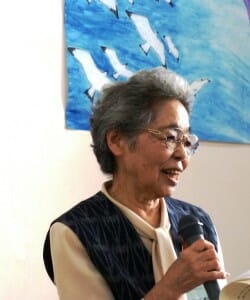
“On August 22, 1944, I lost my only sister in the Tsushima Maru naval disaster.” The passenger ship was sunk by an American submarine. More than 1,400 civilians lost their lives, including 700 children. “Up until the day of her death at the age of 96, my mother continued to say: “The war ate her on me. . .” Mrs Toshiko Tsuhako spoke from the bottom of her heart as she recounted her story to us. Her city, on Okinawa Island, had been the theatre of the only land battle in Japan through the months of April, May and June 1945, leaving 150,000 dead. “I was just an innocent child when I found myself thrown into the tragic experience of war, in contact with painful wounds that it inflicts on the bodies and the spirits of people. The war ended when I was 12 years old. My mother had a fragile constitution and, since I was the only daughter now, I devoted all my strength to trying to support and alleviate her afflictions. At the age of 16 I met the Christian faith and received the grace of Baptism.” As an adult she came into contact with the Focolare spirituality: “I was quite surprised when I heard that the foundress, Chiara Lubich, had come to understand, in the midst of the Second World War, that God loves us immensely and that we are all brothers and sisters who aspire to a united world, because this coincided exactly with the great dream that I carried inside me from when I was a young teenager.” “Although I was aware that everything that happens is in God’s hands, countless times I would wonder: ‘Why are there still such cruel and painful wars?’, while I continued on dreaming of a ‘global Family’ where the people live mutual gratitude and communion.” “I think that God is in need of our collaboration in building a truly peaceful world. It is true that we should cultivate hearts that love their own lands, but more than anything we should cultivate sensitive souls that devote themselves to the good of others, souls that know how to love.” “On this anniversary of the termination of the war,” Toshiko testifies, “I renew my trust in God and my commitment to continue along the path of peacebuilding.”
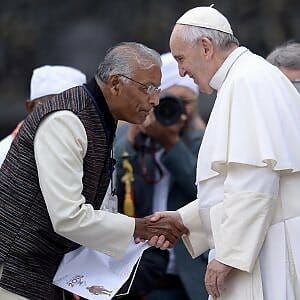
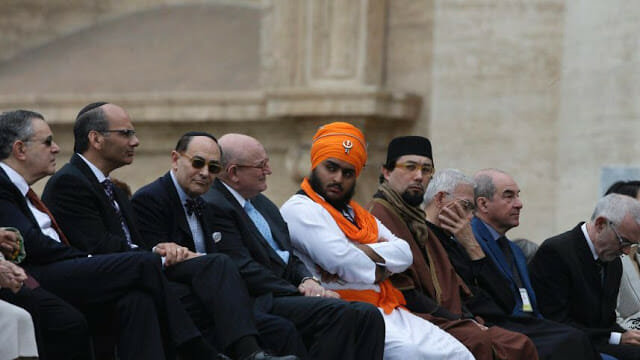 On 28 October 1965 at the conclusion of the historical assembly of bishops of the Catholic Church, the Council Fathers promulgated Nostra Aetate, the shortest document ever to be issued by the council’s working sessions. Half a century has passed since then, and the impact of those few pages revealed to be prophetic considering that the Catholic Church had passed centuries in the more or less firm conviction that there was ”no salvation outside the Church” – the famous Latin adage extra ecclesiam nulla salus. In February 2013, a few days before announcing his ”retirement” and upon reflecting on the Council at the end of the celebration of its 50th anniversary, Benedict XVI defined this document as a « trilogy that revealed its importance only in the course of decades,» along with Gaudium et Spes and religious freedom. In effect Nostra Aetate opened the Christian world’s horizon towards the others in their ”otherness,” but the management of which, according to the council’s procedures was not at all easy. At the personal suggestion of the French-Jewish historian, Jules Isaac to John XXIII, the Pope entrusted the initial scheme to Cardinal Bea. The idea was to draft a document that would contribute to prevent the repetition of tragedies like the Shoà, but after long and complex debates, the Council laid down a few pages addressing all the religions of the world. In effect, through a laborious and difficult process, the document opened to all the main religious faiths, undoubtedly and particularly stressing the confrontation with Judaism and Islam. Nostra Aetate underlines how the Jews should be presented in a positive manner: “They should not be presented as God’s rejects or as accursed, almost as if this came from the Holy Scriptures.” Above all, it excludes Israel’s collective responsibility for the death of Jesus. Therefore, this radically changed the views the Christian and Catholic world had of Israel for two millenniums. Likewise, a great respect emerged also towards Islam. “The Church regards Muslims with esteem” – declared the document – and “if in the course of the centuries, many disagreements and hostilities arose between Christians and Muslims, the Holy Council urges all to forget the past and sincerely practice mutual understanding, and together defend and promote social justice, moral values, peace and liberty for all.” As earlier said, also the recognition of the traditions of Hinduism and Buddhism is clearly highlighted, without forgetting the traditional religions. In fact, the document also affirms that “the Catholic Church does not reject what is true and holy in these religions.” What history often has not recognised as religions are now valued by Catholic tradition which acknowledges the presence of truth and sanctity also in their traditions.
 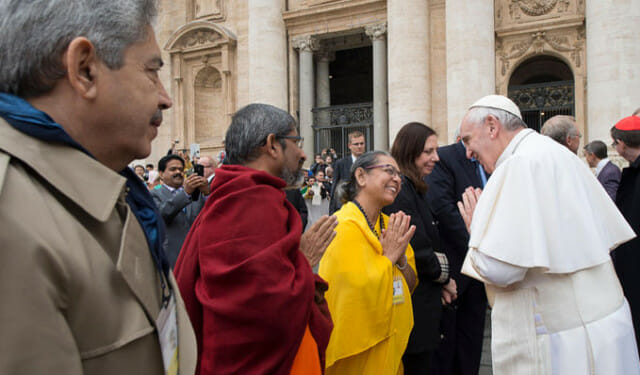 Today, a great variety of events are being celebrated in various parts of the world to reflect on the value of Nostra Aetate and the consequences it has brought about between men and women of different religious traditions. Amongst all is the particularly important event held at the Pontifical Gregorian University and organized by the Pontifical Council for Interreligious Dialogue. For three days, from 26 to 28 October, about 400 people of diverse geographic, cultural and religious areas met and reflected together on what has come about over the last 50 years. There were representatives of all the major religions of the world (Jews, Muslims, Hindus, Jainists, Buddhists, and Sikhs and those of the Tenri-kyo and the traditional African religions). They reflected on highly relevant themes today, violence, commitment to peace, the challenge of religious freedom, education and transmission of values. The convention was opened by Card. Jean-Louis Tauran, President of the Pontifical Council for Interreligious and by Card. Kurt Koch President of the Pontifical Council for Dialogue for the Promotion of Unity among Christians, and ended with a valuable and articulated reflection on ”Educating toward peace” by the Secretary of State, Card. Pietro Parolin. The participants then took part in the Audience in St. Peter’s square where Pope Francis dedicated his catechesis precisely to Nostra Aetate. He proposed a road-map for the future of dialogue, and encouraged all to work together for the poor, justice, the environment, and of course, peace. Rita Mousalem and Roberto Catalano, co-directors of the Centre for Interreligious Dialogue of the Focolare Movement, participated in the convention and conveyed the greetings of Maria Voce and the Movement when they briefly presented the important features of the Focolare’s interreligious dialogue and ensured the commitment of its members in continuing to work for the encounter and friendship between men and women of diverse faiths. Roberto Catalano