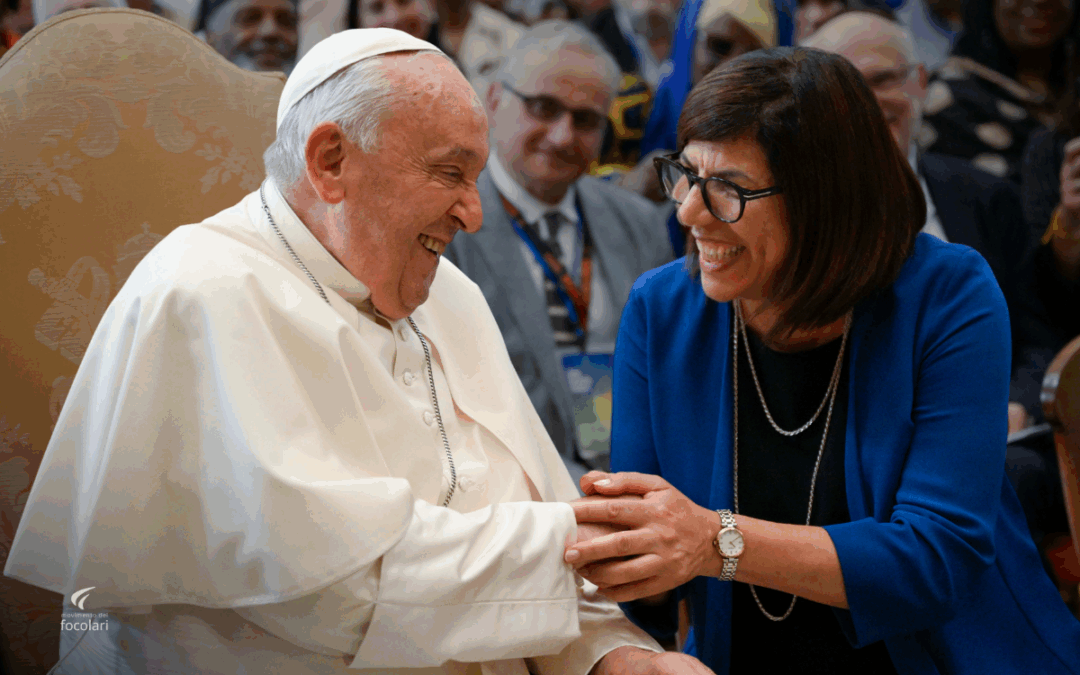
It was with deep sorrow that I learned of the return to the house of the Father of our beloved Pope Francis. Together with the whole Church, we give him back to God, filled with gratitude for the extraordinary example and gift of love that he has been for every person and every people.
There have been many moments, throughout his entire pontificate, in which the Holy Father has been a close and loving shepherd also for the Focolare Movement. He has always welcomed us and has guided us to witness to the Gospel with courage and in a radical way.
We have lived many moments with him, which we will never forget In one of them we remember his words to the General Assembly of the Focolare, when he received us in audience in 2021:
‘Always listen to Christ’s cry of abandonment on the cross, which manifests the highest measure of love. The grace that comes from this, is capable of inspiring in us, who are weak and sinners, generous and sometimes heroic responses. It is capable of transforming suffering and even tragedy into a source of light and hope for humanity’.
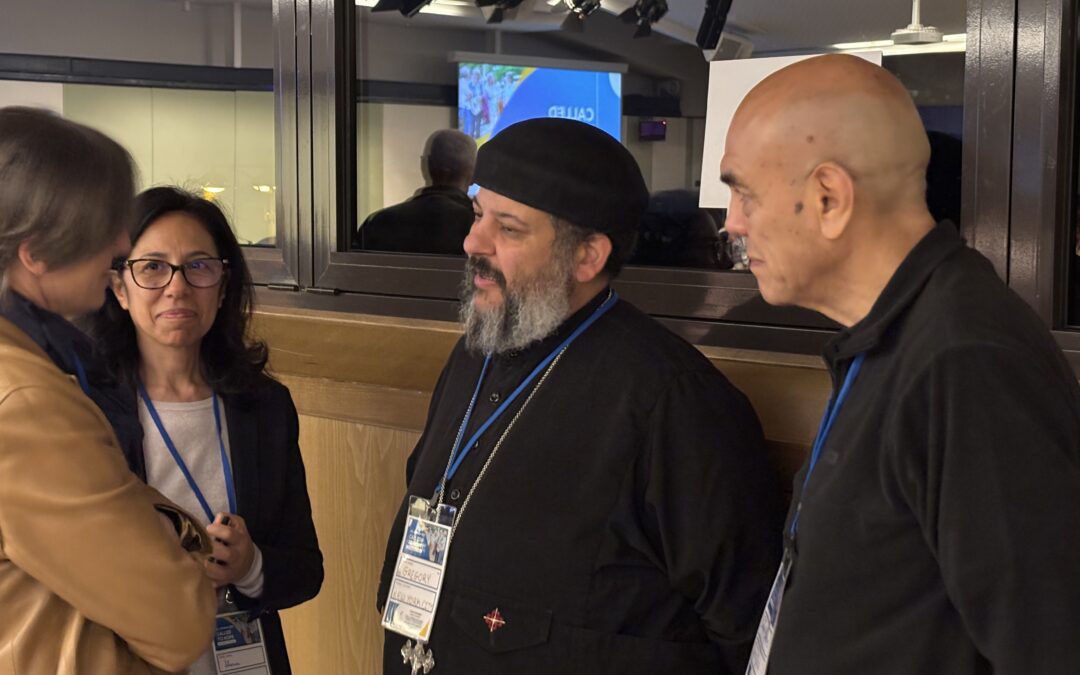
Finally, I cannot fail to testify also to the Pope’s love and personal concern for me, for the sufferings of my people in the Holy Land, and my immense gratitude for having invited me to participate in the Synod on Synodality, where he himself opened the doors of the Synodal Church that is now starting to take its steps throughout the world.
Together with the entire Focolare Movement in the world, I unite myself to the prayer of the universal Church and of all men and women of good will, certain that Our Lady ‘Salus Populi Romani’, (Mary, Health of the Roman People) to whom he was so devoted, will welcome him into heaven with open arms.
This year 2025 the feast of Easter is celebrated on the same day by all Christian Churches. Margaret Karram, the President of the Focolare sends her wishes for this feast together with those of some representatives of various Churches..
Enable subtitles and select your preferred language.
An Easter of hope but above all, an Easter to be lived together. In this year 2025, which marks 1,700 years since the Council of Nicaea, Christian Churches will celebrate Easter on the same day: Sunday, 20th April.
This is a wonderful coincidence that calls all Christians to take a decisive step toward unity—a call to rediscover ourselves as united in plurality.
In an age marked by divisions on every front and especially at this time that brings us closer to the mystery of the Resurrection, we would like to share what Chiara Lubich said in Palermo in 1998 about “A Spirituality for Dialogues”, specifically an “ecumenical spirituality.”
It is a direct invitation to respond to the call of mutual love, not as individuals, but together. It is an opportunity to look upon the Jesus Forsaken on the cross as a light which, even in the ultimate sacrifice, not only leads us but becomes the sure pathway along which we can take our steps.
Enable subtitles and select your preferred language.
According to the calendar of major events for the Jubilee of Hope 2025, the Jubilee for Families, Children, Grandparents and the Elderly will take place from 30th May- 1st June and the Jubilee for Young People will take place from 28th July-3rd August. These will be two major events that will bring thousands of people from all over the world to Rome.
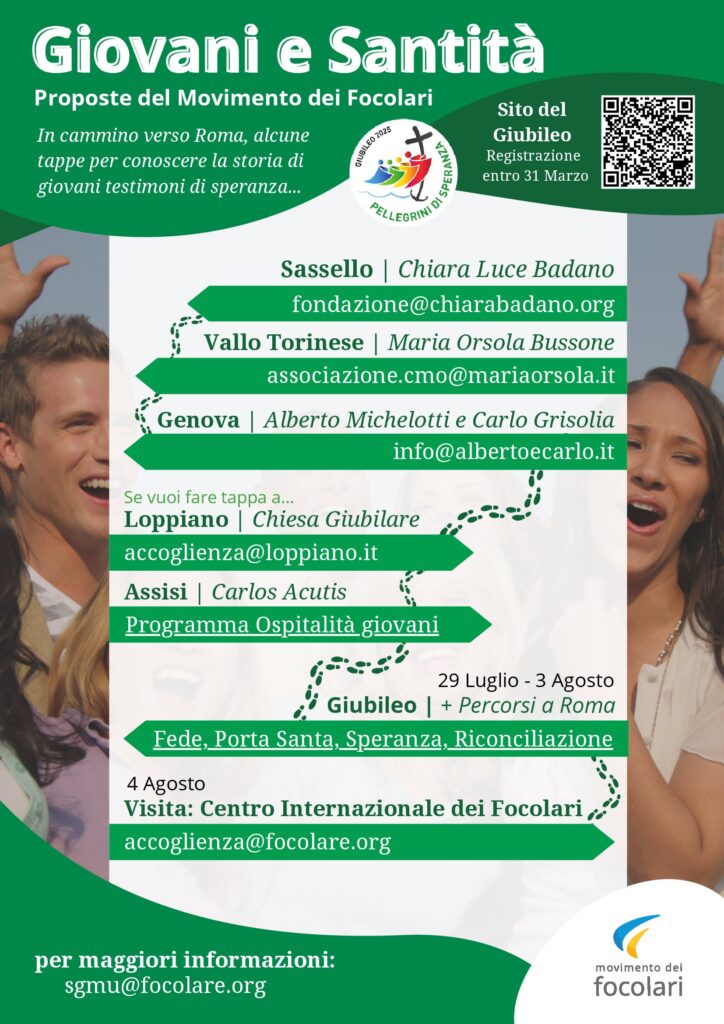
For the occasion, the Focolare Movement is offering several itineraries to provide opportunities to get to know more about the spirituality of unity and the lives of some witnesses of hope. In particular, a multi-stop tour for young people has been created around Italy entitled Youth and Holiness. We interviewed Paola Torelli and Lais Alexandre Pessoa from the Movement’s Youth Centres to find out more.
Let’s start with the Youth Jubilee: where did the idea of the “Young People and Holiness” tour come from?
The Youth Jubilee is a unique opportunity to set out on a journey, both physically in Rome and in other jubilee locations around the world. This journey is not just about visiting places, but above all it is an experience of encounter with God and with many witnesses of hope, whose lives can help us grow in faith and hope. Hence the idea of Young People and Holiness, a journey in the company of some witnesses of hope, for all the young people participating in the Jubilee at the end of July.
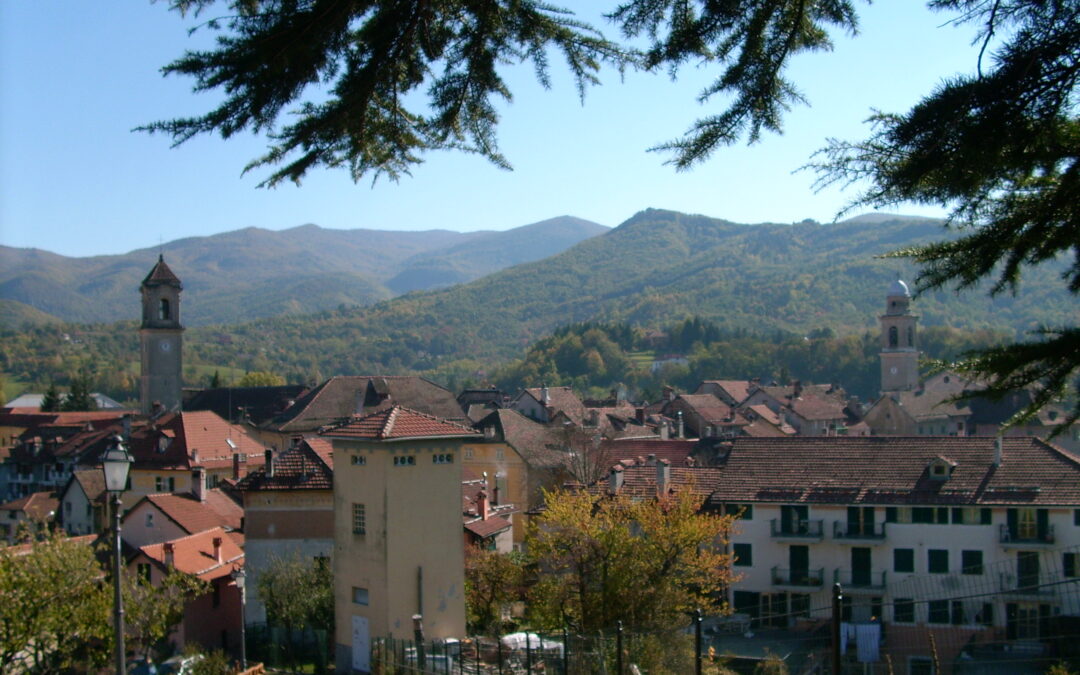
Genoa to getto know more about two friends Alberto Michelotti and Carlo Grisolia, now servants of God (info@albertoecarlo.it)
Loppiano (Florence), the international little town of the Focolare, to meet some of today’s witnesses of hope.(accoglienza@loppiano.it)
Assisi to discover the life and witness of saint Carlo Acutis, who will be canonised on 27th April 2025 as part of the Jubilee of Adolescents. (Youth Hospitality Program)
Rome for a journey in stages based on the four key words of the Jubilee: Pilgrimage and Profession of Faith, Holy Door, Hope, Reconciliation. The route will follow the traditional itinerary of the Seven Churches, accompanied by a spiritual guideline.
4th August, visit to the International Centre of the Focolare (Rocca di Papa). Visitors can take a guided tour to gain a deeper understanding of the charism of unity and the life story of the founder Chiara Lubich, whose body is buried there. (accoglienza@focolare.org)
Can you choose only one stage or is it one complete journey that includes all the stops?
The proposed stages are independent, each group or person can choose which ones to participate in or, if possible, follow the entire route. Contact details are provided for each stop regarding programs and visits.
Are there any other initiatives for young people?
Every month, at the Focolare Meeting Point in Rome there is a gathering entitled Call to one hope – Young people on the Journey. Together with some other Movements and Associations, we offer a chance to nurture and strengthen “hope” through shared testimonies, reflection, silence, and prayer. It’s an experience of mutual discovery. Preparing these events together with the other Movements and Associations helps us grow and become ever more the Church.
Let’s move on now to the Jubilee for Families, Children, Grandparents and the Elderly at the end of May: what does Focolare propose?
There will be two events on Friday, 30th May. They are interactive routes to deepen the Jubilee of Hope, designed for families with children and young people up to the age of 12, They include reflections and games suitable for that age group. The first will take place at the Focolare International Centre where participants can visit several significant places, such as the house where Chiara Lubich lived and the chapel where she is buried, together with the co-founders of the Movement. The second event will take place in Rome in several churches and significant places, starting from the Focolare Meeting Point.
Wars, massacres and bloodshed, extreme polarizations, situations in which even pacifism can become divisive: this is the current situation in which we are immersed.
The figure of Igino Giordani (1894-1980), a man of peace because he was a just and coherent man, gives us some inspiration today to lift our gaze and continue to hope, attempting to foster a dialogue even where it seems impossible, to break down crystallised ideologies and absolutisms, to build an inclusive society and to rebuild peace on unity.
One of the most vivid witnesses of the culture of peace of the twentieth century, his pacifism draws directly from the Gospel: killing another man means murdering a being made in the image and likeness of God. Giordani therefore yearned for peace, spent himself in every possible way for it ways, engaged in dialogue with anyone in the name of peace, did not back down even when it came to lending his support to the ratification of the Atlantic Pact and ensuring the security and defence of Europe and Italy… We can say that his pacifism was comprehensive and spared no effort.
Let’s look at some of his writings.
“…World War I broke out […] And massive pro-war rallies took place in the streets, which I attended so as to protest against the war; so much so that once a person I respected, upon hearing my shouts, admonished me: ‘You’re asking to be killed!’…
[…] In the “radiant May” 1915, I was called to arms. […] […]
The trenches. It was there, that I left school and entered life, in the arms of death under the salvos of cannons. Mud, cold, filth, there I bitterly discovered that the soldiers were all opposed to the ‘murder’ called war, because murder meant the killing of a man: they all detested it… […] We were in Oslavia, near some ruins called Pri-Fabrisu: Later during a three-year hospital stay, I recalled the memory of the agony (from the Greek, “agon” meaning struggle) suffered in those places in a short poem entitled The faces of the dead. I remember the last verse that said: “This is curse of war” [2]».
Giordani was seriously injured and when he returned from the trenches, he spent three years in the military hospital in Milan, suffering irreversible damage to one leg. His pacifism was therefore grounded in life experience. Later, when he was engaged in political life, he always strove for dialogue with everyone, even with those whose views differed from his, firmly believing that every person should always be welcomed and understood. He never entrenched himself in absolute positions. This is how he described his speech in Parliament in favour of the Atlantic Pact:
“I remember a speech I gave in the Chamber on 16th March, 1949 […], about the Atlantic Pact, which had for too long been presented solely in its anti-communist aspect, that is, as a military build-up against the Russians […] I said that every war is a failure of Christians: “If the world were Christian, there would be no wars… […] War, I added, is murder, it is deicide (killing of God’s image, that is, of man who is made in his image) and it is suicide”
Giordani’s speech was applauded by both the right and the left: a patient weaver of relationships, he highlighted the positive value of a choice by Italy that could have been interpreted as in favour of war. Giordani firmly believed that for peace to prevail, every possible path must be pursued, transcending strategic allegiances. He hoped that Christian politics would be capable of unravelling the existing polarizations to act in favour peace.
In 1953, he wrote:
“War is a large-scale murder, cloaked in a kind of sacred cult […]. It is to humanity, what disease is to health, what sin is to the soul: it is destruction and devastation, affecting both body and soul, individuals and communities.
[…] The end may be justice, freedom, honour, bread, but the means produce such destruction of bread, honour, freedom and justice, as well as human lives, including those of women, children, the elderly and innocents of all kinds, which tragically nullifies the very purpose for which they were intended.
In essence, war accomplishes nothing except to destroy lives and wealth
Giordani therefore reminds us that peace is the result of a deliberate project: a project of fraternity among peoples, of solidarity with the most vulnerable, of mutual respect. This is how a more just world is built, today too.
[1] Igino Giordani, L ‘inutilità della guerra, Città Nuova, Rome, 2003, (third edition), p. 57 [2] Igino Giordani, Memorie di un cristiano ingenuo, Città Nuova, Rome 1994, pp.47-51 [3]Idem, p.111 [4] Igino Giordani, L’inutilità della guerra, Città Nuova, Roma, 2003, (third edition), p. 3