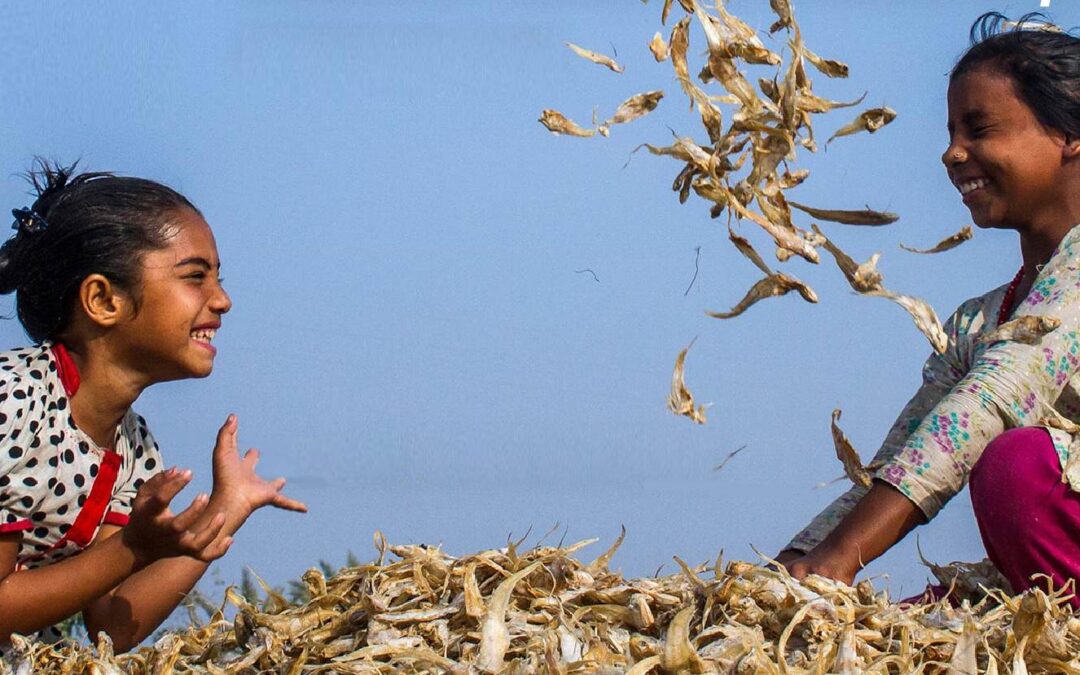
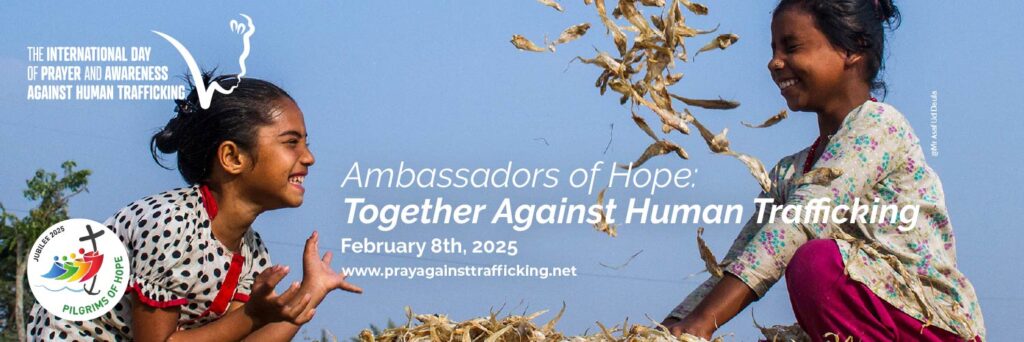
This February we celebrate the XI International Day of Prayer and Awareness against Human Trafficking which falls annually on 8 February – the feast of St Josephine Bakhita, the Sudanese nun who had the dramatic experience of being trafficked as a child.
This year the event is inspired by Pope Francis‘ invitation to be pilgrims of peace and apostles of hope and is part of the events linked to the Jubilee 2025. The theme is: Ambassadors of Hope: Together against Human Trafficking.
Celebrated all over the world, the World Day of Prayer and Awareness against Human Trafficking was introduced by Pope Francis in 2015. Coordinated by Talitha Kum, it draws on a network of organisations – including the Focolare Movement – with the aim of praying together, reflecting collectively on the realities of human trafficking and supporting victims, survivors and vulnerable populations. In a particular way, this initiative aims to promote and help women, children, migrants, refugees and young people.
This year, during the week of 4 to 10 February, various events will take place to raise awareness of the issue. More than 100 representatives of the various partner organisations – young people from all over the world, supporters and activists, survivors, refugees, migrants and public figures from the world of art and cinema – will gather in Rome to promote an appeal for hope, peace, love and unity of the Catholic Church with the aim of healing the wounds of the world. Among other events, Gen Verde will participate in the event ‘Invoking Hope and Promoting Healing Events’ on 6 February at 4-7pm (Italian time) at the Pontifical University of the Holy Cross.
But the central event will be the online pilgrimage scheduled for 7 February from 11.30 a.m. to 4.30 p.m. (Italian time): a marathon of prayer and reflection across all continents and available in five languages.
Recently, the Dicastery for the Doctrine of the Faith published the Declaration ‘Dignitas Infinita’ referring to serious violations of human dignity, such as human trafficking described as ‘an ignoble activity, a disgrace for our societies that call themselves civilised’. Likewise, it stresses the importance of combating phenomena such as the ‘trade in human organs and tissues, sexual exploitation of children and young girls, slave labour, including prostitution, drug and arms trafficking, terrorism and organised international crime’. It also mentions the repercussions of this crime against humanity. “Trafficking defaces the victim’s humanity, offending their freedom and dignity”.
It is currently estimated that 50 million people globally are affected by modern day slavery. Those who suffer the consequences most are women and children. The Jubilee year and the theme of hope highlight the importance of promoting this value through concrete actions such as the global fight against the despicable reality of human trafficking. We are therefore called to action, to be ambassadors of hope, because the human dignity and fraternity that we all uphold are in grave danger.
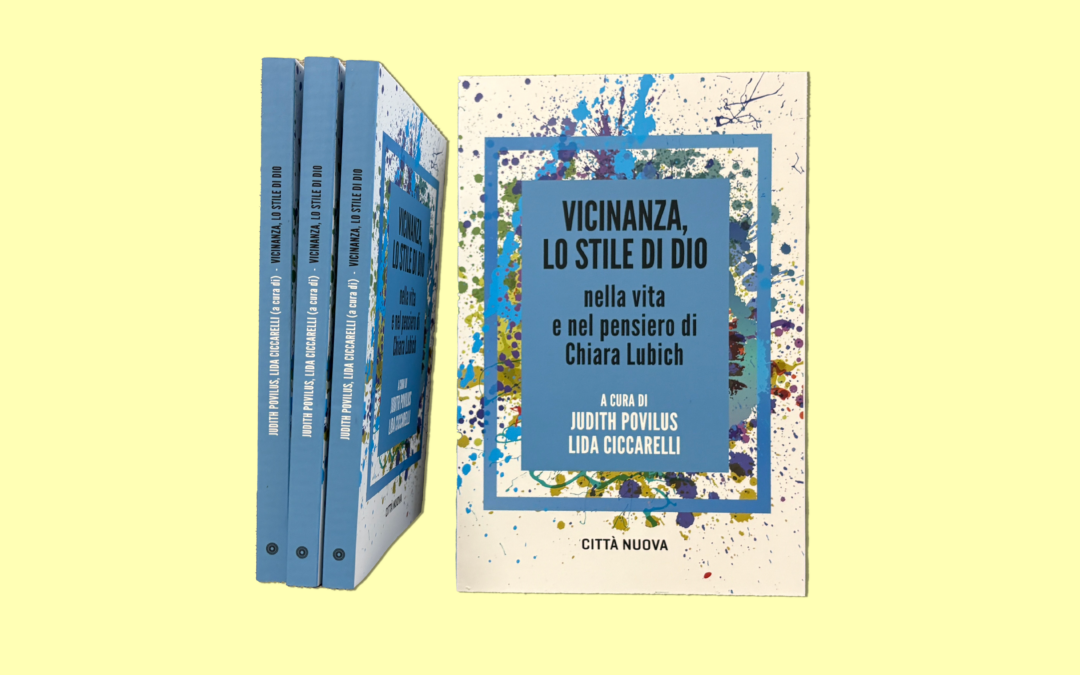
Chiara Lubich, founder of the Focolare Movement, repeatedly spoke in her speeches about closeness as God’s way of being near to humanity. As reflected in the title of this book, Closeness is the style of God which, through His life, Jesus revealed to us. It is also the main way to bring God to men and women today. To gain a deeper understanding of the book’s content, we interviewed the authors: Judith Povilus and Lida Ciccarelli.
Lida, Judith, what is the book about?
Lida: “It is a collection of Chiara Lubich’s ideas on the theme of love for others from the perspective of proximity. This is a topic dear to Pope Francis, who has often urged people to take care of the world around them and to be close to our brothers and sisters in the style of God: closeness.”
Judith: “For the English edition, we wondered how to translate the title. The solution could be the answer to your question: Learning Closeness from God—learning from God how to be close, recognizing how He has drawn near to us, so that we, in turn, may be close to those around us.”
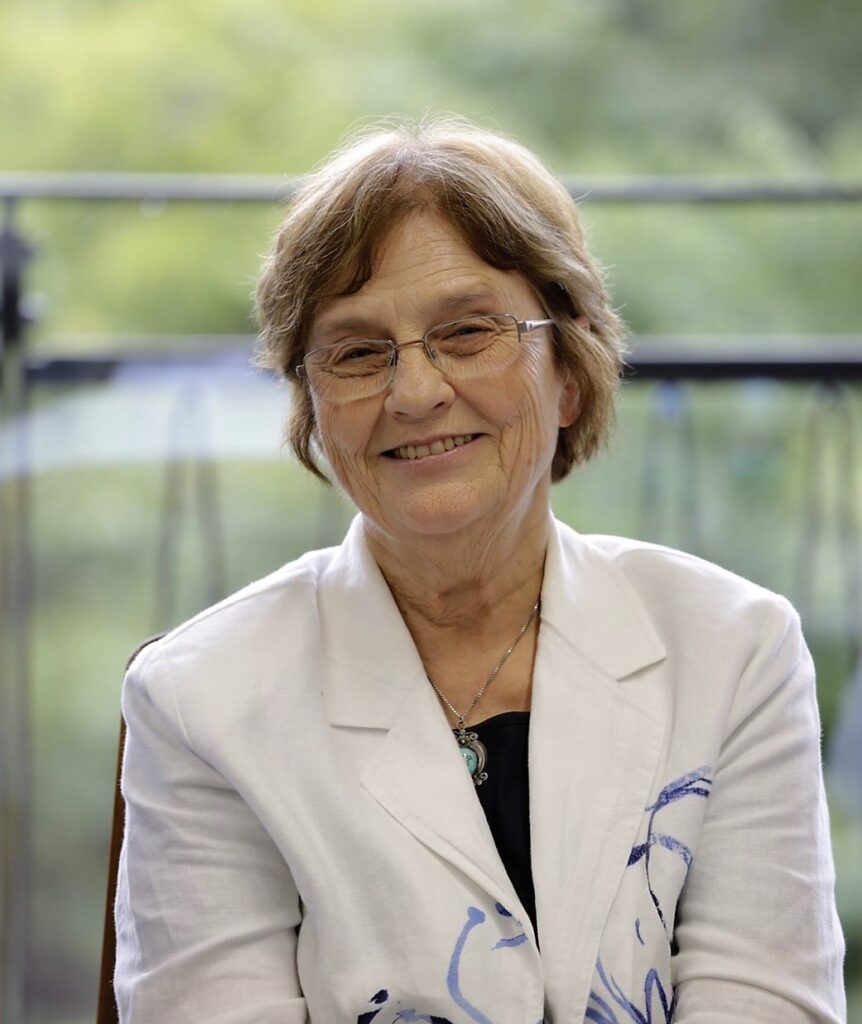
Judith Povilus, PhD in Fundamental Theology, is Emeritus Professor of Logic and Foundations of Mathematics at Sophia University Institute (Loppiano, Florence). She is the author of: The Presence of Jesus Among His Own in Today’s Theology (1977); Jesus in Our Midst in the Writings of Chiara Lubich (1981); Numbers and Light: On the Sapiential Meaning of Mathematics (2013); and co-editor of Unity: A Glimpse from Chiara Lubich’s ‘Paradise ’49’ (2021). (2021).
How can we bring God into today’s world, where there is so much loneliness, indifference, war, and division?
Lida: “If we look around us, there are reasons to be pessimistic. Yet, as Christians, we are always called to witness God’s love. For me, the way forward is the path of Jesus: society back then was no better than today’s, yet Jesus always brought the life of heaven. We must do the same, where there is no love, let us bring love; where there is loneliness, let us become companions in life; where there is division, let us be instruments of reconciliation and unity.”
Who is the ‘neighbour’ to whom we bring God?
Judith: “The encyclical Fratelli tutti recalls the Parable of the Good Samaritan, where the Scribe asks Jesus, ‘Who is my neighbour?’ Jesus turns the question around, showing that everyone is a candidate to be my neighbour. There are no limits—it is up to me to draw near to others. Being a neighbour is a transformative act. Your question is beautiful: finding God is what every human being most deeply longs for, even if they are unaware of it. Let us allow God to live in us, so that through our love, He may touch hearts.”
Cultural, social, and political differences often lead to fragmentation and polarization, increasing fear of others. Chiara Lubich’s ideal of unity challenges this trend.
Lida: “That’s absolutely true. Chiara was countercultural. She embedded in us a simple yet revolutionary idea: we are all brothers and sisters because we are all children of the Father in heaven. It is a simple idea, yet it makes us free and breaks down walls of division. If we put it into practice, it changes our lives. The other person, whether young or old, whether they share my views or not, whether rich or poor, a foreigner or someone from my own country, should be seen with new eyes. Everyone is a child of the Father and everyone, absolutely everyone, is loved by the Father just as I am.”
Lida Ciccarelli, with degrees in Philosophy and Moral Theology, is a professor of Church History and Spiritual Theology at the Mystici Corporis International Institute (Loppiano, Italy). A former member of the Spirituality Commission at the General Secretariat of the Synod, she is currently a Postulator at the Dicastery for the Causes of Saints.
Proximity is a key concept both in Christian Churches and in other religious traditions. Is it the path to universal fraternity?
Lida: “That’s exactly what we experienced recently with a group of young Shiite Muslims, students of Dr. Mohammad Ali Shomali, Director of the International Institute for Islamic Studies in Qum, Iran. They came to Sophia University, in the little town of Loppiano, for a short course on Christianity. We did not so much speak about fraternity—we lived it.”
Judith “I was responsible for several lessons on the spirituality of unity. While speaking about God as Love, I told them the Parable of the Prodigal Son. I asked: ‘Is anyone here a father? Can you understand the depth of this mercy-filled love?’ Seven of them were young fathers. During a break, they joyfully and emotionally showed me photos of their children. In this atmosphere, their spontaneous questions about spirituality allowed them to understand the charism of unity more deeply. With joy, we discovered common ground or clarified aspects of Christianity that had previously been unclear. I realized that closeness, with all its human nuances and the willingness to share in the life of others, is truly the path to sharing the gift of the charism, which is for everyone, non-Christians too. Together, we can be builders of a more fraternal world.”
What advice would you give to readers? How should they view others?
Lida: “If the reader is already familiar with Chiara’s writings, I would suggest approaching them as if for the first time. Then, pause whenever something strikes you and listen to Wisdom knocking at the door of your heart.”
Judith: “Yes, indeed, Chiara’s writings in the anthology section are profound, diverse in genre and content. They cannot be read all at once. Personally, every time I meditate on one writing or another, I discover new insights or new steps to take.”
Lida: “So, in conclusion, how should we view other people? As Jesus looked at the rich young man: ‘He looked at him and loved him.’ What must that gaze have been like? A gaze of love, freely given, that reaches deep within and says: You are important to me, I love you just as you are.”
Sometimes we are faced with situations where it is difficult to make a judgment or take a clear position. Wetry to understand the deeper meaning of whatever we are facing and comprehendits significance andvaried perspectives. We need a light to guide us. Just as underground miners move forward one meter at a time with the help of a simple lantern, we too have a light that can illuminate our steps, one by one. We know what this is: love for each other is a powerful light that guides us and helps with the difficult task of informing our personal consciences as we journey through life. We need to be able to be aware of the complexity of views and opinions held by people around us or those we meet sometimes by chance. It is important to always maintain a sense of honesty and to be aware of the limitation of our own point of view. Openness of mind and heart, the fruit of true love, creates a capacity for a dialogue that listens, that looks for the good in the other person and is open to the possibility of creating something together. Timothy Radcliffe, one of the theologians present at the last Synod of Bishops of the Catholic Church, referred to this personal need we may experience. He told members of the Synod that: ” The bravest thing we can do is to be honest with each other about our doubts and questions, those for which we have no clear answers. Then we will approach each other as fellow seekers, beggars of truth (1)”. In a conversation with members of the Focolare, Margaret Karram commented on this reflection: ‘Thinking about it, I realised that many times I did not have the courage to really say what I thought: perhaps because I was afraid of not being understood or because I didn’t want to be different from the majority. I realised that being “beggars of truth” means having that attitude of closeness towards one another, in which we seek the good of the other.”(2). This is Antía’s, experience. She is a member of “Mosaico”, a performing arts group that began in Spain in 2017. It is composed of young Spaniards from different backgrounds and cultures who use their art and workshops to offer their experience of fraternity to others. Antia tells us: ‘It connects with my values – a fraternal world, in which everyone (very young, inexperienced, vulnerable…) gives their contribution to the project. “Mosaico” makes me believe that a more united world is not a utopia, despite the difficulties and hard work involved. I grew up working in a team where dialogue was too honest at times and I often gave up on my own ideas which I believed to be the best. I see that in this project “good” is built piece by piece together, by us all ” (3).
1. Timothy Radcliffe, Meditation to Synod of Bishops, 2.10.2023 2. Margaret Karram, President of Focolare Movement, 3.02.2024 3. Mosaic GRLP
THE IDEA OF THE MONTH is currently produced by the Focolare Movement’s “Centre for Dialogue with People of Non religious Beliefs“. It is an initiative that began in 2014 in Uruguay to share with non-believing friends the values of the Word of Life, i.e. the phrase from Scripture that members of the Movement strive to put into practice in their daily lives. Currently, THE IDEA OF THE MONTH is translated into 12 languages and distributed in more than 25 countries, with adaptations of the text according to different cultural sensitivities.
This month’s Word of Life is taken from a series of final recommendations that the Apostle Paul makes to the community of the Thessalonians: ‘Do not quench the Spirit, do not treat prophecies with contempt but test them all; hold on to what is good. Abstain from every kind of evil.” [1] Prophecy, discernment, dialogue and listening. These were Paul’s instructions to the community that had recently embarked on a journey of faith.
Among the various gifts of the Spirit, Paul highly esteemed that of prophecy.[2] A prophet is not someone who foresees the future but rather a person who has the gift of seeing and understanding personal and collective history from God’s perspective.
However, all gifts are guided by the greatest gift of all and that is charity and fraternal love.[3] Augustine of Hippo states that only charity enables us to discern the attitude we should take in the face of a range of different situations.[4]
Test everything but hold on to what is good.
We should consider not only the personal gifts we may have, but also bear in mind the potential and variety of views and opinions offered to us by the people around us or with whom we work or even meet by chance. It is important to always maintain a sense of honesty and to be aware of the limitations of our own point of view.
This word of life could be a motto to adopt in every situation of dialogue and even opposing views. Our hearts and minds are broadened when we listen to other people: although we may not accept everything they say, we may find something good in their ideas. When love impels us to create a space within ourselves in order to listen to other people, we have the possibility of building something together.
Test everything but hold on to what is good.
Cardinal elect Timothy Radcliffe, one of the theologians present at the Synod of Bishops of the Catholic Church, said that ‘the bravest thing we can do at this synod is to be honest with each other about our doubts and questions, those for which we have no clear answers. Then we will approach each other as fellow seekers, as beggars searching for the truth.” [5]
In a conversation with members of the Focolare, Margaret Karram commented on this reflection: ‘Thinking about it, I realised that many times I did not have the courage to really say what I thought: perhaps because I was afraid of not being understood or because I didn’t want to be different from the majority. I realised that being “beggars of truth” means having that attitude of closeness towards one another, in which we all want what God wants, and where together, we all seek what is good.’[6]
Test everything but hold on to what is good.
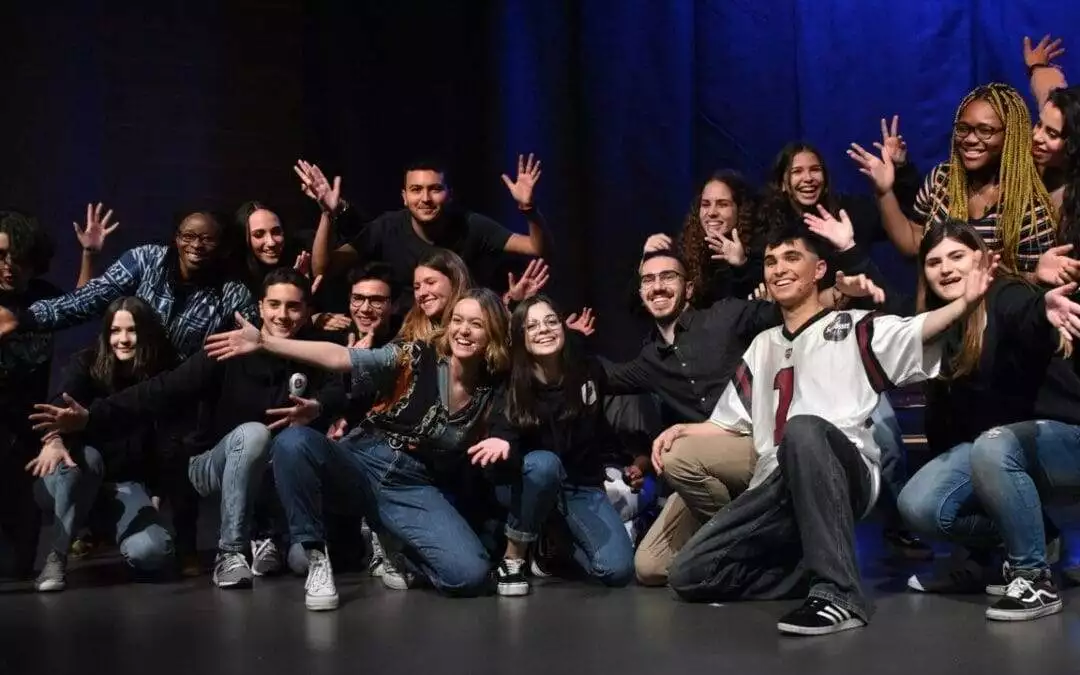
This is Antía’s, experience. She is a member of “Mosaico”, a performing arts group that began in Spain in 2017. It is a local project that has developed from the Gen Rosso music group. It is composed of young Spaniards who use their art and workshops to offer their experience of fraternity to others.
Antía tells us: ‘It connects with my values – a fraternal world, in which everyone (very young, inexperienced, vulnerable…) gives their contribution to the project. “Mosaico” makes me believe that a more united world is not a utopia, despite the difficulties and hard work involved. I grew up working in a team where dialogue was too honest at times and I often gave up on my own ideas which I believed to be the best. I see that in this project “good” is built piece by piece together, by us all.”[7]
Edited by Patricia Mazzola & the Word of Life Team
[1] Ts 5, 19-22. [2] Cf. Giovanni Paolo II, Udienza Generale, 24.06.1992, n.7. [3] Cf. 1 Cor 13. [4] Cf. Agostino di Ippona, Ep. Jo. 7, 8. [5] Padre Timothy Radcliffe, Meditazione n. 3, Amicizia, Sinodo dei Vescovi, Sacrofano, 2.10.2023. [6] Margaret Karram in conversation with focolarini, 3.02.2024 [7]Mosaic GRLP
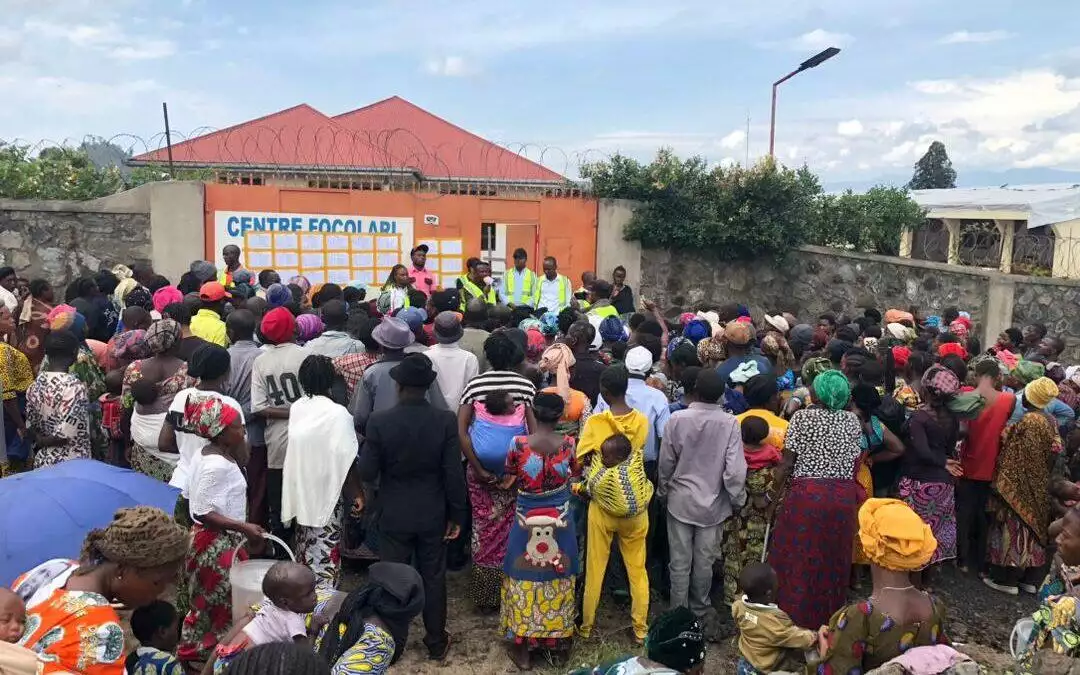
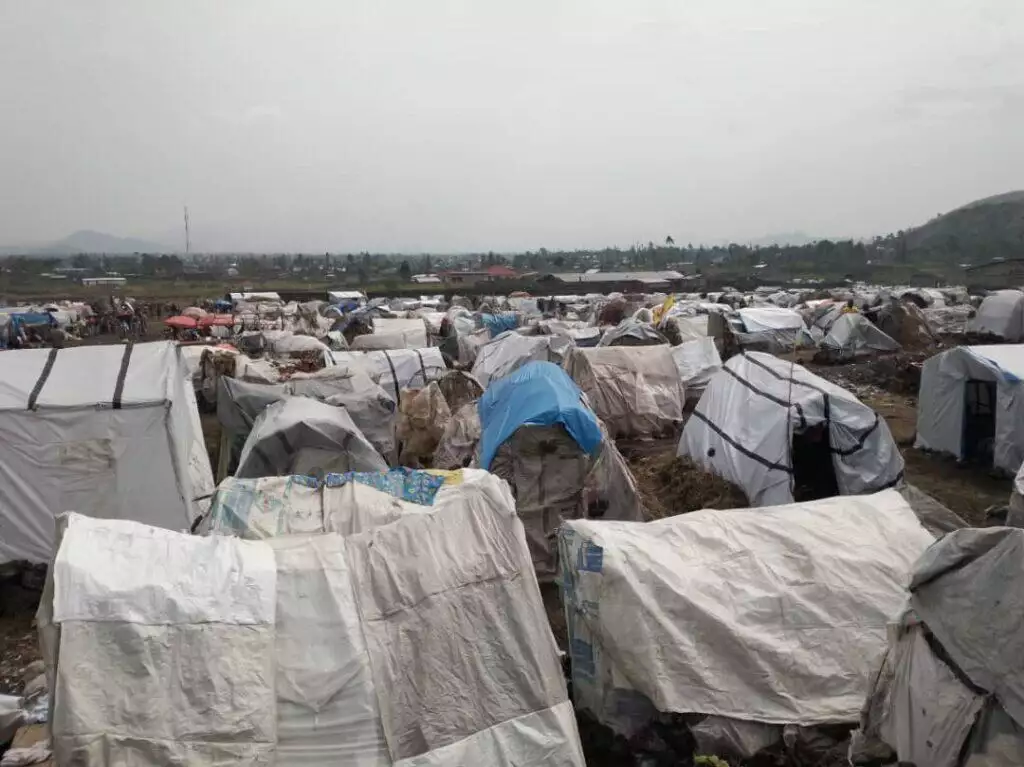
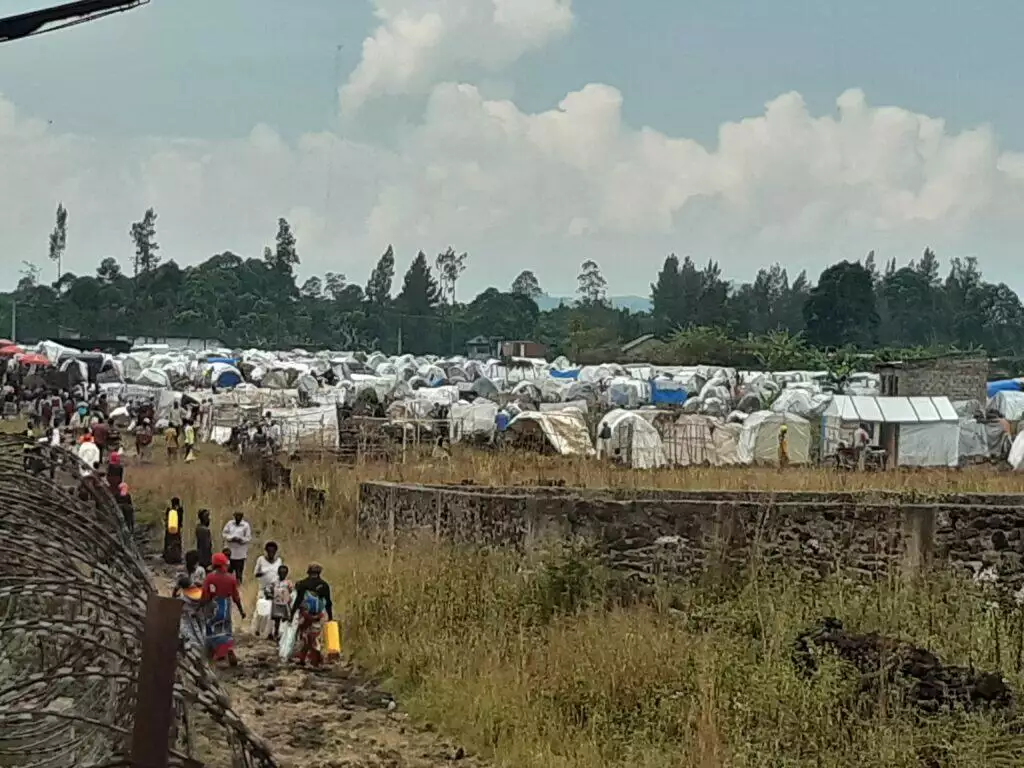
The city of Goma, capital of the North Kivu region (Democratic Republic of Congo), was attacked and is now controlled by the armed rebel group M23. Conflicts between Congolese government forces and the M23 militia intensified after the killing of General Peter Cirimwami, governor of North Kivu province on the 25th of January 2025.
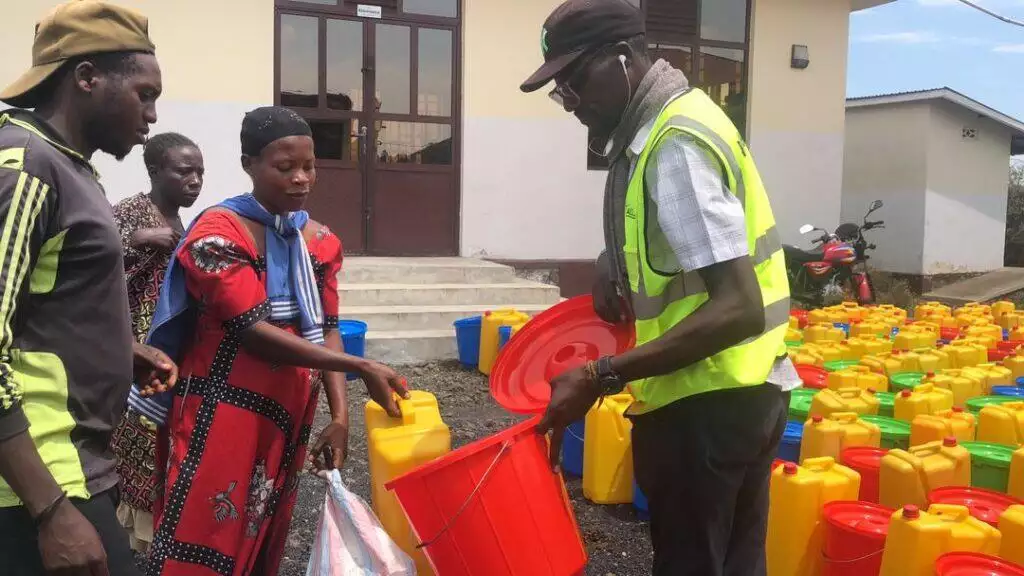
The Focolare Movement has been present in Goma since 1982 with a very active community which provides aid to people in need and has numerous initiatives serving the poor and refugees. A women’s focolare opened in 2019. Since 2020, a Social Centre has been built to provide basic necessities and shelter, thanks to the help of various organisations and people of goodwill. At the same time, career guidance and training courses have been set up to offer dignity and the means of survival to refugees, with particular attention to single women with children. Many people have thus been helped and, among them, are those who have recently arrived at a refugee camp near the “Louis Quintard Centre / Focolare”. Since 2023, thanks to the support of AMU, a micro-credit support project has been set up and, since the riots intensified last February, AMU has also supported the local community of the Movement to carry out emergency actions there, in particular by providing drinking water and hygiene kits to the many displaced people in the city’s refugee camps.
Tension in the region is very high and there is a growing apprehension about what may happen in the coming days with the possibility of an escalation of the conflict. This could have tragic consequences for a city and a population that are already living in difficult situations due to conflicts that have been ongoing for more than thirty years.
That is why we want to invite everyone to strengthen their prayers by joining in the “Time out”, a minute’s silence and prayer for peace that we offer every day at 12 noon local time, as well as to support all actions for peace and to encourage diplomatic actions that seek an end to all conflicts that are still taking place in the world.
Azione per un Mondo Unito ETS (AMU) IBAN: IT 58 S 05018 03200 000011204344 at Banca Popolare Etica Codice SWIFT/BIC: ETICIT22XXX
Azione per Famiglie Nuove ETS | Banca Etica – filiale 1 di Roma – Agenzia n. 0 | Codice IBAN: IT 92 J 05018 03200 000016978561 | BIC/SWIFT: ETICIT22XXX
Causale: Emergenza Goma
Tax benefits are available for such donations in many EU countries and in other countries around the world, according to different local regulations.Italian contributors will be able to obtain deductions and allowances from income, according to the rules for non-profit organisations