Every day terrible things are happening all around us and sometimes they are on such a scale that they overwhelm us and make us feel helpless: migrants are losing their lives as they undertake journeys in desperate conditions, people are experiencing the daily tragedy of war and dramatic social injustices continue to plague the planet.
“What can I do?” This question may leave us feeling paralyzed and tempt us to close in on ourselves in an attitude of resigned individualism. The first hurdle to overcome is to allow ourselves to be cross-examined by that very question. “What can I do?”
The fishermen on the shores of Lampedusa in Italy asked themselves this and then connected with generous people in the area forming a network that was able to reach out to others. They began by saving one, then ten, then a hundred and then thousands of desperate castaways who were abandoned to the waves of the Mediterranean Sea. There are also communities living in areas that border on war zones (in Europe, Africa, Asia…) who have asked themselves the same question. They welcomed people into their homes not on the basis of political or economic calculation, but because of natural human compassion. It’s in situations like this that you can see small or large daily “miracles” which are not utopian dreams but are the actions upon which the society of the future is built.
Professor Russell Pearce [1] of Fordham School of Law in New York emphasised that it is important to seek for hope and not wait for it to come to us. He conducted interviews with people from two organizations that promote dialogue and peace between Israelis and Palestinians – Parents Circle and Combatants for Peace – and sought to understand how their members managed to maintain relationships with each other in the aftermath of 7 October 2023 and during the subsequent war in Gaza.
Why have these groups sustained their ties with one another? Why have these ties even become stronger? Both Palestinians and Israelis reported that their dialogue has been transformative and described it as a dialogue of love. A Palestinian participant observed, “The change we experienced was a very “sacred journey” for each of us and left an impact and a deep bond in our souls. It was a process that transformed the other person into a brother or sister.”
An Israeli member also commented, “We worked to build trust and become a family, years of sacred work with all the challenges, dynamics and doubts.” Pearce concluded by saying that the Jewish sages teach that “if you save one life, you save the whole world”; a Palestinian who leads the Parents Circle youth programme explained, “If you change one person, you change a whole world.”
Chiara Lubich wrote, “The most visible aspect of unity is fraternity. This certainly seems the best way to counteract the prevailing norms of society (…) to reach greater freedom and equality. (…) It is a sound way for those who hold the fate of humanity in their hands but also for mothers of families, for volunteers who work for solidarity in the world, for those who share their company’s profits to help eliminate poverty and for those who oppose war. Thus, fraternity “from above” and fraternity “from below” will meet in peace.” [2]
——————————–
THE IDEA OF THE MONTH is currently produced by the Focolare Movement’s “Centre for Dialogue with People of Non religious Beliefs”. It is an initiative that began in 2014 in Uruguay to share with non-believing friends the values of the Word of Life, i.e. the phrase from Scripture that members of the Movement strive to put into practice in their daily lives. Currently, THE IDEA OF THE MONTH is translated into 12 languages and distributed in more than 25 countries, with adaptations of the text according to different cultural sensitivities. dialogue4unity.focolare.org
[1] R. Pearce: “Dialogo e Pace sostenibili” [Ekklesia-Sentieri di Comunione e Dialogo- n.4 Octtober December 2024].
[2] C. Lubich, No alla sconfitta della pace, in «Città Nuova» n. 24/2003
We are in a lonely place near Bethsaida in Galilee where Jesus is speaking about the Kingdom of God to a large crowd of people. He had gone there with the disciples so they could rest after a long and busy period in that region, during which they had preached and called for conversion ‘proclaiming the good news everywhere and healing many people.’[1] They were tired but very happy as they recounted what they had experienced.
However, when people heard what they had done, they made their way to join them. Jesus welcomes everyone. He listens, speaks and heals and the crowd continues to grow. Evening approaches and hunger sets in. The disciples worry about this fact and propose a logical and realistic solution to their master: ‘Send them away, so that they may go to the villages to find food and stay there.’ They think that Jesus has already done more than enough…. but he responds:
You give them something to eat.
They are astounded. They have only five loaves and two fish for a few thousand people; it is not possible to find all that is needed in a little place like Bethsaida, nor do they have the money to pay for it all.
Jesus wants to open their eyes. He is deeply touched by the needs and problems of the people, and he wants to find a solution for them. He does this by starting from reality and valuing what is there. True, the disciples have very little, but he entrusts them with a mission: he asks them to be instruments of God who is mercy and who looks after his children. The Father can intervene and yet he also ‘needs’ them.
The miracle ‘needs’ our initiative and faith, and then the Father will take it further.
You give them something to eat.
Jesus understands the disciples’ objections but asks them to do their part. Even if their contribution may be small, he does not regard it with disdain nor does he simply solve the problem for them. The miracle takes place, but it requires their full participation and their making available all that they have and can procure. This implies a certain sacrifice and trust in Jesus.
Jesus is a teacher, and he starts from the events that unfold around us to help us learn how to take care of one another. When we are aware that others are in need, excuses such as ‘it’s not our job’, ‘we can’t do anything about it’ or ‘they have to make do like everyone else’ have no value at all. According to God’s plan for society, blessed are those who feed the hungry, who clothe the poor and who visit those in need. [2].
You give them something to eat.
This episode recalls a passage found in the book of Isaiah that describes a banquet offered by God himself to all nations when he will ‘wipe away the tears on every face.’[3] Jesus asks people to sit down in groups of fifty, a number found in Old Testament texts that describe significant occasions. He is the Son but he acts like the Father revealing his divinity.
He himself will give everything, even to the point of becoming food for us in the Eucharist, the new banquet of sharing.
During the covid-19 pandemic, the focolare community in Barcelona became aware of the many challenges that the people around them were facing. They used social networks to create a group to collect information about needs and to pool resources. They commented that it was impressive to see how furniture, food, medicine and household appliances were circulated. They said, ‘Alone we can do little but together we can do a lot.’ Even today, the ‘Fent Família’ group helps to ensure that no one among them is in need. This is how the first Christians lived [4].
It was the birthday of a dear friend with whom I had shared ideals, joys, and sorrows. But it had been a long time since I had written to him or seen him. I hesitated a little: I could send him a message, but I didn’t know how he would take it. The Word of Life encouraged me: “Lord, you know everything; you know that I love you” (Jn. 21:17). He replied shortly later: “What a joy to receive your greeting.” And a dialogue began: messages went back and forth. He told me about himself. He was satisfied with his job, had an excellent salary and confided that he wanted to come visit me. I encouraged him and made myself available to welcome him and help organize his stay. One more reason to keep him in mind… and not wait another year to send him a message.
(C. A.- Italia)
Crushed by pride
I could forgive Miguel for the evenings he spent in the tavern, but not for the infidelity he once confessed. I was the good wife and mother, the victim. However, ever since he had been spending time with Father Venancio and others from the parish, my husband seemed like a different man: he was more present at home, more affectionate with me. I, on the other hand, remained distant every time he suggested we read the Gospel together and try to put it into practice. Once, because it was his birthday, I agreed to go with him to a family meeting. That was the first of many. One day, a phrase struck me: “Build peace.” How could I do that, having discovered how selfish, full of misery and resentment I was? Pride kept me from asking Miguel for forgiveness, while he, in our 28 years of marriage, had asked me for forgiveness more than once. Still, I searched for the right moment. Until one day, at a family group meeting, after asking God for help, I managed to share our experience as a couple and ask Miguel for forgiveness. That day, I felt a new, true love for him be reborn.
(R. – Mexico)
Caring for Others
Since I’ve been spending time in Havana, neck-deep in the daily struggles of our neighbourhood residents amid the country’s severe economic crisis, I’m still not used to the timely interventions of Providence. Among the many, this is the most recent. Someone from our community told me about a substantial donation of quality medicines, all related to the treatment of nervous disorders. I was a bit perplexed since they didn’t match the usual categories of medications needed by the poor who come to us but I went to collect them anyway. Then I remembered that once a month, on Monday mornings, a psychiatrist visits our neighbourhood to provide free consultations to those in need. So, at the first opportunity, I contacted him and showed him the list of medicines. As he read through, his face lit up: “These are exactly what I was looking for!” he exclaimed, astonished.
(R.Z. – Cuba)
Compiled by Maria Grazia Berretta (taken from The Gospel of the Day, New City, year X– no.1 May-June 2025)
“Blessed are the peacemakers, for they will be called children of God”. (Mt 5,9)
Do you know who the peacemakers are that Jesus is talking about?
They are not the people that we call peaceful, the ones who prefer a quiet life and can’t stand arguments. They might seem naturally conciliatory but this can often hide the fact that they don’t want to be disturbed or have any trouble.
Peacemakers are not even those good people who, because they trust in God, do not react when they are provoked or offended. Peacemakers are people who love peace so much that they are not afraid to intervene in conflicts to obtain peace for those who disagree with one another. […]
Anyone who possesses inner peace can be a bearer of peace.
First, we need to be bearers of peace in our own behaviour, all the time, by living in harmony with God and by doing his will.
Peacemakers then strive to create bonds and establish relationships among people. They help reduce tension and break down the state of “cold war” they find in many places, such as the family, at work, at school, in sports, between nations, etc. […]
Television, the newspapers and the radio describe every day how the world is like an immense hospital and nations are often like huge patients who are in extreme need of peacemakers to heal the strained and impossible relationships that threaten to break out into war, when it is not already happening. […]
Peace is a characteristic of the kind of Christian relationships that believers try to establish with the people they are in contact with, or who they meet occasionally. They are relationships of sincere love without falsehood or deception, without any form of implicit violence or rivalry, competition or selfishness.
To work in order to establish this kind of relationships in the world is revolutionary. In fact the relationships that usually exist in society are of a completely different nature and, unfortunately, often they do not change.
Jesus knew that human coexistence was like this, and that is why he asked his disciples to always take the first step without waiting for other people to take the initiative or respond, and without expecting reciprocity: “But I say to you, love your enemies … And if you greet only your brothers and sisters, what more are you doing than others?”. […]
?”. Jesus came to bring peace. His whole message and behaviour show this.
However, this new relationship established among people is often what exposes false relationships in society and reveals their hidden violence.
People don’t want this truth to be discovered and there is a danger, in extreme cases, that they respond with hatred and violence to anyone who dares to disturb the current state of affairs and the ways they are organized.
Jesus, the bearer of peace, was killed by human violence. “Blessed are the peacemakers, for they will be called children of God”
How then will you live this word of life?
? First of all, by spreading love everywhere in the world. […] Then you will cautiously intervene when peace is threatened around you. Often, all it takes is to listen with love to those who quarrel, for as long as is needed, and a peaceful solution is found.
A very effective means of reducing tension among people is humour. A rabbinical text states: “The future kingdom belongs to those who willingly fool around because they are peacemakers among people who quarrel”.
Ancora non ti darai pace finché rapporti interrotti, spesso per un nonnulla, non siano ristabiliti.
Furthermore, you will not be at peace until relationships that were broken over the slightest thing are re-established. Perhaps you can be a peacemaker in a group or association you belong to, by setting up activities aimed at developing a greater awareness of the need for peace. […]
What matters is not to stand still, letting your few days of life go by without doing something for your neighbours, without preparing yourself properly for the life that awaits you.
Chiara Lubich
(da Parole di Vita, Opere di Chiara Lubich, Citta Nuova Editrice, Roma 2017, pp. 196-197)
I’m Anibelka Gómez, a volunteer of the Focolare Movement in Santiago de los Caballeros (Dominican Republic), a teacher and current the principal of a public school.
Education is not just a right but a powerful tool to transform our communities. As educators, we have the power to influence the building of a more just and fraternal society. At a certain point, I felt a deep concern: how can I help build the “dream” of unity for which Jesus asked the Father? What concrete actions can I take to ensure that education becomes a driving force for peace in our communities?
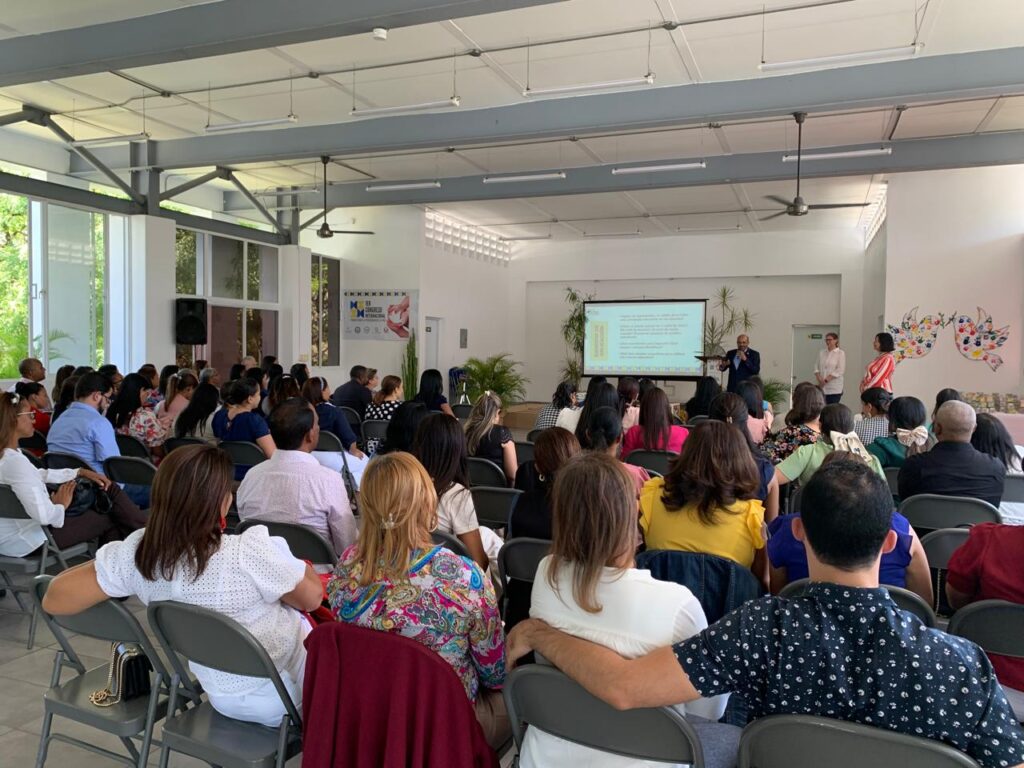
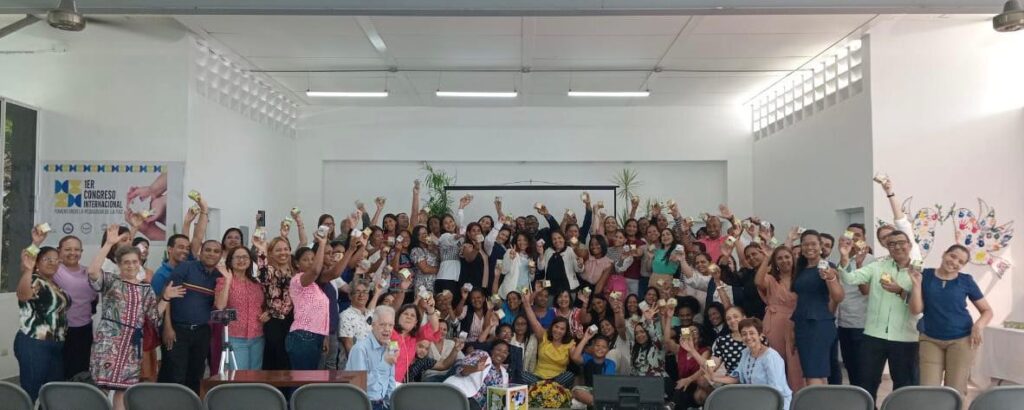
So last year we thought of doing something that went beyond the walls of our school. We had limited resources but believing in the power of Jesus who promised to be present among those who love one another, we organized an international congress entitled: “Promoting an Education of Peace” in Santiago de los Caballeros. We decided that the basis of this congress would be the mutual love between the organizers, members of the Focolare Movement of the Dominican Republic and Puerto Rico. It was attended by 140 teachers, psychologists, principals and education professionals, representing 55 educational centres, including the Café con Leche School in Santo Domingo, a school which is committed to living the “art of loving” proposed by Chiara Lubich.
Pictured: International Congress “Fostering Peace Pedagogy” (Photo: Anibelka Gómez)
God’s providence was evident through the help, support, and collaboration of Director Rafael Liriano and Councillor Ysmailin Collado of the 08-04 Educational District, the National Association of Principals (ASONADEDI), some local entrepreneurs and the community of Santiago, which supported us with the practical arrangements.
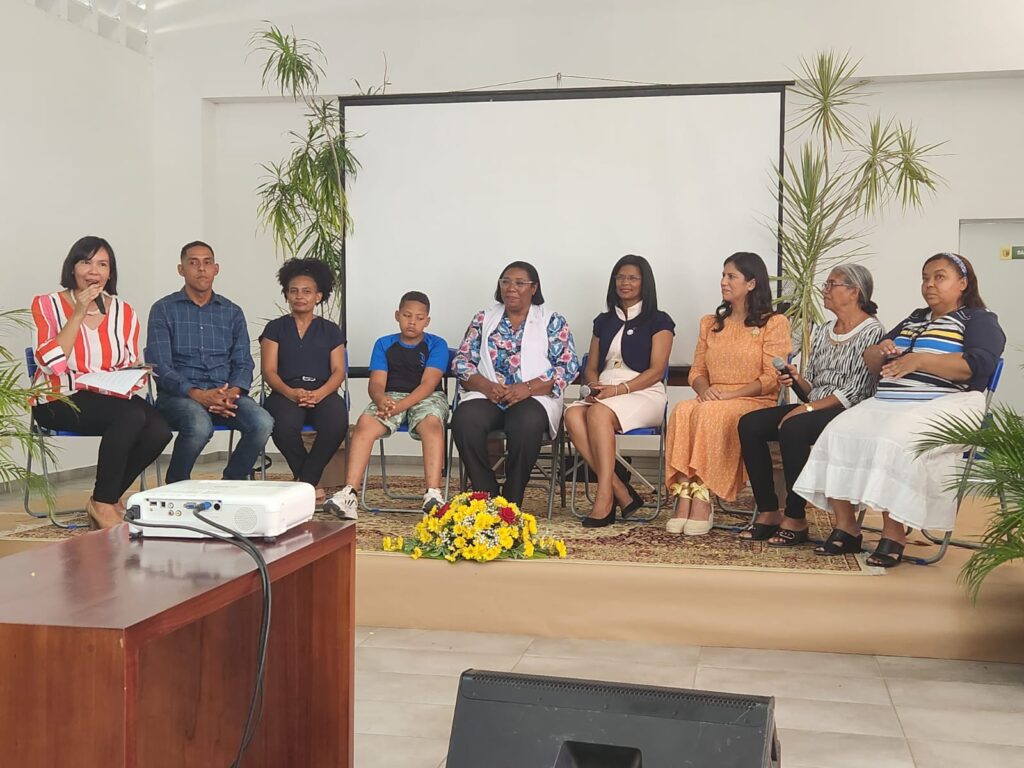
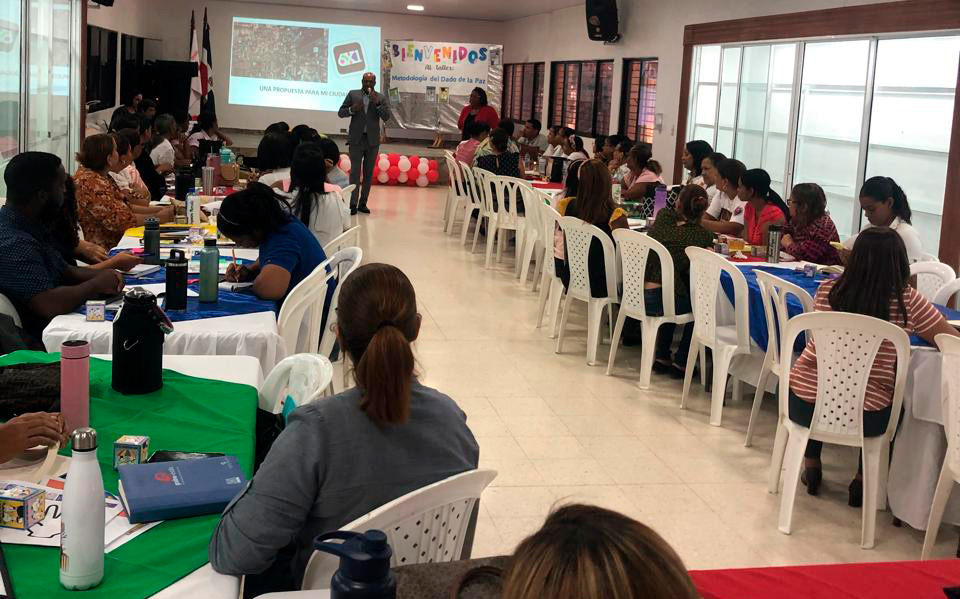
The congress sparked renewed interest in learning more about the Focolare Movement’s educational initiatives, such as the Cube of Peace and the 6×1 Methodology (six steps for one goal). This led to a follow-up seminar entitled “A Culture of Peace and the 6×1 Methodology”, with principals and teachers from 20 schools participating. The goal was to share the approach with other schools and educators.
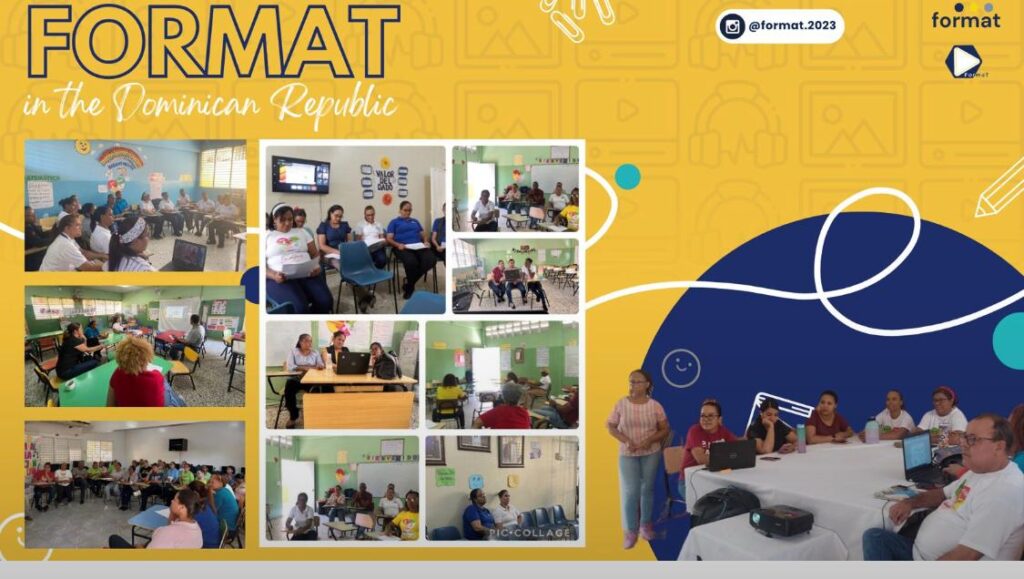
Left: Workshop on FormaT, right: Workshop on the Peace Nut and Methodology “6 x 1”(Photo: Anibelka Gómez)
This workshop highlighted the urgency of introducing the Cube of Peace and the 6×1 Methodology into schools. Several principals and teachers affirmed that implementing these programs would help children promote a culture of peace for the good of society. To continue this initiative, a new training course called FormaT was offered, an online course for those who accompany children, adolescents and youth in educational settings. Its aim is to share experiences, skills and tools for education and accompaniment. The course is offered online from Colombia and involves teachers from 14 educational centres. It runs monthly from September, with 9 modules, and leads to a certificate for participants.
The impact has been significant. The participating schools have formed strong bonds. During Lent, we held a retreat with FormaT participants, followed by a weekend gathering for the participating principals. It amazes us to see how Jesus multiplies our efforts, touches hearts and brings about fruits beyond what we can imagine, giving life to real experiences of unity.