In the afternoon of October 1, at the Focolare Movement’s International Mariapolis Center in Castel Gandolfo, Rome, the Raising Hope Conference was inaugurated with the participation of His Holiness Leo XIV, alongside notable figures such as Arnold Schwarzenegger, former Governor of California, and the Hon. Marina Silva, Brazil’s Minister of Environment and Climate Change.
The session combined testimonies, spiritual and artistic moments, in thanksgiving for the 10th anniversary of the encyclical Laudato Si’. Representing the Laudato Si’ Movement, Associate Director Christina Leaño and Brazil Director Igor Bastos presided over the day’s opening.
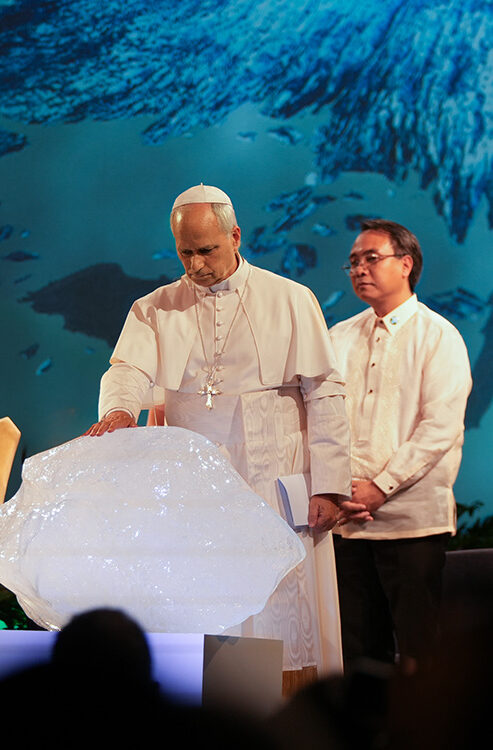
A symbolic moment came when Pope Leo XIV touched and blessed a block of ice more than 20,000 years old, broken off due to climate change from a glacier in Greenland, as well as water brought from around the world—gestures embodying compassion and concern for the cry of the Earth and the poor.
Laudato Si’: What remains to be done?
“This Encyclical has profoundly inspired the Catholic Church and many people of goodwill,” Pope Leo began in his speech on Laudato Si’, “it opened strong dialogue, reflection groups, and academic programs.” The Pope noted how his predecessor’s encyclical spread “to international summits, to ecumenical and interreligious dialogue, to economic and business circles, to theological and bioethical studies.”
Giving thanks to the Heavenly Father “for this gift we have inherited from Pope Francis,” Leo stressed that today environmental and social challenges are even more urgent. On this anniversary we must ask ourselves: “What remains to be done? What must we do now to ensure that caring for our common home and listening to the cry of the earth and the poor do not appear as passing trends or, worse still, are seen and felt as divisive issues?” he asked.
Return to the heart: from data collection to care
“Today more than ever it is necessary to return to the heart, the place of freedom and authentic decisions,” affirmed the Pontiff, because although it “includes reason,” it also “transcends and transforms it.” “The heart is where external reality has the greatest impact, where the deepest search takes place, where the most authentic desires are discovered, where one’s ultimate identity is found, and where decisions are forged.”
In this regard, he stressed that “only by returning to the heart can a true ecological conversion take place.” “We must move from collecting data to caring; and from environmental discourse to an ecological conversion that transforms both personal and community lifestyles.”
Leo reminded those present that this experience of conversion orients us toward the living God: “We cannot love God, whom we do not see, while despising His creatures. Nor can we call ourselves disciples of Jesus Christ without sharing His vision of creation and His care for all that is fragile and wounded.”
No room for indifference or resignation
Before concluding, the Pope looked with hope to the upcoming international summits —COP30 in 2025, the World Food Security Committee session, and the 2026 Water Conference— “so that they may listen to the cry of the earth and the cry of the poor.”
He also encouraged young people, parents, and those working in administrations and institutions to contribute to “finding solutions to today’s cultural, spiritual, and educational challenges, always striving tenaciously for the common good.”
Finally, he reflected: “God will ask us if we have cultivated and cared for the world He created and for our brothers and sisters. What will our answer be?”
1.5 billion Catholics can get involved
Actor and former Governor of California, founder of the USC Schwarzenegger Institute and the Schwarzenegger Climate Initiative, Arnold Schwarzenegger, began his address by congratulating the Holy Father for installing solar panels on the roofs of the Vatican: “I am standing next to a hero,” he declared.
“There are 1.5 billion Catholics — that power and strength must be used to get involved in the climate movement,” Schwarzenegger said, urging more focus on talking about pollution: “The average person doesn’t understand when we talk about net zero or rising temperatures. Instead of speaking to the head, we must speak to the heart. We can end pollution if we work together, because God put us on this Earth to make it a better place.”
Toward the COP of hope
Next came the Hon. Marina Silva, Brazil’s Minister of Environment and Climate Change, co-chair of COP30. In her address, she expressed being inspired by Christian values in taking part in the conference.
Confidently, she stated: “I am certain that the Pope will make a great contribution so that COP30 goes down in history and becomes, as we all ardently hope, the COP of hope, to preserve and cultivate all forms of life that are part of the beautiful garden God has given us.”
From tears to hope
On stage, the Pope was joined by Dr. Lorna Gold, Executive Director of the Laudato Si’ Movement and President of the Conference Organizing Committee; theologian Margaret Karram, President of the Focolare Movement; Fr. Jesús Morán; and Yeb Saño, Chair of the Board of the Laudato Si’ Movement, who shared his own story of facing climate catastrophes in the Philippines and introduced the testimonies.
A symbolic spiritual moment followed when representatives from East Timor, Ireland, Brazil, Zambia, and Mexico brought water from their homelands, poured into a common bowl on stage. They embodied the cry of indigenous peoples, wildlife, ecosystems, future generations, migrants, the poor, and the Earth itself.
From tears to hope, with the audience on their feet, Pope Leo approached the glacial ice and proclaimed a blessing over the water and all present: “May we work for the flourishing of all creation.” Musical performances by Adenike, Gen Verde, and the Pacific Artists for Climate Justice brought joy and energy to the encounter.
A block of Greenland’s ice
The ice traveled more than 5,000 kilometers from the fjords of Nuuk, Greenland, to Castel Gandolfo, Rome. Artist Olafur Eliasson organized the transfer with the support of geologist Minik Rosing. Collected from the Nuup Kangerlua fjord, the block of ice had detached from the Greenland ice sheet due to climate change and was melting into the ocean. Greenland’s vast ice sheet is one of Earth’s most important climate regulators. Formed from compacted snow over tens of thousands of years, it contains layers more than 100,000 years old with ancient air bubbles recording the history of our atmosphere. NASA’s Earth Observatory estimates Greenland’s ice sheet is losing about 270 billion tons per year due to climate change. As the ice releases meltwater into the ocean, it reminds us that our global relationship with ice sheets is existential: they connect us to the past, shape our present climate, and —depending on our care or neglect— will determine our common future. If the ice melts completely, NASA predicts sea levels could rise by about seven meters (23 feet), reshaping coastlines and displacing millions worldwide.
Is there anyone who, at certain times of their life, has not felt that they simply could no longer cope?
The author of Psalm 121 felt like this when facing great difficulties and wondered where the help needed could be found.
The answer is an affirmation of faith in God, in whom he or she trusts. The conviction with which the author speaks of the Lord, who watches over and protects each individual and all peoples, expresses a certainty that seems to arise from deep personal experience.
‘My help comes from the Lord, the maker of heaven and earth.’
The rest of the psalm, in effect, is a proclamation of a powerful and loving God, who created all that exists and guards it day and night. The Lord ‘will not let your foot falter, will not let your keeper fall asleep,[1], says the psalmist, eager to convince the reader.
Although surrounded by difficulties, the author has looked up,[2] sought a foothold outside and beyond their immediate sphere and found an answer.
The psalmist firmly believes in this God who watches over everyone day and night: he or she is ‘the keeper of Israel’iv and therefore, this belief must be communicated to others.[3].
The psalmist firmly believes in this God who watches over everyone day and night: he or she is ‘the keeper of Israel’[4] and therefore, this belief must be communicated to others.
‘My help comes from the Lord, the maker of heaven and earth.’
Chiara Lubich says, ‘In times of uncertainty, anguish and delay, God wants us to believe in his love and asks us to trust… He wants us to take advantage of these painful circumstances to show him that we believe in his love. And that means to have faith that he is our father who does not abandon us. That means casting all our worries onto him, loading everything on to him.[5]
But how does God‘s help actually reach each one of us?
Scripture recounts many episodes when this comes about through the actions of men and women, such as Moses, Elijah, Elisha or Esther, who were called to be instruments of divine care and concern for a particular person or for whole nations.
We too, if we ‘look up,’ will recognize the action of people who, consciously or not, come to our aid and we will be grateful to God from whom all goodness ultimately comes, for it is he who created each person’s heart. We will be able to witness this goodness to other people.
It is difficult to do this if we are closed in on ourselves and rely solely on our own strength to solve problems during challenging times.
Instead, when we are more open and our eyes are raised and see around us, we also discover that we can be instruments of God who provides for his children. We sense the concerns of others and can give them much needed help.
‘My help comes from the Lord, the maker of heaven and earth.’
Roger, from Costa Rica, recounts. ‘A priest I knew told me that someone was coming to the social help centre to collect some incontinence pads for a parishioner who needed them. While I was waiting for him, I saw a neighbour passing by who I knew was living in a very difficult situation and I gave her some food including the last seven eggs I had. She was surprised by what I did and revealed that she had nothing in her home that she, her husband or her children could eat. I reminded her that Jesus’ said, “Ask and it will be given to you” (Mt 7:7), emphasizing that he is aware of our needs. She returned home happy and grateful to God.
In the afternoon the person sent by the priest arrived. I offered him coffee. He was a truck driver and, while chatting, I asked him what he was transporting. “Eggs,” he replied, and he wanted to give me thirty-two!’
Edited by Silvano Malini & the Word of Life Team
[1]Sal 121 [120], 3 [2]Cf. Id., v 1. [3]Cf. Id., v. 8. [4]Id., v. 4. [5] C. Lubich, Conversations, Rome 2019, p. 279.
Who, at one point or another during their life time, has not felt that they simply could not cope?
These are times of confusion and great vulnerability when we become aware of our own limitations and it seems clear that we cannot face all of life’s challenges alone.
When we feel like this, we need to lift our gaze, shift our focus away from our difficulties and open up to a broader reality. By making this subtle yet decisive change from within, we become aware of an invisible “web”. This is like a delicate fabric of intertwining people, experiences, and circumstances that envelop, accompany, sustain and fill us with understanding.
This help does not always manifest explicitly; it comes from life itself with its mysterious ability to regenerate, heal, and set us on our way once again. This happens not through spectacular events but through discreet actions that are filled with human and symbolic meaning. They may be a silent presence in times of mourning, healing hands, an attentive gaze, a kind word, an unexpected phone call that breaks into our isolation or a gesture of trust when self-esteem falters.
How many people around us have believed in us before we ourselves had the courage to do so? And how often did we find the strength to resume our journey thanks to the faith and trust we have encountered?
Even our inner self that is so often worn down by doubt, despondency or fatigue can be renewed thanks to a meaningful encounter or a gratuitous gesture that makes us feel welcomed, recognized, and loved.
Then, driven by deep and sincere gratitude, we want to reciprocate and tell others about our transformative experience. And so, what we have received becomes a gift and, in a very humble way, we can become a gift for others.
THE IDEA OF THE MONTH is currently produced by the Focolare Movement’s “Centre for Dialogue with People of Non religious Beliefs”. It is an initiative that began in 2014 in Uruguay to share with non-believing friends the values of the Word of Life, i.e. the phrase from Scripture that members of the Movement strive to put into practice in their daily lives. Currently, THE IDEA OF THE MONTH is translated into 12 languages and distributed in more than 25 countries, with adaptations of the text according to different cultural sensitivities. www. dialogue4unity.focolare.org
To all those who belong to the Focolare Movement in the world
We, the leadership of the Focolare Movement, gathered in Rome, representing those who belong to the Movement in 140 countries where it is present, express how much we are suffering at the continuing escalation of armed conflicts that are devastating the Middle East and many other parts of the world.
We express our firm and unwavering closeness to the people and nations who are suffering, and we condemn all forms of violence, injustice and oppression.
Aware that peace begins with our daily actions, we would like to invite everyone to embrace and endorse the following commitments with their lives:
• to be ‘artisans of peace’, prepared to overcome ideologies and divisions,
• to promote and support networks of solidarity in order to provide material, psychological and spiritual support to the victims of all wars,
• to ensure that each of our communities becomes a ‘home of peace’, where we learn to defuse hostility through dialogue and mutual understanding, where justice is practised and forgiveness is fostered,
• to promote educational programmes to develop a culture of peace, inclusion and non-violence, especially among the new generations,
• to encourage all local and global initiatives that generate encounters and interreligious and intercultural dialogue, which are fundamental for reconciliation.
We commit ourselves to ensure that forgiveness, dialogue and fraternity are not mere words but become real pathways that open up the future and prevent violence from having the last word.
May an unceasing and confident prayer rise from every corner of the earth to the God of peace, so that he may enlighten the hearts of those who have the power to act so as to put an end to every conflict.
“We went to the Pope this morning to share with him the life of the Movement and to listen to what he had to say to us,” said Margaret Karram and Jesús Morán, President and Co-President of the Focolare Movement at the end of a private audience with Pope Leo XIV. “It was a meaningful, personal and fraternal meeting. He was interested to hear about our work for peace, for ecumenical and interreligious dialogue, for the dialogue with cultures and, especially, for communion between ecclesial movements. He encouraged us to continue spreading the charism throughout the world.” “At the end,” says Margaret Karram, “I asked him if we could bring his blessing to all those belonging to the Movement. ‘Certainly!’ he replied.” If you would like to follow Margaret and Jesús’s “live coverage” of this event, tune in tomorrow at 6 p.m. Italian time for the Link-up (the worldwide video conference call).



![‘My help comes from the Lord, the maker of heaven and earth.’ (Ps 121 [120]:2)](https://www.focolare.org/wp-content/uploads/2025/10/louis-hansel-onxjrr3Erwc-unsplash-min-1080x675.jpg)


