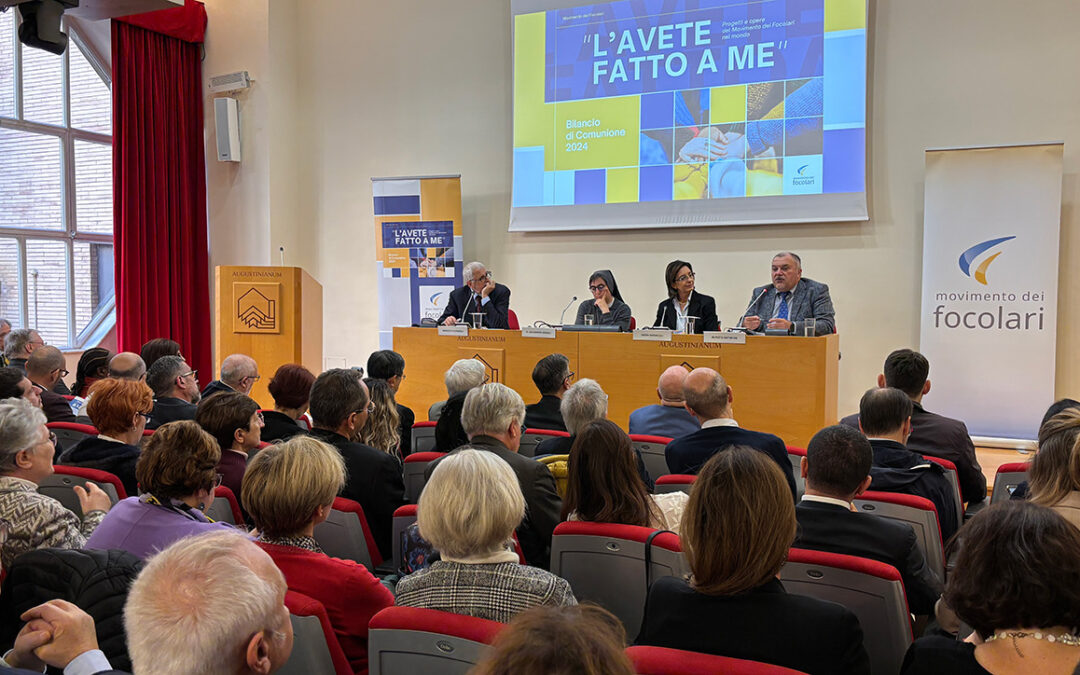
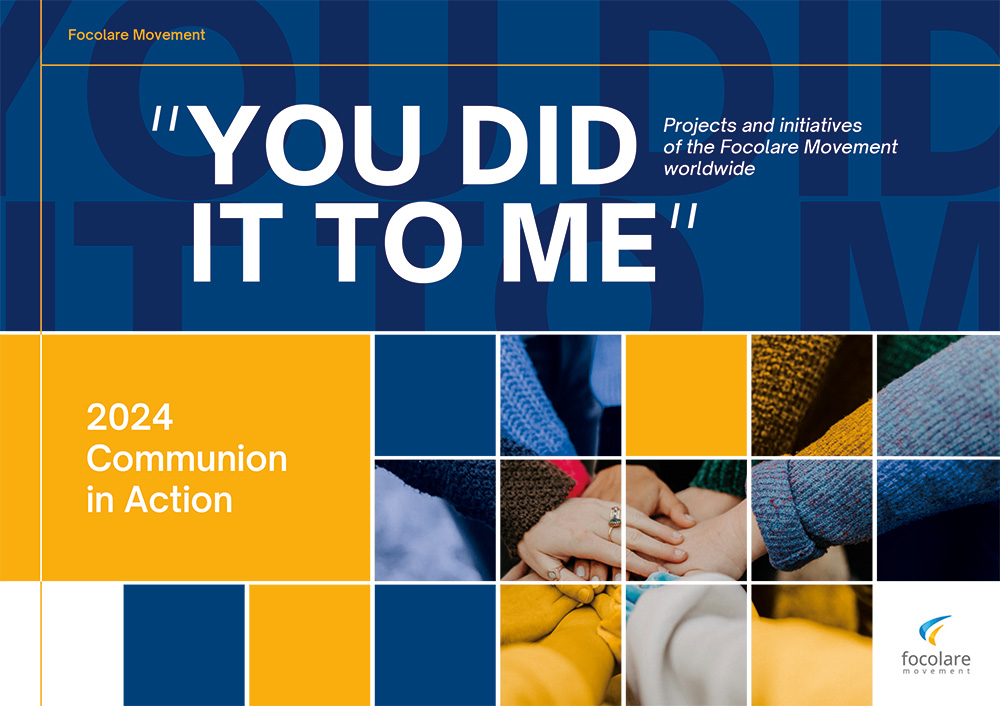
“We have chosen to tell stories of closeness and fraternity that are the fruit of the commitment of many people and communities around the world who are striving to generate trust every day.” With these words, Margaret Karram, president of the Focolare Movement, opened the event presenting the 2024 Assessment of Communion in Action, held on the 6th of November 2025 at the Augustinian Patristic Pontifical Institute in Rome. This document goes beyond a financial report and describes the ongoing projects in various countries linked to the Focolare Movement and their specific impact on individuals, communities and geographical areas. “It does not merely measure numbers, but speaks of relationships,” emphasised Sister Alessandra Smerilli, secretary of the Dicastery for Integral Human Development. “Communion is a strategic asset. It is not simply the sharing of resources, but the building of bonds that generate trust, cohesion and resilience. In economic terms, it is relational capital: it reduces exclusion costs, encourages participation and enables processes of integral human development. Where there is communion, fragility becomes an opportunity, because those who are part of networks of reciprocity have a better chance of being able to escape marginalisation. In a time of great inequality, this assessment is both a prophetic statement and good news: every single act is important.”
Margaret KarramAlessandra Smerilli – Moira Monacelli
The figures
Ruperto Battiston, co-responsible for the Focolare Movement’s finances, explains the figures: “The 2024 Assessment of Communion in Action shows an income of €8.1 million from donations, from the communion of goods given freely by those belonging to the Movement and from contributions of external institutions for training projects. Expenditure amounted to €9.6 million and was allocated to initiatives that generate long-term value: local projects, little towns, social initiatives and educational and cultural programmes, as well as to support the International Centre.
Thanks to an extraordinary communion of goods of €208,568, it was possible to help people belonging to the Movement who are in situations of particular need and also the structures that help those who are poor.
In addition, the Economy of Communion distributed 394 individual grants and supported 14 projects in 13 countries, for a total of €669,566.
Among the many figures, this year we have chosen to highlight the sums allocated to structures involved in safeguarding and formation in safeguarding, as recommended in the recent report by the Pontifical Commission for the Protection of Minors.”
Five projects were presented from among those illustrated in the Assessment: Fo.Co. ONLUS – Italya social cooperative that welcomes migrants and unaccompanied minors, promoting inclusion and employment. It has reopened an abandoned convent, transforming it into a reception centre; UNIRedes – Latin America: a network of 74 organisations active in 20 countries, which reaches thousands of people every year with educational, health and cultural projects. The Focolare Medical Centre –in Man, Ivory Coast: established during the civil war, today it is a 24-hour health centre offering telemedicine and hospitalisation services. Focolare Carpentry – Philippines: a vocational training centre that has restored dignity and work to over 300 young people excluded from the school system. TogetherWEconnect – Israel and Palestine: an educational project involving 500 students in courses on dialogue, self-esteem and active citizenship.
A methodology based on the Gospel
“Communion is not welfare, but protagonism and reciprocity,” explained Moira Monacelli of Caritas International. “Being present does not only mean doing for but walking with.” The activities described in the Assessment stem from a tangible love, which translates into listening, shared responsibility, education and trust in Providence. “Giving hope is not saying it with words,” concluded Monacelli, “but building communities where fraternity becomes a reality.”
The Communion in Action Report (Bilancio di Comunione – BdC) is an instrument which began in the tradition of the Social Reports of non-governmental and non-profit organisations. It expresses a style inspired by the Gospel and is an invitation to promote relationships of reciprocity and communion and to contribute to the implementing of societies where people and nations can live with dignity, justice and in peace. For 2024, the Focolare Movement has analysed data relating to permanent and ongoing initiatives, projects and actions in many countries. The reported data does not represent a complete or exhaustive map of all the initiatives taking place but is a significant sample that expresses the commitment of over a hundred projects which, supported by the spirituality of the Focolare Movement, respond to the needs of humanity, so as to generate trust, social cohesion and a sense of community.
The participation of the new generations in the path that leads to the 2026 General Assembly of the Focolare, aims to be an integrated process, which progresses through different forms of involvement. The young people of the Movement around the world have been invited to take an inclusive and active commitment in their local communities. For this reason, a document has been prepared that presents what emerged at the last Assembly in 2021. This document invites adolescents and young people worldwide to reflect on three key questions. 1: What have we managed to achieve in our local area based on the proposals from the last Assembly? 2: What do we want to achieve in the future and to what do we want to commit? 3: What is a desire or dream you have for the Movement over the next five years?
This is an indispensable process for uniting generations and giving continuity to their journey towards unity. Communities have been encouraged to create moments of communion that foster dialogue and the development of proposals, so as to enhance the leadership of young people, rooted in their real lives and their particular sensitivity.
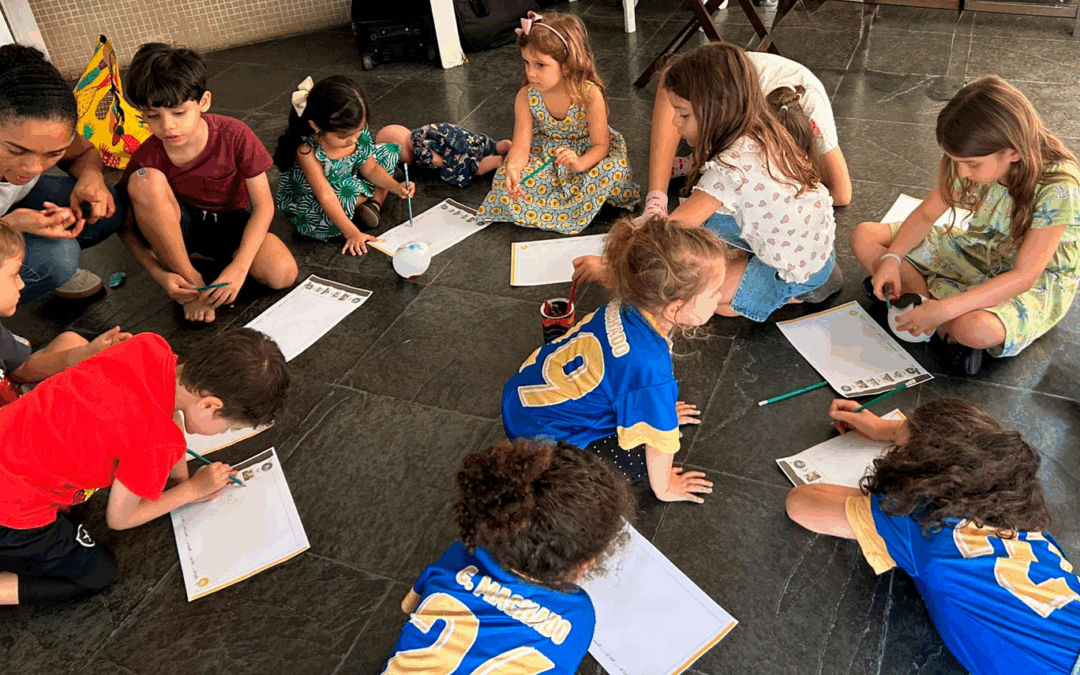
Special attention has also been given to the participation of the children of the Focolare Movement, who have been asked to respond through drawings to the question: What can we do to help make the world more united? These drawings will be displayed in the halls where the participants in the Assembly will meet so that they can inspire and speak to the hearts of many.
Turn on English subtitles – The original is in several languages.
Recently, an observatory established by three Italian universities reported that more than a million hate messages were posted online in one year. Messages of hate against foreigners, Jews and, in particular, women are becoming increasingly violent.
Of course, we cannot generalise, but most of us, at some time, have experienced argumentative attitudes, insults and antagonism in our families or at work or during sport and so on which divide us and undermine social cohesion. On a more global level, there are currently 56 armed conflicts worldwide, the highest number since World War II, resulting in a significant number of civilian casualties.
It is in this context that Jesus’ thought provoking words resonate more truthfully and powerfully than ever.
Blessed are the peacemakers, for they will be called children of God.
‘Every nation and every person feels a deep longing for peace, harmony and unity. Yet despite our efforts and goodwill, after thousands of years of history, we still find ourselves unable to achieve stable and lasting peace. Jesus came to bring us peace – a peace that, he tells us, is not like that which ‘the world gives’,[1] because it is not merely the absence of war, strife, division and trauma. His peace encompasses all of these things but it is so much more: it is the fullness of life and joy; it is the salvation of the whole person; it is freedom; it is justice and fraternity among all peoples, based on love.’[2].
Sermon on the Mount begins (Matthew 5–7). Jesus, who embodies all the Beatitudes, addresses his disciples instructing them. It is worth noting that the eight Beatitudes are formulated in the plural. This suggests that the emphasis is not on individual attitudes or personal virtues, but rather on a collective ethic carried out in a group.
Blessed are the peacemakers, for they will be called children of God.
Who are the peacemakers? ‘This ‘beatitude’ is the most active one and explicitly asks for concrete efforts. The words are similar to those in the first verse of the Bible that refers to creation and they indicate initiative and industriousness. Love is creative by nature … and seeks reconciliation at any cost. Those who have learned the art of peace and practise it are called children of God. They know that there can be no reconciliation without giving one’s life, and that peace must always be sought everywhere… This is not an autonomous work that is the fruit of one’s own abilities, but a manifestation of the grace received from Christ, who is our peace and has made us children of God.’[3].
Blessed are the peacemakers, for they will be called children of God.
So, how can we live out these words? Firstly, by spreading true love everywhere. Secondly, we must intervene when peace is threatened around us. Sometimes, simply listening lovingly and attentively to those in conflict can provide a way forward.
Furthermore, it asks that we do not give up until broken relationships, often caused by trivial matters, are restored. Perhaps we could initiate special activities within our groups, associations or parishes to raise awareness of the need for peace. There are myriad proposals around the world, large and small, that work for this: marches, concerts, conferences and volunteer work set in motion a current of generosity that builds peace.
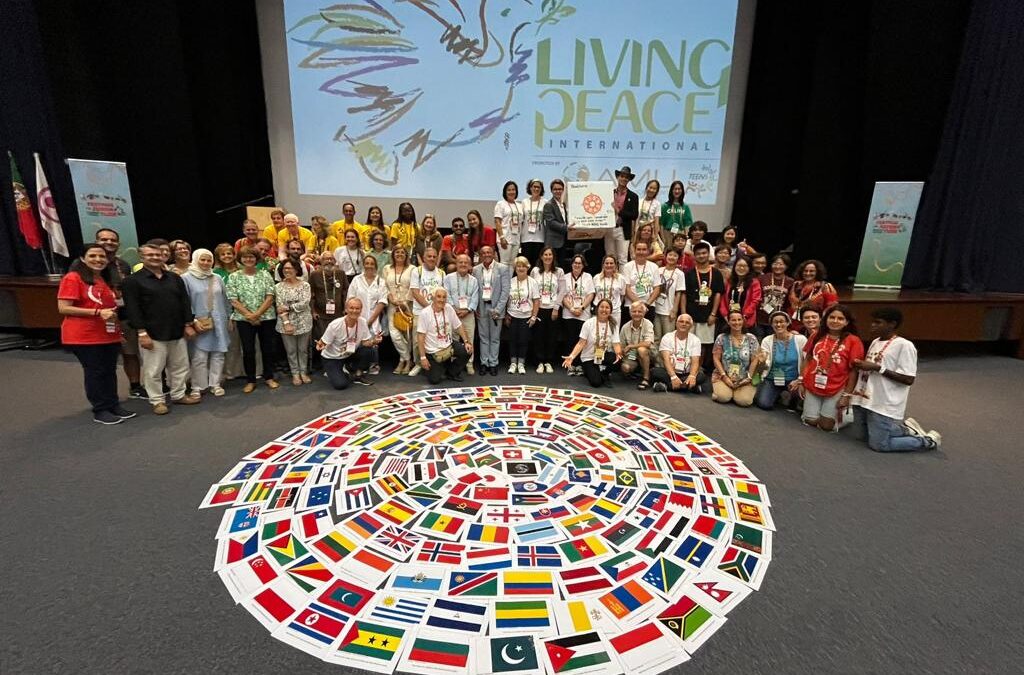
There are also peace education programmes, such as «Living Peace». To date, over two million children, young people and adults in more than 2,600 schools and groups on five continents are involved in its initiatives. These include launching the ‘Peace Dice’ — inspired by Chiara Lubich’s ‘art of loving’[4] – with phrases written on each side to help build peaceful relationships, and the worldwide ‘Time Out‘ initiative which is a moment of silence, reflection, or prayer for peace at 12:00 noon every day.
Prepared by Augusto Parody Reyes and the Word of Life Team
We live in a time when tensions, conflicts, and messages of hatred seem to be multiplying everywhere: on social media, at work, in politics and even within families. Globally, armed conflicts are reaching levels unseen in decades. This situation reminds us that peace is never guaranteed but must be cultivated daily. In the light of this, Chiara Lubich’s words from 2004 are still very relevant today: “Every nation and every person has a deep longing for peace, harmony and unity. But despite our efforts and goodwill, after thousands of years of history, we find ourselves unable to maintain stable, lasting peace (…) because peace is not only the absence of war, struggles, divisions, and traumas.” True peace is “fullness of life and joy; it is the integral salvation of the person; it is freedom; it is justice and fraternity in love among all peoples.” Working for peace requires taking action and initiative, sometimes creatively. Each of us has the potential to become a “peacemaker” by promoting harmony and collaboration in the small things of everyday life and by joining global initiatives that foster cooperation. Some concrete examples are significant. The Living Peace project began with a personal desire to promote peace and then evolved into an extensive peace education programme. Currently, over 2,600 schools adhere to this project and two million children, young peopleand adults from five continents are involved in its the initiatives . Among these is the “peace dice,” which has phrases written on each face that help build peaceful relationships and that everyone tries to put into practice. Recently, in a webinar entitled “Forgiveness and Peace: the Courage to Make DifficultDecisions,” the importance of forgiveness and reconciliation in being peacemakers and rebuilding what had been broken was highlighted. Finally, another example is the Rondine Method: an open-air workshop that enables people to move beyond the resoning that regards others as the enemy. Israelis and Palestinians, Serbs and Bosnians, Armenians and Azerbaijanis but also Malians, Nigerians, and Colombians, and most recently Russians and Ukrainians, have built a viable way to repair relationships destroyed by hatred and build solid bonds in favour of peace. Over the last thirty years, many young people have visited “Citadel Peace”, a small medieval village on the outskirts of Arezzo. Some of these people are now politicians, ambassadors, business men or women and young leaders who are dedicating their lives to healing the wounds of those painful conflicts and laying the foundations for a future that combines peaceful relations and development. To live this idea, let us resolve to sow seeds of peace wherever we are by ceating relationships of trust, solidarity, and cooperation, because every step toward peace makes us more fully human and brings the whole of society closer to a future of justice and fraternity.
THE IDEA OF THE MONTH is currently produced by the Focolare Movement’s “Centre for Dialogue with People of Non religious Beliefs”. It is an initiative that began in 2014 in Uruguay to share with non-believing friends the values of the Word of Life, i.e. the phrase from Scripture that members of the Movement strive to put into practice in their daily lives. Currently, THE IDEA OF THE MONTH is translated into 12 languages and distributed in more than 25 countries, with adaptations of the text according to different cultural sensitivities. www. dialogue4unity.focolare.org