“The more you read the book, the more you become aware that everyone is called to ‘closeness’. The perception of being able to achieve it and the liberating conviction that this kind of lifestyle brings joy and builds, brick by brick, is the path towards a more unified world.”
Cardinal Pierbattista Pizzaballa, Latin Patriarch of Jerusalem, uses these words in the preface to the book by Margaret Karram, President of the Focolare Movement, entitled ‘Closeness, a path to peace. Pages of life’.
A truly autobiographical text in which the author retraces her family history and writes about herself, her origins, her childhood in Haifa (Israel), the people she met and her decision to give her life to God. But at the same time, it is a real itinerary, a guide or, as Pizzaballa further describes it, “a multidimensional journey: going within, going outside and going Above” that allows the reader to accept the author’s invitation to get involved in a meaningful way in the encounter with others.
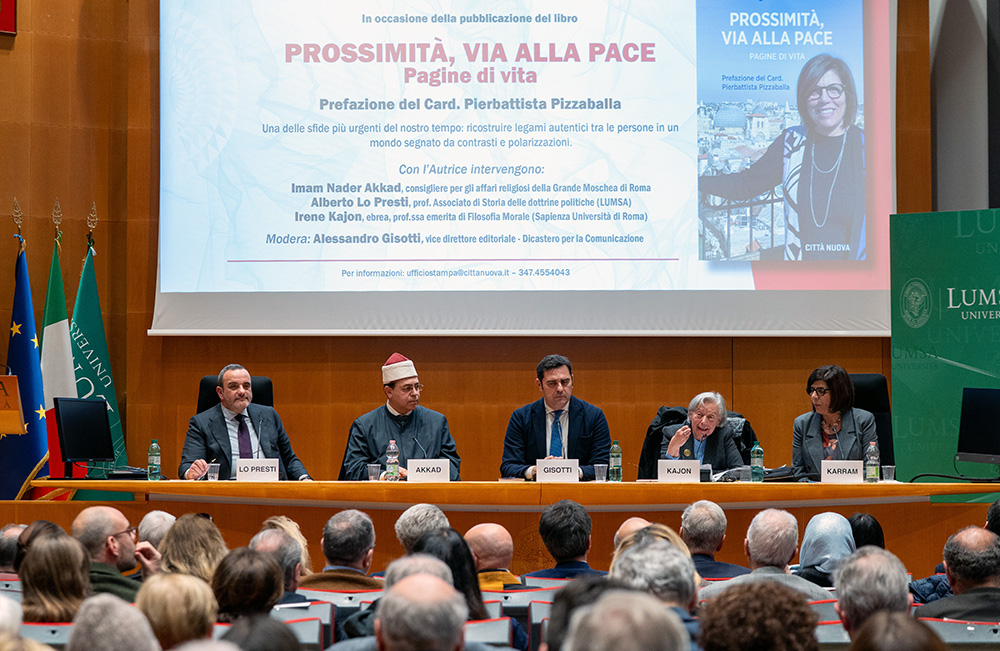
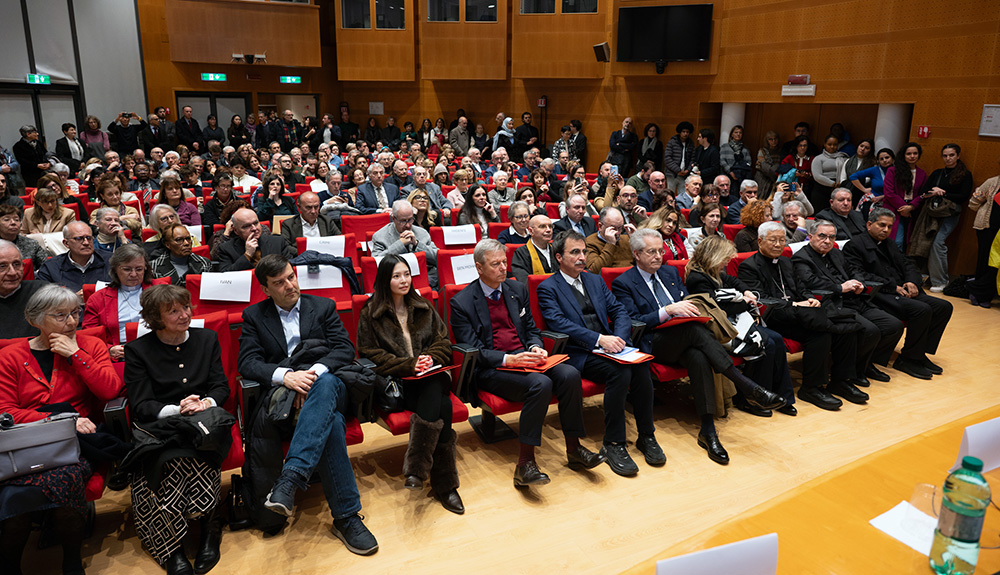
The text was presented at the Jubilee Hall of LUMSA University (Rome, Italy) on the 30th of January 2026 during an event that turned into a unique opportunity for exchange and dialogue. It focused on the theme of “closeness” and aimed to foster a tangible experience of it.
The proceedings were opened by Prof. Francesco Bonini, Rector of LUMSA, who welcomed the participants. The event was moderated by Alessandro Gisotti, Vice Director of the Editorial Department of the Dicastery for Communication of the Holy See. Alongside the author, speakers included Imam Nader Akkad, Advisor on Religious Affairs at the Great Mosque of Rome, Irene Kajon, member of the Jewish community and Professor Emeritus of Moral Philosophy at the Sapienza University of Rome, and Alberto Lo Presti, Associate Professor of History of Political Doctrines at LUMSA.
In the light of Karram’s book, the debate addressed various topics. Among the first points raised was a careful look at the value of identity, as a process and as a movement. “This is a recurring theme, especially in the first few pages,” explains Prof. Kajon, “where a reality is shown that reveals the intertwining and coexistence of many different cultures, languages and religions. In the logic of closeness, it is good that identity, an identity that is intertwined with different elements, always maintains a sense of restlessness … because this is precisely what guarantees openness to others …. What unifies identity is precisely closeness, that is, being human. It is the human family that allows us to unify the identities that are found in each person.”
Imam Nader Akkad, thinking of his Aleppo (Syria), spoke of closeness as a concept that is not at all abstract, but rather something very real that finds its only possible fulfilment in closeness to others and in fraternity. “Closeness becomes the possibility of achieving a ‘shared meaning’, and it is the concept of ‘family’ that forms the basis of society,” says Imam Akkad, “a bridge that is suspended is useless. Two banks are needed. Sometimes the banks become rigid …. Closeness shortens distances, making us understand how close we are. When I draw closer, I recognise my brother or sister, I recognise their suffering and their joys. Closeness helps us to travel through different identities … and not to feel like minorities, but like citizens, so as to build peace together.”
Referring to the concept of ‘inventive love’ as an agent of social, political and cultural transformation proposed by Chiara Lubich, foundress of the Focolare Movement, and in the light of the current crises, Prof. Lo Presti says, “When we see conflicts and divisions in the international system, it is not Chiara Lubich’s vision of a united world that is in crisis …, but rather all those beliefs, philosophies and overly modern visions that believed that humanity would achieve the most beautiful goals of its civil adventure through rationality, or by relying on scientific and technological progress, or simply by expanding markets in an indistinct globalisation, and so on …. The united world that should be the fruit of closeness, is not a victorious march, it is an obstacle course. We need people who are able to look beyond the obstacle and not give in to it. We need people who are able to have hope in their hearts, who see crises as opportunities for the future. In fact, all this means being inventive and creative.”
Therefore, an attempt to raise our gaze. An attempt that, through encounters with various people and key figures, led Margaret Karram to write this text. Karram said, “This moment of authentic dialogue makes me understand that there are many of us who carry in our hearts the hopes and concerns of our time. This book did not come from me alone. It is a multifaceted story. The time we live in is unique, it passes quickly, we are constantly connected. However, this also creates new distances, which are often invisible but very deep. For this reason, addressing the topic of closeness was not a pre-planned decision, either for me or for the Focolare Movement. The more I listened to people, to communities, young people and families, the more I saw a universal need emerging: the need to feel close to one another, not close through a screen, but close in the practicality of life.”
The event, which began as a book presentation, became a moment of sharing that opened up a vision of one’s neighbour as the first step towards the path of peace. It turned into an opportunity to come together, to listen to one another in a synodal way, to discover that in building daily relationships, small sparks of hope, can make a difference.
“Peace begins with Dignity. A Global Call to End Human Trafficking” is the theme of the 12th International Day of Prayer and Awareness against Human Trafficking, celebrated each year on 8 February, on the occasion of the Feast of Saint Josephine Bakhita. A Sudanese woman and religious sister, enslaved from the age of seven, Saint Bakhita has become over time a universal symbol of the Church’s commitment against human trafficking.
Established by Pope Francis in 2015, the World Day is coordinated by the international anti-trafficking network Talitha Kum, led by Religious Sisters, and is promoted by the International Union of Superiors General (UISG) and the Union of Superiors General (USG), in collaboration with several Vatican dicasteries and many other organisations around the world, including the Focolare Movement.
According to the United Nations, an estimated 27 million people worldwide are victims of human trafficking, predominantly women, children, migrants, and people forced to flee their homes. This is a complex and dramatic phenomenon that takes multiple forms—from sexual exploitation to forced labour, from domestic servitude to forced marriage—and which, while remaining largely hidden and underreported, is increasingly finding new forms of exploitation online.
Each year on 8 February, thousands of people around the world join the International Day of Prayer and Awareness through events, moments of prayer, and awareness-raising initiatives in communities, parishes, and associations.
On Friday, 6 February, the Online Pilgrimage against Human Trafficking will connect all continents in a global prayer journey, from Oceania to Asia, from the Middle East to Africa, from Europe to the Americas. A message from the Holy Father is expected at the central moment of the event. The pilgrimage will be live-streamed from 11:00 a.m. to 2:00 p.m. (CET) in five languages (English, Spanish, Portuguese, French, and Italian) on www.prayagainsttrafficking.net. preghieracontrotratta.org
On Sunday, 8 February, the final event will take place in St Peter’s Square with the Angelus prayer with Pope Leo XIV, followed by a Eucharistic celebration presided over by Cardinal Vincent Nichols at St. Peter’s Basilica.
“Human trafficking remains a deep global wound, violating human dignity and disrupting the peace of our societies, especially in a world torn by conflict, war, and forced displacement. By placing the theme of peace and human dignity at the heart of this year’s World Day, we call all people of goodwill to move beyond awareness and unite in concrete action to end this crime. Our commitment is to walk closely with victims and survivors, to listen to their voices, and to advocate for systemic change that addresses the root causes of trafficking and builds a world rooted in peace, justice, and dignity for all.” saidSister Abby Avelino, Coordinator of the Day and of the International anti-trafficking network, Talitha Kum.
The organizers also invite everyone to take part in the mobilization through social media by sharing a post on 8 February using the official hashtag #PrayAgainstTrafficking.
A moment of sharing and exchange that traced the path of the Foundress of Focolare from Trent, her birthplace, to the Castelli Romani and to Rome, highing the fruits produced in regions and in communities.
The following took part in the event: Franco Ianeselli, Mayor of Trento; Mirko Di Bernardo, Mayor of Grottaferrata (Rome); Massimiliano Calcagni, mayor of Rocca di Papa (Rome); Francesco Rutelli, former mayor of Rome, who in 2000 presented the honorary citizenship of the capital to Chiara Lubich; Mario Bruno, former Mayor of Alghero and co-director of the Focolare’s New Humanity Movement; Giuseppe Ferrandi, Director of the Historical Museum Foundation of Trent. The exhibition, on display at the Focolare Meeting Point (3 Via del Carmine, Rome) and created by the Chiara Lubich Centre and the Historical Museum Foundation of Trent, will remain open throughout 2026.
Watch the video with interviews with the mayors present. Original in Italian. For other languages, activate the subtitles and then choose the language.
This word of life is taken from the book of Revelation, the text that concludes the collection of writings that are found in the New Testament. As the name implies, it unveils and reveals: in fact, the aim of the author was to help the reader understand the significance of the last things that will occur at the end of time: the return of Christ to earth, the definitive defeat of evil and the rising up of a new heaven and a new earth.
It is not an easy text to understand. It dates back to the years 81-96 AD when Christians were facing fierce persecution and there was an atmosphere of fear in their communities. They had begun to wonder what would become of them and the message that had been entrusted to them? Some were asking why did God not intervene?
This was the situation when the author was sent into exile by the Romans to the island of Patmos. While he was there, he began to have a series of visions and was commanded to write them down.
Behold, I am making everything new!
The book of Revelation sought to bring hope to persecuted communities: despite the difficulties and violence they were experiencing at the time and the uncertainty of the future, it conveyed the message that good will ultimately triumph and God will make all things new.
Today too, when we watch the news or read the headlines, we see so much tragedy and distress in the world that we risk becoming desensitised to it all… But there is a Father who weeps with us; there is a Father who sheds tears of infinite compassion for his children. We have a Father who waits in order to console us, because he knows our sufferings and has prepared a different future for us. This is the great vision of Christian hope, which stretches over all the days of our life, every day of our existence, and seeks to raise us up once more [1].
Behold, I am making everything new!
We cannot know when and how this will happen and there is no point in searching for the answers. What is certain, however, is that it will happen.
“The final pages of the Bible show us the ultimate panorama towards which a believer is travelling: the Jerusalem of Heaven, the heavenly Jerusalem. It is described as an immense ‘tent’ where God will welcome all people and dwell with them forever (Rev 21:3). This is our hope. What will God do when we are finally with him? He will show us infinite tenderness, like a Father who welcomes his children who have long struggled and suffered. Behold, the tent of God is with all men and women! … He will wipe away every tear from their eyes, and there shall be no more death, nor mourning, nor weeping, nor pain, for the former things have passed away… Behold, I am making all things new!’ (Rev 21:3-5). 21,3-5). The God of newness [2].
Behold, I am making everything new!
How can we live this month’s Word of Life?
«It assures us that we are on our way to a new world that we are preparing and building right now. Therefore, this is not a mere invitation to disengage and escape from the world of the present. God wants to renew all things: our personal lives, friendships, married love, families; he wants to renew social life, the world of work, school, culture, leisure, health, the economy and politics… in a word, all areas of human activity. But to do this, he needs us. He needs people who let his Word live in them, who are his living Word and are like Jesus wherever they are» [3].
A young Christian woman called Alice understood that following God’s call meant that she needed to change many aspects of her behaviour and allow God to act more fully in her life and so renew it from within. She received the ‘immense gift,’ of the opportunity to spend some time in India. There, she began to understand real joy and she felt immersed in God’s grace, even during difficult times. She spent time in prayer, community life, and volunteer service. She was deeply touched by the children she met in the orphanage because even though they had nothing, they were incredibly enthusiastic and taught her a lot about life. Alice’s time in India was not just a trip, but a pilgrimage, a journey of ‘ups and downs’, where she had to ‘empty her rucksack’ but found enrichment and freedom.
Edited by Augusto Parody Reyes the Word of Life team
[1]Cf., Pope Francis, General Audience 23 Aug 2017 [2] Ibid. [3] Cfr. C. Lubich, Parole di Vita, Word of Life
Since ancient times, men and women have nurtured the desire to know what the future will bring and have used magical rituals or the interpretation of natural signs in order to do so. Great works produced by different cultures and religions in the past reveal this need. It often arises during periods of great suffering for a people or nation.
But is it really useful to know what will happen? What do we gain by knowing in advance what we will experience or how we will cope? None of the legendary traditions reveal this completely, and more often than not, symbolism hides the very concrete search for and expectation of a better tomorrow that gives meaning to today’s suffering.
We could say that we are not concerned about the future when things are going well, however, when they are going badly, we are sustained and encouraged by the hope that tomorrow will be better. It is then that many of us feel a deep need to await a new, different world, not only for ourselves but for everyone.
Today’s world expresses a “cry” that emerges from all of humanity. Even if we are not directly affected, we only need to watch the news or leaf through the newspapers to become aware of tragedies of all kinds. How do we react? Are we so accustomed to this negativity that we are immune and simply try to survive or, on the contrary, do we think deeply about the future and act accordingly? The world we imagine and desire certainly does not yet exist but, as George Orwell reminded us, it is possible that it will be. But what does this mean? What can we do? We find an answer in the thoughts of Albert Camus: “True generosity towards the future consists in giving everything to the present.” [1]
The future, therefore, is not just something to await but can be prepared and, in a sense, anticipated even now. It depends on our attitude and our daily actions. We do not know when we will see the fruit of change: it is like a silent seed that grows without us noticing and, over time, becomes a plant capable of nourishing, protecting and generating life around it.
We cannot imagine the consequences but they will certainly be new and creative. The future is unpredictable but it will develop according to relationships that have been transformed, feelings shared and solidarity that has become action.
We need courage to be a driving force for change and renewal in society; we need to allow ourselves to be challenged by people who suffer, who are aloneor need our help or advice. Even though we will encounter difficulties and inner struggles, there will also be moments of joy and real fulfillment.
Recently, an event was held in Florence to raise awareness and involve participants in a network of fraternity. There were opportunities to reflect and share experiences on how to build a future of peace in various areas such as economics, trade unions, industrial reconversion and ecology. This is an initiative that we want to spread rapidly to other cities and countries.
Take courage! We are builders and not spectators and our goal is to create a future of fraternity, harmony and peace.